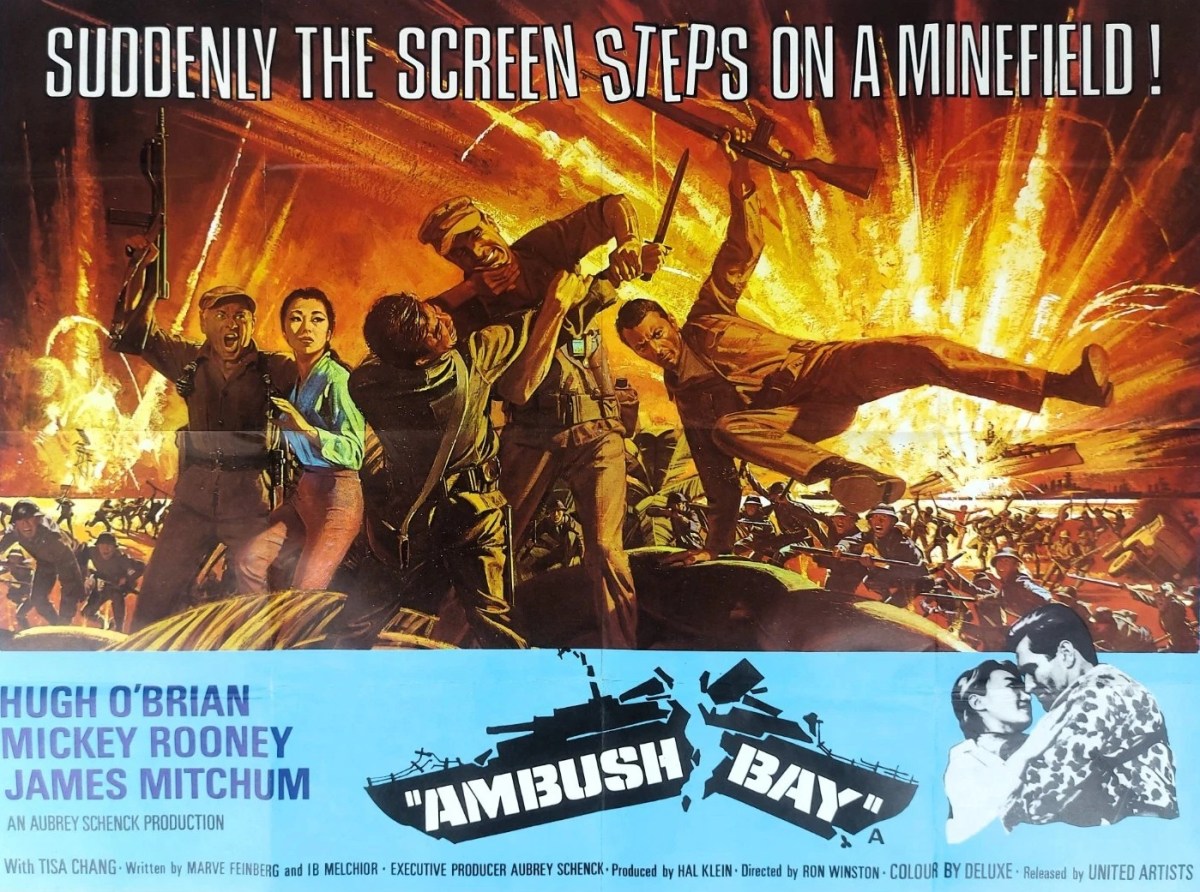
Ambush Bay (1966) ****

I’m going out on a limb on this one. I don’t think anyone’s done anything but give it a cursory examination and mark it down as a standard programmer of the era. But I saw a lot that was considerably impactful.

Generally speaking, although the war picture had gradually shifted from the gung-ho to the more realistic (Operation Crossbow, 1965, Von Ryan’s Express, 1965), it’s generally accepted that it was The Dirty Dozen (1967), Beach Red (1967) and Play Dirty (1968) that ushered in the new era of authenticity and violence.
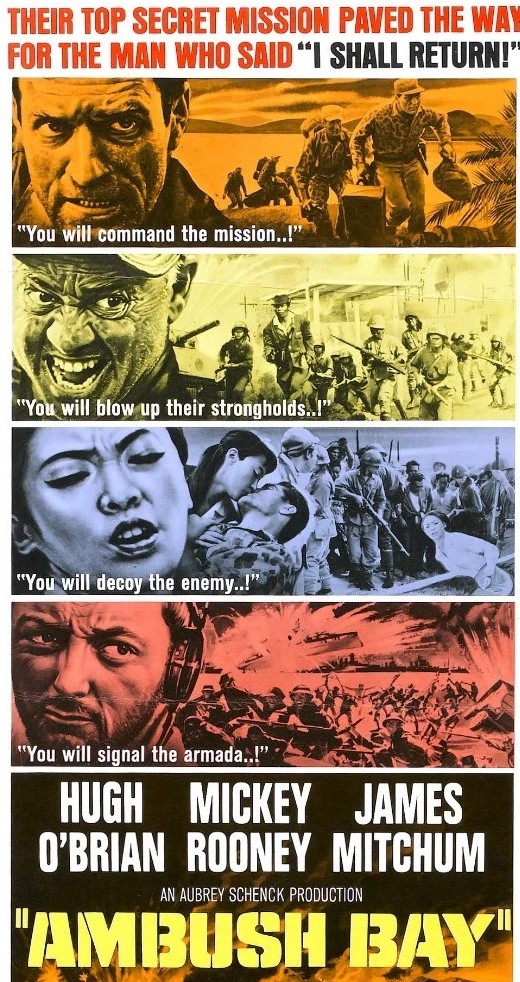
Oddly enough, this little picture, minus the bloodletting, was the bridge. It’s way tougher than you would expect for a low-budget picture only ever intended to fill out the lower half of a double bill and never going to catch the eye of a critic hoping to find an unknown movie to punt.

Let’s start with the ruthlessness. A bunch of Yanks on a secret mission in the Philippines are hounded by Japanese soldiers. At their first encounter, knives are the weapon of choice so as not to attract attention. We don’t see the knives going in but we hear them slicing into flesh. They capture one of the enemy who begs to be taken prisoner but nobody’s got time to bother with such niceties so they tie him to a tree and come morning he’s dead. Rather than give away their own position, they don’t fire on the pursuing Japanese which results in one of their own being killed. A female American-born Japanese spy, convinced her natural charms can distract the Japanese, volunteers at one point to stay behind, even if that means becoming the sexual plaything of the Japanese commander and then passed on to his men. And when that ploy fails she is ruthlessly sacrificed.

There are other narrative reversals. The Dirty Dozen, for example, begins with a lengthy introduction to each of the condemned men. Here, as the team prepare to land on the Philippines, we are introduced, via voice-over, to each of the team. And then you learn that the real reason for this is that we’ll count up the number of men in the group and become aware that they are gradually being whittled away.
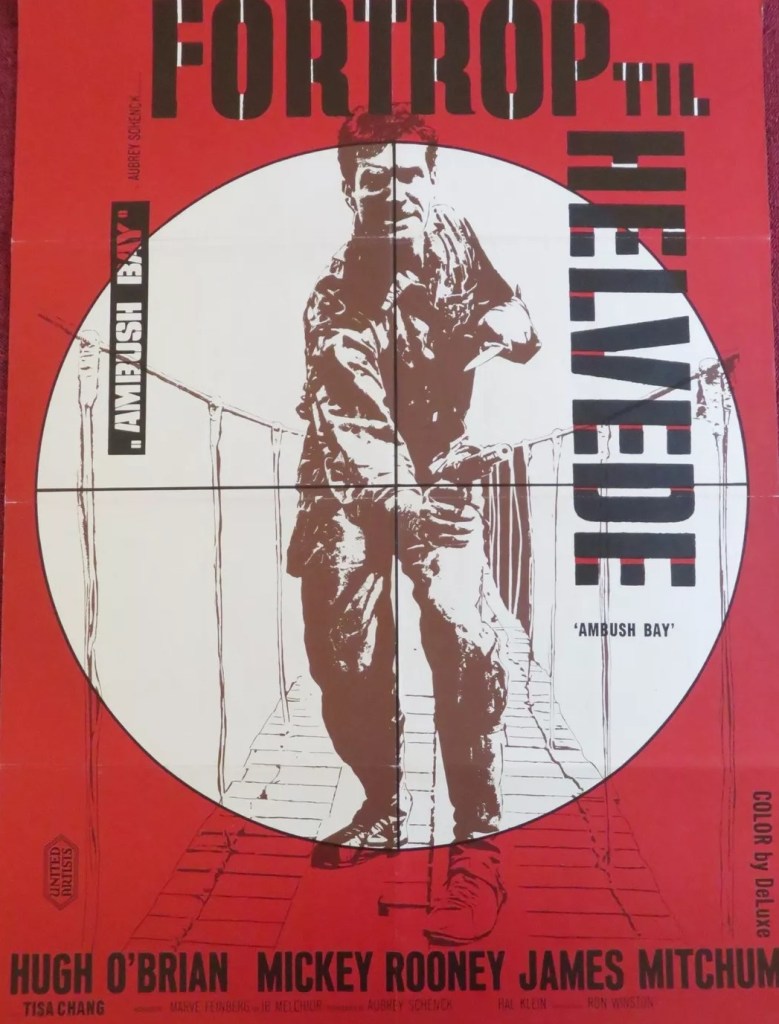
And then there’s the voice-over itself. This not being one of those post-modernist numbers where the narrator is speaking from beyond the grave, audiences know that a narrator is a survivor. But what they’re not going to guess is that he’ll be the only survivor.

Or that he least deserves to survive. Private Grenier (James Mitchum) is a rookie – “six months ago he was stacking shoe boxes” – and he’s truculent and troublesome. His only job is to keep the radio safe, excused fighting duties so that he can broadcast to the waiting General MacArthur the outcome of the mission. But he’s as useless at guarding the radio as he is at everything else and the radio is shot to pieces. He’s so dumb he doesn’t realize the purpose of a Japanese tea house.

There’s not an ounce of the gung-ho. The dialog is delivered in an undertone. Nobody makes a meal of any line of dialog no matter ho juicy. Everything undercuts. When Commander Sgt Corey (Hugh O’Brian) plans to go into serious harm’s way his number two Sgt Wartell (Mickey Rooney) asks what will happen if he doesn’t come back. In matter-of-fact tones, but without the snap of someone thinking he’s delivering a great line, Corey replies, “You get a field promotion and an extra eight bucks a month.”

The Ambush Bay of the title is supremely ironic. It’s the Americans who are going to be ambushed. The Japanese have seeded the sea-bed of the beach where they guess the Americans are going to land with mines. Nothing unusual there. Minesweepers will clear the path. Except these are unusual mines, anchored to the seabed and only loosened by remote control by the enemy.

The initial mission is just to locate the aforementioned spy Miyazaki (Tisa Chang) who turns out to be a sought-after sex worker in the tea house. But when the radio is out of action, they have to disable the radio tower controlling the mines. By this point they’re down to just two men, Corey and Grenier.

Grenier has the ingenious plan of draining fuel from a truck to make a Molotov cocktail, toss it into a fuel dump and in the confusion make their way to the radio tower. Even at this late stage, reversals come thick and fast. Great idea – you got a match? Nope. But the lorry driver is smoking. He discards a lighted cigarette. But when he gets out of his cab he grinds the cigarette with his foot. Luckily, they can revive it.

All the way the dialog is like loaded dice. “Idiot,” muses Grenier, “that’s the nicest thing he’s said to me.”

Miyazaki has some choice lines. “If you’re dead that won’t help me.” And, encountering Corey’s disbelief at her gender,  “Suppose I refused to believe you were my contact.” And in the understated manner of every individual, of the leering Japanese commander, she notes, “He desires me, I think that’s the phrase.”

Visually, this isn’t littered with gems. Most of the visuals are under-stated, brutality generally off-camera but there’s one unforgettable scene. The Japanese commander, having been distracted by Miyazaki puts his pistol in his holster. A few minutes later, realizing he has been duped, he takes it out of its holster.

Hugh O’Brian (Ten Little Indians, 1965) is superb as the non-scene-stealer-in-chief. Mickey Rooney (The Secret Invasion, 1964) has less opportunity for grandstanding than in most of his pictures. And surely this is the recently-deceased James Mitchum’s (In Harm’s Way, 1965) best role, as he shifts from amateur to professional. If you’re looking for an understated scene-stealer Tisa Chang (better known for her stage work – she only appeared in five films) is choice.

Directed by Ron Winston (Banning, 1967) from a script by Ib Melchior (Planet of the Vampires, 1965) and Marve Feinberg in his debut.

The lowest-budgeted film, just $640,000, in the 1966 release schedule of United Artists, on a cost-to-profit scale this proved one of its most successful pictures hammering out $1.7 million in rentals.

Worth going out on a limb for.
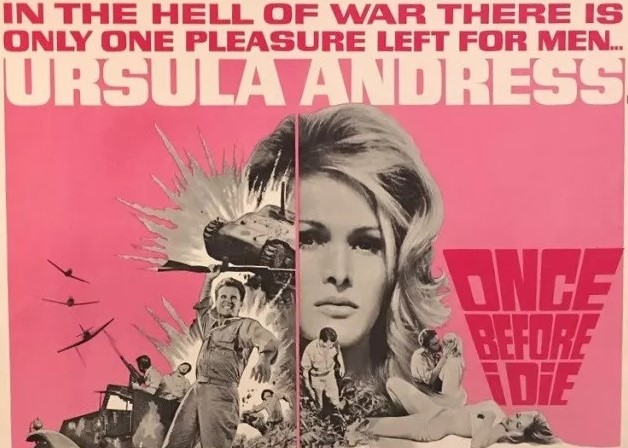
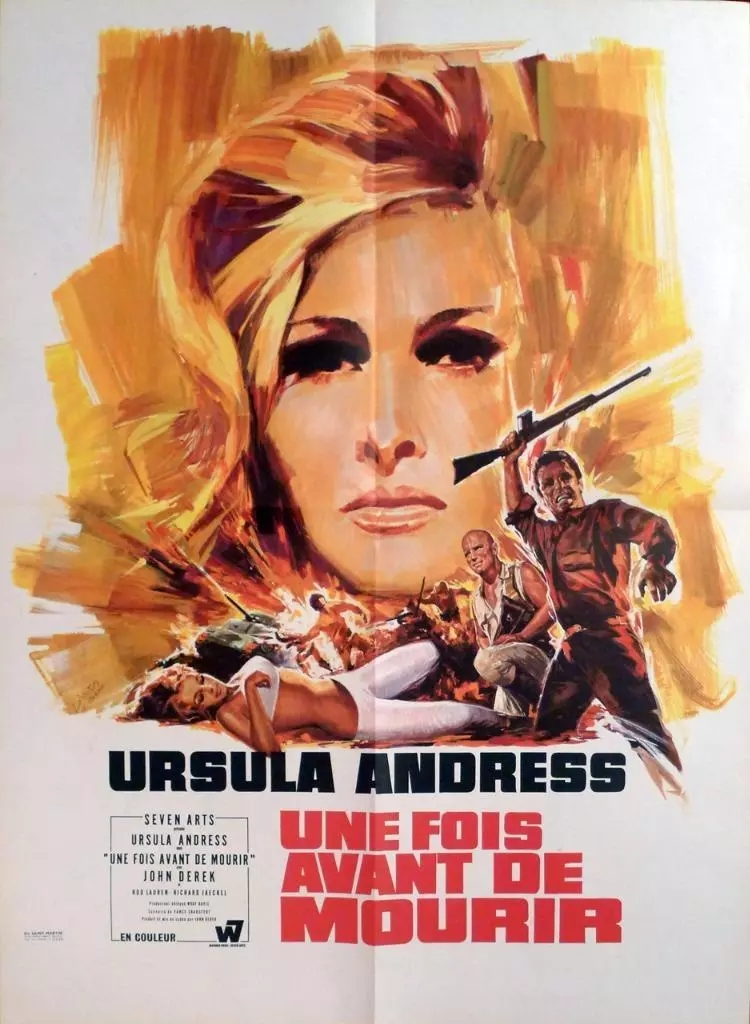
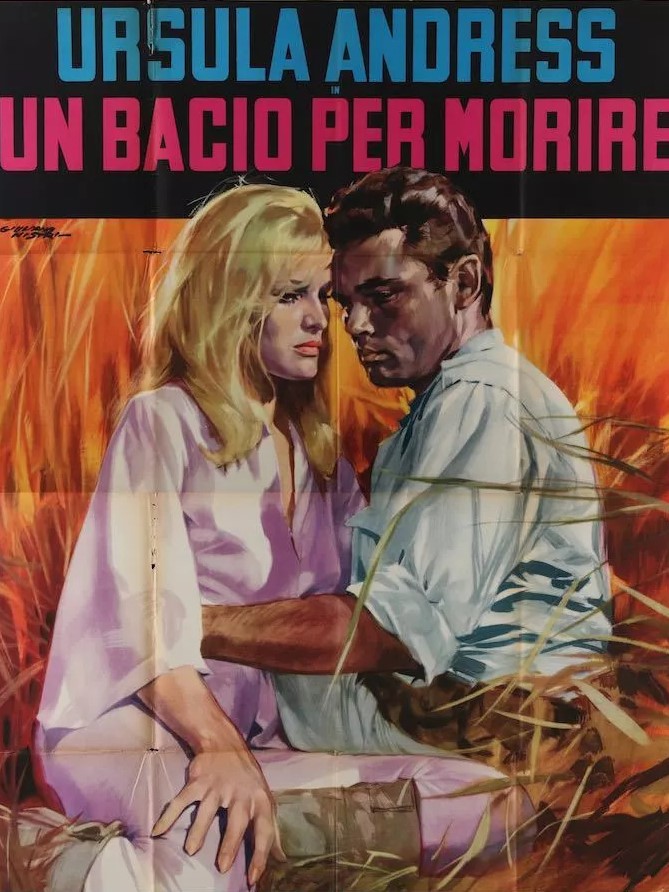
Once Before I Die (1966) ****

Nobody ever took Ursula Andress seriously as an actress. Ditto the directorial skills of her one-time husband John Derek (Bolero, 1984). Their combination was viewed as a cosmic joke. And it doesn’t start well here, the credits little more than a paean to her beauty, hair rippling in the wind etc, so much so you wouldn’t be surprised to find her later on running in slo-mo through a cornfield. The opening sequence couldn’t be more Raquel Welch, Andress sporting a white bikini as she shoots the rapids. And the premise looks like little more than a wartime western.

Instead…

Technically, this is surprising, ocasionally astounding, as the director makes use of the kind of image layering that attracted kudos for Francis Coppola in Apocalypse Now (1979) and with one stunning sequence shown entirely, in close-up, through the eyes of the actress. Andress is far from eye candy. Opportunities to show her naked or at least soaked to the skin, obligatory scenes set in water, are passed over. Instead, she is the camera’s conduit. The innocent bystander responding to war, and sharing in the shock of the youngsters, mostly virgins, who will never see a naked woman before they die.

Having to literally deal with the title should be the only false note and yet strangely enough there’s a haunting lyrical quality in the contrast between her, in the midst of battle,  acquiescing to the shameful desire of a 22-year-old soldier to be kissed and his colleagues’ glee at burning to death the occupants of an enemy tank. An act of humanity set off against raw brutality.

The set-up is simple enough. Just after Pearl Harbor, a group of polo playing soldiers in the Phillippines are strafed by Japanese planes. Cavalry leader Bailey (John Derek) and his troop set off by horseback cross country for Manila. He sends his girlfriend Alex (Ursula Andress) off in the same direction in her ritzy car. Against instructions, she loads up her car with puppies and refugees, an old lady and a child, and when she gets stuck, Bailey allows the trio to accompany the soldiers to safety. When they reach a village, her linguistic skills come in handy, pinpointing a Frenchman and his native girl, purportedly translating, as lying about food supplies.

In rooting out a bloodied teddy bear, Bailey is accidentally killed and for the rest of the picture Alex is in something of a catatonic state, but doing her best to keep up soldier morale, as attendant to the worries of the young, fearing death, as to the more experienced  gung-ho shaven-headed Custer (Richard Jaeckel) who welcomes a hero’s demise. By the end, she is a combatant, shooting an enemy soldier.

By taking Alex as the cinematic focus, the director can dispense with the usual tropes of a battle-weary squad in wartime. So, beyond the youngster’s confession, we learn nothing of the soldiers’ lives, and that, too, is somehow refreshing, as going down that route at best seems like a vain attempt to make audiences sympathize with unsympathetic characters, and at worst, is a delaying device.

All you need to know is that guys who would otherwise be larking about, drinking beer, telling tall stories or playing polo, are vicious in war, gunning down as if a communal firing squad a captured grunt, so trigger happy they shoot one of their own in the middle of the night, so careless they are liable to drop a grenade at their own feet.

And, much to my astonishment, there’s dialog and scenes Tarantino would be proud of. Custer explaining that he shaves his head “to get rid of every hair” is the kind of line that in a more acclaimed picture would be noted. Custer again, accused of making up a story that he has killed a bundle of Japs, looks initially as if he believes himself guilty of too fertile an imagination until he interrupts a chat between two disbelieving officers by chucking an enemy corpse onto their laps.

And there’s genuine screen charisma between Alex and Bailey, a wonderful scene where she takes gentle umbrage at being scolded for refusing to obey orders, but nothing played out to the brim, everything understated, the actions of a couple who don’t need to display their love to the world because they are already committed.

The Virgin Soldiers (1969) played the central theme for laffs but didn’t achieve an ounce of the truth expressed by the raw youngster, who’s ashamed to be revealing such fears to a woman, and to be even asking her to relieve them, and of the dumbness to be muddying his thoughts in a life-and-death situation with fantasies about sex. You can certainly argue with the notion that women in wartime are obliged to have sex with any passing soldier (who sometimes take without asking) who could die a virgin, and taking that into consideration, this shouldn’t work at all. It’s only a kiss and hand-holding after all, and she’s not maternal about it, or even pitying, and after all, deprived of a future husband, she also needs solace.

I mentioned before about finding suprises in my trawl through this decade’s movies and there couldn’t be a bigger surprise than this which must have lain unseen on my shelves for years as I dreaded inflicting upon myself another movie by the director of Tarzan the Ape Man (1981).

But astute direction and the determination to allow Andress to act, to show scenes through her eyes, the sign of any great actress, pay off. Career-best performance from Richard Jaeckel (The Devils’ Brigade, 1968), no show-boating here either.  The budget restricts the action, but, oddly enough, that’s to the film’s benefit as it allows it to play off Andress more.

Well worth a watch.

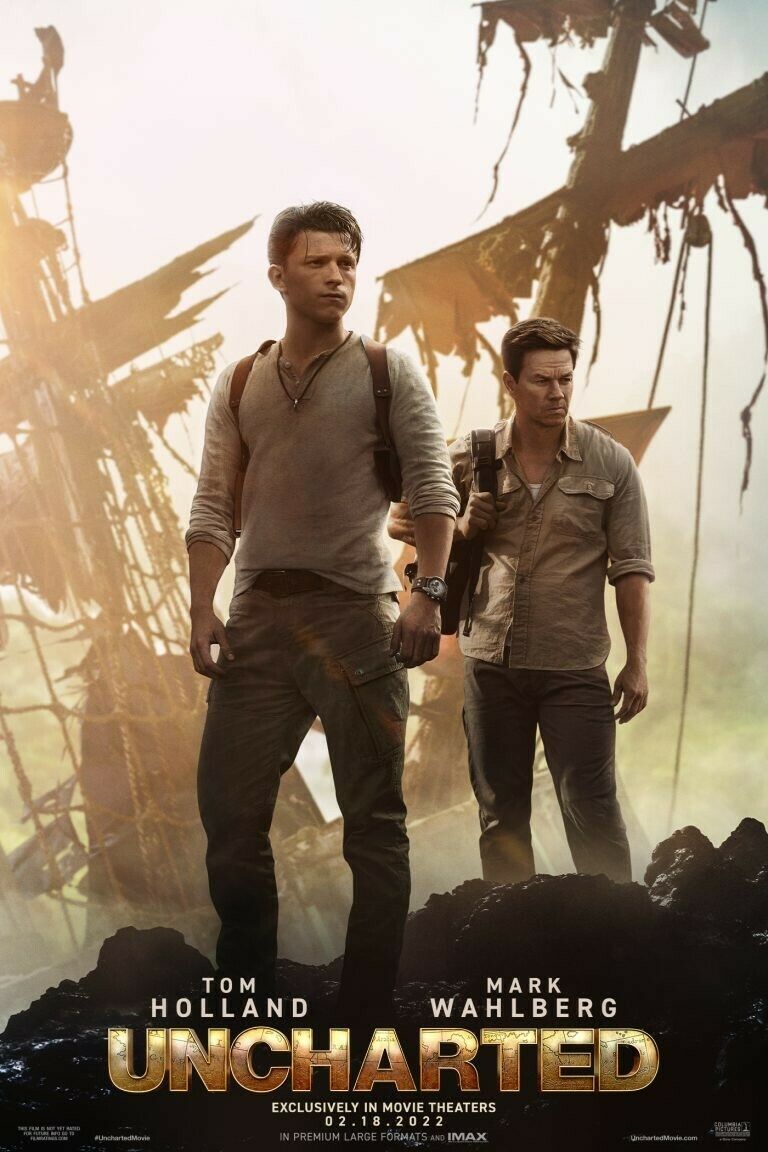
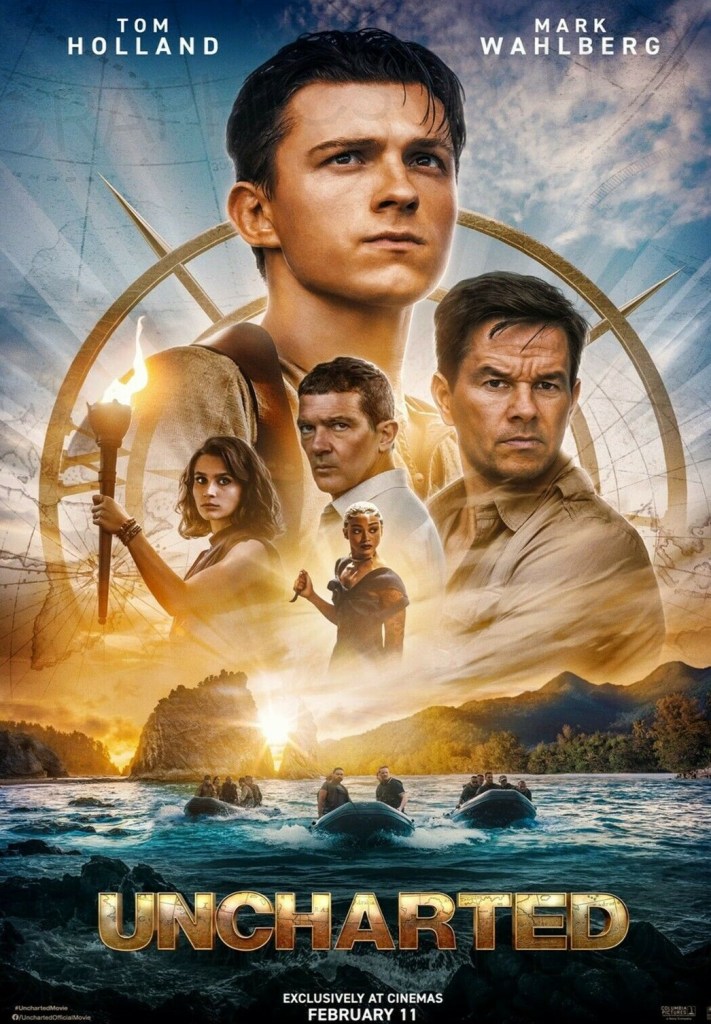
Uncharted (2022) **** – Seen at the Cinema

Hugely enjoyable fast-paced romp with clues, ancient maps, sunken treasure, double-cross upon double-cross, action and twists all the way in what could be the next major franchise. Barman Nathan Drake (Tom Holland) teams up somewhat unwillingly with  unscrupulous Victor Sullivan (Mark Wahlberg) and Chloe Frazer (Sophie Ali) to find $5 billion in gold. In their way: the ruthless Santiago Moncado (Antonio Banderas), henchperson Braddock (Tati Gabrielle) and assorted roughnecks.

Confession: I’ve no idea what computer game sparked this movie so come with no preconceptions. History lesson: the gold was lost by Portuguese Ferdinand Magellan, the first guy to sail round the world, while Sir Francis Drake was the first Englishman to do the same.

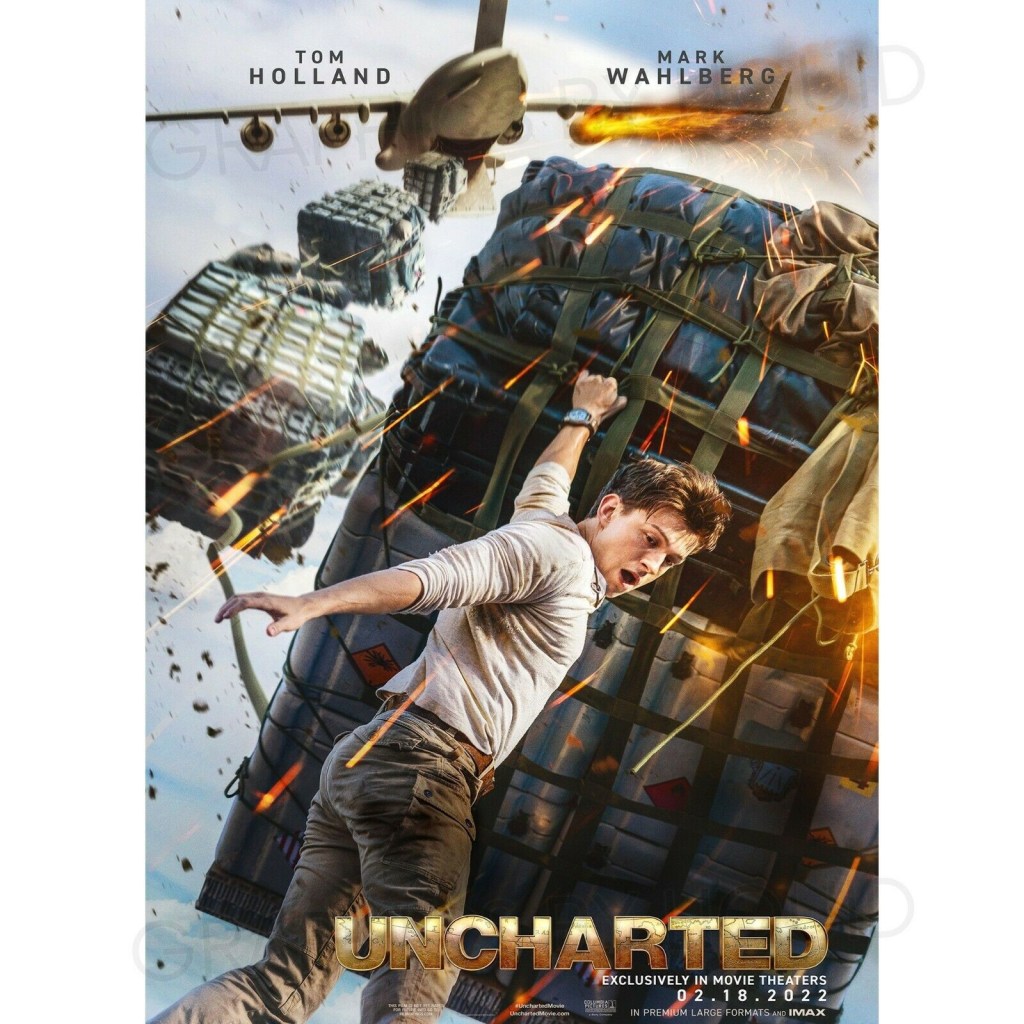
Two outstanding action sequences top and tail the movie, the first a battle in a cargo plane that is dumping its cargo, the second, just astonishing in its virtuosity, a duel between airborne shipwrecks. In between are a scramble in an art gallery and a roofotop chase. And to keep the audience on its toes all kinds of relics are brought into play as well as hidden tunnels, churches and chambers complete with the usual Indiana Jones-style booby traps, never mind a ton of bullets, and a bunch of clues to be deciphered from maps and walls not to mention postcards and trees. Part of the fun is that the gang don’t get it right all the time with alarming consequences.

It’s all done with such verve and although it’s certainly a close relative to the Indiana Jones series it’s minus their mystical nonsense while the characters certainly are not called upon to do good for their country or save the world from any dictatorships. The guys just want to make money. And what’s wrong with that? It lends the movie a certain solidity. And the fact that none of the characters trusts the others ensures that the status quo never remains quo for long and that swift change is going to be the order of the day.

Tom Holland (Spider-Man: No Way Home, 2021) bulks up and seizes the opportunity to become a major star outside the comic book hero. Too often franchise pictures have produced wallpaper stars, attracting audiences in the tight confines of their multiverses but failing to add any box office muscle to other projects. This character proves an inspired choice. Holland gets to be athletic, as well as the young guy making his bones in a cut-throat (pardon the pun) world, holds up his side in the edgy banter with Wahlberg, and rounds out his personality by being a prize thief and vulnerable guy who misses his lost older brother.  

Mark Wahlberg (Infinite, 2021) hasn’t had this good a role since Patriot’s Day (2016) and since he’s not relied upon to carry the picture can get up to all sorts of shenanigans, which he’s usually knee-deep in, much to his apparent enjoyment. Antonio Banderas (Hitman’s Wife’s Bodyguard, 2021) for once has a legitimate reason to use his Spanish in a Hollywood movie.

Sophie Ali (Truth or Dare, 2018) and Tati Gabrielle in her movie debut rock as female actioners, extremely convincing as mean gals, and should have been shuttled into any number of female-led action movies of the last few years that failed to bring the requisite bite. Both muscle their way into the game and refuse to be muscled out or, by dint of romantic entanglement, lose their edge. There’s a nice cameo – and a running joke – by Steven Waddington (The Imitation Game, 2014) as an incomprehensible Scotsman.

Reuben Fleischer has taken the directorial cojones he displayed in Gangster Squad (2013) and Venom (2018) and squeezed the life out of them to keep this little number zipping along, scarcely stopping to take a breath, never finding itself in a dead end, and holding enough marvel back to pull off  the audacious ending of the flying shipwrecks, on a par with any image Steven Spielberg ever pulled out of his locker. Rafe Judkins, another movie debutante, and the partnership of Art Marcum and Matt Holloway (Iron Man, 2008)  assembled the screenplay from the Playstation game.

As I said I’ve no idea what were the ingredients in the original game and whether the writers have played fast and loose with the concept but all I can say is it’s a helluva movie.

Discover WordPress

A daily selection of the best content published on WordPress, collected for you by humans who love to read.

The Atavist Magazine

by Brian Hannan

WordPress.com News

The latest news on WordPress.com and the WordPress community.