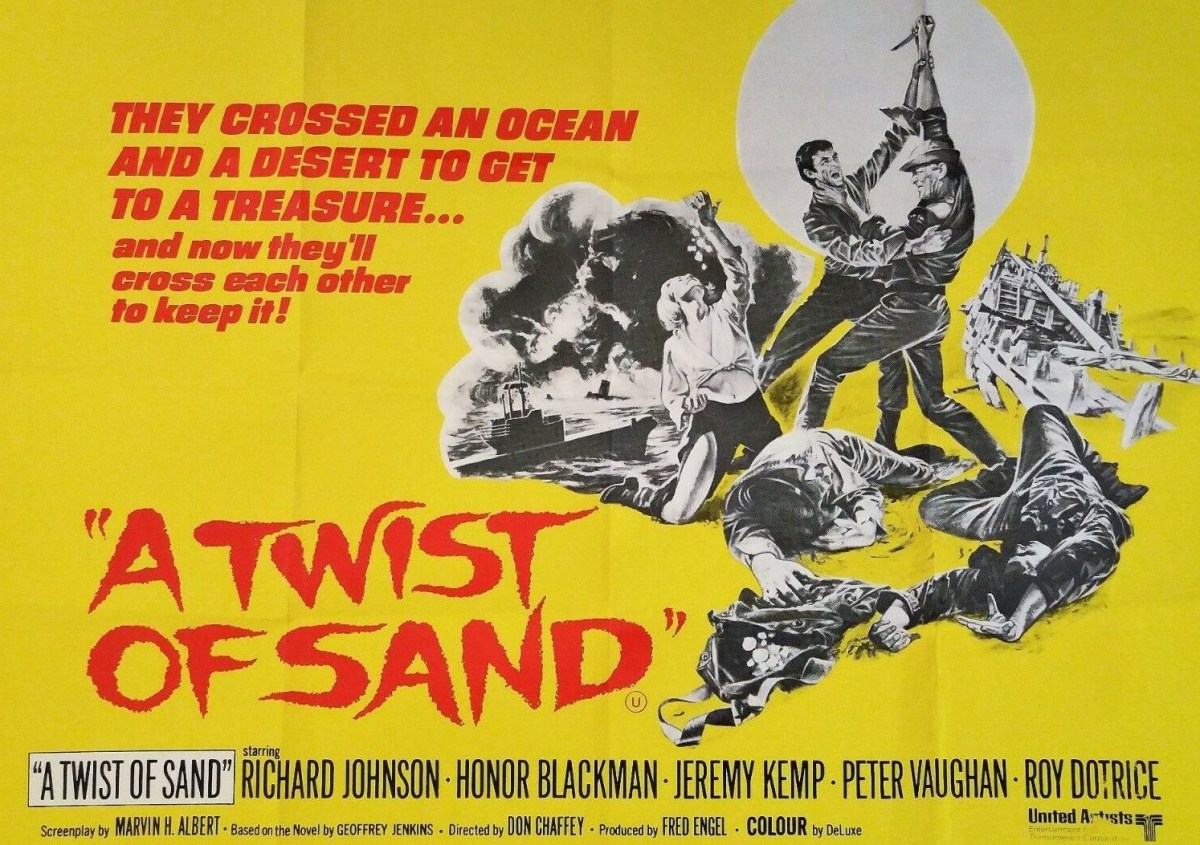
A Twist of Sand (1968) ***

Initially promising, ultimately disappointing thriller that proves you should not go to sea  without a big budget. Because he is the only skipper to have successfully negotiated the Skeleton Coast off Namibia in South Africa, smuggler Geoffrey Peace (Richard Johnson) gets roped into a scheme to collect stolen diamonds by Harry Riker (Jeremy Kemp) and Julie Chambois (Honor Blackman).

Peace knows his way around this area thanks to World War Two submarine exploits and that particular expedition is recalled both in a flashback and its repercussions form part of a plot. Also on board the boat are the goggle-eyed knife-wielding Johann (Peter Vaughn) and Peace’s shipmate David (Roy Dotrice).
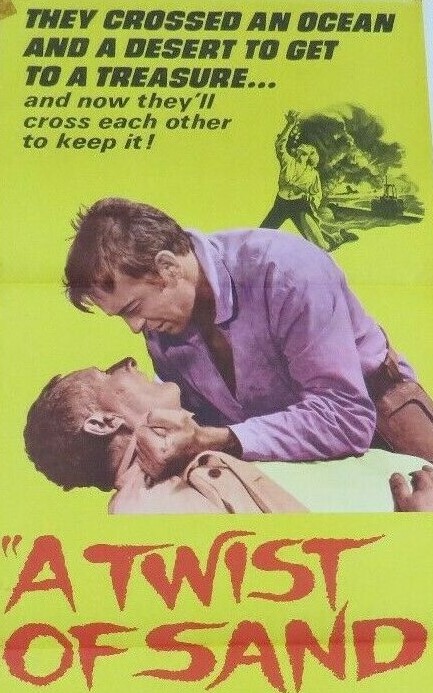
Peace has to navigate through the treacherous waters of the Skeleton Coast before the team embark on a trek through the desert to find the diamonds, hidden in the unlikely location of a shipwreck, itself in imminent danger of being buried in an avalanche of sand that could be triggered by sudden movement or sound.

On paper – and it has been adapted from the bestseller by Geoffrey Jenkins – it has all the ingredients of a top-class thriller, but it doesn’t quite gel. For a start, the flashback, where Peace has to hunt down a new class of German submarine and not only sink it but make sure there are no survivors, gets in the way of the action.

The sexual tension you might expect to simmer between Peace and Julie does not appear to exist, the bulk of the threat coming from the villainous-looking pair, Riker and Johann, the former already known to be untrustworthy, the latter too fond of producing a knife at odd occasions. The trek into the desert takes way too long and rather than increase tensions slackens it off and there is no real explanation as to why the ship was lost so far into the desert without entering Clive Cussler archaeological territory.
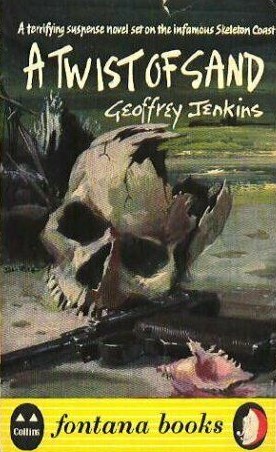
Extracting the diamonds is certainly a taut scene, with the sand dunes threatening to collapse any moment but the climax you saw coming a long way off and although there is an ironic twist it is not enough to save the picture.

On the plus side, Richard Johnson (Deadlier Than The Male, 1967) shucks off the suave gentleman-spy persona of Bulldog Drummond to emerge as a snarly, believable smuggler. But Honor Blackman (Moment to Moment, 1966) is wasted and this is one of the least effective bad guy portraits from the Jeremy Kemp (The Blue Max, 1966) catalog. Roy Dotrice (The Heroes of Telemark, 1965) is better value while Peter Vaughn (Hammerhead, 1968), menacing enough just standing still, overplays the villain.

Set up as a thriller very much in the Alistair MacLean vein, this shows just how good MacLean’s material was, how great a command he had of structure and not just of action but twists along the way. A Twist of Sand wobbles once too often in its structure and never quite manages to build up the necessary tension between characters. Although the Skeleton Coast sea-scene falls apart due to defective special effects, the other two sequences at sea are well done, the opening section where Peace is chased by Royal Navy vessels, and the underwater attack on the German submarine where murky water manages to obscure the effects sufficiently they appear effective enough.

Don Chaffey (The Viking Queen, 1967) does his best with material that’s not quite up to standard. Marvin H. Albert (Tony Rome, 1967) doesn’t do as good a job of adapting other people’s work as he does his own. 

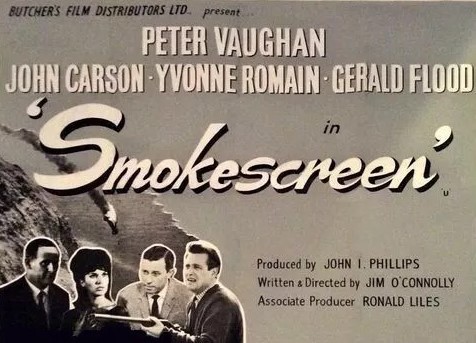
Smokescreen (1964) ***

Little gem with a terrific central performance. We tend to be condescending to these old British crime B-features. Occasionally one achieves cult status but mostly critics these days are as dismissive as back in the day. You might be surprised to learn that audiences treated them with a good deal more respect. In making up the support on a double bill, they represented value for money.

It’s also easy to forget that at this point the public were not inundated with television detectives and the true-crime genre had not been invented. Tales like this one, while lacking a big budget, proved very satisfactory viewing, especially if they were as clever as this. I could see the plot of Smokescreen being easily remade for a television one-off or as part of a series.

Main character, insurance agent rather than police detective, in his personal awkward demeanor, reminds me a great deal of the current BBC hit Ludwig.

Significant effort has gone into developing Roper (Peter Vaughan). For someone meant to be upholding the law, he skirts the rules in the matter of his personal expenses, ensuring he always finds the correct price for a taxi or a hotel meal before doing without and claiming it. So he doesn’t at all come across as an attractive character. He looks sly, sleekit, and he’s not smart enough to know how to butter up the office secretary Miss Breen (Barbara Hicks), who always wants minor attention, a postcard or similar.

Like Charles like Nothing but the Best (1964), he’s a sponger, without that character’s class or charm. Sent out on a case to Brighton on England’s south coast, hoping to find a missing man still alive and his wife making a false claim, he ensures that a professional colleague Carson (Trevor Bayliss) does all the driving, saving Roper on taxi fares which he can illicitly claim back. There’s an excuse for this unattractive behavior, but I preferred him less obviously redeemed.

Anyway, he’s a joy to watch, a real person with ordinary flaws rather than the usual ones afflicted contemporary detectives such as alcohol or drug abuse or failing marriage or an affair or requiring serious redemption for past major error.

All the characters have been well fleshed out. Carson nurtures secret feelings for supposed widow Janet (Yvonne Romaine). But she doesn’t at all come across as a femme fatale, which goes against the actress’s screen persona. There’s a great scene with a doctor (Derek Francis) whom his colleague upsets – Roper tiptoes away from the trouble – and who then demands a fee for being professionally consulted even if it’s only a few minutes in his garden.

Local cop Insp Wright (Glynn Edwards) is similarly offhand and down-to-earth, there’s a nice piece of comedy with a station master (Derek Guyler) and a great scene where Roper is way out of his element – and his league – trying to pump information out of a very attractive secretary (Penny Morrell) by getting her drunk, and wincing every time she puts an expensive cocktail on the bill.

Roper’s diligence pays off in the end, but there’s no grandstanding, as there is with Ludwig or any other cop, when he solves the case.

It’s a very clever story well told, enough interest to keep an audience feeling it has been entertained and if the main feature comes up to scratch back in the day would come out of the cinema very satisfied indeed. Roper manages proper detection, miffed when said colleague is correct in an assumption Roper dismissed, and the diligence that requires.

With little of a budget to speak of, these B-features had to make up for the lack of expensive location shots or camera tricks by ensuring the script not just ticked along nicely and provided an interesting resolution but that the characters appeared real, making up for lacking the cosmetic of attractiveness by reminding an audience of real people. Everyone would know a penny-pincher like Roper’s boss or a snippy secretary who can bring employees to heel or a sleekit colleague who’s doing a minor bit of ducking and diving.

This is a particularly significant turn by Peter Vaughan – who you might remember as the elderly Maester in Game of Thrones – because he made his name playing villains generally lacking any nuance. He was the titular evil criminal mastermind in Hammerhead (1968), a thug in Twist of Sand (1968),  a nasty piece of work in Straw Dogs (1971). Although he found regular work as a character actor, he might find it somewhat disappointing that he was never again let near anything quite as finished as this piece.  Yvonne Romain (Return to Sender, 1963) toys with her screen persona. Future British television dependables pop up everywhere, Gerald Flood and Sam Kydd in addition to Glynn Edwards and Deryck Guyler

Writer-director Jim O’Connolly (The Valley of Gwangi) writes some great stuff and is lucky to have the actors who can pull it off.

Great characters, solid detection and excellent twists.

Taste of Excitment (1969) **

Must-see for all the wrong reasons. An epic of confusion, appalling acting and dodgy accents make this thriller a prime contender for the “So-Bad-It’s-Good” Hall of Fame. Director Don Sharp (The Devil-Ship Pirates, 1964) jibed at star Eva Renzi (Funeral in Berlin, 1966) when he should have concentrated on a script that is over-plotted to within an inch of its life. A couple of kidnaps, casino visit, a sniper, and a vertiginous cliff-top maneuver are thrown in before a truth serum lights up the climax in spectacularly hilarious fashion.

Promising material goes badly awry. English tourist Jane Kerrell (Eva Renzi), floating around the South of France, is being targeted for unknown reasons. A white Mercedes has tried to drive her off the road, mysterious phone calls and visions make her believe she is going mad, that prognosis helped along by handy psychiatrist Dr Forla (George Pravda). And before you can say Surete, Scotland Yard and NATO she is the chief suspect in the murder of a man called Chalker on the ferry to France. Assistance comes in the form of handsome artist David Headley (David Buck) – preposterously famous “I’m David Headley” “The painter?” – who nearly does what’s she’s been complaining everyone else is trying to do, namely knock her down with his car. He specialises in painting nude women and for no reason at all, given he is identified immediately as a lothario, he resists her attempts to take her to bed.

Turns out Jane is something of a boffin, as any self-respecting computer expert would be known in those days, and a millionaire businessman Beiber (Paul Hubschmid), one of Headley’s rich clients, enlists the painter to offer her a job. Of course, he has something else in mind. His company is being accused to shipping unnamed goods to the unnamed opposition, hence the involvement of NATO chap Breese (Francis Matthews).

But nobody is to be trusted, especially as the French police have dismissed her fears as nonsensical. Scotland Yard’s Inspector Malling (Peter Vaughan) throws flames on the fire by not coming to her rescue but planning to arrest her since she is the last person to see Chalker alive. Then it turns out Chalker must have given her a code or secret message before he died. The police take apart her red Mini Cooper in clinical French Connection style but find nothing. That just shows how dumb they are. It never occurred to them, as it does instantly to Headley, to check the carburretor.

By now you’ll have guessed consistency is not this movie’s strong point. You never even know who the sniper Gaudi (Peter Bowles) is targeting his aim is so appalling. There’s even a sinister secretary Miss Barrow (Kay Walsh) with a pronounced Scottish accent in the Jean Brodie class. Headley comes up with an idea to disguise her – by changing her hairstyle (that’ll fool them!! – and astonishingly, in keeping with the bizarre tone, it does).

For someone who is meant to be paranoid Jane is surprisingly trusting, toddling off with clearly-identified villains when fed a line.

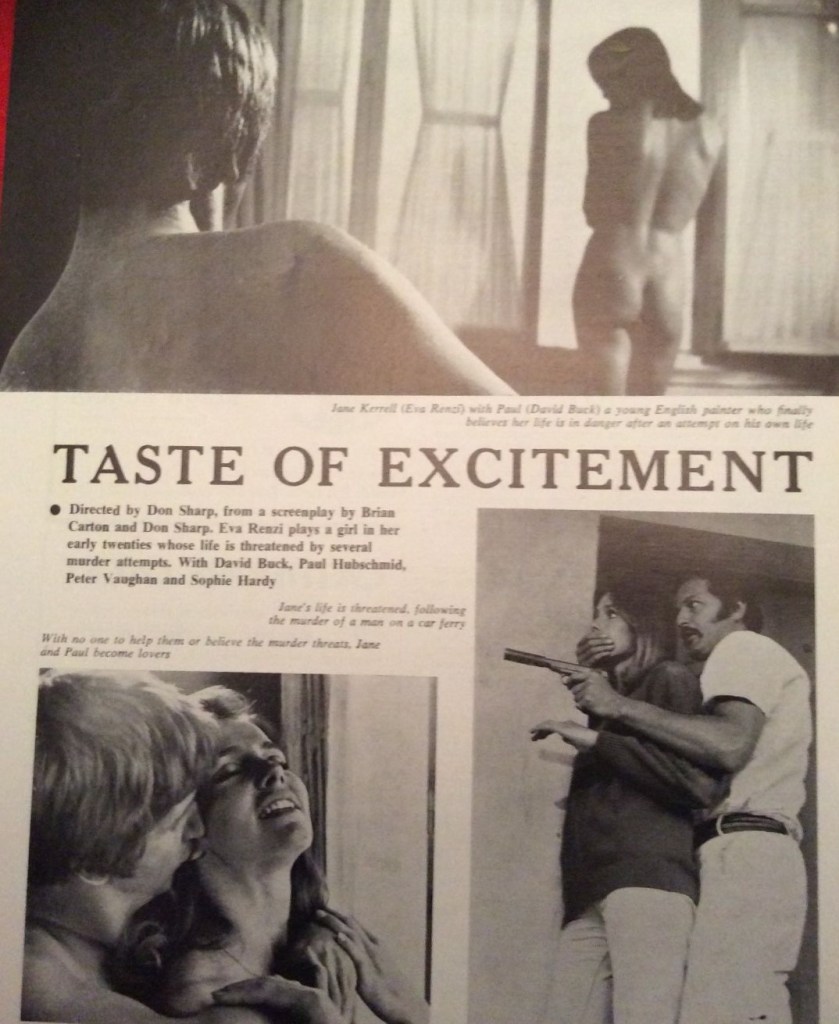
Most of the advertising, including this spread in “Films and Filming” magazine, made play of the sight of Eva Renzi’s naked derriere but ignored the unusual gender equality when it came to the nudity since in this scene David Buck gets out of bed and stands as equally starkers by the window.

You won’t be surprised when Jane ends up trussed and gagged, in her bikini naturally, in a fabulous house with an electrified fence. I can’t resist telling you about the truth serum. Before the evil psychiatrist has the chance to question her he is bopped on the head, Headley having sneaking in before (the dolts!) Gaudi thought to switch on the electric fence. (The electric fence is nullified by the police who just switch off all the electricity in the area.) But when she escapes, still full of the truth drug, when Gaudi calls out to find out where she is hiding, the serum forces her to give the correct answer. In the midst of the danger, Headley takes the opportunity to get an honest answer to the question of whether she loves him. And that’s not the best bit. The final line, given there hasn’t been a decent line all the way through, is a cracker. “Never believe a woman when she is telling you the truth” certainly gives you something to ponder.

So much is held back from the audience that there is never a chance, unlike Charade (1963), of genuine tension. Even the one gripping moment, taking a shortcut along a perilous cliff road, which is well done, is undercut by their pursuer beating them to their destination. The whole thing has an air of being improvised or being devised by someone who thought that twists counted more than characterisation, plot development or relationships.

The acting is so uniformly bad that Eva Renzi actually looks good. David Buck (Deadfall, 1968) is miscast in the slick Cary Grant role. While it is entertaining to see Peter Bowles (The Charge of the Light Brigade, 1968) drop his plummy English accent, his Italian accent fails to pass muster. Peter Vaughan (Alfred the Great, 1969), saddled with the bulk of the murky exposition, does his best. In a bit part, veteran Kay Walsh (A Study in Terror, 1965), holds the acting aces but she doesn’t have much competition.

Director Don Sharp also had a hand in the screenplay so it’s difficult to know who must take most blame, him or colleagues Brian Carton and Ben Healey. This was the alpha and omega of this pair’s movie career.

If you want to see how not to handle a potentially classy thriller tune in.  Can’t make up my mind whether to give this two stars for being so bad or four stars for being so bad it’s good. You decide.

And you can do so for free on Flick Vault. Be warned that you have to get past some adverts first. And if you’re wondering what happened to the opening credits, there ain’t any.

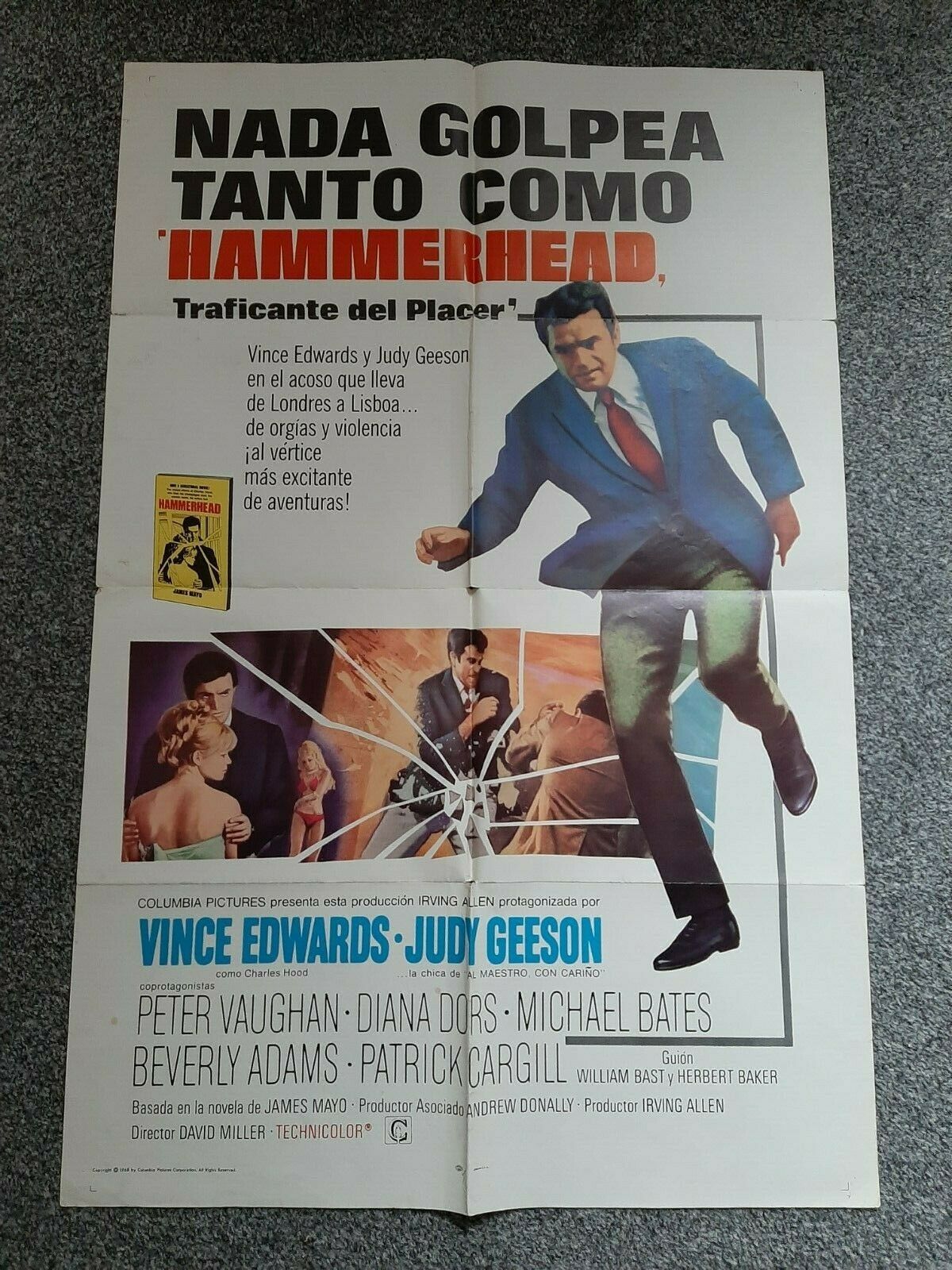
Hammerhead (1968) ***

Zest and Zero might be a more appropriate title for this late “so-bad-it’s-good” addition to the 1960s spy cycle. Judy Geeson (Here We Go Round the Mulberry Bush, 1967) is the firecracker to Vince Edwards’ (television’s Ben Casey) fizzle. It’s colorful vs. colorless. Edwards, as art connoisseur Charles Hood (from the James Mayo book series), is meant to be a cut above the normal spy when in fact he hardly makes the cut. Hood is on the trail of the evil Hammerhead (a white-gloved Peter Vaughan). Sue Trenton’s (Geeson) lust for life takes her from participation in uninhibited art spectacle to classier cabaret, at various points leaping headfirst into the story, sorely disappointed to discover that Hood is not the international jewel thief of her imagination but a mere spy.

A far cry from the audacity of James Bond or the spoofery of Matt Helm or Derek Flint, nonetheless you can’t imagine this was ever taken seriously. But Geeson’s light touch is trampled all over by the ponderous Edwards. Quite how director David Miller went from Back Street (1961), Lonely Are the Brave (1962) and Captain Newman M.D. (1963) straight into this is anyone’s guess. He ran out of ideas pretty quick, the wardrobe budget minimal, Geeson much of the time restricted to a towel or bra and panties, an entire scene of Ivory (Beverley Adams) gyrating in a bikini, other sequences set against a backdrop of scantily-clad females.

The plot is non-existent. Hood doesn’t even know what he’s chasing – a “secret report” of some kind. Halfway between camp and incompetent, the picture scores in unintentional ways. Hammerhead makes a grand entrance – lowered in a cradle from a helicopter! The big chase involves a hearse. Trenton, who can’t sing, gets to sing. Occasionally the comedy is intentional, a taxi driven onto the shore a few scenes later is stranded by the incoming tide. Needing somewhere to screen some stolen footage, Hood invades a blue movie club. Avoiding a villain in a post office, Trenton plays a version of pass-the-parcel. The monosyllabic steal the picture – in reply to Hood’s pestering, a manservant’s inevitable reply is “it depends” and that of the dancing Ivory “louder.” But the biggest opportunity for Bond-style gags, Hood and Trenton trapped in a coffin, is wasted, although there is a nod to Thunderball in the harpoonery department.

Perhaps what best passes the time is the opportunity for star-spotting. British sexpot Diana Dors, complete with lipstick transmitter, puts in an appearance. There is a flock of British television actors in Patrick Cargill (Father, Dear Father), Michael Bates and Windsor Davies (both It Ain’t Half Hot, Mum), William Mervyn (All Gas and Gaiters), Tracy Reed (Doctor Finlay’s Casebook) and Kenneth Cope (Randall and Hopkirk, Deceased). Dave Prowse (Star Wars) makes his movie debut and former top British star Kathleen Byron (Black Narcissus, 1947) has a small role. Beverly Adams is almost a spy film mascot, with The Silencers (1966), Kiss the Girls and Make Them Die (1966), Murderer’s Row (1966) and The Ambushers (1967) in her locker. The gaggle of gals includes future Hammer star Veronica Carlsen (Dracula Has Risen from the Grave, 1968), Maggie Wright (Sex and the Other Woman, 1972) and former Slaygirl and 2001: A Space Odyssey stewardess Penny Brahms (The Games Lovers Play, 1971).

You half expect Judy Geeson to turn out to be a femme fatale or at least a decoy or there to provide a plot twist. But, no, she is just an adventuress, at times inventive and resourceful. Just a shame that an outing with the dull Edwards would put anyone off adventure for life.

A romp of the wrong kind for sure.

Discover WordPress

A daily selection of the best content published on WordPress, collected for you by humans who love to read.

The Atavist Magazine

by Brian Hannan

WordPress.com News

The latest news on WordPress.com and the WordPress community.