
Delicious caper movie. Under-rated and largely dismissed because a) it is very British, b) audiences preferred Stanley Baker in an action film like Zulu (1964) and c) it appeared a year after the action-driven heist picture The Italian Job. So many black marks you might think it was an automatic candidate for relegation.
But, in fact, it is a delight, a gem that never outstays its welcome and, furthermore, elicits tremendously enjoyable performances from the three principals, with the added bonus, I guess, of the costume budget being much reduced by Ursula Andress prancing around so much in the nude.

Mr Graham (Stanley Baker) is an uptight, bowler-hatted, spectacled, unmarried, straitlaced banking executive. That’s too fancy a title for his job. He’s not the manager, he’s not even the deputy, he’s the deputy to the deputy (here called an “under-manager”) and his sole joy in life appears to be granting or refusing overdrafts, an action that might, to one of life’s smidgeons, be construed as an exercise in power.
One of his clients is uber-sexy Lady Britt Dorset (Ursula Andress) who, while living in penury, manages to swan around in the most divine outfits and a swanky sports car, mostly as the result of his overdrafts. Although he believes he is tough and worldly it never occurs to him to wonder how his client has the wherewithal to repay the overdrafts.
She is married, but to the equally poverty-stricken Lord Nicholas Dorset (David Warner) whose sole income derives from a daily payment from sitting in the House of Lords and schemes such as attaching his name to a restaurant chain.
It doesn’t strike Mr Graham as particularly odd that Britt takes a fancy to him, infidelity appearing to be written into her marriage vows. And it’s not long before the deputy deputy manager starts to wonder how he might turn this relationship into something more permanent. So he comes up with a clever caper, a three-man job, or more correctly a two-man one-woman job. He’s going to steal £300,000, split three ways, from his bank. Nicholas will pose as a bank inspector, Britt will be the one who physically removes the cash and Mr Graham, naturally, will take on the role of criminal mastermind, finding a way to get hold of the necessary duplicate keys and over-riding the usual security concerns.
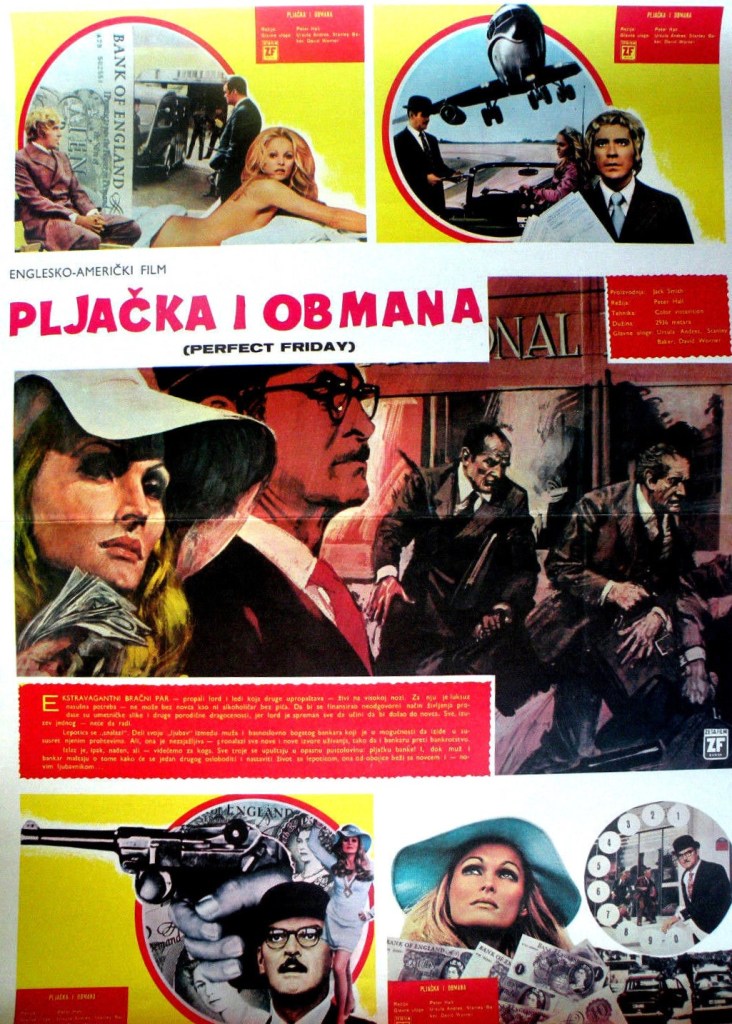
For a good while most of the plan consists of keeping the husband out of the way, sent on various “missions” across the country and abroad, to give Mr Graham time to enjoy making love to the wife. There’s an occasional hiccup to the plan, but mostly it appears to be running smoothly.
Except, as you might imagine, double cross is afoot. Mr Graham would like to purloin the husband’s share, all the more to set up cosy home somewhere abroad with the wife. And, as you might expect, there’s a sting in the tale.
But this is all so effortlessly done, tremendous tension as the robbery is carried out in complete silence (as was by now par for the course), jaunty music intervening at other times, the combination of the three opposites making for a delightful scenario, the stuffy manager at odds with the lazy, louche husband, and an unlikely companion for the sexy, apparently docile, wife.
Some clever directorial touches from Peter Hall (Three into Two Won’t Go, 1967) provide unexpected zest, but primarily this is a comedy of manners shifted onto the heist plane. And the best thing about it is the performances.
Ursula Andress (The Blue Max, 1966), here taking top billing, delivers her best-ever performance, the sexy front concealing a clever brain, easily manipulating lover and husband, deceit embedded in her genes, the hard-coiled core hidden from view, as she indulges both herself and her paramour.
Stanley Baker is superb, almost in Accident (1966) stiff upper lip mode, but without, until sex triggers criminality, that character’s free-wheeling attitude and immorality. He lives his entire life in a glass booth, observing and being observed, working within an arcane code of practices, not believing that he, of all people, could actually break the rules.
But David Warner (Titanic, 1997) steals the show as a bored upper-class lord who wants nothing more than a quiet life paid for by someone else and who almost throws a hissy fit when, as part of his role, he is forced to wear clothes he finds demeaning. If it wasn’t for the prize, this whole enterprise would be so much beneath him, and he doesn’t even have the satisfaction of being able to put this underling in his place.
Sheer enjoyment.


 The Magnificent 60s