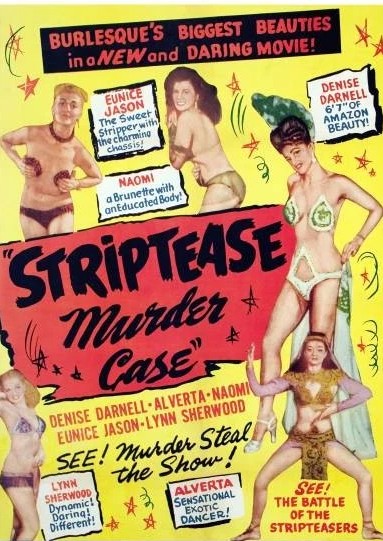
A treat in so many ways. A killer who could be the evil twin of Q, James Bond’s gadget supremo. A denouement worthy of Hercule Poirot. A femme fatale whose villainous boyfriend thinks he’s in charge until he learns, to his cost, she’s far smarter. A hero who’s just an ordinary bloke, derided for the most part, who enjoys none of the brio of the good guy who wins out because he can’t get over his loss.
And all this packed into an exceptionally slim running time once you deduct time for half a dozen striptease routines. Given the era the title is bait-and-switch, not much to see here that the censor of the times would permit.
In The Flamingo Club in London’s Soho, businessman Branco (Kenneth J. Warren) is being blackmailed by former mistress Rita (Ann Lynn), a stripper. What he doesn’t know is that she’s set her sights on more than blackmail and she’s not become his mistress for the few scraps of nice clothing and fancy jewels he can bestow on her. She’s set out deliberately to seduce him so she can get the inside gen on his operation with a view to moving in.
Branco, sensing imminent threat, goes to sound engineer Perkel (Peter Elliott) for the answer. Perkel, in a manner that would delight Q, has rigged up a mic that, via a transistor and remote control, will electrocute the singer at the switch of a button. Only problem is, inadvertently, he kills the wrong girl, Diana (Jean Muir), wife of hapless M.C. Bert (John Hewer), an alcoholic former comedian down on his luck.
The cops aren’t interested in his theories of dirty dealing especially when the autopsy returns a verdict that suggests nothing untoward except bad luck for someone so young. But Bert’s found something unusual. Diana’s corpse is cold except for her ear, which is warm, which gets him to thinking. He tracks down Diana, only to be beaten up by her boyfriend Rocco (Carl Duerring), but when he calls on his inner Poirot he alights on Perkel.
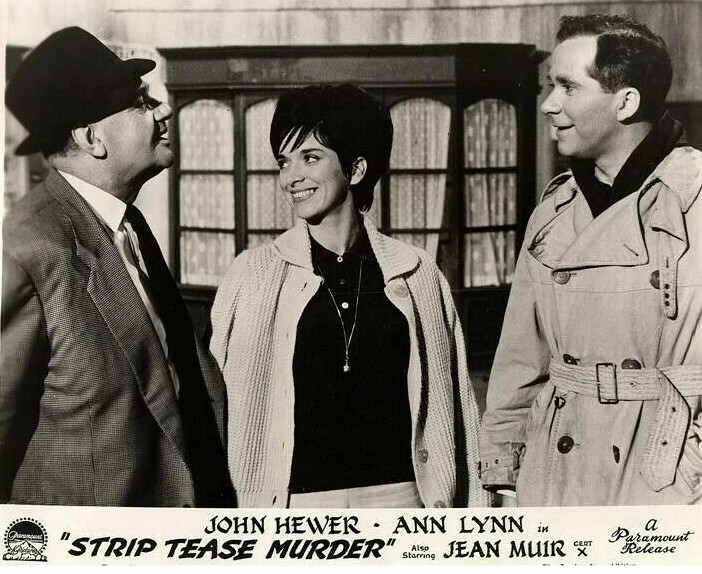
Diana reveals her true plan to the astonished Branco, who is shot by Rocco, with the entrepreneurial woman taking over his drug-running operation. Then with the help of the strippers and waiters at the club, Bert brings the villainous trio to the club where he enacts a potential second killing with the cops looking on.
So some very well-drawn characters make this worth more than the meager plot suggests. Perkel is a beaut. It’s worth remembering that Q was hardly a harmless inventor, and that most of his gadgets were meant to kill the enemy, such actions deemed justified because the bad guys are Russians or intent on global domination. Perkel is of the same boastful persuasion as Q, demanding that his ingenuity be recognized, willing to carry out murder for free just for the opportunity of proving that his weapon can kill more than snakes or horses. He is easily flattered and even when being arrested believes the cops are more interested in his invention – who knows, maybe it would end up in Q’s laboratory.
Diana, too, is something of a surprise, shifting from being apparently nothing more than a gangster’s moll to becoming the kind of ambitious gangster her boyfriend could not hope to emulate and more ruthless.
And Bert, while dogged for sure, and dumping the booze after his wife’s death, never finds a moment’s solace. Solving the murder won’t bring back the victim. Unusually, in this respect, reality intrudes in the world of crime fiction.
John Hewer (Three Spare Wives) went on to become a British television fixture, ironically as an M.C., host of variety show The Pig and Whistle (1965-1977). Ann Lynn (Piccadilly Third Stop, 1960) had a more varied career in television and film with a notable turn as the wife with lesbian tendencies in Baby Love (1969). Kenneth J. Warren was the bad guy with too much imagination in The Saint: The Fiction Makers (1968). Peter Elliott (Village of Daughters, 1962) steals the show as the meek killer who thinks genius excuses murder.
This was put together by the Danzigers, American producer brothers, who were prolific creators of B-pictures designed for the supporting feature slot in the days when audiences demanded double bills. Directed by Ernest Morris (Echo of Diana, 1963) from a script by Paul Tabori (Doomsday at Eleven, 1962).
Had this been made today, with hopefully the stripper element not played for exploitation, critics would have been pointing to the unusual depth of character.
It’s short enough to be well worth a look.
 The Magnificent 60s