Goodbye Charlie (1964) ***

Gender switch comedies were a rarity in Hollywood at this point though of course Billy Wilder had scored big with Some Like it Hot (1959) and I’m guessing the possibility of Tony Curtis repeating his drag act was an audience lure for this one. Alas, that wasn’t to be. This goes the other way. Or several other ways. A woman playing a man who is a woman. That would be catnip these days were it a transgender thing, but it ain’t.

Confused? So sex predator Charlie (a male) drowns while escaping enraged husband Sir Leopold (Walter Matthau) only to reappear, re-born or reincarnated (as the producers decide after googling it, sorry, after they look it up in a book) as a naked woman walking along the highway, rescued by the wealthy Bruce (Pat Boone) and delivered to the nearest house, Charlie’s own pad, now occupied by old buddy George (Tony Curtis).

There’s some light comedy as George tries to safely manhandle the unknown woman, clad only in Bruce’s coat (necessitating his later return of course) and gradually the surroundings seem over-familiar to the woman and then, shazam, George works out from what she knows about him that actually she must have returned as a man, also called Charlie (Debbie Reynolds).

A cosmic joke, in other words. The man who preyed upon women returning as a woman. See how he likes it to be on the receiving end of misogyny. But, mostly, he/she lolls around with legs spread like a man, gulps down whisky and is a dab hand at cards. But that’s not where the humor lies, apparently, because the movie moves on quickly from the woman acting the man and into the man-woman discovering all the female tricks of the trade, visiting a beauty parlor and the hairdresser. Charlie discovers it’s not the same fun slapping a woman’s backside – what a revelation – if you’re a woman.
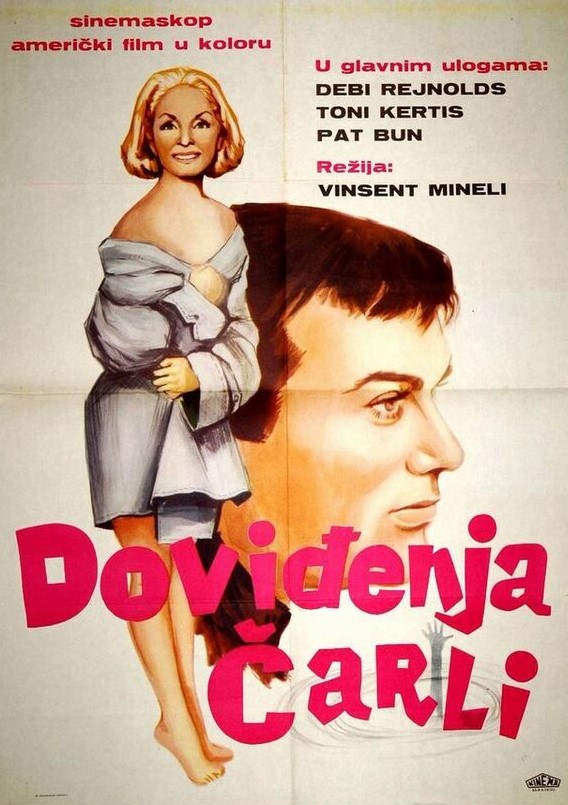
But, basically, the female Charlie decides to become a female version of the male Charlie, the predator, ripping off friends, chasing the big money, trying to seduce Bruce.  So, mostly, it’s one odd plot device after another.

But the sizzle is Debbie Reynolds, not so much the man-woman stuff, but turning into a mean Bette Davis character before your eyes, all hard-edge and shifty moves. There’s sexual tension as well, George initially resisting the woman he knows is or was a man, before finding the attraction too much, and the same going for Bruce. There’s a fair whack of sexual confusion, as the newborn Charlie still finds herself ogling women.

In those far more innocent times, it doesn’t know what it wants to say and lacks the narrative to say it. Audiences had terrific fun with Jack Lemmon and Tony Curtis in Some Like it Hot, but that narrative ploy was bang on, and Lemmon enjoying dressing up as a woman and Curtis having to keep his male instincts at bay while ogling Marilyn Monroe was pure catnip.

Here, Curtis is mostly the foil for Debbie Reynolds and by the time it looks as though they might get it together she is way past behaving like a man and is most definitely a desirable woman so it’s kind of difficult to make this work romantically or humorously.

Perhaps the oddest element is that the signs were already there that it wouldn’t work that well. It started as a Broadway play written by George Axelrod (The Seven Year Itch, which was a Broadway smash) but it barely lasted a dozen weeks on stage. By that time, though, Twentieth Century Fox had splashed out $150,000 for the rights. Still, bigger sums have been buried in the annual accounts.

And I guess when Vincente Minelli (Two Weeks in Another Town, 1962) came on board with a pretty decent cast it seemed at least doable. Like many a lightweight comedy from the decade – Dear Brigitte (1965) for example – it’s keep afloat by a terrific performance by the principal star, in this case Debbie Reynolds (Divorce American Style, 1967). You might spot Ellen Burstyn (The Exorcist, 1973) in an early role.

Take away Debbie Reynolds and it would limp along.
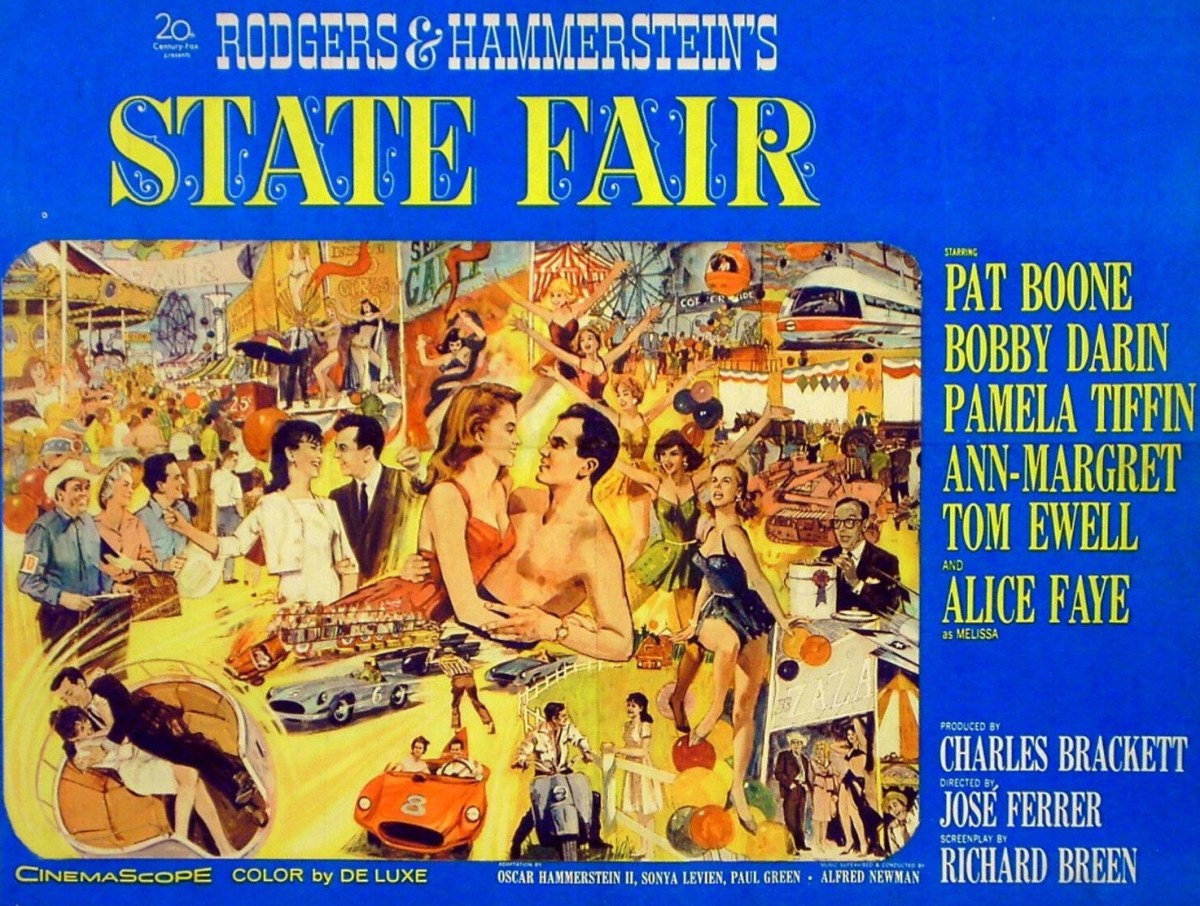
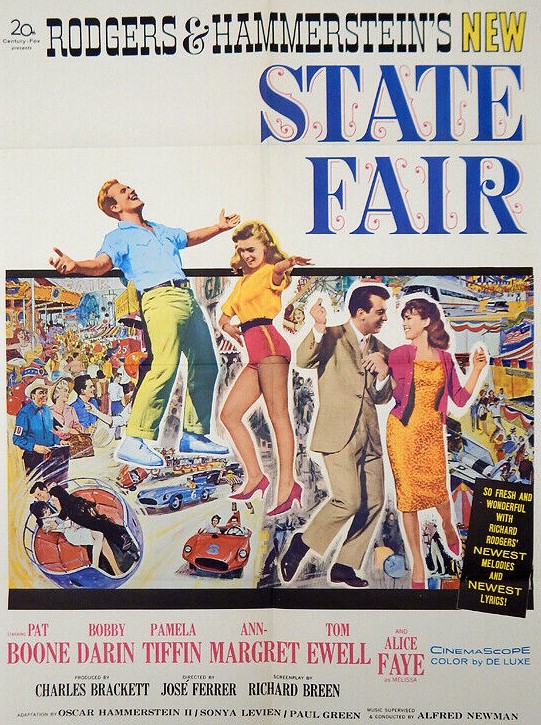
State Fair (1962) ***

Ann-Margret lights up this corny-as-they-come musical. A car-racing sub-plot is about the only attempt to update it from the previous version in 1945. But if you like a love story, you’ve got three, that is if you include Blueboy the pig’s amorous advances. The remake avoids the edginess that had been introduced to movie musicals by West Side Story (1961) and settles for family-friendly and lightweight.

But there is something very American about the Frakes, a family of farmers. They all want to be winners at the annual state fair, parents Abel (Tom Ewell) and Melissa (Alice Faye) desperate to come home with trophies, she for her mincemeat, he with his pig. Son Wayne (Pat Boone) is also intent on victory, in a car race. Daughter Margy (Pamela Tiffin) would be happy with a bit of romance.

Wayne is very taken by showgirl Emily (Ann-Margret) while commentator Jerry (Bobby Darin) has eyes for Margy. The romances are not quite as innocent as you’d expect. Emily makes it clear she’s had other men, making her in Wayne’s eyes “a bad girl,” and that anything that happens at a state fair stays at a state fair, while she goes merrily on her way to her next conquest. Jerry is considerably less open with Margy, happy to string her along until he gets his chance at the big time.

Blueboy, who snorts like billy-o on seeing a female pig in the next stall, has to do all his courting behind bars.

This is more of a musical than the original. Oscar Hammerstein II now deceased, Richard Rodgers adds four more songs on his own, so there’s a bit more mooning and prancing about.

Although “It Might as Well Be Spring” was viewed as the standout song, the standout performance belonged to Ann-Margret who adds spectacular zip, showing off her figure is a series of dance moves on stage leading a male ensemble.

Oddly enough, of all the prospective competition winners, Wayne is the only loser. But that’s out of choice as he rams into a rival to drive him off the track and prevent him winning. Equally oddly, in this context, that’s seen as something of a victory, putting a bully in his place. The racing sequence, and thankfully minus any song, is a highlight.

The humor, deriving mostly from the parents, is slightly labored. Blueboy is let down by the script which doesn’t permit him to build up enough personality to make the audience root for him. But the sequence where three judges taste the alcohol-enhanced mincemeat works well. While at the outset the parents appear merely there as filler, they eventually come into their own in a demonstration of mature love.

Ann-Margret brings a touch of Vegas to the state fair.

Quite what made director Jose Ferrer (Return to Peyton Place, 1961) – an Oscar-winning actor – think he was cut out for a musical is anybody’s guess since, in the first place, this would only be his seventh picture in 11 years and, in the second place, he had no experience in this line. There are too many scenes just of the fair, a souped-up job that was more like an outdoor exhibition than a mom-and-pop local affair. While he lacks the flair of the big time Hollywood directors of musicals, for most of the songs he just points the camera and lets the actor get on with it, the dramatic scenes working reasonably well.

But since only Ann-Margret is called upon to show any real angst he’s quite limited in opening up the movie’s emotional appeal.

Ann-Margret (The Swinger, 1966), changing from natural brunette to flame-haired, steals the picture by far, not just on stage but revealing the screen persona that would take her to the top. Pamela Tiffin (The Pleasure Seekers, 1964, where she played second fiddle to Ann-Margret) is left in the shadows by Ann-Margret’s sizzling performance. Pat Boone (The Main Attraction, 1962) and Bobby Darin were better known as crooners which tends to mean they’re better with songs than dialogue, as is the case here, though Darin was excellent in the non-musical Pressure Point (1962).

Former top Fox star Alice Faye (In Old Chicago, 1938), making a comeback after 17 years, has little to do but frown and Tom Ewell (Tender Is the Night, 1962) has little to do but gurn and moon over his pig.

But, hey, it’s a musical and different rules apply. Fairly passable entertainment with some decent songs and the added bonus of Ann-Margret.

Discover WordPress

A daily selection of the best content published on WordPress, collected for you by humans who love to read.

The Atavist Magazine

by Brian Hannan

WordPress.com News

The latest news on WordPress.com and the WordPress community.