Night of the Following Day (1969) ***

As his popularity in the 1960s faded, Marlon Brando was often called upon to save, or greenlight, a picture unworthy of his talent. Except that director Hubert Cornfield failed to extract enough tension from a kidnap thriller with an inbuilt deadline and a double-crossing sub-plot this might have been one to rise out of the mediocrity.

It’s not unknown for strangers working together on a robbery to adopt pseudonyms, colors in the case of Reservoir Dogs (1992) or cities as in Spanish television hit The Money Heist. Here they are known by their designated tasks, which seemed a nod towards artistic pretension at the time. Even so, the gang have too many frailties for taking on a caper like this, the pressure of a deadline and the publicity their crime attracts exacerbating the situation. So kidnapping a millionaire’s daughter (Pamela Franklin) are: Chauffeur (Marlon Brando), in on the job because he owes a favour to Friendly (Jess Hahn), whose sister Blonde (Rita Moreno) is also the chauffeur’s drug-addict girlfriend, the psychopathic Leer (Richard Boone) and a pilot (Al Lettieri).

All except the pilot are holed up in a remote beach house in France. The first signs of cracks show when Blonde is so drugged up she fails to collect her colleagues from a small local airport and, when suspecting the chauffeur of having sex with the girl, she explodes in a tantrum. And because she can’t get her story straight she attracts the attention of a local cop (Gerard Buhr). Despite making a good job of calming down the terrified girl, Leer has other plans for her which the Chauffeur is constantly trying to thwart. At various points various people try to quit. At various points romantic and family ties are pulled tight.

The details of the cash hand-over are well done as is the unexpected double-cross and the diversion allowing them to escape but about ten minutes of the running time is people driving around in cars, only at the later stages to any useful dramatic purpose, time that would been better spent filling us in on the characters. Most of the tension derives from a gang with two loose cannons and certainly the wait for the confrontation between Chauffeur and Leer is worthwhile.

The biggest plus point is Marlon Brando (The Chase, 1966) and even – perhaps because of – sporting a blonde wig and black tee-shirt remains a compelling screen presence. He might have been slumming it but he is certainly believable as the minor criminal way out of his depth. It’s a mistake to think of him as intended to exude menace along the line of Quint in The Nightcomers (1971) because this is actually a complicated role. On the one hand he clearly never wanted to be involved, participation triggered by a sense of honor, trying to keep his girlfriend and the kidnappee safe while at the same time happy to resort to considerable violence to achieve his ends.

The malevolent Boone (The Arrangement, 1969) almost steals the show, beginning as the voice of reason and gradually succumbing to his inner vices. The love interest benefits from Brando and Moreno (West Side Story, 1961), also in blonde wig, being ex-lovers in real life and it takes little to ignite the anger in Moreno. But her portrayal of the addict who cannot stay off her chosen poison long enough to carry out a simple task is excellent. Pamela Franklin (The Prime of Miss Jean Brodie, 1968) has little to do except look scared and she has one revealing scene when in attempting to seduce the Chauffeur sets up the prospect of a different kind of liaison with Leer.

Hubert Cornfield had not directed a picture since Pressure Point (1962) which acted as a decent calling-card and showed how good he was at creating tension between opposing individuals. Instead of focusing here on the characters, Cornfield seems more interested in the visuals, none of which as it turns out are particular arresting and in one instance virtually impossible to see what is going on.

Not so much a curiosity as a masterclass in how to blow a once-in-a-lifetime gig with Marlon Brando and what not to do with a thriller.

The Innocents (1961) ***

One description of this film’s prequel The Nightcomers (1972) was that, even with the overt sex and violence, it was an arthouse picture masquerading as a horror movie. And obviously absent the sex and violence that’s how I feel about this one. I’m of the old-fashioned school when it comes to horror – once in a while I expect to jump. The biggest problem here is that fear is telegraphed in the face of governess Miss Giddens (Deborah Kerr). Instead of the audience being allowed to register terror, all the tension is sapped away by one look of her terrified face.

Atmospheric? Yes! Scary? No.

Certainly, the set-up is likely to spark the darkest imaginations. Orphans Miles (Martin Stephens) and Flora (Pamela Franklin) are abandoned by their uncle (Michael Redgrave) who wants to spent his time enjoying himself in faraway London without having to bother about the care of the minors. The governesses he installs are given carte blanche to deal with any situation that arises – as long as they don’t concern him with it. And he’s so disinterested in the children’s welfare that he hires a completely inexperienced governess in Miss Giddens despite the fact that the previous occupant of the post, Miss Jessel, had died in mysterious circumstances and a little digging would have revealed that she lived a hellish life under the thumb of valet Quint.

The kids appear somewhat telepathetic or telekinetic – Flora knows Miles is coming home before Miss Giddens does, Miles knows when the governess is standing outside his door. They’re maybe a too bit self-indulgent – Flora enjoys watching a spider munch on a butterfly and isn’t above finding out if her pet tortoise can swim, while Miles has Miss Giddens in a neck stranglehold.

But it’s unlikely the children are summoning ghosts – Quint appears to Miss Giddens at the top of a tower and again peering in through a window, Miss Jessel turns up, too, and I lost count of the number of disembodied voices. The ghosts it turns out have taken possession of the children in order to continue their relationship.

And while this is all very clever it does not chill you to the bone. The children are not as cute as they need to be to make this work. You get the impression, given half the chance, they would happily turn into little savages and experiment with all manner of cruelty. And that would occur whether there was the likes of Quint around to lead them astray because the adults in their lives are so selfish and set the wrong kinds of standards. But with the focus perennially on the trembling Miss Giddens, there’s little chance of getting inside the heads of the children.

Since jump scares are not in director Jack Clayton’s cinematic vocabulary, the best scenes are not visual, but verbal, housekeeper Mrs Grose (Meg Jenkins) filling the governess in on the unequal relationship between Quint and Miss Jessel, Flora imagining rooms getting bigger in the darkness (effectively more dark), Miles seeing a hand at the bottom of the lake.

There’s certainly an elegiac tone and the camera clearly sets out to destabilise the audience but that’s just so obvious it seems more an arthouse ploy than a horror schematic.

This was start of Deborah Kerr (Prudence and the Pill,1968) playing psychologically distorted characters. Over the previous decade she had revelled in a screen persona that saw her playing the female lead (sometimes the top-billed star) opposite the biggest male marquee names of the era – Burt Lancaster (twice), Cary Grant (twice), Yul Brynner (twice), Gregory Peck, William Holden, Robert Mitchum (three times), David Niven (twice), Gary Cooper. Now she turned fragile and that screen persona, introduced here, would see her through the next decade.

So she’s both very good and very bad here. Her character facially registers her inner thoughts but those too often get in the way of the audience. I found the kids more limited in their roles, not through acting inexperience, but through narrative restriction.

Jack Clayton (Dark of the Sun, 1968) directs from a screenplay by Truman Capote (In Cold Blood, 1967) and William Archibald (I Confess, 1953) from the celebrated Henry James story.

A bit too artificial for my taste. Probably heresy to admit it but I preferred the prequel.

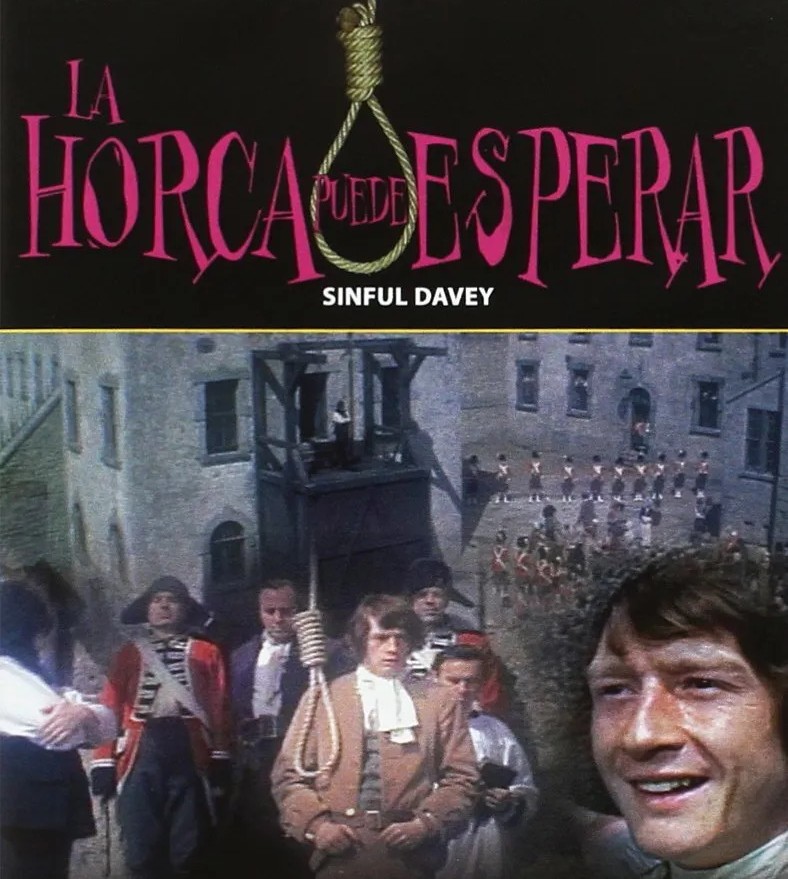
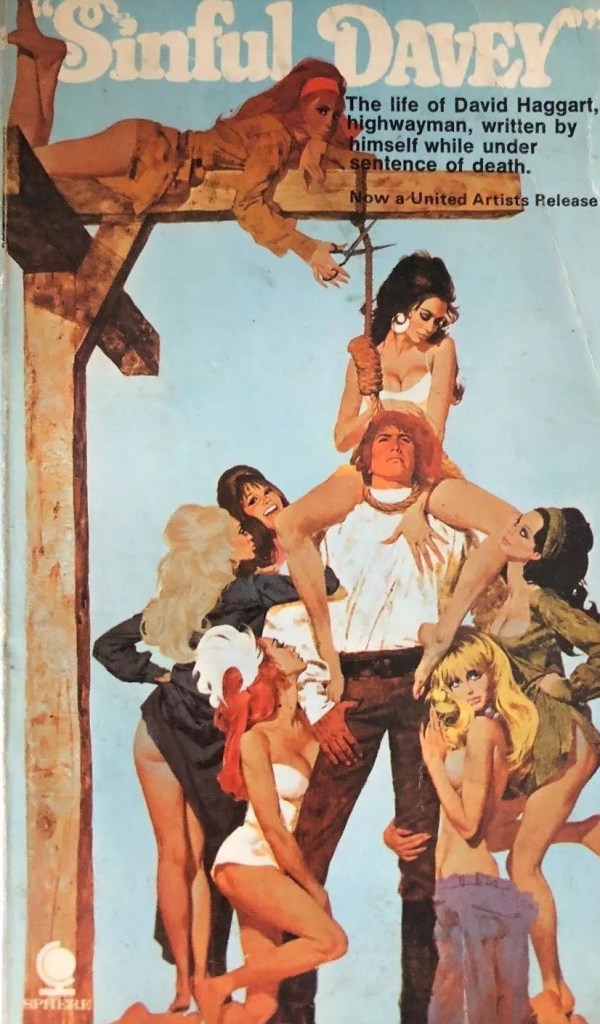
Sinful Davey (1969) **

Major disappointment from a director of the caliber of John Huston. Granted, the quality of his output during the decade had been variable but this marked a new low and the suspicion lingers that he only took on the gig to spend time in Ireland – the movie was filmed there – where he had set up a home in the grand manner of a country squire. Equally odd is James Webb as screenwriter. Having chronicled  the American West via How the West Was Won (1962) and Cheyenne Autumn (1964), Webb had turned his attention to British history, beginning with Alfred the Great (1968).

But where that had at least historical reality to guide the narrative, here Webb relies on the dubious autobiography of the titular subject, resulting in an episodic, picaresque, sub-Tom Jones (1963) and even sub-Where’s Jack? (1969) tale set in the Scottish Highlands.   And much as John Hurt later achieved considerable recognition for his acting, the role, as played, could have been handled just as easily by any number of rising male stars, since, beyond being able to affect two accents – broad Scots and upper-class English – little is required.

In fact, the director clearly couldn’t distinguish between the Irish and the Scottish accent as among the  joblot of accents, none more than serviceable, there is many an Irish lilt.  As if to make the point that he couldn’t care less, you will also discern on the soundtrack a refrain from “Danny Boy.”

Beyond that it made a good scene, quite why Davey Haggart (John Hurt) decided to announce his desertion from the British Army in such ostentatious manner is difficult to understand. He’s a drummer, marching along, banging said drum, when he takes it into his head to jump off the nearest bridge into the nearest river, complete with drum, only to find himself headed for a mill. In possibly the best line in the script, seeing the mill wheel blocking his escape, he mutters, “Who put that there?”

From here on it’s a tale of pursuit – two actually. Lawman Richardson (Nigel Davenport) leads the merry chase but he’s also got childhood sweetheart Annie (Pamela Franklin) on his tail to ease him out of scrapes in the hope that he’ll reform. Beginning as a pickpocket, he  switches to highway robbery and piracy, rarely with particular success. Loaded down with booty on the carriage he has stolen, for example, he loses control of the horses and is left at the side of the road, as poor as when he started. 

He’s certainly inventive but contemporary audiences will recoil from the notion of using the head a height-challenged man aloft another’s shoulders to test the rotting rafters inside a jail, leading not to escape but to a home-made pleasure parlor, since it provides entry to the female jail above where our hero establishes himself as a pimp.

But that’s as inventive as this picture gets and in the manner of Cat Ballou and Where’s Jack? you know that whenever a hero heads towards the gallows you can be sure the hanging will be thwarted. The period setting – the 1820s – offers little assistance, as the picture could be set any time before the invention of steam, and could as easily have taken place in a galaxy far far away long long ago called Brigadoon for all the period authenticity shown.

This didn’t lead to instant stardom for John Hurt and possibly just as well as he’d have been wasted in a series of ingenue roles. Pamela Franklin (And Soon the Darkness, 1970) doesn’t have much to do beyond trying to master a Scottish accent. Nigel Davenport (Play Dirty, 1968) was in his element playing yet another frosty authoritarian figure.

John Huston (Night of the Iguana, 1964) did prove one thing – that he lacked the knack for comedy.

The Lion (1962) ***

For such a harmless picture The Lion raises a couple of troubling issues. The first concerns the titular beast. Doubt if you’d get the authorities these days to greenlight a movie where a pre-pubescent girl was in such close proximity to a full-grown lion. Having as a safety measure two sharpshooters on the sidelines out of camera range, as director Jack Cardiff did here, might not cut it.

Secondly, we’ve got censor double standard. I remember my shocked parents forbidding me from seeing Zulu (1964), a massive hit in Britain, on account of the toplessness of the indigenous females. The censor didn’t slap an X-certificate on that sequence on the assumption that such nudity, in the context of tribal tradition, wouldn’t apparently incite the lewd male gaze. Had this been white breasts on show, in whatever tradition, the censor would not have been so lenient, signifying an inherent racism. Here, surprisingly, we’ve also got female toplessness, somewhat more discreet than Zulu, but coming as a surprise to your reviewer.

Perhaps the oddest feature of the picture is the contradictory message: Africa is wonderful but it’s not the place to bring up a young girl. Certainly not one who embraces the wildness with considerably more conviction than a passing wildlife tourist. As the imdb stub puts it: the young girl Tina (Pamela Franklin) must be brought “back to civilization.”

And there’s a distinctly old-fashioned tint to a storyline that demands the appearance of her father Robert (William Holden), long divorced from wife Christine (Capucine), as the firm male hand required to drag his estranged daughter back to said civilization. Christine’s current partner John (Trevor Howard), grizzled poacher-turned-gamekeeper, former big game hunter now eking out a living as a game warden, appears more sanguine about the girl’s lifestyle but less welcoming to the visitor. Tina has raised the wild lion King from a cub and as their bond is intense she is reluctant to give him up.

Disney would have taken a different approach, buffing up the cuter aspects. That the studio could show adult and child perspective in tandem is instanced by Pollyanna (1960) and in the later The Jungle Book (1967) solved the problem of a young boy becoming too involved with his wild playmates by having an intriguing young girl tempt him away. Or a touch of the Born Free (1966) playbook might have seen Tina simply mutate from childhood to an adult job in the animal preservation business

Instead, playing out in almost literal fashion, are two human male beasts battling it out (though not physically, unfortunately) over the mother with the needs of the child seemingly swept to one side as the love triangle takes hold.

The best scenes concern Robert and Tina, especially her early disinterest in his presence, and her later delight at leading him a wild dance through the jungle and seeing how his terror of her lion pal equates with her complete lack of fear. While John’s role is to keep a grip on poaching, he’s not so friendly to the animals, almost determined to torment them by running his jeep recklessly at or around them to elicit maddened response and alarm the visitor with their wildness rather than their apparent, at a distance, docility.

Perhaps the lack of a punch-up ensures this movie never catches fire. There’s quite a perplexing sub-plot that dictates the outcome. The son  of the local tribal chief has his eye on Tina and during the aforementioned tradition it’s clear the young girl wants to participate in the frenzied dance courtship ritual.

But this kind of tradition is at the polar opposite of civilization as is the tradition that an old man, succumbing to fatal illness, should be left out in the wild to die. Christine intervenes to save him. Meanwhile, believing his father dead, the son sets out to achieve manhood by killing the lion and in the ensuing tangle John kills both young man and lion. The tribal response to the death of their new chief goes unrecorded but Bullit’s action drives Tina towards her parents. With the lion dead, it’s a lot easier to winkle the girl away from Africa and back to civilization.

Plenty of wildlife for your buck, but plot and characters are not a patch on Hatari! (1962) or The Last Safari (1967). William Holden, whose yen for making movies as far away from the U.S. tax authorities as possible was destroying his career, is good value as the estranged father and if you are looking for smouldering then Trevor Howard (The Long Duel, 1967) is your man. Capucine would tee up with Holden – the pair had an affair – again in The 7th Dawn (1964) but she was more effective in the later picture than here.

Jack Cardiff (Girl on a Motorcycle, 1968) directs from a script by Irene and Louis Kamp (The Sandpiper, 1965) based on the bestseller by Joseph Kessel (L’Armee des Ombres/Army of Shadows, 1969).

Might have preferred the Disney version.

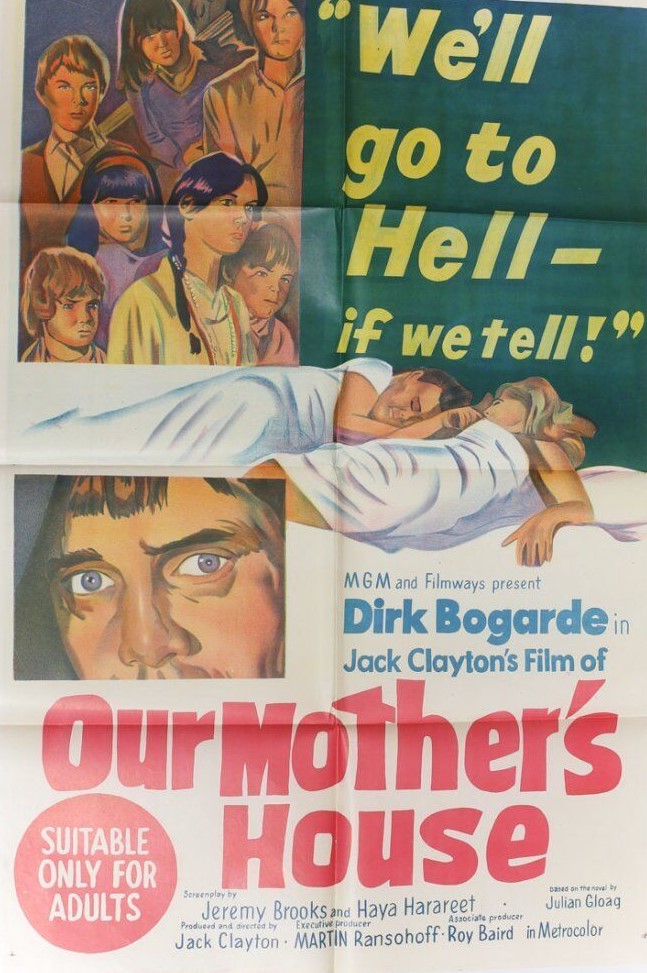
Our Mother’s House (1967) ***

Lord of the Flies set in a sprawling London Victorian mansion. At its best when kids give rein to vivid imagination, not so strong when melodrama intrudes.

After the death of her invalid mother and dreading being sent to an orphanage, eldest child Elsa (Margaret Brooks), who has been with the help of a maid running the house anyway, determines that she and the rest of the brood will pretend their mother is still alive. They bury the body in the garden, manage financially after Jimimee (Mark Lester) discovers an aptitude for forging their mother’s signature on the monthly cheques she receives from a trust fund, and hold séances in the shed to commune with the deceased one.

To maintain the pretence, they get rid of the nosey and querulous maid Mrs Quayle (Yootha Joyce) and come up with all sorts of reasons to explain their mother’s absence to school teachers and neighbors. Child fears run rampant as they visualize the terrible lives they would lead in an orphanage. But the generally tolerant community lifestyle is disturbed by the dictatorial rule of Elsa, determining that Gerty (Sarah Nicholls), for example, must have her long hair sheared off for innocently breaking a house rule and, in keeping with their mother’s fundamentalist beliefs, refuses to call a doctor when the girl falls ill. But the séance takes on a creepier aspect, Elsa the one in communion with her mother and therefore using the supposed other-worldy presence to enforce her will.

So far, so Lord of the Flies, and excellent in its depiction of a world ruled by children according to their fears and beliefs and without adult intercession. But it loses its grip when melodrama takes hold.

Their mother’s dissolute husband Charlie (Dirk Bogarde) returns, romancing Mrs Quayle, and, initially, spoiling the children, who are delighted to see him. He soon reverts to form, spending all their money, getting Charlie to forge his mother’s signature on the house deeds, planning to pocket the proceeds and dispatch the kids to an orphanage. Worse, he breaks the spell their seemingly devout mother had over their children, informing them that their mother’s conversion to religion only came after a life of debauchery and that, in fact, every single one of them is illegitimate and not his offspring. That’s too much for Diana (Pamela Franklin) who kills him with a poker.

Too many twists for sure and by diverting a fascinating dissertation of childhood into adult melodrama robs the film of much of its power.

Director Jack Clayton had been here before with The Innocents (1961) but, there, less was spelled out. Dirk Bogarde (Justine, 1969) is surprisingly good as the charming rough layabout with an eye to the main chance but it’s the children who captivate especially Pamela Franklin (And Soon the Darkness, 1970) and Mark Lester (Oliver!, 1968). The children’s innocence in any case would have been despoiled as they challenged Elsa’s rule and it would have been more satisfying to go down that route.

It was based on the bestseller by Julian Gloag and for anyone wondering what happened to Haya Harareet (Ben-Hur, 1959, and The Secret Partner, 1961) she married Clayton and is credited with the screenplay of this along with Jeremy Brooks.

Slow-burn that trips the wrong way.

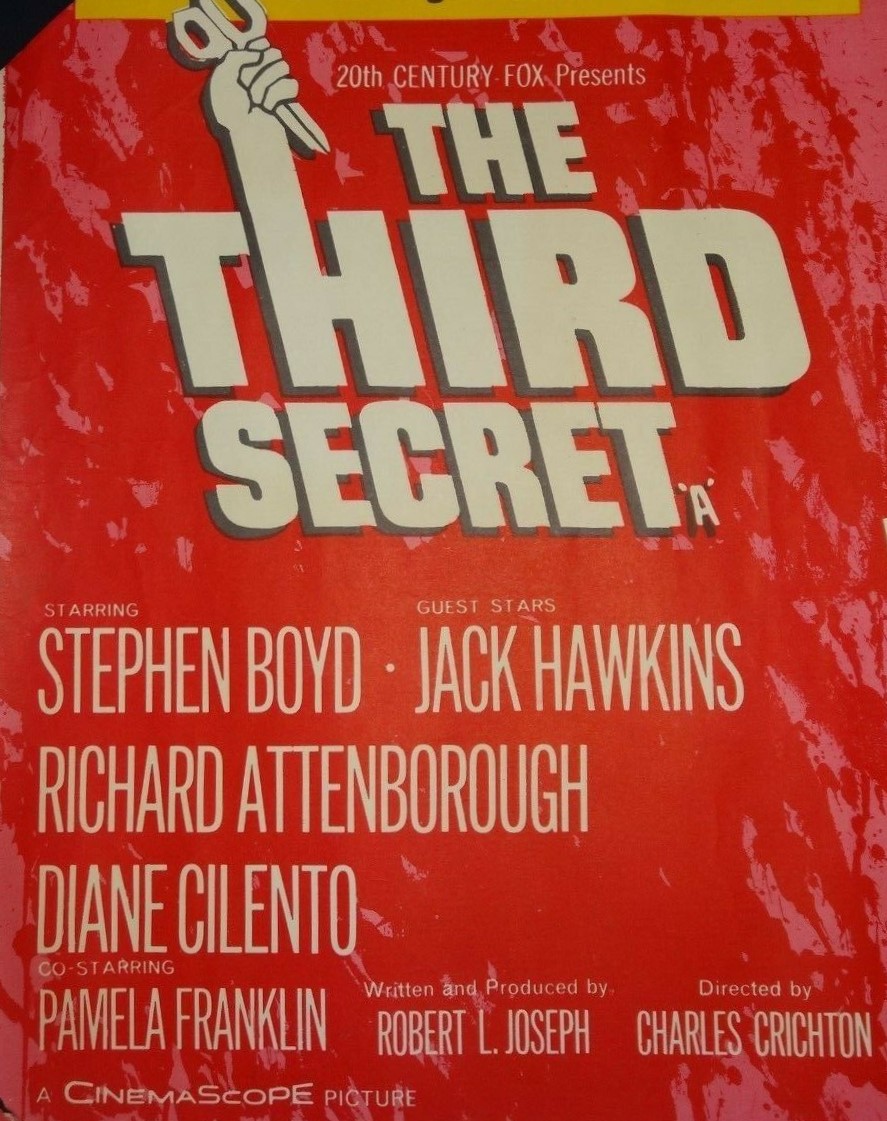
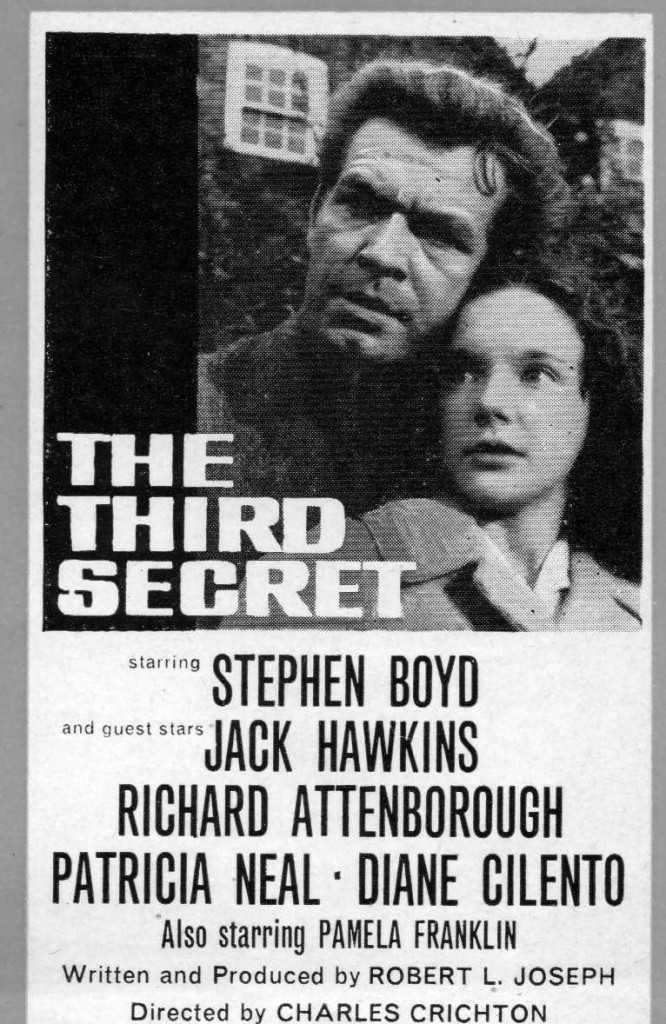
The Third Secret (1964) ***

Non-exploitative films about the psychologically vulnerable were thin on the ground during the 1960s and although The Third Secret is a bit talky nonetheless it does explore issues normally dealt with in heavy-handed fashion. Catherine Whitset (Pamela Franklin) the young daughter of a famous psychiatrist convinces television journalist Alex Stedman (Stephen Boyd) to investigate her father’s supposed suicide. Whitset needs the murder verdict because otherwise she will lose her home (no insurance payout on suicide). Stedman, Whitset’s patient, wants a similar outcome because his world would be turned upside down if the psychiatrist had committed a deed which he appeared steadfastly opposed.

The main suspects are all patients of the dead doctor – judge (Jack Hawkins), gallery owner (Richard Attenborough) and secretary (Diane Cilento). Although all outwardly successful socially-functioning upstanding members of society each is mired in mental agony – anger management, sexual inadequacy, depression, low self-esteem among problems addressed – defenses against which are perilously thin. Under sustained pressure each of the individuals will crack to reveal the cowering creature underneath.

But are they the killer or just condemned to torment? With the one man who could keep them sane removed from their lives, who knows what carnage they can self-inflict. All, even Stedman – given to bouts of terrible rage and drunkenness – seem capable of murder and there is every likelihood (as any viewer will guess) that his investigation could lead back to himself.

Director Charles Crichton (The Lavender Hill Mob, 1951) might have been suffering from low self-esteem himself having been unceremoniously dumped from The Birdman of Alcatraz (1962) and certainly the atmosphere is one of severity, not just characters teetering on the brink, but the black-and-white photography rendering London a wasteland, the tide on the Thames always out so the shore is just mud. However, his compositions do have style. The title’s explanation by the way is that the first secret is what you keep from the public, the second is what you hide from yourself, but the third is the truth.

Boyd (Ben-Hur, 1959) and Franklin (The Innocents, 1961) appear often on the point of hysteria, the girl’s high-pitched voice set against his growling outbursts. Attenborough (fresh from the heroics of The Great Escape, 1963) plays against type as a hand-wringing wannabe artist stuck in a role he despises. Hawkins, too, more used to heroic roles, is convincing as a man trying to escape his past. The neurotic Cilento has the best scenes, touching in her efforts to cling to normality. Judi Dench makes her debut in a bit part. The investigation takes the form of character analysis rather than “where were you on the night of…” which gives the picture an unique flavor, but best to know that going in rather than complain about the slow pace. If the psychological does not keep you hooked, there are sufficient twists to keep you watching.

Discover WordPress

A daily selection of the best content published on WordPress, collected for you by humans who love to read.

The Atavist Magazine

by Brian Hannan

WordPress.com News

The latest news on WordPress.com and the WordPress community.