Fast Charlie (2023) ****

If you like your characters to sport monikers like Donut (“don’t call me Donut”) or Blade (not that Blade, obviously) or The Freak (“get me The Freak”) and like to see death dealt out in novel fashion – taxidermized bird beak through the eye, beer bottle through the mouth, and an update on the Magnum .357 “blow your head clean off” trope – then this one is for you. Not to mention the riffs on Quentin Tarantino and John Wick. And, here’s the kicker, a delicate meditation on old age and father-son relationships.

Your first port of marquee call, of course, should be star Pierce Brosnan. Not the Abba-magnet of Mamma Mia (2008), and far removed from James Bond, but with a hint of the clever machination of The Thomas Crown Affair remake (1999). You might regard his character as a common-or-garden retired hitman now doing business as a chauffeur to a younger generation of hitmen (step up Donut) but he tends to see himself as a “problem-solver” or even “concierge” (as though we might be talking The Continental Hotel). I suspect Brosnan was drawn to the script for the “cowboy draw” soliloquy that has echoes of the gold watch in Pulp Fiction (1994).

Add in director Philip Noyce, director of Patriot Games (1992) and Clear and Present Danger (1994), the titles heavily promoted on the poster, and also, more importantly from this picture’s perspective, Dead Calm (1989). The poster says nothing about screenwriter Richard Wenk but since he gave us The Equalizer trilogy – three of my favorite pictures – then suddenly this little movie, shoved out into streamer with none of the publicity accorded lesser movies, has got my attention.  

I started out not liking this at all but gradually warmed to it and at the end considered it a pretty good addition to the sub-genre of new-gangster-takes-over-old-gangster’s-territory-but-with-a-twist. So  Charlie (Pierce Brosnan) is driving hitman Donut (Brennan Keel Cook) to knock off low-end crim Kramer. Donut’s M.O. is the knife, but this being the kind of picture where characters swerve from the norm, he decides instead he’ll stick some explosive device in a box of donuts. That works, for sure, but it has the unfortunate by-product of blowing the guy’s head clean off – clean off as in no longer attached to the shoulders and, even if you could scrape up the bits and pieces, unrecognizable.

Therein lies the problem. To pick up his dough, Charlie needs to show an identifiable corpse. Donut is soon out of the picture, the dumb sonofa, pistol in hand while driving over bumpy road, shoots himself in the head, brings down a telegraph pole and sets the car on fire. Still Charlie isn’t known as fast for nothing (in fact, the title had no relevance whatsoever, so if you’re expecting a car chase buckle up and get frustrated) and he decides the dead man’s wife should somehow be able to identify him.

Sure enough, Marcie (Morena Baccarin), now an ex-wife but still harboring sentimental thoughts about her deadbeat now dead husband, explains he has a tattoo on his ass that she is willing to verify as belonging to the ass of said deceased. That should be that, another problem solved by our problem-solver or concierge, if you prefer.

Except, suddenly, all hell breaks loose. It’s gang war time.   Charlie’s ageing boss Stan (James Caan) is the object of the hit and, unfortunately, for the hitters, Charlie treats this old man very much like a father (hence the “cowboy draw” soliloquy) and takes agin anyone who could have been responsible for the hit, which is pretty much anyone who has crossed the screen in the early part of the picture.

These dudes will have names, for sure, but heck, they hardly appear before Charlie starts to knock ‘em off so don’t expect me to remember them all. In any case, the movie, I warned  you to expect a narrative swerve, moves in a different direction. One route is that subtle kind of May-December romance Wenk gave us in The Equalizer 3 (2023), Charlie, while trying his hand with Marcie, aware that he’s got very little chance of success, given the age gap (acknowledged at least rather than expecting younger women to jump into bed with any old guy just because they’re an ageing movie star and that’s what the audience expects), even though he’s a cultured hitman, pretty ace in the kitchen and old-style in attitude to women. Whether it’s her particular set of skills – see what she can do with a bird beak – or her lost soul that’s the attraction.

But that element is left kind of floating in the background as the story shifts up a gear as we discover why the hit was out on Kramer in the first place and why everybody else was getting rubbed out. It wouldn’t be this kind of picture without a couple of twists at the end.

Charlie is a laid-back hardman with a nice line in quips, self-possessed and self-effacing, but a regular guy when it comes to the regular things in life. His relationship to Stan is very touching and the romantic element is underdone.

So if you’re going to buckle up for his one, ignore the opening sequence, set the Tarantino vibe aside and wait until it gets into the meat-and-potatoes of relationships and of course, for the thrill-seekers out there, Charlie taking revenge.

Shows there’s more to Brosnan than a raised eyebrow, a last hurrah for James Caan (no introduction needed), and Brazilian actress Morena Baccarin (Deadpool, 2016) reveals unusual reserve in what could easily have been, in other hands, a more showy part.

Worth a look and free on Amazon Prime.

Violent City /Family (1970) ****

Of all the lazy, incompetent streamers this has to take the biscuit. Not content with branding as new films made over half a century ago, now we have films being screened which clearly nobody has bothered to watch even once. Otherwise, how to explain a picture where the language lapses into Italian at critical moments without the benefit of sub-titles.

Which is a big shame because, confusing through the movie is, it takes an unique approach to the femme fatale angle and serves up a noted screen tough guy as one whose heart is genuinely broken – suck that up, pale imitators going by the name of Stallone, Schwarzenner, Willis et al.

Post-Bullitt (1968) but pre-The French Connection (1971) we open with a dazzling car chase where the pursued race up stairs rather than down as is the current trope and batter their way through closely-packed streets in the Virgin Islands. That’s before wannabe retired assassin Jeff (Charles Bronson) is gunned down, although he’s still capable of diving under a burning car to escape immediate detection.

Jeff is on the lam with lover Vanessa (Jill Ireland). Dumped in jail with time to repent (no, strike that), mull over his circumstances, in the meantime dodging a tarantula (a real one!) crawling over his body, and coming to the conclusion that the moll has set him up and has returned to her previous lover, ace racing driver Coogan (no idea who plays him, imdb doesn’t know either). Despite having abandoned his profession, Jeff, not getting the hang of the broken-hearted moping malarkey, decides he’ll come out of retirement for the usual one last job, this time laying waste to Coogan.

But someone spots him and he’s blackmailed by Mafia chief Weber (Telly Savalas) into continuing his murderous ways. But here’s a sting in the tail – a wonderful twist to end all twists: Weber is Vanessa’s husband. She’s not a femme fatale at all just a sexual butterfly who dances from one lover to the next with Weber’s tacit approval.

But, in fact, in another twist, she is, after all, the femme fatale to end all femme fatales, setting up Jeff to bump off Weber so that she and attorney lover (what, another one) Steve (Umberto Orsini), Jeff’s best buddy, can take over her husband’s organization now that it has gone legit. And in the final twist to end all twists this ends with Jeff’s broken heart turning him suicidal (beat that Schwarzenneger, Stallone, Willis et al).

This is a very down’n’dirty Italian thriller, dashing from deadbeat locale to Southern Belle balls, from rusting riverboats to swampland, from factories to fashion shoots, the confusion factor infused further by the sudden incursions into Italian, often in mid-scene, as if this was some kind of artistic coup, determined to leave the viewer baffled.

Despite going the whole nine yards in the broken-heareted department, Jeff isn’t quite the full-blown romantic, an attempted rape of Vanessa in New Orleans only interrupted by (wait for it) three thugs beating another character to death. Naturally, Jeff isn’t the kind of good bad guy who intervenes, and these characters, even more naturally, have nothing to do with the plot (except as Jeff points out it’s a violent city after all). But what the hell, it’s that kind of film.

I’ve cutting Amazon Prime a big break here with my rating, because despite the language problems, it’s a cut above your normal thriller, and Charles Bronson (Red Sun, 1971) before being typecast by Death Wish (1974) gives a very good account of himself, certainly a lot more to do than just grimace, and, heck, you even feel sorry for him twisted inside out by emotion. Telly Savalas (A Town Called Hell, 1971) is a bit more polished and emotionally aware than his usual villain.

You might be tempted to call Jill Ireland (Rider on the Rain, 1970) the stand-out. She still can’t act for toffee, but she is well suited to playing this kind of jinxed minx, whose beauty snags dupes well below her league. And (spoiler alert) she does let it all hang out, indulging in copious nudity.

Directed with some flair by Sergio Sollima (The Big Gundown, 1967) and extra marks for coaxing unusual performances from the three principals. Six screenwriters (can’t you tell) put this together including Lina Wertmuller (The Belle Starr Story, 1968). Great score by Ennio Morricone.

Given I couldn’t understand half of what was going on thanks to streamer disinterest in sub-titles, I was still very impressed. Worth a watch.

NOTE: Amazon Prime has this under the title Family but once the credits roll it switches to original title Violent City.

Youtube has the trailer.

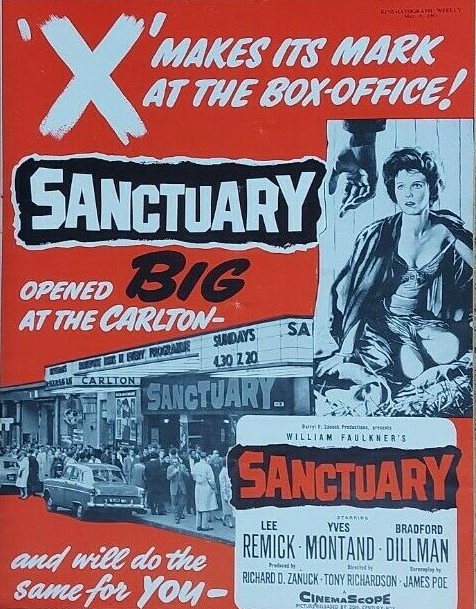
Sanctuary (1961) ***

This overheated melodrama stands as a classic example of Hollywood’s offensive attitudes to women. Nobel prize-winning author William Faulkner could hardly blame the movies for sensationalising his misogynistic source material since if anything the movie took a softer line.  Told primarily in flashback as headstrong southern belle Temple Drake (Lee Remick) attempts to mitigate the death sentence passed on her maid Nancy (Odetta). Given that such appeals are directed at Drake’s Governor father (Howard St John), and that the maid has been condemned for murdering Drake’s infant child, that’s a whole lot of story to swallow.

Worse is to follow. Drake takes up with Prohibition bootlegger Candy Man (Yves Montand) after being raped by him and thereafter appears happy to live with him in a New Orleans brothel – the “sanctuary,” no irony intended, of the title – despite him slapping her around. The film steers clear of turning her into the prostitute of the original book, but pretty much sets up the notion that high class women will fall for a low-class tough guy whose virility is demonstrated by his brutality. In other words a “real man” rather than the dilettantes she has previously rejected.

After the Candy Man dies, Drake returns home and marries wealthy suitor Gowan Stevens (Bradford Dillman) who blames himself, rightly, for Drake falling into the clutches of the gangster in the first place. But a past threatening to engulf her precipitates the infanticide.

Faulkner was a Hollywood insider, adapting Sanctuary for The Story of Temple Drake (1933) and earning high praise for  his work on Bogart vehicles To Have and Have Not (1944) and The Big Sleep (1946). The success of The Tarnished Angels (1957) starring Rock Hudson, The Long, Hot Summer (1958) with Paul Newman and The Sound and the Fury (1959) headlined by Yul Brynner had sent his cachet rocketing. But all three were directed by Americans – Douglas Sirk and Martin Ritt – who had a distinctive visual style and an ear for what made melodrama work.

Sanctuary had been handed to British director Tony Richardson (Look Back in Anger, 1959) and he didn’t quite understand how to make the best of the difficult project. So while Lee Remick manages to suggest both strength and fragility, and makes her character’s wanton despair believable, Yves Montand is miscast and Bradford Dillman fails to convince even though portraying a weak character. Too many of the smaller roles appear as cliches. And it’s hard to believe the maid’s motivation in turning murderer. Watch out for Strother Martin (Cool Hand Luke, 1967).

What was acceptable steamy melodrama in the 1930s fails to click three decades on. Faulkner’s thesis that high-falutin’ women want a man to master them and furthermore will fall in love with their rapist seems to lack any understanding of the female mind and will not appeal any more to the modern sensibility than it did on release. Lee Remick is what holds the picture together, in part because she plays so well the role of a woman embracing degradation, and refusing – no matter how insane the idea appears – to let go of the man she believes is the love of her life. It’s not Fifty Shades of Grey, but it’s not that far off that kind of fantasy figure, and given the success of that book, it’s entirely possible there is a market for what Faulkner has to peddle.

Not easy to find. This is actually on YouTube if you go onto that channel and search. Strangely enough, if I post a link, it says it is no longer playing there – but just as strangely if you go looking you will find it.

The Cincinnati Kid (1965) *****

Steve McQueen had little trouble identifying with this role. He was the Hollywood contender, trying to knock current kingpin Paul Newman off his perch, and in Norman Jewison’s tense, often heart-stopping, drama he has the ideal vehicle. For the most part this is a winner-take-all face-off, as much a showdown as any western shootout, in darkened rooms under the harsh light of a New Orleans poker table between a rising star always referred to as The Kid (Steve McQueen) and the unofficial world champion, the urbane cigar-smoking Lancey Howard (Edward G. Robinson).

Broadened out in the initial stages to include scenic diversions – the Mississippi at dawn, a cockfight, some jazz – plus romance and intrigue, this is essentially pure sport, a game of stares, where bluff holds the ace and women exist on the perimeter only to fill in the time before the next hyped-up encounter. There’s no trophy to be won, not even glory, just the right to call yourself “The Man.” The Kid feels the pressure of punching above his weight, Lancey of getting old.

Farmer’s daughter and arty-wannabe Christian (Tuesday Weld) is the Kid’s main squeeze until she gets between him and his game. When she takes off, he makes do with Melba (Ann-Margret), girlfriend of dealer Shooter (Karl Malden) who was somewhat preoccupied with giving the Kid more than a helping hand to satisfy the vengeful Slade (Rip Torn), a rich businessman.

Although it finally comes down to a confrontation between the Kid and Lancey, subordinate characters like sweating poker player Pig (Jack Weston) and stand-in dealer Ladyfingers (Joan Blondell) help dissipate the tension. But in fact anything that occurs only seems to increase the tension as it comes down to the one big final hand. 

This is McQueen (The Magnificent Seven, 1960) in transition, from the loner in The Great Escape (1963) to an actor exuding charisma and on top of his acting game. While on the face of it little more than a sporting lug, the Kid is an appealing character, engaging with a little shoeshine boy, winning over Christian’s truculent parents with what appears a card trick but is actually a demonstration of the phenomenal memory necessary to excel in his chosen field. There’s a winsome child in there among the macho persona. The poker face that McQueen developed would become one of his acting traits over the years.

Edward G. Robinson (Seven Thieves, 1960) gives a rounded performance as the reigning poker champ accepting emotional loss as the price for all his financial gains. Tuesday Weld is an appealing waif. Karl Malden (Pollyanna, 1960) essays another tormented soul and Rip Torn (Judas in King of Kings, 1961) a sleazy one. Also look out for a host of great character actors including Jack Weston (Mirage, 1965), Oscar nominee Joan Blondell (Advance to the Rear, 1964) and Jeff Corey (Once a Thief, 1965) plus composer and bandleader Cab Calloway.

Ann-Margret, all eye-shadow and cleavage, is in her best man-eater form. But, thankfully, there is more to her character than that. It is unclear whether she simply latches on to a potential winner or is pimped out by Shooter, but just hooking up with that older man (i.e. Shooter) makes her interesting, since looks are far from his attraction. Her ruthlessness is spelled out in simple fashion. She is determined to win, cheating at solitaire and she slams the wrong pieces into a jigsaw just for the satisfaction of making it look complete. You can sense a depth in this character which the film does not have time to fully explore.

Although often compared to The Hustler (1962), and in many eyes considered both its inferior and a crude rip-off, this is in some respects a greater achievement. At least in The Hustler, there actually was action, players moving around a pool table, clacking balls racing across the surface.  Poker is all about stillness. Any gesture could give away your thoughts. Unlike any other sport, poker requires silence. There is no roaring crowd, just people dotted round the room, some with vested interest if only through a wager, some wanting to say they were there when a champion was toppled.

So the ability to maintain audience interest with two guys just staring at each other, interspersed with minimal dialog, takes some skill. Building that to a crescendo of sheer tension is incredible.

The first four pictures of Canadian director Norman Jewison (Send Me No Flowers, 1964) did not hint at the dramatic chops, confidence, composure and understanding of pacing required, especially as he was a last-minute replacement for Sam Peckinpah, to pull this off. That he does so with style demonstrated a keen and versatile talent that would come to the boil in his next three films: The Russians Are Coming, The Russians Are Coming (1966), In the Heat of the Night (1967) and The Thomas Crown Affair (1968).  

The former blacklisted Ring Lardner Jr. (Tracy-Hepburn comedy Woman of the Year, 1942) was credited with his first screenplay since The Forbidden Street in 1949 and he shared the chore with another iconic figure, Terry Southern (Dr Strangelove, 1964), basing their work on the original novel by Richard Jessup. Not sure who contributed the classic line: “Read ’em and weep.” Mention should be made of a terrific score by Lao Schifrin.

Discover WordPress

A daily selection of the best content published on WordPress, collected for you by humans who love to read.

The Atavist Magazine

by Brian Hannan

WordPress.com News

The latest news on WordPress.com and the WordPress community.