Billy Budd (1962) ***

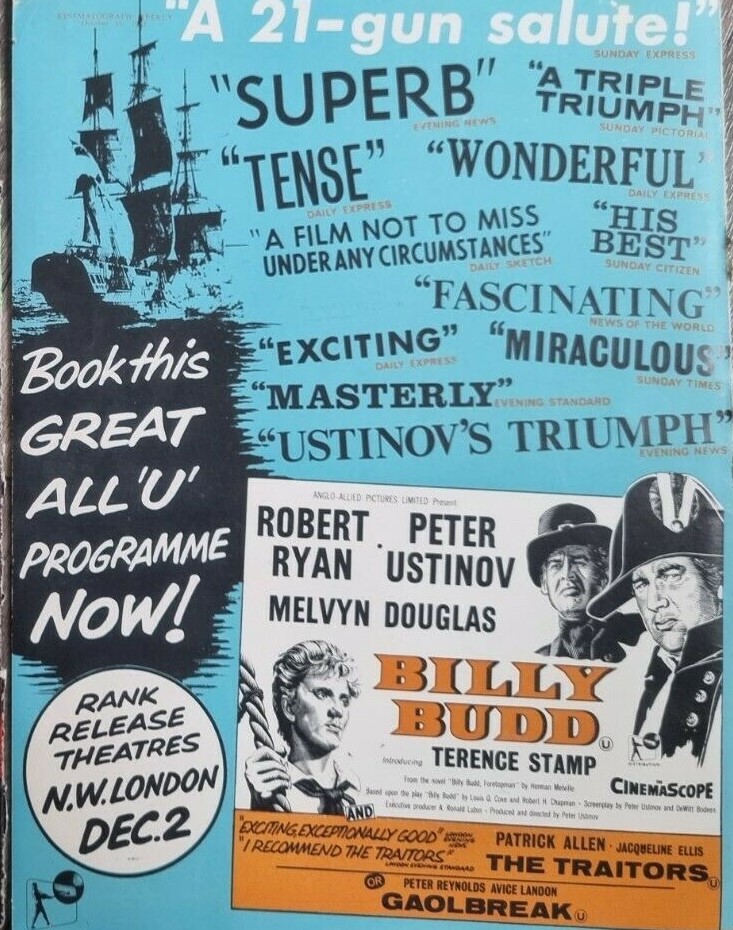
Unfairly muscled out by lavish roadshow Mutiny on the Bounty (1962) but covering similar territory minus sailors going off-piste on a South Pacific island. Peter Ustinov outranked fellow triple hyphenates Billy Wilder (writer, producer, director) and John Wayne (actor, producer, director) in that he could add acting to his other skills (writer, producer, director) and in some respects he was actually better remembered as a noted raconteur on late night television shows. I was surprised to discover he was actually well versed in the directing malarkey by the time he came to helm Billy Budd, four previous excursions dating from the late 1940s and most recently Romanoff and Juliet (1961). He was better known at this point as an Oscar-winner for Spartacus (1960). He would win another for Topkapi (1964) and go on to direct another three pictures.

Billy Budd is a claustrophic affair that you’ll need a bit of a history lesson to understand. The British Navy had two methods of recruiting sailors. The first was the more honest, awaiting a supply of volunteers. The second, the most dodgy legal proces ever invented, involved grabbing any likely candidate and forcing – “pressing”- them into service. Normally, this caper took place on land and gangs of recruitment officers did the business, hence the term “press gang.”

However, I was unaware that in times of war – this is set during the Napoleonic War – the British Navy could board any passing merchant vessel and commandeer any of its crew. In this case,  Captain (actually Post Captain if you’re being technical about it) Vere (Peter Ustinov) hijacks only one sailor, Billy Budd (Terence Stamp).

Quite why it’s only this singleton is never explained. There are a couple of other irregularities that run against making this a tight ship in terms of narrative construction. The first is, that in the first of two critical incidents, our otherwise charming and chatty Budd is suddenly struck dumb with a stammer, the first time such an affliction has put in an appearance. The second is that, in consequence, Budd strikes an officer, the bullying Master-at-Arms Claggart (Robert Ryan) who hits his head while falling and dies.

Now even I know, and I’m hardly a naval scholar, that striking an officer is punishable by death. The fact that Claggart has a Capt Bligh disposition, inclined to find any opportunity to bring out the lash, makes no difference to the outcome. So while it seems that court martial provides dramatic scope, here the outcome is never in doubt. This isn’t Queeg on The Caine Mutiny, which is a more complicated affair, where the captain’s sanity is questioned.
So where the narrative should have built up in intensity, it largely flounders and depends (successfully as it happens) on audience appreciation of Budd as an innocent abroad.

That said, like Mutiny on the Bounty, it reveals the remarkable lack of recourse to any higher authority on ship should the highest authority either carry out or endorse cruelty. The minute he’s on the ship Budd is exposed to the sadistic will of Claggart who has condemned a sailor to a pitiless flogging for reasons that cannot be explained. Budd soon learns that Claggart has accomplices who will sabotage a crew member’s gear so that he will be put on a report, accumulation of sufficient black marks resulting in automatic flogging without interference from the captain.

While Vere is hardly in the Capt Bligh category and most of the time comes across as relatively amiable, our introduction to him is firing a shot across the bows of a merchant ship that doesn’t want to stop in case its crew is press ganged. He is quite ready to invoke the rules to get what he wants and is enough of a disciplinarian that the crew kowtow to him. He might feel a touch of remorse that Budd is the sacrificial lamb  to the Royal Navy’s rule of law, but he’s hardly going to go against procedure.

So mostly what we’ve got is the acting. Terence Stamp (The Collector, 1965), in his debut, was Oscar-nominated and you can see why and in some senses this is the career-defining role before acting affectations and mannerisms took over. Robert Ryan (The Wild Bunch, 1969) is very effective as the sinister Claggart. And there are a host of other British names to look out for – David McCallum (Sol Madrid/The Heroin Gang 1968), Ray McAnally (Fear Is the Key, 1972), Paul Rogers (Three into Two Won’t Go, 1969) and Niall McGinnis (The Viking Queen, 1967)  among the foremost.

Ably directed by Ustinov who wrote the screenplay with Dewitt Bodeen (Cat People, 1942) based on the original Herman Melville novel and a stage adaptation by Louis O. Coxe and Robert H. Chapman.

Worth seeing for Stamp’s performance.

H.M.S. Defiant / Damn the Defiant! / The Mutineers (1962) ****

Had the audacity to take on Mutiny on the Bounty (1962) at the ticket wickets, beating that much-delayed production into cinemas in both Britain (where it was hugely successful, the ninth biggest film of the year) and the U.S. (less so). While in some respects young officer Lt Scott-Pagett (Dirk Bogarde) fits the Fletcher Christian template as the arrogant upstart, he is actually more of a Captain Bligh, mercilessly flogging his crew.

While Scott-Pagett is loathed by all, he is not the real cause of a mutiny. That had been a long time coming, thanks to inflation, poor conditions and a change in equipment that kept sailors at sea far longer than before.

Set in 1797 at the beginnings of the Napoleonic War, Captain Crawford (Alec Guinness) is tasked with escorting ships from Italy to England. He abhors unnecessary punishment and will even reduce the number of strokes to minimize human damage for a miscreant. But in taking his young son along on his first trip to sea, he becomes a hostage to fortune as Scott-Pagett finds any excuse to beat the lad.

Crawford has to tread carefully for his junior officer has powerful friends in London and been responsible for ensuring his previous commanders fell foul of the Admiralty. Even so, Scott-Pagett continually over-steps the mark, challenging his superior’s decisions, even disobeying orders, until he is finally brought to heel, humiliated and confined to quarters. That makes him even more determined to get his own way and bring down the captain. When Crawford is wounded in a battle with an enemy ship, Scott-Pagett takes over, only to unleash the wrath of the crew.

Never shying away from exposing the harsh life aboard – the actually mutiny sparked by a sailor forced to eat food riddled with worms – it also in mellower moments offers a fascinating glimpse of life at sea, the racing up the rigging, the dancing to a hornpipe. The sea battles, especially in the absence of CGI, are exceptionally well done, Captain Crawford’s men enduring terrific fusillades as they draw close enough to inflict damage.

Oddly enough, the situation only escalates into mutiny after a lesser rebellion, the equivalent these days of a strike, with a call for the entire Navy to down tools, fails to materialize. Rebel ideas clash with patriotism when the mutiny prevents delivery of vital information about a French invasion of England.

But the film also depicts the uneven power struggle. Sailors are completely impotent, on board a ship there’s no appeal to a higher power, while a captain hesitates before over-ruling an officer for fear it sends out the wrong signals about hierarchy and obedience to the general recruits.

The crux of the film is the duel between captain and lieutenant. Crawford can be undermined as long as his son is under the command of Scott-Pagett. Fellow officers would think twice about upsetting a man of such high breeding who has the ear of the powerful ashore.    

The role was a very bold choice for British matinee idol Dirk Bogarde (The High Bright Sun, 1964). Having rid himself of his Rank contract, he had determined to act against type, a role as a sadistic officer, face twisted in constant sneer, was so far from the dashing heroes of previous films that there was a fair chance it would alienate his legion of fans as much as its predecessor Victim (1961) in which he played a blackmailed homosexual.

It was a bit of a swap for Alec Guinness who in Tunes of Glory (1960) had played the arrogant bully determined to bring down a superior officer. Both are excellent and the scenes between them are superb, one of the few times when two British actors of the highest caliber were affordable in  a non-roadshow picture. But there’s also a rich supporting cast. Anthony Quayle (East of Sudan), more normally associated with officer roles, tones down the bombast to play an ordinary seamen, split between fomenting agitation and keeping his own supporters in check.

A bunch of rising stars making the most of the opportunity include Nigel Stock (The High Bright Sun), Ray Brooks (The Knack, 1965), Tom Bell (Lock Up Your Daughters!, 1969) and Johnny Briggs (The Devil-Ship Pirates, 1964) – all of whom would make bigger career strides in British television through, respective, Owen M.D. (1971-1973), Big Deal (1984-1986), Out (1978) and Coronation Street (1974-2006).

Lewis Gilbert (The 7th Dawn, 1964) directed from a screenplay by Edmund North (Patton, 1970) and Nigel Kneale (Quatermass and the Pit, 1967) based on Mutiny by Frank Tilsley and completed by his son Vincent Tilsley. With a wealth of material, Gilbert proves adept at moving through the gears while not losing sight of the main drama.

Well worth a watch.

Discover WordPress

A daily selection of the best content published on WordPress, collected for you by humans who love to read.

The Atavist Magazine

by Brian Hannan

WordPress.com News

The latest news on WordPress.com and the WordPress community.