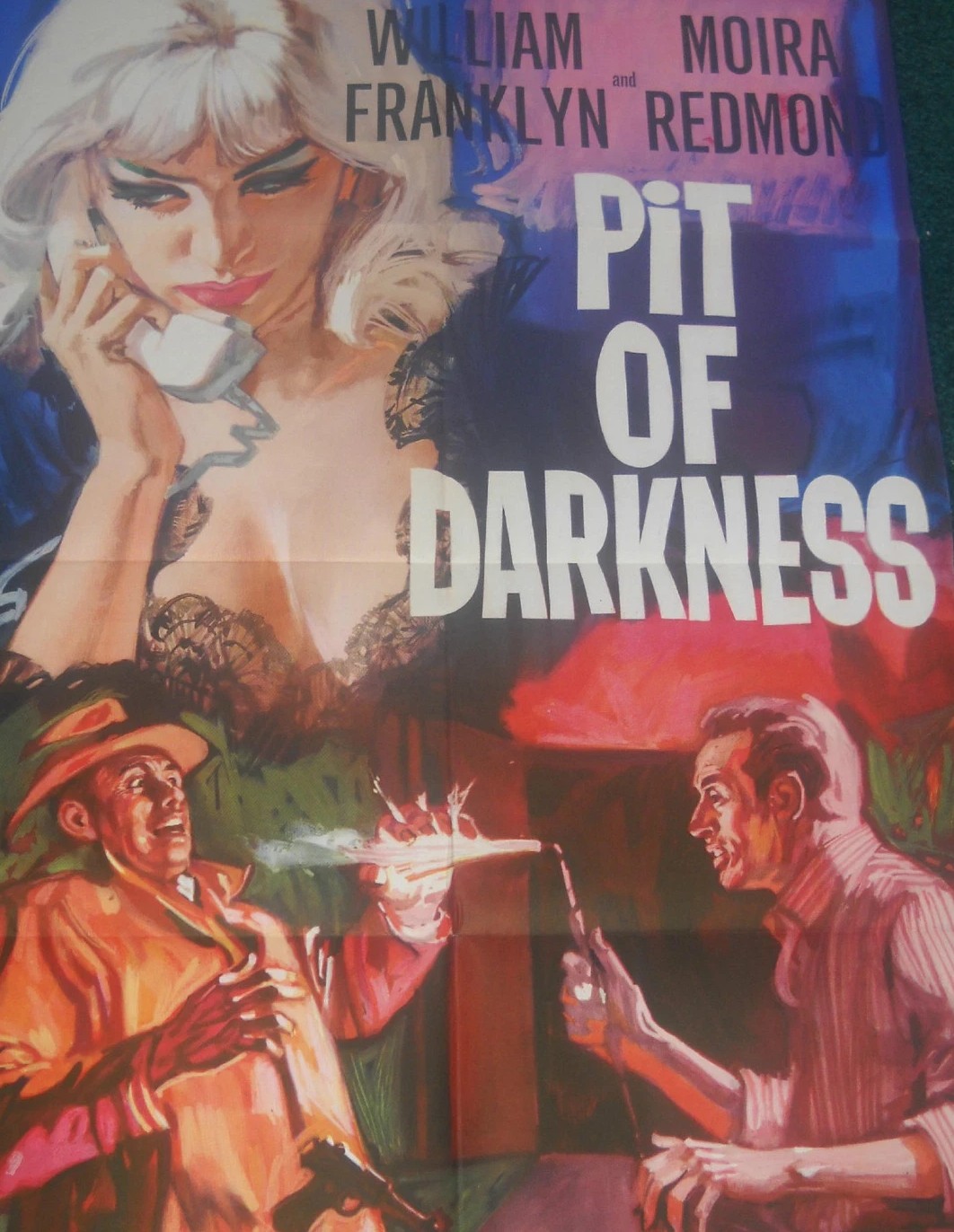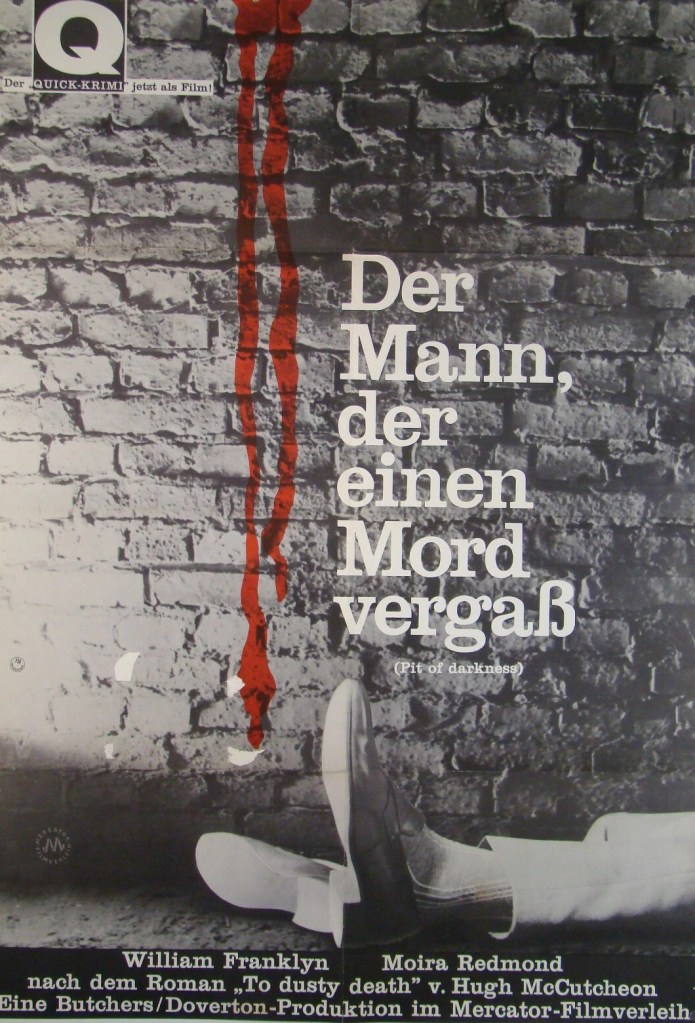
Pit of Darkness (1961) ****

Occasionally I get to wondering when one of these British crime B-pictures is exceptionally well-plotted, refreshing and above all logical, whether it might have benefitted from grander treatment Hollywood-style. You could easily see Cary Grant or Gregory Peck wriggling around in this one and with a Grant or Peck involved they’d be accompanied by a glamor puss of the Sophia Loren, Deborah Kerr vintage. And that would put the whole movie in an entirely different light and ensure it wasn’t lost for decades, as was the fate of this one.

What struck me most about the opening section here, an attitude maintained for about half the picture, was that the actress wife Julie (Moira Redmond) of amnesiac Richard (William Franklyn) didn’t believe for a minute his story that he couldn’t remember where he’d been for the last three weeks. There wasn’t an ounce of sympathy. That struck me as an entirely believable reaction. Rather than going all soppy at his return, she reckoned he’d run off with another woman and only came back because the affair had gone sour.  

And it doesn’t help his case that he was found unconscious on a piece of London waste ground where four days before the private detective she had hired to find him was discovered murdered. Then there are the suspicious phone calls, leaving him to deny the existence of anyone called Mavis.

But just when we start to believe him, suddenly we don’t. He seems to be too familiar with the Mavis who calls him and agrees to meet her at a remote cottage. And then we’re back on his side, as he just avoids being blown up in the cottage. But he leaves his hat behind.

And he doesn’t own up to Mavis about being nearly killed and gives a spurious reason for buying a new hat and not keeping the old one. So we’re on her side, something is going on for sure. And then back on his, when someone tries to sideline him in a hit-and-run accident.

In turn, he’s suspicious of everyone, including his wife, and his colleagues at work, especially Ted (Anthony Booth) who seems an unlikely candidate to have won the heart of his delectable secretary Mary (Nanette Newman).

He works for a firm that makes safes and whatever’s going on appears to be linked to a burglary that occurred in his absence involving one of the safes the company made. Eventually, Julie comes round to his way of thinking. Clues lead him to a nightclub, whose mysterious owner Conrad (Leonard Sachs) somehow seems familiar. He encounters Mavis, a dance hostess, and she agrees to help him but when he goes round to her apartment finds a corpse. There’s something distinctly odd going on in the building across the street from his office. On further investigation, he uncovers an assassin. Luckily, our man is armed with the office pistol and the villain is chucked from the roof.

But, still, nothing makes much sense, even though bit by bit memory is returning. He realizes he shouldn’t have been found unconscious on the waste ground, but dead, murder only interrupted by the sudden arrival of a gang of boys.

But in retracing his steps in order to unlock the lost memories he finds himself undergoing a perilous process a second time. He works out that he was kidnapped and locked in a cellar in the club. When he confronts Conrad, that instigates a repeat.

Conrad locked him away and when bribery and the seductive wiles of Mavis didn’t work, Conrad convinced Richard that his wife was in danger if he didn’t go along with the burglary. And Conrad isn’t one to let a good opportunity go to waste, so second time around, using the same threat that worked the last time, he forces Richard to commit another burglary. But this time there’s a catch and one that Richard’s secretary hasn’t known about to pass on to Ted.

So the bad guys are caught, and in the way of the obligatory happy ending the audience is left to assume that the police will ignore his part in the robbery and the death of the man on the roof.

Not just exceptionally well-plotted, but the addition of the marital strife, the suspicious wife, adds not just to the tension but makes it all the more believable and turns the amnesia trope on its head.

Having wished for a Cary Grant or a Gregory Peck, I have to confess I was more than satisfied with William Franklyn (The Big Day, 1960) who managed to look innocent and guilty at the same time. Certainly Deborah Kerr would have managed more in the acerbic look department than Moira Redmond (The Limbo Line, 1968) but I have no complaints.

Interesting support cast at the start of their careers, so Anthony Booth (Corruption, 1968) displays just a hint of his later trademark sarcastic snarl and there’s no chance for Nigel Green (The Ipcress File, 1965)  to put his steely stare into action or effect his drawl. Nanette Newman (Deadfall, 1968) has little to do except look fetching. Leonard Sachs was taking time off from presenting TV variety show The Good Old Days (1953-1983).

More kudos for the script than the direction this time for Lance Comfort (Blind Corner, 1964).

Given it’s from the Renown stable. I would normally have expected to come upon this picture on Talking Pictures TV, so I was surprised to find it as one of the latest additions to Amazon Prime.

First class.

The L-Shaped Room (1962) ***

Has contemporary bite, given half the picture is about abortion, banned in Britain at that time and the Pill yet to come on-stream. Being a single mother was an equally unwelcome tag unless you were a widow, in which case you were shrouded with respectability.

Pregnant French lass Jane (Leslie Caron) has decided to hang on in Britain rather than face the shameful ordeal of returning home. She knows who the father is, Terry (Mark Eden), to whom she lost her virginity in a week-long affair in Cornwall, but she’s not planning to hustle him into a shotgun wedding and you get the idea that, at 27, her virginity was weighing heavily on her.

Ending up in a bedsit in London – the titular room a landlord’s clever way of turning one decent-sized room into two smaller ones, each with a share of the window – she is clearly au fait with a British legal loophole that permits termination should pregnancy damage her mental health. And there were enough Harley St doctors to mentor her through such a loophole, for a fee of course.

It’s the briskness of Dr Weaver (Emlyn Williams) that puts her off. She has another go, later on, this time with black market pills from one of her neighbors, but they don’t work. Meanwhile, she has fallen in love with aspiring writer Toby (Tom Bell) and divines, correctly, that he won’t want to bring up another man’s child. In the end, she has the baby and scarpers back to France to face the music.

On the face of it an ideal candidate for the “kitchen sink” mini-genre that was pervasive at the time, but actually much more rewarding than many of the genre with dealt with male anger. This is much more about acceptance, without being craven or abject about it.

And there’s much to enjoy in director Bryan Forbes’ understated style. Half the time you could imagine you were in noir from the use he makes of the commonplace manner in which lights in staircases generally went off after a minute or so (not so much an energy-saving device as a money-saving one for the landlord) and he makes clever play of these sudden changes. There are also, unusual for the time, disembodied voices – the camera on Jane as she mounts the stairs, the voice her out-of-sight landlady Doris (Avis Bunnage). And every now and then the camera glides from her room into that of her neighbor, jazz trumpeter Johnny (Brock Peters) who can hear everything through the paper-thin walls, her morning retching and her night-time love-making with Toby.

How Johnny does find out about her baby is beautifully done, the best sequence in the movie. She works in a café where Johnny eats each night and she’s set a little table for him with a flower in a bottle. But he doesn’t turn up. She suspects, for no real reason except the worst, that he’s in the basement making out with one of the sex workers, but it’s Johnny (who had always been a good friend) who tells her that, from a sense of his disgust, he has let her boyfriend know the truth.

Like Darling (1965), this is a fascinating portrait of a woman making the wrong decisions. But Jane lacks Diana’s power. She’s not helpless exactly, and certainly has a good line in getting rid of unwanted attention. Her motives are not entirely clear. She wasn’t in love with Terry and for a long time she fends off Toby. She deludes herself into believing that Toby’s love for her will overcome his distaste that she is carrying another man’s child. That’s when she takes the pills.

You could kind of get the impression, however, that the real reason for Jane’s predicament is so that the actress can follow in the footsteps of Greta Garbo, Katharine Hepburn et al to wallow in grief. But it’s more subtle than that. She hasn’t been thrown aside by a callous male. She had made a decision to lose her virginity without considering the consequences and now that there is consequence changes her mind in impulsive fashion on how to deal with it.

Surrounding this central tale are some snapshots of life in a tawdry rooming-house. Two of the occupants are gay, Johnny and faded actress Mavis (Cicely Courtneidge), the landlady has a succession of gentlemen friends, while in the basement Sonia (Patricia Phoenix) works as a prostitute.

Leslie Caron (Guns of Darkness, 1962) was nominated for an Oscar and won a Bafta and a Golden Globe. The film was nominated for a Bafta and a Golden Globe. Tom Bell (Lock Up Your Daughters!, 1969) is good as the struggling writer. And Brock Peters (The Pawnbroker, 1964) has a peach of a part.

Director Bryan Forbes (Deadfall, 1968) wrote the script from the Lynne Reid Banks bestseller.

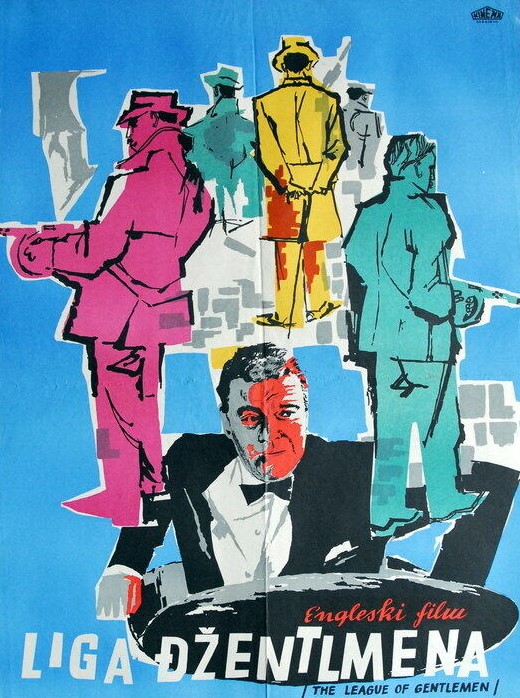
The League of Gentlemen (1960) ****

Cracking British heist film prefiguring titles as disparate as The Dirty Dozen (1967) and Heat (1995). Superb opening scene shows the lid coming off a manhole cover and after a short pause to avoid being drenched by a municipal street cleaner a man in a dinner suit emerges and makes his way to his Rolls Royce. Say hello to Lt-Col Hyde (Jack Hawkins).

Don’t be fooled by early reviews that tabbed this this an “action-comedy,” the humor is only incidental, while serving the important purpose of cutting the grandiose down to size, and not in the vein of, for example, Beverly Hills Cop (1984).

A group of ex-WW2 officers receive a mysterious parcel containing a pulp novel and £50 in notes torn in two, the other halves redeemed if they turn up for a meeting at the Café Royal in London. The opening section is almost a riposte to the recruitment sequence of The Magnificent Seven, out the same year, which strived for effect, and zipped along with one-liners.

This gang are all down-on-their-luck, any courage or leadership displayed during the conflict counting for nothing in peacetime. The sequence is surprisingly risqué for the period, virtually all the characters engaged with disreputable women. So, we have Major Race (Nigel Patrick) running some gambling scam with easy-come-easy-go confederate Peggy (Melissa Stribling), Lt Lexy (Richard Attenborough) a garage mechanic with a sideline in fixing the odds on one-arm bandits and inclined to steal other men’s girlfriends, and Captain Porthill (Bryan Forbes) a pianist playing in seedy dives and living off a middle-aged woman whom he cheats on.

Barely getting by emotionally or financially are Major Rutland-Smith (Terence Alexander) whose glamorous wife (Nanette Newman) takes a string of lovers while ritually humiliating him and Captain Mycroft (Roger Livesey) running a chaplain racket and selling erotic magazines. Hyde lives on his own in a mansion, his absent wife described as “the bitch.”

There’s an undercurrent here that’s barely explored of soldiers who have lost their way, but at the time it could remain underutilized because audiences would be filled with men whose post-war experiences chimed with these characters. Hyde has come up with a stunning plan to relieve a bank of close on a million pounds, the cash split equally, using the various skills his team had acquired through war service.

It’s a bold and, even if carried out with military precision, frankly terrifying exercise that intends to use machine guns and smoke bombs to scare the living daylights out of anyone who dares intervene, bringing New York-style gangsters to the streets of peaceful London. First stop is an army training where, in a ruse similar to that of the later The Dirty Dozen, Mycroft impersonates a commanding officer, inspects troops and deals out humiliation at the drop of a hat. Without doubt, this is an amusing sequence, especially when his superiors in the enterprise, Hyde and Race, are forced to eat disgusting Army slop, but it fulfils the same role as in the Robert Aldrich picture, the least likely soldier allowed to strut his stuff, tension undercut.

The heist itself follows the normal template of planning and execution and it’s brilliantly done, although the crooks are undone by a minor flaw in the procedure. Except for the opening section, and when Hyde exposes, as perhaps community therapy, the criminality of his gang, we learn little more about them, except, as if revisiting the past, how they respond (or not) to the discipline and hierarchy of the Army model on which the group operates. Scoring points off each other, or rebelling, or meting out punishment for misdemeanors, it’s like being back in the Army.

Nobody’s seeking redemption as in The Magnificent Seven or The Dirty Dozen, but it’s still easy to sympathize with an odd bunch whose expectations have been dashed. The scene where Race witnesses Hyde’s stark living conditions, and then offers to wash up the plates piled up in the sink, tells you a lot about how lost some of these men are.

Excellent acting all round from, by British standards, an all-star cast. At one time the number one British star, Jack Hawkins was an occasional Hollywood pick, leading role in Howard Hawks’ Land of the Pharaohs (1955), major supporting roles in Bridge on the River Kwai (1957) and Ben-Hur (1959). Richard Attenborough (The Angry Silence, 1960) had been a top name for over a decade, Nigel Patrick top-billed in director Basil Dearden’s previous outing Sapphire (1959). Kieron Moore (Day of the Triffids, 1963), Bryan Forbes (better known as a writer and director) and Nanette Newman (The Wrong Box, 1966) were rising stars, and you might want to include Oliver Reed (Hannibal Brooks, 1969) in that roster as he makes a camp entrance in a bit part.

Basil Dearden (Khartoum, 1966) is in top form with a script by Forbes from the John Boland bestseller.  

Worth seeing.

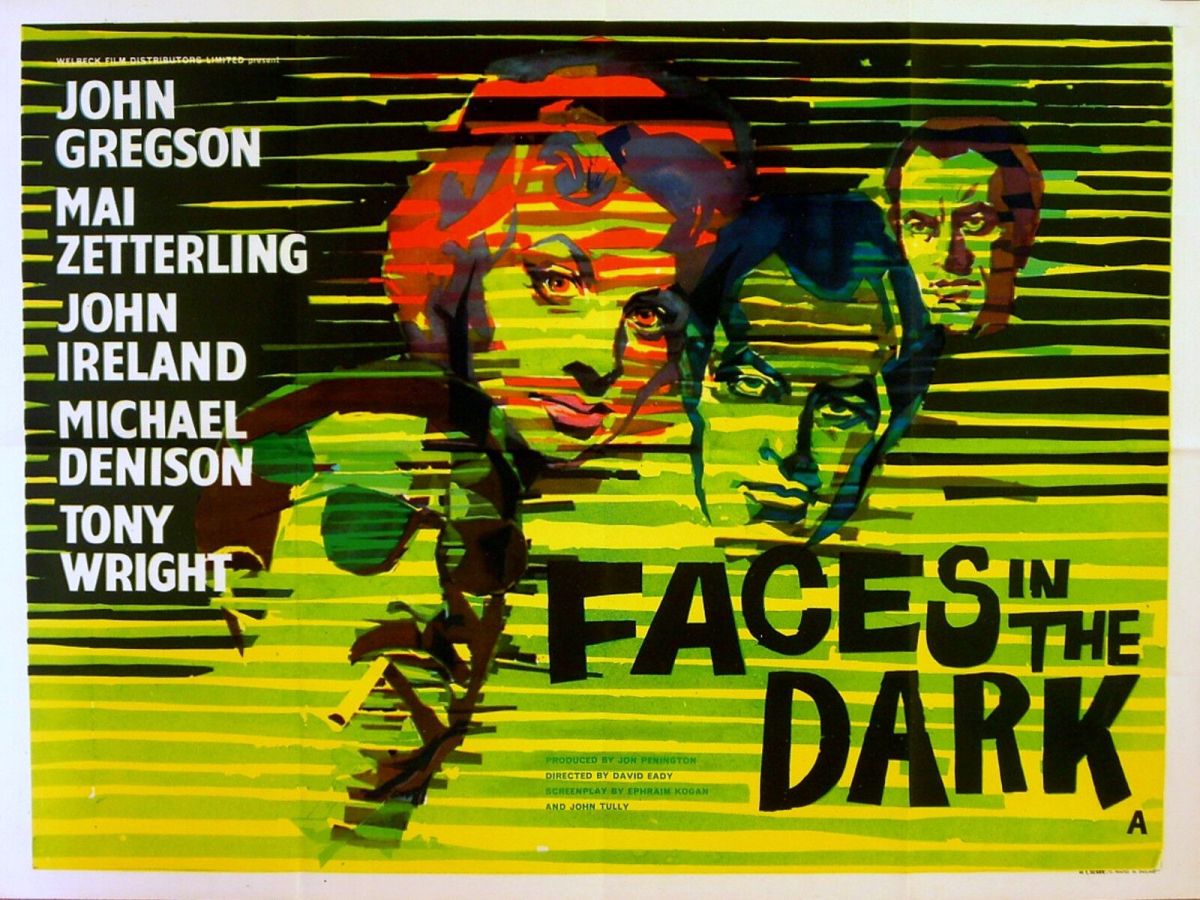
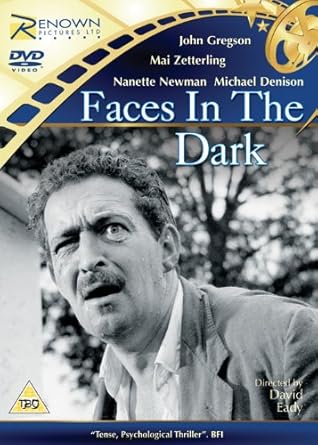
Faces in the Dark (1960) ***

Had his been tagged “From the Makers of Vertigo”, it might have immediately attracted a greater immediate audience and been treated these days with more critical reverence. But Vertigo wasn’t the cult film it is now, so the names of the authors of the source book, Pierre Boileau and Thomas Narcejac, would have no promotional value.

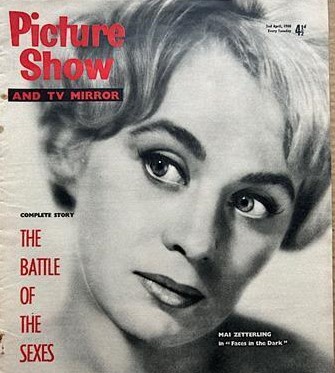
Throw in a stunning score by Mikis Theodarakis (Zorba the Greek, 1964) and a top-line cast including Swedish bombshell Mai Zetterling (Only Two Can Play, 1962), cult character actor John Ireland (The Ceremony, 1963) and an early role for Nanette Newman (The Wrong Box, 1966) plus a gender switch on the traditional gaslighting plot and you have makings of a classy little number.

When an experiment goes wrong, ambitious arrogant businessman Richard Hammond (John Gregson) is blinded. To help him recuperate wife Christiane (Mai Zetterling) flies him off to their luxurious Cornwall retreat where, to ensure is mind isn’t overloaded with business concerns, she switches off the phone. Along for the ride are his sponging brother Max (John Ireland), business partner David (Michael Denison), housemaid Janet (Nanette Newman) and chauffeur Clem (Tony Wright).

When things are not what they seem – the cat has suddenly lost its tail, a peach plant has disappeared from the garden, he smells pine, hears church bells – he believes he is going insane. Doesn’t take long before he realizes this is not a haven, but a trap. Sounds providing the greatest clues, he hears a giveaway clicking, indicating the presence of David, in his wife’s bedroom when the partner is meant to be a hundred miles away.

His brother has also disappeared, believed dead, and when his wife gives the help the night off and he is left in the house with the lovers is convinced they are trying to poison him and refuses to eat any food. Given sounds are so important, there’s one brilliant scene, where, having escaped, he discovers none of the locals can understand what he’s saying, and not because he’s gabbling either. But that’s such a clever plot point, I wouldn’t be a spoiler.

So you’ve got tension fairly climbing the walls .

The only downside is that Richard is such an unlikeable character – not a poor soul like Audrey Hepburn in Wait until Dark (1967) – that it’s hard to summon up the sympathy an audience requires for such a story to properly work. Theoretically, he’s just a driven man, whose genius is being blocked by the cynical bankers, but from the outset he’s full of bluster and nasty put-downs, and has everyone in the factory he owns on edge.

Anger at his condition and fear that insanity or failure lies ahead puts him in a constant rage and, heavily sweating for no particular medical reason, he’s not the most charismatic of screen characters. Even though his reaction would fit with a successful businessman failing to come to terms with the calamity, those elements, which might have evoked greater sympathy, are somewhat adrift when they get tangled up with the plot.

Director David Eady (The Verdict, 1964) does his best to compensate. The music, as mentioned, helps, throbbing piano rather than screaming violins. And there a couple of neat visuals, the swirling smoke of the credit sequence reappearing to devastating effect in one sequence. But, mostly, he lines up reasons for Richard to begin to question his sanity and believe he is being duped – he can’t read documents he must sign and as the only part of his handwriting that stands up is his signature suspects his impoverished brother will write a larger sum on a cheque he signs.

And since most of this unfolds through the mind of Richard, the director plays fair with the audience. There are no nods and winks about the nature of the relationship between wife and partner. Even though she confides in David that she’s planning to leave Richard, there’s no indication that it’s for the partner.

So this is more like a detective story and, as with Vertigo, featuring an obsessive character driven mad by obsession, both led on by the devious, and having to piece together a strange amalgam of clues.

John Gregson (The Frightened City, 1961), normally essaying more stoical characters, overacts, but the others do the opposite. Mai Zetterling is convincing and former British matinee idol Michael Denison plays against type (he wouldn’t make another movie for 30 years). Nanette Newman shows promise while John Ireland reins in the surliness. Ephraim Kogan (in his sole movie credit) and John Tully (who didn’t get another movie credit for the decade) wrote the screenplay.

Effective thriller ripe for a remake.

Catch it on Amazon Prime or DVD.

https://amzn.to/3RoBDfb

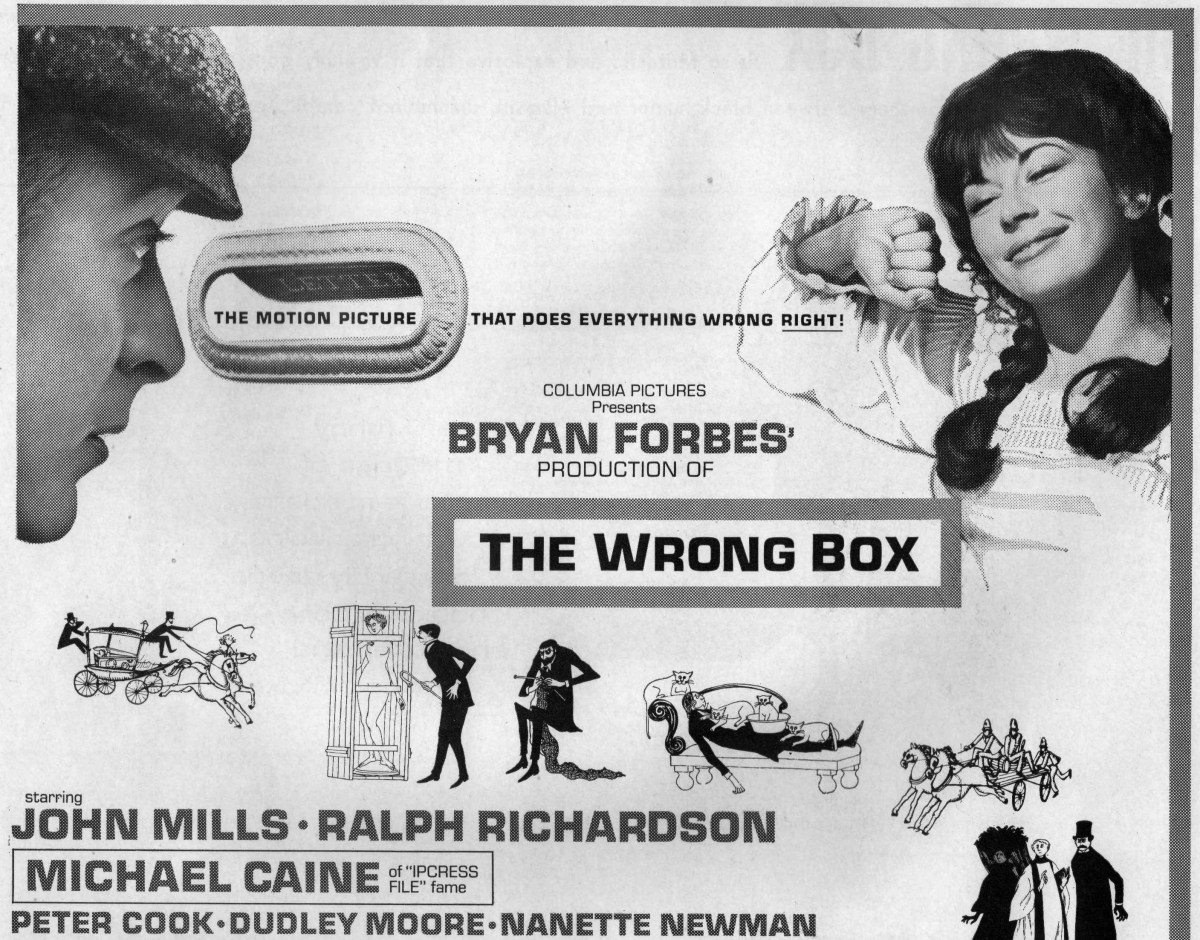
The Wrong Box (1966) ***

Somewhere between SBIG (So Bad It’s Good) and WAL (Worth a Look), The Wrong Box is a black comedy in the wrong directorial hands. Better known for thriller Seance on a Wet Afternoon (1964) and POW drama King Rat (1965) Bryan Forbes struggles to bring enough comedy into the proceedings or to wring sufficient laughs out of what he has.

Neither the wit nor the slapstick is sharp enough. But it does exhibit a certain charm. Essentially an inheritance story, it pivots on the notion that the two potential inheritors are on their last legs and putting one, Joseph Finsbury (Ralph Richardson), out of action will benefit dastardly nephews Morris Finsbury (Peter Cook) and John Finsbury (Dudley Moore) of the sole survivor Masterman Finsbury (John Mills).

It turns out Joseph Finsbury is not dead. That does not cue as much hilarity as it should., as the nephews plot to send him to his grave. Given the idea was dreamed by none other than Robert Louis Stevenson of Dr Jekyll and Mr Hyde fame, you can imagine it was written less with comedy in mind.

With so much dependent on set-pieces, it’s rather a hit-and-miss affair, with the conspirators’ failures not matching the humor of watching potential victims escape their proposed doom. Only occasionally does it sparkle.

Surprisingly, the film relies on affecting performances from the shy, retiring Michael Finsbury (Michael Caine), a gentle soul, who enjoys a very innocent romance with Julia Finsbury (Nanette Newman), a young woman terrified of being murdered, which condition provides ample opportunity for her to be rescued/consoled. who enjoy a very innocent romance.

Ralph Richardson steals the movie as a dotty pedant, weighted down with erudition and a knack, equally, for boring the pants off anyone within earshot and for escaping from the jaws of death including a massive train pile-up and several murderous attempts.

Michael Caine, in a follow-up to The Ipcress File (1965) and Alfie (1966) convincingly plays against type. John Mills (The Family Way, 1966) also plays against type as a villain rather than Hitherto, I had been rather sniffy about Nanette Newman (Deadfall, 1968),wife of the director, but here she is delightful.

Peter Cook (A Dandy in Aspic, 19680 and Dudley Moore, in his movie debut, let the show down by being so obviously the personalities from their comedy series Not Only…But Also (1964-1970), a partnership that works so well on television just frittered away here from what looks like characterization with nowhere else to go. But there is a nice cameo from Peter Sellers (The Millionairess, 1960) as an inebriated doctor.

Hard to say whether the blame lies with Larry Gelbart (The Thrill of It All, 1963) for his screenplay or Bryan Forbes for his direction.

Michael Caine got it spot-on when pointing out in his autobiography that it was a “gentle success in most places except Britain” precisely because to foreigners it represented an acceptably stereotypical view of a country full of eccentrics while to Brits it was all too stereotypical. So if you’re from America or other points global you might like it and if you are British you might not. On the other hand, the score by John Barry is one of his best with a wonderful theme tune.

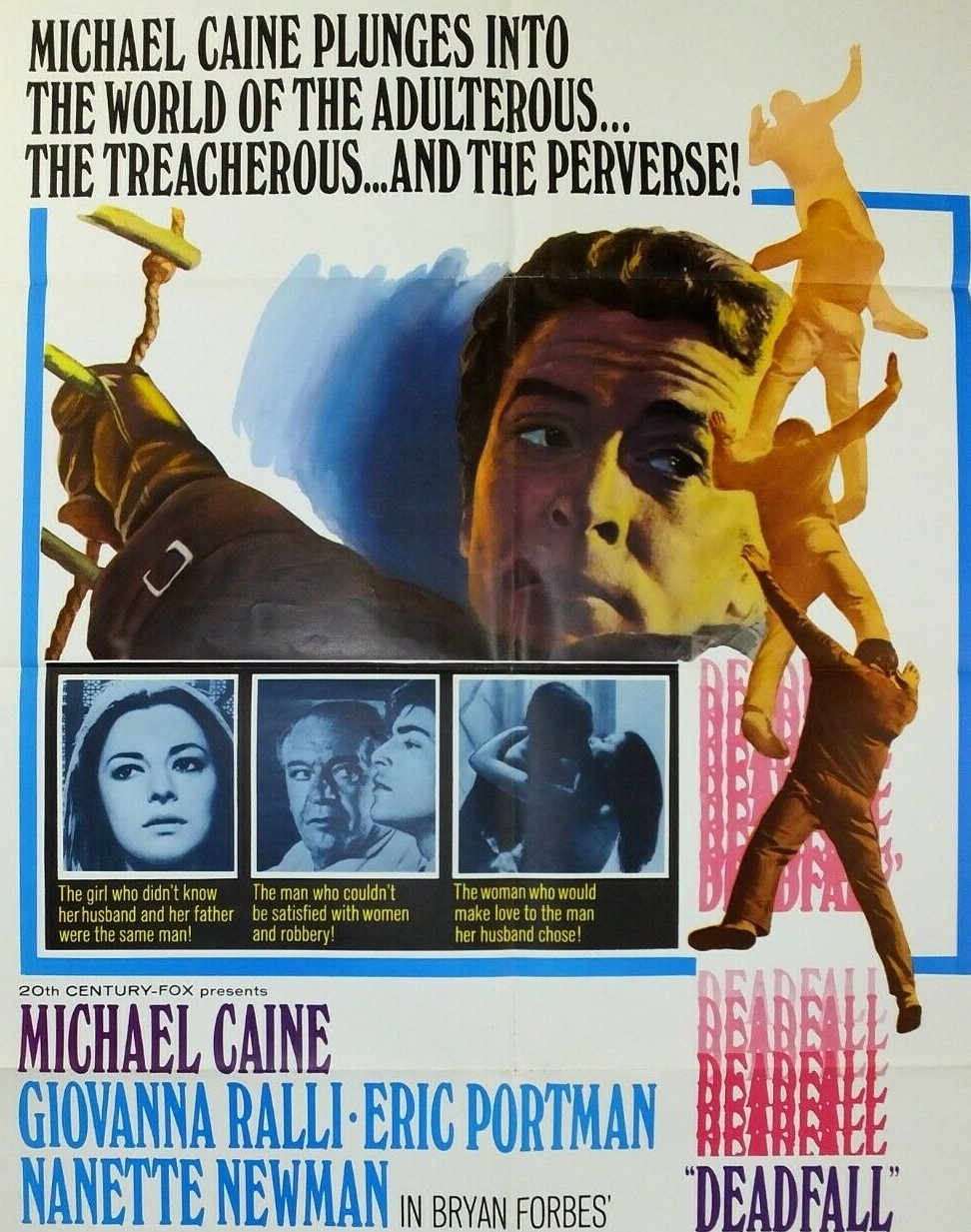
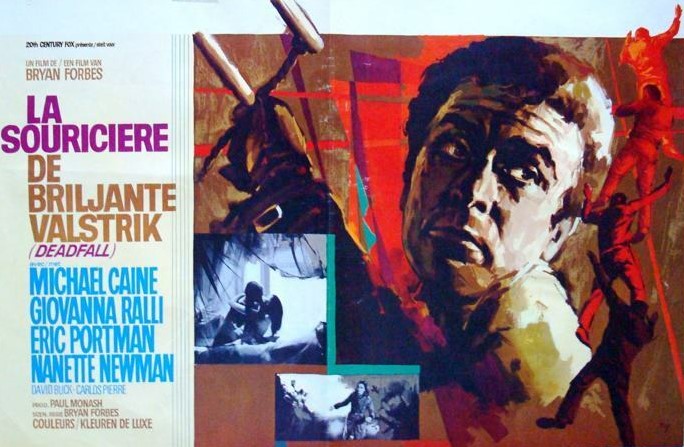
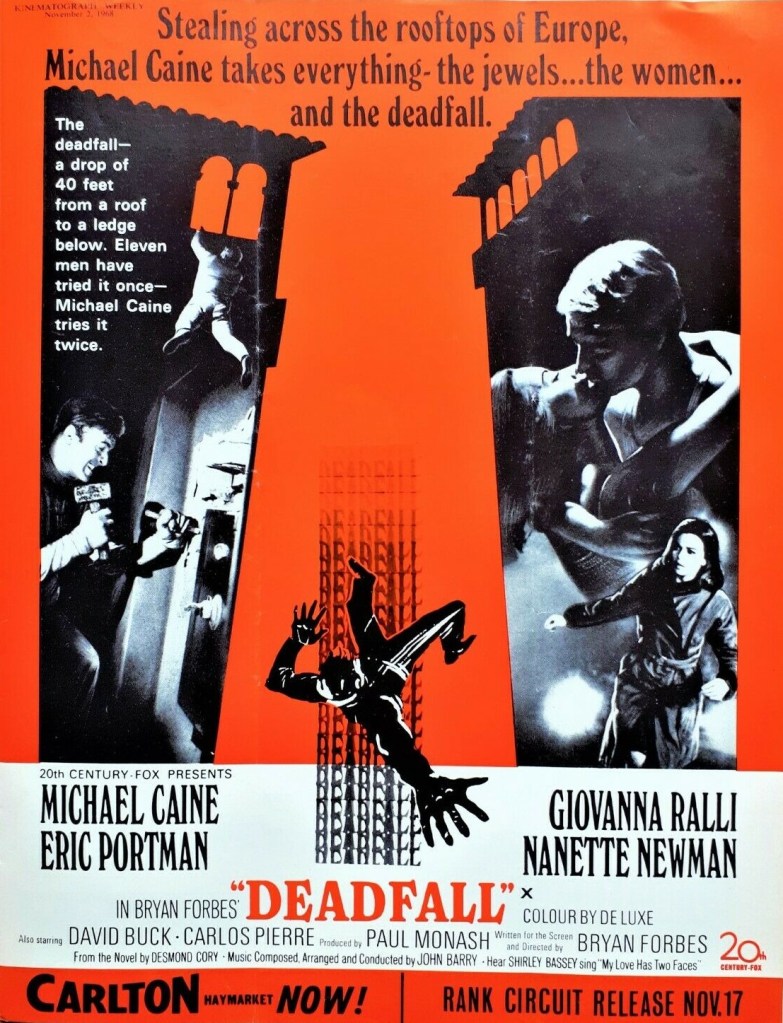
Deadfall (1968) **

“The Big Reveal” comes too late to save this heist-cum-melodrama. It can’t make up its mind whether it wants to join the canon of superlative 1960s caper pictures – in which case it needed to make a greater effort on the cat burglary front – or whether it’s an odd addition to the menage a trois category, in which case it needed characters you could actually believe. Worst of all, it contains one of the great artistic follies, a robbery carried out in time with an  orchestra playing one of the great John Barry compositions, “Romance for a Guitar and Orchestra.”

The only problem, there’s no dramatic reason for this. Since the concert is miles away from the robbery, it’s not as if the music drowns out the shenanigans. Director Bryan Forbes (King Rat, 1965) shoots himself in the foot. It’s too clever a device by half, even if the music is intended as a counterpoint to the  robbery’s more dramatic themes or the silence which had become a trope.

Cat burglar Henry (Michael Caine) forms a business partnership with elderly safecracker Moreau (Eric Portman) and falls for his wife Fe (Giovanna Ralli). The husband-wife relationship is off to begin with, he preferring males, and the wife admitting she doesn’t always find men attractive, though quite what she is hinting at is never made clear. The target is millionaire Salinas (David Buck), whom Henry is investigating to the point of pretending to be an alcoholic so he can get to know Salinas in a sanatorium.

Any other movie would get straight to the point – draw up plans and get on with it. But here, for no real reason except delay, Moreau wants them to do a trial run,  a safecracking job on the mansion of the kind of couple who drive off in a posh car to attend a concert. The effort put into the planning isn’t really up to scratch, not when compared to the likes of Topkapi (1964) – to which every heist film of the era was measured – or Gambit (1966) or even the less well-known The Happy Thieves (1960) or Seven Thieves (1960).

Apart from some cat burglary skills the whole episode is perfunctory, guard dogs knocked out by drugs. The background music, the aforementioned John Barry opus, just about kills off any prospect of tension. It only sparks into life when Moreau admits the safe is beyond him and Henry has to prise it out of the wall and cart it to the waiting car.

The second heist would have been far more interesting had we known from the start that Salinas welcomes burglary attempts, seeing it as some kind of duel of wits with malfeasants.

In between the two robberies there is time enough – too much time in fact – for Henry and Fe to get it together, for Fe to run off and then return only to learn in The Big Reveal the kind of despicable man her husband is. The movie can’t even deal with the incestuous sub-plot and just lets it hang there. But by that stage you couldn’t care less. Fe isn’t the type of femme fatale to bother crossing the road for, the romance seems too prescribed and the downbeat ending makes no sense.

I’m only giving this any points at all really because it stars Michael Caine (Hurry Sundown, 1967) and features a lengthy slice of John Barry music. Caine has been in enough duds for sure, but this doesn’t have the ring of one of his doing-it-for-the-money numbers or a stab at the Hollywood big-budget scene. Caine is good enough and Eric Portman (The Bedford Incident, 1965) is an interesting study. But it just doesn’t gel, not just let down by Giovanna Ralli (The Caper of the Golden Bulls, 1967) but by the pretentious direction and dramatic miscalculation of Bryan Forbes.

Forbes’ wife Nanette Newman (The Wrong Box, 1966) makes a puzzling appearance in a small role with no dramatic credibility. Leonard Rossiter (Deadlier than the Male, 1967) provides another cameo. For many the high spot will be to see John Barry in the flesh, conducting the orchestra playing his composition.

The Wrong Box (1966)***

Somewhere between SBIG (So Bad It’s Good) and WAL (Worth a Look), The Wrong Box is a black comedy in the wrong directorial hands.

Better known for thriller Seance on a Wet Afternoon (1964) and POW drama King Rat (1965) Bryan Forbes struggles to bring enough comedy into the proceedings or to wring sufficient laughs out of what he has. Neither the wit nor the slapstick is sharp enough. But it does exhibit a certain charm.

Essentially an inheritance story, it pivots on the notion that the two potential inheritors are on their last legs and putting one (Ralph Richardson) out of action will benefit the dastardly nephews (Peter Cook and Dudley Moore) of the sole survivor (John Mills). It turns out Richardson is not dead. That does not cue as much hilarity as it should.

Surprisingly, the film relies on affecting performances from Michael Caine, playing against type as a gentle soul, and Nanette Newman as a young woman terrified of being murdered, who enjoy a very innocent romance. Hitherto, I had been rather sniffy about Ms Newman, but here she is delightful. Ralph Richardson steals the movie as a dotty pedant, weighted down with erudition and a knack, equally, for boring the pants off anyone within earshot and for escaping from the jaws of death including a massive train pile-up and several murderous attempts by Mills.

Cook and Moore let the show down by being so obviously just themselves but there is a nice cameo from Peter Sellers as an inebriated doctor.

Michael Caine got it spot-on when pointing out in his autobiography that it was a “gentle success in most places except Britain” precisely because to foreigners it represented an acceptably stereotypical view of a country full of eccentrics while to Brits it was all too stereotypical. So if you’re from America or other points global you might like it and if you are British you might not. On the other hand, the score by John Barry is one of his best with a wonderful theme tune.

POSTCRIPT. Just to back up Caine’s assertion, I pulled out the Pressbook from my stack and it goes heavy on critical praise. Newsweek said: “As funny and sunny a movie as any audience could ask for.” From the New York Times came: “so fantastic and explosive it virtually pops right out of the screen! A crazy, merry tale that tumbles somewhere between black humor and elegant, uninhibited camp.” The New York Post thought it was “a beautifully designed elaborate spoof,” while as far as the New York Daily Post was concerned it was “a laugh a minute.”

Discover WordPress

A daily selection of the best content published on WordPress, collected for you by humans who love to read.

The Atavist Magazine

by Brian Hannan

WordPress.com News

The latest news on WordPress.com and the WordPress community.