Tag: Nancy Kwan
Fate Is the Hunter (1964) ***
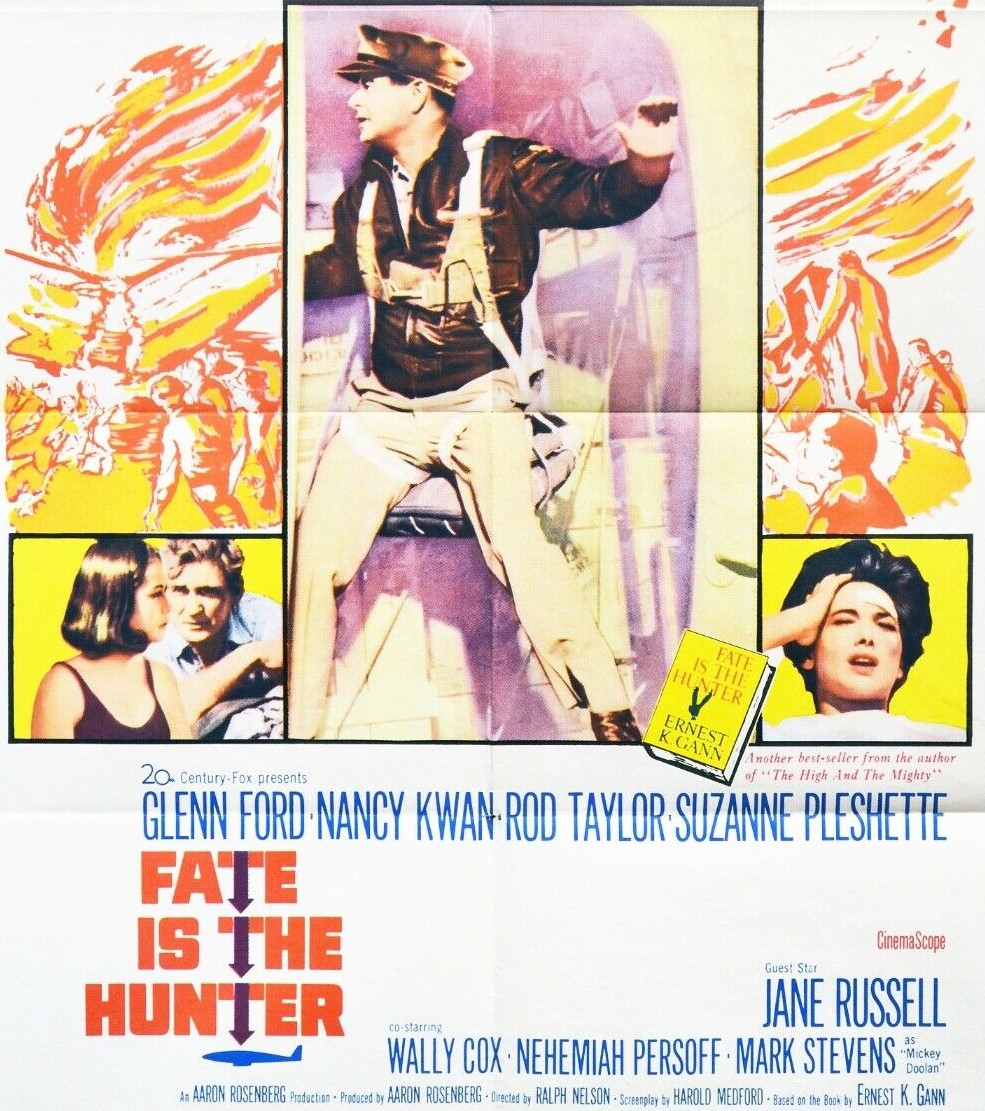
More like Flight from Ashiya (1964) than Flight of the Phoenix (1965) in that airline disaster triggers flashback rather than contemporaneously finding a solution to the problem, but similar in tone to the more recent Flight (2012) and Sully (2016) where the automatic response of the authorities was to blame pilot error rather than ascertain mechanical malfunction. Unlike the two modern pictures, pilot Jack Savage (Rod Taylor) cannot be interrogated in court because he died in the explosion. So investigator Sam McBane (Glenn Ford) seeks some corresponding incident in the past which might account for the pilot making such a mistake.
Other options face McBane. Sabotage could be the cause since a passenger took out a $500,000 insurance policy days before boarding the twin-engine plane. Bird strike cannot be ruled out after feathers are found in the engine. Or it could be simple misfortune. Three inbound planes all running late prevent the plane returning immediately to Los Angeles and it would have landed safely on a beach except for hitting a temporary structure. But engineers hardly need to pore over the evidence. The fault is staring them in the face. Savage had reported two engines catching fire but the wreckage reveals one engine intact.
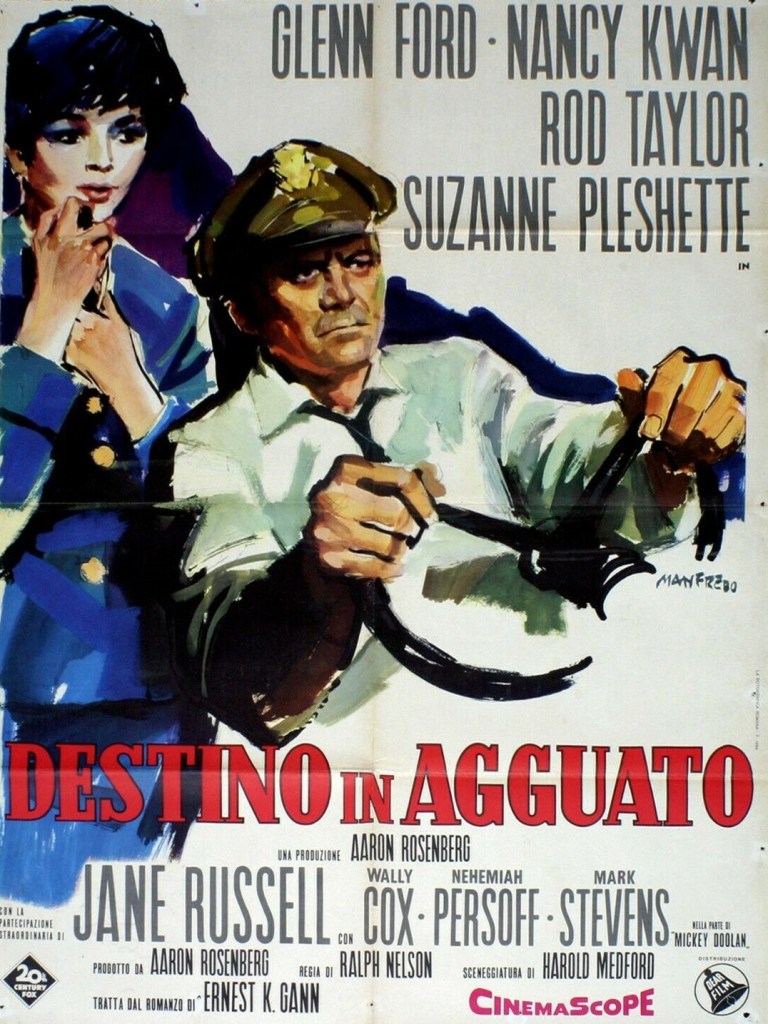
However, the only survivor, stewardess Martha Webster (Suzanne Webster) maintains that two red warning lights were flashing, indicating malfunction in both engines. But since she is badly injured and in a woozy state, this is not taken as gospel. So McBane dips into the playboy past of Savage, a buddy, a man with such appeal he can serenade real-life figures as Jane Russell (playing herself). Two occasions highlight the man’s heroic history of emergency landings. So can he be the unreliable character painted by a jilted fiancée (Dorothy Malone) or the drinker who should not have been in a bar so soon before take-off?
The tight-lipped shoulder-hunched humorless soulless McBane, described as “one of the best-built machines” known to man, finds himself questioning his own attitudes as he uncovers more of his friend’s life. But when it comes to the big enquiry, televised, he has no better an explanation to ascribe the unexpected collision of different events than the “fate” of the title. Naturally, that mystical prognosis hardly goes down well with his superiors. Luckily, McBane comes to his senses and suggests a simulation which does, in fact, pinpoint the flaw.
It’s relatively easy to pinpoint the flaw in the picture. Audiences expecting a disaster movie with characters stranded by a crash were disappointed to find that by cinematic sleight-of –hand they were being presented with The Jack Savage Story, which with the larger-than-life character and his various aviation and romantic adventures would easily have made a picture in its own right. Stuck instead with the glum McBane as their guide, who, beyond his steadfastness, does not come into his own until the last 15 minutes, seemed an unfair trick. The explosion of the doomed plane at the 10-minute mark is easily the dramatic highlight and the continued flashbacks rather than adding to the tension often eased it.
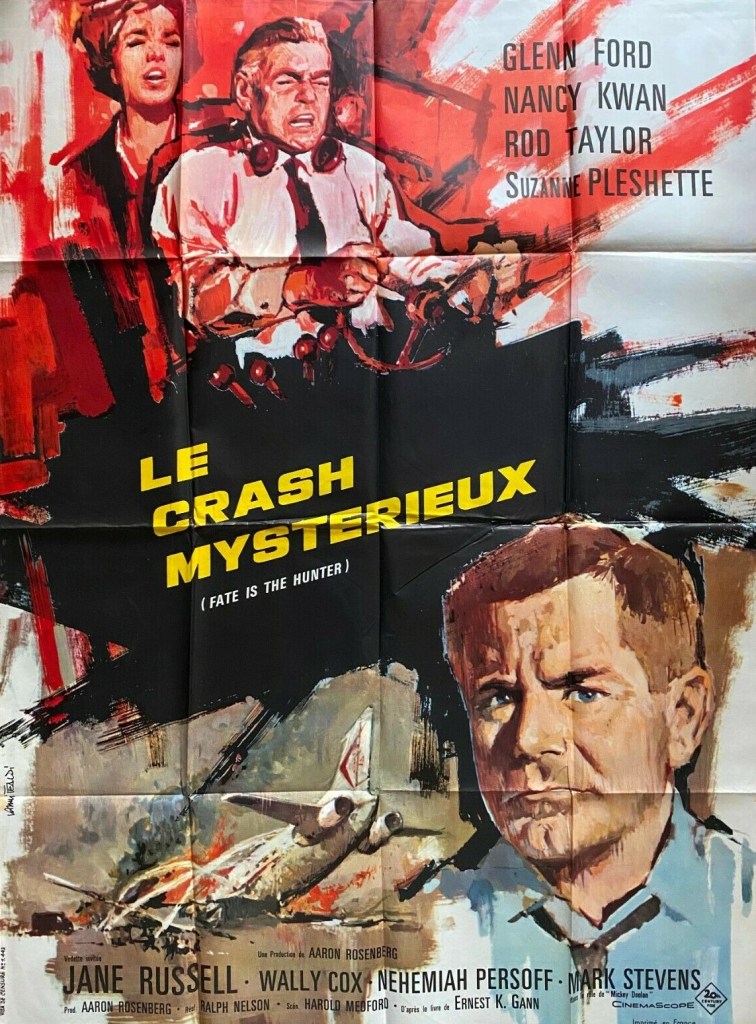
With four stars above the title, audiences might have anticipated some kind of four-sided triangle, but the two female stars scarcely appear although Martha has one excellent scene, shocked when asked to don her uniform again, and Sally (Nancy Kwan) enjoys a fishing meet-cute with Savage.
That said, if you accept as McBane as more of a private eye, his surly demeanor fits, and the Savage life story is certainly a fascinating one and the various aviation episodes unusual enough to maintain interest. Glenn Ford (Is Paris Burning?, 1965), his box office sheen waning and about to shift exclusively to westerns, is always watchable but there’s no real depth to the character. Rod Taylor (Dark of the Sun, 1968) is at his most exuberant and that’s no bad thing, and beneath the bonhomie a good guy at heart, but his portrayal provides little of the shade that would make it thinkable he was to blame. Suzanne Pleshette (The Power, 1968) and Nancy Kwan (Tamahine, 1963) are both under-used. Look out for Mark Stevens (Escape from Hell Island, 1963), Jane Russell (Gentlemen Prefer Blondes, 1953) in her first movie in seven years, and Dorothy Malone (The Last Sunset, 1961).
Ralph Nelson (Once a Thief, 1965) sticks to the knitting but four scenes stand out: the explosion, Martha’s breakdown at the sight of her uniform, the stewardess during the simulation staring down the plane at the empty seats filled with sacks of sand, and an excellent composition (which Steven Spielberg pays homage to in West Side Story) of a character being preceded into a scene by his very long shadow. Also worth pointing out is that, in almost James Bond style, the opening sequence lasts ten minutes before there is any sign of the credits.
Harold Medford (The Cape Town Affair, 1967) wrote the screenplay based very loosely on the eponymous bestselling memoir by Ernest K. Gann, whose The High and the Mighty had been turned into a hit picture a decade before. The author was so furious with how much the adaptation veered from his biography – which often pointed out the dangers of flying, recurrent pilot death and airplane unworthiness a main theme – that he took his name off the credits, missing out on an ancillary goldmine as the movie, a box office flop, proved a television staple.
Tamahine (1963) ****

Columbia sold this as if Nancy Kwan was a Bond girl with massive images of the star in a bikini (see above) – the advert in the trade magazine comprised a drop-down A2 pull-out i.e. three times the size of a normal page. But anyone expecting a salacious time would have been in for surprise. For although Kwan swam underwater during the credits (not Helen Mirren style as in The Age of Consent, 1969) and did reveal a naked posterior, you could not have imagined a more innocent, joyous, movie.
Tahitian teenager Tamahine (Nancy Kwan) wreaks havoc on the British stiff upper lip when after the death of her father she is sent to the all-male English public school run by his cousin Poole (Dennis Price), a widower. But it’s not a sex comedy with all the misunderstandings and double entendres that genre normally entails. Instead, it’s a clash of cultures, free love and expression versus prudery and repression. Poole has trouble enough on the female front, his daughter Diana (Justine Lord) inclined to enjoy a gin-soaked afternoon and in the middle of an affair with art master Clove (Derek Nimmo).

to stick a double entendre in the poster.
Without mischievous intent, Tamahine causes chaos, assuming an artist’s model would be naked she scandalizes the petrified Clove and egged on by a gaggle of schoolboys whose hormones are off the scale she jams a chamber pot on the school weather vane. The plot, if there is one, is mostly Tamahine fending off suitors, Clove and Poole’s son Richard (John Fraser), and attempting to persuade Poole to take a paternal interest in her well-being.
But mostly it’s about how a sweet-hearted woman struggles to survive in a world where attitudes to sex remain Victorian and in which the avowed aim of education is to build character through manly pursuits such as beating the living daylights out of each other rather than teaching them to express emotion. And certainly the movie takes a more benevolent view of public schools than the later, brutal, If…(1968).
While endorsing free love, Tamahine draws the line at crossing the line in the matter of Richard, whom she deems a relation, no matter how distant. Challenging all conventions, she takes part in sports day.

But the comedy is so gentle and Tamahine so charming that this is best described as a delight. I found myself chuckling throughout and I felt I had just watched a genuine feel-good movie. On paper it certainly doesn’t sound so potentially good, especially when you consider the clichéd portrayals you might expect from the supporting cast, but in reality it exerts an extraordinary appeal.
Hardly off-screen, Kwan (The World of Suzie Wong, 1960), in only her fourth film, easily carries the movie as if she scarcely felt the weight of stardom on her shoulders and is a revelation as the imparter of tender wisdom. What aids the film enormously is that Dennis Price and Derek Nimmo play more interesting parts than their movie personas suggest. Price (Tunes of Glory, 1960), in a far cry from his Ealing comedy heyday, dispenses with his wry delivery and cynical demeanor. Unusual for a character actor, his character actually has a story arc and turns what could have been a stereotypical role into a moving performance. Before his strangulated vowels got the better off him, Derek Nimmo (The Liquidator, 1965), too, delivers probably his best performance.
Justine Lord (Night after Night after Night, 1969) is good as the rebellious daughter but James Fox offers none of the intensity he brought to the screen a year later in The Servant (1964) and neither does John Fraser (El Cid, 1961) light up the screen. In small parts you can spot Michael Gough (Batman, 1985) and Coral Browne (The Killing of Sister George, 1968).
Full marks to director Philip Leacock (The War Lover, 1962), himself a former public school boy, for not taking the easy way out with loutish comedy but instead crafting a film full of sensitivity and sensibility. Denis Cannan (Why Bother to Knock, 1961) based his screenplay on the Thelma Nicklaus novel.
You might be surprised at the four-star rating and I do confess it is a shade optimistic but it is worth more than three stars. It’s worth taking a moment to examine the whole issue of ratings. You might be asking how can Tamahine be given four stars, the same as The Battle of the Villa Florita and a tad below the very few I deem five-star pictures. The answer is I compare like with like. If the best films in your opinion must concern social comment or excel technically, then there will be little place in your world for a sheer confection like Tamahine. But if you watch a wide variety of films and recognize those that contain a high enjoyment factor then you will want to draw attention to such. Hence, the rating.
It’s true that sometimes we do want movies to tackle difficult issues or take us into other worlds, but other times there is nothing to beat an old-fashioned good-hearted picture like this.
The Girl Who Knew Too Much (1969) ***
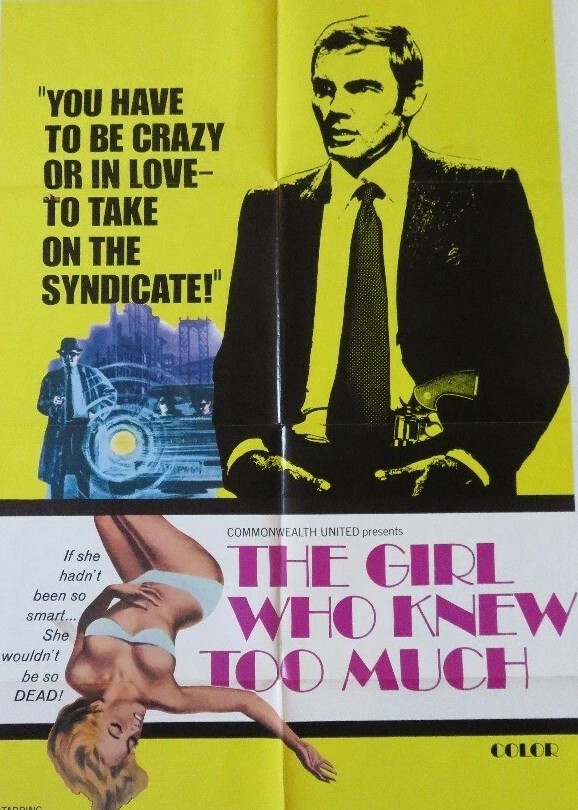
Prophetic plot is the best reason to watch this more considered feature from newcomers Commonwealth United. Another movie featuring a former star on the wane in Nancy Kwan. Again, one of those neo noir films which might have made a bigger splash with an actor other than Adam West, coming off the Batman television series and 1966 film, in the lead. A fair bit of philosophizing from the supporting cast.
The Mafia trying to go legit had been tackled in Point Blank (1967) and The Brotherhood (1968) and would be key to Michael Corleone’s machinations in The Godfather Part Two (1974), but here it goes into far deeper and more dangerous territory. At this point, organized crime was still run by the Mafia, but what if that and the legitimate big businesses and financial institutions they operated were prey to foreign interests.

Most movies that involve Russian, Eastern European, Albanian or South American gangs taking over American criminal networks, usually by force, concentrate on the illegal activities rather than the legitimate and powerful businesses suborned through money laundering. Although here the plot is somewhat convoluted involving the CIA and priceless artefacts, the core asks the question – what would happen in the U.S. should the Mafia come under Far East control.
This occurs for the dumbest of reasons. One of the Mafia top hoods, part of the management committee, wants to be in sole control so he’s enlisted the help of Far Eastern bodies, not realizing that the foreigners intend it to go the other way, and that he is in their grasp.
A convoluted tale is an invitation to plot holes. Hard to imagine restaurateur Johnny Cain (Adam West) as a former top assassin when in three out of four tussles with gangsters he comes off worst. He’s tossed in the drink, chucked through a window and thrown out of a door.
And he’s only turned detective under duress. The Mafia force him to track down the killer of old-school gangster Tony Grinaldi (Steve Peck) otherwise they will take out a contract on him. His first port of call in Grinaldi’s girlfriend Revel Drue (Nancy Kwan), who had enjoyed a brief liaison with Johnny until her lover promised her a termination. Then old buddy Lt Miles Crawford (Nehemian Persoff), philosophizing cop, lends a hand. The CIA turn up the heat since someone is killing the great spies of Bermuda. The missing artefact, a solid gold statue of a Tibetan god, enters the mix. Grinaldi’s wife, drunken actress Tricia (Patricia Smith) is the secret lover of one of the top Mafia guys, Kenneth Allardice (Robert Alda).

When one set of thugs aren’t trying to do away with Johnny, another bunch have Revel in their sights. But it turns out that the foreigners are backing Allardice, knocking off the other four members of his committee leaving him in sole control.
All the way through except clinging to Johnny and looking scared, Revel (“a small town girl who wanted a big city man”) hasn’t had much to do, so I was expecting at the very least, once she turned the romantic screws on Johnny, that she would turn out to be a femme fatale in the pay of the foreigners. Turns out the femme fatale comes from a different source. Tricia has infiltrated the organization, either on her own account or on behalf of the government (it isn’t clear which). Marrying Grinaldi then launching into an affair with Allardice who, having conveniently got rid of his rivals, leaves her in pole position to head the group.
There are some neat touches. Johnny lives on a big yacht not the usual down-at-heel houseboat occupied by a down-on-his-luck private eye, a naked leg part of a naked body warming Johnny’s bed kicks over the phone when it interrupts her bed warming activities, the Mafia headquarters are atop a snazzy department store, the academic Johnny seeks out for information on the artefact is a part-time stripper.
But we’ve also got to suffer two whole songs from cabaret artists Lucky (Buddy Greco) which slows the tempo right down.
Nancy Kwan made an instant splash as the romantic lead opposite William Holden in The World of Suzie Wong (1960), a box office smash, for which she won two Golden Globes. Her star potential was quickly recognized, either top-billed or leading lady in her next seven films. But after Lt. Robin Crusoe, U.S.N. (1966) her marquee slipped and after making up the numbers in The Wrecking Crew (1968) her career never recovered. For sure, she held onto her place in the sun for far longer than Tippi Hedren (Tiger by the Tail, 1968) who was at one point the bigger star, but Hollywood burned through stars at a heck of a pace or dropped them altogether or sent them into the exploitation/B-picture hinterland – Kwan was the star after all of Wonder Women (1974) and Fortress in the Sun (1975).
Adam West barely found a place in the sun, five films, and supporting roles/bit parts at that, over the next decade represented a poor return.
Final film of director Francis D. Lyons (Destination Inner Space, 1966), an Oscar-winning editor, from a screenplay by Charles A. Wallace (Tiger by the Tail, 1968). Became something of a cult item on television.
Interesting concept but you need patience.
The Corrupt Ones / The Peking Medallion (1967) ****
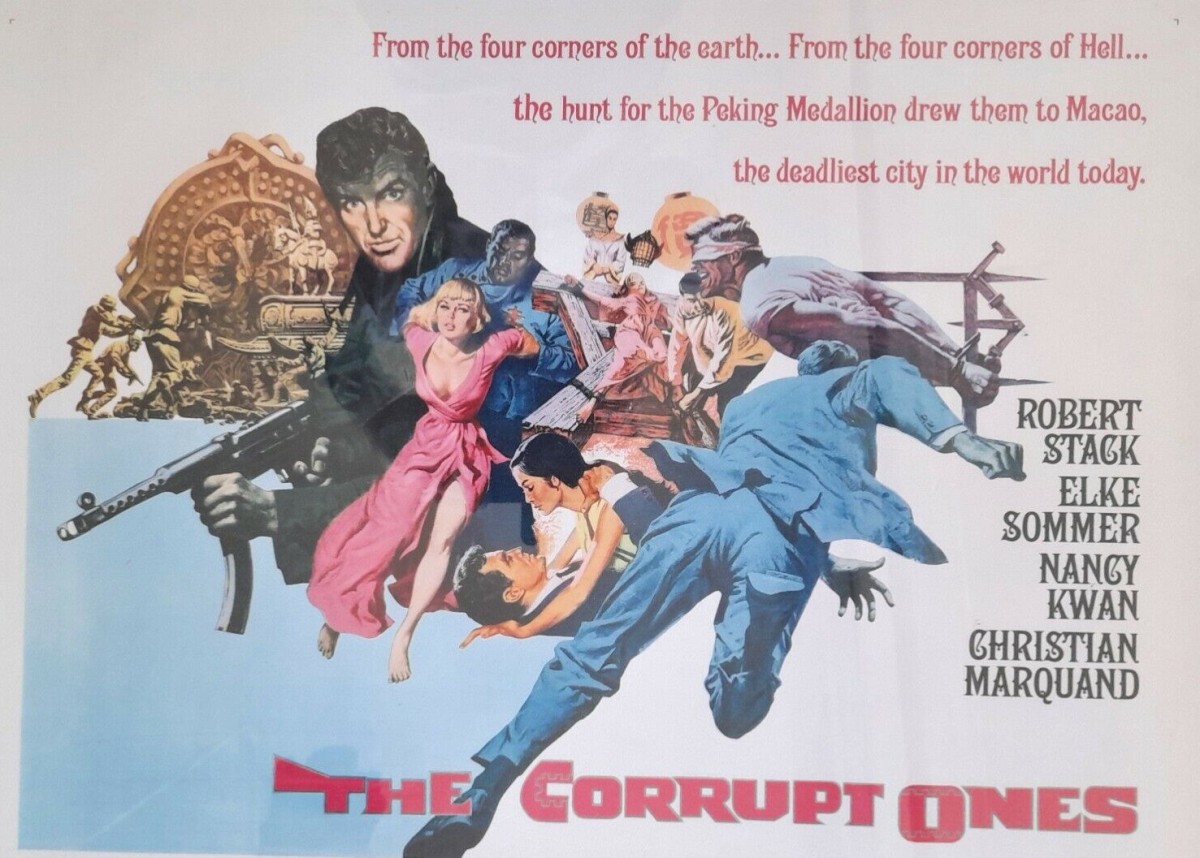
Non-stop action as spy Cliff Wilder (Robert Stack) battles a variety of crooks in Macao on the Chinese border as they seek to recover the legendary Peking medallion. Wilder hails from the James Bond school of espionage, duty bound to kiss every girl he meets. He might wonder at their compliance until he realizes they are only after his knowledge of the missing medallion.
The violence is criminally brutal – punch-ups, gunfights, samurai swordfights, murder and torture by blowtorch and acid and being dragged behind a motorboat. The string of sexy women is matched by handsome men, Brandon (Christian Marquand) and Danny (Maurizio Arena) in addition to Stack. The thriller pitches helter-skelter through nightclubs, casinos, caves, temples and palatial mansions, the pace only slowing down for, naturally, a scene in a stately rickshaw.
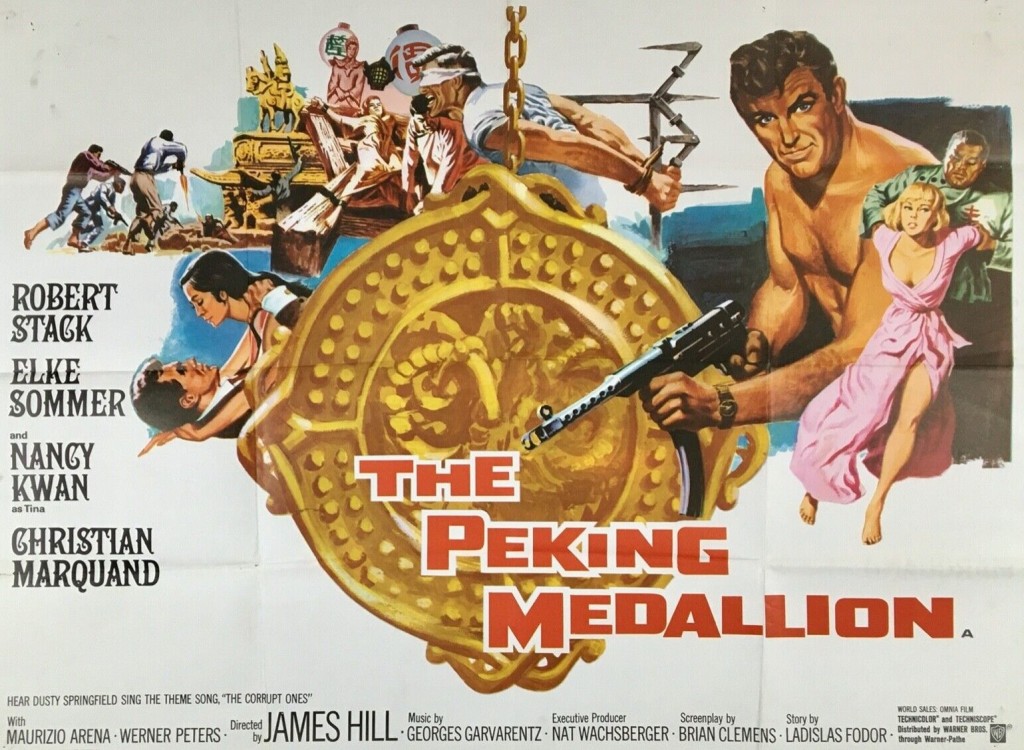
As well as Wilder who briefly – and unknowingly – has the medallion in his hands, others in the hunt include Lilly Mancini (Elke Sommer), wife of Danny who had passed it to Wilder before being killed. Mancini is on the wrong side of the femme fatale equation. Once Wilder is wise to her seductive charm,s he quips, “Maybe you’re telling the truth but I can’t trust you.”
Also in hot pursuit are gangster Brandon and a Chinese mob headed by Tina (Nancy Kwan) That’s on top of a corrupt cop (“I have never feared death, only poverty” is his mantra) who doesn’t care who wins the prize as long as he gets his share. Double cross is the order of the day, alliances forged then broken. The action never stops long enough for one of those tension-building scenes of which Alfred Hitchcock or imitators like Stanley Donen (Charade, 1963, and Arabesque, 1966) were so fond.
Wilder faces danger with a quip, a kiss or gritted teeth, an old-fashioned tough guy without the James Bond self-awareness. He carries out his manly duties until his brain kicks in and he realizes this isn’t a spy picture after all but a genuine treasure hunt with clues that have to be deciphered. After that, the pictures sidetracks down another route. For a moment, the movie seems to have lost the plot. But then all hell breaks loose and we are back on the safe ground of fistfights, double-crossing and shooting.

Fans of improbable storylines, exotic settings, action, interesting bad guys and twists and turns will love this. How can you fail to love a movie with a samurai vs camera tripod swordfight?
An exemplary cast for this kind of malarkey, a French-Italian-German co-production with English as the mother tongue. Scarcely creditable that Robert Stack, in his biggest picture since The Untouchables tv series (1959-1963), was once Oscar-nominated given subtlety is never required. Nancy Kwan (The World of Suzie Wong, 1960) steals the show as the villainess but she’s run close by Elke Sommer (The Prize, 1963). In supporting roles are Werner Peters (Istanbul Express, 1968) and Christian Marquand (The Flight of the Phoenix, 1965).
Might seem a considerable change of pace for director James Hill after Born Free (1966) but that’s only if you ignore his work on the equally complicated A Study in Terror (1965). Screenplay punched out by Englishman Brian Clemens (And Soon the Darkness, 1970), Hungarian Ladislas Fodor (best know for the Dr Mabuse series) and Harald Bloom, his only known credit.
Great fun.
PREVIOUSLY REVIEWED IN THE BLOG: Robert Stack in Is Paris Burning? (1966); Elke Sommer in The Prize (1963), The Art of Love (1965), The Money Trap (1965), The Oscar (1966), The Venetian Affair (1966), Deadlier than the Male (1967), They Came to Rob Las Vegas (1968) and The Swiss Conspiracy (1976); and James Hill’s A Study in Terror (1965); Nancy Kwan in Tamahine (963), Fate Is the Hunter (1964), The Wild Affair (1965).
Behind the Scenes: Coming Soon(er) or Later or Not At All

My discovery that Hayley Mills’ career could have taken an entirely different turn had either Deep Freeze Girls or When I Grow Rich entered production in 1965/1966 and therefore prevented the star returning to Britain for The Family Way (1966) – and, as it transpired, love and marriage – made me look again at the huge volume of movies that were either never made at the time initially announced or never made at all.
I’d covered a couple of classic examples previously, 40 Days of Musa Dagh for example taking nearly half a century from initial proposal to some kind of fruition. And, of course, the financial collapse of studios at the end of the 1960s put an end to the prospects of such big budget movies as Man’s Fate, to be directed by Fred Zinnemann.
But sometimes as many as half the movies announced by a studio or independent for their forthcoming schedule never made it to the big screen. Others such as This Property Is Condemned (1966), initially to star Elizabeth Taylor and directed by John Huston, still got over the line but with new players, Natalie Wood as star and Robert Mulligan in the hot seat. On the other hand, of the quartet of movies – Lie Down in Darkness, Guardians, Grass Lovers, and Linda – that producer William Frye (The Trouble with Angels) thought would make his name, none were made.
Everyone knows moviemaking is a dicey business, but you don’t realize just how tricky it is unless you count up just how many pictures, often trumpeted with big stars signed up, just don’t make it to the cinema screen. Not that Hollywood was unwilling to gamble. Studios snapped up anything – novel, Broadway play – that appeared a decent prospect.
In the early 1960s talent agency Famous Artists earned for its clients a grand total of $850,000 (equivalent to $8.5 million now) for a disparate bunch of properties. King Rat by James Clavell went for $160,000 plus a percentage and was made in double quick time. As was Lilith by J.R. Salamaca, costing $100,000, and Sylvia ($20,000 purchase price) by E.V. Cunningham (aka Howard Fast). Ken Kesey’s One Flew Over the Cuckoo’s Nest went for $85,000 to Kirk Douglas’s Bryna outfit, which explained why, a decade later, it ended up being produced by his son, Michael.

But Broadway play The Perfect Set-Up by Jack Sher, sold to Hollywood for $400,000 and with Angie Dickinson signed up for the lead, was never made. You might recall George Peppard in a TV movie Guilty or Innocent: The Sam Sheppard Murder Case (1975) but that wasn’t based on The Sheppard Murder Case by Paul Holmes that someone shelled out $25,000 for in 1962.
Director Paul Wendkos had planned to follow up Gidget Goes to Rome (1963) with Native Stone, an architectural drama in the vein of The Fountainhead based on the Edwin Gilbert book that cost him $10,000 but that hit the buffers. Two novels by thriller writer John D. MacDonald, hot after Cape Fear (1962) – the aforementioned Linda costing $15,000 and A Child Is Crying $5,000 – were not made either. Nor, out of this batch, were Indian Paint by Glenn Balch or Fish Story by Robert Carson.
Even as powerful a producer as Ross Hunter (Midnight Lace, 1960), couldn’t get onto the starting grid The Public Eye as a vehicle for Julie Andrews, Laurence Olivier and director Mike Nichols (it would have been his movie debut) – when made in 1972 starring Mia Farrow and Topol it was under the aegis of Hal Wallis. Hunter also spent $350,000 on Dark Angel to star Rock Hudson but that fell at the first hurdle as did Broadway play A Very Rich Woman to star Katharine Hepburn.
Tony Curtis was down for a remake of Casablanca (1942) called The Fifth Coin and relocated in Hong Kong and to co-star Nancy Kwan. Shooting on the Seven Arts production had a start date: November 15, 1965. But never went in front of the cameras. Kwan was particularly unlucky. The aforementioned Deep Freeze Girls also had a budget ($1.5 million) and a start date (October 1965) but it didn’t get off the ground either.
And of course Seven Arts had become enmeshed in the long-running John Huston saga of The Man Who Would Be King. This version, to star Richard Burton, had been set a $4 million budget and was due to start in April 1966. No go. At least The Owl and the Pussycat, budgeted then at $1.6 million and due to start on Dec 1965, was worth waiting five years for – when it was eventually filmed, though by Rastar not Seven Arts, it starred Barbra Streisand and George Segal.
In 1964 Columbia had 77 movies on the stocks. Richard Brooks was setting up Catch 22, Peter Sellers was being lined up for the musical Oliver!, and Carl Foreman was prepping Young Churchill. All these projects dropped off the roster, only to pop back up several years later with different stars (Ron Moody in Oliver!) or directors (Mike Nichols for Catch 22) or even studios (Paramount for Catch 22).
But others were simply shunted aside. Whatever happened to The Gay Place to team James Garner and Jean Seberg? Or The Fabulous Showman to be directed by Blake Edwards? Or another long-running saga, Andersonville with Stanley Kramer at the helm? Or Stephen Boyd as Richard the Lionheart? Even though The Ipcress File (1965) proved a big hit the same author’s Horse Under Water stalled at the starting gate, as did Robert Rossen’s Cocoa Beach and Ann-Margret in Strange Story.
When Robert Evans ushered in a new era at Paramount he placed his faith in writers. He doubled production and had over 40 writers working on projects. Some had little or no experience of movies but were big literary names. John Fowles, the adaptation of whose The Magus (1968) was an expensive flop, was hired to write Dr Cook’s Garden, but it was never made. Edna O’Brien had Three into Two Won’t Go on the stocks at Universal so she was set to write Homo Faber. Another casualty.
Oscar-winning screenwriter Edward Anhalt (Becket, 1964) was to make his directorial debut with We Only Kill Each Other. It didn’t happen. Nobody had ever managed to film Thomas Wolfe’s epic novel Look, Homeward Angel, so Paramount took a tilt at that without success. Escape from Colditz went into cold storage and an adaptation of Harold Robbins bestseller 79 Park Avenue ended up as a television mini series in 1977 and at a rival company, Universal.
It’s still standard operating procedure for Hollywood to snap up any big bestseller or Broadway hit without ever knowing whether it will ever see the light of day but willing to take the risk.
SOURCES: “Famous Artists,” Variety, August 8, 1962, p5; “Sanford and Frye of TV To Make Theatrical Films,” Box Office, January 7, 1963, p10; “Col-Frye TV Pact,” Box Office, August 19, 1963, p10; “Columbia Policy,” Variety, May 6, 1964, p13; “Seven Arts Pix Multiply,” Variety, March 31, 1965, p4; “Ross Hunter’s Crowded Future,” Variety, May 12, 1965, p7; “Bob Evans Pays Chip Service To Writer As Star,” Variety, May 1, 1968, p19.
Behind the Scenes: “Kitten with a Whip” (1964)

Ann-Margret was a late arrival on the scene. The voluptuous Mamie van Doren (3 Nuts in Search of a Bolt, 1964) had bought the rights to the novel by Wade Miller in September 1959 before selling them on the Universal a couple of months later, possibly in exchange for the starring role.
Wade Miller was the pseudonym of writing team Robert Wade and H. Bill Miller, who had teamed up at the age of 12, and wrote screenplays under another pseudonym, Whit Masterson. Together they had turned out 30 novels, and hundreds of short stories and their work had been the basis for, most famously, A Touch of Evil (1958). The later Yellow Canary (1963) and Warning Shot (1966) were based on their novels. The moment Hollywood came calling Fawcett publishing, through its Gold Medal paperback division. rushed out a movie tie-in edition, adding another when the film was due for release.
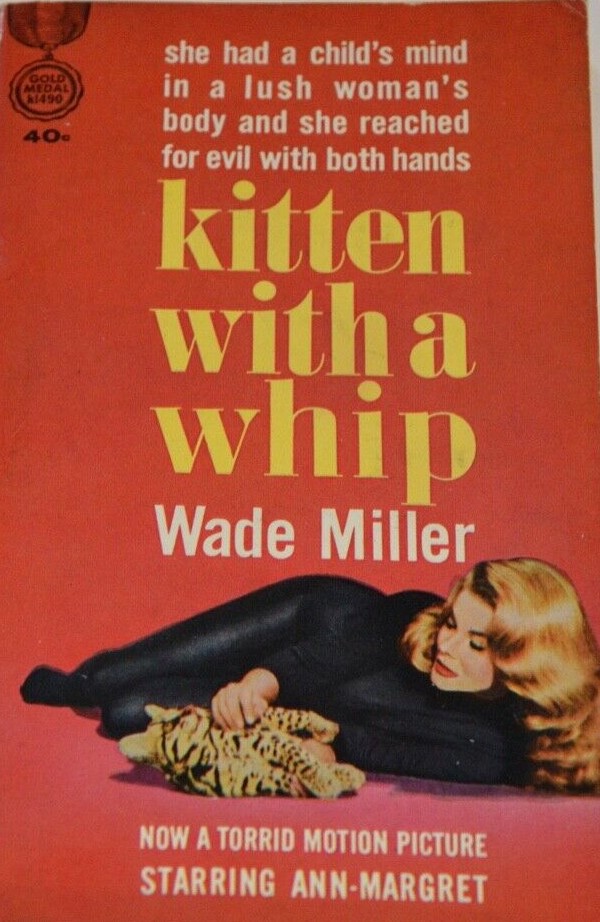
Laszlo Gorog (Too Soon to Love, 1960) was initially allocated the screenplay, but was quickly replaced by Alfred Benner (Key Witness, 1960). Nancy Kwan (Tamahine, 1963) and Steve Forrest (Yellow Canary) entered the frame when Richard Rush (Too Soon To Love) was being tipped to direct. Brigitte Bardot turned it down. And it languished in limbo for a couple of years before being handed to television director Douglas Heyes – a journeyman known for episodes of Laramie, Cheyenne, The Twilight Zone, The Virginian, et al.
It wasn’t meant to be his debut feature. That was intended to be If One Is To Die from his own original screenplay, announced in 1961. But that was for Twentieth Century Fox. When that failed to materialize, and after a short spell back in television, he did double duty – writer and director, a role he had carried out countless times for television – for Kitten with a Whip
It was the last of the 11 movies scheduled by Universal for production in 1963, shooting beginning on December 27. The studio, at the forefront of developing new talent, put new recruit Patrica Barry (Send Me No Flowers, 1964) in the secondary female role.
That this got into the mix for Ann-Margret must have taken some determined wheeling and dealing for by 1963 the actress was in phenomenal demand, especially for someone with so little experience. She had contracts for over a dozen pictures. In part, she was the most exciting addition to a growing pool of new talent that included Michael Callan (The Interns, 1962), Alex Cord (Stagecoach, 1966), George Segal (The Quiller Mmorandum, 1966) and Peter Fonda (Lilith, 1964), but the fact that she could sing and perform made her doubly attractive since Hollywood had now worked out that hit singles and live performances were “the fastest route to the showbiz area…and the springboard to…film fields.”

Film adaptations of hit musicals, benefitting from the “broader pull of Hollywood productions” and “wider audience exposure,” boosted sales not just of the original soundtrack but also the original Broadway cast recording. Columbia’s Bye, Bye Birdie (1963) sold two million copies of the movie soundtrack and album and 1.5 million of the Broadway version.
There was a three-picture deal with Frank Sinatra’s Essex Productions that should have included Marriage on the Rocks (at that time known as Community Property, its original Broadway title) delayed until 1965 when the original director pulled out. Columbia was owed three movies, Twentieth Century Fox five. Every time she signed a new contract her price went up. She was the object of a bidding war. MGM appeared to be in the lead when it raised her going rate, ponying up $275,000 plus a percentage for two movies – Viva Las Vegas (1964) and Say it with Music (shelved). But Universal trumped that, $250,000 per picture for six movies, the first being Kitten with a Whip.
Her arrival in showbiz had triggered whirlwind of promotion. She snaffled her first headline in December 1960, at the age of 19, when Jack Benny added her to his nightclub act in las Vegas. Four months later her face adorned a full-page ad in Hollywood Reporter that announced her television debut on the Jack Benny Show on CBS April 2, 1961. By then Twentieth Century Fox was sniffing around and she landed a $1,000 a week contract. The studio set her as female lead in State Fair (1962) but she was abruptly dropped and when reinstated it was as second female lead.
At this stage, publicity focusing around her voice. Signed to RCA Victor, she quickly became a top-selling artist. In return for delivering 12-24 singles and a number of albums over three years, the label committed to spending $50,000 a year in promotion. Columbia assigned George Sidney, director of Bye, Bye Birdie, to make an eight-minute promotional film.
After well-received turns in A Pocketful of Miracles (1962), Bye, Bye Birdie and female lead to Elvis Presley in Viva Las Vegas, Kitten with a Whip represented departure, her first dramatic role. Although some observers later criticized her management team, in retrospect it’s clear that a sensible strategy was in operation, alternating lighter fare where she could sing and dance with more serious works (Once a Thief and The Cincinnati Kid, 1965, and Stagecoach the following year) where she did neither.
Exhibitors were so convinced she was the real deal that she was the youngest-ever winner of their Star of the Year Award, previous holders of the trophy including the more established likes of John Wayne, Gregory Peck, William Holden, Deborah Kerr and Doris Day, but only after they had been in the business for several years with umpteen box office hits to prove their worth.
Male lead John Forsythe, after years on television in Bachelor Father (1957-1962), was making a movie comeback. But he had signed an unusual contract with Universal, suggesting nobody was confident he was as genuine a prospect. The studio offered him a deal for two pictures a year, but one that also included television work for its television arm Revue.
Reviews were better than the actress might have expected. Eugene Archer, the second-string critic on the New York Times said “she demonstrated enough untrained talent to suggest interesting dramatic possibilities in better films.” Box Office opined that Ann-Margret delivered “a realistic and surprisingly effective characterization” but pleaded for studios to “let her return to lighter fare.” Variety was dismissive: “display of over-acting.”
Exhibitors took a negative view. “Does this popular star a great deal of harm,” was typical of the response. Others were more forthright, describing the movie as a “glaring example of the type of show that shouldn’t be made.” Overall, it was not what anybody – critics, audiences, cinema managers – expected and not in a good way. The St Paul Evening Dispatch took the MPAA’s Production Code to task for passing a picture of “sheer sadism, depravity without redeeming reason.”
In some first run situations, it was the solo feature. Other cinemas paired with Lolita (1962), a somewhat obvious choice, or Lilith (1964) or British film Young and Willing (1962), Faces in the Dark (1960) with Mai Zetterling and Audie Murphy western Bullet for a Badman (1964). In some cities, it bypassed first run and went straight into the drive-ins. In smaller locales it went out on the lower half of a double bill.
Only in Pittsburgh did it score at the box office, “lofty” the assessment. It was deemed “sluggish” Washington, “slow” in Chicago and Los Angeles, and “slim” in Columbus, Ohio. Of 21 movies released in the Winter Quarter, it was ranked lowest where it mattered most, at the ticket wickets, according to Box Office. It didn’t rake in $1 million in rentals, the amount required to earn a place on Variety’s annual box office chart.
Kitten with a Whip didn’t appear to harm the star’s career. Critics praised her work on Once A Thief and The Cincinnati Kid. But as her career first prospered and later crashed and burned it was considered something better not mentioned. John Forsythe fared less well. Outside of television, he only made five movies in five years.
Heyes’ movie career stuttered. He had been due to write and direct The 12th of Never, based on his own novel, to star Sandra Dee, one of Universal’s top marquee names, in June 1964, but when that was cancelled returned to television until called back to direct Beau Geste (1966).
There might have been reassessment of the value of the original film when Gus Van Sant announced he planned a remake in 2007. On the other hand, that it was Lindsay Lohan’s favorite picture didn’t do it much good.
The Wild Affair (1965) ***
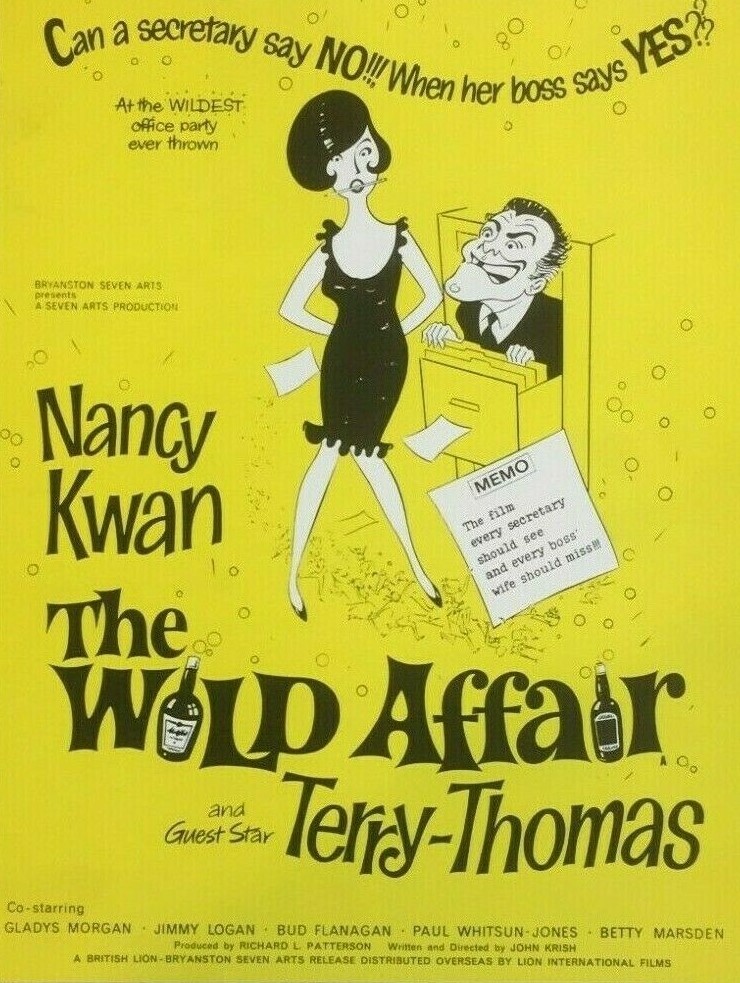
An unexpected gender equality twist as fiancée Marjory (Nancy Kwan) decides to embark on the equivalent of a stag party after seeing the state it left potential husband in. Although the full-scale Hen Party was a few decades away, Britain had given way to the Permissive Society, so, theoretically at least, a young lass on the brink of marriage could have a wild fling and with her last day at work coinciding with the office Xmas party she does her best.
Predatory men, of course, have a sixth sense regarding available women so there’s no shortage of suitors and she is egged-on by an alter-ego she calls Sandra who tut-tuts at her in the mirror when she fails to let herself go. Meanwhile, boyfriend Andy (Donald Churchill) has decided she will be bored silly at the party and plans to whisk her away for Xmas shopping.
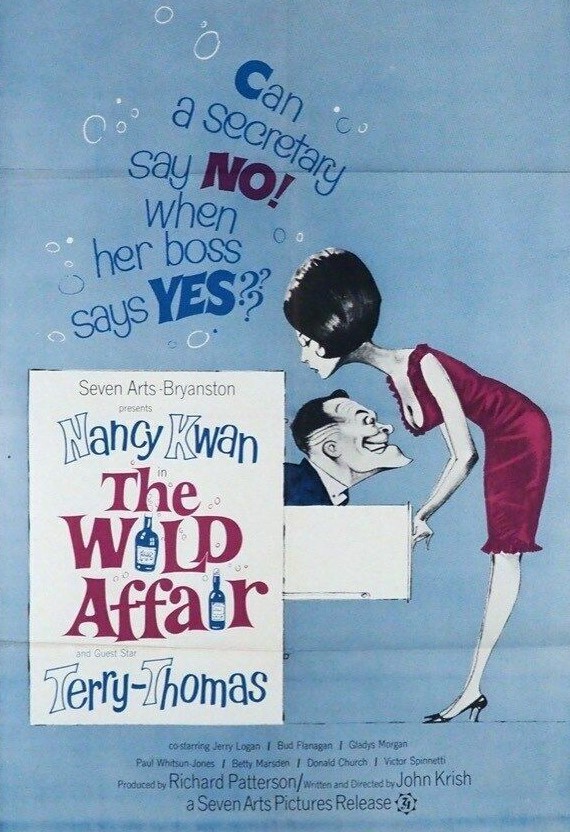
The roster of potential lady-killers is headed by boss Godfrey (Terry-Thomas) forever maneuvring her into the confines of his office. Scottish salesman Craig (Jimmy Logan) wines and dines her in a private room. The company’s in-house designer Quentin (Victor Spinetti) tries to seduce by spouting poetry by D.H. Lawrence.
An office party being the kind of occasion where emotions run wild, tempers fray and home truths spill out, we discover Marjory is not the only one with romance in mind. An older secretary Mavis (Betty Marsden), lip perpetually a-quiver, more or less announces that Godfrey is the love of her life, ignoring, at least for the moment, that he has already embarked on an affair with model Monica (Joyce Blair).
Marjory switches from staid housewife-to-be (she has to quit her job on getting married, as was standard at that time) to exploring her inner Sandra, submitting to a make-over by Quentin that turns her into a vamp. With clothes by Mary Quant and a bob from Vidal Sassoon, she would have been quite the eye-catching catch had she remained still long enough for anyone to catch her. However, this being a comedy, and Marjory/Sandra an innocent among wolves much of the running time is spent getting her out of situations of her own making.
But although humor is to the fore, you get the sense this is a ground-breaking film desperate to break out into something more serious. Marjory challenges the notion that marriage ended careers, that women had to make do with sitting at home doing housework waiting for husband to return, in a life devoid of excitement or development.
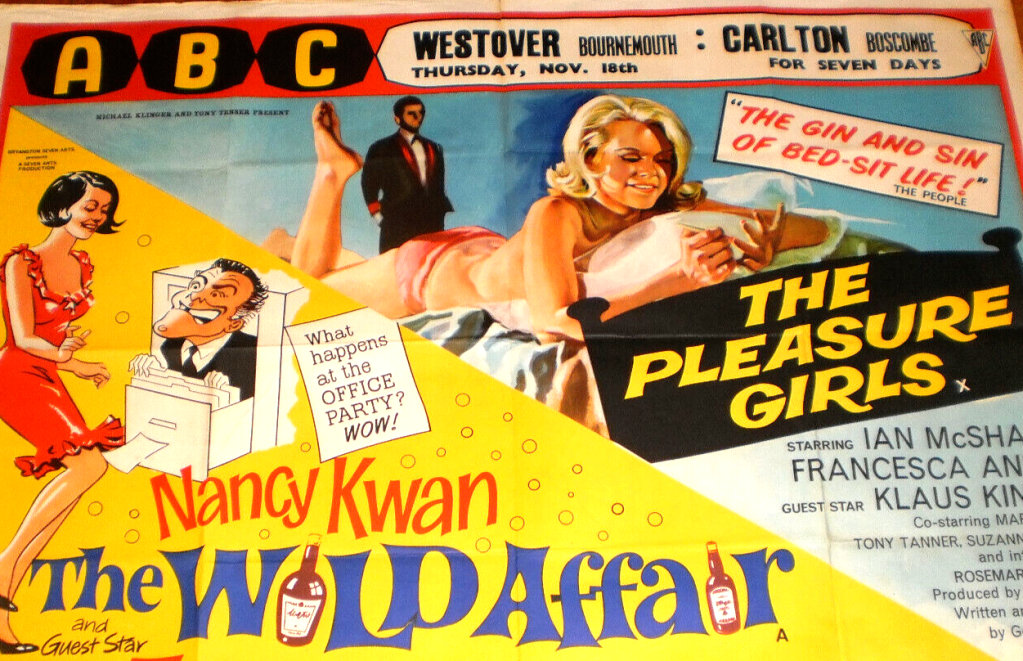
If this is her idea of beginning married life, you certainly get the idea that her marriage will have a more feminist tinge than Andy might be expecting. The Sandra alter-ego, initially expressed as a flighty piece, soon develops into inner doubt, channeling a potential rebel. In some respects, this is standard stuff, middle-class girl sensing opportunity only to be taken advantage of and certainly this particular year appeared to be filled with characters on the cusp of change and/or consequence – Four in the Morning (1965), The Pleasure Girls (1965), The Hallelujah Trail (1965), Georgy Girl (1965), and you might even include Doctor Zhivago (1965). Female characters later in the decade would have fewer qualms.
So it has a time capsule feel, full of surreptitious suggestion. You get the impression that when Marjory quashes Sandra it’s only a temporary solution and that questions that remain unanswered will pop up at a later stage.
The ploy of the alter-ego in the mirror allows writer-director John Krish (Unearthly Stranger, 1963) to seed the comedy with more serious elements and ask questions that might be uppermost in the female mind. He throws in the occasional surreal moment such as the husband being trapped in a phone booth by a drunk (Frank Finlay) or an innovative way to stifle rising chaotic emotions. But some scenes could do with editing, namely the makeover scene which relies overmuch on reaction shots.
Nancy Kwan at last fulfils the potential shown in The World of Suzie Wong (1960), portraying a more complex character than the free-spirited Tamahine (1963). Terry-Thomas (Arabella, 1967) does too much mugging and his well of double-takes runs dry for this to be considered one of his better works. Joyce Blair (Be My Guest, 1965) makes the most of a man-eater role.
Silent American film superstar Bessie Love puts in an appearance and Scottish comedian Jimmy Logan is convincing in a dramatic part. Frank Finlay (A Study in Terror, 1965) is an inspired drunk and English comic Bud Flanagan has a bit part. Krish based the script on a novel by William Samsom. If you want to learn more about “The Permissive Society,” check out a course run by the University of York, which dates it starting in 1957.
Strictly matinee material until you notice the undertones.
The Corrupt Ones / The Peking Medallion (1967) ****
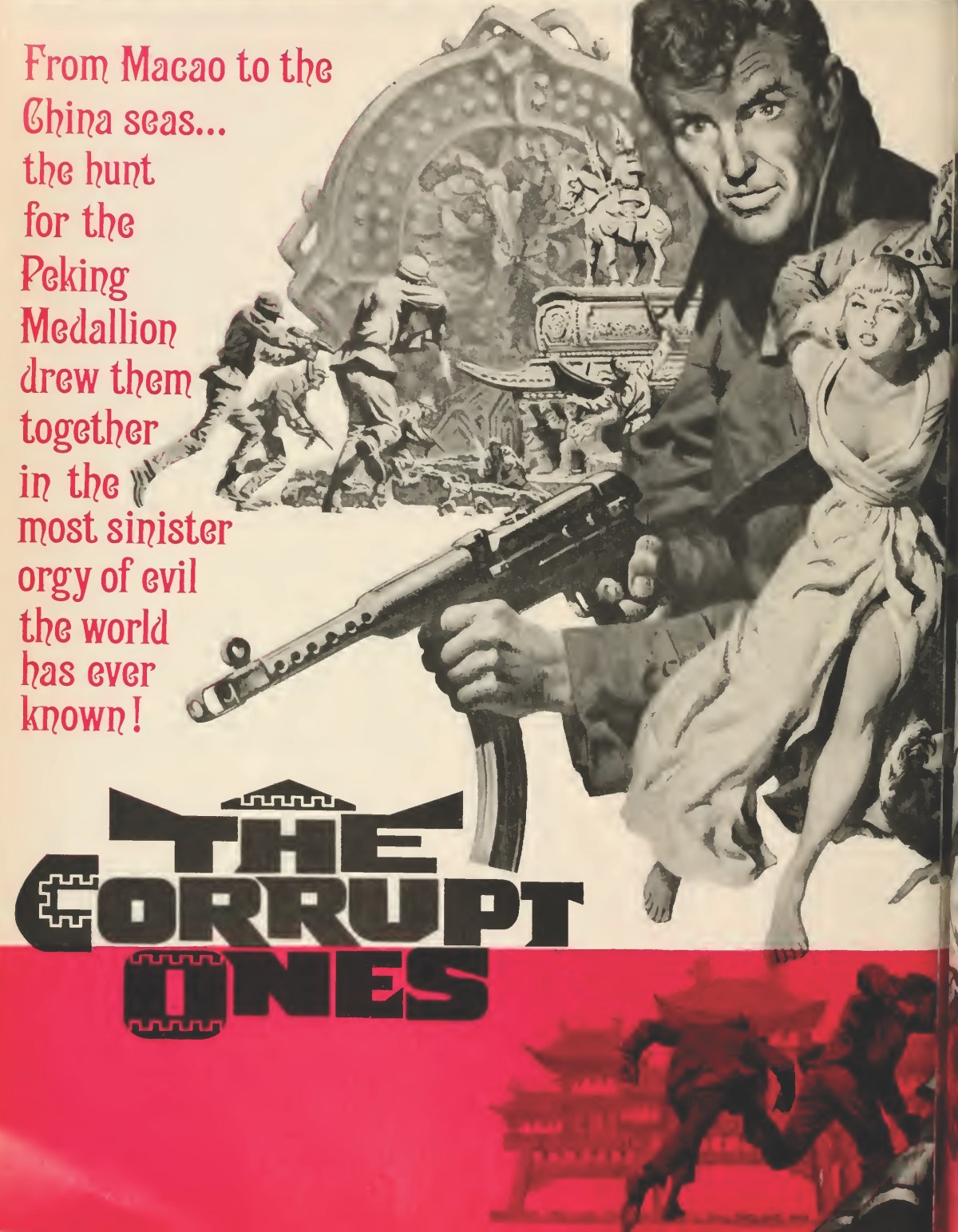
Non-stop action as spy Robert Stack (The Untouchables tv series) battles a variety of crooks in Macao on the Chinese border as they seek the legendary Peking medallion. Stack hails from the James Bond school of espionage, duty bound to kiss every girl he meets. He might wonder at their compliance until he realizes they are only after his knowledge of the missing medallion.
The violence is criminally brutal – punch-ups, gunfights, samurai swordfights, murder, torture by blowtorch and acid and being dragged behind a motorboat. The string of sexy women is matched by handsome men (Christian Marquand and Maurizio Arena in addition to Stack). The thriller pitches helter-skelter through nightclubs, casinos, caves, temples and palatial mansions, the pace only slowing down for, naturally, a scene in a stately rickshaw.
As well as Stack who briefly – and unknowingly – has the medallion in his possession, others in the hunt include Elke Sommer, wife of the man (Arena) who passed it to Stack before being killed. Sommer is on the wrong side of the femme fatale equation. Once Stack is wise to her seductive charms he quips, “Maybe you’re telling the truth but I can’t trust you.”
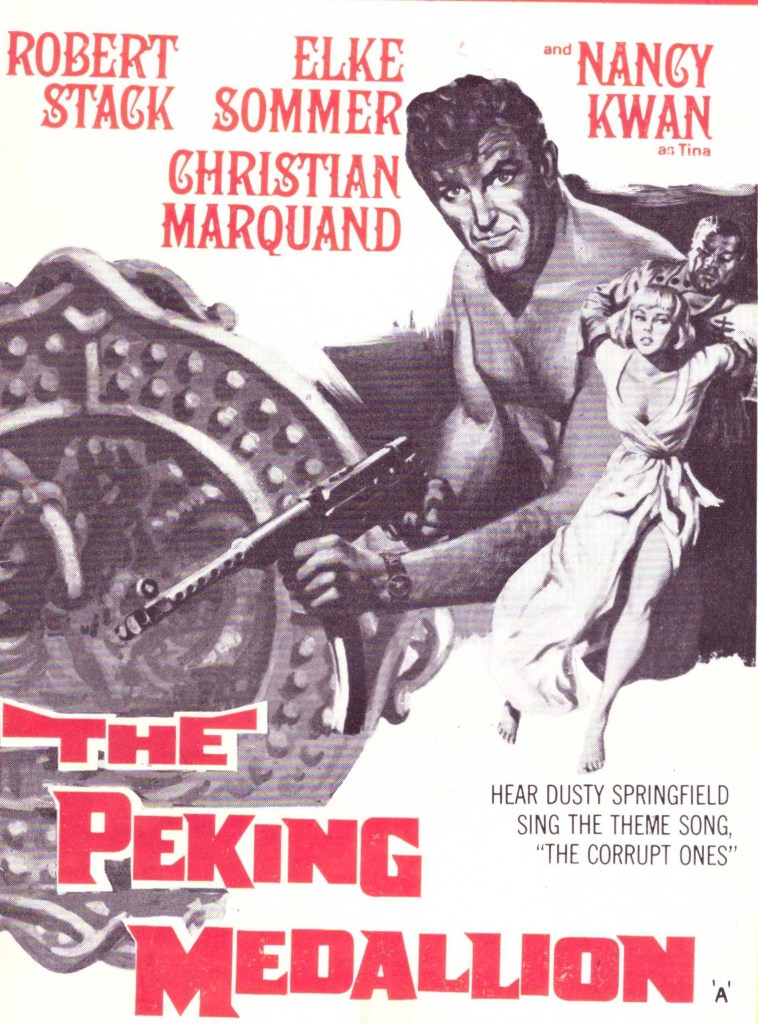
Also in hot pursuit are gangster Brandon (Marquand) and a Chinese mob headed by Nancy Kwan (The World of Suzie Wong, 1960). That’s on top of a corrupt cop (“I have never feared death only poverty” is his mantra) who doesn’t care who wins the prize as long as he gets his share. Double cross is the order of the day, alliances forged then broken. The action never stops long enough for one of those tension-building scenes of which Alfred Hitchcock or imitators like Stanley Donen (Charade, 1963, and Arabesque, 1966) were so fond.
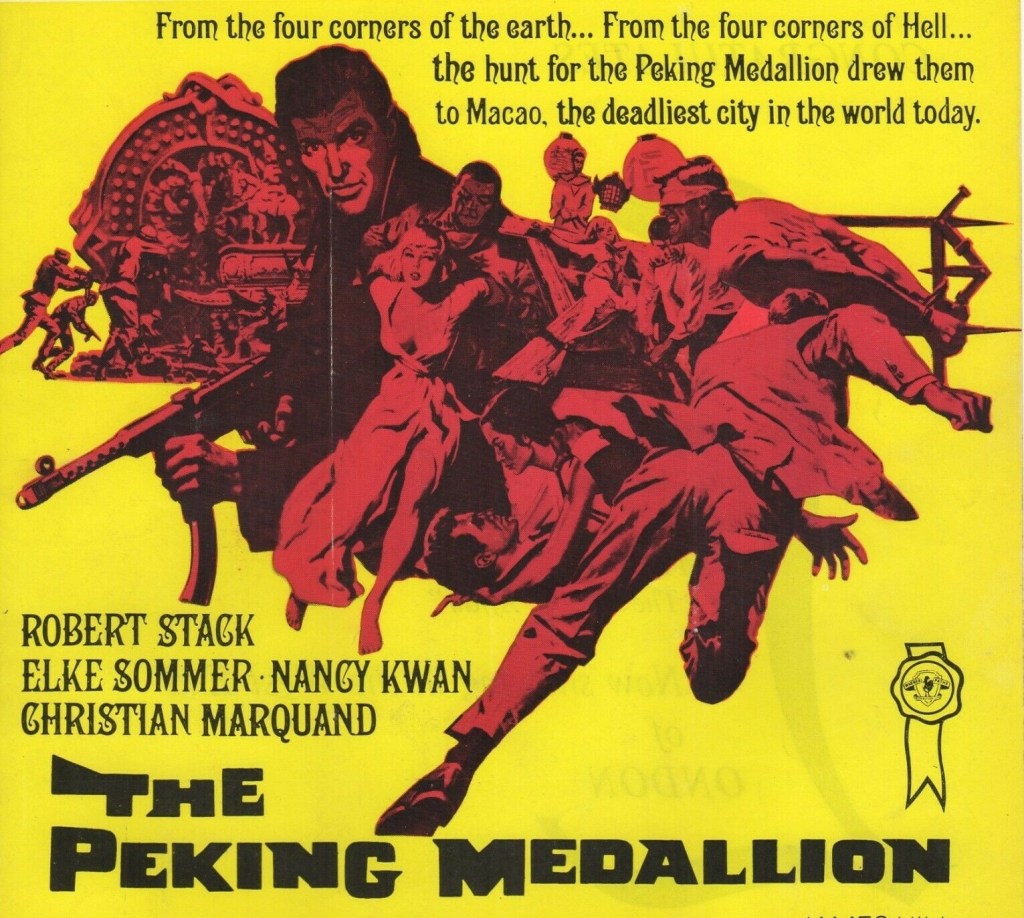
Stack faces danger with a quip, a kiss or gritted teeth, an old-fashioned tough guy without the James Bond self-awareness. He carries out his manly duties until his brain kicks in and he realizes this isn’t a spy picture after all but a genuine treasure hunt with clues that have to be deciphered. As this causes the movie to sidetrack down another route, it looks like the picture has lost the plot. But then all hell breaks loose and we are back on the safe ground of fistfights, double-crossing and shooting.
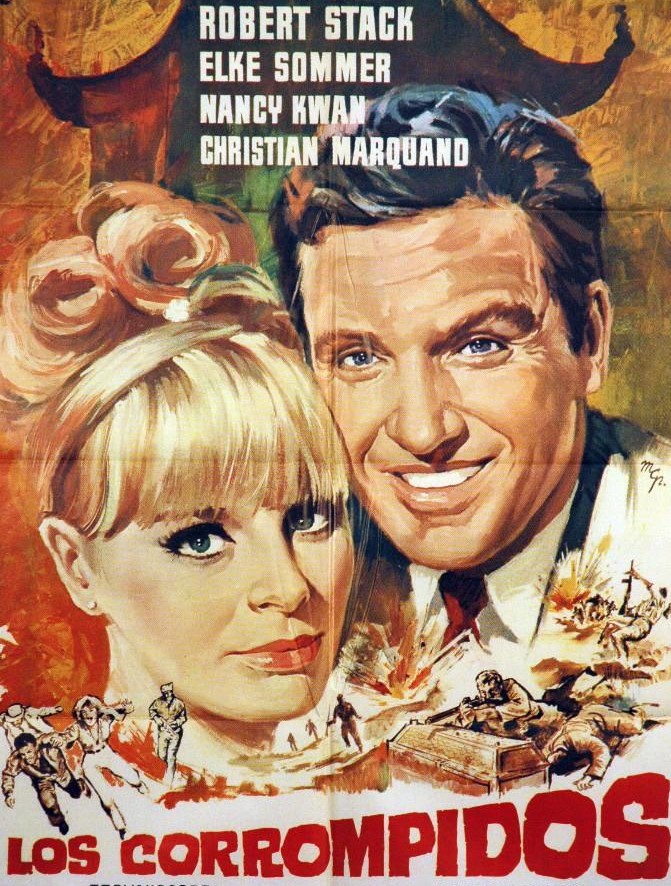
The script by Brian Clemens deftly mixes a variety of genres. What might have been a definite change of pace for British director James Hill given his previous effort was Born Free (1966) was anything but since he was responsible for the most recent Sherlock Holmes thriller A Study in Terror (1965).
Fans of improbable storylines, exotic settings, action, interesting bad guys and twists and turns will love this. How can you fail to love a movie with a fight featuring a samurai sword versus a camera tripod?
Many of the films from the 1960s are to be found free of charge on TCM and Sony Movies and the British Talking Pictures as well as mainstream television channels. But if this film is not available through these routes, then here is the link to the DVD and/or streaming service.
 The Magnificent 60s