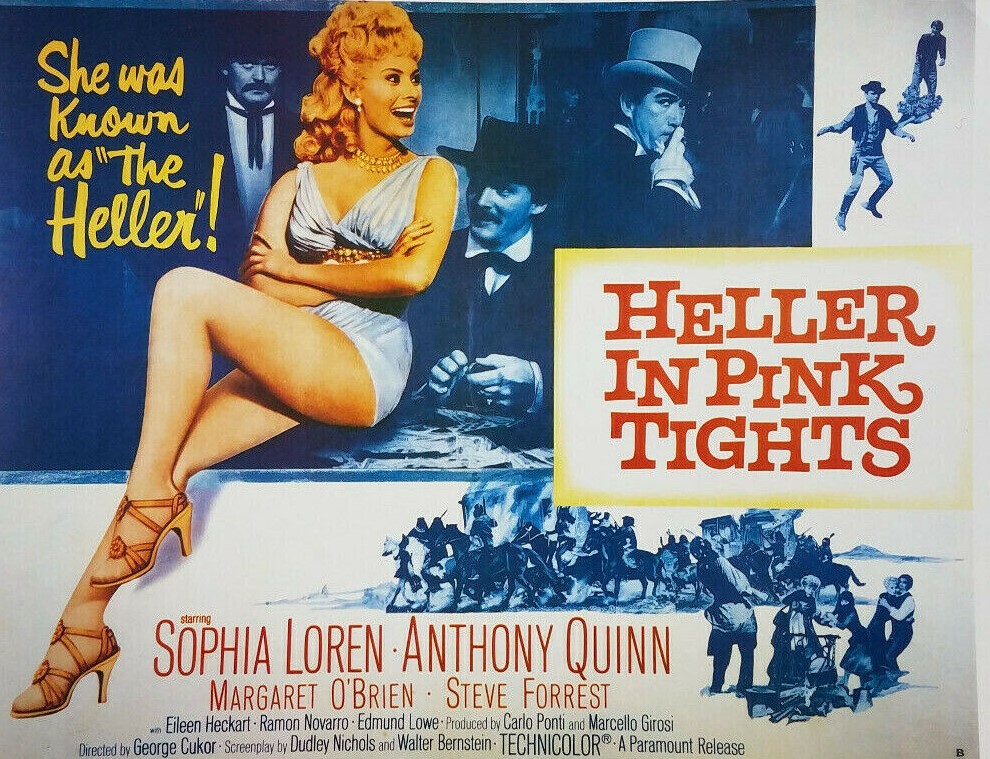
Heller in Pink Tights (1960) ****

Taken on its own merits, George Cukor’s western is a highly enjoyable romp. Hardly your first choice for the genre, Cukor ignores the tenets laid down by John Ford and Howard Hawks and the film is all the better for it. Although there are stagecoach chases, gunfighters and Native Americans, don’t expect upstanding citizens rescuing good folk. Instead of stunning vistas Cukor chooses to spend his budget on lavish costumes and sets.

You can see he knows how to use a colour palette, and there is red or a tinge of it in every scene (to the extent of rather a lot of red-haired folk), and although this might not be your bag – and you may not even notice it – it is what makes a Cukor production so lush. The film might start with comedic overtones but by the end you realise it is serious after all.
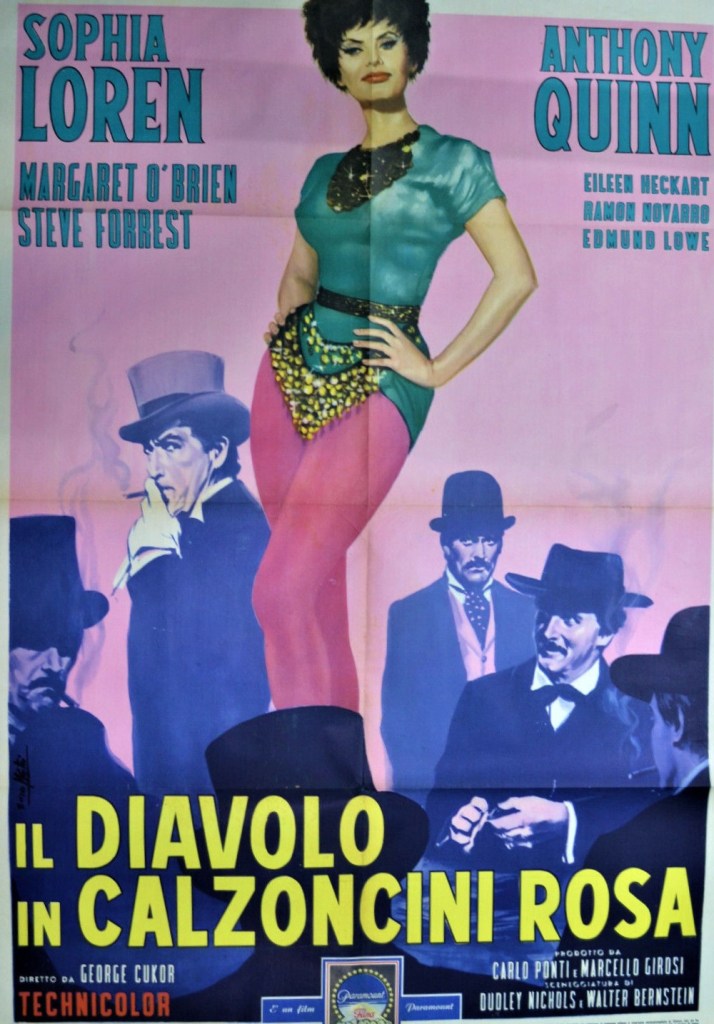
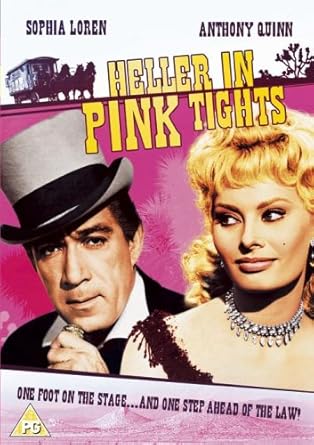
Angela (Sophia Loren) is the coquettish leading lady and Tom (Anthony Quinn) the actor-manager of a theatrical company managing to stay one step ahead of its creditors, in the main thanks her propensity for spending money she doesn’t have. Of course, once gunfighter Clint (Steve Forrest) wins Loren in a poker game, things go askew. 

Anthony Quinn (Guns for San Sebastian, 1968) had never convinced me as a romantic lead, but here there is genuine charisma between the two stars. Sophia Loren (Five Miles to Midnight, 1962) is at her most alluring, in dazzling outfits and occasionally in costumes as skin-tight as censors would allow in those days, but with a tendency to use beauty as a means to an end, with the conviction that a smile (or occasionally more) will see her out of any scrape. There is no doubt she is totally beguiling. But that is not enough for Quinn, as she is inclined to include him in her list of dupes.

While primarily a love story and a tale of theatrical woes set against the backdrop of a western, when it comes to dealing with the tropes of the genre Cukor blows it out of the water.  We open with a stagecoach chase but our heroes are only racing away from debt until they reach the safety of a state line. We have a gunfighter, but instead of a shoot-out being built up, minutes ticking by as tension rises, Cukor’s gunman just shoots people in sudden matter-of-fact fashion.

Best of all, George Cukor (Justine, 1969) extracts tremendous comedy from the overbearing actors, each convinced of their own genius, and the petty jealousies and intrigue that are endemic in such a troupe. An everyday story of show-folk contains as much incipient drama as the more angst-ridden A Star Is Born (1954), his previous venture into this arena.

From the guy who gave us The Philadelphia Story (1940) with all its sophisticated comedy, it’s quite astonishing that Cukor extracts so much from a picture where the laughs, mostly from throwaway lines, are derived from less substantial material. Quinn (his third film in a row with Cukor) has never been better, no Oscar-bait this time round, just a genuine guy, pride always to the forefront, king of his domain inside his tiny theatrical kingdom, out of his depth in the big wide world, and unable to contain the “heller.”

I won’t spoil it for you but there are two wonderful character-driven twists that set the world to rights.

There is a tremendous supporting cast with former silent film star Ramon Novarro (Ben-Hur: A Tale of the Christ, 1925) as a duplicitous businessman, former child star Margaret O’Brien, another star from a previous era in Edmund Lowe (Cukor’s Dinner at Eight, 1933), and Eileen Eckhart. Dudley Nichols (Stagecoach, 1939) and Walter Bernstein, who wrote a previous Loren romance That Kind of Women (1959) and had a hand in The Magnificent Seven (1960), do an excellent job of adapting the Louis L’Amour source novel Heller with a Gun, especially considering that contained an entirely different story.

Without a doubt it’s Cukor’s picture but Loren and Quinn combine to make it such a believable delight.
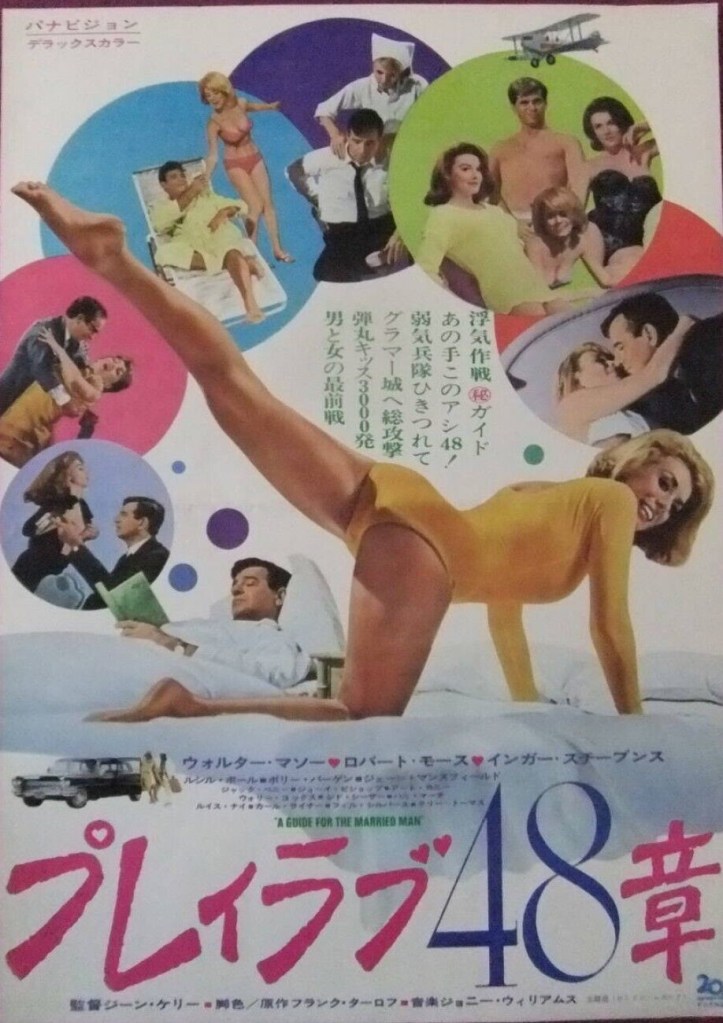
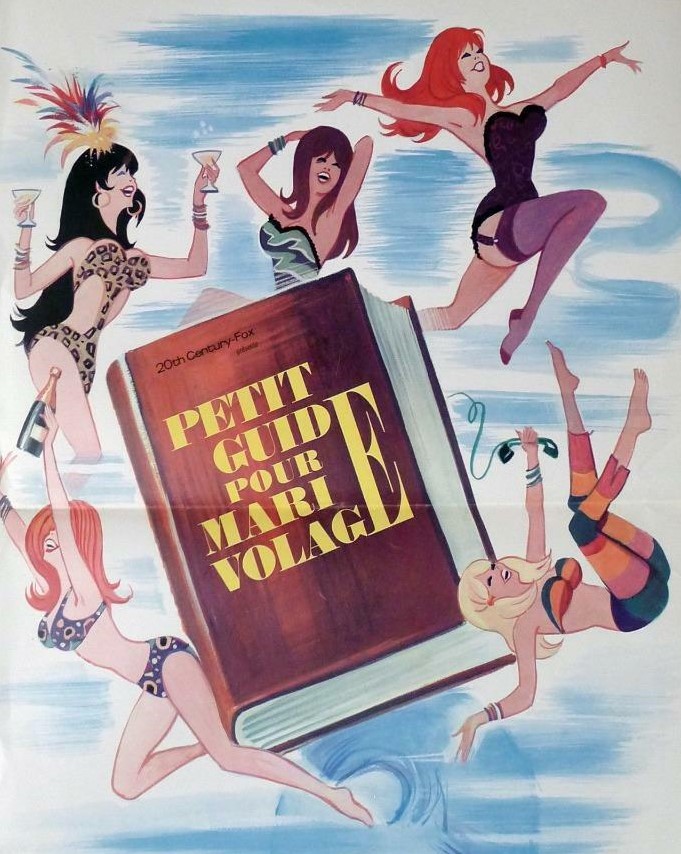
A Guide for the Married Man (1967) **

Little has dated as badly as this male supremacy sexist hogwash. While Billy Wilder can manage to inject some sophistication and even elegance into the thorny subject of adultery and male philandering (The Apartment, 1960), director Gene Kelly has little to offer but crudity.

Walter Matthau (The Fortune Cookie, 1966), top-billed for the first time, does little more than act as listener to neighbour Ed (Robert Morse), supposed expert on wifely deception and link man to a series of lame unconnected sketches featuring a battalion of cameo stars.

It’s more likely to be remembered for being the final film Jayne Mansfield (Playgirl after Dark/Too Hot to Handle, 1960) made before her premature death. Her episode might well sum up the depths of hilarity this opus stoops to – the compelling issue of what to do when your illicit companion loses her bra in your bedroom.

Perhaps the only amusing note is the notion that this has come from the pen of the Oscar-winning Frank Tarloff (Father Goose, 1964), responsible also for the source novel, drawing on the experiences of a bunch of “swingers” reputedly enjoying to the full the sexual excesses of the decade, a decidedly middle-aged gang intent on not leaving all the fun to the hippies and the liberated young

The women here are straight out of The Stepford Wives template of female docility, existing only to please their men, any passing woman automatically in the stunner bracket intent on demonstrating every wiggle possible. Worse, one is so weak that she can be easily manipulated into believing that she did not, in fact, catch her husband in bed with another woman once the wily man falls back on that old political adage of plausible deniability.

What makes the antics of Paul (Matthau) and Ed so reprehensible is that their wives are trusting knock-outs in the first place. Ruth (Inger Stevens), Paul’s other half, not just a keep-fit fanatic but a fabulous cook, able to present a superb meal on a miniscule budget.

So we are meant, I suppose, to sympathize with Paul’s flawed efforts at beginning an extra-marital affair. Or at the very least laugh at his failures, rather than mock his inadequacies as a husband. Paul’s main target is divorcee Irma (Sue Anne Langdon) but it’s no surprise Ed beats him to the punch. There’s an old-fashioned morality lesson at the end but I was hoping, instead, for a twist whereby smug Paul discovered his wife was playing away from home. Although, admittedly, that would be out of character for Ruth.

You might get through this if cameos are your thing and you want to spent a whole movie waiting for an appearance by It’s A Mad, Mad, Mad, Mad World (1963) alumni Sid Caesar, Jack Benny, Phil Silvers and Terry-Thomas plus the likes of Lucille Ball (Yours, Mine and Ours, 1968), Polly Bergen (Kisses for My President, 1964), Art Carney (Harry and Tonto, 1974), Carl Reiner (The Russians Are Coming, The Russians Are Coming, 1966), Linda Harrison (Planet of the Apes, 1968) and Jeffrey Hunter (Custer of the West, 1967).

Walter Matthau just about keeps this afloat and lucky for his career he had The Odd Couple (1968) up next. Inger Stevens (Firecreek, 1968) is wasted.

This was a box office riot on initial release, but times have changed. Gene Kelly (Hello, Dolly!, 1969) directs with a leaden hand. 

Guide to a Slimeball might be a better title.

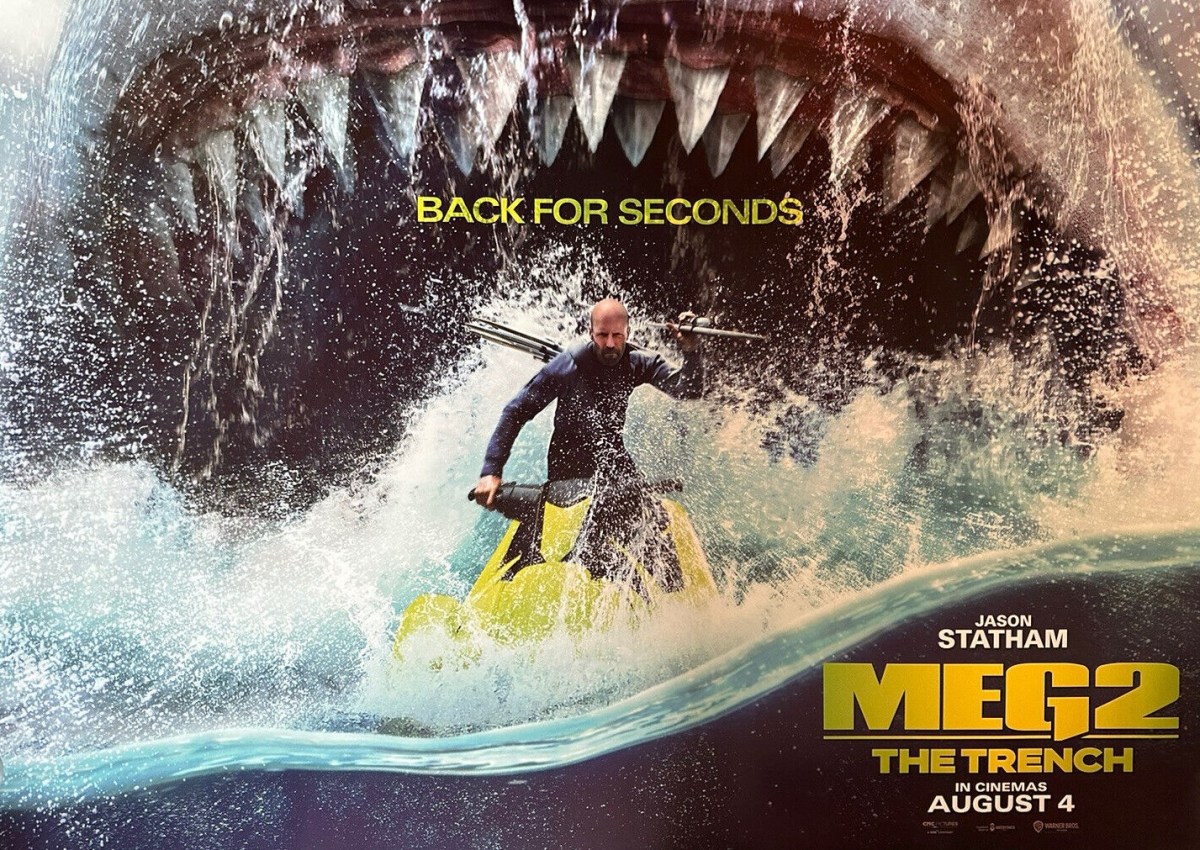
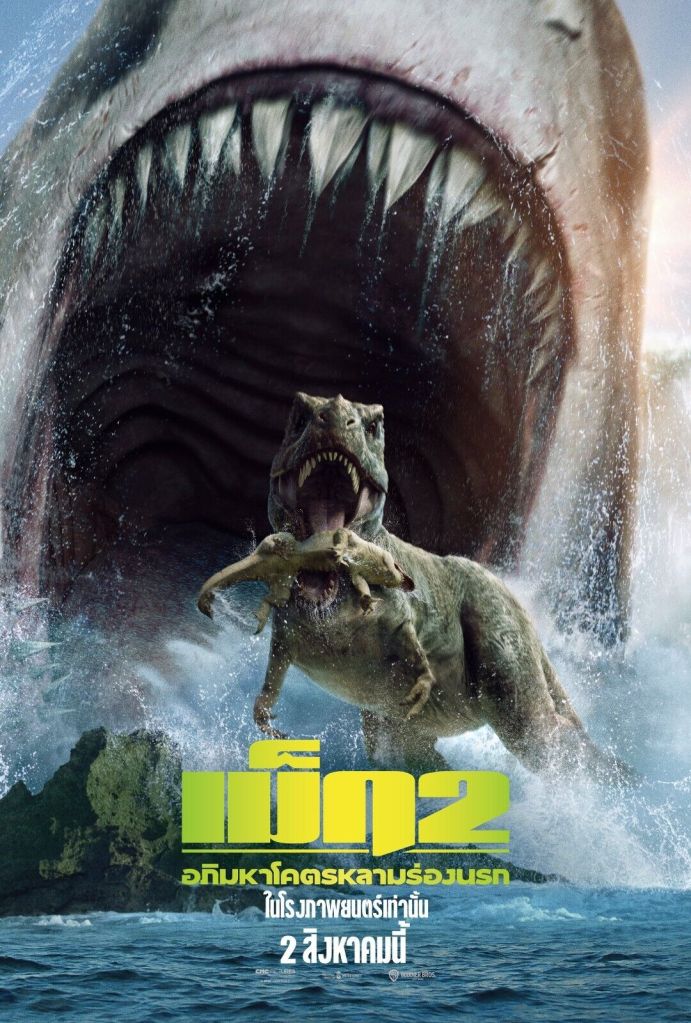
Meg 2: The Trench (2023) **** vs The Dive (2023) **

Once you get over the notion of Jason Statham as an eco-warrior, and alternating between grumpy and cuddly step-dad, and that the eco-goodies are actually hypocritical eco-baddies, pillaging the depths of the ocean for the equivalent of Avatar’s unobtainium, and the top scientist who keeps a captive Megaladon in check by what looks like dog-training techniques, and the usual gobbledegook sci-fi anomalies, you are in for a hell of a ride as a trio of Megs start chomping down on the kind of witless holidaymakers who peppered the likes of Piranha 3D.

There are neat references to Jurassic Park and nods to Chinese rather than American culture, especially in veneration of the old, and the action, once it surfaces from the gloomy depths, is breath-taking. Perfect summer popcorn material. You can pretty much ignore the MacGuffin, whose sole purpose is to ensure the Megaladons are freed from climactic imprisonment – the “thermoclime” – in the Mariana Trench.

Given there’s a fair bit of plotty-plot-plot to get through it’s just as well we kick off with action. Jonas (Jason Statham) ingeniously bursts out of a container on a merchant ship dumping hazardous waste and having captured on film the evidence he requires is scooped from the ocean like a drowned rat by a seaplane with giant jaws. Deep-sea exploration company owner Jaining (Wu Jin) has teamed up with billionaire investor Hillary (Sienna Guillory) to make further forays into the aforementioned trench.

On a routine dive in a far-from-routine submersible, Jonas’s teenage step-daughter Meiying (Shuya Sophia Cai) stows away so when the crew discover an illicit mining operation and that the captive Meg has escaped and teamed up two other Megs, the stakes couldn’t be higher. It’s a bit murky down below and despite the various oohs and aahs of the explorers nothing really stunning on view. Still, that’s not what we’re here for, and luckily Avatar-style visuals take second place to more action as Jonas, striding along the trench floor in exosuit, has to save all from the ruthless mercenary Montes (Sergio Peris-Mencheta).

But, really, this a mere prelude to what’s going to happen once everyone, creatures included, surface. The Megs are slick operators, keeping tight formation as they tear through the water. Fancying a tourist snack, the creatures home in on Fun Island. Jonas has his work cut out saving the innocent rich from the quartet of predators and a bunch of nasty prehistoric amphibians while fending off Hillary and her gang of thugs.

It’s certainly inventive enough and occasionally light-hearted and the action is spread out among the various participants, Meiying proving a chip off the old block, and no romance this time getting in the way. Heartless villain Hillary is despatched in the most obvious homage to Jurassic Park and the climax, as you might expect, is Jonas going one-on-one with any alpha male, whether Montes or the gigantic creatures. Explosives taped to harpoons, explosives made out of fertilizer, and helicopter rotors are among the improvised weapons.

While you couldn’t accuse it of being thoughtful, and you might even consider it a shade cynical in its use of eco-activism, it never takes itself seriously, which means it’s just a whole load of fun. Go looking for anything more meaningful or more cinematic (a la Steven Spielberg) and you’re wasting your time. But who, really, would make such a mistake. The popcorn is calling.

Certainly, compared to arthouse cop-put The Dive it’s a work of genius. This purported anti-blockbuster resorts to info-dumps to create any sort of suspense. By the time you’re halfway through you’re desperate for a shark, octopus, manta-ray, demon of the deep, to gobble up this hapless pair of divers, sisters Drew (Sophie Lowe) and May (Louisa Krause). If it had the conviction of its arthouse credentials, there would have been a tragic ending, the incompetent Drew unable to save the resourceful, efficient, May, trapped underwater by an unexplained rockfall.  

The falling rocks manage to bury their rucksacks, including car keys, but magically miss the jetty yards away.  For no earthly reason except it fits the story, May can’t open the car boot to find a tire lever. For no earthly reason, as an experienced diver, and although her life depends on it, she doesn’t know how to properly attach an oxygen tank. And quite how, in her bewilderment, and in murky depths, she manages to find the trapped sister time and again is baffling. And when she does find the solution to releasing her sister it’s one of those daft ideas straight out of Apollo 13 that you sit there questioning. Naturally, there’s a pocket of trapped air underground just when it’s most needed.

But, mostly, Drew’s running around like a headless chicken and for some reason that detracts rather than builds suspense. Half the time we’re getting info dumps, not of the time-running-out variety, but on how far down they are and what you’ve got to do avoid the bends.  But you discover less about the characters than in The Meg 2, and care even less. Drew is grumpy, disillusioned for some reason, while May is sparky and enthusiastic and any time the supposed suspense gets too much director Maximilian Erlenwein cuts away to their carefree childhood or to a conversation that is meant to have hidden meaning.

Rotten Tomatoes critics rate The Dive (69%) above Meg 2 (30%) but audiences, who know better, go the other way, 73% for the monster-filled concoction, 50% for the monster-free bore.

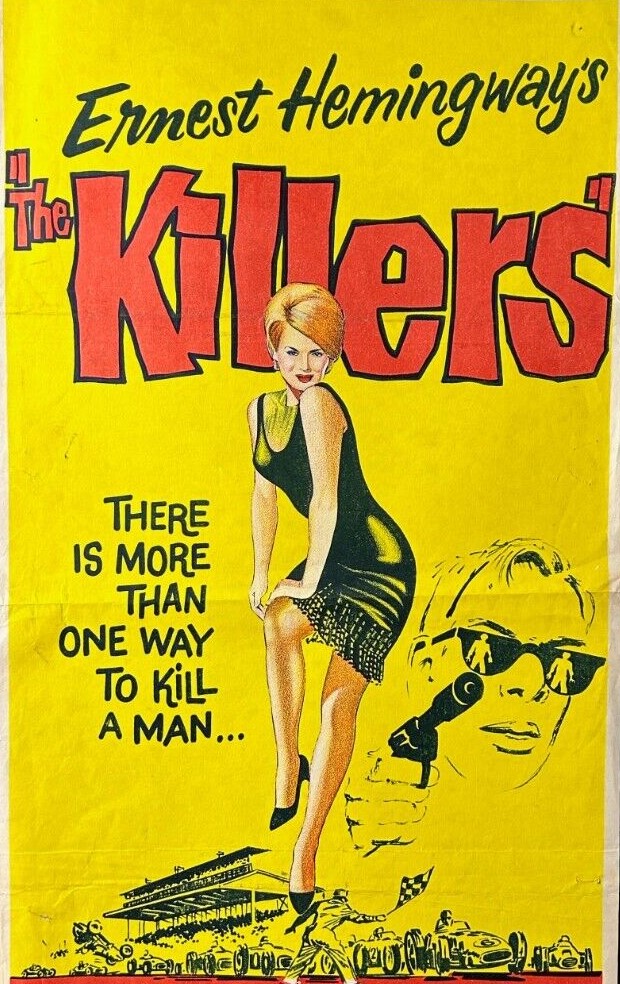
The Killers (1964) ****

Angie Dickinson (Jessica, 1962) is the standout as the cold-blooded double-crossing femme fatale in this slick tale of a double heist. Sure, Lee Marvin (The Professionals, 1966) attracted the bulk of the critical attention as the no-nonsense hitman and John Cassavetes (Machine Gun McCain, 1969) attempts to steal the show as the dupe, but Dickinson walks away with it. Although he makes a vicious entrance, Marvin really only tops and tails the movie.

Violence wasn’t the marketable commodity it proved later in the decade, and this was initially made with television in mind, so it’s surprising how stunning the brutality remains today. In the opening sequence, set in a home for the blind, hitmen Charlie (Lee Marvin) and Lee (Clu Gulager) knock around a sightless receptionist before moving on to shooting at point-blank range their victim, ex-racing driver Johnny North (John Cassavettes). But when they get to thinking why they were paid way over the odds to shoot North, they discover he was involved in a million-dollar heist and before you can say flashback we tumble into the story of how gangster’s moll Sheila (Angie Dickinson) lured him into participating in the robbery organized by boyfriend Jack (Ronald Reagan).

There’s nothing particularly complicated about Jack’s plan – hijacking a mail truck on a remote road – but the movie takes its sweet time getting there, focusing on Johnny’s racetrack antics and on Sheila nudging Johnny into the illegal kind of pole position. She’s pretty convincing as the all het-up lover to the extent of persuading Johnny to double-cross Jack but her convictions only run one way – to whatever best suits herself.

Eventually, it appears as if the million bucks has disappeared into thin air. Jack presents himself as an honest businessman, but Sheila only holds to the party line for as long as it takes the hitmen to dangle her from a fourth-storey window. But gangsters are rarely as amenable or as dumb as the schmucks they snooker, so Jack is more than able to take care of himself and his property (counting the loot and Sheila in that category).

There might be twists a-plenty but the main narrative thrust is which way will Sheila spin? Was she ever even in love with Johnny? Or having snared Johnny and then managed to convince him to double-cross Jack did she plan to run off with the money herself? Or was she going to double-cross him all along once his usefulness was over?

And even if her heart is in the right place, then that’s plain tragic, stuck with the lout, unable to break free, perhaps playing all the alpha males off against each other her only hope of maintaining her fine lifestyle while not ending up another casualty.

A surprising chunk of time is spent on the racecourse, not just building up the romance and  endorsing Johnny’s driving skills, and as well as the tension of a specific race – and the possibility that too much loving could fatally damage the driver’s track ambitions – you are kept in some kind of narrative limbo as you keep wondering when the heck the killers are going to re-enter the equation.

Don (here credited as Donald) Siegel (Coogan’s Bluff, 1968) directs with considerable aplomb, especially as this carries a television-movie-sized budget and that he hadn’t had a stab at a decent picture since making his initial mark with Invasion of the Body Snatchers (1956). From the iconic opening shot of a pair of dark sunglasses to the sad greed-soaked finale, Siegel’s brilliant use of sound and movement plays in stark contrast to moments of stillness and silence. Throw in aerial tracking sequences, realistic race scenes, and one bold shot of a handgun being pointed at the audience (a similar shot in his Dirty Harry, 1971, ruffled more feathers and generated more critical note).   

But the director’s cleverest ploy is to introduce the hitman, then dive elsewhere, leaving audiences begging for more. So it’s just as well that Angie Dickinson delivers in spades. You need to believe she could be as conniving as she is seductive for the entire tale to work. She is the linchpin far more than Lee Marvin.

And that’s to take nothing away from his performance, a far cry from the over-the-top villains of The Commancheros (1961) and The Man Who Shot Liberty Valance (1962), setting up the template for the later quiet-spoken thug of Point Blank (1967).  

As highly watchable as this is, it wasn’t a career breakout for any concerned. Lee Marvin was just a supporting actor on Ship of Fools (1965) and far from first choice for Cat Ballou (1965), the movie that did make his name. Don Siegel wasn’t offered another movie for four years. Angie Dickinson tumbled down the credits, reduced to second female lead in The Art of Love (1965) and working in television or in movies as a supporting actor until the low-budget The Last Challenge/Pistolero of Red River (1967).

Ronald Reagan bowed out of the movies after this. Clu Gulager, who had a running role in The Virginian (1963-1968) only made three movies in the next seven years.

Gene Coon (Journey to Shiloh, 1968) adapted the short story by Ernest Hemingway which when previously filmed in 1946 marked the debut of Burt Lancaster with the sultry Ava Gardner as the femme fatale.  

Striking, tense, and a must for fans of Dickinson, Marvin and Siegel.

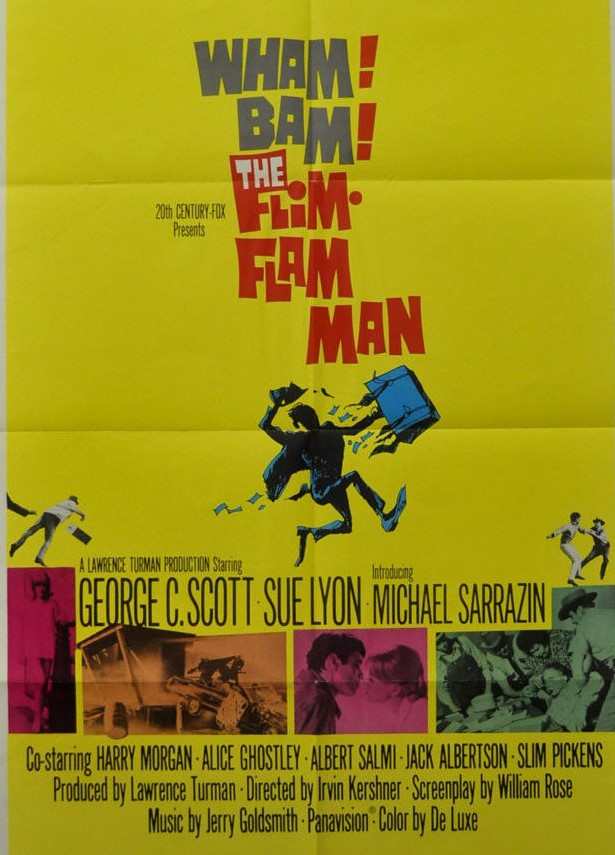
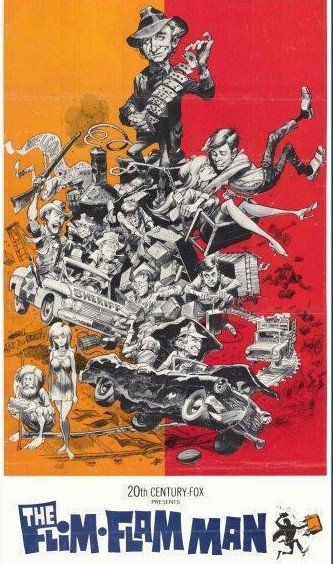
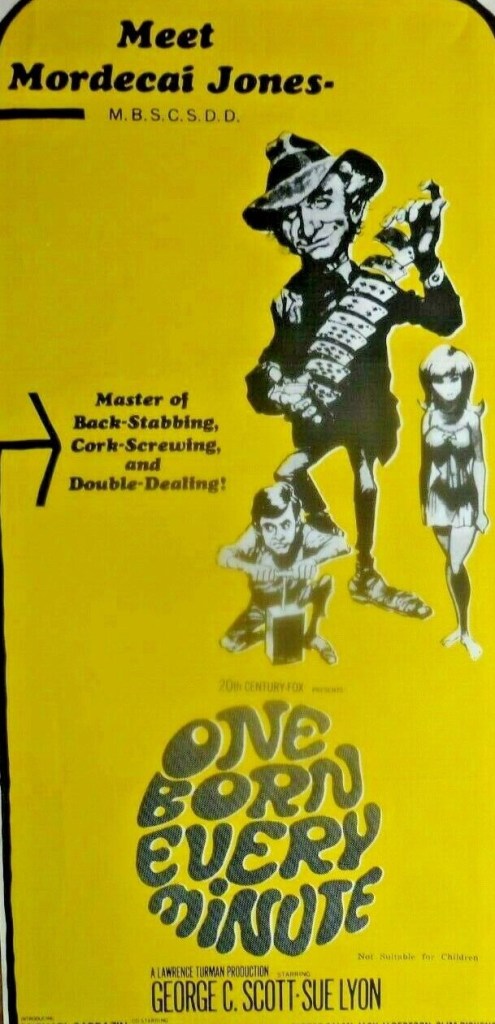
The Flim Flam Man / One Born Every Minute (1967) ***

Throwback to It’s A Mad, Mad, Mad, Mad World (1963), prelude to Smokey and the Bandit (1977) and in the middle of the car chases and town wrecking a character study of a pair of grifters, one veteran, the other his pupil.

U.S. Army deserter Curley (Michael Sarrazin) teams up with veteran con man Mordecai (George C Scott) who teaches him the tricks of the trade. There’s nothing particularly innovative about the older man’s techniques – Find the Queen, The Lost Wallet, selling hooch as genuine whiskey – and the rewards are not particularly rewarding unless you are living at scavenger level in whatever run-down habitat you can find.

The dumb cops, Sheriff Slade (Harry Morgan) and Deputy Meshaw (Albert Salmi), aren’t quite so stupid otherwise they wouldn’t occasionally happen upon their quarry. And the larcenous duo offer nothing more clever by way of escape except to hijack vehicles.

So once you get past the aforementioned car chases and town wrecking it settles down into a gentle old-fashioned drama. Luckily all the good ol’ boy shenanigans are limited to the police, and neither main character is afflicted by over-emphatic accents.

Mordecai ain’t no Robin Hood nor a criminal mastermind who might have his eyes on a big- money heist. His ethos is stealing not so much from the gullible but the greedy. All his suckers think they can make an easy killing from a guy who appears a harmless old duffer.

He’s not looking for a big score because he’s got nobody to settle down with and because, although on a wanted list (as “The Flim-Flam Man” of local legend) he’s not going to exercise the authorities except cops with very little otherwise to do. He is as laid-back a drifter as they come.

Curley offers the drama. He starts to have qualms not so much about stealing from the greedy but about the repair bills for the cars they wrecked, especially one belonging to the young innocent Bonnie Lee (Sue Lyon), to whom he takes a fancy. While she reciprocates it’s only up to a point, having the good sense not to hook up with a criminal, so eventually he has to choose between giving himself up and serving time in the hope Bonnie Lee will hang around and severing his links with Mordecai, whom he treats as a father figure.

How he works that out is probably the best scene, especially given his temporary profession. Whether this is the first picture to feature so prominently incompetent cops rather than either the tough or corrupt kind I’m not sure but Slade and Meshaw take some beating.

In his first starring role, Michael Sarrazin (Eye of the Cat, 1969) is the cinematic catch. All the more so because director Irvin Kershner doesn’t take the easy route of focusing on his soulful eyes, permitting the actor to deliver a more rounded performance. He’s certainly more natural here than any future movie where he clearly relied far more on the aforementioned soulful eyes.  

While I’m not sure the ageing make-up does much for him, George C. Scott (Petulia, 1968), in his first top-billed role, tones down the usual operatics and makes a convincing loner who can make one good romantic memory last a lifetime. He switches between completely relaxed to, on spotting a likely victim, sharp as a tack. The harmless old man guise falls away once he smells greed, replaced by cunning small-time ruthlessness.

Sue Lyon (Night of the Iguana, 1964) has little to do except not be the sex-pot of her usual screen incarnation and that’s to the good of the picture. By this stage of his career Harry Morgan was more likely to be found in television so it’s a treat to see him make the most of a meaty supporting part. Look out for Strother Martin (Cool Hand Luke, 1967) and Slim Pickens (Rough Night in Jericho, 1967).

Irvin Kershner (A Fine Madness, 1966) appears on firmer ground with the drama than the wild car chase/town wrecking but I suspect it takes more skills to pull off the latter than the former where the actors can help you out. Though I notice Yakima Canutt is down as second unit director so he might be due more of the credit. Screenwriter William Rose had already plundered the greed theme and, to that extent the car chase, for his seminal It’s A Mad, Mad, Mad, Mad World.

The outlandish elements, fun though they are, give this an uneven quality that gets in the way of a tidy little picture.

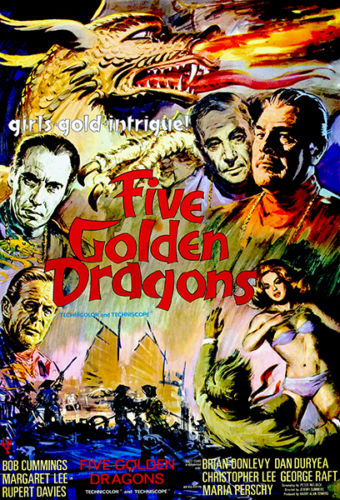
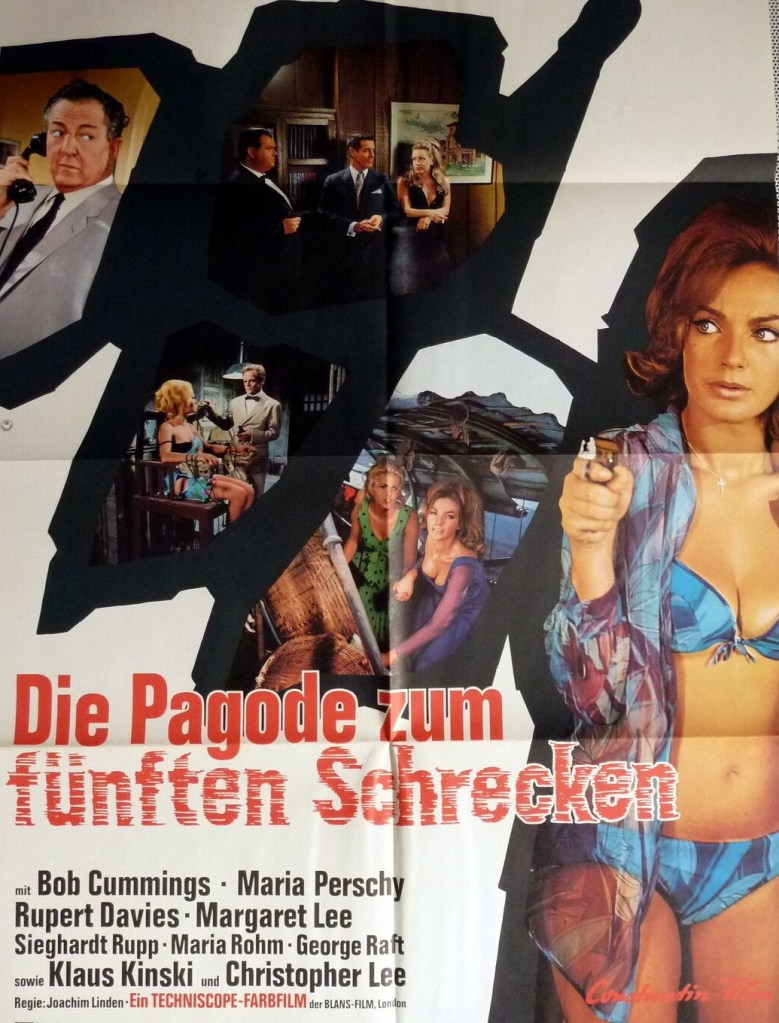
Five Golden Dragons (1967) ***

Producer Harry Alan Towers, himself something of a legend, had put together a quite superb cast – rising Eurostar Klaus Kinski (A Bullet for the General, 1967), Hollywood veterans Robert Cummings (Dial M for Murder, 1954), George Raft (Scarface, 1932), Dan Duryea (Black Bart, 1948) and Brian Donlevy (The Great McGinty, 1940) plus British horrormeister Christopher Lee and Rupert Davies (television’s Maigret). Throw in Margaret Lee (Secret Agent, Super Dragon, 1966) and Austrians Maria Perschy (Kiss, Kiss, Kill, Kill, 1966) and  Maria Rohm (Venus in Furs, 1969).

And all in aid of an enjoyable thriller set in Hong Kong that dances between genuine danger and spoof. I mean, what can you make of a chase involving rickshaws? Or a race over bobbing houseboats parked in a harbor? There’s a Shakespeare-quoting cop Sanders (Rupert Davies) whose sidekick Inspector Chiao (Tom Chiao) often out-quotes him. And there’s British-born Margaret Lee, a cult figure in Italian circles,  belting out the title song and just for the hell of it Japanese actress Yukari Ito in a cameo as a nightclub singer.

A newly arrived businessman is chucked off the top of a building by an associate of gangster Gert (Klaus Kinski)  but not before leaving a note that falls into the hands of the police. The note says, “Five Golden Dragons” and is addressed to playboy Bob (Robert Cummings) for no particular reason. No matter. A MacGuffin is still a MacGuffin, and probably best if left unexplained.

Bob is soon involved anyway after falling for two beautiful sisters, Ingrid (Maria Rohm) and Margret (Maria Perschy). Turns out Margret knows more about Bob than he would like, and knows too much for her own good, namely that the titular dragons are the heads of an evil syndicate, specializing in gold trafficking, meeting for the first time in Hong Kong in order to organize the handover of their empire to the Mafia for a cool $50 million  

In a nod at the spy genre, there are secret chambers opened by secret levers. There are double-crosses, chases, confrontations, not to mention a a trope of sunglasses being whipped off, voluntarily I might add.  Apart from breaks here and there for a song or two, director Jeremy Summers (Ferry Across the Mersey, 1964) keeps the whole enterprise zipping along, even if he is stuck with Cummings.

In truth, Cummings (Stagecoach, 1966) is a bit of a liability, acting-wise. While the rest of the cast takes the film seriously, he acts as if he’s a Bob Hope throwback, cracking wisecracks when confronted with danger or beautiful women, or, in fact, most of the time, which would be fine if he wasn’t a couple of decades too old (he was 57) to carry off the part of a playboy and if the jokes were funny. 

Towers (under the pseudonym Peter Welbeck responsible for the screenplay, loosely based on an Edgar Wallace story) was a maverick but prolific British producer who would graduate to the likes of Call of the Wild (1972) with Charlton Heston but at this point was churning out exotic thrillers (The Face of Fu Manchu, 1965) and mysteries (Ten Little Indians, 1965) and had a good eye for what made a movie tick. This one ticks along quite nicely never mind the bonus of a sinister George Raft and the likes of Margaret Lee and Maria Rohm (Towers’ wife).

Cult contender that doesn’t take itself too seriously.

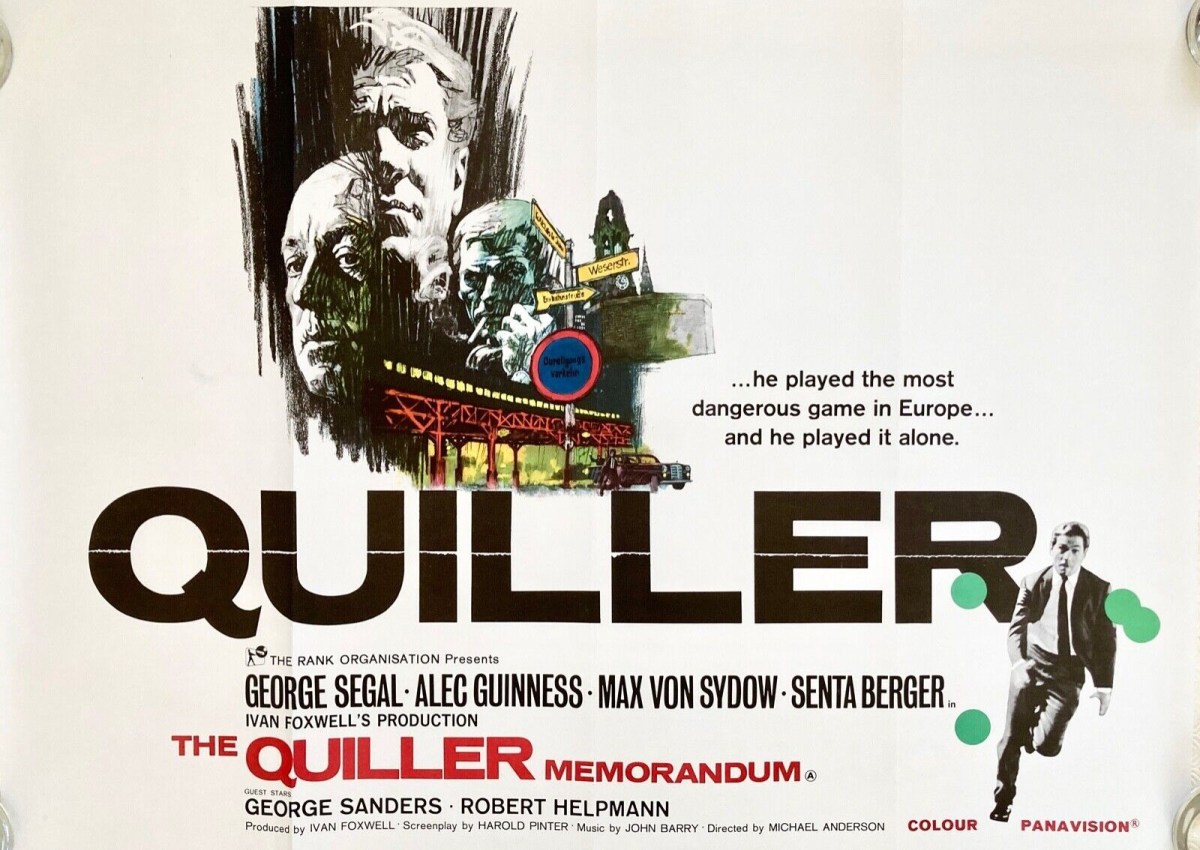
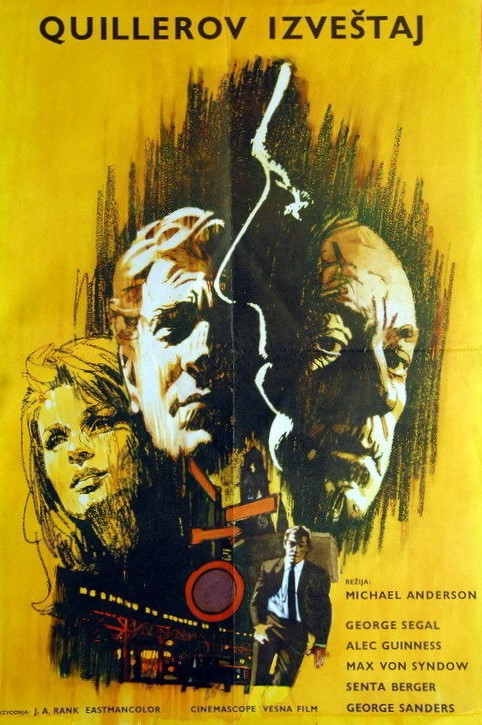
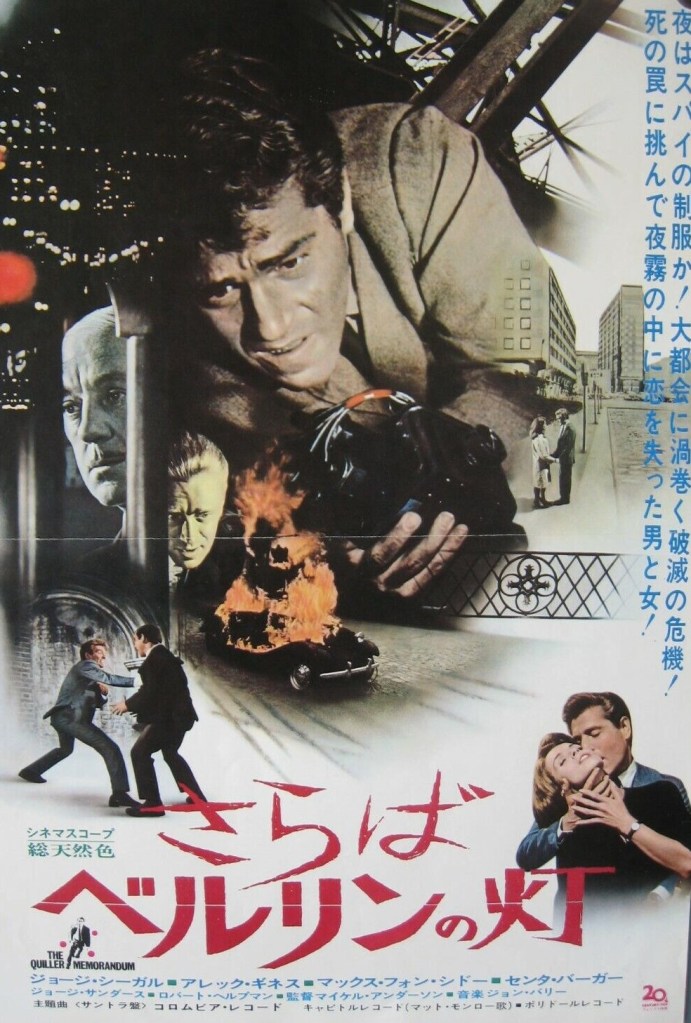
The Quiller Memorandum (1966) ****

Stylish cat-and-mouse thriller that fits into the relatively small sub-genre of intelligent spy pictures. George Segal was a difficult actor to cast. He had a kind of shiftiness that lent credibility to a movie like King Rat (1965), a cockiness that found a good home in The Southern Star (1969) and an earnestness ideal for Who’s Afraid of Virginia Woolf (1966).

But Quiller fit his screen persona like a glove. The part called for charm to the point of smarminess and courage to the point of callousness. A lone wolf for whom relationships were a means to an end, he adopted identities – journalist, swimming coach etc– as the occasion suited. His undercover mission is to expose a neo-Nazi organisation. But just as he seeks to discover the location of this secret enterprise, so his quarry attempts to find out where his operation is based. 

Michael Anderson (The Dam Busters, 1955) had just finished his first spy effort, Operation Crossbow (1966) and that film’s documentary-style approach was carried on here but with a great deal more style. There is consistent use of the tracking shot, often from the point-of-view of one of the protagonists, that gives the film added tension, since you never know where a tracking shot will end. Although the film boasts one of John Barry’s best themes, Wednesday’s Child, there was a remarkable lack of music throughout. Many chase scenes begin in silence, with just natural sounds as a background, then spill out into music, and then back into silence.

But much of the heavy lifting is done by playwright Harold Pinter (The Servant, 1963) in adapting Adam Hall’s prize-winning novel. Hall was one of the pseudonyms used by Trevor Dudley-Smith who wrote The Flight of the Phoenix (1965) under the name Elleston Trevor. The Quiller Memorandum involved wholesale change, from the title (the book was called The Berlin Memorandum) onwards. Quiller is now an American, not British, drafted in from the Middle East.

The book is set against the background of war crime trials; Quiller a British wartime rescuer of Jews now tracking down war criminals; the main female character (played in the film by Senta Berger) had, as a child, been in Hitler’s bunker; and there is a subplot concerning  a bubonic plague; there was a preponderance of obscure (though interesting for a reader) tradecraft; plus the Nazi organisation was named “Phoenix.”

While retaining the harsh realities of the spy business, Pinter junks most of this in favour of a more contemporary approach. Instead of meeting his superior Pol (Alec Guinness) in a theater, this takes place in the Olympiad stadium. Guinness’s upper crust bosses, Gibbs (George Sanders) and Rushington (Robert Flemyng), are more interested in one-upmanship. Berlin still showed the after-effects of the war and Pinter exploits these locales.

One lead takes him to Inge (Senta Berger), an apparently innocent teacher in a school where a known war criminal had worked.

But the core remains the same, Quiller prodding for weaknesses in the Nazi organisation. his opposite number Oktober (Max von Sydow) allows him to come close in the hope of reeling him in and forcing him to reveal the whereabouts of his operation. Quiller plays along in order to infiltrate the Nazis.

There is a lot of tradecraft: “do you smoke this brand” (of cigarettes) is the way spies identify themselves; Quiller followed on foot turns the tables on his quarry; the American is poisoned after being prodded by a suitcase; Quiller employs word associations to avoid giving away real information.

Having flushed out his adversaries, Quiller is now dangerously exposed. But that’s his job. He’s just a pawn to both sides. He’s virtually never on top unlike the fantasy espionage worlds inhabited by James Bond, Matt Helm and Derek Flint.

The structure is brilliant. Quiller spends most of the picture in dogged bafflement. The  supercilious Pol flits in and out, as if such work is beneath him.Quiller is stalked and stalks in return. There are exciting car chases but the foot chases (if they can be called that) are far more tense.

But the core is a bold thirteen-minute interrogation scene where Quiller s confronted by Oktober. As an antidote to the thuggery and danger to which he is exposed, Quiller becomes involved with Inge.

Segal is a revelation, grown vastly more mature as an actor after Who’s Afraid of Virginia Woolf (1966) for which he was Oscar-nominated, confident enough to abandon the showy carapace of previous pictures. This is a picture where he sheds layers, from the opening brashness to the sense of defeat in surviving the interrogation ordeal, knowing the only reason he is still alive is to lead the enemy to his own headquarters, buoyed only by inner grit. He hangs on to his identity by his fingertips.

And it’s a revelation, too, or perhaps a backward step for Max von Sydow, who presented a less clichéd character in The Reward (1965). While dangerous enough, it looks like he is already slipping into the category of foreign villain.

Senta Berger (The Secret Ways, 1961) is hugely under-rated as an actress. She was in the second tier of the European sex bombs who came to prominence in the 1950s and 1960s, the top league dominated by Brigitte Bardot, Sophia Loren and Gina Lollobrigida. On screen she is not as lively as those three, but the quiet intensity of her luminous beauty draws the camera in.

Here, she is utterly believable as the innocent women who, in falling for Segal, is dragged into his dangerous world.  She was criminally under-used by Hollywood, often in over-glamourous roles such as The Ambushers (1967) or as the kind of leading lady whose role is often superfluous.

Discussion of Alec Guinness as a spy inevitably turns to his role as George Smiley in the BBC series Tinker, Tailor, Soldier, Spy (19790 and its sequel three years later, but this is a less dour portrayal, almost whimsical in a way.  

A must-see for collectors of the spy genre.

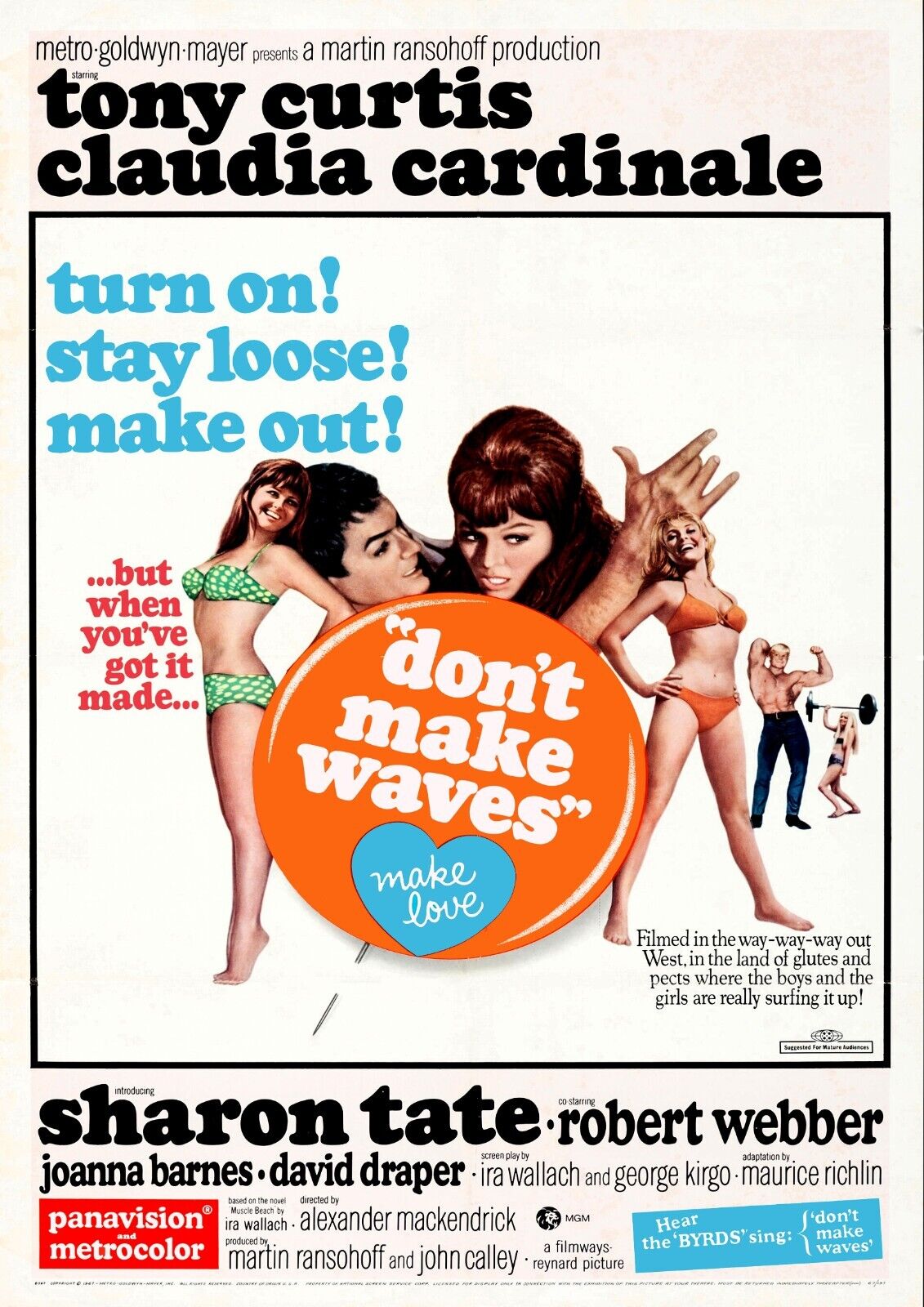
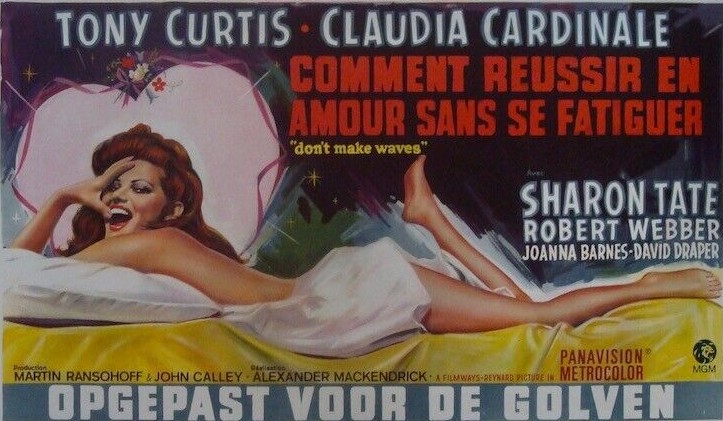
Don’t Make Waves (1967) ****

Unfairly maligned on release. Part throwback screwball comedy, part farce, part satire and in low-key fashion the first disaster movie. Oddly enough, that wild combination hits the mark. Tony Curtis makes amends for Boeing Boeing (1965). Claudia Cardinale on top form as a ditzy brunette. Last hurrah for Ealing Comedy grey eminence Alexander Mackendrick (A High Wind in Jamaica, 1965). Plus Sharon Tate as a sky-diver. What’s not to like?

Hardly surprising though at the time it got the thumbs-down from critics and the cold shoulder from audiences. A very late arrival to the short-lived beach movie cycle and unlikely to compete with the harder-edged satires like The Russians Are Coming, The Russians Are Coming (1966) and Divorce American Style (1967) or the latest off the Neil Simon conveyor belt Barefoot in the Park (1967).   

Marvelous opening with sight gags galore sees vacationer Carlo (Tony Curtis) wrestling with a runaway car then seeing hapless wannabe artist Laura (Claudia Cardinale) accidentally setting fire to the vehicle. To make amends for destroying all his belongings, she invites him to stay the night. Unfortunately, her married lover Rod (Robert Webber) turns up, cueing a whole layer of farce, traditional bedroom-style here but later even better in the office, properly done this time compared to Boeing Boeing.

The next day Carlo is rescued from drowning by Malibu (Sharon Tate) with whom he promptly falls in love and attempts to separate her from her hulk of a boyfriend Harry (David Draper), all muscle but little brain and prone to easily-exploited bouts of depression.

Carlo is the smarter younger brother of the character in Boeing Boeing, managing to muscle in on Rod’s swimming pool business and demonstrating his sharp salesmanship skills. Except that Laura is so shrill and a kept woman, you’d expect him to be more interested in her than Malibu, but then where would be we be without a love triangle. In an odd sub-plot involving an astrologer (Ed Bergen), Carlo manages to win over Malibu. Meanwhile, Rod’s smarter wife Diane (Joanna Barnes) infiltrates her husband’s cosy love nest.    

Although Carlo is effectively set up as somewhat shifty hero he undergoes a series of humiliations, brought down to earth by being repeatedly picked up and carried like a doll by Harry, and being drowned in mud. Other times he lives high on the hog, realizing he could make a killing here.

There’s no great plot, just the usual misunderstandings, but, unusually, characters are given moments of self-reflection and self-deprecation, and the satire focuses on the self-involvement of the beautiful people. There’s a fair bit of ogling but the camera is gender-equal, the toned bodies of the muscle men given as much attention as any passing female in a bikini.

I found myself chuckling all over the place, mostly at the antics of Carlo. This is a pretty good performance by Tony Curtis, mugging kept well under control but adept at physical comedy. And Claudia Cardinale (Once Upon a Time in the West, 1968) is equally game, drenched for a good chunk of time, and hit by sudden self-awareness as the tale unfolds. You might balk at her high-tempo performance but otherwise the set-up wouldn’t work. If she wasn’t so annoying why would Carlo look elsewhere for romance?

The disaster element involves a runaway clifftop house, a situation created by the unlucky Laura, and it doesn’t take much to see what elements The Poseidon Adventure filched, playing it for drama rather than comedy.

While not in the same category Mackendrick classics The Man in the White Suit (1951), The Ladykillers (1955) or even The Sweet Smell of Success (1957) – co-starring Curtis – this is not to so far off. Mackendrick excels at building the comedy, confidently marshals the farce, but, more importantly, doesn’t lose sight of the characters in the ensuing chaos.  

Producer Marty Ransohoff tries to pull a fast one by slapping an “introducing” credit on Sharon Tate, conveniently ignoring her performance in the previous year’s Eye of the Devil (1966). She’s less iconic here – unless you imagine that with her bronzed face she’s a distant cousin of George Hamilton – but she’s far from the dizzy blonde, much more pragmatic, the one who switches electricity back on after the blackout, and with her own oddball ways. Trivia note: they modelled “Malibu Barbie” on Tate.

Worth a look.   

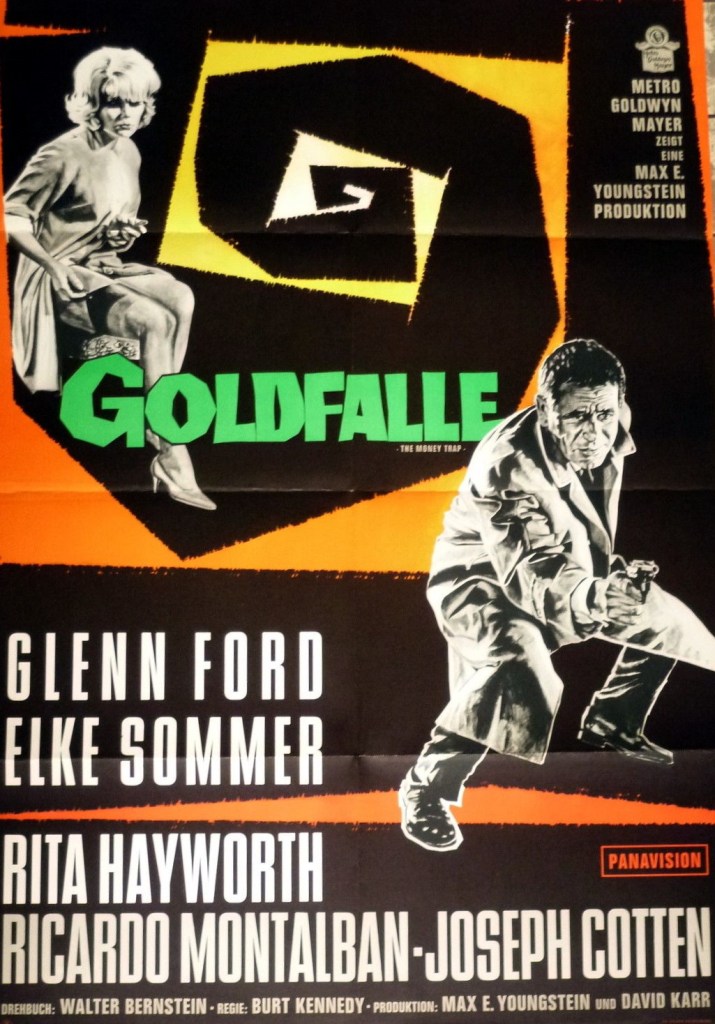
The Money Trap (1965) ****

Film noir morality play. Highly under-rated, especially unfair since all four principals put in excellent performances, plus a nifty screenplay, and generally erratic director Burt Kennedy on very solid cinematic ground, even if he has a predilection for showing legs, and not just of the female variety.

Film noir is at its best when the plot is simple, usually good guy inveigled into taking a wrong turn through avarice, revenge or a femme fatale. This takes an unusual route. Idealistic cop Joe (Glenn Ford) worries beautiful wealthy spendthrift wife Lisa (Elke Sommer) will abandon him for a richer guy since her allowance has dried up.

Assuming she is already making her play, Joe has a one-night stand with old flame Rosalie (Rita Hayworth), a lush married to a murdered burglar. His partner Pete (Ricardo Montalban), envious of his buddy’s wealth, blackmails him into robbing the safe of Mafia doctor Van Tilden (Joseph Cotten) who, in self-defence, killed the burglar. Meanwhile, as contrast,  the pair are investigating the murder of a sex worker trying to earn extra money to shore up her husband’s miserable income.  

While it’s got all the requisite of film noir, atmospheric use of light given it’s shot in black-and-white, that unusual footage of legs, and feet, especially when Rosalie is followed by Tilden’s thug Matthews (Tom Reese), cunning villain, the unexpected twist, neither of the femmes it transpires is much of a fatale, greater backbone than you might expect.

But mostly, it focuses on decision and consequence. Will Joe accept he could lose his wife, will Lisa make the jump into a lower standard of living in order to hold onto her husband, or will Joe distrust that his wife can change and find a way to bring the loot he thinks will keep her satisfied? Lack of trust all round proves their undoing.

There’s the usual, silent, heist, though quite where Joe and Pete acquired their safecracking skills is never discussed. It is the perfect robbery, a dodgy doctor unlikely to call in the cops, especially as they might get suspicious as to just why he is such a common burglary target. Except it’s not. For what’s in the safe is too hot for any cop and Van Tilden, more streetwise than the police, is always one step ahead. Instead of it being the greedy Lisa who could ruin their otherwise stable and loving marriage, it’s Joe.

There are a handful of clever twists, not least that Joe’s dalliance with Rosalie signs her death warrant, but I won’t give those away. It’s too tightly told to spoil it. That’s part of the beauty here, it’s a neat 90 minutes, short and to the point, temptation and consequence.

If ever there was an actor under-rated during this decade it’s Glenn Ford (Rage, 1966). He was hardly ever cast in a big-budget picture except as part of an “all-star cast”, and mostly, given the extravagances elsewhere, in A-pictures whose budgets in reality turned them into B-pictures, and he ended the decade in a rut of westerns, all as under-rated as him. But he brought a tremendous intensity to every role, equally believable as romantic hero and potential heel, and in action, as here, he moves with lethal speed. He had a unusual gift as an actor – you always knew he was thinking. And was very likely to be saying one thing and thinking or meaning another.

Here he acts his socks off. You wonder just what has he got to live in such a fancy house with a rich gorgeous damsel and it doesn’t take long to find out his attraction to him, that right stuff that would rarely come an heiress’s way, more likely to trundle her way through endless marriages and affairs seeking a stability that wealth does not bring.

Elke Sommer (They Came To Rob Las Vegas, 1968) is a revelation, mostly because the script builds her a proper character, loving wife temporarily distracted by potential loss of wealth, but knowing enough about her husband to recognise she’s be better off with him than without him.

Rita Hayworth (The Happy Thieves, 1961) makes the most of her last meaningful role, not lit to shimmering glory by a black-and-white camera, but while shown at her blowsy physical worst redeemed by mental strength. Ricardo Montalban (Cheyenne Autumn, 1964) , usually relegated to a supporting role, provides not only the narrative impetus, but his character twists and turns throughout. Joseph Cotten (Petulia, 1968) has cold blood running through his veins.

This is early-promise Burt Kennedy (Dirty Dingus Magee, 1970) and with a tight script by Walter Bernstein (Fail Safe, 1964) delivers a surprisingly effective very late period film noir.

Terrific acting, by twisty plot held in check by realistic consequence.

Grand Slam (1967) *****

Stone cold classic. An absolutely riveting watch from start to twist-ridden finish. The best heist picture I have ever seen. Although throwing an occasional nod to acclaimed predecessors Rififi (1955) and Topkapi (1964), in my opinion this majestic opus tops both. And for one simple reason. There is no grandstanding, neither from director nor actors.

Although director Giuliano Montaldo (Machine Gun McCain, 1969) tosses in a few Hitchockian moments, these are never long-drawn-out in the manner of the master, because there’s never any let-up in the suspense and therefore to do otherwise would be to indulge himself.  If there is boldness it’s in the muted tone. The marquee names – Edward G. Robinson (The Biggest Bundle of Them All, 1968), Janet Leigh (The Manchurian Candidate, 1962) and Adolfo Celi (Danger: Diabolik, 1968) – are all low-key, non-intrusive.

The title “Carnival of Thieves” had already been used for another heist movie
-” The Caper of the Golden Bulls.”

The bulk of the Rio-set action is carried out against the background of the annual carnival by what appear to be a bunch of unknown supporting stars who seem honor-bound to make no attempt, except as befits character, to steal the limelight, so we are not faced with a Reservoir Dogs (1992) or The Usual Suspects (1995) where everyone is jockeying for position, expecting stardom to beckon.

Fabulous plot is matched by terrific telling, information cleverly withheld until the last moment so that it is a constant railroad of surprise. For example, a church tower plays a critical part in abseiling into the robbery locale, but what we don’t know until it suddenly rings is that there’s a massive bell that, if otherwise there had not been a carnival going on below, might have caused a few to glance up at an inopportune moment. Nor are we shown its clock until the moment when we realize the thieves are running behind schedule.

The memorable stand-alone moments are reserved for the opening. The first shot is of a cherubic choir singing farewell to their retiring schoolmaster Professor Anders (Edward G. Robinson). The next short sequence has him in New York examining in a shop window a display of expensive cigarette lighters (those, it takes us time to realize, also play a crucial role). Then he arrives at a stunning mansion where he passes through what appears to be an upmarket crowd, dinner jackets and cocktail gowns, watching a classical musical concert. You imagine the woman on stage is an opera singer. As Anders is being shown into another room she starts peeling off her clothes to the classical music.

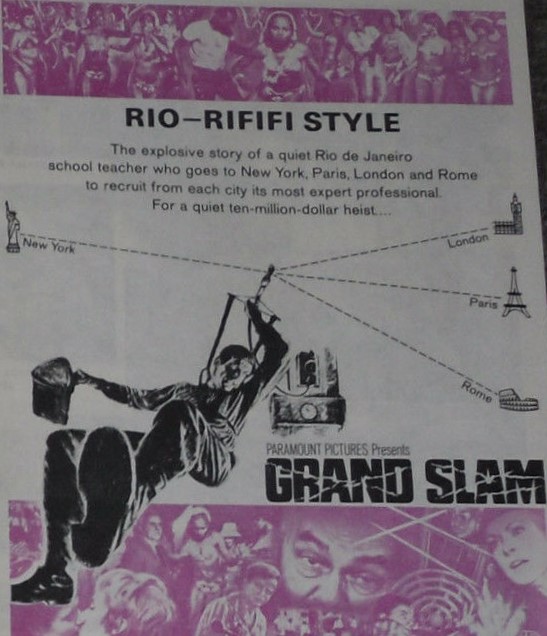
Anders has come to meet childhood buddy Milford (Adolfo Celi), now a big-time gangster, to ask for help in recruiting a team of four experts to carry out the audacious theft of $10 million in diamonds. You might gaze in astonishment as I did at Milford’s superb filing system, a huge alphabetical bank covering every known area of criminal expertise.

Once the crew are selected Anders bows out and we don’t see him again till the end. You keep on expecting a star of Edward G. Robinson’s caliber to turn up again, but that’s part of the clever ongoing bait-and-switch. The team, recruited from European capitals, comprises English safecracker Gregg (George Rigaud), German muscle Erich (Klaus Kinski), meek Italian electronics whizz Agostino (Riccardo Cucciolla) and French playboy Jean-Paul (Robert Hoffman).

Playboy? What the? Who on earth hires a playboy for a multi-million-dollar heist? Well, his area of expertise is seduction. And the plan requires the secretary, Mary Ann (Janet Leigh), to the vault’s general manager to fall into his arms because she possesses a vital key. As per the norm, there’s a bunch of stuff that doesn’t go according to plan, most notably a newly-installed sound detection device in the vault that requires ingenious invention to beat. But what also doesn’t go according to plan is the seduction.

This is one of the cleverest devices I’ve witnessed for ratcheting up suspense, especially since time is so critical. This should be a slam-dunk for the impossibly handsome Jean-Paul, who has beauties hanging off his arm. Especially as Mary Ann is something of a plain Jane, eyes concealed behind thick spectacles, wearing unflattering clothes, a cold fish with a snippy demeanor, rebuffing his every approach. When finally Jean-Paul succeeds and manages to access her purse wherein lies the key, he finds two key-rings. Having successfully managed to filch the key, three times he is foiled getting it safely to his confederate.

Twist upon twist, oh you haven’t seen the half of it. The usual falling out among thieves is restricted to tough guy Erich instinctively taking against the lightweight playboy and there’s an unexpectedly tender scene of the mild Agostino attracting the attention of a young Brazilian Setuaka (Jussara), so poor she is reduced to squatting on an empty yacht, lack of mutual language scarcely hindering prospective romance.

A couple of times the audience reacts to unspoken tension, at one point the crew think Mary Ann has spotted them from her office window, another time you think she has made the connection between the lighters. And there’s just a stunning scene at the end when Jean-Paul leaves Mary Ann and alone in her apartment she switches off the lights. And the subsequent shock on her face as she realizes she is the patsy. And one scene where the rolling of eyes conveys enormity of reaction.

Silly me, I’ve spent so much time going on about the incidentals I’ve given almost nothing away about the heist. Just as well, I guess. The robbery is timed to take 30 minutes and that’s the screen time allocated, so you follow the team minute-by-minute inch-by-inch as their elaborately complex scheme unfolds.

The confidence of the director in dispensing with dialog and during the heist with music speaks volumes about the quality of the production.

But could you imagine either of the Oceans pictures minus stars Frank Sinatra, Dean Martin, Sammy Davis Jr, George Clooney and Brad Pitt. That’s effectively what Montaldo has set out to do here. The major stars don’t dominate. It’s left up to the workers to carry the movie and in sticking to their characters rather than showboating it all turns out splendidly.

Edward G. Robinson is at his quiet best, completely lacking in the intensity you might anticipate, the calmest criminal mastermind if all time. Janet Leigh is just superb – and I can see where her daughter Jamie Lee Curtis – gets that austere prim look from. Theoretically, Klaus Kinski (Five Golden Dragons, 1967) is the pick of the supporting cast, mainly because eventually he gets to be the Klaus Kinski we all expect, but my money is on Riccardo Cucciolla (Sacco and Vanzetti, 1971) as the unobtrusive lovelorn genius and Argentinian George Rigaud (Guns of the Magnificent Seven, 1969) for his spot-on depiction of a cool upper-class Englishman. It took eight writers to put together the screenplay and you can see why, every detail, every nuance of character, finely wrought.

In all the time I’ve been writing this Blog I have never enjoyed such an unexpectedly  enjoyable experience.

This is one film you just can’t afford to miss.

Discover WordPress

A daily selection of the best content published on WordPress, collected for you by humans who love to read.

The Atavist Magazine

by Brian Hannan

WordPress.com News

The latest news on WordPress.com and the WordPress community.