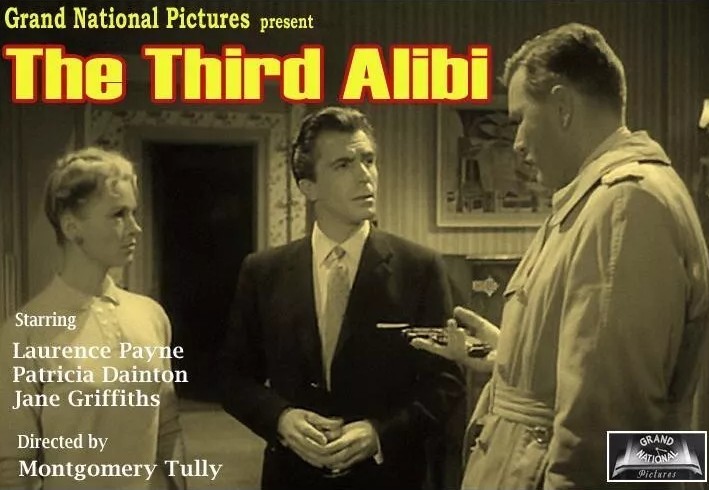
The Third Alibi (1961) ***

Sometimes there’s nothing more satisfying than a well-plotted narrative that doesn’t overstay its welcome and comes with a sting – or two – in the tail. And in the B-picture world we can accommodate all sorts of venal characters and even hope – or at least wonder if – they will get away with their nefarious plans.

We might have sympathy for stage composer Norman (Laurence Payne) stuck in a soulless marriage with Helen (Patricia Dainton). Small wonder he seeks spice through an affair with divorced sister-in-law Peggy (Jane Griffiths). After all, being a creative is hard work and we want him to enjoy showbiz success.

But that’s until driving home at night he knocks down an old man and races off without stopping. Luckily, the old fella’s not dead, otherwise it would have been in the papers. But then he’s bounced into asking his wife for a divorce since Peggy has announced she’s pregnant. But Helen isn’t agreeable, not least because of her dislike for her sister. And Helen’s very ill, a heart condition, but for reasons best known to herself, won’t confide this to her husband.

So Norman is left with no alternative but to bump her off. He comes up with a very clever plan that will allow him to pretend not be at home when he kills his wife there and also dreams up one of these clever alibis for Peggy, who’s integral to his plan, by getting her to make a nuisance of herself at the cinema, so everyone recalls her both arriving and departing, allowing her to slip out of the theater for the period of time she needs to assist Norman.

But Helen overhears the conspiracy. And when Norman goes home to shoot his wife, using an unlicensed therefore untraceable pistol provided by Peggy (war heirloom) instead of his own licensed traceable gun, he discovers the house is empty.
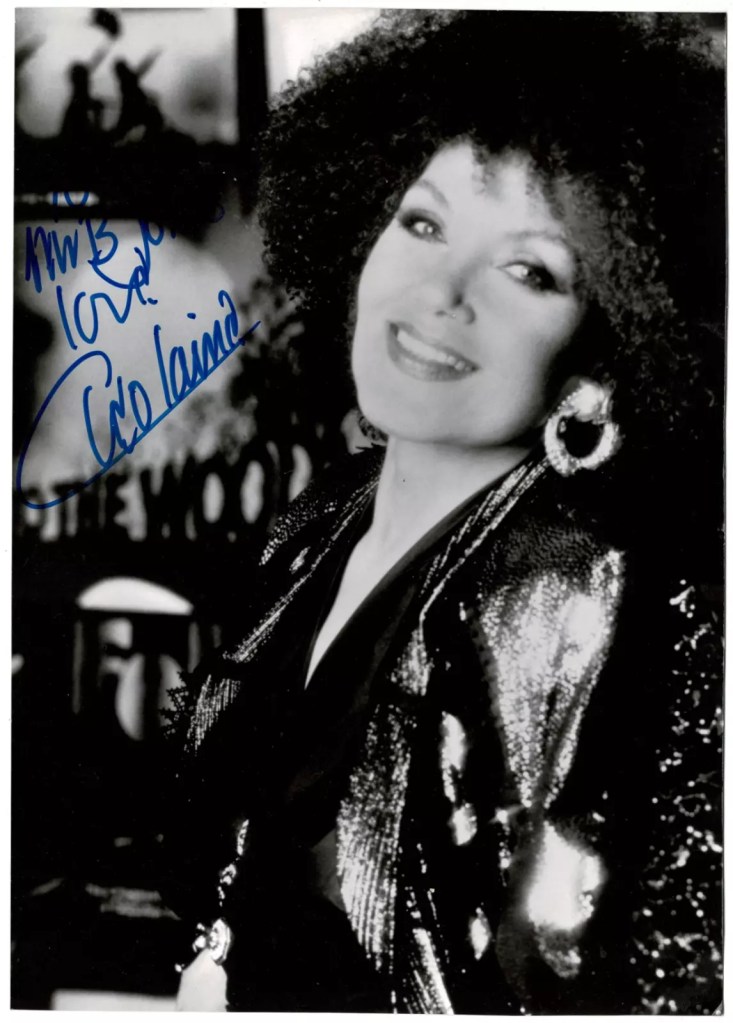
Jazz singer Cleo Laine makes a cameo appearance, as, too, does Dudley Moore.

When he returns to his lover, he finds her dead, shot through the head. As he rushes out, the police arrive. He’s only a suspect for a short time as his various alibis hold up. Helen appears to be standing by him. But then the police find his gun in the bushes outside the dead woman’s house.

When Helen confesses to the police that her husband has demanded a divorce, that puts her in the firing line. Except she’s got a perfect alibi. She stole the idea from the conspirators, making her visit to the cinema easily remembered by the staff both at the start of the movie and the end. It’s pretty much an unbreakable alibi unless any other witness can finger her.

Norman protests his innocence of course. And the irony is we know he’s innocent, but our sympathies are now with the killer, Helen, which twists around our preconceptions.

After all, not only is she the injured party in the romantic stakes, but she’s very ill, so needs all the audience sympathy she can get. So the audience, against its better judgement, is batting for her.

But, suddenly, twist number one, they don’t have to. Because the strain is all too much, and she has a heart attack and drops dead. And, surely, it won’t be long before Norman can find a way out of his predicament. And he believes he has the very thing.

There’s a nosy old neighbor who takes too close an interest in visitors to the house. So he must have seen Norman arrive there at the very time his lover was shot. The neighbor is brought in.

He’s a poor old soul. And blind. The result of being knocked over by a car a few weeks before.

What a cracking ending to a cracking tale. I always wonder why these kind of stories don’t get resurrected for some sort of portmanteau series, in the manner of Tales of the Unexpected. Although there’s little fat on them, a bit of judicious trimming would make them ideal for a one-hour television slot and this one, in particular, is little more than a three-hander, so wouldn’t cost much.

Each of the main characters is well drawn, each allowed a moment to stretch their emotional muscles. Solid, if not spectacular, acting from Laurence Payne (Crosstrap, 1962), Patricia Dainton (The House in Marsh Road, 1960), and Jane Griffiths (The Double, 1963), and impressive turn from John Arnatt (A Challenge for Robin Hood, 1967) as a doughty cop.

Written by Maurice J. Wilson (The House in Marsh Road) and director Montgomery Tully (The House in Marsh Road) from a play by Pip and Jane Baker. Tully is in fine form at the helm, wasting no time in driving this towards ironic conclusion.

I’ve been clocking up a few from the Tully portfolio in the last month or so. Astonished to find he directed another seven pictures this decade, so I might, in due course, complete the collection.

Enjoyable.
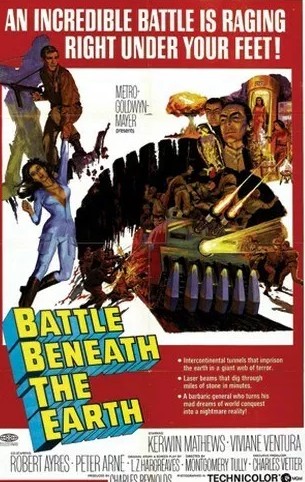
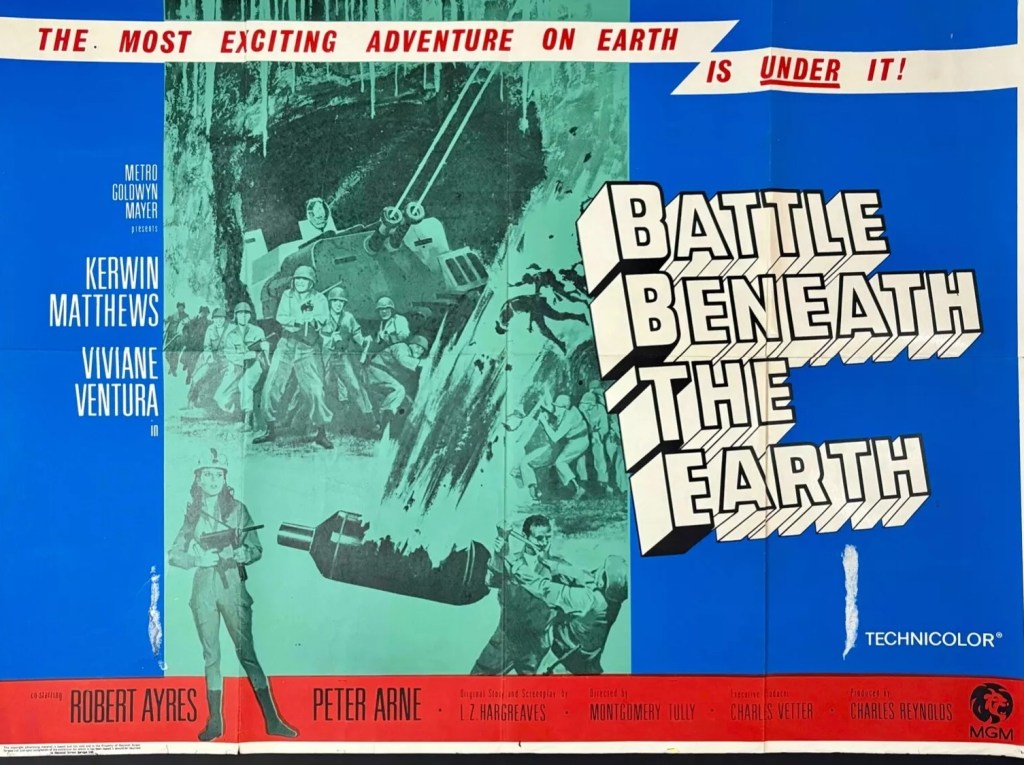
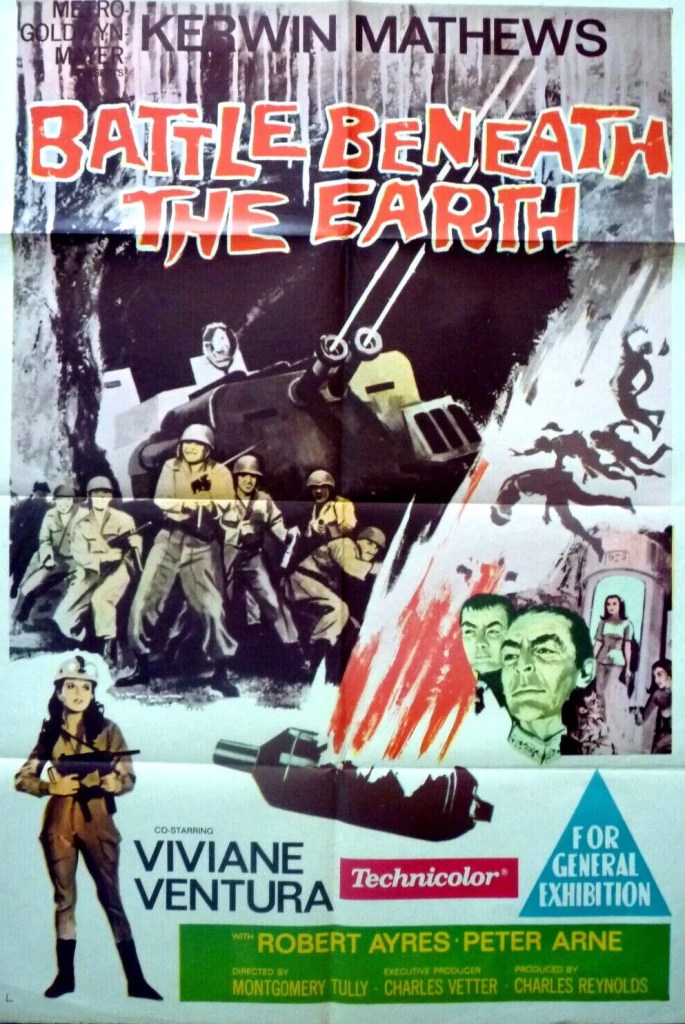
Battle Beneath the Earth (1967) ***

Aliens, would be your first guess these days should you happen upon strange disturbances emanating from underneath the earth’s surface, citing the examples of War of the Worlds or an iteration of Transformers, whereby creatures from outer space had remained dormant buried in our habitat for millions of years, like inveterate moles, waiting to spring into action. But this is the 1960s and domination of the Universe is not on the cards. Instead, it’s mere global domination. And as James Bond and others in the espionage game have persuaded us if it’s not some supervillain we’re under threat from it’s the Russians or Chinese.

Even if you detected odd goings-on there was more chance of you being stuck in a mental institution, as is the fate of seismologist Arnold Kramer (Peter Arne), who makes the mistake of causing a “listening disturbance,” arrested lying down on the streets of Las Vegas with his ear pressed to the ground.

Navy Commander Jonathan Shaw (Kerwin Mathews) is on an equally sticky wicket, his latest undersea project resulting in the death of 27 men. However, his assistant Susan (Norma West) prevails upon Shaw to take a look at her brother Arnold. But he isn’t impressed. Until he hears about a mining disaster in Oregon, the deepest mine in the USA, and recalls that Kramer had mentioned discovering unusual activity underground in Oregon.

So off Shaw goes to investigate and finds a laser-drilled tunnel and a lair with missiles. There’s a vehicle with some kind of death ray and before your mind jumps to the notion that this is alien-induced we’re in the command post of Chinese General Chan Lu (Martin Benson) who, as well as planning whatever devilish destruction he aims to visit upon the Americans, has also been in the business of mining gold and growing plants packed with vitamins.

Turns out there’s more than one tunnel – they run from China underwater across the Pacific and underground through America – and although Chan Lu’s stock of nuclear warheads is depleted after being defused by the Yanks he’s still got enough left in the tank to turn America in a desert and kill 100 million people. And there’s not much time to waste – the Chinese plan to strike in 48 hours.

Meanwhile, to buff up the story, Shaw’s team adds volcanologist Tila Yung (Viviane Ventura), providing the opportunity for extra peril and a touch of incipient romance. The Yanks plan to locate the Chinese in a tunnel under the Pacific  and detonate a 10-megaton atom bomb. But things don’t go according to plan. One of the team is hypnotized and Shaw and crew are ambushed and imprisoned.

Chan Lu is far from the lunatic villain and invites Shaw post-conflagration to team up to help to peacefully reconstruct the broken world. Being a pragmatic sort, the General is somewhat surprised to be turned down. Naturally, Shaw’s gang break out of the cell, Arnold the one with the clever idea, and sabotage the Chinese bombs, so it doesn’t end well for the villain, while our hero has the beginnings of a romance.

This was the final movie for director Montgomery Tully (The Terrornauts, 1967, Fog for a Killer, 1962, The Third Alibi, 1961) and he brings some of the pacing he demonstrated in the B-film crime thrillers to the material so it rattles along. The background is well handled and the two male leads are unusually damaged for a sci-fi romp. Audiences might have felt duped that Viviane Ventura (A High Wind in Jamaica, 1965) doesn’t appear until about halfway through. Kerwin Mathews (Maniac, 1963) leads with his chin but the movie’s not expecting much else. Written by L.Z. Hargreaves (Devil Doll, 1964) aka Charles Vetter, the film’s producer.

Decent hokum.

The House in Marsh Road (1960) ***

Well-structured thriller – especially given the short running time – that allows time for the story to blossom and, given the supernatural tinge, in a somewhat unusual fashion. Worth noting, too, the gender fallibility in keeping with the time, the wife who will support her husband come what may, through his heavy drinking, philandering and deceit. The only truth is that somehow or other her husband is going to get hold of her money.

Wife Jean (Patricia Dainton) is initially complicit in her husband David’s (Tony Wright) small-time fraudulent activity, willing to scamper from short-term let to short-term let, vanishing without paying the bills, because she believes in his grandiose ambitions of rising above his lowly status as a book reviewer to become a novelist.

The too handsome to be true bad guy.

When she inherits a house from an aunt, he wants to sell it and use the £6,000 to fund his ambition, though once he meets sexy secretary Valerie (Sandra Dorne) his plans change to using the dosh to set up a new life with Valerie. Of course, that would mean eliminating his wife and inheriting the property himself. A first attempt, to push her down a life shaft, fails and he moves on to sleeping pills.

Jean is so in thrall with him that even when she catches him out in lying, theft and an affair, she still is apt to stand by him after giving him a frosty reception and a good ticking-off. It’s only when she suspects worse that she seeks help.

Unbeknownst to her she has an invisible ally, a poltergeist named Patrick, who has the habit of rearranging furniture, sighing, setting off the alarm, and, for people to whom he takes an aversion – such as David and Valerie – smashing mirrors and disrupting their desk. Given the budget and the period, the paranormal aspects are kept to the minimum, noise the most obvious evidence, while other actions occur when the camera is not present.

You sometimes wish these kind of British B-pictures would add another 30-40 minutes to explore consequence in true film noir style. There’s no doubt that Valerie would soon find a way to rook David of his inheritance and dump him, easiest way being to lead the police to him.

While Jean finds an attorney willing to take note of her suspicions, you can’t but help noting that mention of a poltergeist is not helping her case, and in the normal course of events she would be committed, leaving David free to cash in on the house and indulge his mistress.

It doesn’t get to the obvious ending, of her being disbelieved, and forced to return to the house and spend her time going mad wondering how her husband is going to bump her off. Instead, Patrick comes to her aid, starting a fire which engulfs the house in her absence. Husband and lover die in the blaze.

As ever, no great acting. Patricia Dainton (The Third Alibi, 1961) might be accused of not putting enough terror in her characterization but that would be to overlook the fact that in those days handsome husbands were implicitly trusted. Tony Wright (Faces in the Dark, 1960) is smug enough but Sandra Dorne (Devil Doll, 1964) only requires a touch of smouldering to steal the show.

Based on a story by Laurence Meynall, inventively written by Maurice J. Wilson (Fog for a Killer, 1962), especially for the undercurrent of malevolence and manipulation. Ably directed by Montgomery Tully (The Terrornauts, 1967).

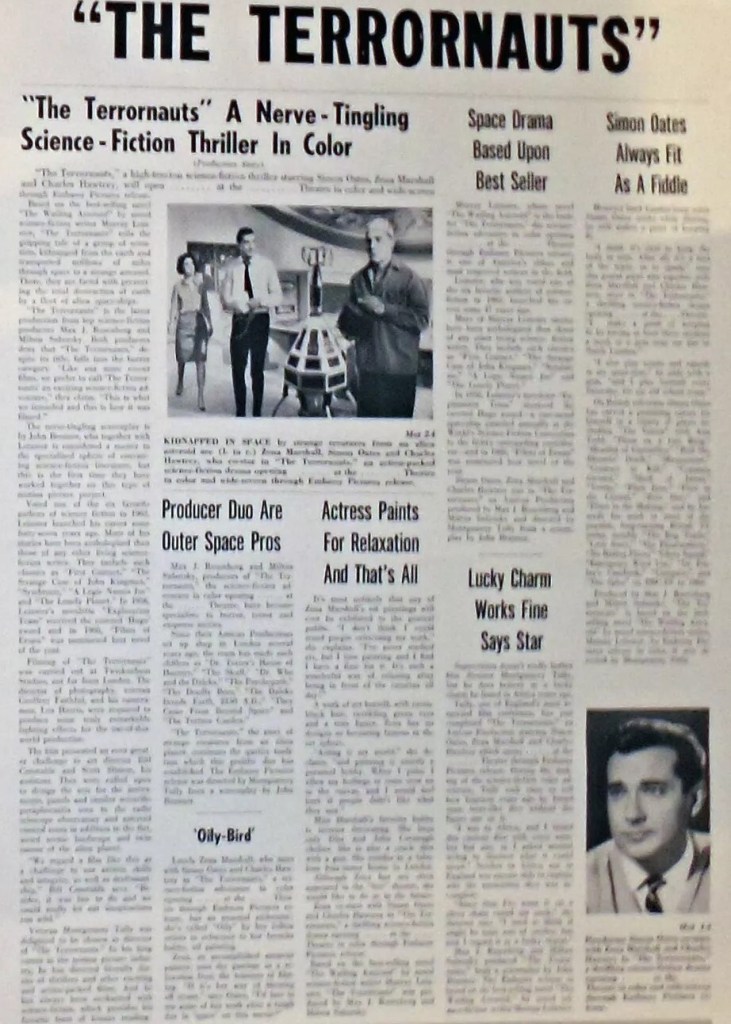
Behind the Scenes: “The Terrornauts” (1967)

Unless you’re a sci-fi buff of a certain vintage, you probably haven’t heard of Murray Leinster who wrote The Wailing Asteroid on which The Terrornauts is based. Which is a shame because he was one of the giants of science fiction of the golden age. Time magazine called him The Dean of Science Fiction.

For a contemporary audience his name is of considerable significance because he invented the concept of the multiverse. In those days it was called a parallel universe or an alternate history but it amounted to the same thing. And he did so nearly a century ago – in 1934 in fact.

He was second only to H.G. Wells in originating science fiction concepts. He was the first, for example, to imagine meeting an alien culture that was as advanced as our own. He explored themes of mutual distrust, mutual assured destruction, and aliens as superior beings. He also invented the idea of the Internet and man-eating plants.

In The Wailing Asteroid, Leinster draws upon many of the ideas he was first to promulgate.

We have alien encounter. We have the fear that as a consequence terror might be brought back to Earth. We have a species that has evolved far beyond human experience.

We have the same kind of instant absorption of knowledge that occurs through the Internet. The little blocks that our hero finds might as well be called Miniature Googles.

You could also argue that what the space explorers discover is akin to The Sentinel that features in 2001: A Space Odyssey, released in 1968. And you could also view the asteroid as a life-affirming alternative to the hovering destructive Death Star of Star Wars filmed a decade later.

The Terrornauts is a rarity because only a handful of Leinster books were ever filmed. But he was very important to the movies in another way, at the forefront of an invention – front projection – that changed the way movies were made in the 1960s.

At this point, production entity Amicus was as well known for its sci fi output as its horror thanks to Dr Who and the Daleks (1965) and Daleks Invasion Earth 2015 A.D (1966).

So when Embassy Pictures knocked on the door and offered a flat fee of around half a million dollars for a science fiction double bill, Amicus was delighted. Hammer sold its horror pictures as double bills, a complete program more attractive to an exhibitor and more lucrative for a producer than  half a program.  

Amicus contracted to make The Terronauts and They Came from Beyond Space. They weren’t big enough to have stars under contract, nor the first port of call should a director or star have a pet project that required funding.

Their modus operandi was to trawl through the hundreds of novels published every year, either in pre-publication galley form, or when printed. Max Rosenberg claimed to read 500 books a year. “The basic job of a producer,” explained his partner Milton Subotsky, “is to find properties.”  That was how they came across The Wailing Asteroid.

It was occasionally part of the deal in Hollywood that when a studio bought a best-seller, the author was given the opportunity to write the screenplay. But that wasn’t the case here.

Instead, Amicus turned to another science fiction author. John Brunner was as prolific as Leinster. Brunner got the gig because he mixed in the same social circles as Subotsky. Mostly, he wrote conventional space opera and it was only after his experience on The Terrornauts that he acquired a bigger name in science fiction, after winning a Hugo Award in 1969.

The first casualty was the title. The Wailing Asteroid was not as catchy as The Terrornauts. And Brunner had no qualms about scrapping most of the original narrative. He telescoped the time frame. The action in the book takes place over several months, not a couple of days. The book involves multiple countries. Leinster’s novel was set in the United States, but Brunner made the characters British and added the comedy – no tea lady or accountant in the original.  And there’s no humor either. He changed the hero’s occupation from design engineer to scientist, and dumped the incipient hesitant romance between Joe and Sandy. But he brings in the notion of scientists hunting for intelligent life in space.

Nor does Leinster’s book involve little green men, robots or human sacrifice. That’s all Brunner’s doing. He turns what was really a concept novel, an exploration of ideas more akin to 2001: A space Odyssey and Planet of the Apes. Brunner shifts it from what if to alien abduction.

Budget shaped the picture. The first four reels are slow and full of dialog because dialog can be shot much quicker and more cheaply than action. Low budgets didn’t bother Amicus. “I defy any other picture making company,” proclaimed Rosenberg, “to turn out that sort of picture with the budget we are under.” He added, “We make pictures for a price and I think we’re better at it than anybody else.” 

Amicus had something of a stock company, Freddie Francis, for example, the in-house director, had helmed four pictures, the same number as Peter Cushing headlined. Christopher Lee starred in two, Robert Bloch contributed four scripts and Elizabeth Lutyens scored two pictures. But only Lutyens was retained here.

Amicus handed The Terrornauts to veterans, the majority involved were over 50 years of age. Cinematographer Geoffrey Faithful was 74, author Murray Leinster 71,  supporting actor Max Adrian 64, special effects guru Les Bowie 64, director Montgomery Tully 63, composer Elizabeth Lutyens 61.

It would prove the last hurrah for female lead Zena Marshall, Montgomery Tully would bow out later that year after Battle Beneath the Earth and Geoffrey Faithful would only make another two pictures.

The Terrornauts and They Came from Beyond Space were not filmed in October-December 1966 as has been widely reported. Instead, production took place earlier in the year. According to British trade magazine Kine Weekly’s Shooting Now section, The Terrornauts was first to go before the cameras at Twickenham Studios, on June 13 1966 and still featured on its production chart on August 3. Filming on They Came from Beyond Space in the second last week of September continued also at Twickenham until the week of November 3.  

Though to some observers the amount spent on The Terrornauts was very little, in fact the £87,000  budget was nearly double the amount spent on City of the Dead and slightly more than The Skull. Admittedly, there were special effects to consider but to offset that the stars came cheaper than the likes of Peter Cushing and Christopher Lee.

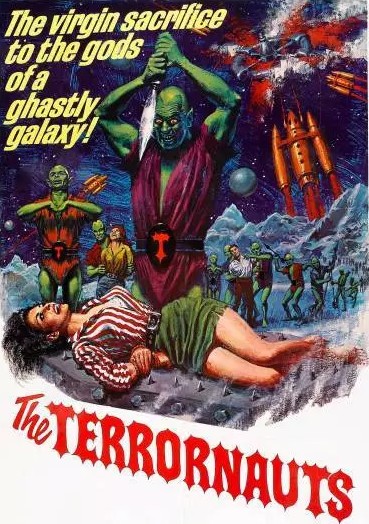
For a time it looked as if Embassy expected The Terrornauts to prove the more popular picture. It ran a one-page advertisement in trade newspaper Variety for The Terrornauts in April 1967 claiming it would be available to rent the following month. The image of Zena Marshall being held down by aliens was accompanied by the tagline – “the virgin sacrifice to the gods of a ghastly galaxy” They didn’t run any adverts for They Came from Beyond Space.

I’m sorry to have to tell you this is a condensed version of the audio commentary by me that accompanies the spanking new DVD released by Vinegar Syndrome – I’m sure you’ll forgive me another small plug – and it’s on special offer.

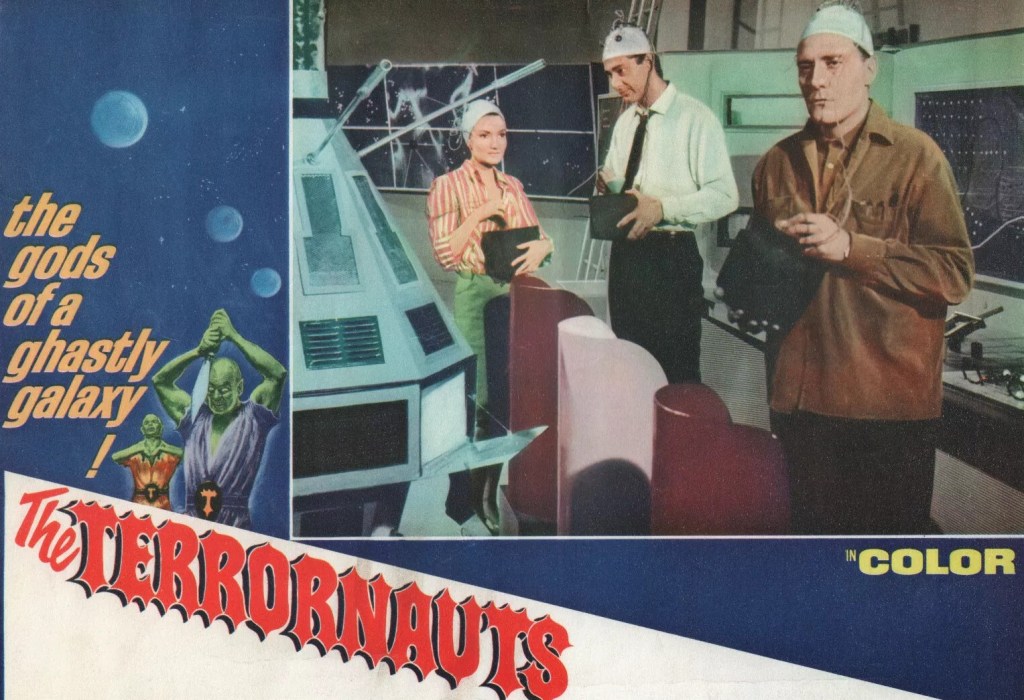
The Terrornauts (1967) ***

The easiest ways to acquire cult status are a) to be impossible to find and b) in a genre piece add in the unexpected. In this case, although originally devised as the support feature to They Came from Beyond Space (1967), in an Amicus sci fi double bill, this was denied initial release in Britain and other parts of the world and only seen fleetingly thereafter.

The genre upset is in two parts. First, we have the notion of aliens coming to the assistance of Earth. Secondly, for foreign audiences, it upends ideas of Englishness. Overseas moviegoers would have become used to the arrogant upper class characters, the bowler hats, tourist landmarks, Cockneys out for a “larf”, and probably never actually heard a genuine British accent in their lives because the diction was so incomprehensible it was usually dubbed.

Here we have two very recognizable, in British terms, types – the tea lady Mrs Jones (Patricia Hayes) always ready with down-to-earth wisdom, and bureaucracy in the shape of interfering bean-counter Joshua Yellowlees (Charles Hawtrey, taking a break from Carry On duties). They provide a supply of gentle comedy, unusual for the genre.

Along with Dr Joe Burke (Simon Oates), Ben Keller (Stanley Meadows) and Sandy Lund (Zena Marshall), working in radio telescope laboratory seeking signals from outer space, they are kidnapped by aliens. Apart from an odd-shaped robot, on the alien craft they encounter nobody but are still set intelligence tests and then step through a transporter which lands them on an alien planet but one which is strangely familiar to Burke from a childhood incident on an archaeological dig in France. These aliens of the little green men variety are not so accommodating and it would come as no surprise that they elect Sandy for sacrifice. When she’s rescued and they’re all safely back on the alien craft, a greater danger materializes. Earth is going to be obliterated by another set of aliens, deadly enemies of the ones who are so helpful, and the Earthlings have to master the alien weaponry to defeat them and save Earth.

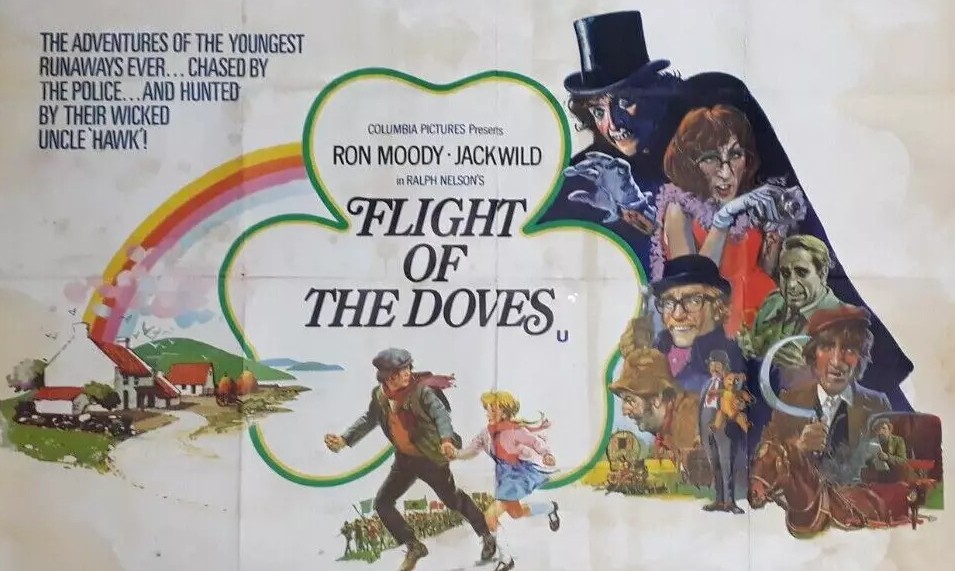
Saw “The Terrornauts” on original UK release when it was support to “Flight of the Doves.”

There are two twists at the end, one ending in speculative fashion, the other on a comedic note. The transporter returns to Earth and the same spot as Burke had his odd encounter, though nobody commenta on this. But to undercut that climax, the space travelers are arrested for trespass by a French gendarme. There’s no great acting and, in truth, it’s the oddball supporting players who steal the show, and Patricia Hayes would later achieve considerable fame as Edna, The Inebriate Woman (1971). This was the swansong for Zena Marshall (The Switch, 1963) and the penultimate picture of veteran Montgomery Tully (Fog for a Killer, 1962). Written by sci fi author John Brunner from the novel The Wailing Asteroid by Murray Leinster. Score by Elizabeth Lutyens (The Skull, 1965).

This is more thoughtful than the general run of sci fi B-movies, and the special effects, considering the tiny budget, are acceptable.  Had it enjoyed more success Amicus might well have continued down this route rather than the horror portmanteau for which they were associated, for by the time this movie was made, their efforts were split evenly between horror and sci fi and their biggest hits had been the big screen Dr Who adaptations.

Though They Came from Beyond Space was seen more widely in Britain as the support to Rank release The High Commissioner/ Nobody Runs Forever, The Terrornauts sat on the shelf. It was given a very limited release as one of three potential supports to Flight of the Doves (1971) which is how I saw it at the Gaumont first run cinema in Glasgow. And that was because Simon Oates had starred in hit BBC ecological thriller Doomwatch (1970-1972). In the United States, it had a sporadic cinema release, very little evidence of first run, but very quickly became a late-night television favorite.

If you accept the comedy and aren’t fussed to not be battling monsters, this is a very interesting diversion from the sci fi norm and well done with the budget.

Vinegar Syndrome has just brought this out on DVD.

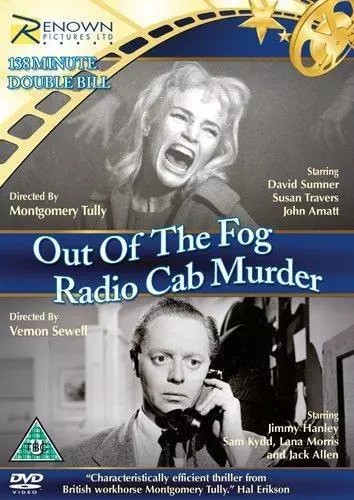
Out of the Fog / Fog for a Killer (1962) ***

Unusual and unusually effective entry into the low-budget British B-film crime category. Teeters for a time on the bittersweet before plunking for ending on a  more realistic sour note. Surprising, too, in being issue-driven – the problem of the rehabilitation of criminals, or the way such efforts are blocked by the general populace wanting nothing to do with thieves and villains, especially when it comes to employment or romance.

On release from prison, George (David Sumner) is given the chance of a new life from do-gooder Tom Daniels (James Hayter) who runs a halfway house for ex-cons. George isn’t particularly grateful, since he sees life stacked up against him. But he’s making an effort and turns down the chance to join the other residents in setting up an illegal scheme. Instead, Tom finds him work as a driver for a furnishings manufacturer where he meets Muriel (Mela White). But their nascent romance is scuppered when the cops come calling, investigating a murder on the “Flats”, an area of wildland close to both the factory where he works and the pub he frequents.

When the killer strikes again, and again, the cops Det Supt Chadwick (John Arnatt) and Sgt Tracey (Jack Watson) realize the murderer is striking at the full moon. Luckily, neither of the detectives is apt to go down the werewolf route, especially as the killer tends to strike when a full moon would be of little assistance because the “Flats” are covered in thick fog (for no apparent reason except the script says so).

George becomes the chief suspect and the cops decide to set up Sgt June Lock (Susan Travers) as bait – odd how often this became a trope in these B-pictures. She’s to befriend George and, come the full moon, prevent herself being killed (the cops are keeping tabs on her) long enough to trap George as the killer.  

There’s generally little time to waste in these running-time-conscious thrillers (this only lasts 68 minutes) on any characterization beyond the obvious but here we discover George has been disowned by his mother, a rather well-off character who lives in a good-sized house in middle-class Chiswick. When he asks to be allowed home, she turns him away and when the cops come calling her first words are, “I don’t have a son.” She’s a cold fish for sure, and hardly the entire reason he’s turned to crime, but it would go some way to explain his general bitterness.

George also appears to have an artistic bent and June encourages him, going so far as lining him up for some work. Before we get to the finale, there are other treats in store, the shrewish mother Mrs Foster (Hilda Fenemore) of the sulking Lily (Coral Morphew) who escaped attack by the killer. The other occupants of the house are also well-drawn, with a villainous hierarchy in operation, and clearly much more likely than George to re-offend.

The cops, too, are more ready than usual to admit defeat. Clues are non-existent what with the fog and any attempt at forensics limited to wondering why George cleaned his shoes so assiduously, the obvious deduction being the existence of mud or grass would have put him close to the crime scene.

In truth, there’s not much to the detection, but at least, as I said, nobody falls for the werewolf line and the idea of the date bait seems to come too easily to the cops.

As it stands, it’s mostly a character study, of a young man who can’t get a break, of society’s attitude to criminals, the lack of redemption available and little chance of a second chance once your past is discovered. I’m not sure how much this was an issue at the time but George exhibits a more understandable seam of bitterness than the likes of the surly Arthur Seaton in Saturday Night and Sunday Morning (1960). The movie only scratches the surface of the affect of a child on the lack of a mother’s love, and since we don’t know what triggered George’s first crime it’s hard to go any deeper.

There’s the chance of a happy ending. June is clearly smitten with George and determined to prove him innocent rather than, as her superiors require, guilty. But bitterness wins out in the end.

Directed by Montgomery Tully (The Terrornauts, 1967) who had a hand in the screenplay along with producer Maurice J. Wilson (Master Spy, 1963) based on the novel by Bruce Graeme.

David Sumner (The Long Duel, 1967) gets his teeth into a peach of a part. Career-wise Jack Watson (The Hill, 1965) fared best though Susan Travers (Peeping Tom, 1960) had a running role in TV series Van der Valk (1972-1973)

Interesting twist on the genre.

Discover WordPress

A daily selection of the best content published on WordPress, collected for you by humans who love to read.

The Atavist Magazine

by Brian Hannan

WordPress.com News

The latest news on WordPress.com and the WordPress community.