Funny how you remember the circumstances of seeing a film for the first time. This was important for me because it was the start of me digging into the vast heritage of the movies rather than watching just what was showing at my local cinema. I can’t pin down the exact date, but I have a feeling I was still at school, though in the advanced stage of that academia. I saw this on a 16mm print in a terraced house sitting on the hard kind of seats you used to get in assembly halls.
The location was the Scottish Film Council, the predecessor of the Glasgow Film Theatre, which was located in the city’s West End. The occasion was the final film in an eight-movie retrospective of Elia Kazan pictures. Either before or after I attended a similar Fellini retrospective. Certain more controversial films were omitted, so no Gentleman’s Agreement (1947), Pinky (1948) or Baby Doll (1956) and although this was the early 1970s no room for Splendor in the Grass (1961), America, America (1963) or The Arrangement (1969). Afterwards, there was a cup of tea and a biscuit and a discussion hosted by John Brown, who in my memory smoked small cigars, later a television and screen writer.
It was an introduction for me to the power of the retrospective, to view a huge number of a director’s films back-to-back (the screenings were weekly) and to understand the thematic symmetry of their work. Kazan predated the New Hollywood of the late 1960s and 1970s, so, although his movies usually challenged existing norms, these days they are often viewed as more stolid than of the first rank, his cause not helped by revelations that he named names at the anti-Communist hearings of the 1950s.
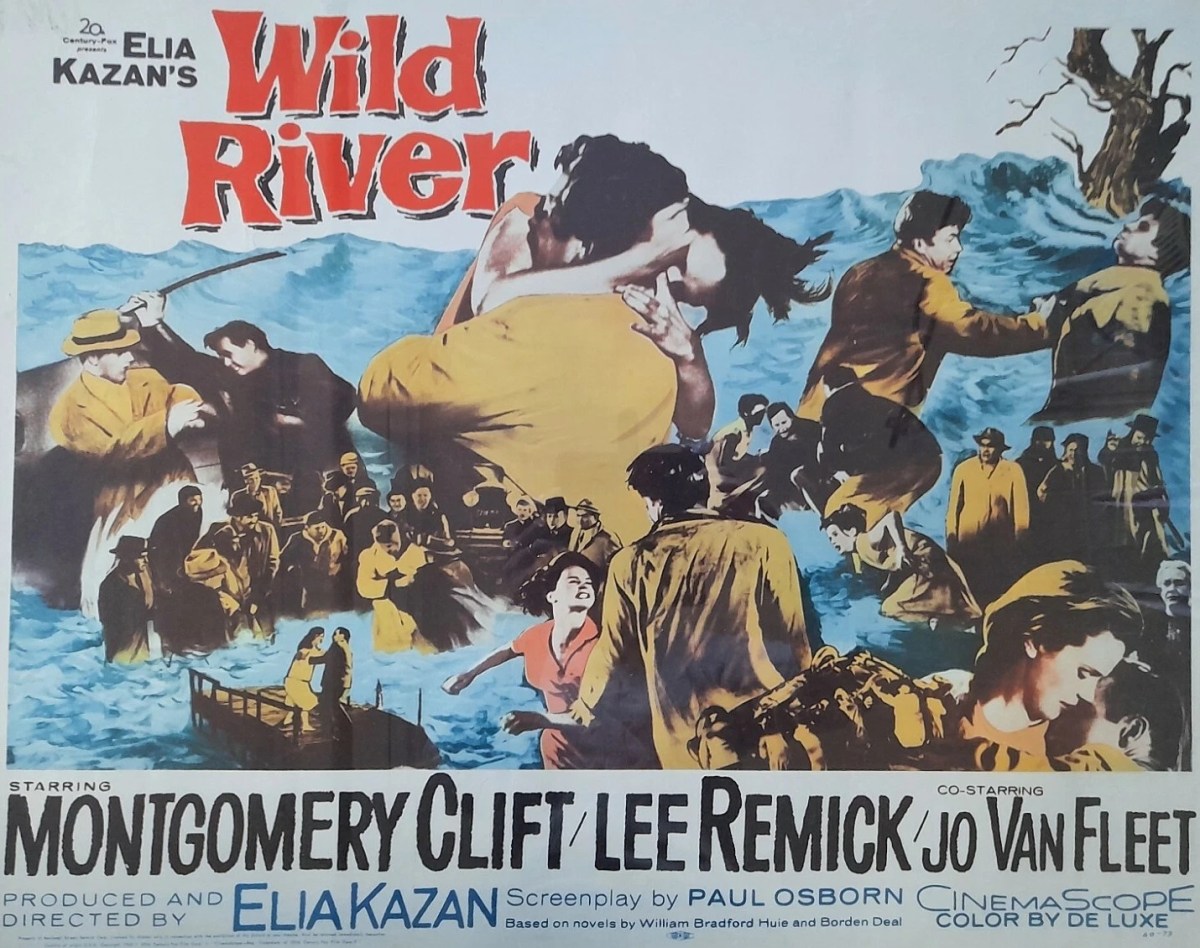
Wild River is one of those films that plays completely differently now thanks to the intervening decades. A contemporary audience is unlikely to sympathize with hero Chuck Glover (Montgomery Clift) whose job is to persuade farmers in the early 1930s to clear out of the way of land that is going to be swamped with water to supply a new dam that would serve to both control the catastrophic flooding in the Tennessee Valley and bring electricity to an impoverished area.
These days ageing landowner Ella Garth (Jo Van Fleet) would attract massive publicity in her fight to avoid being shifted from land that had been in her family for generations, especially as she claims that dams go “against nature.”. And no matter how sympathetic a character like Chuck might be to her circumstances he would be viewed as a more well-meaning-than-most government apparatchik.
And in some respects, this plays much better as one of the few movies exploring the plight of the African American at the hands of the racist authorities. Chuck incites local hostility when he recruits Blacks to work alongside Whites, in the end conceding that they should work in separate crews. But he comes unstuck when he sticks to the principle that they should be paid the same, more than double the going daily rate for Blacks.
In consequence he is beaten up and, worse, a gang of thugs attack the house inhabited by his lover Carol (Lee Remick) and her two young children and the cops, when they arrive, are apt to condone the violence.
Ella takes a maternal attitude to her Black workforce and while certainly nobody received abusive treatment at her hands she has a patronizing manner, though in the end she encourages them to leave.
Despite his democratic and anti-racist views, Chuck comes over as a clever dick, thinking his smooth eastern charm can convince the reluctant woman to move and for the racists to abandon their inherent racism.
I’m not sure about the widowed Carol either, she almost seems to be throwing herself at the first decent man who comes her way. While she is already being courted by a local fellow, who is more decent than the rest, that is clearly going to be a marriage of convenience, but what exactly makes Chuck so much more an attractive proposition is never made entirely clear except that, for narrative purposes, it creates a romantic deadline – is she just a fling, thrown over when he heads home – and a whiff of tension.
However, marriage to the other man would have made her just a passive housewife, whereas she realizes that in many ways she is smarter than Chuck, more grounded, and she would have more freedom in this kind of match.
Oddly enough, there’s a Hitchcock vibe here. At several points the camera tracks Glover in longshot as he appears to be heading for trouble.
The racist elements give this its bite rather than any ecological issues. The acting is certainly of high quality, Montgomery Clift (The Misfits, 1961), less mannered than in some of his work, in one of his last great roles. It’s an interesting part. At one point he wishes he could once in a while win a physical fight, and it’s Carol who is more likely to show the venom required in battle.
Lee Remick (No Way To Treat A Lady, 1968) continued to build on her exceptional promise. Jo Van Fleet (Cool Hand Luke, 1967) gets her teeth into the kind of role most actors dream of. You can spot Bruce Dern (Once Upon a Time in Hollywood, 2019) in his first role.
An unusual approach to the screenplay, too, by Paul Osborn (The World of Suzie Wong, 1960). Like The Towering Inferno (1974) a decade later, this derived from two novels – Dunbar’s Cove by Borden Deal and Mud on the Stars by William Bradford Huie (TheAmericanization of Emily, 1964).
Despite my ecological reservations, still stands up..
How often does a government hoodwink a morally upright citizen into deceitful action for the cause of the greater good? In this case physicist Professor James Bower (Montgomery Clift) doesn’t need a great deal of urging because what’s at stake are Russian space race secrets and the man selling them is a Russian scientist he knows from translating his books. It’s apparent from the outset that in setting out to make contact in East Germany, he is walking into a trap. It’s moody, and drab in the vein of The Quiller Memorandum (1966), shot in soulless German streets, and of course it is the final performance, after a four-year screen absence, of a frail-looking Clift, an iconic Hollywood star for nearly two decades.
But genres can be confusing. Although tagged as a spy picture it’s not really a spy film. It’s a character study. In fact, two character studies. And when you get to the end and realise the sacrifice made in order not to compromise principle, it turns into quite a different movie, one with considerably more depth than you might have imagined.
Bower is a rather adept amateur spy, neatly dodging being followed, and capable of nipping between two moving trams to evade pursuit. His instructions lead him to asking for a particular prescription and being sent in apparent haphazard fashion to an intended meeting with Dr Salter, his contact. Instead he is led to Counselor Peter Heinzmann (Hardy Kruger).
His hotel room is not merely bugged but fitted with electronic instruments to prevent sleep and distort his mind. Meanwhile Heinzmann is engaged in a hawk-vs.-dove battle with Orlovsky (David Opotashu) to determine whose methods, the latter preferring torture and brainwashing, would prove the more successful in forcing Bower to betray the whereabouts of the would-be defector. And there is also a doctor’s receptionist Frieda (Macha Meril), with whom romance so obviously beckons your natural moviegoer instinct is to regard her as lure rather than friend.
It’s a chess game, Bower a pawn, with the net growing tighter, imprisoned in more ways than one, being groomed for defection himself. Although there is double cross, triple cross, murder and an excellent chase, and a final unexpected, very human, twist, it’s far from your typical spy thriller, in general subtle in tone except for the nightmarish hotel scenes. Heinzmann is also a pawn, fighting a system that sees degradation as its most potent weapon and even while a danger to Bower displays humanity.
Quite what the set was like is anybody’s guess given than not only was Clift dead by the time of the film’s release but that Belgian director Raoul Levy (Hail,Mafia, 1965) – better known as the producer of many Brigitte Bardot films and now helming only his second film – had committed suicide.
If ever there was proof of star power, this is it. Even when the film is meandering and the plot at times impenetrable, Clift exerts an almost hypnotic hold on the viewer. Despite his clear infirmity, the intensity of expression that enraptured audiences from films as disparate as Red River (1948), From Here to Eternity (1953) and The Misfits (1961) has not vanished. Since many scenes are just meetings that scarcely progress the story, it is quite a feat to keep audiences interested. Far from his greatest performance, he still displays screen presence.
He is helped along by Hardy Kruger (Flight of the Phoenix, 1965) in one of his more measured performances, both sharing the knowledge that in doing good for their country they are betraying themselves. David Opatashu (Guns of Darkness, 1962) is excellent as his quietly ruthless superior and there should be mention of Karl Lieffen as the constantly complaining Major. Even as a dowdy East German, Macha Meril (Une Femme Mariee, 1964) still captivates. Serge Gainsbourg contributed the music.
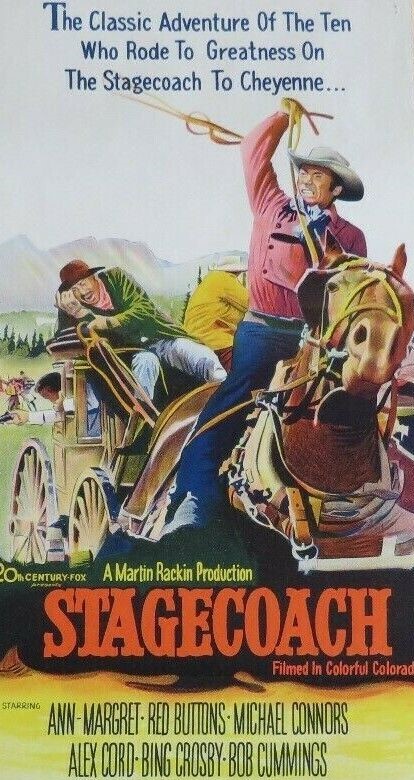
Ann-Margret is pipped to the post by…Ann-Margret. The Swinger and Stagecoach duked it out at the top of the All-Time Top 40 with the former taking it by a good margin. But it was the reversal in the annual stakes, with the western ahead just by a nose. The films viewed most this year. As ever some surprise picks.
Stagecoach (1966). Ann-Margret and Alex Cord in decent remake of John Ford classic western.
The Swinger (1966). Ann-Margret as novelist who tries to live up to the sexy persona she has invented.
The Sins of Rachel Cade (1961). Angie Dickinson as African missionary with Peter Finch and Roger Moore in thrall.
Fireball XL5. The famous British television series from Gerry and Sylvia Anderson, now colorized. “My heart will be a fireball…”
Fraulein Doktor (1969). German spy Suzy Kendall out-foxes Kenneth More. Grisly realistic WWI battle scenes and a superb score from Ennio Morricone.
Vendetta for the Saint (1968) Roger Moore vs the Mafia.
Plane(2023). Gerard Butler channels his inner Bruce Willis in Die-Hard-on-a-desert-island adventure.
Baby Love (1969). Orphan Linda Hayden proves too much of a temptation for upper-middle-class London family.
The Best House in London (1969). David Hemmings goes into battle for sex workers.
TheSisters (1969). Nathalie Delon and Susan Strasberg in complicated love triangle of love and betrayal.
Pendulum (1968). Taut thriller with cop George Peppard accused of murdering unfaithful wife Jean Seberg.
Moment to Moment (1966). Jean Seberg investigated for murder in Hitchcockian thriller set in the South of France.
Rage (1966). Glenn Ford and Stella Stevens combat pandemic in Mexican town.
The First Deadly Sin (1980). Frank Sinatra’s cop chases down a serial killer.
Go Naked in the World (1961). Gina Lollobrigida finds that her profession (the oldest) and true love (with rich Anthony Franciosa) don’t mix. Great turn from Ernest Borgnine as a doting father.
Lady in Cement (1969). Sinatra as private eye Tony Rome who takes on gangster’s moll Raquel Welch as a client.
Champions (2023). Woody Harrelson as the basketball coach saddled with a bunch of misfits.
A Dandy in Aspic (1968). Cold War thriller with Laurence Harvey as a double agent who wants out. Mia Farrow co-stars.
She Died with Her Boots On / Whirlpool (1969). Sleazy British film from cult Spanish director Jose Ramon Larraz sees kinky photographer Karl Lanchbury seduce real-life MTA Vivien Neves.
Once a Thief (1965). Less glamorous role for Ann-Margret as wife of ex-jailbird thief Alain Delon who is forced into another job.
Diamond Head (1962). Charlton Heston chews the scenery in Hawaiian epic.
Titanic (1997). Reissue in 3D of the James Cameron box office smash.
Can Heironymus Merkin Ever Forget Mercy Humpe and Find True Happiness? (1969) Self-indulgence reaches new heights with writer-director-producer Anthony Newley’s autobiographical tale about stardom. Then-wife Joan Collins co-stars.
Sergeant Ryker (1968). Lee Marvin in Korean War courtroom drama.
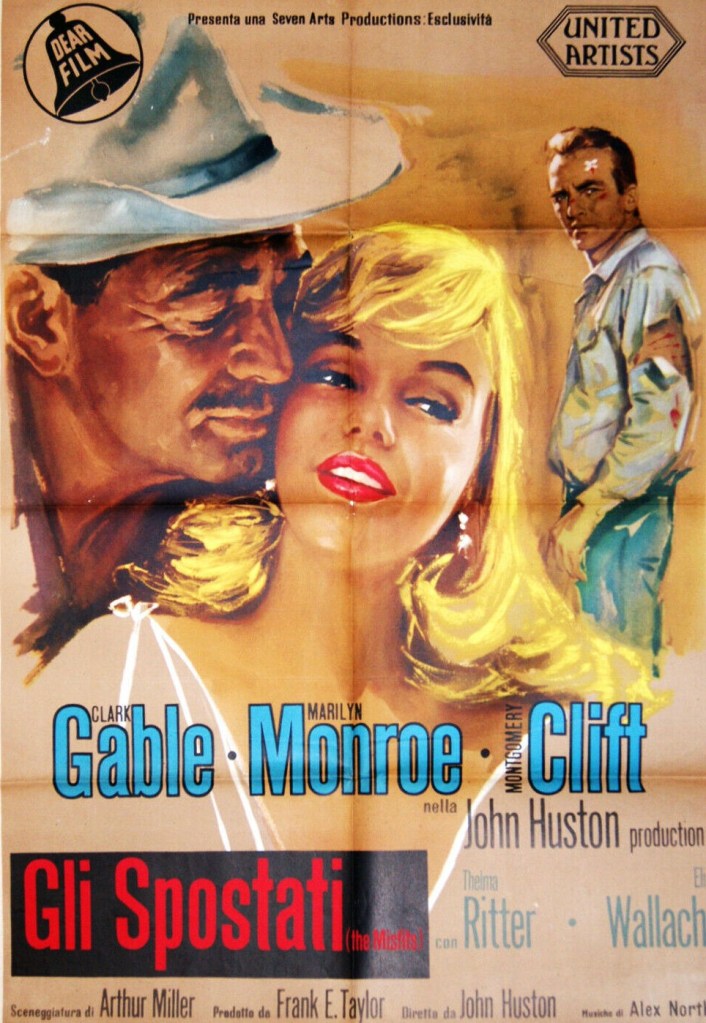
The Misfits (1960). Clark Gable goes out on a high, ably supported by Montgomery Clift and Marilyn Monroe in John Huston tale of losers.
Once Upon a Time in the West(1969). Sergio Leone masterpiece featuring the stunning cast of Claudia Cardinale, Henry Fonda and Charles Bronson and that fabulous Morricone score.
In Harm’s Way (1965). John Wayne and Kirk Douglas in Otto Preminger WW2 epic set in Pearl Harbor and after.
The Invitation (2022). Gothic thriller starring Nathalie Emmanuel.
Beat Girl / Wild for Kicks (1960). Gillian Hills is tempted into joining the striptease game. Christopher Lee puts in an appearance.
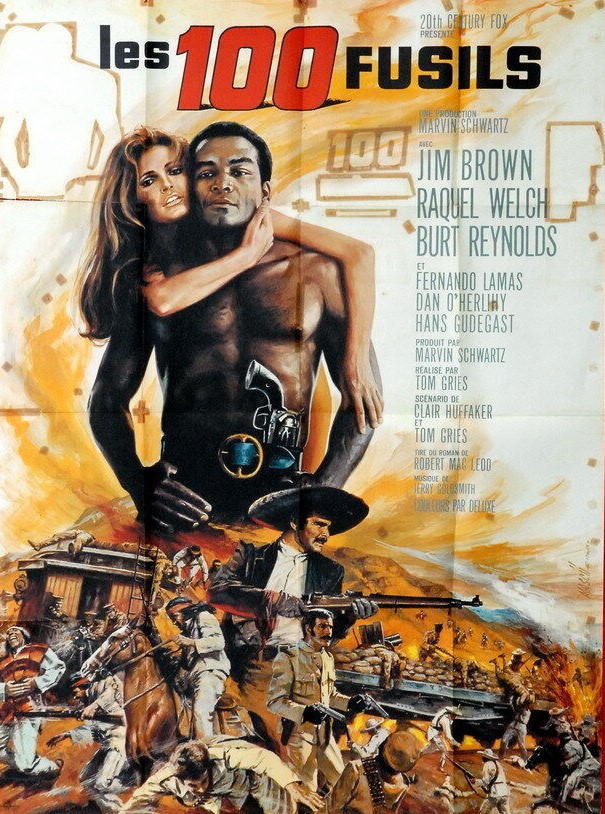
100 Rifles (1969). Raquel Welch, Jim Brown and Burt Reynolds heat up the screen in Tom Gries western set in Mexico.
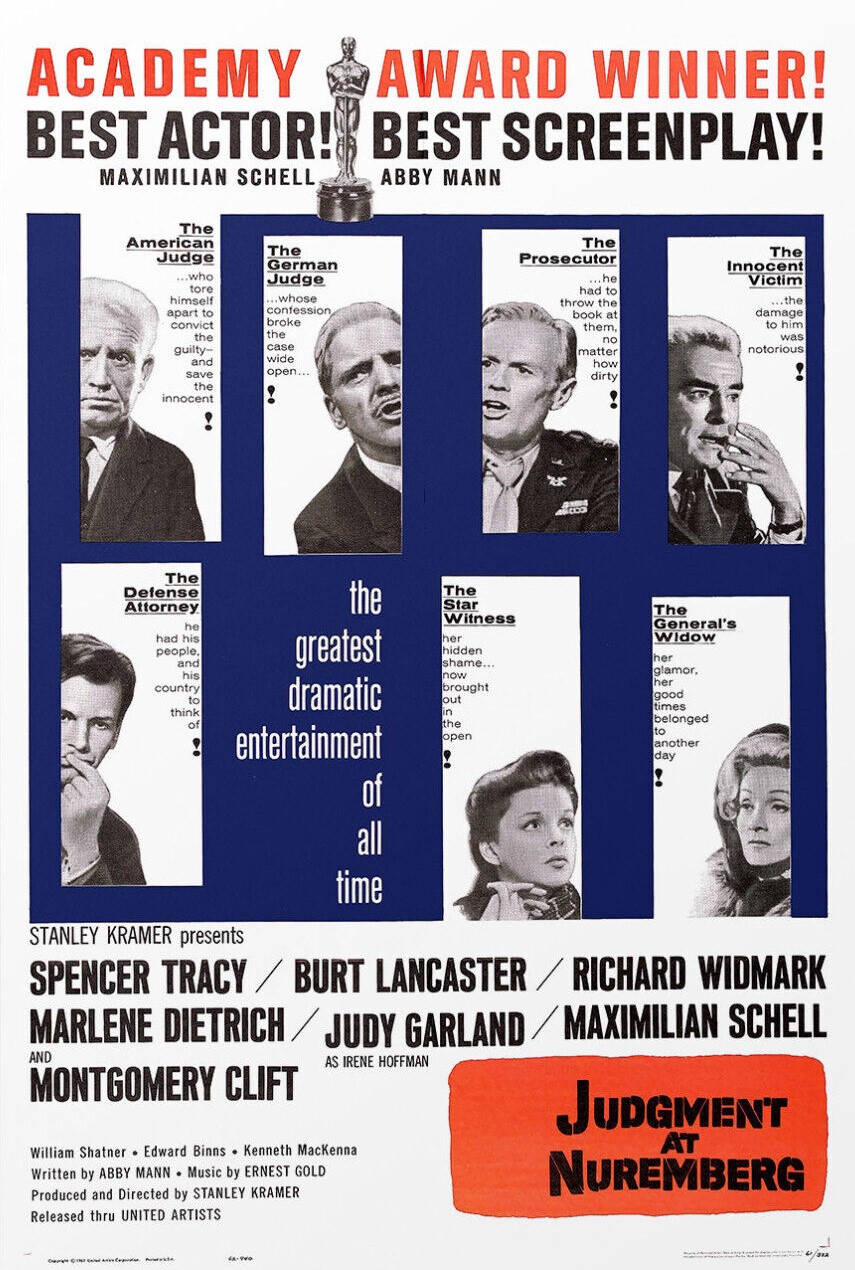
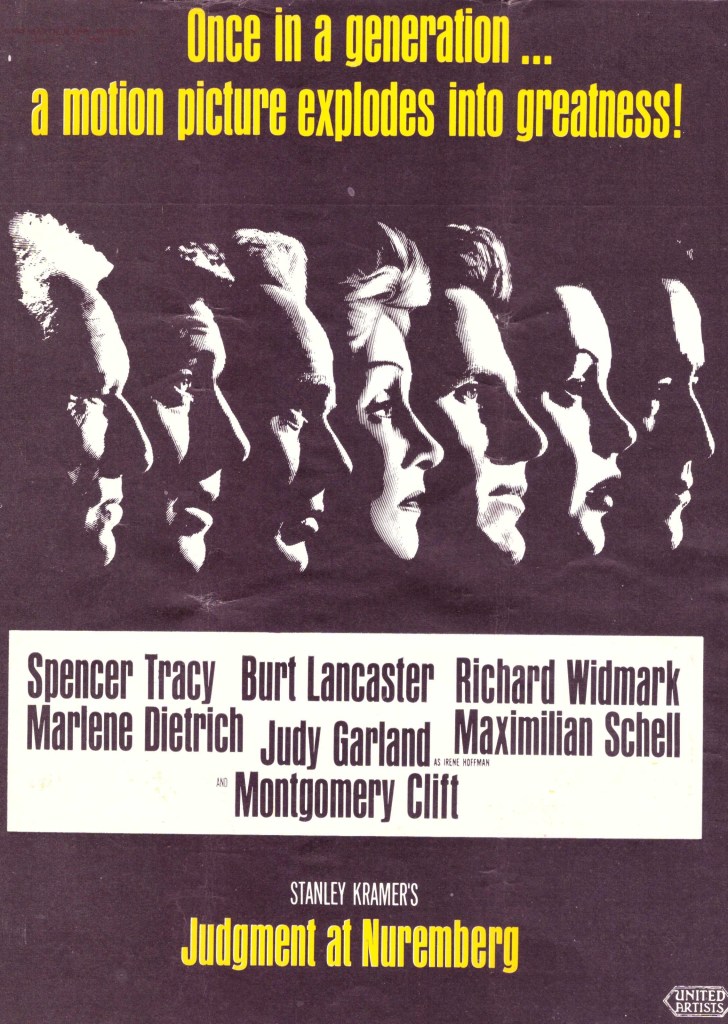
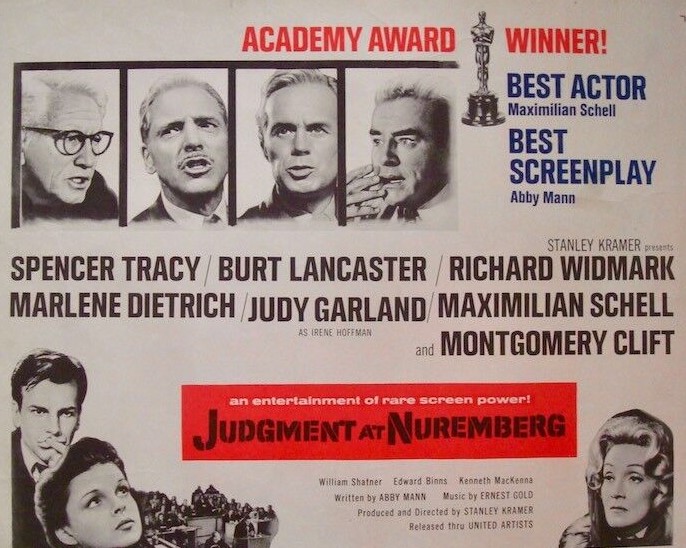
Laurence Olivier could have played a Nazi long before his celebrated villainous turn in Marathon Man (1976). He was producer-director Stanley Kramer’s first choice to play Chief Judge Dr Ernst Janning. He turned the role down in favor of getting married to actress Joan Plowright. Kramer had already decided an all-star cast was required to attract an audience for the grim picture.
The screenplay was an extended version of Abby Mann’s teleplay that had screened on the ABC in 1959. Although Marty (1955) had transitioned with box office and critical success from television to cinemas, that boom was long over.
United Artists, with whom Kramer had a multi-picture deal, were not keen. “I did what looked like a compromise to them, but what I had been planning to do anyway. I promised to fill the cast with stars of such magnitude that their presence would almost guarantee the film wouldn’t lose money.”
There were a couple of other obstacles to overcome. A stage version of the teleplay was being planned for London and Paris and Kramer had to take out an injunction against a documentary with a similar title, Verdict at Nuremberg.
Kramer was known as an issues-driven director, his debut Not As a Stranger (1955) tackling the medical profession, The Defiant Ones (1958) racism and in On the Beach (1959) nuclear war. Along with Otto Preminger, he was viewed as a director of “worthy” pictures, not always a recommendation in the eyes of the critics, but as long as the movies made money and attracted Oscar interest likely to remain attractive to studios. Kramer was just about the only producer (High Noon, 1952, and The Caine Mutiny, 1954, on his calling card) who made a successful career-long transition to direction.
With the exception of Olivier, replaced with Oscar-winner Burt Lancaster (Elmer Gantry, 1960) – not incidentally second choice either, the director preferring to have used a German actor – Kramer hired all his first choices. Spencer Tracy, in fact, was the first recruit. After working with him on Inherit the Wind (1960), Kramer got it into his head when considering a picture to ask himself what part there might be for Tracy.
The actor provided “A depth and candor that would make people notice.” Maximilian Schell (Topkapi, 1964) reprised the role he had essayed on television, a man “living in a complicated gray zone.”
Kramer had a reputation for hiring singers and dancers – Gene Kelly, Fred Astaire, Frank Sinatra – for dramatic roles and he continued in that vein by hiring Judy Garland. It was a difficult decision. He theorized that “the very disorders that made it difficult to work with her fitted perfectly with the role.”
You could have said the same of Montgomery Clift (Freud, 1962), “reduced almost the level of the unsound person he was portraying.” Given the actor’s problems remembering lines, Kramer allowed Clift to basically ad lib, when attacked on the witness stand permitted to reach “for a word in the script” that appeared the correct emotional response to “convey the confusion in the character’s mind.” While Clift did not often adhere to the script, whatever he said worked well enough. Rarely has a director been so sympathetic to a troubled actor. “He needed someone to be terribly kind,” said Kramer, “someone who would consistently bolster his confidence and tell him he was wonderful.
Marlene Dietrich, who had firsthand experience of Nazi Germany at first hand, having fled the country, actually knew the general whose wife she was portraying, which helped to “deepen my understanding of the emotions of Hitler’s victims,” conceded Kramer. Opening up about her experiences and fears allowed Kramer to extend the scope of the character.
While the courtroom where the original trial had taken place was not available for hire – it was in current use – Kramer was permitted to measure and photograph the room to reconstruct it on a soundstage. Only 15 per cent of the movie was shot in Germany.
The experience of filming Inherit the Wind, another courtroom drama, taught Kramer the need to have fluid camerawork since talk and gesture tends to be static. “I learned to move the camera often to achieve a sense of movement for the viewer.”
Abby Mann was required to open up the teleplay, move the action outside the courtroom – scenes in the judge’s accommodation, on the derelict streets, in restaurants – and avoid cinematic claustrophobia and making it a “pious sermon.” “In my opinion,” argued Kramer, “Judgment at Nuremberg conveys a moral not always honoured, then or now, in the world of politics.”
Kramer had a particular method of pre-production. He built all his sets six weeks before filming began. As part of that process, he sat down with his cinematographer and went through the script scene by scene working out the lighting and camera positions. Then he called in the actors and took them through the sets and roughly his shooting thought-process, taking on board any queries and suggestions. Film like this “sort of demanded it be shot in sequence with a single camera,” explained cinematographer Ernest Laszlo (Fantastic Voyage, 1966).
The 360-degree turning of the camera was not as revolutionary as you might imagine – although, according to critics, Michelangelo Antonioni invented it for The Passenger (1975). Laszlo had done if before on The Hitler Gang (1944) for director John Farrow. But this was infinitely more complicated set-up with the revolving camera in constant use to allow Kramer the required fluidity.
“I used two key lights,” said Laszlo. “Shooting this I used one and then as we went round I used the other.” It wasn’t as simple as it sounds, the lights needed to be positioned with mathematical precision so the audience wasn’t aware of any change in the lighting.
“The circling camera saved us photographically,” said Kramer, preventing the picture from seeming “slow and cerebral.” As smooth as it appears on screen it was cumbersome. The entire crew involved had to carry cables and equipment round in a circle. But it permitted Kramer to pick up the judges without cutting to them.
Kramer also used the camera to achieve another transition. As the picture began, German actors spoke in German (with translators offscreen) to show the trial was mostly in German. But for the movie to work, the dialog needed to be in English. “We started the transition scene with Schell addressing the court in German. Laszlo’s camera zoomed in on him, then turned elsewhere, then turned again to Schell so that we were able to switch his speech from German to English in perfect cadence as the camera came in on him the second time. His English picked up from his German so naturally you could almost let it pass without noticing.”
Kramer conceded there might, in fact, be “too much camera movement.” But that was in part dictated by a “very authentic situation, a long courtroom, very wide, and the spacing between the original attorney’s box and the witness box was at least forty feet. That’s a long distance if your try to photograph it.” Also, it wasn’t like a normal Hollywood or American trial, where the lawyers can prowl in front of judge and jury. Here, the attorneys could not move from their box.
“Unless you want to play ping-pong in the cutting room, you have to move the camera…I felt trapped by these three positions – the judges, the attorneys and the witnesses in that big spread. So, the forty feet was compressed to twenty-eight feet. We had to put a lot of light on the far figures to hold the forms in focus,” resulting in the actors “perspiring a lot during these shots.”
The movie, rolled out as a roadshow, did better than expected, the all-star cast proving a major draw, global box office netting a healthy profit. Schell won the Oscar as did Abby Mann, Kramer was nominated in his dual capacity as producer and director.
SOURCES: Stanley Kramer, It’s a Mad, Mad, Mad, Mad World: Life in Hollywood (Harcourt Brace & Company, 1997) p179-197; Donald Spoto, Stanley Kramer Film Maker (Samuel French, 1990)p230-233; “An AFI Seminar with Ernest Laszlo, American Cinematographer, January 1976, p52; “Judgment at Nuremberg Still Slated for Legit,” Box Office, February 3, 1960, p6; “Kramer Gets Injunction,” Box Office, December 11, 1961, p14.
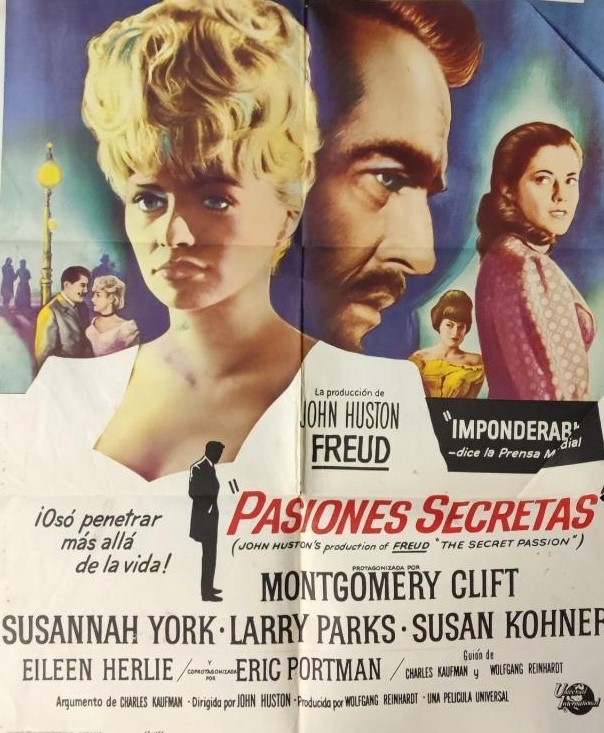
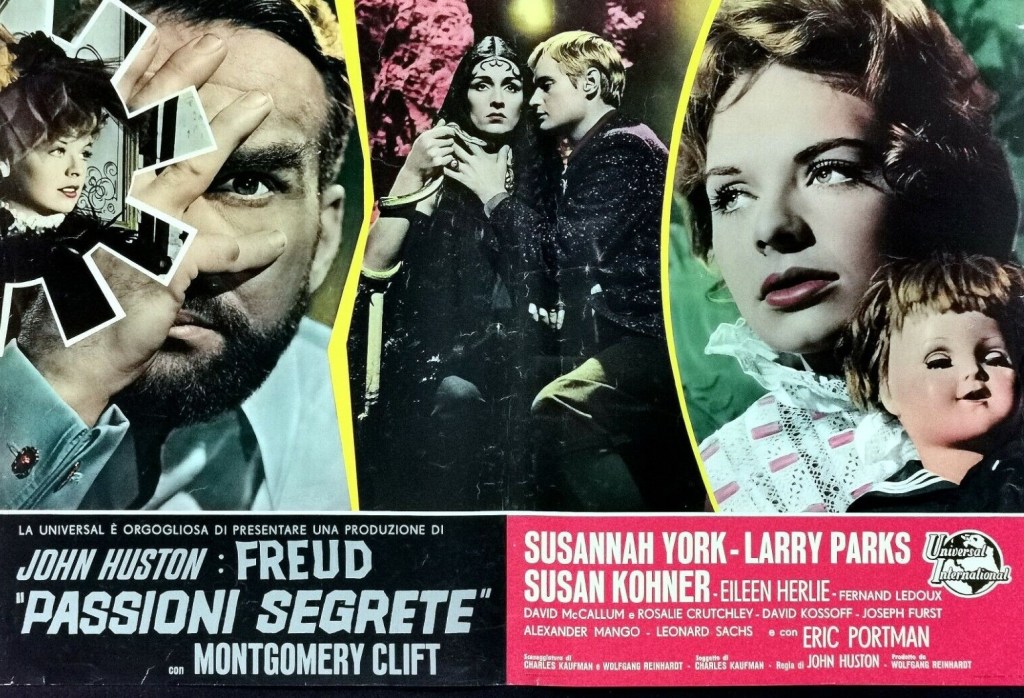
Your leading man is an alcoholic drug-addled star with substantially impaired sight. Your leading lady, in her first major role, decides she knows more about acting than the very experienced director. But in the world of victimhood, who gets the blame? Not of course Montgomery Clift (The Defector, 1964) or Susannah York (Sands of the Kalahari, 1965), but director John Huston (The Night of the Iguana, 1964).
Huston had been trying to put together a movie about the flawed god of psychiatry, Sigmund Freud, for 13 years. In 1949, with a screenplay by Charles Kaufman and backed by Twentieth Century Fox, it was going to be called Dr Freud. That version was still on the stocks a couple of years later. It wasn’t the first attempt to put the Viennese genius’s life on film, in 1940 Warner Brothers announced Edward G. Robinson in The Life of Freud with a script by Gary Endore.
Huston began serious work on the movie in 1956, but it was only greenlit two years later, after he signed a five-picture $20 million deal with new production unit Seven Arts, set up by Ray Stark and Eliot Hyman, future kingpins at Columbia and Warner Bros, respectively. It was to follow The Man Who Would Be King (not finally made until 1975), for which Huston was scouting locations in Afghanistan. At that point Freud was scheduled for 1959. Then it was Unforgiven (1960) and The Misfits (1961) that came first.
Mostly, the delay was caused by the screenplay. Huston had handed the task to celebrated French philosopher and playwright, who with what amounts to contempt for Hollywood, had written a 300-page script. His next attempt was 780-pages. Read that and weep, Christoper Nolan and Martin Scorsese, this was a 10-hour movie. When questioned, Sartre retorted “so make a 10-hour film.” Huston contemplated turning the script into two unrelated movies, perhaps in the vein of Young Tom Edison and Edison, the Man (both 1940).
Sartre spent two weeks at Huston’s home in Ireland, with Reinhardt on hand as well, trying to condense the material. But he spoke so rapidly that Huston confessed “I could barely follow even his basic thought processes….sometimes I’d leave the room in desperation, on the verge of exhaustion from trying to follow what he was saying.” Huston could not fault Sartre’s diligence. The playwright rose at 5am and would have 20-25 pages ready for discussion five hours later.
Sartre was paid $40,000 for his screenplay. Kaufman was brought back on board but his work didn’t gel with Huston’s vision. Wolfgang Reinhardt, whose name also appeared as producer, was more involved on the script. His relationship with Huston went back to Juarez (1939) on which they were co-writers and Dr Ehrlich’s MagicBullet (1940), for which Huston was credited with one-third of the script and Reinhardt was producer. But Reinhardt hadn’t received a screenplay credit since Juarez and his last Hollywood picture as a producer was Caught (1953). More recently, he had found work in Germany on The Trapp Family (1956). According to Huston, he was “misunderstood, distrusted and ill-used in Hollywood.”
Eliot Hyman questioned Reinhardt’s contribution. In addition to snagging $30,000-$35,000 and a 7.5 per cent profit share for his producer duties, Reinhardt was being paid $300 a week plus expenses for screenwriting, fees Hyman considered “out of line.”
Huston was determined that “Freud’s descent into the unconscious should be as terrifying as Dante’s descent into Hell.” Sartre was viewed as having not just objectivity but as someone who knew Freud’s work intimately. But clearly major work was required to trim the Sartre script. It took six months to reduce the material into a workable script. Naturally, Sartre objected to the reworking and wanted his name removed.
Eventually, with the project at an impasse, Huston turned to leading British psychiatrist Dr David Stafford-Clark to provide clarification. Clift, who as a patient had considerable experience of psychiatrists, insisted on joining their discussions, but “his presence served only to delay and confuse.” When asked to leave, he stood outside the door and cried, then “drank himself unconscious.”
That should have been warning enough. Having worked with an equally addled Montgomery Clift on The Misfits (1961), Huston might have thought twice about going back into the lion’s den. But, while not covered in box office glory, The Misfits was superlative, with all three principles turning in excellent performances. And in any case, Clift was the go-to actor for the tortured character.
Eva Marie Saint (The Stalking Moon, 1969) was first choice for the role of troubled teenager Cecily and after she turned it down Huston approached Marilyn Monroe whose psychiatrist advised against it. So, it went to 22-year-old English actress Susannah York, who had attracted Hollywood’s attention after two British films – Tunes of Glory (1960) and Loss of Innocence / The Greengage Summer. Unusually, this was not a romantic part, treatment of this patient critical to Freud’s analytical breakthrough. Karl Malden (Pollyanna, 1960) was offered the second male lead, but due to his unavailability it provided a comeback for Larry Parks (The Jolson Story, 1946) who hadn’t worked in Hollywood since 1954.
Huston recalled, “He had deteriorated to a shocking degree… I should have dropped Monty…but I didn’t. I thought that when we got on the set and he had lines he would be all right.”
Clift continually tried to rewrite the movie. He had got hold of previous copies of the script and produced his own indecipherable version and spoke the lines in an infantile manner. “Finally, I realized this was primarily a stall for time,” said Huston. “Monty was having difficulty memorizing the lines. I was surprized at this because he had done so well during The Misfits.” But those lines were simple compared to the long, complicated speeches of Freud.
“I’m sure Monty had almost no conception of what he said in the picture – yet he had the ability to make you believe what he did.” Eventually, his lines were written on boards, on the labels of bottles, door frames and other places on the set. Added Huston, “There was a mist between him and the rest of the world that you simply couldn’t penetrate.”
Huston also encountered problems with York. “Susannah was the personification of the uninformed arrogance of youth. Shortly, under Monty’s influence, she became convinced she was entitled to scientific opinions regarding a subject of which she was woefully ignorant.”
She and Monty would collaborate to rewrite their scenes. York refused to do a scene as originally written until a call to her agent changed her tune.
It took all Huston’s experience to hold onto his temper but a confrontation with Clift in his dressing-room resulted in a door slammed so hard it shattered a mirror. That was later conflated into Huston smashing furniture and tearing the couch apart. Huston was also blamed for Clift receiving rope burns during the climbing sequence. In fact, the shots were arranged so that after just holding on to the rope for the short period required, the actor could let go and land a few feet down on a pile of mattresses. Instead, he slid down the rope, holding on with his hands.
“My reputation for cruelty appears to stem directly from this one scene,” complained Huston, convinced the rope burns were Clift “for his own reasons beating himself up.”
Cinematographer Douglas Slocombe developed a technique of three-plane camerawork to help audiences distinguish between reality, dreams and memory. Scenes where characters recalled memories were shot through a small clear-glass plate mounted on the lens matte box. Dreams acquired an extreme black-and-white effect with chalky faces and other details standing out as luminous in tunnels of darkness. This was achieved through a combination of dramatic contrast in photography, stock and lab work.
The production spent five weeks at the Bavaria Studios in Munich before shifting to Vienna, which included 10 days of night shooting.
Universal underwrote the movie, and with To Kill a Mockingbird (1962) also on its roster, intended to celebrate its golden anniversary in fine style with “record rentals” from a raft of movies appealing to the public and the critics.
Freud’s daughter Anna and son Ernest didn’t take kindly to Hollywood’s interpretation of their father’s life and disassociated themselves from the movie and the Viennese hierarchy objected to the film’s louche elements.
Filming began in August 21, 1961, including three weeks on location in Vienna, and was due to wrap on December 5. That it took another two months to complete, (final shooting date was February 10, 1962) inflating the budget, was laid at the foot of Clift. Never mind the drink and drugs he was consuming in mighty proportions, he had cataract problems and could hardly see.
Universal sued Clift for $686,000 for not acknowledging his cataract problems prior to filming, an issue that prevented him memorizing his lines. Clift counter-sued for the remaining $150,000 owed from his $200,000 fee, claiming the problems had developed during filming. “I refuse to accede to the defendant’s demand that this condition…was responsible for delays to the picture.” Firemen’s Fund Insurance, whose policy covered the actor for a year from April 1, 1961, with the proviso the movie finished by December 5, 961, denied liability.
Universal was concerned that the title would mean little to the general public and pre-release toyed with changing the title to Freud: The Dark Passion but agreed, in the end, not to “tamper” with it. However, exhibitors disagreed. And once Minneapolis second-run and neighborhood cinema owners refused to book it under the existing title, it was changed to The Secret Passion, which at least got it through the door with bookers even if the public remained wary. On posters, The Secret Passion part of the title grew bigger and bigger until the Freud element almost disappeared. The film was cut after initial release but the DVD shows the full version.
Despite critical approval and a 12-week run in New York and some decent runs in smaller houses in the country’s bigger cities, it was a flop, not managing the $1 million in rentals required to earn a spot on Variety’s annual box office chart.
SOURCES: John Huston, An Open Book (Columbus books, 1988) p294-305; “Memo from Eliot Hyman,” July 15, 1959, United Artists Archive, University of Wisconsin, Box 7, Folder 7; “Endore for Freud,” Hollywood Reporter, February 24, 1940, p2; “Robinson As Freud,” Box Office, March 2, 1940, p2”; “Dr Freud Bio On Fox Docket,” Box Office, September 17, 1949, p19; “20th Lead with Five in Biopic Sweepstakes,” Variety, January 24, 1951, p5; “Freud Biopic 1st Hyman 7-Arter,” Variety, July 30, 1958, p3; “John Huston’s Next Spot – Afghanistan,” Variety, October 15, 1958, p19; “Huston Seeks Saint,” Hollywood Reporter, November 10, 1958, p2; “Universal Unchained,” Variety, August 19, 1959, p5; “Huston in on Freud Biography,” Variety, October 28, 1959, p11; “Sartre Script on Freud: 780 Pages,” Variety, June 29, p3; “Freud Rolls August 21,” Variety, July 26, 1961, p5; “Freud Moves Location,” Hollywood Reporter, October 12, 1961, p6; “Freud on Night Shift,” Hollywood Reporter, October 24, 1961, p3; “Freud Film Not To Liking of Kin,” Variety, November 1, 1961, p2; “Three-Plane Photography Developed for Freud,” Hollywood Reporter, December 19, 1961, p11; “Huston’s Freud Ends Photo Phase,” February 14, 1962, p4; “Universal Sues for $600,000,” Hollywood Reporter, April 30, 1962, p3 “Montgomery Clift’s Eye Trouble,” Variety, June 5, 1963, p5; “U’s Insurance Claim on Monty Clift,” Variety, June 27, 1962, p7; “It’s Plain Freud, U Won’t Tamper,” Variety, October 3, 1962, p3; “Never Heard of Freud,” Variety, October 9, 1963, p5; ’“Top Rental Films of 1963,” Variety, January 8, 1964, p37.
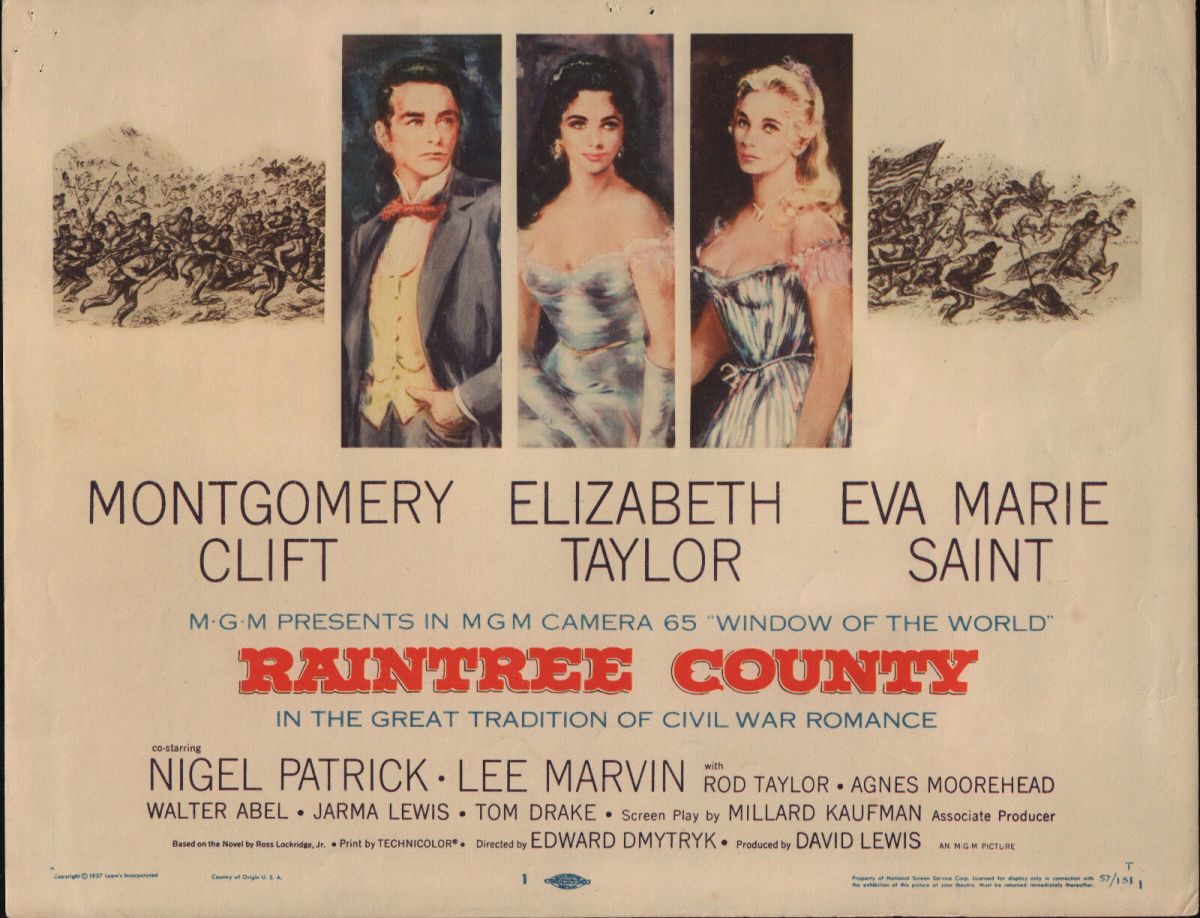
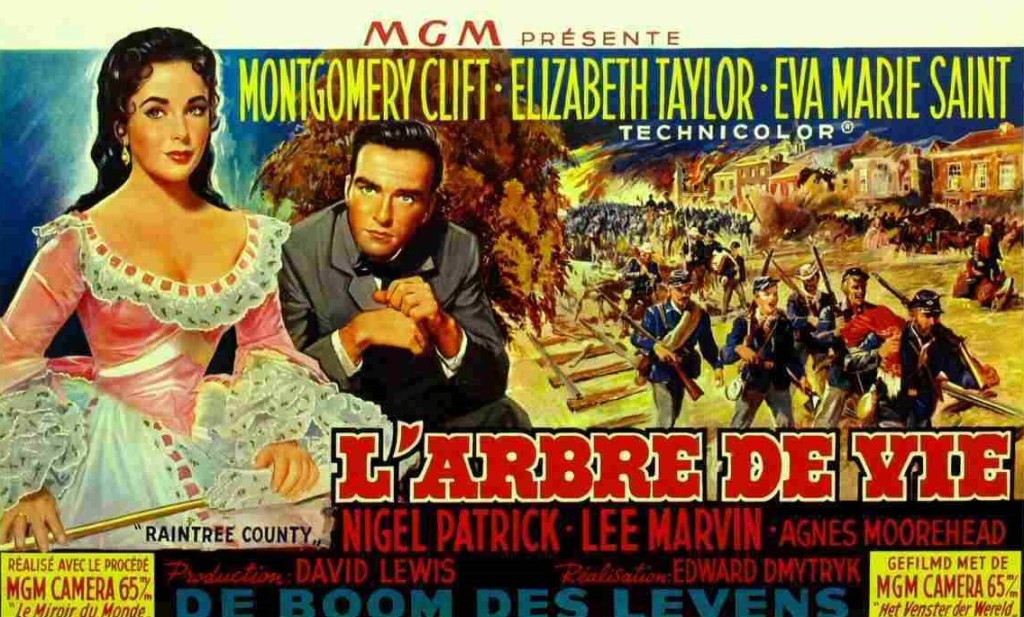
Much-maligned melodrama. No more episodic over a three-hour running time than Ben-Hur (1959) or Doctor Zhivago (1965) and though bookended by the American Civil War has less grandiose views on history. Part of the problem is that, faced with such length, critics expected something with greater depth rather than just ordinary people caught up in circumstance. As if a stunning treatment of madness was not enough, inside the warring mind of a beautiful woman, whose realisation of her condition sets her on the road to tragedy. But it is riddled throughout by an element of fantasy, the fabled “rain tree” with golden leaves triggers a moment of madness in all who seek to find it in the swamps.
Like Zhivago, the narrative arc is a love triangle between principled teacher John Shawnessy (Montgomery Clift), southern belle Susana (Elizabeth Taylor) and reporter Nell (Eva Marie Saint). Sub-plots involved drunken gregarious Flash (Lee Marvin), bumptious Garwood (Rod Taylor) and the charming adulterous Professor (Nigel Patrick). The characters intertwine at various points and John, Flash and the Professor come together during the war while Garwood tries to make political capital out of it afterwards.
John and Nell have known each other since childhood, but there’s no real sense that they are childhood sweethearts. If they have passion for each other, it’s well hidden, and when Susana turns up, she steals him away, in part by the ruse of pregnancy. Despite her incipient madness, perhaps because of it, John sticking by her no matter what, there’s grand passion in full view. But the best scenes are Susana talking not about her condition, but what she believes to be true and her fears that her truth may be false. She lies, for example, about her age when a fire killed her father and his lover. She leaves her husband a note that she discovers she has never written. Her confusion at the depth of her illness, fear that she might have inherit the genes of her mother (also insane), is very touching.
She also does one thing that smacks of “Hollywood madness,” the crazy action that is shorthand for insanity, but within the twisted confines of her mind that is out of love for John. She has a dark secret about her role in the events surrounding the fire. But she overcomes her innate racism out of love for him, prior to the war freeing her slaves. She clings to John because she knows he is the one route out of her madness.
Audiences wouldn’t buy a three-hour picture about madness. You might perceive the other episodes as mere filler, and in some senses that’s true, but the episodes in themselves are quite entertaining and revealing. Though told the “rain tree” is a local myth, a kind of “holy grail”, John is the only character who tries to find it, out of idealism or insanity who knows, and nearly drowns as a result. Flash has come by his nickname for his running exploits and is challenged to a race by John and the otherwise outwardly idealistic Professor, a gambler, tries to influence the outcome.
Though a stranger in town Susana (“I’ll arrange it”) positions herself to place the garland of victory upon his head. When the Professor tries to make off with another man’s wife, John’s skills with a bullwhip prevent him getting shot. Although John’s mother and Nell push him towards politics, Susana leaves him be, recognizing the joy and fulfilment he gets from teaching.
The war is primarily viewed through the perspective of the Professor, a non-combatant who has found himself a job as a war correspondent, making wry comment as he illustrates various battles. By the end of it, soldiers on both sides are weary of the slaughter.
This was intended as one of the first roadshows, MGM’s initial attempt at incorporating its innovative widescreen process Camera 65 (meaning 65mm – the other 5mm in the more common 70mm taken up with the sound strip) that was later used to tremendous effect on Ben-Hur. And while this lacks the scope or action sequences of the Biblical epic, it looks just sumptuous on the wide screen.
Director Edward Dmytryk (Mirage, 1965) has a keen compositional eye and he also favors actors over showing off his directorial skills. But there are exceptional scenes from the directorial perspective. In one the camera remains fixed on Montgomery Clift at the side of the screen while in the background Lee Marvin is creating havoc. In another we follow a female warden as she unlocks door after door in an asylum before Montgomery Clift is led to Elizabeth Taylor.
The acting is superb, Elizabeth Taylor was nominated for an Oscar and might well have won except Joanne Woodward was playing a character with a split personality in The Three Faces of Eve. But it was a bold role for a young star like Taylor, and a tremendous piece of casting. As much as she uses words to try to explain or understand herself, when the camera cuts to her face you can see the terror in her eyes.
Clift had disfigured his face during an accident during shooting and that clearly physically affected his performance. Eva Marie Saint (36 Hours, 1964) is very effective as the rejected lover. Lee Marvin (Point Blank, 1967) takes the showboating approach to his role while Rod Taylor (Chuka, 1967) is not above some scene-stealing himself. But then both are competing with the over-the-top Nigel Patrick (The Battle of Britain, 1969). Millard Kaufman (The War Lord, 1965) wrote the screenplay from the Ross Lockridge Jr. bestseller.
The kind of film to immerse yourself in the performances and let the running time take care of itself.
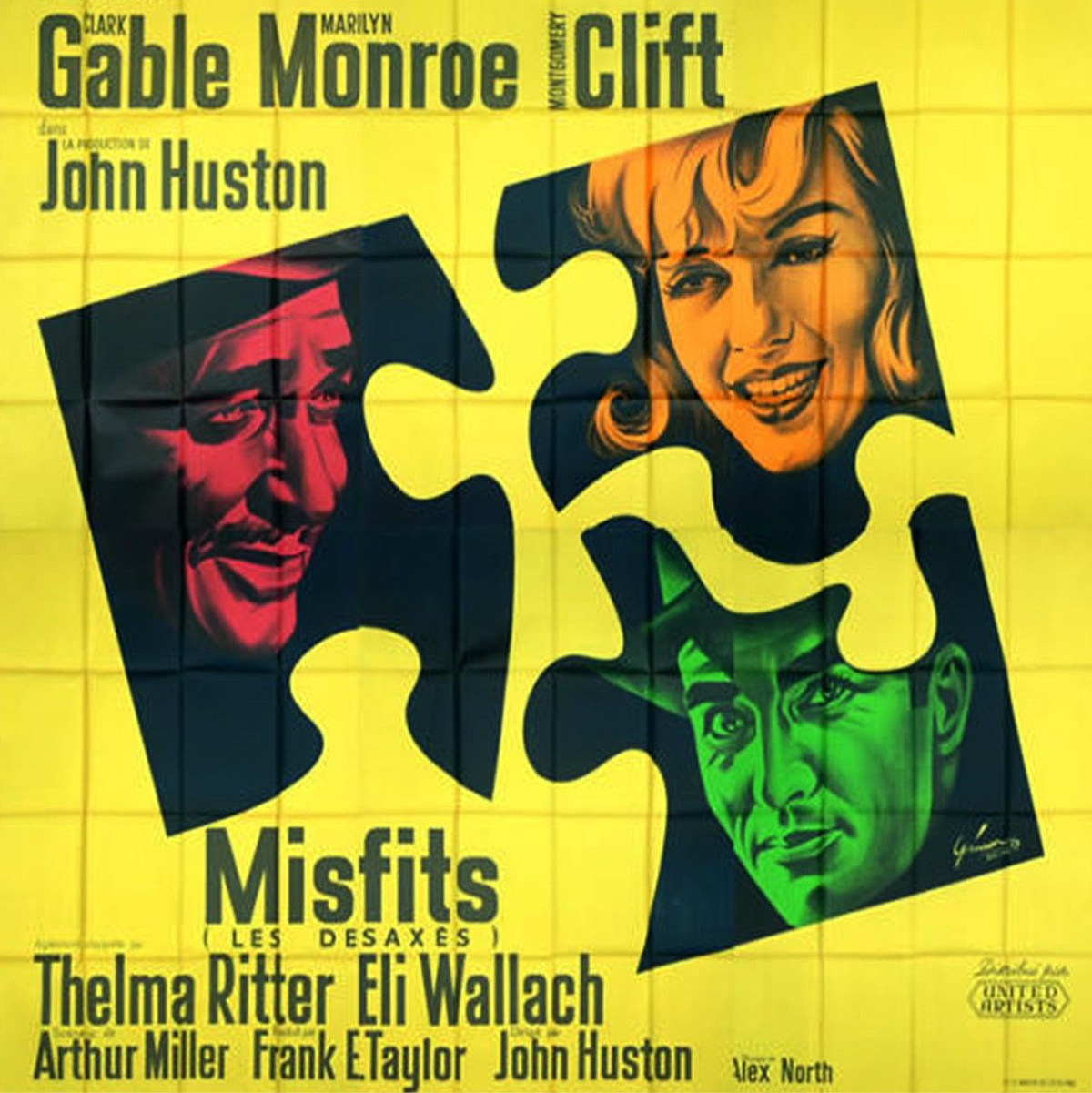
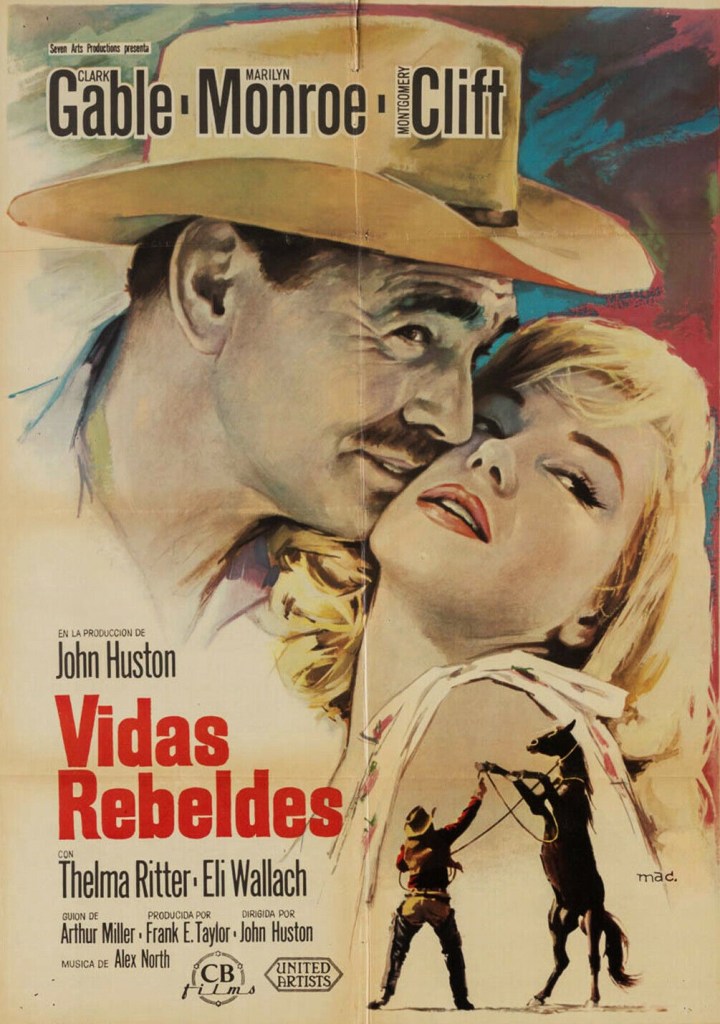
Arthur Miller, author of arguably the greatest play of the 20th century, Death of a Salesman, had gone to Reno to get a divorce so he could marry Marilyn Monroe. While there, he befriended some cowboys who took him with them while they caught horses. He turned the experience into a short story The Mustangs, published in Esquire (October 1957 issue). It provided the basis for the screenplay The Misfits. While the character of Roslyn, played by Monroe, was based on another woman, Miller explained, “I had written it to make Marilyn feel good.”
In July 1958 he sent it off to director John Huston, not just on account of a body of work that included The Big Sleep (1946) and The Treasure of the Sierra Madre (1948), but because he had nursed Monroe through her debut on The Asphalt Jungle (1952) calming her nerves by telling her “if you’re not nervous you might as well give up.” Miller felt Huston would “present Marilyn with the bracing challenge, her fighting her problems through to a fine performance.”
Huston was enthusiastic – he saw the story as representative of a “dog-eat-horse-society” – and called the writer over to his house in Ireland where they spent two weeks putting the finishing touches to the screenplay, except for the last 15 minutes. Originally, it was a lengthy piece, almost an epic, production executives timing it at two hours 47 minutes, too unwieldy for a standard drama, so inevitably compromise would be required.
For tax reasons, Huston wanted to film in Mexico but relented and agreed to shooting it in Nevada. Talent agency MCA, which represented Huston, effectively put the film together as a package. Although Robert Mitchum was initial first choice, when he didn’t respond the screenplay went to Clark Gable, another MCA client, who accepted immediately. Eli Wallach was next on board. At this point, with only six films under his belt and better known for his work on Broadway, Wallach would not have expected to see his name above the title. But he was told that his name would be second to appear on the credits, after Gable.
But as the weeks went by and first Monroe then Montgomery Clift – both MCA clients – signed up his name slipped further down the credits. He consoled himself that his name would be “first position under the title” as that billing position was technically known. That proved an illusion. Thelma Ritter, apparently, boasted greater box office wattage so in the final credit rankings he placed fifth.
Although Monroe was viewed as the most mentally fragile, Clift and Gable also had issues to overcome. Due to the injuries suffered in a car crash and his well-known dependency on drugs, nobody would insure Clift but eventually an agreement was reached. Gable failed the medical, having gained 35lb while filming It Happened in Naples (1960) in Italy, ballooning his weight to 230lb. But two weeks later he was cleared.
The producer for such a heavyweight production was an industry lightweight. Frank E. Taylor’s main claim to fame was that he had been Miller’s publisher before he achieved fame as a playwright, working for the small company that published the author’s non-fiction work Situation Normal (1944) and the novel Focus (1945). Taylor had some Hollywood experience, but after four years employed there managed only one credit, John Sturges’ film noir Mystery Street (1950).
The original plan to start filming in September 1959 was scuppered by the incompletion of It Happened in Naples so it was shelved until the next spring. The next start date – March 3, 1960 – was an unexpected casualty of the Actors Strike which had delaying shooting on Monroe-starrer Let’s Make Love by five weeks. So when that film finished on July 1, there was little of a break for Monroe what with costume and wig fittings and test photographs before reporting on July 18, 1960, for what was expected to be a 50-day shoot, for The Misfits.
The budget was set at $3.5 million – a substantial amount for a black-and-white picture – with $1.6 million going to the principals. Clark Gable was down for $750,000, Marilyn Monroe and John Huston $300,000 apiece – although a generous profit participation scheme could see the actress earn as much as Gable – and Arthur Miller on $225,000. It was shot mainly on location in Nevada at Reno, Dayton and Pyramid Lake (a misnomer because it was all dried out) with a couple of weeks’ studio work at the end. Unusually, it was being filmed in chronological order to assist Monroe achieve her characterization.
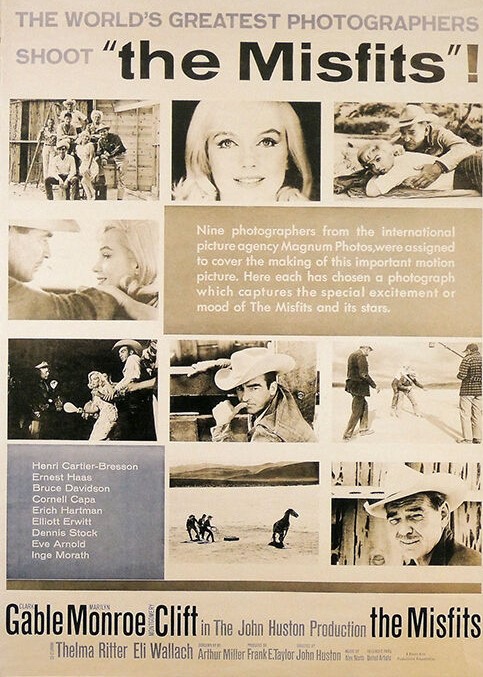
Taylor had achieved a publicity coup by convincing famed photographic cooperative Magnum to cover the shoot in depth. Photographers of the calibre of Henri Cartier-Bresson, Inge Morath and Eve Arnold worked in teams of two, each for a 15-day stint. Bresson would say of Monroe’s ethereal beauty: “I was struck as by an apparition in a fairy tale.”
Before a foot of film was exposed, the movie was in crisis. The script had been refused approval by the Production Code, the self-censorship system to which all studios subscribed. Code head honcho Geoffrey Shurlock complained that “the illicit relationship involving Roslyn and Gay seems to lack effective compensating moral values…(with the) difficulty that your story readily accepts illicit sex rather than condemning it.”
While there was publicity value to be gained from a tussle with the Production Code, it would not sit well with the distributors. The lack of a rating would inhibit many cinemas from risking a booking, despite the box office appeal of the cast.
Everyone had known going into production that getting Monroe on the set at all never mind in a condition to work would be a considerable achievement. Aware of her inability to rise early, Huston had shifted the daily start time by an hour to 10am. Sometimes shooting was restricted to only a couple of hours per day and since she was in most scenes there was a limit to how much the director could shoot around her.
Among the cast nobody knew her better than Eli Wallach. He had met the actress several years before when she had popped backstage after his performance in Teahouse of the August Moon on Broadway. He recalled: “She looked nothing like the movie star I’d seen onscreen; she wore a simple dress and had short blond hair. She was pale, shy, and wore no lipstick.” They became friends and would go out dancing. He introduced her, gradually, to The Actors Studio where she met Lee Strasberg, husband to Paula who became her acting coach.
“By the time we began to work on The Misfits in 1960,” said Wallach, “she seemed to have become a different Marilyn than the one I had known in New York, and the action that happened off-screen during the making of the film seemed to rival what was happening onscreen.”
Even so, the early part of the shoot went well. Commented Wallach, “Her mood waned and she began to lose her self-confidence.” For one scene where she was to do nothing more difficult than cross the road, she kept stopping halfway through. She had forgotten her motivation. Huston advised, “Your motivation comes from your need to cross the street without getting hit by any of the cars.” The next take was perfect.
But the signs of trouble were there from the outset. The evening before her first scene a nervous Monroe nearly took an overdose of Nembutal. Her unpredictability meant that on some days she only managed an hour or two, other days nothing at all. On August 27 she collapsed and was sent to Westside Hospital in Los Angeles for treatment, where she could be weaned off her addiction to barbiturates under the care of her analyst, not returning until September 6. On September 12, 13 and 19, she was indisposed and didn’t turn up for work.
If this was a case of life imitating art – her marriage to Miller was falling apart – she seemed to react to some lines as if the words were intended for Marilyn and not the character she was playing. In one scene Gable says, “You’re the saddest girl I ever met. What makes you so sad?” Monroe burst into tears. Wallach surmised, “Marilyn seemed to feel that the camera could detect her innermost thoughts.” In another scene, where Monroe and Wallach dance she “seemed upset and unhappy.”
Apart from casting her in The Asphalt Jungle, Huston had “saved her from the casting couch” by prior to that film setting up a proper screen test for her opposite John Garfield, providing her with a calling card that would reduce the requirement for her to jump into bed with a producer to get a part. But even on The Asphalt Jungle, she seemed dependent on her acting coach, at this point Natasha Lytess. “At the end of a take,” recalled Huston, “Marilyn would look to her for approval. The coach would nod her head.”
Monroe was taking pills to go to sleep and pills to wake up in the morning. The doctor on location eventually refused to give her any more, but of course she found them elsewhere. After visiting her in hospital, Huston was convinced the worst was over. But her renewed effervescence didn’t last.
“Marilyn returned to her old ways as though she’d never had a break,” recollected Huston. “One Sunday afternoon I visited her in her suite to get an idea of what to expect in the week ahead. She greeted me euphorically – then went into a kind of trance. She was the worst I’d ever seen her. Her hair was a tangle; her hands and feet were grubby; she was wearing only a short nightgown which wasn’t any cleaner than the rest of her.”
Despite her personal problems, Monroe was an extremely skilled actress. Observed Huston, “She could be marvelously effective. She wasn’t acting – I mean she was not pretending to an emotion. It was the real thing. She would go deep down within herself and find it and bring it up into consciousness.”
Huston, not necessarily known for accommodating actors, turned on the charm, always agreeing to another take if Monroe or Paula Strasberg (paid $3,000 a week) asked for it. Although most people disparaged Paula’s presence on the set or, more correctly, Monroe’s dependence on her, Huston acknowledged that without her his job would have been more difficult and he called a halt to crewmen nicknaming her Black Bart after her choice of clothing, habitually a black sack dress and black hat. So integral was Strasberg to Monroe’s life that the actress later moved from a hotel room shared with her husband to Strasberg’s apartment.
When even Strasberg failed to control her client, her husband Lee, the inventor of the Method School of acting which had revolutionised American drama, was flown in from New York. He had a different take on the situation. The problem wasn’t with Monroe but Huston. The director’s – refusing to deal directly with Paula. Raged Lee: “I will not tolerate this treatment of her, she is an artist,” threatening remove his wife from the picture.
Miller saw it differently: “Coach (Strasberg) was a little crazy, she was an opportunist I thought and not competent to help.” However, there was a very real issue to be addressed. Monroe had never come to terms with her fame and could not cope with the pressure of being the screen character with whom the world was infatuated.
Monroe’s technique was very individual. “I don’t want to discuss the Method. I don’t believe I have the experience. I try to use Method to the best of my ability. It makes working more possible…The writer has done the words then it’s up to the actor…I can’t work unprepared, I’d shoot myself. I can’t memorize words by themselves. I have to memorize the feeling.”
Clark Gable was on a career high, at least in terms of remuneration, earning $750,000 a picture, on a par with John Wayne and William Holden, the highest-earning stars at the time. Gable had the privilege of being paired with some of the top female stars – But Not For Me (1959) with Carroll Baker, Doris Day in Teacher’s Pet (1958) and Sophia Loren on It Happened in Naples, the title a twist on his star-making picture It Happened One Night (1934), and more than holding his own against Burt Lancaster in war picture Run Silent, Run Deep (1958).
Despite his commercial appeal he held to a particular ethos when choosing a role. “If I hadn’t liked this story I wouldn’t have done it no matter how much money they offered me,” he said. “I have to like the story or I won’t do it…I never select a part for the part itself. I always look at the overall story first.” Of his character, Gable observed: “He’s the same man but the world has changed. Then he was noble. Now he is ignoble.”
The press was salivating over the prospect of The King falling for The Blonde Bombshell. But regardless of her physical attractions, Gable was put off the actress by her untidiness and her lack of personal hygiene. But he was not perturbed by her behavior. “I’m just unhappy about her problems, her fears, her personal life, but if I were to chastise or criticize her it would only deepen her despair,” he said. When, largely thanks to Monroe’s hospitalization, shooting continued past the original completion date he was compensated to the tune of an extra $48,000.
With the male actors, Gable had a tendency to get off on the wrong foot. Initially annoyed with Montgomery Clift for fluffing lines, they became good friends after trading insults. But it took John Huston to end an unexpected rift between Gable and Eli Wallach.
Prior to their first day working together, Eli Wallach was surprised to answer a knock on his hotel room door to find Gable’s assistant Bama Davis who asked him to read to the visitor the scene they would perform the next day. Somewhat puzzled by this behavior and worried this approach was indicative of the actor, Wallach did not speak to Gable when they first met. It fell to Huston to break the ice by handing both actors a shot of Jack Daniels.
Gable was more sensitive to his own performance than you might imagine. He asked Huston to reshoot the scene where he wakens up Monroe because he “didn’t think he showed the love that was necessary.” He refused a stunt double for the scene where Gable, Wallach and Clift try to throw the mustang. In the film the mare dragged Gable and Wallach around the lake floor. In reality, in long shot it was stunt double Tom Palen being dragged by an actual horse. For close-ups of Gable while there were no horses in sight, the star was still dragged at 35mph for 400ft behind a truck. It took 28 cuts of Gable for the stallion fight to be matched with second unit footage.
Gable was angry at the way the second unit treated Tom Palen. After the stuntman had already endured two injuries Gable drew the line on hearing that he was called upon to be smashed on the face by hooves.
Gable was immensely proud of his work. “I have two things to be proud of in my career – Gone with the Wind and this one.” He later amended that to, “This is the best thing I did in my life.”
John Huston and Reno, where the film crew were housed, were a match made in heaven. The director was an inveterate gambler. He lost $25,000 one night but won it back the next and some. Overall, he left with less than when he arrived.
But he had an artist’s instinct when it came to film. He was not one for giving much direction. Huston expected “actors to be themselves, he didn’t interfere very much with their interpretation.” He prided himself on telling an actor as little as possible. “When I have to step in, I feel defeated.”
But he knew what he wanted and how, technically, to get the best out of an actor. At first Wallach played his drunk scene with rage until Huston pointed out that drunks always try to pretend they’re sober. And Huston knew what he didn’t want. Which was unwanted advice from an actor. For one scene with Monroe, Wallach expected a close up and committed the cardinal error of pointing this out to the director. “Never,” growled Huston, “never tell a director where to set up the camera.”
For Montgomery Clift’s first scene where he is seen talking to his mother in a callbox, Huston wrapped it after the first take, ignoring Clift’s pleas for another shot. ‘You’ll never do it better,’ said Huston, ensuring he did not fall prey to Clift’s lack of self-confidence either.
Monroe seemed to instinctively understand – and approve of – Huston’s technique. “He watches for the reality of a situation and he leaves it alone and he waits until he needs more or less before he comes in.”
Monroe wasn’t the only one whose illness shut down the set. Shooting on October 3 was cancelled because Huston came down with a recurrence of bronchitis due to the alkali dust on the dry lake. He was missing again the following day.
But if the actors in general appreciated Huston’s technique, Arthur Miller did not. It was unusual for a screenwriter to be present during the entirety of a shoot. For all that he brought certain extra intensity to scenes he re-wrote and his improvisation resulted in at least one great scene – Monroe’s paddle-boarding was not originally in the script but incorporated after watching her play with the toy between takes – Miller was generally a pain in the butt.
With no experience of moviemaking he clearly regarded himself as something of an authority and failed to recognise the distinction between the production of a play – where the writer was top dog – and a movie, where he was not.
Miller complained to Huston and Taylor about the lack of atmosphere, calling for more long shots “to constantly remind us how isolated these people are.” He had the temerity to criticize Gable’s performance. For one scene he observed that the actor had not “shown sufficient expression in his eyes.” Gable patiently explained that actions had to be minimized because they would be magnified a hundred times on the screen. “He turned out to be right,” conceded Miller, “he had simply intensified an affectionate look that was undetectable a few feet away.”
“I learnt from John,” said Miller, “ that he would pack the lens with material and let the camera choose…he put a lot of elements in front of the camera and let it find its way. So there’s not a lot of cutting from one face to the other ion conversation.” (In fact, this was old-school filmmaking where characters were grouped together rather than filmed apart). But he complained vociferously about the director’s positioning of Monroe fifty yards from the camera for her “Murderers! Murderers!” scene.
Miller thought such distance would ensure she wouldn’t be heard. But when Miller saw the rushes he realised the director was right. Huston wanted to portray Monroe at this point “as if she were a voice lost in the wilderness.”
Miller also wanted one scene which fades to darkness. Huston had to explain the practicalities. “You can only have one light in any given scene. In plays you can dim the light through a scene but not in a motion picture. You’re asking for values that aren’t there.”
His presence certainly wasn’t doing his wife any good. It might have been better if he had been absent, since the marriage appeared to disintegrate under their noses. He was being prophetic when he said of her first scene: “I couldn’t help feeling her disappointment not only in her character’s marriage but in her own…I had sensed something withdrawn in her, not merely in the character she was playing.”
He was prone to rewriting, in part with what he believed were better ideas, but also to emphasize developments he perceived in the characters as their screen personalities unfolded. By October 6 Gable had enough of the constant script changes and refused to film anything that had been written after September 20. Luckily, he relented and agreed to shoot the much-revised final scene. But even Miller received his come-uppance on a personal level. One day on location miles into the desert, Huston came upon a stranded Miller, abandoned by Monroe and her entourage.
Four-time Oscar nominee Montgomery Clift had an extraordinary success rate in pictures. Up till now he had appeared in only thirteen pictures but at least half were gems – Red River (1948), A Place in the Sun (1951), I Confess (1953), From Here to Eternity (1953), Raintree County (1957), The Young Lions (1958) and Suddenly, Last Summer (1959). But a bad car accident in 1956 exacerbated his drug and sexuality issues and he was considered an unexploded grenade. “He’s the only person I know who’s in worse shape than me,” said Monroe.
In fact, perhaps encumbered with helping nurse Monroe, he was able to put his own problems to one side. Apart from the early tiff with Gable, his most difficult point was when he received rope burns during his part in the mustang chase. He had forgotten to put on gloves at the start of the scene and he couldn’t suddenly appear with them on when he had to haul on the rope.
The longest scene lasting all of five minutes. The longest Huston had ever shot and one of the longest ever committed to camera was shot “day for night,” the effect achieved by a red lens opening and using red and green filters. The shooting area was covered by a black tarpaulin to kill the direct rays of the sun. Big 10k lights were hauled in to give the effect of moonlight on Monroe and Clift. Second unit director Tom Shaw was on standby with insect spray to keep insects off the actors.
But the long stretches of dialog defeated the actors and finally to save film on wasted takes Huston sent them off to rehearse by themselves. After several takes they completed the scene without missing a line. But there had been a problem with Clift’s bandage so the scene required reshooting. First Clift fluffed a line, then Monroe, then Huston interrupted, objecting to the camera position, “that’s a most unflattering angle.” After Clift fluffed a line once again, it was done.
For another scene at the lake also shot “day for night,” the cowboys did not actually build a camp fire, that was artificial, lit underground using gas, while trees and bushes were planted for the occasion.
If you ever wondered how movie crews get the bashes in bashed cars, the answer is they put them there. Monroe’s new Cadillac was battered by sledgehammers to represent a vehicle dented by admirers wanting to attract Monroe’s character’s attention by bumping into her.
It wasn’t just Monroe who caused problems. Two forest fires on August 20 saw Reno covered in black smoke with 200 firemen attending the blazes. Within a day the fire had consumed 35,000 acres and caused $200 million in damages and cut the power lines to Reno. However, the crew reacted by bringing a lighting truck and generator from Dayton.
On October 24, the crew was shipped back to Hollywood for scenes and footage requiring back projection. Landscape scenes of Pyramid Lake, for example, were screened behind the aeroplane and for scenes taking place in cars. Huston had commissioned 360-degree stereopticon shots of the lake so that single head shots could be used with rear projection.
Among the reshoots was the dance sequence at the Stix house “to show more joy and abandon” and the scene on the truck bed between Gable and Monroe in which Miller had complained “there was a lack of interaction between the two players.”
The scene where Gable was trampled by the horse was reshot with artificial hooves. Buckets of actual alkali from the lake were spread on a wooden platform, the artificial legs in the end manipulated by Huston. The last scene shot was a retake of Gable and Monroe in the station wagon. “For the first and last time on the picture,” observed journalist James Goode, “Huston didn’t ask for another take.”
Final scene was shot on November 4 – 40 days behind schedule and $500,00 over budget. One week later, Miller and Monroe announced their separation. Twelve days after shooting ended Clark Gable was dead.
Although the general impression given was that Taylor was a competent producer, in fact he saw his role in a different light. “I have this absurd Machiavellian function…the screenplay here has been a vindictive instrument which Arthur and John are using to attack each other.” He noted: “All the energy is going downhill when it should be going up,” adding, “the writer is blaming the director and the director is blaming the writer.”
Taylor was enthusiastic about the completed film. He told his Max Youngstein of United Artists, “It’s like an express train. It has a pace, a speed you don’t see in the screenplay itself. The script will get an Academy Award and Clark…this is a major-size hero we have on our hands.” But Youngstein was disappointed, concerned it lacked the Huston touch.
In post-production the Production Code situation was exacerbated by the fact that the completed film could, conceivably, contain a scene where Marilyn Monroe showed her right breast. This appeared to have come about by accident.
Nudity was certainly not in the script as no mainstream studio at that time would greenlight a film showing naked breasts. For the bedroom scene on September 21, as Monroe rises from the bed to put on her bathrobe, nine takes in all were filmed. In Take 7 she revealed her right breast. That was the one originally printed.
There were arguments that the nude scene should be included at least for the overseas market where censorship was seen to be less onerous. But Frank Taylor argued that Take 7 should be included for the domestic market. Since the movie was on course anyway to be denied the Seal of Approval from the Production Code there seemed little to lose by including the nudity.
Although Arthur Miller was undecided, Marilyn Monroe was happy enough. “Gradually, they’ll let down censorship” and she suggested that nudity was one way of pulling viewers away from television. Max Youngstein of United Artists was enthusiastic. It was Huston who nixed it, commenting, dryly, “I have always known girls have breasts.” And finally Taylor gave ground after realising that the film would be forever remembered as the one where Monroe revealed a breast rather than for its artistic merit.
The distribution approach was risky. Usually, at that time, big films went out slowly, launched in one or two cinemas in the major cities, and held over there for weeks at a time until ready to slip down the food chain. Instead, UA planned to make available 1,000 prints simultaneously, a distribution technique known then as “saturation” – what today we would term “wide release.” But that was traditionally reserved for low-budget offerings of the here-today-gone-tomorrow variety where the movie had vanished before bad word of mouth could spread. UA had precedent for taking this route. It had used saturation for The Magnificent Seven (1960). But that had been a flop. In the end The Misfits did decent enough business, though not at the level you would have expected from the cast.
In writing this article I delved deeply into the James Goode book, which I can highly recommend, on the making of the film, especially as he goes in for the kind of detail normally excluded from “making-of” books.
For example, he provides a complete breakdown of costs. Apart from the $1.6 million already mentioned, other costs include $200,000 for production, $85,000 for sets, $45,000 for lighting, $39,000 for sound, $150,000 for transportation, $32,000 for negative film (200,000 feet at 0.454 cents a foot), and $25,000 for positive prints. There was $750 per week to rent the generator, $225 per week for the small camera dolly, $400 per week for the motorized camera crane, $200 per week for folding chairs and $200 per month for Monroe’s trailer.
Hiring Boots the stunt horse cost $150 a week against a 10-week guarantee. There was a $10,000 bill to build the rodeo ground, $500 to rent the saloon, $15,000 went on renting the Stix house and $1,000 for use of the lake. The production paid for 17,570 lunches at $2.75 a head. There was $6,000 for hotel accommodation and $2,000 for the Dodge truck used in the lake scenes.
As many as 1,500 extras were called up and paid immediately. Stunt doubles, whether on contract or salary, were paid a base sum plus a bonus according to how much work they did on a given day. Sometimes the media was given a daily meal allowance, but other times not, the same being true for accommodation.
The final cost of the picture was $3.995 million. I found that a fascinating figure. Sure, it was nearly $500,000 over budget. But the film shot for 90 days instead of 50. In other words, shooting the extra 40 days cost proportionately little. Yes, Clark Gable accounted for another $48,000 in overtime but did this really mean that contracts were so tight that it effectively ensured that everyone, once signed up, could not leave until the movie was finished and not receive compensation on a pro-rate basis?
SOURCES: James Goode, The Story of The Misfits (Bobbs Merrill, 1963); Arthur Miller, Timebends, A Life (Grove Press, 1987); Eli Wallach, The Good, the Bad and Me (Houghton Mifflin Harcourt, 2005); David Bret, Clark Gable, Tormented Star (JR Books, 2010); Arthur Miller, Serge Toubiana, The Misfits (Phaidon, 1963); John Huston, An Open Book (Macmillan, 1981); Arthur Miller, “Monroe Miller Magnificent Misfits,” Washington Post, December 13, 1987.
A knockout. Stone cold five-star gold label classic. It’s rare for a non-western to turn into one of the greatest westerns of all time. Forget The Wild Bunch (1969) and Once Upon a time in the West (1969) and every other paean to the dying of the Old West. This is all you need. A true insight into just what is left for the cowboy once civilization and modernization have run their course.
What’s perhaps most astonishing is that three major Hollywood stars plus a top director and one of the three greatest American playwrights of all time combined to make an indie. There’s no high drama of the kind Hollywood usually requires, no love dashed, no death or murder, nothing dramatic enough to be called narratively gripping. Made today, it would be the kind of picture that would traipse from film festival to film festival, hoping for a break at Sundance. The cast would be no-namers unless a star, fed-up with actioners, wanted to gain some artistic credibility.
This is as misleading a tag line as you could get. Admittedly, selling the movie’s core sadness in the early 1960s would have been tough.
By some freak of Hollywood magic this was greenlit. There’s plenty good dialog but nothing that’s going to make it into the Classic Line Hall of Fame and there’s only a handful of finely wrought scenes. So beyond the astonishing mustang sequence, what reverberated was the acting, with each big star producing a scene of the highest quality, for pure emotional impact possibly unsurpassed in their entire careers.
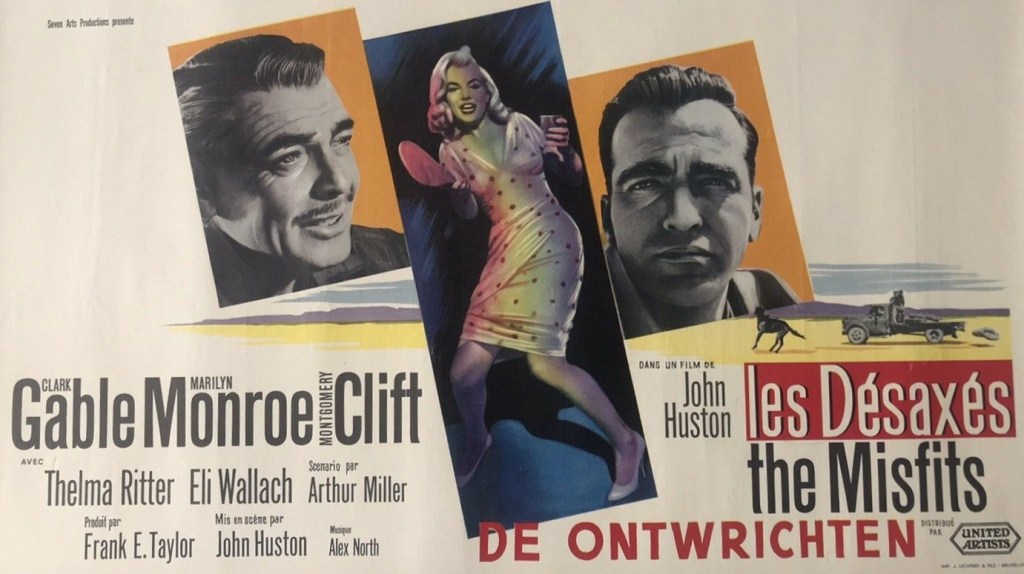
The story itself is pretty slim. Roslyn (Marilyn Monroe) in Reno to get a divorce hooks up with washed-up cowboy Gay (Clark Gable) and grieving car mechanic Guido (Eli Wallach). They repair to Guido’s cabin in the country, unfinished after his pregnant wife died because he didn’t have a spare tire. They are joined by hard-drinking man-hungry Isabelle (Thelma Ritter). Roslyn shacks up here with Gay, brightening up the place with decorative ideas and planting vegetables.
At the rodeo they stake drunken Perce (Montgomery Clift), a tough guy with mother issues, self-destructing one rodeo at a time. At various times the trio nurse and console each other, but mostly they get drunk. The three men take Roslyn along to show off their cowboy skills, catching wild mustangs. This is less old-fashioned than you might imagine. It’s more like tracking down the great white shark in Jaws (1975), a primeval battle between man and beast. Man has the advantage of being able to use Guido’s biplane to drive the horses down to Gay and Guido waiting with lassoes.
And tires.
What are the tires for you might well ask? Well, they fulfil the same function as the barrels in Jaws, to weight down the animals so they are easier to track, perhaps exhausting them so much they might just topple over and die. So the odds are not exactly even.
The guys are further disadvantaged by Roslyn’s presence. When she learns of the horses’ fate – not as you might expect to become working horses on a ranch like current television series Yellowstone – she is horrified. The critters will end up as pet food. So much for the Wild West.
This is an absolutely fantastic sequence and I’m surprised it doesn’t turn up on critical lists at all as one of the great western segments of all time. It says more about the end of the West than all the violence of The Wild Bunch or operatic fervour of Once Upon a Time in the West. And it’s a companion piece to The Old Man and the Sea, man, for all his endeavors, ending up with virtually nothing.
There’s a few twists and turns to this sequence so I won’t spoil it for you except to say it is one of the very few sections in movies where character plays out in action.
And this isn’t even Gable’s greatest scene. The moment when, drunken out of his skull already, he bleats in the street about his kids carries awesome power. What he’s saying doesn’t even make a great deal of sense, which is the beauty of it, because what drunk ever makes sense, most of the time he’s effectively addressing the demons inside.
Clift has a horrifically comic scene. His brain is as washed away as his body. He wakes out of a drunken stupor and can’t remember why he has a huge bandage round his head and proceeds to unravel it, again with a monologue that reveals his inner catatonic state.
Monroe is mute in her best scene. She just stares in horror at the mustang incident unfolding. And she has another terrific scene, probably the most ordinary thing she ever did in her screen career, battering a ping-pong.
The title is actually a rodeo term apparently for, unsurprisingly, a horse that was too small or weak to work. I would have preferred something less obvious because it’s quite clear from the outset all the characters are misfits.
This is probably the closest Monroe got to playing a character who reflected her inner turmoil. Roslyn’s beauty brightens up lives but mostly she is depressed, thinking that even when you win you lose, too fragile to cope with reality, and inclined to need consoled as much as she is willing to nurse the others. Gay is a superb creation, who despises men who earn “wages,” that is have a regular job and lose their freedom. Even if freedom means no female companionship and being reduced to catching horses for the few bucks they will bring in from pet food manufacturers, he would rather do that. Perce is just so battered by life he hasn’t a clue what he’s doing. The self-serving Guido whines.
Put all these characters together and they still live in world of their own, and although they occasionally cross the border into another’s existence by and large it is without understanding.
Without John Huston’s empathetic direction it would be unbearably sad, but with virtually nothing in the way of real plot he draws us inexorably in to their small lives. Given its budget and the box office potential of the stars, it was a flop on release. Now it’s a masterpiece.
However tragic or premature, few Hollywood stars could have gone out at the top with a picture of this quality as did Gable and Monroe. Possibly as a result of his exertions on the film, Gable died a few days after shooting completed, Monroe eighteen months later, but what a final legacy.
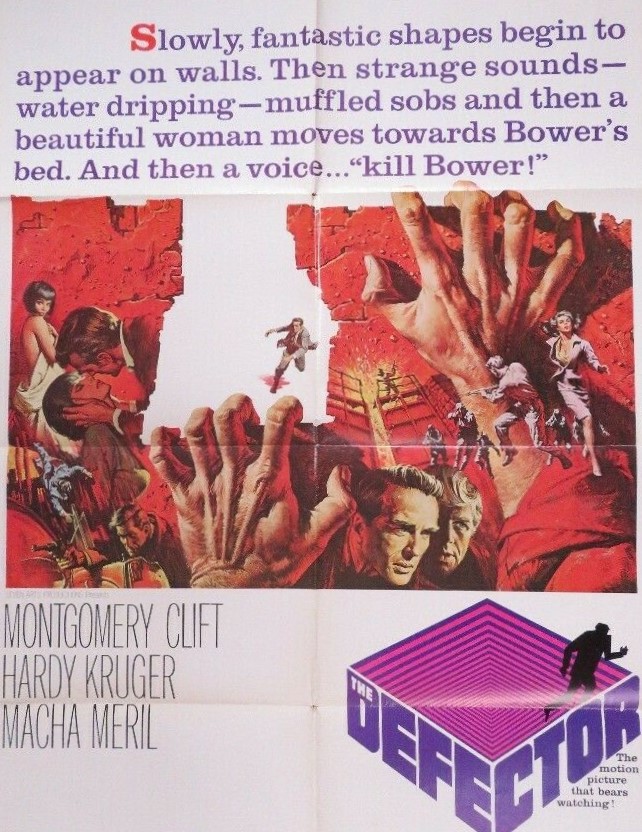
How often does a government hoodwink a morally upright citizen into deceitful action for the cause of the greater good? In this case physicist Professor James Bower (Montgomery Clift) doesn’t need a great deal of urging because what’s at stake are Russian space race secrets and the man selling them is a Russian scientist he knows from translating his books. It’s apparent from the outset that in setting out to make contact in East Germany, he is walking into a trap. It’s moody, and drab in the vein of The Quiller Memorandum (1966), shot in soulless German streets, and of course it is the final performance, after a four-year screen absence, of a frail-looking Clift, an iconic Hollywood star for nearly two decades.
But genres can be confusing. Although tagged as a spy picture it’s not really a spy film. It’s a character study. In fact, two character studies, the other being a far-from-typical communist. And when you get to the end and realize the sacrifice made in order not to compromise principle, it turns into quite a different movie, one with considerably more depth than you might have imagined.
Bower is a rather adept amateur spy, neatly dodging being followed, and capable of nipping between two moving trams to evade pursuit. His instructions lead him to asking for a particular prescription and being sent in apparent haphazard fashion to an intended meeting with Dr Salter (Hans Messemer), his contact. Instead he is led to Counselor Peter Heinzmann (Hardy Kruger). His hotel room is not merely bugged but fitted with electronic instruments to prevent sleep and distort his mind. Meanwhile Heinzmann is engaged in a hawk-vs.-dove battle with Orlovsky (David Opatoshu) to determine whose methods, the latter preferring torture and brainwashing, would prove the more successful in forcing Bower to betray the whereabouts of the would-be defector. And there is also a doctor’s receptionist Frieda (Macha Meril), with whom romance so obviously beckons your natural moviegoer instinct is to regard her as lure rather than friend.
It’s a chess game, Bower a pawn, with the net growing tighter, imprisoned in more ways than one, being groomed for defection himself. Although there is double cross, triple cross, murder and an excellent Hitchcockian escape/chase, and a final unexpected, very human, twist, it’s far from your typical spy thriller, in general subtle in tone except for the nightmarish hotel scenes. Heinzmann is also a pawn, fighting a system that sees degradation as its most potent weapon and even while a danger to Bower displays humanity.
Clift’s physical state, skin drawn tight over his face, works to the movie’s advantage, turning him into more of a Glenn Ford-type actor, the staunch man-next-door with steely resolve, but not the kind of character you would imagine Elizabeth Taylor or Marilyn Monroe giving a second glance. In fact, since the story calls for him to be suffering from a mysterious malady – hence the need to seek out a pharmacy and doctor in a foreign country – his features endorse this plot point far better than if he had been fit and well.
Quite what the set was like is anybody’s guess given that not only was Clift dead by the time of the film’s release but that Belgian director Raoul Levy (Hail, Mafia, 1965) – better known as the producer of many Brigitte Bardot films and now helming only his second film – had committed suicide.
If ever there was proof of star power, this is it. Even when the film is meandering and the plot at times impenetrable, Clift exerts an almost hypnotic hold on the viewer. Despite his clear infirmity, the intensity that enraptured audiences from films as disparate as Red River (1948), From Here to Eternity (1953) and The Misfits (1961) has not vanished. Since many scenes are just meetings that scarcely progress the story, it is quite a feat to keep audiences interested. Far from his greatest performance, he still displays screen presence.
He is helped along by Hardy Kruger (Flight of the Phoenix, 1965) in one of his more measured performances, both men sharing the knowledge that in doing good for their country they are betraying themselves. David Opatashu (Guns of Darkness, 1962) is excellent as his quietly ruthless superior and there should be mention of Karl Lieffen as the constantly complaining Major. Even as a dowdy East German, Macha Meril (Une Femme Mariee, 1964) still captivates. Serge Gainsbourg contributed the music.








 The Magnificent 60s