Behind the Scenes: “The Terrornauts” (1967)

Unless you’re a sci-fi buff of a certain vintage, you probably haven’t heard of Murray Leinster who wrote The Wailing Asteroid on which The Terrornauts is based. Which is a shame because he was one of the giants of science fiction of the golden age. Time magazine called him The Dean of Science Fiction.

For a contemporary audience his name is of considerable significance because he invented the concept of the multiverse. In those days it was called a parallel universe or an alternate history but it amounted to the same thing. And he did so nearly a century ago – in 1934 in fact.
He was second only to H.G. Wells in originating science fiction concepts. He was the first, for example, to imagine meeting an alien culture that was as advanced as our own. He explored themes of mutual distrust, mutual assured destruction, and aliens as superior beings. He also invented the idea of the Internet and man-eating plants.

In The Wailing Asteroid, Leinster draws upon many of the ideas he was first to promulgate.

We have alien encounter. We have the fear that as a consequence terror might be brought back to Earth. We have a species that has evolved far beyond human experience.

We have the same kind of instant absorption of knowledge that occurs through the Internet. The little blocks that our hero finds might as well be called Miniature Googles.

You could also argue that what the space explorers discover is akin to The Sentinel that features in 2001: A Space Odyssey, released in 1968. And you could also view the asteroid as a life-affirming alternative to the hovering destructive Death Star of Star Wars filmed a decade later.

The Terrornauts is a rarity because only a handful of Leinster books were ever filmed. But he was very important to the movies in another way, at the forefront of an invention – front projection – that changed the way movies were made in the 1960s.
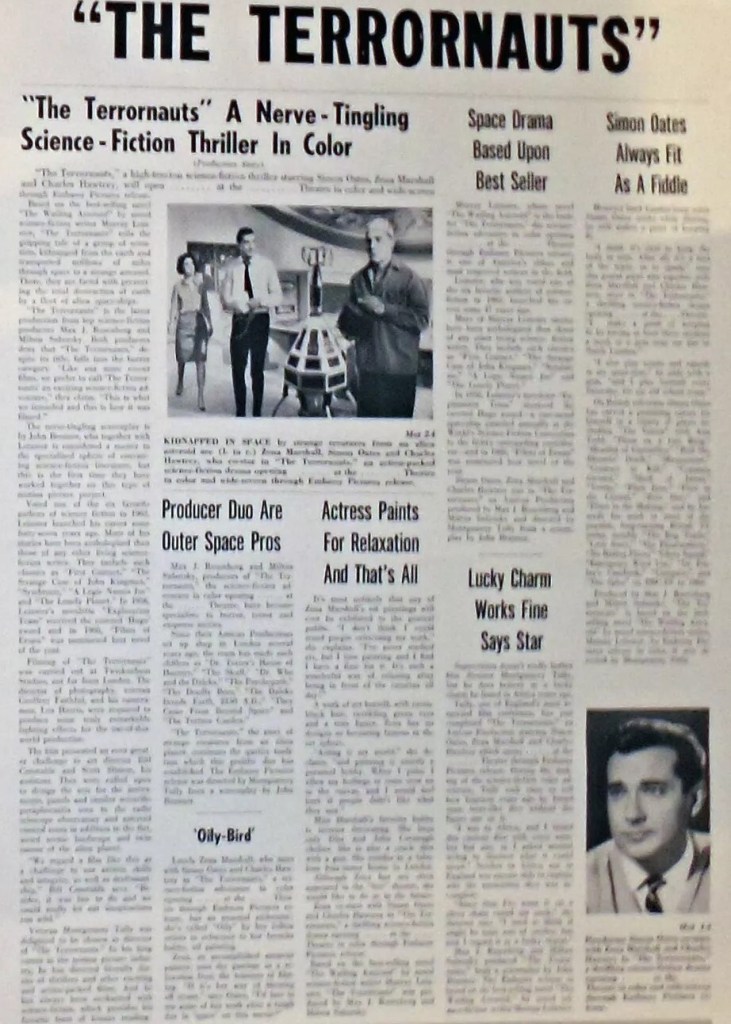
At this point, production entity Amicus was as well known for its sci fi output as its horror thanks to Dr Who and the Daleks (1965) and Daleks Invasion Earth 2015 A.D (1966).

So when Embassy Pictures knocked on the door and offered a flat fee of around half a million dollars for a science fiction double bill, Amicus was delighted. Hammer sold its horror pictures as double bills, a complete program more attractive to an exhibitor and more lucrative for a producer than  half a program.  

Amicus contracted to make The Terronauts and They Came from Beyond Space. They weren’t big enough to have stars under contract, nor the first port of call should a director or star have a pet project that required funding.

Their modus operandi was to trawl through the hundreds of novels published every year, either in pre-publication galley form, or when printed. Max Rosenberg claimed to read 500 books a year. “The basic job of a producer,” explained his partner Milton Subotsky, “is to find properties.”  That was how they came across The Wailing Asteroid.

It was occasionally part of the deal in Hollywood that when a studio bought a best-seller, the author was given the opportunity to write the screenplay. But that wasn’t the case here.

Instead, Amicus turned to another science fiction author. John Brunner was as prolific as Leinster. Brunner got the gig because he mixed in the same social circles as Subotsky. Mostly, he wrote conventional space opera and it was only after his experience on The Terrornauts that he acquired a bigger name in science fiction, after winning a Hugo Award in 1969.

The first casualty was the title. The Wailing Asteroid was not as catchy as The Terrornauts. And Brunner had no qualms about scrapping most of the original narrative. He telescoped the time frame. The action in the book takes place over several months, not a couple of days. The book involves multiple countries. Leinster’s novel was set in the United States, but Brunner made the characters British and added the comedy – no tea lady or accountant in the original.  And there’s no humor either. He changed the hero’s occupation from design engineer to scientist, and dumped the incipient hesitant romance between Joe and Sandy. But he brings in the notion of scientists hunting for intelligent life in space.

Nor does Leinster’s book involve little green men, robots or human sacrifice. That’s all Brunner’s doing. He turns what was really a concept novel, an exploration of ideas more akin to 2001: A space Odyssey and Planet of the Apes. Brunner shifts it from what if to alien abduction.

Budget shaped the picture. The first four reels are slow and full of dialog because dialog can be shot much quicker and more cheaply than action. Low budgets didn’t bother Amicus. “I defy any other picture making company,” proclaimed Rosenberg, “to turn out that sort of picture with the budget we are under.” He added, “We make pictures for a price and I think we’re better at it than anybody else.” 

Amicus had something of a stock company, Freddie Francis, for example, the in-house director, had helmed four pictures, the same number as Peter Cushing headlined. Christopher Lee starred in two, Robert Bloch contributed four scripts and Elizabeth Lutyens scored two pictures. But only Lutyens was retained here.

Amicus handed The Terrornauts to veterans, the majority involved were over 50 years of age. Cinematographer Geoffrey Faithful was 74, author Murray Leinster 71,  supporting actor Max Adrian 64, special effects guru Les Bowie 64, director Montgomery Tully 63, composer Elizabeth Lutyens 61.

It would prove the last hurrah for female lead Zena Marshall, Montgomery Tully would bow out later that year after Battle Beneath the Earth and Geoffrey Faithful would only make another two pictures.

The Terrornauts and They Came from Beyond Space were not filmed in October-December 1966 as has been widely reported. Instead, production took place earlier in the year. According to British trade magazine Kine Weekly’s Shooting Now section, The Terrornauts was first to go before the cameras at Twickenham Studios, on June 13 1966 and still featured on its production chart on August 3. Filming on They Came from Beyond Space in the second last week of September continued also at Twickenham until the week of November 3.  

Though to some observers the amount spent on The Terrornauts was very little, in fact the £87,000  budget was nearly double the amount spent on City of the Dead and slightly more than The Skull. Admittedly, there were special effects to consider but to offset that the stars came cheaper than the likes of Peter Cushing and Christopher Lee.

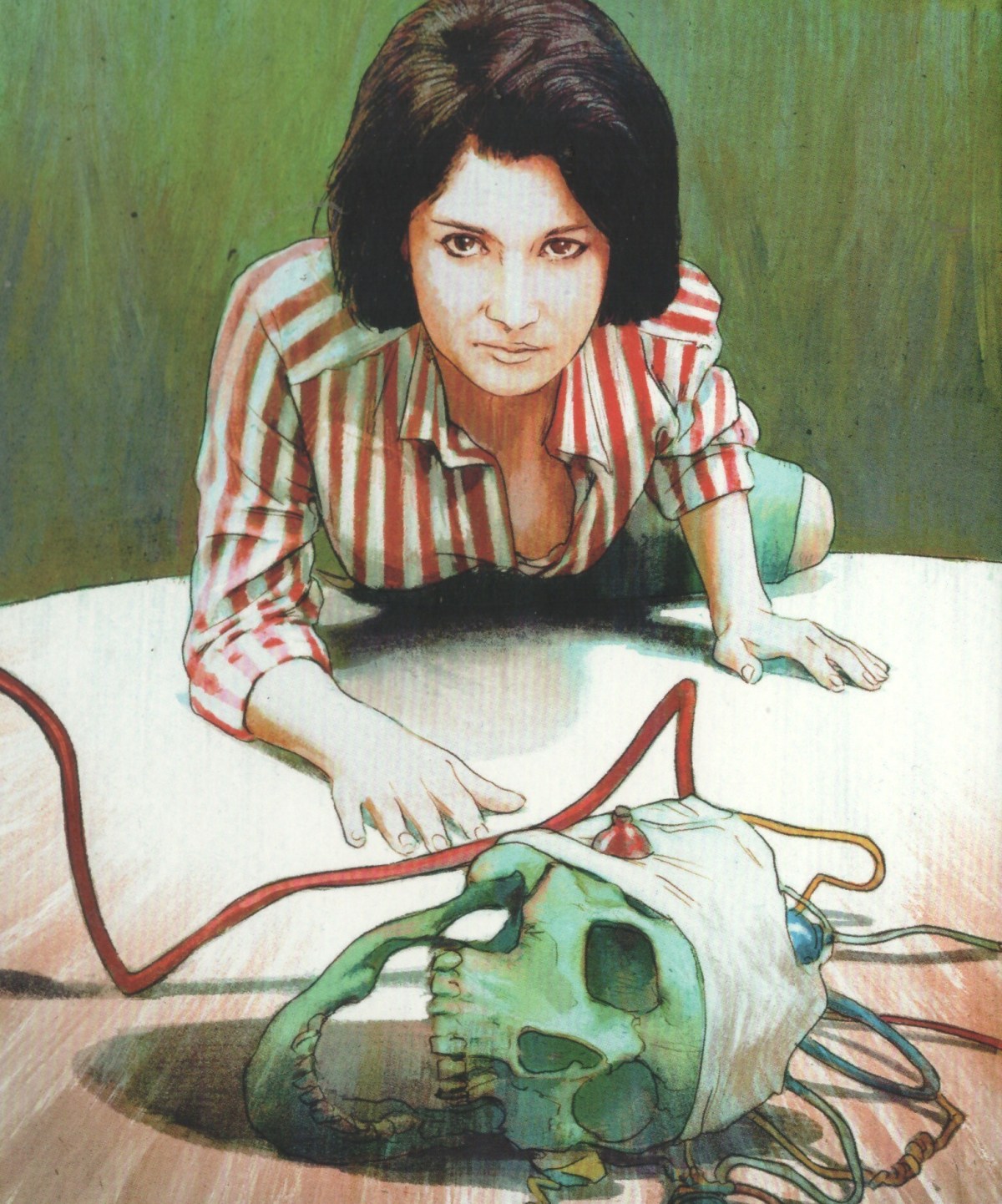
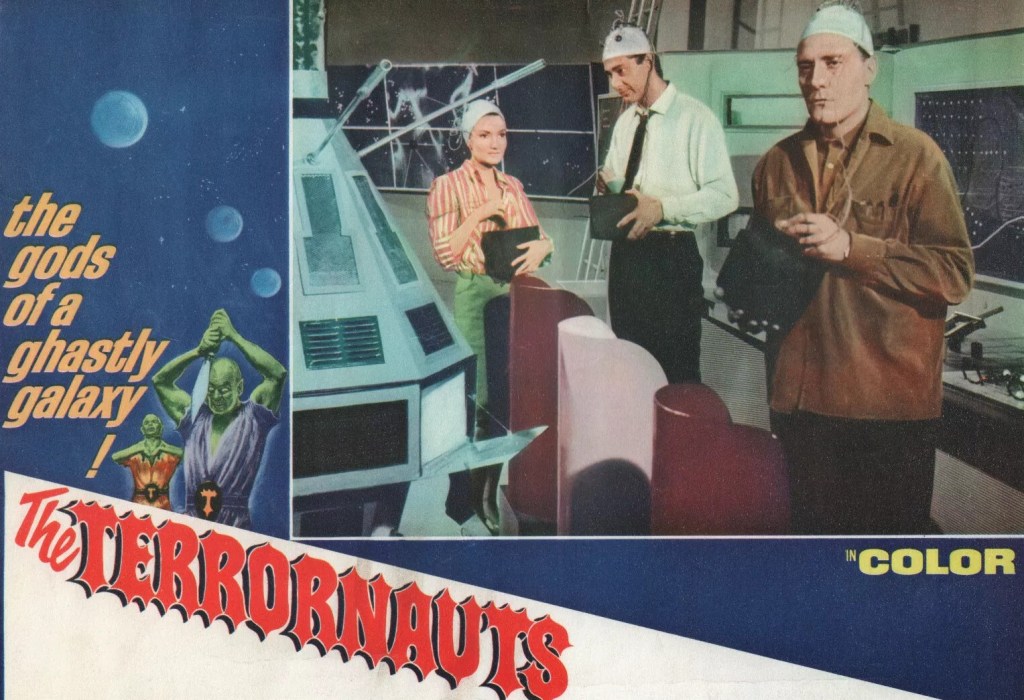
For a time it looked as if Embassy expected The Terrornauts to prove the more popular picture. It ran a one-page advertisement in trade newspaper Variety for The Terrornauts in April 1967 claiming it would be available to rent the following month. The image of Zena Marshall being held down by aliens was accompanied by the tagline – “the virgin sacrifice to the gods of a ghastly galaxy” They didn’t run any adverts for They Came from Beyond Space.

I’m sorry to have to tell you this is a condensed version of the audio commentary by me that accompanies the spanking new DVD released by Vinegar Syndrome – I’m sure you’ll forgive me another small plug – and it’s on special offer.
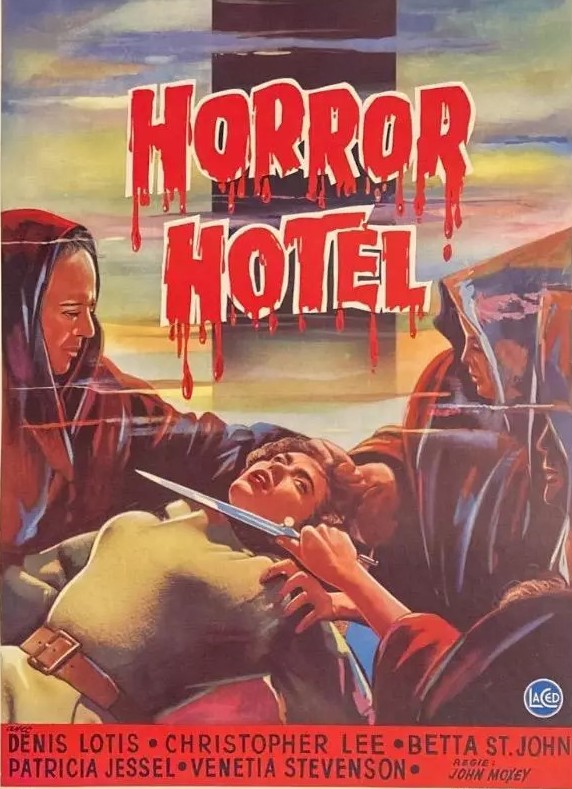
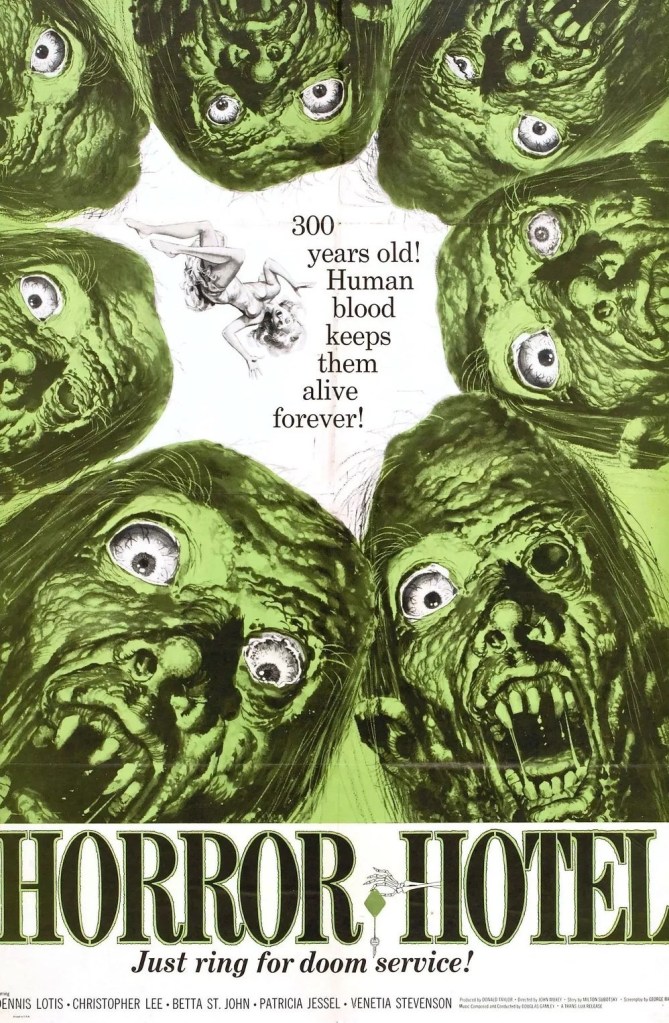
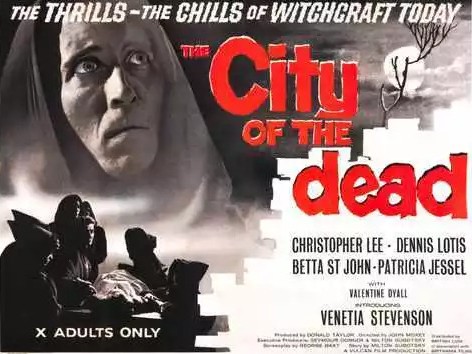
Horror Hotel / City of the Dead (1960) ***

The structure of this piece gives away its origins. It’s effectively a portmanteau, though limited in this instance to three connected tales. Mention the word “portmanteau” and Amicus springs to mind. While that outfit didn’t exist at this precise moment, the movie was put together by the team behind Amicus, American producers Milton Subotsky and  Max Rosenberg. The odd American accents might provide the clue that it was made entirely in Britain with British actors.

The witchcraft-zombie combo works well enough but horror mainstay Christopher Lee (Dracula, Prince of Darkness, 1966) is used sparingly. It marks the debut of Argentinian-born director John Llewellyn Moxey who has acquired something of a cult status in these parts.

We begin with a prolog set in Whitewood, Massachusetts, in 1692 at the height of the witch-burning epidemic where Elizabeth Selwyn (Patricia Jessel) is burned at the stake. Her lover Jethrow (Valentine Dyall) made a pact with the Devil to supply virgin sacrifices at a propitious time in the necromancy calendar in return for eternal life.

Three centuries later history student Nan Barlow (Venetia Stevenson), a virgin with an interest in witchcraft, sets off, at the instigation of Professor Driscoll (Christopher Lee)  and against the advice of fiancé Bill ((Tom Naylor) and brother Dick (Dennis Lotis), to investigate the happenings at Whitewood. She puts up at The Raven’s Inn whose landlady Mrs Newless bears at distinct resemblance to Elizabeth.

Had this picture carried the Amicus stamp, I might have been prepared for what happened next. Nan doesn’t get much chance to do much investigation before she is burned at the stake by the coven of Mrs Newless, revealed as Elizabeth.

So we are on to the third part of the portmanteau. Dick discovers that his missing sister’s supposed abode, The Raven’s Inn, doesn’t exist in any directory, so he ups sticks and with the fiancé sets off in pursuit. Crucially, brother and fiancé, are separated, effectively allowing the stories not so much to dovetail but to keep the fiancé out of action until he is needed.

Dick makes acquaintance with Patricia (Betta St John), antiques dealer and witchcraft expert, who warns him off. Any impending romance, such as would be de rigeur in normal circumstances, is cut off after Patricia is kidnapped and set up for the virgin sacrifice ceremony.

Two virtual last-minute entrants serve to provide a big climax. Driscoll is revealed to be a member of the coven and Bill arises from his sick-bed – he was badly injured in a car crash – to save the day, despite his cynicism knowing enough of demonic folklore to bring a cross into the proceedings. This he does by the complicated process of yanking up from a graveyard a fallen large wooden cross which inflicts the necessary damage on the coven. Though Elizabeth escapes it’s not for long.

Dodgy accents aside, and slightly discombobulated by the structure, which, given it wasn’t released in the U.S. until 1962, might have been viewed as a nod to Hitchcock’s Psycho (1960) in despatching the heroine halfway through, there’s enough here in the atmosphere and the performances to keep the enterprise afloat, if only just.

A good dose of fog always helps and the occasional appearance of the undead and the olde worlde atmosphere makes this work more than the acting which, excepting Lee, is on the basic side. Venetia Stevenson (The Sergeant Was a Lady, 1961) otherwise the pick.

This didn’t set Moxey on the way to fame and fortune but somehow in the world of cult less is more. He made only a handful of movies including Circus of Fear (1966). Written by Subotsky and George Baxt (Night of the Eagle, 1962).

A good first attempt at horror from the Amicus crowd.

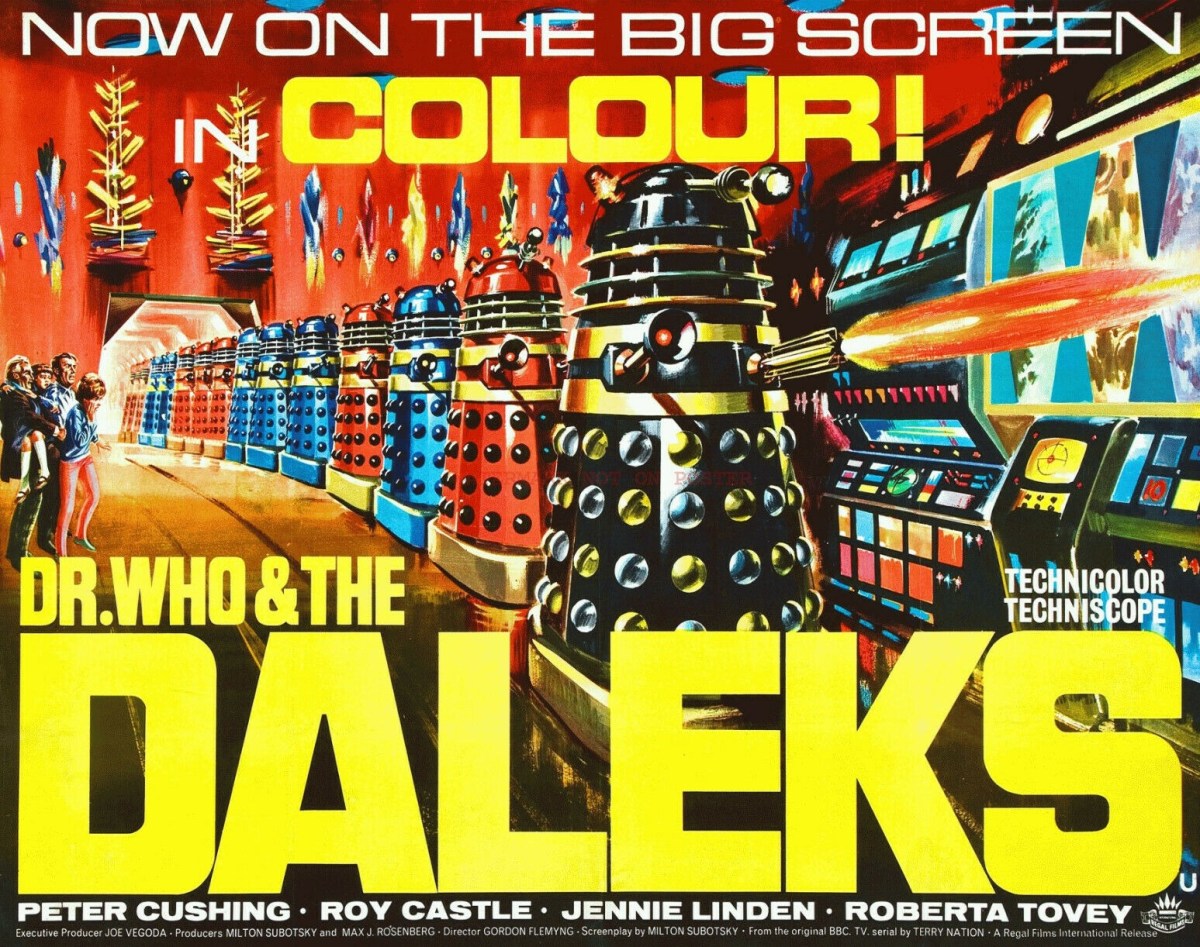
Dr Who and the Daleks (1965) ***

The maiden voyage of the time-travelling Tardis is triggered by some unexpected pratfall comedy. On board are the venerable doctor (Peter Cushing), his intrepid great-granddaughter Susan (Roberta Tovey) and a fearful pair, granddaughter Barbara (Jennie Linden) and accident-prone Ian (Roy Castle). They land on a petrified planet ruled by the robotic Daleks with menacing electronic voices.

The malfunctioning Tardis forces them to investigate an abandoned city but they are quickly imprisoned, the steel robots determined to discover why the earthlings should be immune to the radiation that has consumed this planet after nuclear war. Meanwhile, the planet’s remaining inhabitants, the Thals, are planning an uprising.

Budget restrictions ensure that menace is limited, even as the characters endure a heap of traditional obstacles such as swamp and rocky outcrop. Adults who did not grow up in the 1960s when the BBC television series took Britain by storm and apt to come at this without the benefit of nostalgia will certainly look askance at the sets and costumes. And it doesn’t possess the so-bad-it’s-good quality of some 1950s sci-fi pictures. But since it was primarily made for children, then perhaps it’s better to watch it with a younger person and gauge their response – of course, that may be equally harsh from someone brought up on the modern version of the series or already immersed in superheroes.

On the plus side, it does move along at a clip. Roberta Tovey (A High Wind in Jamaica, 1965) charms rather than annoys as the plucky grand-daughter even if her grandfather has mutated from the sterner figure of the television series into an eccentric inventor. Peter Cushing (The Skull, 1965) is only required to ground the production which he does adequately. The innate comic timing of comedian Roy Castle, in his leading man debut, brings a light touch to proceedings as the bumbling boyfriend and generates some decent laughs. Jennie Linden (Women in Love, 1969) has little to do except look scared.

Oddly enough, it was American Milton Subotsky who, in opportunistic fashion, brought the project to the big screen, although the BBC had a track record of providing product that might make such a leap, The Quatermass Experiment in the 1950s the leading example. He wrote the screenplay and acted as producer and had previously worked with Cushing on Dr Terror’s House of Horrors (1965) and was about to embark on horror masterpiece The Skull the same year. He has approached the material with some reverence and the fact that the budget allowed for hordes of Daleks rather than being seen one or two at a time as on the television probably made some child’s day.

Scottish director Gordon Flemyng (The Split, 1968) would make the leap to Hollywood on the back of this picture and its sequel the following year and you can see what made studios have faith in his ability – he deals with multiple characters, works quickly on a low budget and delivers an attractive picture that was a box office hit.

I suspect that audiences will divide into those who watch the film with nostalgia-colored spectacles, those who think it only as good as a bad episode of Star Trek and those who adore any low-budget sci-fi movie.

Thank You All Very Much / A Touch of Love (1969) ***

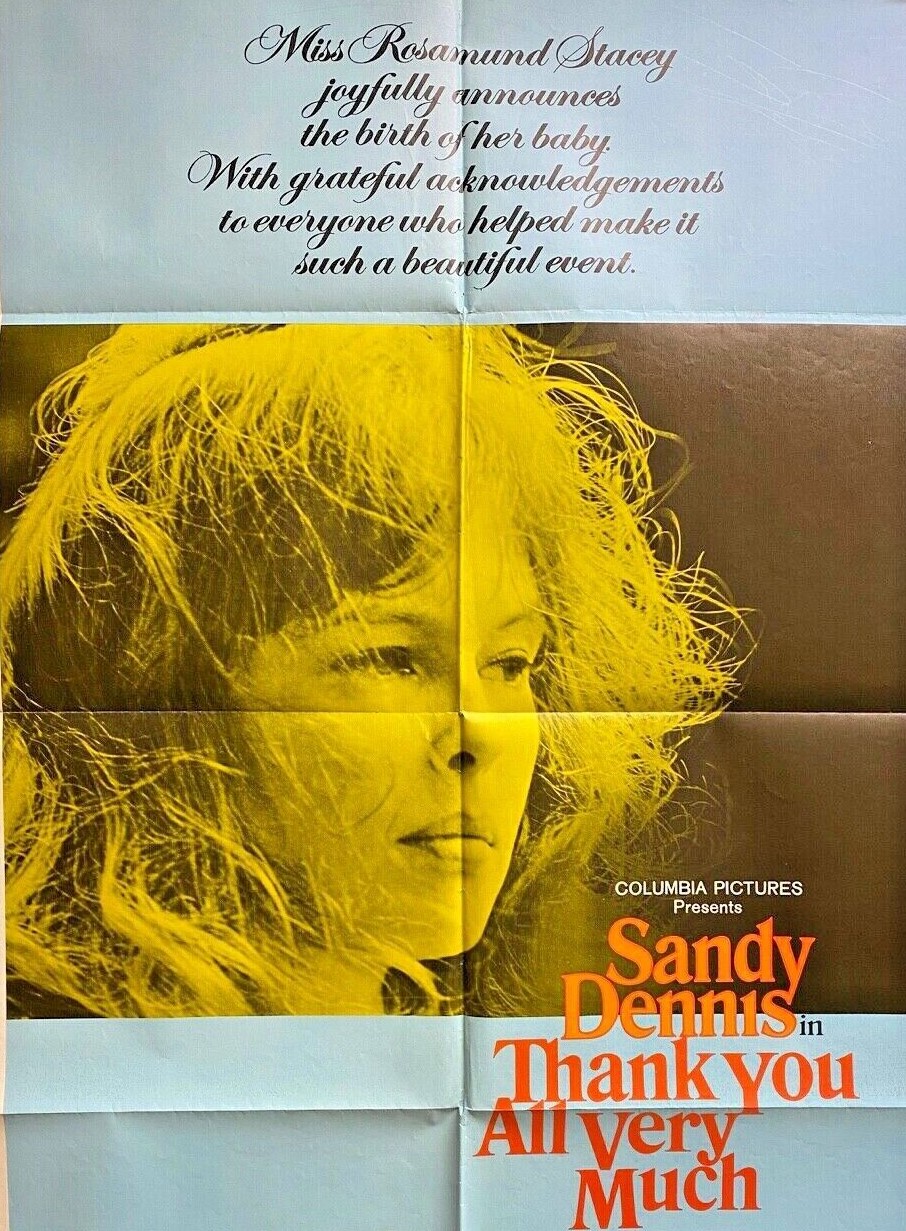
The combination of Amicus and pregnancy might lead audiences to expect a monster baby of It’s Alive (1974) dimensions. Nor would you associate the studio, which made its name in horror pictures where women were either victims or sex objects, with feminism. But producer Milton Subotsky plays it straight, the only concession to the Margaret Drabble source novel is to change the title, from the obvious The Millstone to the more ironic Thank You All Very Much (in the U.S.) and A Touch of Love (in the U.K.).

It doesn’t go down the single mum kitchen sink route either, abandoned female struggling in poverty and desperate for a man. In fact, except in one instance, dependable men are in short supply. Though, it has to be said, female support isn’t much better.

Now there’s counter-programming. A “woman’s picture” supported
by low-budget actioner aimed at men.

Pregnant after a one-night stand with television personality George (Ian McKellen), post graduate student Rosamund (Sandy Dennis), after toying with home-made efforts at abortion, decides to have her baby. Luckily, she can afford it, living in a splendid apartment in what looks like South Kensington rather than a bedsit in a more squalid area of London. Her parents are more remote, tending towards the upper rather than the middle classes, the type who park their offspring in boarding school to minimize a child’s impact on their busy social lives.

Sandy Dennis (Up the Down Staircase, 1967) has quite a trick in her screen persona. She is generally initially presented as weak, whiny, vulnerable, trademark quavering voice helping this along, a potential victim until her inner steel exerts itself and you realize she is not the person you think she is. Almost an actorly version of the Christopher Nolan trope of letting you believe a character is one type of person until he/she turns out to be another.

There isn’t too much of the mother being tormented out of her skull by a baby screaming its head off – or as in Nolan’s latest opus Oppenheimer, a mother unable to cope handing the child over to someone else to look after – but she is very much alone, unable to reveal to the father his part in the pregnancy, despite having another one-night stand with him. So mostly it’s her coping with the system, suffering in silence in the traditional British manner endless bureaucracy, sitting in a long queue in a waiting room, and being beset by the very people you might expect to be more sympathetic.

Supporting feature given more prominence here.

But the nurses seem very much cut from the same pragmatic cloth as her parents. Prior to birth, one nurse informs her that it’s selfish not to give the child up for adoption. When the baby is convalescing in hospital after a heart operation, matron (Rachel Kempson), a graduate from the Nurse Ratchet school of health care, consistently refuses to let the mother see the baby as it’s apparently against hospital rules until in the best scene in the movie, and the one that achieves the Dennis trick, she literally screams the place down.

That nurses on a maternity ward full of little more than I would imagine at times screaming children are so disturbed by the prospect of an adult rebelling against the stiff upper lip conventions of British society says a great deal about the kind of uniformity and subservience expected of the public by those in charge of any large organization. None of the Angry Young Men of earlier in the decade would dream of such a simple solution to a problem.

Eventually, being allowed to sit by her child’s bedside until late into the night permits Rosamund to complete her thesis and win her PhD. She’s not quite as hard-nosed about George as she likes to imagine but since he’s not sufficiently taken with her child to allow it to disrupt a projected trip abroad, she realizes what had been plainly obvious to the audience that she is better off without men – or at least this particular, ineffective, individual – for the time being.

So most of the film is about Rosamund learning to enjoy her independence, able to achieve her goals without male assistance, and that’s generally done by action rather than dialogue or monologue, some heated debate or major crisis. Excepting the incident with Nurse Ratchet, it’s just about coping, and awareness that maternity need not cramp ambition.

Her arty friends (and parents for that matter) are all too keen on having a good time – the males mostly trying to bed her – to lend much support. Some like Lydia (Eleanor Bron) have a warped view of life.

In his movie debut Waris Hussein (The Possession of Joel Delaney, 1972) takes the striking narrative route of not allowing the picture to become tangled up with romantic complication, keeping it squarely focused on feminism, succeeding on your own terms, not reliant on men, embracing both motherhood and career. Margaret Drabble wrote the screenplay.

Sandy Dennis (Up the Down Staircase, 1967) delivers another telling performance, one of the few actresses permitted to be center stage in a non-romantic narrative, because this is the kind of role she can easily pull off. She manages a convincing British accent without falling prey to too much Britishness.

Minus the tell-tale diction that marked his later career, Ian McKellen (Alfred the Great, 1969) has an effective debut as the charming though selfish lover. Eleanor Bron (Two for the Road, 1967) is the pick of the supporting cast as the soft-hearted best friend who is too pragmatic by half. Others popping up include John Standing (Walk, Don’t Run, 1966), Margaret Tyzack (2001: A Space Odyssey, 1968), Maurice Denham (Midas Run, 1969) with Rachel Kempson (The Charge of the Light Brigade, 1968).

Unfussy direction matched with another brilliant turn by Sandy Dennis makes this a must-watch.

Dr Who and The Daleks (1965) ***

The maiden voyage of the time-travelling Tardis is triggered by some unexpected pratfall comedy. On board are the venerable doctor (Peter Cushing), his intrepid great-granddaughter Susan (Roberta Tovey) and a fearful pair, granddaughter Barbara (Jennie Linden) and accident-prone Ian (Roy Castle). They land on a petrified planet ruled by robotic Daleks with menacing electronic voices.

The malfunctioning Tardis forces them to investigate an abandoned city but they are quickly imprisoned, the steel robots determined to discover why the earthlings should be immune to the radiation that has consumed the planet after nuclear war. Meanwhile, the planet’s remaining inhabitants, the Thals, are planning an uprising.

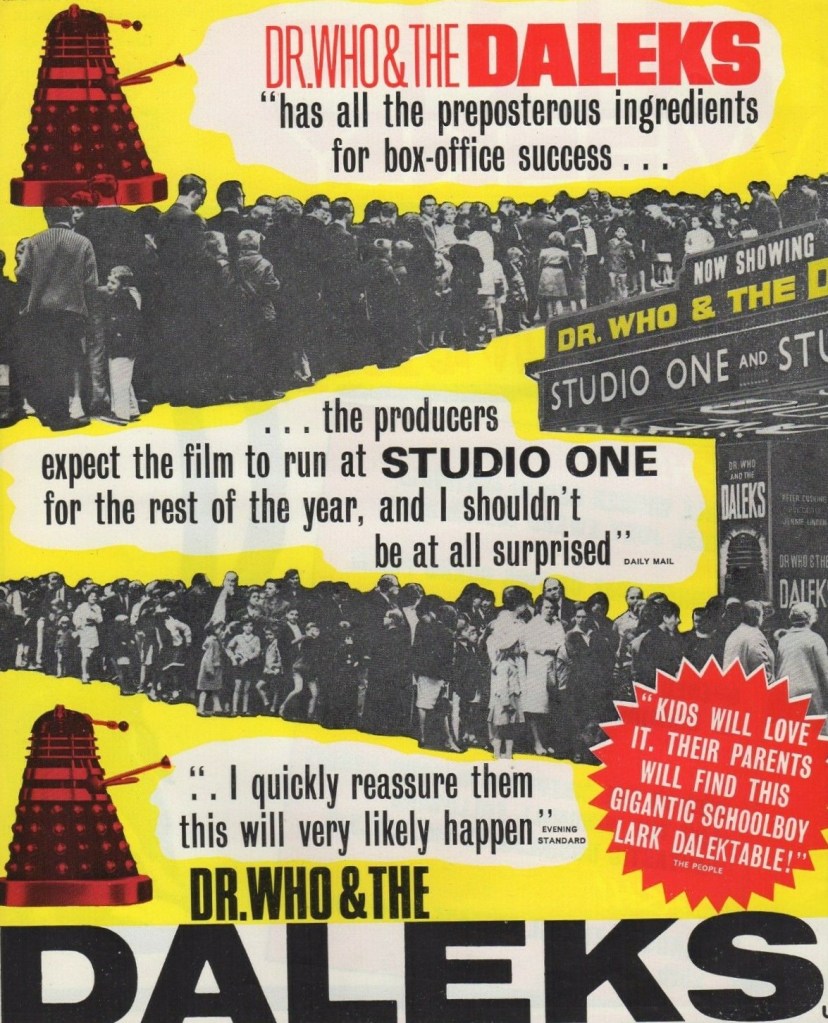
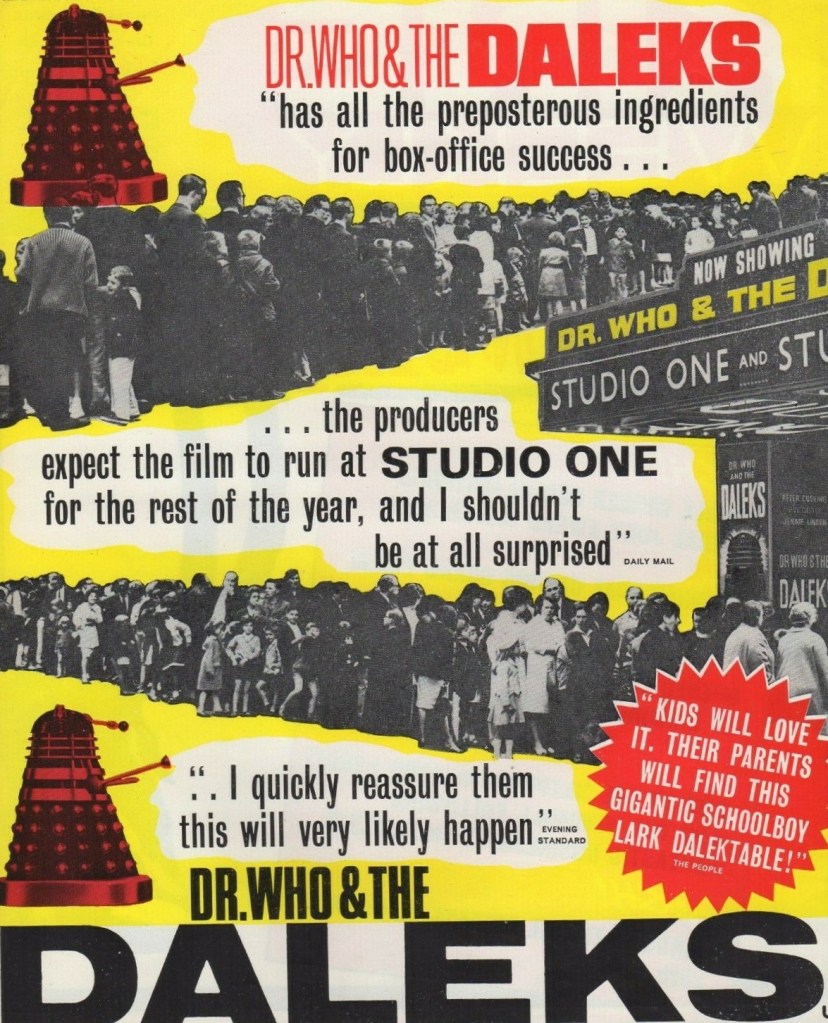
Studio One was one of the smallest cinemas in London’s West End and often used as the launch pad for Disney pictures. Limited capacity ensured that a hit film would run for months and the crowds queueing outside would attract the attention of other passersby.

Budget restrictions ensure that menace is limited, even as the characters endure a heap of traditional obstacles such as swamp and rocky outcrop. Adults who did not grow up in the 1960s when the BBC television series took Britain by storm and apt to come at this without the benefit of nostalgia will certainly look askance at the sets and costumes. And it doesn’t possess the so-bad-it’s-good quality of some 1950s sci-fi pictures. But since it was primarily made for children, then perhaps it’s better to watch it with a younger person and gauge their response – of course, that may be equally harsh from someone brought up on the modern version of the series or already immersed in superheroes.

On the plus side, it does move along at a clip. Roberta Tovey (A High Wind in Jamaica, 1965) charms rather than annoys as the plucky grand-daughter even if her grandfather has mutated from the sterner figure of the television series into an eccentric inventor. Peter Cushing (She, 1965) is only required to ground the production which he does adequately. The innate comic timing of Roy Castle, in his leading man debut, brings a light touch to proceedings as the bumbling boyfriend and generates some decent laughs. Jennie Linden (Women in Love, 1969) has little to do except look scared.

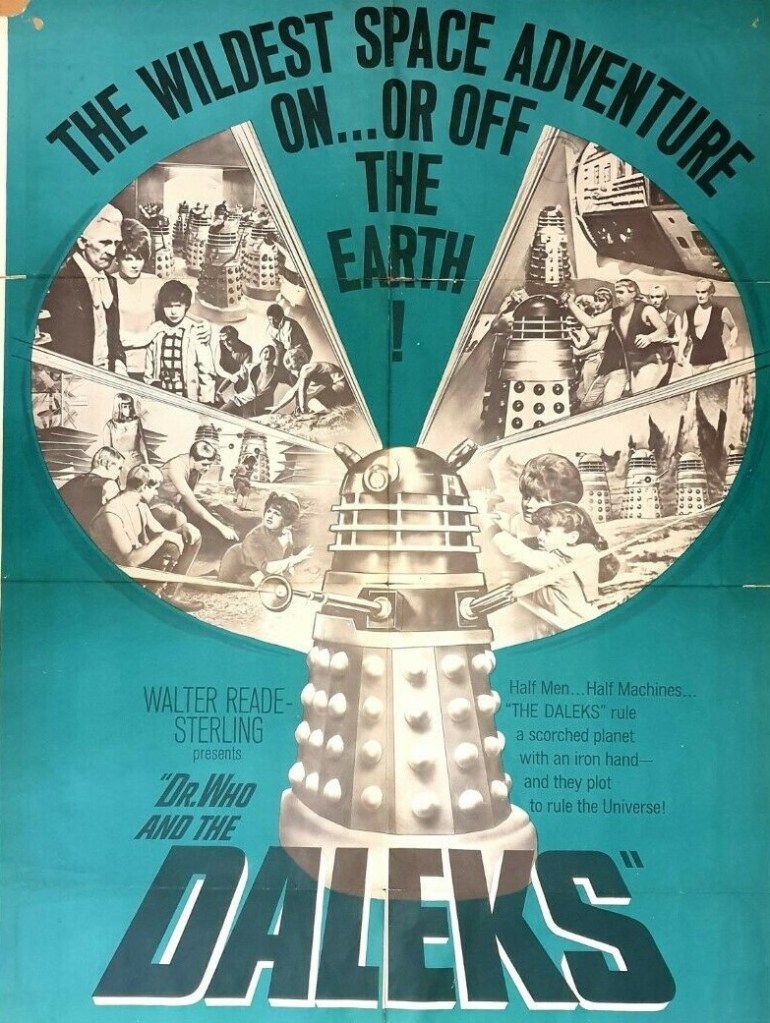
With no built-in audience, the U.S. distributors marketed it in typical fashion – “half men half-machine” – and possibly roped in a bigger adult audience unaware of its origins in children’s television.

Oddly enough, it was American Milton Subotsky who, in opportunistic fashion, brought the project to the big screen, although the BBC had a track record of providing product that might make such a leap, The Quatermass Experiment in the 1950s the leading example. He wrote the screenplay and acted as producer and had previously worked with Cushing on Dr Terror’s House of Horrors (1965) and was about to embark on horror masterpiece The Skull the same year. He has approached the material with some reverence and the fact that the budget allowed for hordes of daleks rather than being seen one or two at a time as on the television probably made some child’s day.

Scottish director Gordon Flemyng (The Split, 1968) would make the leap to Hollywood on the back of this picture and its sequel the following year and you can see what made studios have faith in his ability – he deals with multiple characters, works quickly on a low budget and delivers an attractive picture that was a box office hit.

I suspect that audiences will divide into those who watch the film with nostalgia-colored spectacles, those who think it only as good as a bad episode of Star Trek and those who adore any low-budget sci-fi movie.

You can catch this on Amazon Prime.

Discover WordPress

A daily selection of the best content published on WordPress, collected for you by humans who love to read.

The Atavist Magazine

by Brian Hannan

WordPress.com News

The latest news on WordPress.com and the WordPress community.