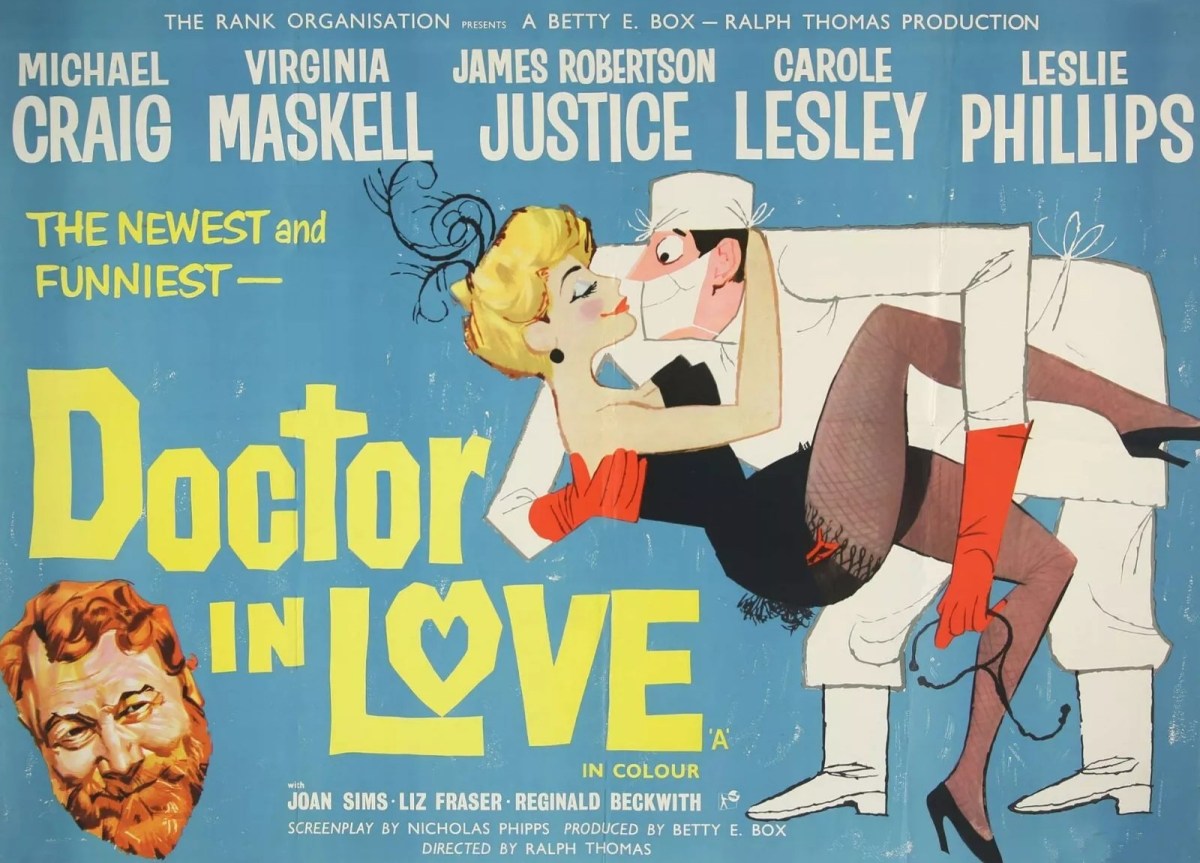
Doctor in Love (1960) ****

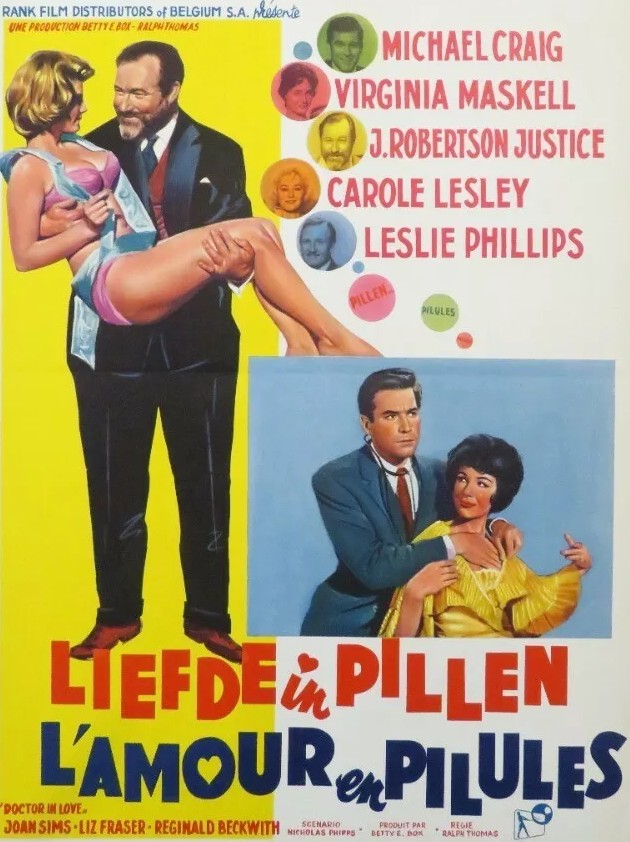
Chortled all the way through. You can see why it was the biggest film at the British box office in 1960. Dirk Bogarde had turned up his nose at repeating the character for the fourth time and went off to make more serious pictures like Victim (1961) which, it transpired,  dented his box office appeal. Replacement Michael Craig (Mysterious Island, 1961), while brawnier, passes this particular screen test with flying colors though he has his work cut out to hold his own against such practised scene stealers as James Robertson Justice (Mayerling, 1968) and Leslie Phillips (The Fast Lady, 1962) and once Virginia Maskell (The Wild and the Willing, 1962) enters proceeding her coolness makes the camera her own.

I was surprised how much this relied on innuendo. But this is a gentler exercise in smut than the sniggering guffawing Carry On approach. And there’s little chance of it descending into misogyny since the females hold all the aces. The plot is episodic and none the worse for that and even a diversion into a strip club, which might suggest a narrative clutching at straws,  proves a surprising highpoint.
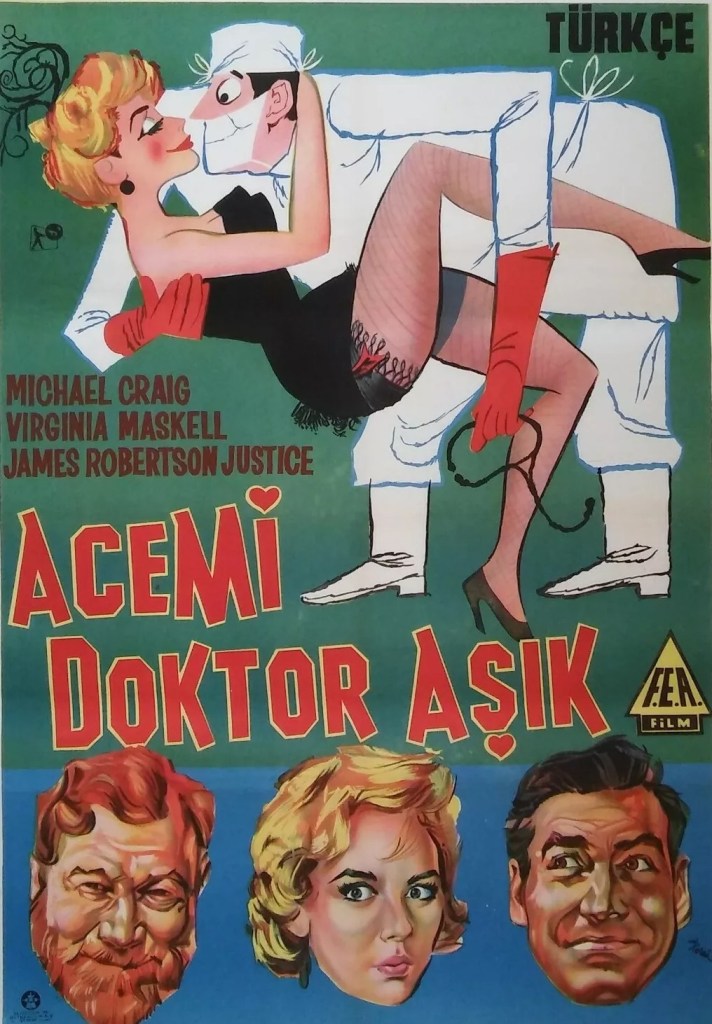
Basic story shifts Dr Hare (Michael Craig) out of hospital and into general practice which provides ample comedic opportunity via patients and colleagues. But, first of all, just to confuse matters and as if the producers were worried the series might not survive outside the boundaries of St Swithins Hospital, the tale begins with him returning to hospital with what turns out to be jaundice.

Cue the booming interventions of Sir Lancelot Spratt (James Robertson Justice) and the first of the love stories wherein Hare and Dr Hinxman (Nicholas Parsons) are rivals for flighty Nurse Sally Nightingale (Moira Redmond), who, in the first of many knocks to the male ego, while playing off one against the other goes off with another man. Before she does, Dr Hinxman takes revenge by prescribing all sorts of medications which will leave Hare so indisposed he is unable to respond to the nurse’s ardor.

Back in civvy street, as a GP, Dr Hare has to fend off predatory female patients and secretary Kitten Strudwick (Carole Lesley) and deal with standard comedic issues such as the boy who gets his head jammed in a cooking pot and the less common task of explaining the facts of life to a 40-year-old virgin. His boss Dr Cardew (Nicholas Phipps) is under the thumb of a wife who has shipped out to California only to summon her husband every now and then. The ever-amorous Dr Burke (Leslie Phillips) fills in and is the prime mover in an episode that involves strippers Dawn (Joan Sims)  and Leonora (Liz Fraser). There’s a particularly good reversal in a drunken scene where the totally inebriated Wildewinde (Reginal Beckwith) completes all the police drunk tests (if that’s what they’re called) with ease.
When Dr Burke is incapacitated, his place is taken by Dr Nicola Barrington (Moira Redmond). And that should have been enough of a plot to see the picture through but the movie doubles down on complication. Dr Barrington fends off Dr Hare and when Nurse Nightingale reappears Barrington in due course quits. Dr Spratt is also on board for further scene-stealing duties including ruling the roost in a strip club and undergoing an operation.

The romantic situation is resolved, Dr Spratt is put in his place temporarily and our hero effects a return to the hospital.

I wouldn’t say the writing (by Nicholas Phipps) is of the highest caliber but the jokes come at an assembly line pace and the cast are superb, barely a cast member incapable of stealing a scene. You hire James Robertson Justice and Leslie Phillips at your peril. Without Dirk Bogarde hogging the scenery, this flows much better than others in the series, with the supporting cast being more than just foil to a star who was a major box office attraction at the time. And it helps that the women – Moira Redmond (Nightmare, 1964), Virginia Maskell, Carole Lesley (Three on a Spree, 1961), and Carry On regulars Joan Sims and Liz Fraser –  are even more adept at scene-stealing than the men and not merely foil for misogynist jokes as in the Carry On series.

Director Ralph Thomas (The Wild and the Willing) seems to have found a new lease of life without having to deal with Dirk Bogarde and brings a certain verve to proceedings, especially in tripping up male ego.

Comedy is such an odd one to judge. Many a time I have sat through with scarcely a titter movies I’ve been told are hilarious. Other times I’ve been told to give them a free ride because they are making a point. So I stick to my own rule.

Make me laugh – I don’t care how – and this had me laughing all the way through.

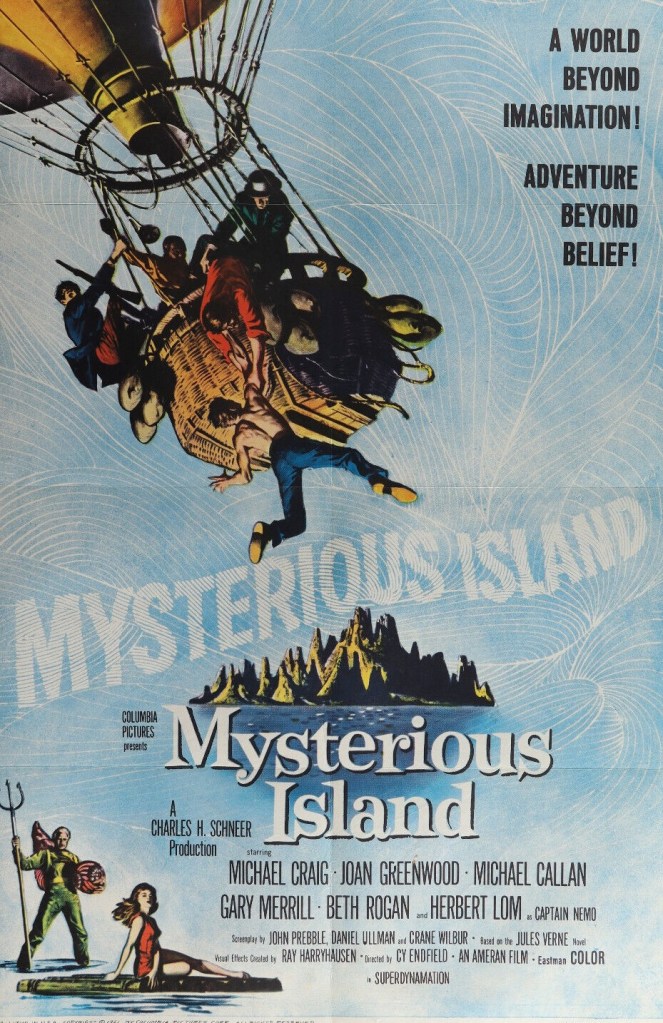
Mysterious Island (1961) ****

It’s the Ray Harryhausen Show. You’re not here for the story, surely, or the characters. You’re just waiting patiently for the monsters to appear. The only element that’s ever wrong with this kind of picture is that in-built delay. The need to set up the story and establish the oddities of the world before the behemoths trundle into view.

Doesn’t matter whether the creatures already live in an accommodating  global ecosystem like Jason and the Argonauts (1963) or One Million Years B.C. (1966). Or whether you are  going to come across them by the simple device, most famously, of dropping through a rabbit hole (Alice in Wonderland) or via a cupboard door (The Lion, the Witch and the Wardrobe) or a  rockface cracking open (Prehistoric Women / Slave Girls, 1967) or a time warp (Wonder Woman, 2017).

Here, it’s a bunch U.S. Civil War soldiers who need to break out of their prison and commandeer a handy hot-air balloon that can fly thousands of miles to the uninhabited volcanic island occupied by giant beasts. So we’ve got a monstrous crab, giant bees, chicken, gigantic octopus. And the success or failure of the picture relies not so much on whether our heroes can overcome these than that they look realistic.

And, boy, they are just brilliant. This is fairly early on the Harryhausen catalogue but if his stop-motion animation was still going through an experimental stage it’s hardly noticeable. Enhanced claws and beaks are just dandy for trapping humans, having them wriggling madly to avoid being split open with one snap. And the bee is pretty cunning, filling in the hole the invading humans have created in the massive honeycomb.

And should, perchance, your mind be wandering director Cy Endfield (Zulu, 1964) has a bout of sequel-itis, throwing in Captain Nemo from author Jules Verne’s 20,000 Leagues under the Sea (1954), and prequel-itis – the pirates from his In Search of the Castaways (1962) – plus, to add the romantic touch, a couple of shipwrecked damsels and, for the climax, volcanic eruption.

No doubt you’re dying to know about the characters you couldn’t really care less about who are encountering this legion of beings. So, we’ve got the grizzled Capt. Harding (Michael Craig), young Herbert (Michael Callan) who will express his romantic side, Sgt. Pencroft (Percy Herbert), Corporal Nugent (Dan Jackson) and Gideon (Gary Merrill). There are joined by posh English lady Mary Fairchild (Joan Greenwood), who happily buckles to and is handy with a rifle, and her niece Elena (Beth Rogan) who decides laziness is the better option when she’s not canoodling with Herbert.

Their job is to squabble, beat off the monsters, adapt a local geyser for cooking purposes, set to building a boat to escape, and await the next monster/person who’s going to upset their plans.

Captain Nemo certainly makes an impression, his ship, the Nautilus, stranded under the volcano and the man himself taking a break from the world since he doesn’t believe he is such a good fit. Turning up out of the waves in an improvised aqualung isn’t quite an entrance on a par with Ursula Andress in Dr No (1962), but it runs it close, though bikini tops rubber-suit all the time.

The pirates are just a menace and I wouldn’t be surprised if you came away with the notion that they are rammed into the tale just so their sunken ship, scuttled by Nemo, can miraculously rise from the waves thanks to the sailor’s ingenuity.

Time has been kind to Harryhausen. What was once viewed as appealing only to children and the childish wondrous aspects of adults has now become cult viewing. And no wonder. In the age of CGI, it’s quite astonishing what he has managed to achieve with what appears the most rudimentary of techniques.

Of the actors, British star Michael Craig (Doctor in Love, 1960) has his hands full to stop the picture being stolen by rising American actor Michael Callan (The Interns, 1962), a grumpy Gary Merrill (A Girl Named Tamiko, 1962), an almost avuncular Herbert Lom (The Frightened City, 1961) and a delightful turn by plummy-voiced Joan Greenwood (The Moon-Spinners, 1964).

You wouldn’t think this was the ideal movie to set you up for Zulu, but Cy Endfield does a good job of keeping the story moving and keeping out of the way during the Harryhausen sections. Screenplay by John Prebble (Zulu), Daniel B. Ullman (the television writer’s only movie of the decade) and veteran Crane Wilbur (The George Raft Story, 1962).

Huge fun. All hail King Ray.

https://amzn.to/3Rmb76d

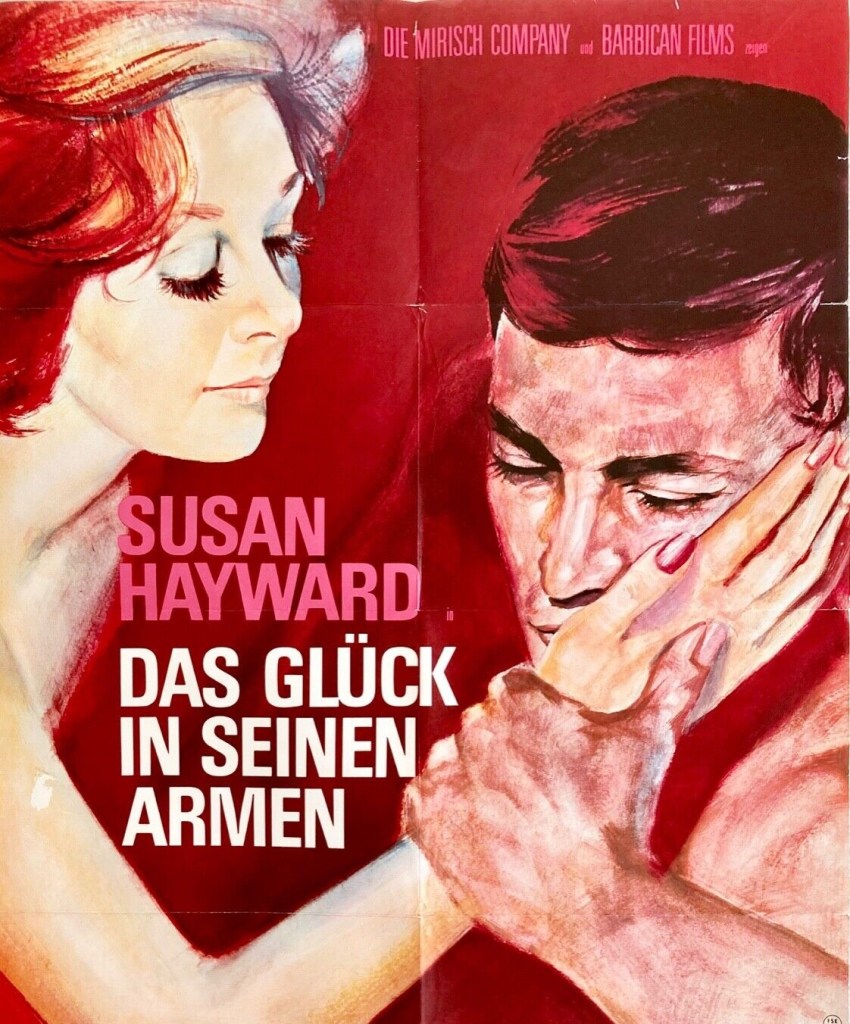
Stolen Hours / Summer Flight (1963) ***

New York Times critic Bosley Crowther famously took Susan Hayward to task for over-acting in the first half of this picture before turning subtle in the second without realizing that was the whole point. Hayward was always full-on, either because he played tougher-than-tough characters (weakness their Achilles heel) or was squaring up against macho males like Clark Gable (Soldier of Fortune, 1954) or John Wayne (The Conqueror, 1956).

Here, she duped audiences. Anyone expecting to view her normal feisty screen persona would come away happy with the first half, bewildered by the second. But, as I said, that was the whole point, a superb effort turning expectations on their head. In any case it was a pretty bold undertaking. In the 1960s, Hollywood went on a cycle of regurgitating old classics but mostly with newcomers like Alex Cord standing in for John Wayne in Stagecoach (1966) or Doug McClure for Gary Cooper in Beau Geste (1966).

There were not many actresses who would think of trying to match the legendary Bette Davis in one of her legendary roles. But Susan Hayward was not just larger than life but a queen of melodrama, able to ratchet up emotions with a look. No actress in the early 1960s could match Davis’s record of two Oscars and a further eight nominations (she would win another one later). By that point Katharine Hepburn equalled her on number of wins but had two fewer nominations (her other wins also came later).  But Hayward ran both pretty close, one win (for I Want To Live, 1959) and four nominations.

So if you were going to select an actress to take on the Davis role in a remake of Dark Victory (1939) you could do worse than choose Hayward. The plot’s been transitioned to England but it follows the same formula as before – in other words stand by for a full-scale weepie. Jet-setting divorced socialite Laura (Susan Hayward) lives life to the full – and then some. When diagnosed with a brain tumor, her reaction is to let all her wildness hang out, reviving romance with old racing driver boyfriend Mike (Edward Judd) before taking stock and abandoning the high life and settling down in the back of beyond (remote Cornwall) with Dr Carmody (Michael Craig).

It’s basically a film of two halves. The almost otherworldly life of the rich and famous who chase after every expensive delight without any notable increase in their happiness quotient contrasts with life in a Cornish village where problems, although apparently smaller, are every bit as vital to those affected. The gaudy section is filled with fine costumes, grand houses and glorious scenery. The serious part is a good bit more down-to-earth as the grande dame discovers her neighborly and maternal qualities. The characters inhabiting the rich life appear flimsy, the poorer people much more realistic. It is almost as if she has swapped fantasy for reality and uncovered a different kind of richness.

There’s not much more to the story than that so it requires acting of the highest caliber to keep us hooked all the way through. Well, for that, you’ve certainly come to the right place. What appears over-acting in the first section is just that, and deliberately so, since the personality switch is the ideal hook. The film’s emotional impact will hit you hard especially the ending. What initially appears to be heading for the sensational soon pulls back to reveal an ordinary person trying to overcome adversity, not with a grand gesture, but simply by living an ordinary life to the full.

While Michael Craig (Life at the Top, 1965) is pretty much a bystander, his calming approach sorely needed in the first half is redundant in the second as Laura comes into her own, developing an inner life she never knew was possible. Hitchcock protege Diane Baker (Mirage, 1965) continues to show early-career promise.

Perhaps more attention should be focused on director Daniel Petrie (The Main Attraction, 1962) who slides out from under his journeyman tab to over-egg the first section and under-egg (if there is such a word) the second. You could almost get the impression of a conductor fine-tuning an orchestra of one.

Superb showing from Hayward certainly gives Bette Davis a run for her money though you could argue she was too old for the role, Davis half her age in Dark Victory, but it’s to Hayward’s credit that you feel the loss of such a vibrant middle-aged personality as you do with Davis’s younger protagonist.

They don’t do melodrama like this anymore, mostly because there isn’t the likes of a Susan Hayward to make them work.

Discover WordPress

A daily selection of the best content published on WordPress, collected for you by humans who love to read.

The Atavist Magazine

by Brian Hannan

WordPress.com News

The latest news on WordPress.com and the WordPress community.