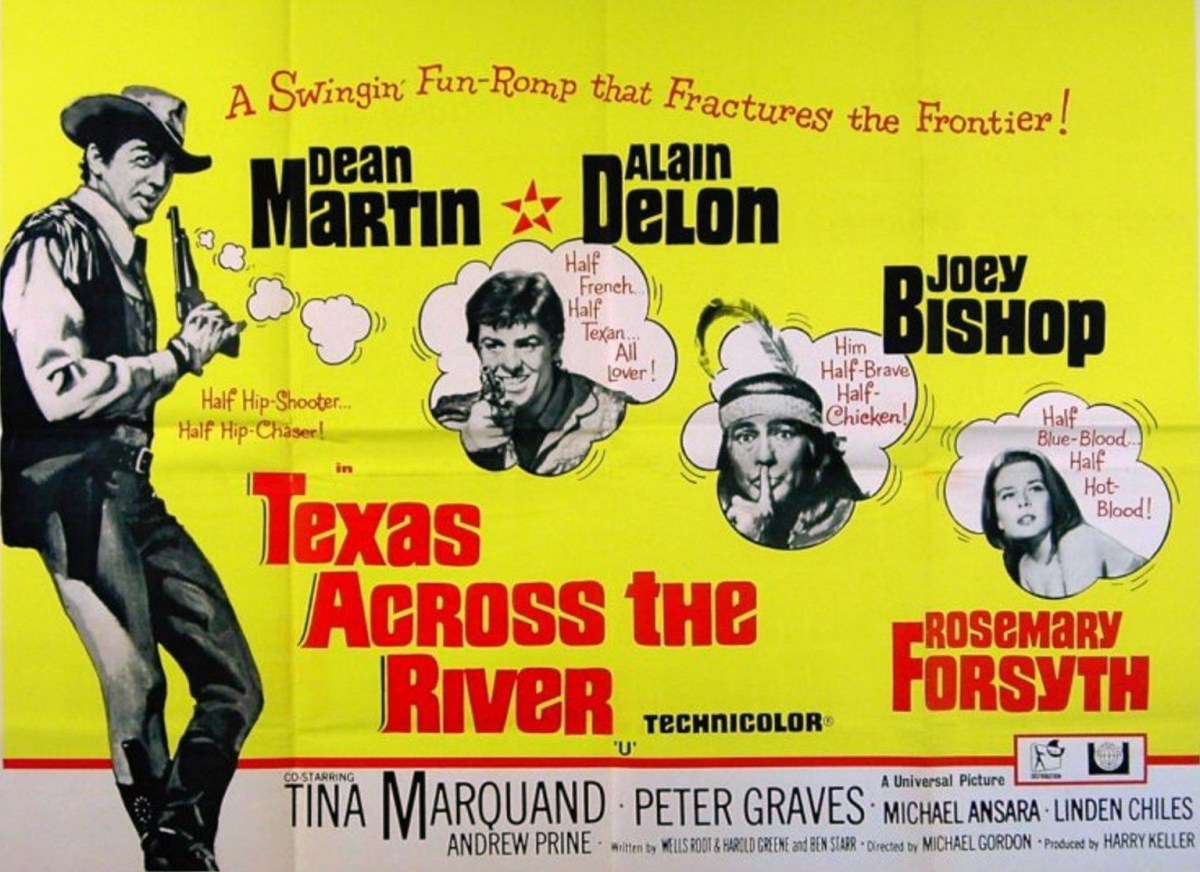
Texas Across the River (1966) ****

Excellent comedy western mixing dry wit and occasional slapstick to joyous effect. The wedding between Spanish duke Don Aldrea (Alain Delon) and Louisiana belle Phoebe (Rosemary Forsyth) is interrupted by her previous suitor Yancy (Stuart Cottle) who is killed in the resulting melee. Escaping to Texas, Don Aldrea’s marksmanship leads settler Sam (Dean Martin) to recruit him to help fight raiding Comanches. Romantic entanglement ensues when the Don rescues Native American Lonetta (Tina Marquand) and Sam has more than a passing interest in Phoebe.

It is so tightly structured that nothing occurs that doesn’t have a pay-off further down the line. Bursting with terrific lines – including a stinger of a final quip – and set pieces, it pokes fun at every western cliché from the gunfight, the cavalry in hot pursuit, and fearsome Native Americans to the snake bite and the naked bathing scene. Incompetence is the order of the day – cavalry captain Stimpson (Peter Graves) issues incomprehensible orders, chief’s son Yellow Knife (Michael Linden) cannot obey any.
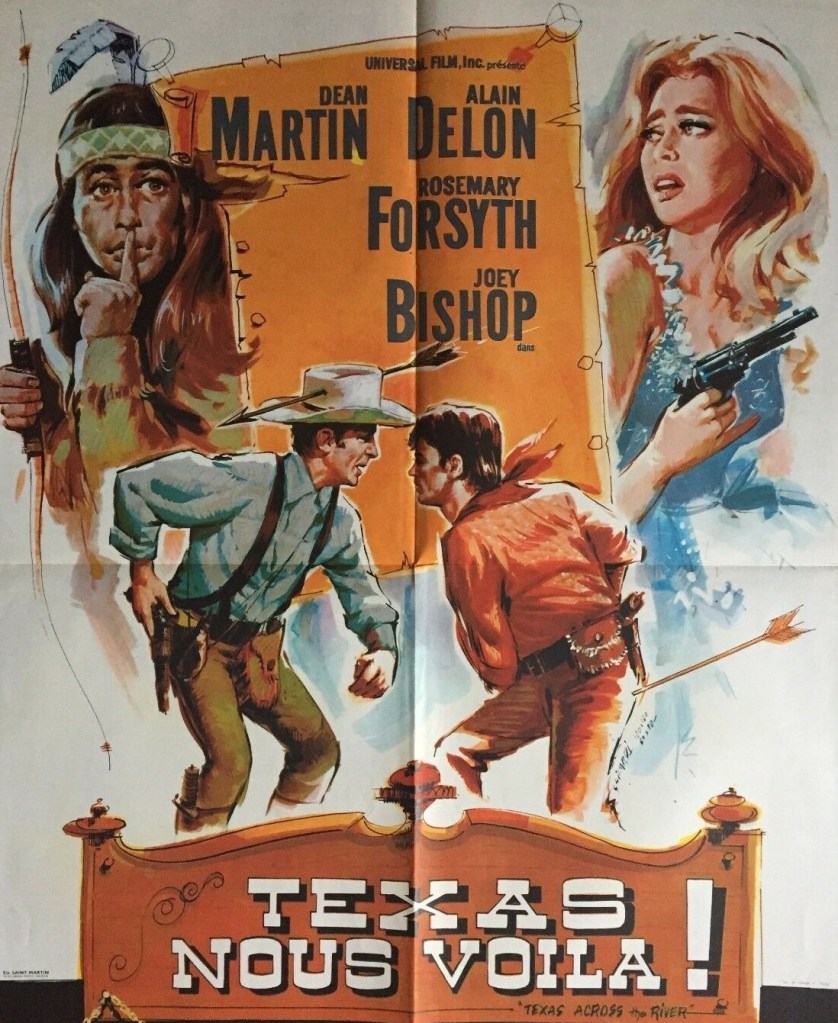
The Don, with his obsession with honor and his tendency to kiss men on the cheeks, is a comedy gift. Despite his terrific head of hair, he is stuck with the moniker “Baldy” and every time he is about to save the day he manages to ruin it. Sam is the kind of guy who thinks he is showing class by removing his spurs in bed while retaining his boots. His sidekick Kronk (Joey Bishop), a mickey-take on Tonto, mostly is just that, a guy who stands at the side doing nothing but delivering dry observations.

Lonetta is full of Native American lore and has enough sass to keep the Don in his place. “What is life with honor,” he cries to which she delivers the perfect riposte, “What is honor without life?” Phoebe is a hot ticket with not much in the way of loyalty.

Two sequences stand out – the slapping scene (whaat?) and a piece of exquisite comedy timing when Sam, Phoebe and the Don try an iron out a complicated situation.

Good as Dean Martin (Rough Night in Jericho, 1967) is the picture belongs to Alain Delon (Once a Thief, 1965) and I would argue it is possibly his best performance. Never has an actor so played against type or exploded his screen persona. Delon was known for moody, sullen roles, cameras fixated on his eyes. But here he is a delight, totally immersed in a role, not of an idiot, but a man of high ideals suddenly caught up in a country that is less impressed with ideals. If he had played the part with a knowing wink it would never have worked.
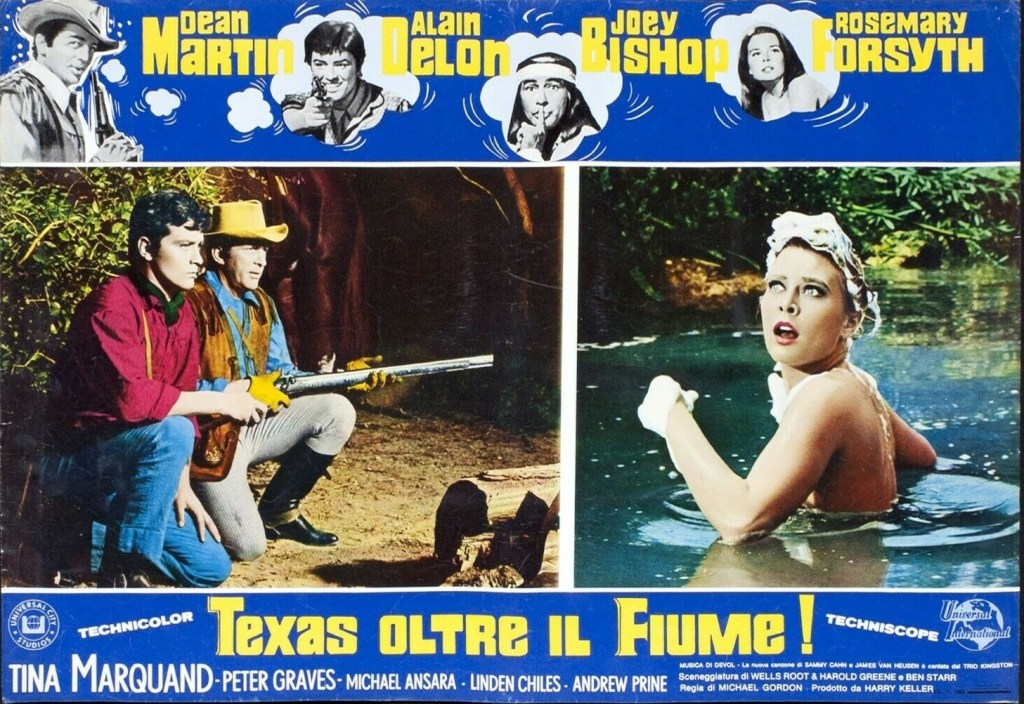
Martin exudes such screen charm you are almost convinced he’s not acting at all, but when you compare this to Rough Night in Jericho it’s easy to see why he was so under-rated. Joey Bishop (Ocean’s 11) is a prize turn, with some of the best quips. Rosemary Forsyth (Shenandoah, 1965) is surprisingly good, having made her bones in more dramatic roles, and Tina Marquand (Modesty Blaise, 1966) more than holds her own. Michael Ansara (Sol Madrid, 1968) played Cochise in the Broken Arrow (1956-1958) television series. Under all the Medicine Man get-up you might spot Richard Farnsworth. Peter Graves of Mission Impossible fame is the hapless cavalry leader.

Director Michael Gordon (Move Over, Darling, 1964) hits the mother lode, the story zipping along, every time it seems to be taking a side-step actually nudging the narrative forward. He draws splendid performances from the entire cast, knowing when to play it straight, when to lob in a piece of slapstick, and when to cut away for a humorous reaction, and especially keeping in check the self-indulgence which marred many Rat Pack pictures – two of the gang are here, Martin and Bishop. There’s even a sly nod to Sergio Leone spaghetti westerns when the electric guitar strikes up any time Native Americans appear. Frank De Vol (Cat Ballou, 1965) did the score. Written by Wells Root (Secrets of Deep Harbor, 1961), Ben Starr (Our Man Flint, 1966) and Harold Greene (Hide and Seek, 1964).

Terrific fun.

The Pink Jungle (1968) ***

Near miss rather than the spectacular crash dive the poor box office returns suggested. Though it’s scarcely surfaced in five decades. Espionage adventure-cum-treasure hunt is slightly undone by knowing winks to the camera and it won’t take an eagle eye to spot that most of the action doesn’t take place in the jungle at all, although the title is explained in a clever twist at the end.

Shame the script goes AWOL and you might be left lamenting what might have been had it been a hit and the boost it could have given the careers of George Kennedy (Cool Hand Luke, 1967), playing ebulliently against type, and Eva Renzi (A Taste of Excitement, 1967) who proved to have lot more screen charisma than her ensuing roles suggested. Not to mention James Garner (Duel at Diablo, 1966), marquee value taking a hit after a string of flops.   

However, if you can accept James Garner as a fashion photographer, and a gag that sees all three male principals decked in out varying shades of lipstick, and shut out the noise of Garner’s character offering commentary on what is about to happen, it’s a pleasant, non-demanding ride, with a believable central romance.

And I learned diamond arithmetic: five carats equals one gram, 28 grams is one ounce so you’re talking a phenomenal amount for a diamond weighing a few ounces never mind a 20lb haul which is where the endless MacGuffins lead. And if Ann-Margret can elect to shoot a fashion spread against the backdrop of motocross (C.C. and Company, 1970), choosing the South American jungle as the ideal spot for a lipstick advert is scarcely a stretch.

The long-winded tale begins with photographer Ben (James Garner) having his consignment of lipstick confiscated by police chief Ortega (Michael Ansara) who suspects they conceal hidden microfilm from the C.I.A. for rebel insurgents. When model Alison (Eva Renzi) arrives by helicopter that’s promptly stolen by South African illegal diamond dealer Ryderbeit (George Kennedy). The stranded couple repair to the nearest town, followed by the cops and by a pair of thugs, where Ryderbeit connects them to Englishman Capt Stopes (George Rose) who boasts a map leading to the lost diamond haul.

There’s no great reason for Ben to get involved, and the script offers nothing compelling, but let’s go for the ride, so suitably prepared (cigars and whisky essentials apparently) they set off with mules into the desert (yep, no jungle) where the model demonstrates her rodeo skills. There, they encounter Australian McClune (Nigel Green), the supposed deceased partner of Stopes, but he dupes them, leaving them stranded without water or mules, in the desert and heads off to find the loot himself. Of course, that does mean he has to come back the same way so the inevitable shootout, compounded by villains and cops, ensues.

Though determinedly sluggish in parts and the introduction of McClune adding little to the scenario, for the most part, although treading a thin line between cliches, it’s enjoyable enough. Ben is surprisingly handy with his fists, Alison has unusual depths and Ryderbeit is an engaging conman.

For a time there’s a bit of a tussle over Alison, as she’s clearly at times more attracted to the “masterful” adventurer Ryderbeit, a cool dude especially when he demonstrates his dance moves, than the cynical Ben. McClune takes a more predatory interest in Alison. But the growing romance between Ben and Alison is gentle stuff and almost required acting of the highest caliber given that the two actors hated each other according to the scuttlebutt.

Guilty of over-plotting and trying hard not to take the scenario seriously enough, even when it’s clear it won’t work unless that does occur, and that as a previous Garner episode proved, as in A Man Could Get Killed (1966), you can easily skirt around dense narrative and espionage malarkey without getting too bogged down. Over-populated, though, with characters and accents vary.

I’m used to Garner’s schtick by now, but Eva Renzi and George Kennedy were revelations, as was Nigel Green (Fraulein Doktor, 1969) also having a ball as a duplicitous character far removed from his usual ramrod-straight persona.

Oscar-winning director Delbert Mann (Mister Buddwing / Buddwing, 1966) does his best but he could have moved it on a bit for the pace seriously slackens at times. Charles Williams (Joy House, 1964) contributed the screenplay based on the novel by namesake Alan Williams.

Far more enjoyable than I expected and worth it for Renzi and Kennedy.

PREVIOUSLY REVIEWED IN THE BLOG: James Garner in Cash McCall (1960), The Wheeler Dealers (1963), Move Over, Darling (1963), The Americanization of Emily (1964), 36 Hours (1965), The Art of Love (1965), A Man Could Get Killed (1966), Duel at Diablo (1966), Buddwing/Mister Buddwing (1966), Grand Prix (1967), Hour of the Gun (1967), Marlowe (1969); Eva Renzi in Taste of Excitement (1969); George Kennedy in Lonely Are the Brave (1962); Charade (1963), In Harm’s Way (1965), Mirage (1965), Shenandoah (1965), The Sons of Katie Elder (1965), The Flight of the Phoenix (1965), Hurry Sundown (1967), Cool Hand Luke (1967), Bandolero! (1968), Guns of the Magnificent Seven (1969); Delbert Mann directed A Gathering of Eagles (1963), Buddwing/Mister Buddwing (1966), Fitzwilly/Fitzwilly Strikes Back (1967).

Discover WordPress

A daily selection of the best content published on WordPress, collected for you by humans who love to read.

The Atavist Magazine

by Brian Hannan

WordPress.com News

The latest news on WordPress.com and the WordPress community.