Behind the Scenes: “The Green Berets” (1968)

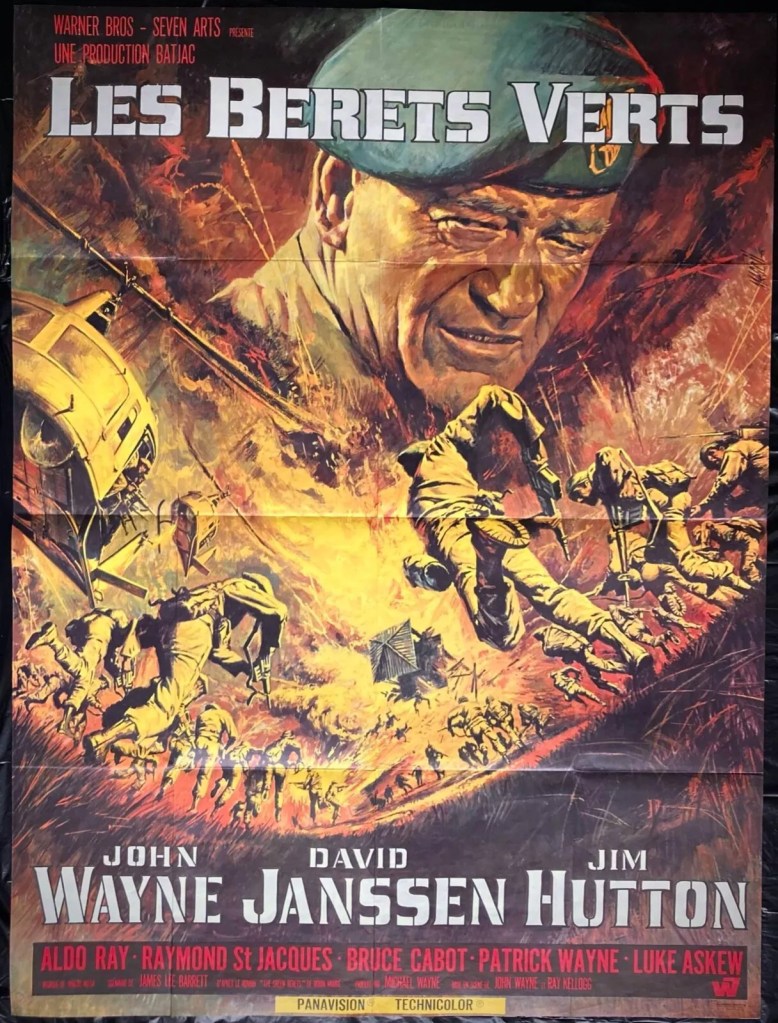
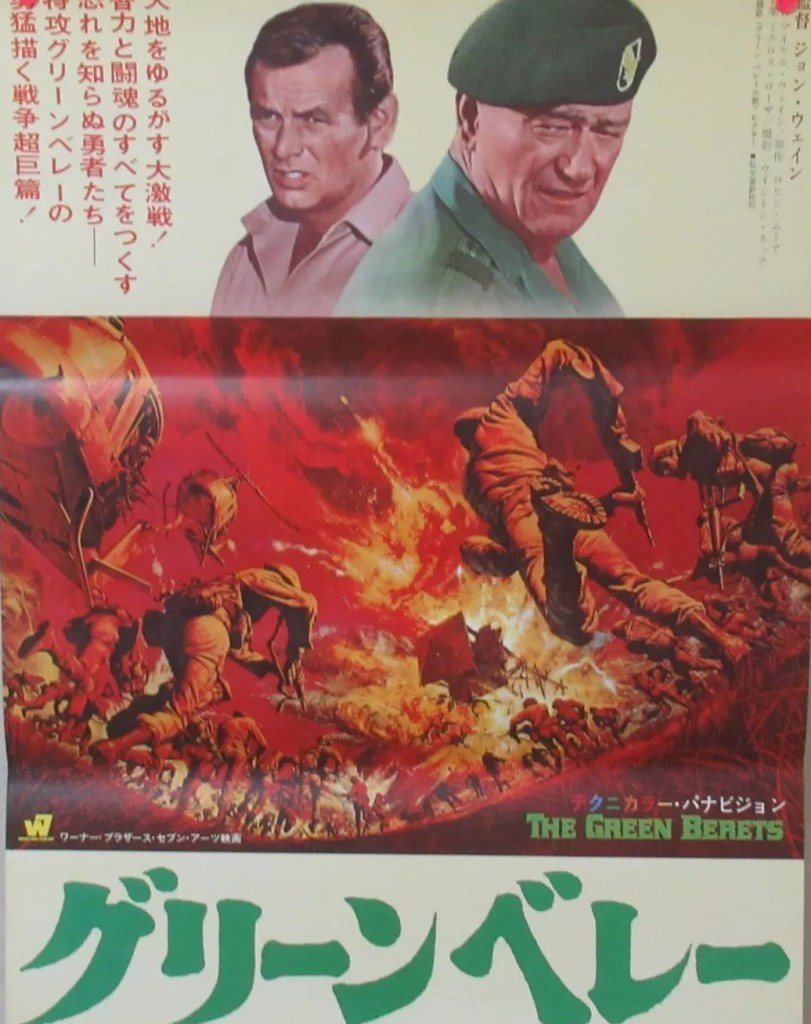
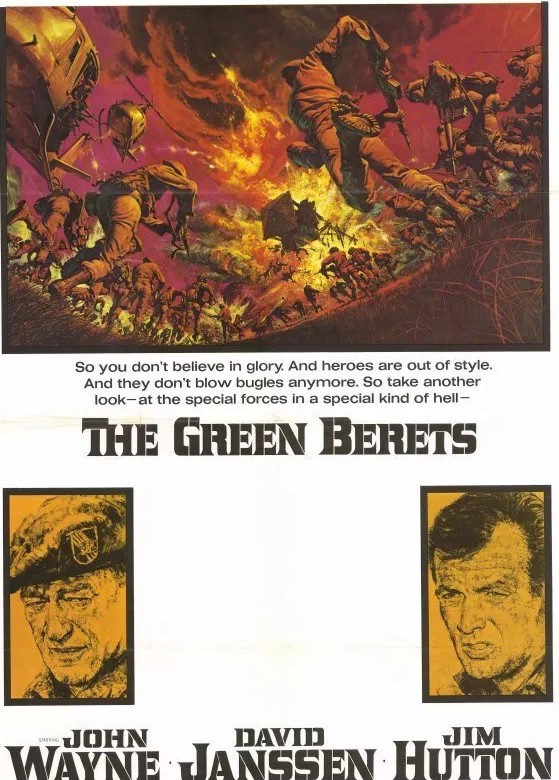
As if John Wayne hadn’t endured enough directing The Alamo (1960), he took on an even weightier task with this Vietnam War picture which, from the start, was likely to receive a critical roasting given the actor’s well-known stance on the conflict and his anti-Communist views that dated back to the McCarthy Era of the 1950s. Wayne had enjoyed a charmed life at the box office with three successive hit westerns, Henry Hathaway’s The Sons of Katie Elder (1965) with Dean Martin, Burt Kennedy’s The War Wagon (1967) co-starring Kirk Douglas, and best of all from a critical and commercial standpoint Howard Hawks El Dorado (1967) pairing Robert Mitchum. Outside of box office grosses, Wayne’s movies tended to be more profitable than his box office rivals because they were generally more inexpensive to make.

Columbia had been the first to recognize the potential of the book by Robin Moore and purchased the rights pre-publication in 1965 long before antipathy to the war reached its peak. A screenplay was commissioned from George Goodman who had served in the Special Forces the previous decade and was to to return to Vietnam on a research mission. But the studio couldn’t turn out a script that met the approval of the U.S. Army. Independent producer David Wolper (The Devil’s Brigade, 1968) was next to throw the dice but he couldn’t find the financing.
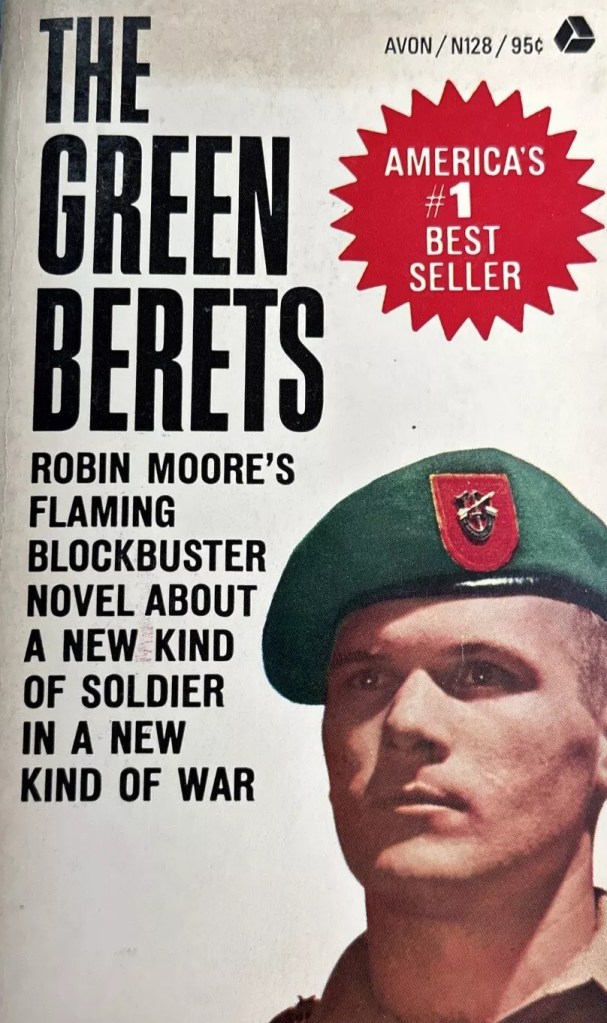
In 1966 Wayne took a trip to Vietnam and was impressed by what he saw. He bought the rights to the non-fiction book by Robin Moore (who also wrote The French Connection) for $35,000 plus a five per cent profit share. While the movie veered away in many places from the book, the honey trap and kidnapping of the general came from that source, although, ironically, that episode was entirely fictitious, originating in the mind of Robin Moore.

Universal originally agreed to back The Green Berets with filming scheduled for early 1967 but when it pulled out the project shifted to Warner Bros. And as if the director hadn’t learned his lesson from The Alamo, it was originally greenlit for a budget of $5.1 million, an amount that would prove signally inappropriate as the final count was $7 million. Wayne turned down the leading role in The Dirty Dozen (1967) to concentrate on this project. Wayne’s character was based on real-life Finnish Larry Thorne who had joined the Special Forces in Vietnam in 1963 and was reported missing in action in 1965 (his body was recovered four decades later).

As well as John Wayne, the movie was a platform for rising stars like Jim Hutton (Walk, Don’t Run, 1966), David Janssen (Warning Shot, 1967) and Luke Askew (Easy Rider, 1969) who replaced Bruce Dern. Howard Keel, who had appeared in The War Wagon, turned down a role.

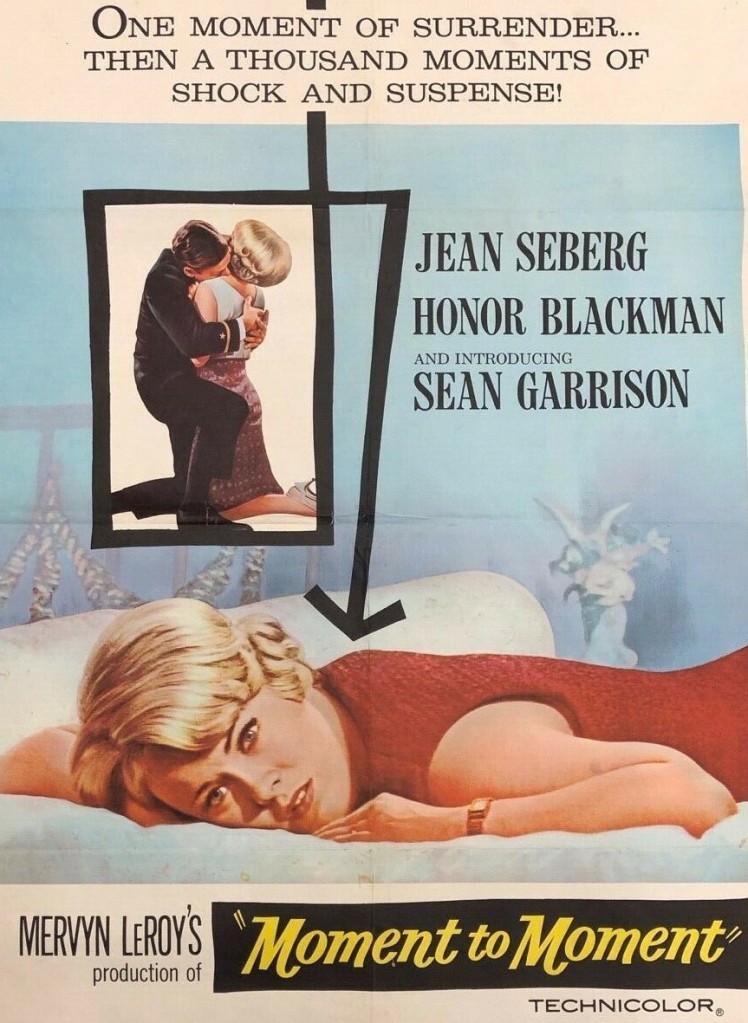
Wayne holstered his normal $750,000 fee for acting plus $120,000 for directing. But it turned out The Alamo had taught him one important lesson – not to shoulder too much of the responsibility –  and Ray Kellogg for the modest sum of $40,000 was brought in as co-director. It was produced by Wayne’s production company, Batjac, now run by his son Michael. But neither Wayne nor Kellogg proved up to the task and concerned the movie was falling behind schedule and over budget the studio drafted in veteran director Mervyn Leroy – current remuneration $200,000 plus a percentage – whose over 40 years in the business ranged from gangster machine-gun fest Little Caesar (1931) to his most recent offering the Hitchcock-lite Moment to Moment (1966).
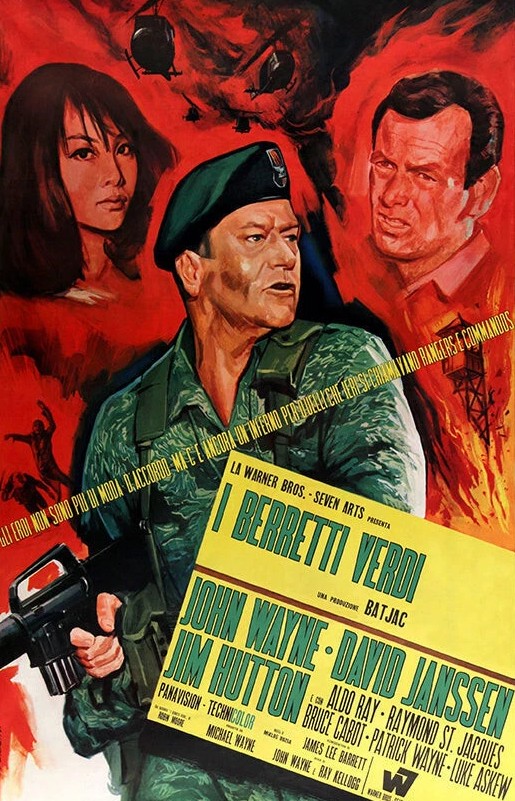
But exactly what LeRoy contributed over the next six months was open to question. Some reports had him directing all the scenes involving the star; others took the view that primarily he played the role of consultant, on set to offer advice. Even with his presence, the movie came in 18 days over schedule – 25 per cent longer than planned. Unlike the later Apocalypse Now (1979), it didn’t go anywhere near South-East Asia so the location didn’t add any of Coppola’s lush atmosphere, though the almost constant rain in Georgia, while a bugbear for the actors, helped authenticity.

It was filmed instead on five acres of Government land around Fort Benning, Georgia, hence pine forests rather than tropical trees.  President Lyndon B. Johnson and the Department of Defense offered full cooperation. But that was only after the producers complied with Army stipulations regarding the screenplay. James Lee Barratt’s script was altered to show the Vietnamese involved in defending the camp and the kidnapped was switched from being over the border. Also axed, though this time by the studio, was Wayne’s wish for a romantic element – the studio preferred more action. Sheree North (Madigan, 1968) was offered the role of Wayne’s wife but she also turned it down on political grounds. Vera Miles (The Hellfighters, 1968) was cast but she was edited out prior to release.

The Army provided UH-1 Huey helicopters, the Air Force chipped in with C-130 Hercules transports,  A-1 Skyraiders and the AC-47 Puff the Magic Dragon gunship and also the airplane that utilized the skyhook system. Actors and extras were kitted out in the correct jungle fatigues and uniforms. Making a cameo appearance was Col Welch, commander of the Army Airborne School at Ft Benning. The sequence of soldiers doing drill was actually airborne recruits.

The attack on the camp is based on the Battle of Nam Dong in 1964 when the defenders saw off a much bigger enemy unit.

This set was built on a hill inside Fort Benning. The authentic detail included barbed wire trenches and  punji sticks plus the use of mortar fire. While the camp was destroyed during filming the other villages were later used for training exercises. .

The pressure told on the Duke physically – he lost 15lb. But the oppressive heat and weather of that location – it was mostly shot in summer 1967 – was nothing compared to the reviews. It was slated by the critics with Wayne’s age for an active commander called into question, never mind the parachuting, the gung-ho heroics and the dalliance in an upmarket nightclub.

“In terms of Wayne’s directorial career,” wrote his biographer Scott Eyman, “The Alamo has many defenders, The Green Berets has none.” That assessment, of course, would be to ignore the moviegoers around the world who bought tickets and put the picture into reasonable profit.

Wayne was clear in his own mind about the kind of movie – “about good against bad”  – he was making and accommodated neither gray areas nor took note of current attitudes to the war as exemplified by nationwide demonstrations. Co-stars David Janssen, Jim Hutton and George Takei were opposed to the war. Takei, a regular on the Star Trek series, missed a third of the episodes on the second season; his lines were written to suit the character of Chekov, who went on to have a bigger role in the television series. Composer Elmer Bernstein turned down the gig as it went against his political beliefs. “The Ballad of the Green Berets,” heard over the opening credits was not composed for the film, having been released two years earlier.

Most critics hated it – “Truly monstrous ineptitude” (New York Times); “cliché-ridden throwback” (Hollywood Reporter); “immoral” (Glamour). Even those reviews that were mixed still came down hard: “rip-roaring Vietnam battle story…but certainly not an intellectual piece” (Motion Picture Exhibitor). Not that Wayne was too concerned. At the more vital place of judgement – the box office – it took in $9.5 million in rentals (what’s returned to the studios once cinemas have taken their cut) – $8.7 million on original release and a bit more in reissue – in the U.S. alone plus a good chunk overseas.

It was virtually impossible to examine a movie like this without taking a political stance. Other movies covering the same topic were allowed greater latitude regarding authenticity, audiences and critics like appearing to accept that creating watchable drama often took precedence over the facts. Both The Deer Hunter (1978) and Apocalypse Now, considered the best of this sub-genre, clearly ventured away from strict reality. With over half a century distancing the contemporary viewer from those inflammatory times, it’s worth noting that it still divides critics. Or, rather, critics and the general public take opposing views.

Although Rotten Tomatoes deems it “an exciting war film”, the critics voting on that  platform gave it a lowly 23 per cent favourable report compared to a generally positive 61 per cent from the ordinary viewer. That contrasts, for example, with a more even split for the likes of Exodus (1960) – 63 per cent from critics and 69 per cent from audiences. However, The Green Berets attracts twice as much interest, collaring 9,000 votes compared to just 4,300 for Exodus.

After this, Wayne’s fee went up to a flat million bucks a picture. “He wasn’t a guarantee of success,” explained his son Michael, “he was a guarantee against failure.” At this point in his career, he was gold-plated. Where other stars in his commercial league suffered the occasional box office lapse – Paul Newman’s career in the 1960s, for example, was riddled with flops like The Secret War of Harry Frigg (1968) – he did not. Especially with a global following, his pictures never lost money.

SOURCES: Michael Munn, John Wayne, The Man Behind the Myth, Robson, 2004; Scott Eyman, John Wayne, The Life and Legend, Simon and Schuster, 2014; Brian Hannan, The Magnificent 60s, The 100 Top Films at the Box Office, McFarland, 2023; Robin Moore, Introduction, The Green Berets, 1999 edition, Skyhorse Publishing; Laurence H. Suid, Guts and Glory, University of Lexington Press, 2002; The Making of The Green Berets, 2020; Review, Hollywood Reporter, June 17, 1968; Review, Motion Picture Exhibitor, June 19, 1968; Renata Adler, “The Absolute End of the ‘Romance of War’”, New York Times, June 30, 1968; Glamour, October 1968; “Big Rental Pictures of 1968,” Variety, January 8, 1969.
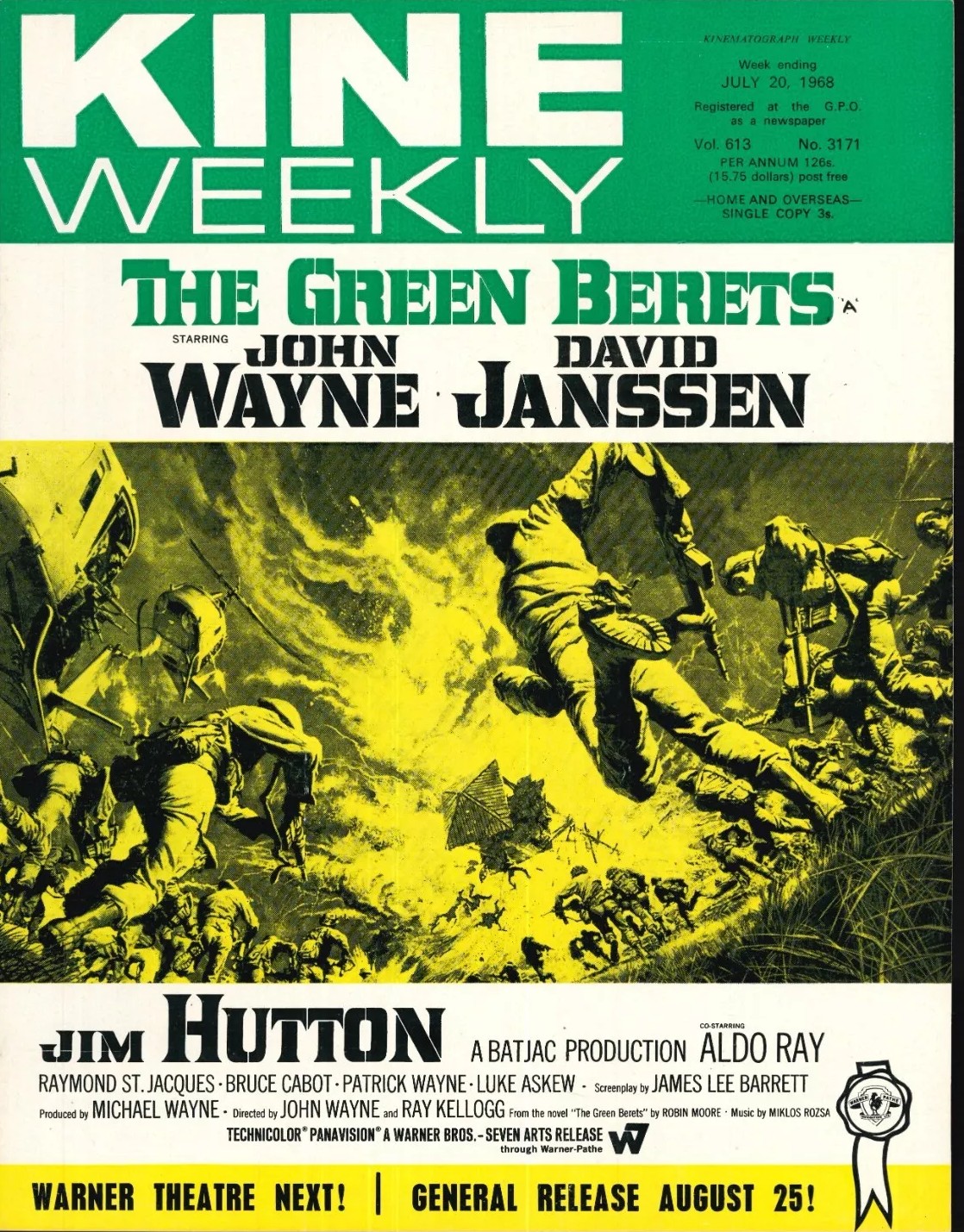
The Green Berets (1968) ***

Apart from attempts to justify the Vietnam War and a hot streak of sentimentality, a grimly realistic tale that doesn’t go in for the grandiosity or self-consciousnesss of the likes of Apocalypse Now (1979), The Deer Hunter (1978) and Platoon (1978). It’s been so long since I’ve watched this that my DVD is one of those where you had to turn the disc over in the middle.

The central action sequence is a kind of backs-to-the-wall Alamo or Rorke’s Drift siege. There’s no sense of triumphalism in the battle where the best you can say is that a reasonable chunk of the American soldiers came out alive but only after evacuating the staging post they were holding, more like Ridley Scott’s Black Hawk Down (2001) where survival is all there is to savor. It’s all pretty brutal stuff, the Americans handicapped by having to also look after the fleeing Vietnamese villagers taking refuge in their camp.

There are plenty grim reminders of how war has become even more devastating in the aftermath of World War Two. The Vietcong take, literally, no prisoners, seen as killing civilians as easily as soldiers. The Americans, for their part, have no compunction in using more sophisticated weaponry, with the addition of targeted air strikes.

Into the mix, somewhat unnecessarily, comes left-wing journo George (David Janssen) whose main job is to change his mind about the work the soldiers are doing, though admitting that to report the truth will lose him his position. He’s slung into the middle of a defensive action headed up by Col Kirby (John Wayne) to hold a position under threat against superior (in numbers) forces. There’s a fair bit of the detail of war but virtually zero about the strategy, whether that’s the U.S. Army’s plan to defeat the enemy or this individual unit’s method of defending this position. Apart from extending the perimeter of the camp to create a more effective killing zone, it’s hard to work out what the heck is going on, no matter how often orders are barked through field telephones or walkie talkies. There are squads out in the field and units in the camp and how the whole operation is meant to mesh is beyond me.

There’s not much time to flesh out the characters, save for “scrounger” Sgt Peterson (Jim Hutton) who adopts an orphan, Vietnamese soldier Capt Nim (George Takei) and Sgt Provo (Luke Askew). The rest of the motley bunch are the usual crew of monosyllabic tough guys and friendly medics and whatnot.

Though the emotional weight falls on Lin (Irene Tsu), fearing shame and being ostracized by her family for befriending the Vietcong general who killed her father and for whom she now lays a honeytrap, Kirby expresses guilt at having to kill anybody.

Despite being sent out to reinforce the position, the Americans are forced to retreat and enjoy only a Pyrrhic victory when the cavalry, in the shape of an airplane, arrives to mow down the enemy after they have captured the position.

The fighting is suitably savage, and there is certainly the notion that the Americans are not only being out-fought but out-thought and that no amount of heavy weaponry is going to win the day.

Possibly to prevent the idea of defeat destabilizing the audience, the movie shifts into a different gear, more the gung-ho commando raid picture that the British used to do so well, where Kirby heads up an infiltration team to capture the Vietcong general who has been seduced by Lin. This sets up a completely different imperative, all stealth and secrecy, the kind of operation that in the past would have been a whole movie in itself rather than the tag-end of one.

While the prime aim of this is to have the audience leave the cinema happier than if they had just witnessed the retreat from the camp, in fact it also serves two purposes. One is worthwhile, to emphasize the sacrifices made by the Vietnamese. Lin, having agreed to prostitute herself, fears being cast out as a result. But the other outcome of this mission is to kill off Sgt Peterson thus leaving the little Vietnamese lad even more orphaned than before.

John Wayne (The Sons of Katie Elder, 1965) doesn’t attempt to gloss over the weariness of his character. Jim Hutton (Walk, Don’t Run, 1966) shifts with surprising ease from comedy to drama. Even as a cliché David Janssen (Warning Shot, 1966) is underused. Watch out for Aldo Ray (The Power, 1968), George Takei (original Star Trek series), Raymond St Jacques (Uptight, 1968), Luke Askew (Flareup, 1969) and Irene Tsu (Caprice, 1967).

Three hands were involved in the direction: John Wayne, veteran Mervyn Leroy (Moment to Moment, 1966) and Ray Kellogg (My Dog, Buddy, 1960). Written by James Lee Barrett (Bandolero!, 1968) from the book by Robin Moore. Worth pointing out the score by triple Oscar-winner Miklos Rosza (The Power, 1968) especially the low notes he hits to provide brooding tension.     

Certainly a mixed bag, the central superb action sequence weighted down by the need to find something to shout about.

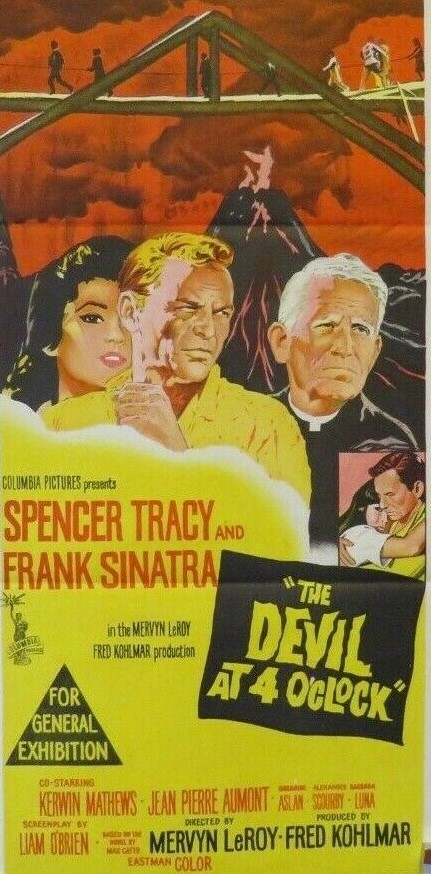
The Devil at 4 O’Clock (1961) ***

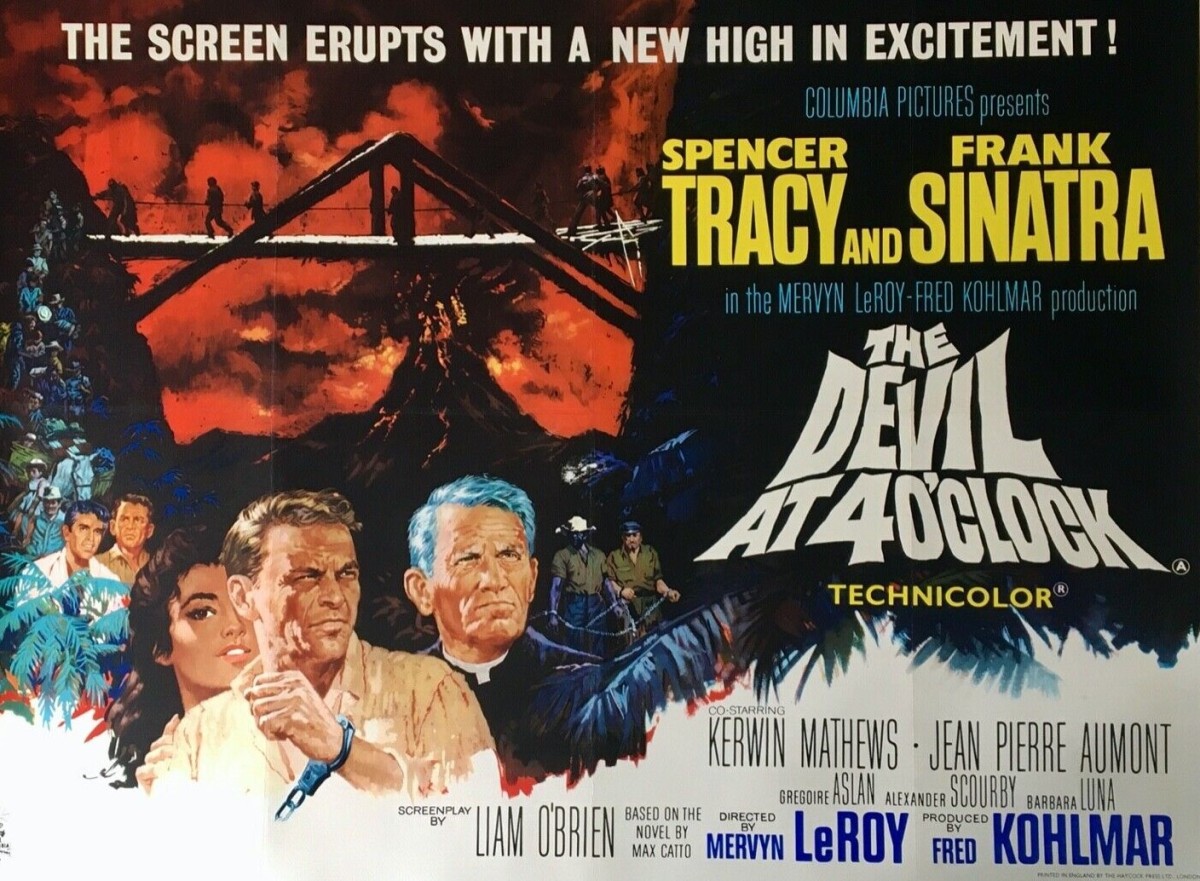
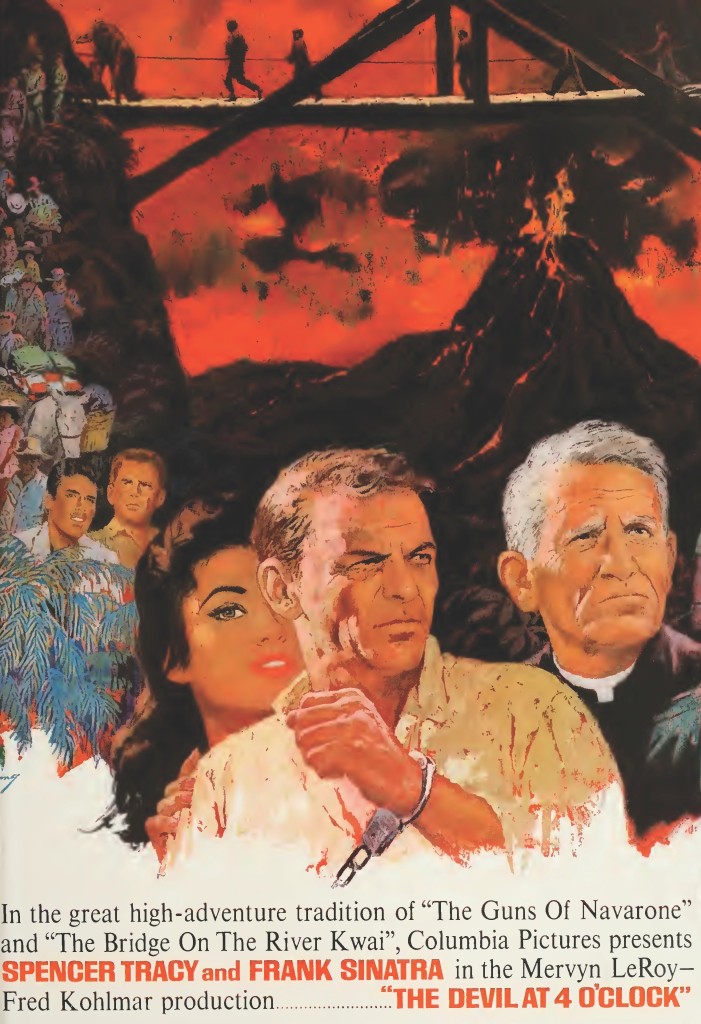
You took on Spencer Tracy (Judgment at Nuremberg, 1961) at your peril. Not even the best efforts of a volcano can wrest the screen from him. And certainly Frank Sinatra (The Detective, 1968) is put in the shade. And if you wanted to work with Tracy you had to cede, no matter how high-flying your career might be, top billing. Both names are above the title and if they were actually equally ranked they would appear in alphabetical order. And it wasn’t until a later disaster picture, The Towering Inferno (1974), that someone solved the tricky problem of designating equal billing by having Paul Newman’s name first on the left of the poster, but Steve McQueen’s name higher on the right.

Anyway, theoretically, nobody should be bothering much who is in a disaster picture when, again theoretically, the audience has come to gawk at the special effects – exceptional for the time but looking tame now. But Hollywood had learned from experience – and the same rules would apply in the disaster boom of the 1970s – that there was no point spending all that money on effects if there was not enough interest in the characters leading up to the disaster element, and also learned you needed stars to attract audiences in the first place.

In the tradition of…previous Columbia hits. Contractual billing agreements referred to the placing of names not faces on the poster , so Columbia could stick Sinatra in the center and
there was nothing Tracy could do about it.

So this scenario has old whisky priest Fr Doonan (Spencer Tracy) getting ready to leave a Pacific island, replaced by the younger Fr Perrau (Kerwin Matthews), while three convicts, led by Harry (Frank Sinatra), on the way to long prison stretches elsewhere make an unexpected pit stop. The rule is that Fr Doonan can make use of any prison labor so he hives them up the mountain to fix the hospital housing lepers that the authorities wish to keep a secret in case it scares off the tourists. Naturally, it’s not long before Harry is making a romantic pitch for  blind nurse (Barbara Luna) but that takes second place to hatching an escape plan.

Running away is only foiled when the volcano begins erupting and as the island authorities begin the evacuation it’s up to the priest and the convicts – Harry’s romantic instinct overcoming reluctance – to fetch the kids in the leper colony. Fr Doonan could have come straight from Boys Town (1938), the kind of two-fisted man of the cloth who tells it like it is, has no compunction about upsetting anyone who gets in his way, but with right on his side generally wins the day. The Governor (Alexander Scourby) isn’t viewed as a bad guy so much by refusing to acknowledge the lepers – especially as by that time the disease was not contagious, priest and hospital workers haven’t caught it, though begging the question why  young kids still did –  as by allowing brutal treatment of the prisoners, sticking three overnight in suffocating heat in a hole in the ground intended for one.

Narrative edge is added by the obstracizing of the lepers – at the time people contracting various illnesses would be treated as lepers and anyone with a serious mental condition stuck away out of sight. But the characters don’t occupy the moral twilight of the later disaster pictures, where the unscrupulous were often offered redemption. Here, the best we’ve got is a rehabilitated sex worker acting as hospital matron and the convicts agreeing to help out.

Kind of suffers from not enough scenes between the priest and Harry, they almost occupy separate narrative threads, but then Frank Sinatra’s got enough on his plate to avoid looking creepy when making advances on a woman who can’t see him. In fact, there’s a serious scene-stealer, another convict Marcel (Gregoire Aslan), getting in the way, his jovial devil-may-care attitude lifting the gloom.

As ever, the main audience concern is who lives and who dies and here the makers throw a curveball and you could interpret the ending as both triumphant and downbeat. The special effects are still pretty good – sensational for the time if truth be told – especially for the pre-CGI era, but the earthquake aspects come in ahead of the rolling lava, which no matter which way you cut it always resembles slow thick soup, although the explosion, done for real using tons of TNT, makes a mark. Technically, the makers pull a fast one in ignoring the tidal wave that follows an eruption, thus allowing most of the islanders to escape by sea.

It being the jungle there’s always a tricky bridge to navigate – Indiana Jones encountered a similar trope decades later – but there’s no snakes or big beasts to cause a narrative diversion. Whatever it is about Spencer Tracy’s screen presence that allows him to inhabit characters with such ease he brings in spades to the priest. Sinatra looks as though he’s learning a thing or two because his Harry bears some similarities in the the down-at-heel unkempt appearance and the lack of scene stealing.

In case you’re wondering, the “four o’clock” of the title is a deadline but appears too late in the picture to create the required tension. Hollywood veteran Mervyn LeRoy (Moment to Moment, 1966) is at helm. Screenplay by Liam O’Brian (The Great Imposter, 1960), in his last movie, from the bestseller by Max Catto (Seven Thieves, 1960).

Worth it for Tracy and Sinatra and Aslan and to see how they managed sfx in ye olden days.

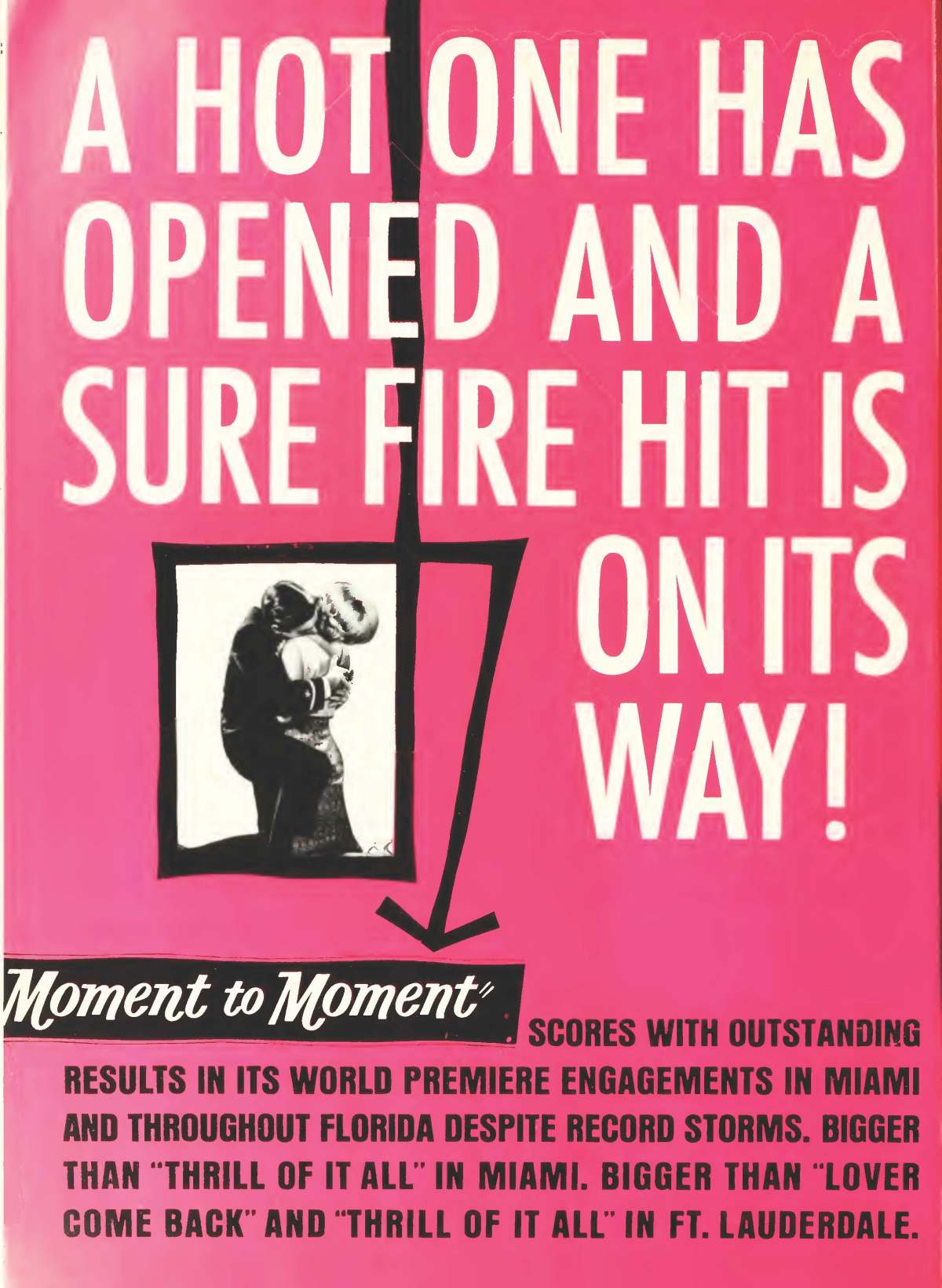
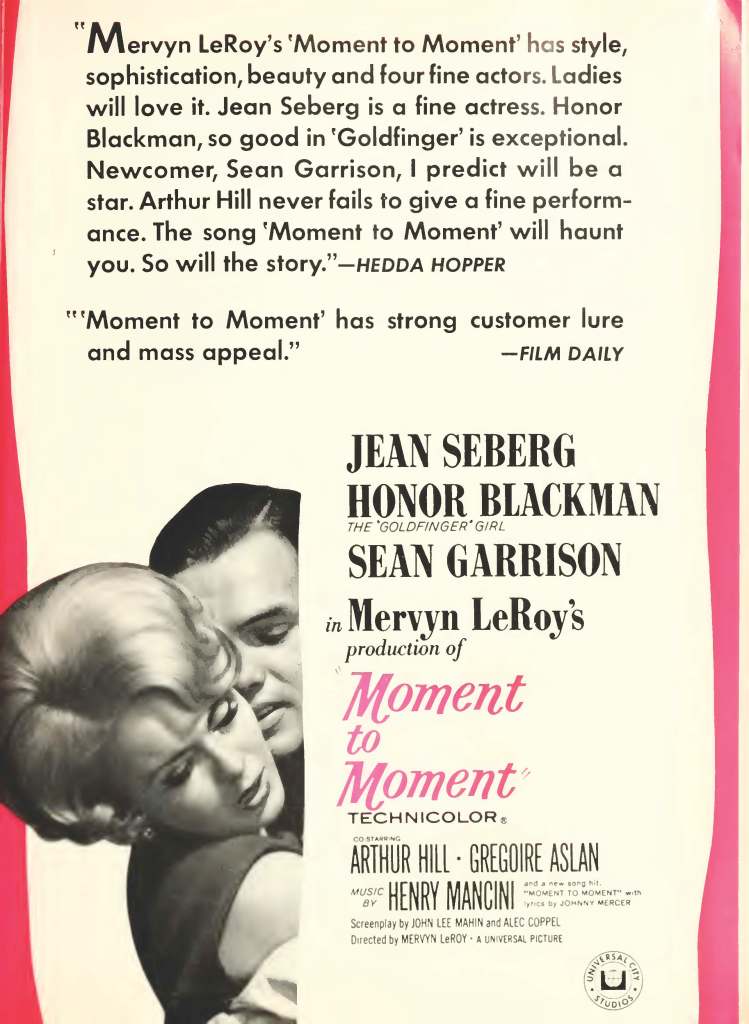
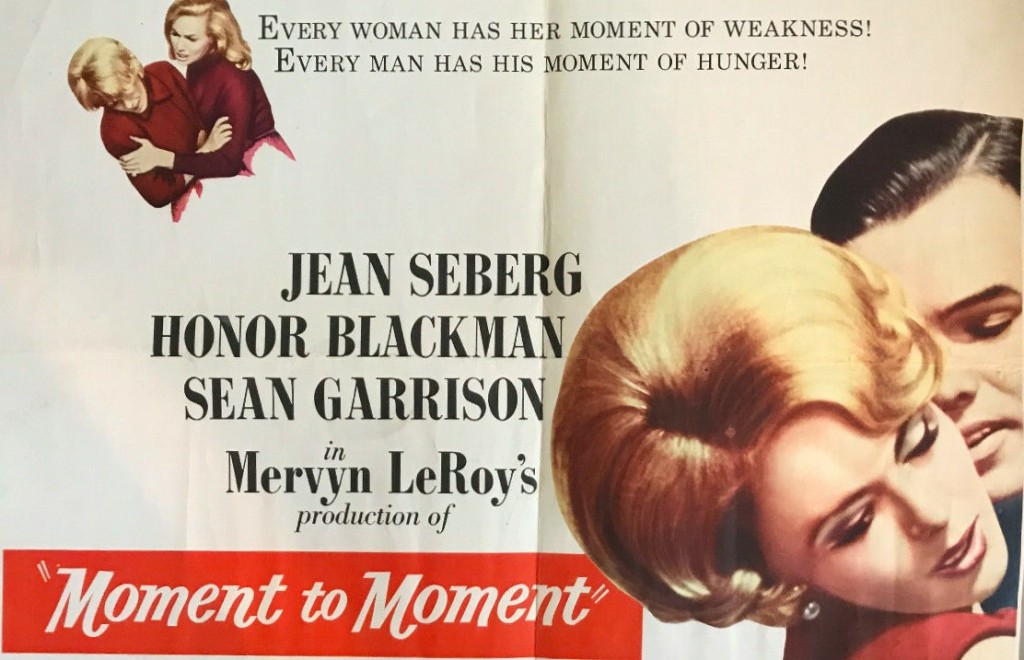
Moment to Moment (1966) ***

Screenwriter Alec Coppel, responsible for Alfred Hitchcock’s Vertigo (1958) – now considered the best film ever made, supplanting Citizen Kane in the Sight & Sound poll – follows pretty much the same structural idea as in the James Stewart-Kim Novak thriller. The second half here is in many respects a repeat of the first, with a man trying to recapture previous experience in a bid to reawaken memory.

But in this case the man is French police inspector DeFargo (Gregoire Aslan) trying to trap glamorous Kay Stanton (Jean Seberg) suspected of killing young sailor and architect-wannabe Mark (Sean Garrison) with whom she has engaged in a brief affair. DeFargo is cunning in the extreme, almost stalking Stanton, turning up unexpectedly, employing all sorts of ruses, including recruiting Stanton’s unsuspecting husband Neil (Arthur Hill), an internationally renowned psychiatrist.

The picture is set on the French Riviera so it’s the height of fashion. Kay wears a series of stunning top-of-the-range clothes (designed in fact by Yves St Laurent), as does high-living  neighbor and suspected accomplice Daphne (Honor Blackman). Kay drives a red sports car and frequents swanky restaurants and chic bars.

A number of cleverly-wrought images in the first half – white doves that turn golden at sunset, dancing to a tune called “Moment to Moment,” the wind causing shutters to bang, a statue in a village square, some sketches, the clacking together of the hard balls used to play the French traditional game of boules, a boardgame called “Blockhead” – prove pivotal in the second half. They form clues from which the inspector has to determine meaning.  

But if ever there was a film of two halves, this is it, and they are not a great fit. The first section involves Kay, lonely due to her husband’s continual absence, embarking on an affair. That she initially resists, in order to prove she is at heart really a good woman, gets in the way of the picture, since that makes the romance more drawn-out than necessary and leaves the viewer wishing the director would get a move on. Even though the time is spent in planting all the clues necessary for the second half to work, had Kay been more keen on a piece of action, driven for example (as is the case) by her husband staying away far longer than promised, it would have speeded things up to get to the more interesting part of the story.

Part of the problem is that the affair is totally unconvincing. Mark is handsome enough and dashing in the way most sailors are in uniform with an artistic streak, first viewed  making sketches, but Sean Garrison is so wooden the romance never sparks. That leaves Seberg to do the heavy lifting and, in fairness, once she is targeted by the wily inspector she comes up to the mark.

I’m not the first to think, after watching this picture, what would Hitchcock have done? That was exactly the same conclusion reached by the New York Times critic on original release. For this picture has a great deal going for it, but not a sufficient quota of suspense, and, as I mentioned, takes too long to get to the core of the story.

However, the second half works exceptionally well, as Seberg is put under pressure by the wily inspector and her husband unexpectedly enters the equation. An abundance of  twists culminate with a number in the final few minutes that serve to confound audience expectation.

Seberg’s career up to now had been somewhat disjointed, a sense of unfulfilled potential. An Otto Preminger protégé via Saint Joan (1957) and Bonjour Tristesse (1958), she was widely believed, despite the artistic coup of Jean-Luc Godard’s Breathless (1960), to have thrown her career away by decamping to France where she made no further films of particular note. Her previous Hollywood offering Lilith (1964) had not commercially delivered. So this high-budget Universal number was considered something of a comeback. But the perfectly-coiffed fashion-model look seems a poor imitation of Grace Kelly (To Catch a Thief, 1955) and Tippi Hedren (The Birds, 1963). At times, with the romance scarcely touching the lower rungs of passion, the movie falls back on haute couture.

Second half Seberg is better than the first as she is given far more material to work with and a decent opponent in Gregoire Aslan. Honor Blackman, as a flirtatious divorcee, reinvents her  screen persona, far removed from her memorable incarnations as Catherine Gale in British television series The Avengers (1962-1964) and Pussy Galore in Goldfinger  (1964). Sean Harrison made only one more movie, and his career mainly consisted of television. Arthur Hill (Harper, 1966) is excellent as the over-enthusiastic husband, unwittingly hammering nails in his wife’s coffin and Gregoire Aslan (Lost Command, 1966) almost steals the show as Seberg’s accomplished adversary.

Veteran Mervyn LeRoy (The Devil at 4 O’Clock, 1964) had a distinguished and versatile career including an Oscar nomination for Random Harvest (1942) and recipient of an Oscar in the form of the Irving G. Thalberg Award for lifetime contribution to the business. But this isn’t quite up to the mark of innovative gangster picture Little Caesar (1931), drama Little Women (1949), Biblical epic Quo Vadis (1951) or cultish The Bad Seed (1958).  

Discover WordPress

A daily selection of the best content published on WordPress, collected for you by humans who love to read.

The Atavist Magazine

by Brian Hannan

WordPress.com News

The latest news on WordPress.com and the WordPress community.