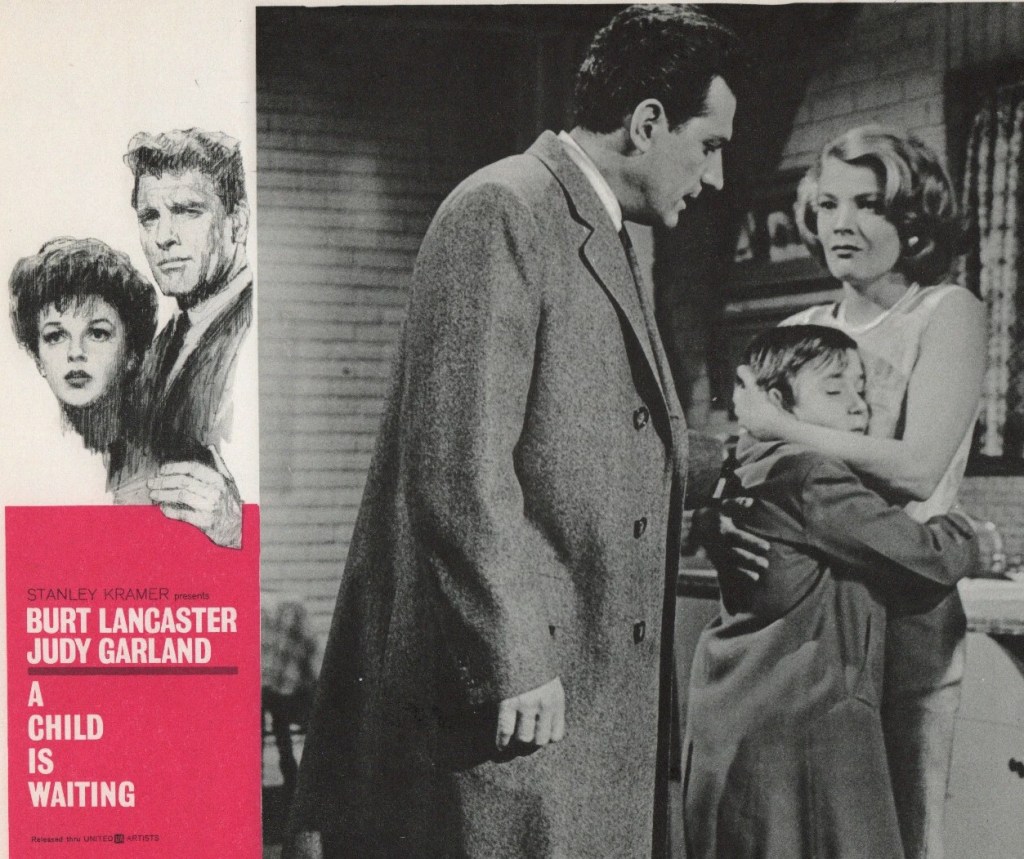
This proved the impossible sell. And Judy Garland was no help. The star was well past her best and if she wasn’t singing it was difficult to attract audience interest. So beyond her name above the title, United Artists did very ittle to use her presence as a distinct marketing tool.
Just like I Thank a Fool the previous year, the subject matter of A Child is Waiting did not lend itself to cross promotion. That did not prevent marketeers doing their level best. However, it was a rather bold suggestion to assume banks would be a natural port of call even under the guise that every child was waiting for their parents to start a savings account to see them through college.
The title seemed to incite temporary madness in the marketing department. How about this for a tie-in approach to a toy department? “A child is waiting for the most exciting game ever devised – Monopoly.”
Groups most likely to respond were identified as psychiatrists, teachers and PTA members but cinemas were warned to avoid giving the “impression that the film is a clinical or documentary one.”
By far the easiest avenue for promotion was a book tie-in. Popular Library had issued a paperback novelization by Abby Mann of his original screenplay with stars Burt Lancaster and Judy Garland on the cover and at the very least that would receive window displays in bookstores and on the carousels of drugstores.
Also limited were the number of taglines on a poster. In those days a movie could be advertised with as many as a dozen different taglines appealing to different market sectors. United Artists stuck to three main taglines with two subsidiary ones. Sometimes both subsidiaries were on the same poster, other times only one.
“Burt Lancaster and Judy Garland ignite a motion picture that gives so much…goes so far…looks so deep into the feelings of man and woman.” This alternated with “Burt Lancaster and Judy Garland take an untouched theme – and make it touching and unforgettable” and “Only Burt Lancaster and Judy Garland could take this untold story…and make your heart tell it over and over again.”
The subsidiary taglines ran to: “If this were flesh of your flesh – would you hold it close…Protect it…Love it…Or would you turn your back and run” and “A child can be so many things, warmth…love…laughter…and sometimes a child can be heartbreak!”
Mainly what marketeers were asking of Lancaster and Garland was a miracle, as if their names alone could drag audiences into theaters.
Even though the Pressbook was relatively small – eight pages A3 – two-thirds of the space was allocated to repeating the adverts, just in different sizes.
The section normally aimed at getting editors to carry snippets of news about the movie provided scant material. There was little to catch the journalistic eye, nothing new about either of the stars, just a rehash of careers. Usually, cinema managers would scour this section looking for a titbit to offer to a reporter, an unusual hobby, something odd that occurred during filming, details about the location or an element that went wrong during shooting.
If you were relying on this Pressbook to fuel demand from exhibitors, you would be sorely disappointed.
Sam Fuller’s (The Naked Kiss, 1964) masterpiece, targeting every conceivable taboo subject – incest, sexual abuse, racism, the atomic bomb – under the guise, as with the later Shock Treatment (1964), of a sane man entering a mental asylum with the aim of uncovering criminality. In this case, uber-ambitious journalist Johnny Barrett (Peter Breck), with his eyes on a Pulitzer Prize, undergoes training from psychiatrist Dr Fong (Philip Ahn) to pass himself off as insane in a bid to find the killer of an inmate called Sloane.
Apparently, in those days in the U.S., incest, while viewed as sexual deviation, was also considered a mental illness. So when Barrett’s girlfriend, stripper Cathy (Constance Towers), turns up at a police station masquerading as his sister and complaining of sexual molestation, he is packed off to the nearest asylum. That he passes muster is not only down to his acting (or over-acting) but to the release of his own inner demons.
Tormented by jealousy and insecurity, he imagines Cathy, dancing as a demonic miniature in his dreams, her mouth a “lush tunnel,” will abandon him for another man or just play the field, no shortage of unsuitable suitors in her line of work. For her part, Cathy finds it hard to maintain the pretence, and clearly starts to crumble under the pressure, almost giving the game away, and soon enough almost compelled to do so after seeing the impact of incarceration – and its various treatments including electric shock therapy – upon her lover.
But what a difference a director with an agenda and a knack for stunning imagery makes. While Denis Sanders with Shock Treatment (1964) and George Englund in Signpost to Murder (1964) take the melodramatic tack to mental illness, which robs the subject matter of some of its power, Sam Fuller takes a two-fisted approach. Sure, there are shades of noir in the lighting, and the internal corruption of personality, but this is a world twisted upside down, filled with intentional and accidental malevolence, often from people who don’t know the difference.
The simmering violence can explode from a minor tiff over vitamin pills, or from the wrong man entering the female quarters at the wrong time, or from deep-seated hatred, while torture is visited upon inmates from the best of intentions as psychiatrists attempt to subdue or quell the worst instincts. Best of all is the depiction of obsession. People are only committed to an asylum because they are a danger to themselves or others, in other words when what is going on in their minds has got out of control and they can think of little else but the thoughts that consume them and are condemned to play out again and again perverse versions of reality.
So we have the patient constantly singing opera who likes to stab inmates with his hands and stuff their mouths full of chewing gum, another obsessed with hide-and-seek, a third with the Civil War, yet another who steals pillowcases in order to turn them into Ku Klux Klan masks. Mental warping renders some relatively harmless and others lethal. But there are also those with nothing left on the surface, reduced to catatonic state, arms stretched out, bodies draped over a bed or a chair, and you can guess that those who still act out will eventually end up silent, helpless and rigidly comatose.
Soon you realize, as Barrett clearly does not, the futility of attempting to carry out an investigation under these circumstances. He has three witnesses to pursue, none of whom a prosecutor would ever consider putting into the witness box in a court, and eventually of course Barrett does find the murderer – the victim killed for threatening to expose an attendant preying on female patients – but by that point his mind is so jumbled up by a combination of treatment and his own psychiatric problems that he either can’t locate the name in his memory or finds himself struck dumb and hallucinating.
When he is mauled by a pack of predatory females he can just about retain his dignity, but once he visualises water pouring in from the ceiling and almost drowns in the subsequent flood, and struck by imaginary lightning to boot, he has only a few shreds of his personality left.
This is brutal stuff and even now an incredible shock to the cinematic system so you wonder how it ever managed to get released. In retrospect, not so much an expose of the treatment methods in asylums as an insight into the power of mental illness once it exerts control on hapless humans.
You won’t forget the long corridor either empty or filled with individuals bent out of shape, or Barrett battered by torrential downpour or buried under a mob of savage women, or the African American white supremacist hunting for a victim or the agony of the outsider Cathy forced into playing this terrible game.
One of those films that creates its own visual grammar. I remember the rediscovery of Sam Fuller by the cognoscenti, a director whose work stood so far outside the accepted masters of cinema like John Ford or Sergei Eisenstein or Howard Hawks that he was the very definition of cult. Critics (Phil Hardy in 1970 and Nicholas Garnham in 1972) even had the temerity to write books about him as if he was fitting company for directors who produced acknowledged masterpieces and he was lionised, in the words of Peter Cowie, “by a posse of film commandos at the Edinburgh Films Society” who hailed him as a cinematic god.
All that acclaim, driven by the French New Wave, was hard to accept because his movies were impossible to find outside of a festival retrospective, unlikely to be screened on television and in the days before VHS and DVD just nowhere to be seen. But eventually, as the books and critical articles accumulated and the films became more readily available, the attraction was obvious.
Without much in the way of Stuart Whitman’s sensitivity in Shock Treatment, Peter Breck (The Glory Guys, 1965) delivers a stunning performance, perhaps all the more so because he is blatantly on the make at the start. There’s nobody to equal Lauren Bacall for ice-cold heart in the later film, but Constance Towers (The Naked Kiss, 1964) quivering with vulnerability runs her close. Special mention in the acting stakes for Hari Rhodes (Mirage, 1965) as Trent.
Ever the multi-hyphenate, Fuller dreamed up the whole thing.
A must see.
PREVOUSLY REVIEWED IN THE BLOG: Sam Fuller’s Underworld USA (1961) and The Naked Kiss (1964); and Constance Towers in The Naked Kiss.
The Stuart Whitman (The Mark, 1961) retrospective sees another great performance as an inmate in a mental institution but perhaps put in the shade by Roddy McDowall (5 Card Stud, 1968) as a murderous gardener and Lauren Bacall, in her first movie in five years, as a psychiatrist in the Nurse Ratchet mold.
Though killing his wealthy boss earns Martin (Roddy MacDowall) a return to the mental asylum, the dead woman’s executor Harley Manning (Judson Laire) believes the gardener is faking it and has hidden a million dollars he says he burned. So Manning hires actor Dale (Stuart Whitman) to fake insanity, thus gaining entrance to the institution and finding out whether Martin is pretending.
Dale is pretty good at the mad act and appears initially to fool resident psychiatrist Dr Beighley (Lauren Bacall). On the other hand, he is sane enough to develop a relationship with another inmate Cynthia (Carol Lynley) whose rejection of men is equally an act.
Turns out Beighley is not fooled by either Martin or Dale. The former she takes under her wing, hoping to discover for herself the missing million bucks, the latter she had sussed out from the start, pointing to the obvious flaws in his role playing. She has a bunch of nasty medicines up her sleeve and when that doesn’t pipe Dale down she has the recourse of sending him in for electric shock treatment.
That doesn’t seem to go so far as the lobotomy in One Flew over the Cuckoo’s Nest (1975) but it renders our hero helpless, or put him out of the picture long enough for her to engage in her unscrupulous scheme of hypnotising Martin to get to the truth.
In reality, this isn’t so much an expose of the goings-on in mental hospitals so much as portrait of femme fatale going overboard. You might think Beighley would be better off getting treatment herself rather than dishing it out so deluded is she in convincing herself that Martin is sane. And there’s an absolutely fabulous pay-off in that department.
For the rest of it, she is the antithesis of the liberal psychiatrists we have mostly seen during this decade, the ones that try to find the good in their patients, helping them along to sanity, or at the very least getting them to understand the depth of their problems. That Beighley and Dr Fleming in Signpost of Murder (1964) conspire to give psychiatrists a bad name is an anomaly when mostly, as with The Mark (1961), they are of an encouraging rather than venal disposition.
Perhaps it was the very nature of the gentle psychiatrist as depicted in Hollywood that gave vent to movies that showed the darker side of the mental institutions where inmates are not only robbed of their freedom but are powerless to prevent being treated either as guinea pigs or being drugged to just shut them up or lobotomised to rid society of their unnerving instincts.
That said, seeing the patients strapped down in gurneys or incapacitated in other ways while the psychiatrist plays God is pretty strong stuff, even viewing it now nearly sixty years later. Some of the other inmates are cliché material, but by concentrating on the three characters with charisma, the enigmatic gardener, the actor attempting to put on the performance of his life and the charming duplicitous psychiatrist there’s enough meat for an entertaining drama with a powerful twist.
Of course, one of the tropes of any prison drama is that someone is innocent of their perceived guilt, and here only Dale really fits that bill, but equally since the rules relating to incarceration in this facility differ entirely from those of a prison, there is every chance that someone sane could be locked up for ever, especially if a powerful psychiatrist deems it so.
Stuart Whitman certainly plays around with his screen persona, the dandified actor entrancing a courtroom and police station with his performance, but fooling them proves easier work than duping the psychiatrist so there’s a couple of great scenes where he realizes this could be a trap of his own making – and there’s a twist in his tale, too. You might well accuse Roddy McDowall hamming it up, but actually, although he appears extrovert in fact he is introverted, concerned only with his flowers and plants, his violent side only emerging when that existence is threatened.
But Lauren Bacall (Harper, 1966) steals the show, cleverly concealing her true nature behind a convincing professional front and undone by greed.
Denis Sanders (One Man’s Way, 1964) directs from a screenplay by Sidney Boehm (Rough Night in Jericho, 1967) based on the bestseller by Winifred von Atta.
Riveting performances drive this one more than the expose elements.
PREVIOUSLY REVIEWED IN THE BLOG: Stuart Whitman in Murder Inc (1960), The Mark (1961), Rio Conchos (1964), Signpost to Murder (1964) and Sands of the Kalahari (1965); Joanne Woodward in From the Terrace (1960) and A Fine Madness (1966); and Carol Lynley in The Cardinal (1963), The Pleasure Seekers (1964), Harlow (1965) Bunny Lake is Missing (1965); Danger Route (1967) and The Maltese Bippy (1969).
While Hollywood was capable of dealing with mental illness head-on in pictures like Frank Perry’s David and Lisa (1962), Sam Fuller’s Shock Corridor (1963) and Robert Rossen’s Lilith (1964), the British were more inclined to take an alternative approach. The titular characters of Billy Liar (1963) and this film dealt with awkward reality by creating a fantasy world.
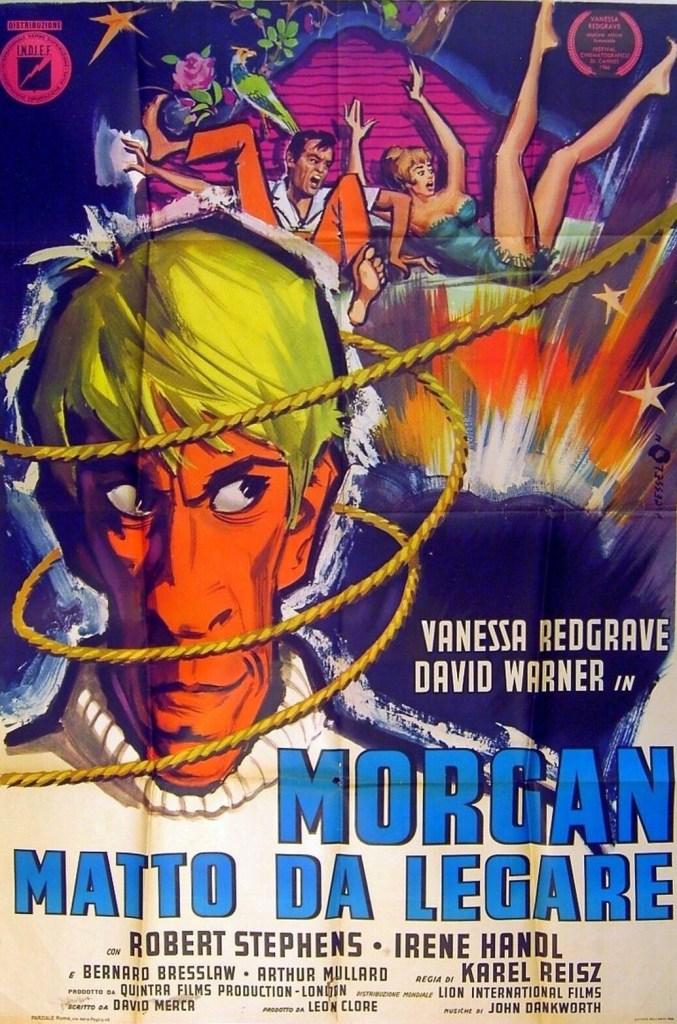
Morgan (David Warner in his first starring role), is a failed artist and virulent communist who cannot come to terms with being divorced by rich Leonie (Vanessa Redgrave) who is planning to marry businessman Napier (Robert Stephens). Morgan forces his way back into his wife’s house and attempts to win her back with nothing stronger than whimsicality and when that fails resorts to kidnap.
And it is clear that she shares his fancy for furry animals, responding to his chest-pounding gorilla impression with tiny pats of her own chest. For a slim guy, Morgan makes a believable stab at a gorilla, shoulders hunched up under his jacket, chest stuck out. And he has an animal’s sense of smell – detecting his rival’s hair oil.
The tone of the film is surreal. Had David Attenborough been a big name then you could have cited him as one of director Karel Reisz’s influences, such was his predilection for inserting wildlife into the proceedings, not just primates but giraffes, a hippo, a peacock and a variety of other creatures. Some are comments on Morgan’s state of mind but after a while it becomes monotonous. The film is clearly intentionally all over the place, the class struggle also taking central stage, but it’s hard work for the viewer. If you had stuck in some psychedelia, the fantasy would have made as much sense as The Trip (1967).
Having said that, towards the end of the picture there is an extraordinary image – possibly stolen from the opening of La Dolce Vita – of Morgan in a straitjacket hanging from a crane. Had that been the film’s starting point, it might have dealt more demonstrably with the subject matter. The whimsy is all very well but the focus on external animals does little to illuminate Morgan’s internal struggle and mental descent.
At this stage of his career, David Warner (Perfect Friday, 1970) exhibited a core instability, although later he was adept at ruthless villains. You could argue he is too charming for the role.
Vanessa Redgrave (Blow-Up, 1966), in her second film and her first starring role, steals the picture, winning her first Oscar nomination (in the same year as sister Lynn for Georgy Girl). She is made of gossamer. Still attracted to a man she knows will only bring her pain, she is far from your normal leading lady. There is a touch of the Audrey Hepburn in her ethereality but she portrays a completely genuine soul, not a manufactured screen personality. Robert Stephens (The Prime of Miss Jean Brodie, 1969) adds a welcome hard core to the frivolity.
But Karel Reisz (Saturday Night and Sunday Morning, 1960) misses the spot. Distinguished British playwright David Mercer adapted his own BBC television work from 1962.
Could have done with taking a step back from the material and offered a more objective assessment.
You couldn’t make this now. What top-ranked actor would be willing to play a character who takes sexual advantage of a vulnerable young woman? You’d find it even harder to get a marquee name to play a female with paedophiliac tendencies, predatory sexual instincts and thinks it fine to drive a lovelorn young man to suicide.
That it was feasible back in the day was largely due to the restraints imposed by the much-maligned Production Code. Most of the issues are delicately probed, the problematic themes only touched upon, so that the result is quite amazing, the director turning to the lyrical, rendered by its intensity a metaphor for internal conflict.
War veteran Vincent (Warren Beatty) takes a job as an occupational therapist at an upmarket mental institution, the kind that looks more like a country club or grand hotel with extensive manicured grounds. Few of the inmates are of the type found in the normal hospitals for the insane, the worst cases a woman with a maniacal laugh and another who treats a doll like a baby, but he is warned insane women are more “sinister” than crazy men.
One of his charges is the withdrawn Lilith (Jean Seberg) whom he gradually coaxes out of her shell, soon believing that it is his innate skill that brings about the possibility that such a high-risk individual could possibly achieve something akin to cure, or at least a greater degree of normality. You can hardly blame him for missing the obvious – that Lilith is using him – for the young woman is every inch the winsome innocent seeking guidance from the more mature responsible male.
It’s mostly shorn of obvious metaphor but there is one scene, compelling in itself, where Vincent plays the knight on horseback, complete with lance, winning a contest of skills for his lady, that completes his idealisation in her eyes. But he is already halfway there, with unexpected dexterity he frees her hair caught in loom, the kind of scene that in an otherwise more romantically-inclined movie would be the meet-cute.
And this isn’t one of those films about a madwoman in an attic or an apparently sane person turning demented. Instead, considerable time is spent analysing the condition of the schizophrenic, either through clinical lead Dr Lavrier (James Patterson) expounding his theories or through Vincent discussing individual patients with his boss Dr Brice (Kim Hunter). The idea of opening up a new realm to an audience is crystallised in one scene where Lavrier explains that even spiders go mad, resulting in asymmetrical webs rather than the typical formations to which we are more accustomed.
And by using one of the oldest tricks in the book, an inexperienced young man negotiating a new world, disbelief is suspended. But just when we think we are seeing everything from Vincent’s perspective, we are thrown into a heightened intensity linked to the lyrical – a river, a waterfall – the madness of ecstasy, what used to be called rapture, as Lilith stares and stares at nature.
But there are warnings about the personality of both characters. Lilith bears a startling resemblance to Vincent’s dead mother. He has difficulty committing, lack of communication while away at war resulting in girlfriend Yvonne (Anne Meacham) marrying someone else.
And there is plenty that is disconcerting about Lilith that only the besotted would overlook. She leads on lovelorn Stephen (Peter Fonda) to potential disasters he cannot foresee. Angry at Vincent, “I show my love for all of you and you despise me,” she seduces vulnerable older patient Laura (Jessica Walter). But the worst aspect of her character is that she perceives no boundaries to behavior. She exhibits inappropriate attitudes to young boys, inviting one to rub his finger along her lower lip.
However, for most of the film the skilful direction of Robert Rossen (The Hustler, 1961) has you rooting for the young lovers. Even while never falling back on the cliché of the doctor-type saving the ill person, there is enough in Vincent’s earnestness and Lilith’s innocence to make that a distinct possibility, were it not for the other discordant elements of her character. The picture is wrapped in natural sound – the river, waterfall, a flute playing mournful tune, ping-pong ball hitting bat, reeds or branches parting, rain, footsteps, a ticking clock, and the bulk of the music emanates from Stephen’s radio. And then he will twist it slightly, reflections are seen upside-down in the river, or a shot of the waterfall is held for too long, the sound of water increasing, or Lilith standing in the river bends down to kiss the surface, or at a picnic she eats a leaf irrespective of whether it might be poisonous.
Usually, when you get so much detail it’s a surfeit, and ends up drowning the viewer. But that’s not the case here. Either it builds or expands. And there is even a throwaway that mocks the notion of containing madness in an institution. The best, most revealing, line in the picture is not spoken by either of the two principals, but secondary character Yvonne, seen only at the beginning and end. When for unspecified reasons Vincent turns up at her house and her husband (Gene Hackman) leaves them on their own, she says, “I told you I’d never really let you make love to me until I was married,” (pause), “well, I’m married now.”
Jean Seberg (Moment to Moment, 1966) is just superb, coming across as a young woman entering adulthood full of fears and insecurities, only suggesting the darker side of her character, and never giving in to the temptation of overplaying. Warren Beatty (Kaleidoscope, 1966) can’t quite match her for subtlety or kick those acting mannerisms – lowered head, looking away – but his stupefied expression towards the end as he realizes just what he has taken on is priceless.
There’s an outstanding cast of rising stars. Peter Fonda (Easy Rider) as the preppy insecure victim is excellent while Jessica Walter suggests the qualities that would make her the prime candidate for the femme fatale in Play Misty for Me (1971). Gene Hackman, in his movie debut and still working on his trademark chuckle, provides early evidence of his immense talent.
Robert Rossen, who wrote the screenplay (from the novel by J.R. Salamanca) and also produced, couldn’t have wished for a better epitaph. This was his final film in a relatively short career – he only directed 10 films.
Despite contemporary reservations about the content this is a beautifully observed piece and well worth a look.
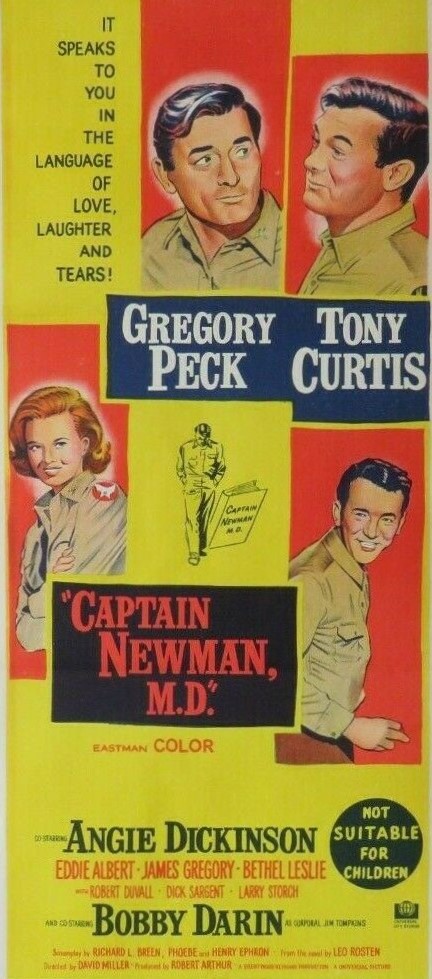
Somewhat lost in the rush to acclaim star Gregory Peck for his Oscar-winning To Kill a Mockingbird (1962), this bold attempt to tackle mental illness among the armed forces deserves reassessment.
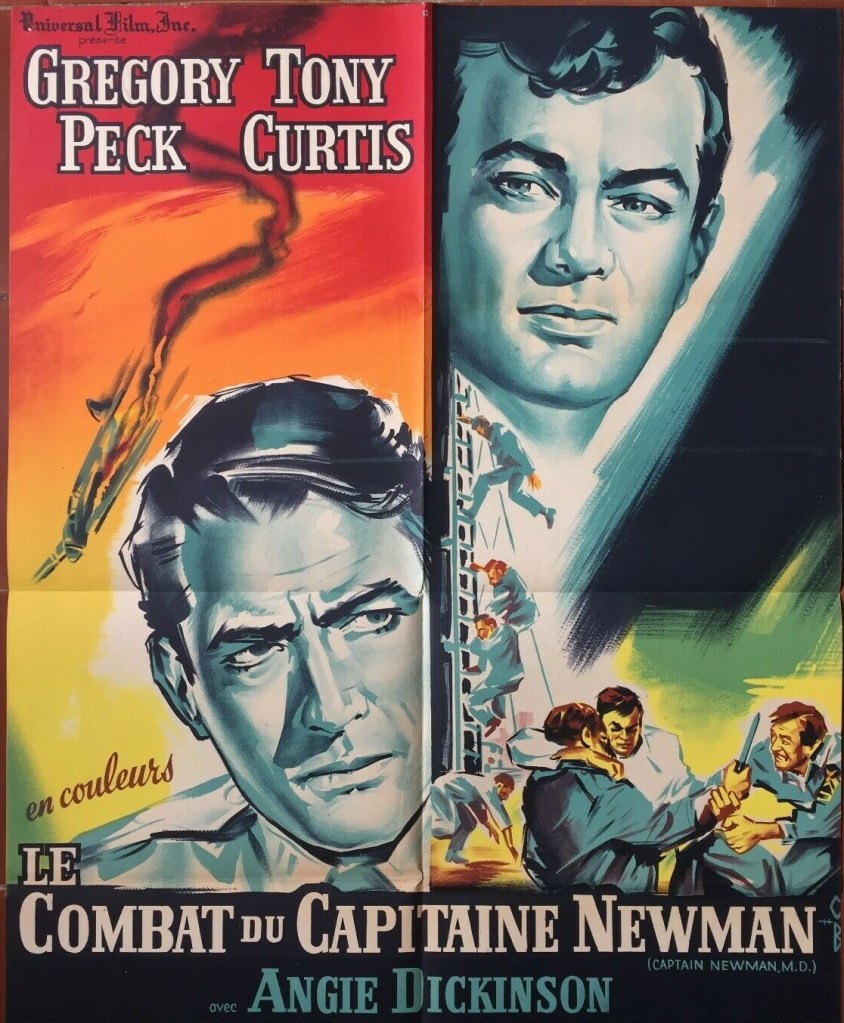
Set towards the end of World War Two, psychiatrist Captain Newman (Gregory Peck) heads up a unit addressing the previously ignored mental health issues of U.S. airmen. One of the first to identify post- traumatic stress disorder, Newman employs a whole raft of unusual techniques such as allowing his clients to tend sheep. And he’s not above using romantic sleight-of-hand to woo Lt. Corum (Angie Dickinson), a nurse in a non-psychiatric department, to join his team. Orderly Corporal Leibowitz (Tony Curtis), more of a con artist than a medical professional, is the other key member of the team.
As you might expect, Newman has to battle superiors to allow him to even attempt to cure any of the men under his care since in standard armed forces opinion they are really just cowards trying to duck out of their duty. Given there’s no prescribed treatment for his clientele, Newman basically improvises on a case-by-case basis to get to the heart of what caused mental collapse.
While the movie motors along nicely on the interplay between these three characters – the potential for real romance between Newman and Corum and Newman’s acceptance of Leibowitz’s alternative, more down-to-earth and decidedly un-medical approach – it focuses on three critical cases. Col Bliss (Eddie Albert) suffers from split personality, Capt Winston (Robert Duvall) is catatonic and Corporal Tompkins (Bobby Darin) too bubbly by far.
In dealing with each, Newman adopts a different persona, occasionally entering into the make-believe world of his clients to expose how much of a fiction they are. Stern with some, he is gentle with others and when he appears to go over the score explains he is not shouting at a person but at his symptoms.
And while at time it feels like a mental equivalent of episodes of a hospital soap, the underlying drive, the knowledge that men are hiding from the horrors of war or endure guilt over action they may have taken or are unable to face the consequence of orders they carried out takes this into a different level. Almost all suffer from the standard conviction that they must be cowards. Newman’s task is to make all face up to their fears.
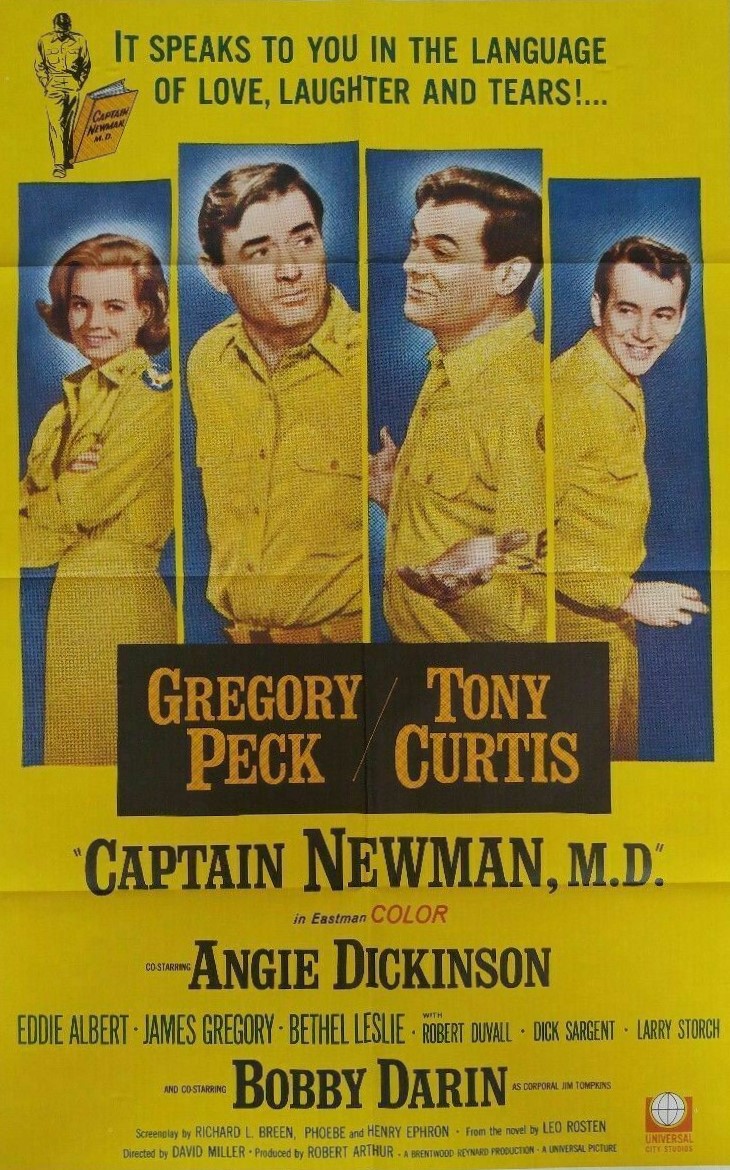
Presumably to overcome fears of audience resistance to the downbeat subject matter, the U.S. poster plain misled the public – “love, laughter and tears” were not much in evidence.
And it’s Corum’s self-appointed job to get under Newman’s skin and in so doing get to the heart of the terrible irony of his role. If he fails and men are discharged without being cured they will be returned to their units while mentally unstable and make decisions that could endanger thousands of men. If he succeeds, he sends men back to face potential death.
Luckily, it’s far from dour. Instead of taking the audience down a medical jargon rabbit-hole, the movie sensibly concentrates of character and humanity. It is filled with brilliant dialogue and whenever Newman appears overwhelmed up pops Leibowitz like the self-appointed class clown to bring events to a cheerier conclusion. Up till the end – a Xmas show by inmates and the arrival of a bunch of Italian POWs – the movie steers well clear of sentimentality and delivers a lucid exploration of the effects of war on the human psyche.
Gregory Peck (Mirage, 1965) is outstanding, not just from the way he adapts his character to suit the situation, but because quite a lot of his role is just to react to what is being said. Most stars would run a mile from being on the receiving end of chunks of dialog and insist on altering the script to make them appear more dynamic. Unlike Atticus Finch who is convinced he can find a solution, Newman knows his detection skills are very basic.
Tony Curtis (The Boston Strangler, 1968) might appear as if inhabiting a custom-made role suited to his natural effervescence and charm, but this is a deeper character than initially seems the case and rather than ride along and enjoy himself he has spells of challenging Newman’s authority. It’s a more subdued role for Angie Dickinson (Jessica, 1962), too, but she also brings a level of seriousness to the part and is integral to the picture’s success.
Bobby Darin (Pressure Point, 1962) was Oscar-nominated but I found his acting over-the-top. Eddie Albert (Green Acres television series 1965-1971) and Robert Duvall (To Kill a Mockingbird), in particular, were more assured. Look out for James Gregory (The Secret War of Harry Frigg, 1968) and former child star Jane Withers.
David Miller (Hammerhead, 1968) strikes the correct tone, leavening the seriousness with humor, but not avoiding the deeper issues. In their final screenplay assignment Henry and Phoebe Ephron (Carousel, 1956), parents of Nora Ephron (When Harry Met Sally, 1989), teamed with Richard L. Breen (A Man Could Get Killed, 1966) for an intelligent screenplay based on the bestseller by Leo Rosten.
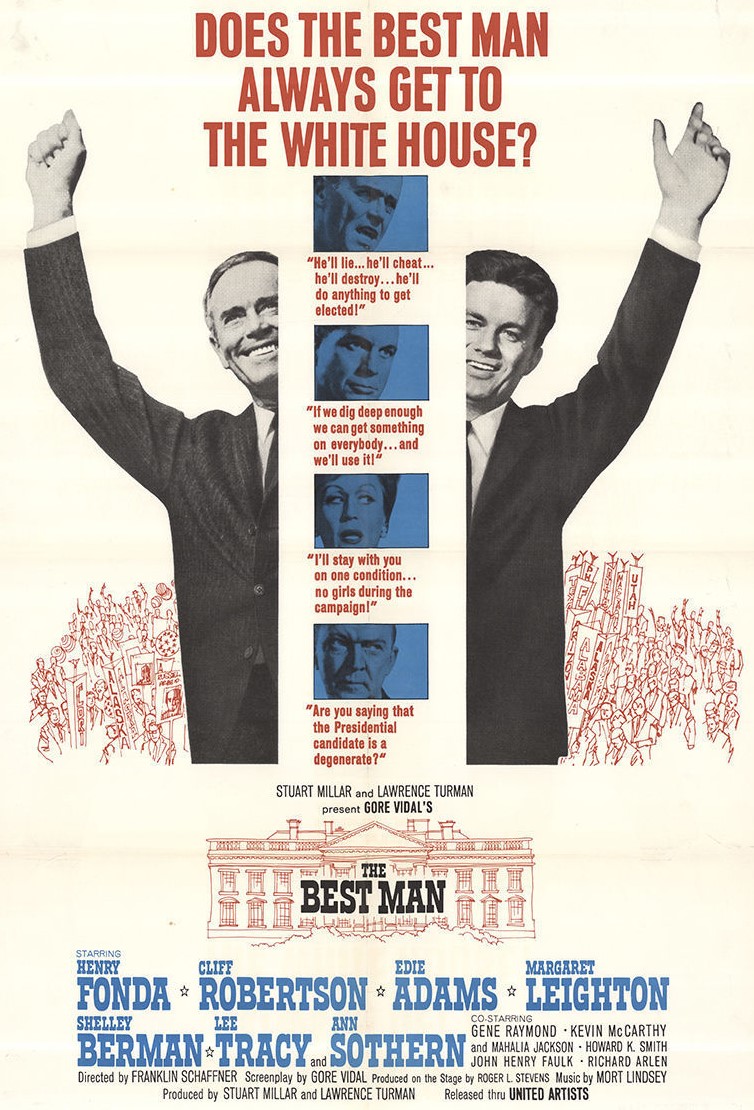
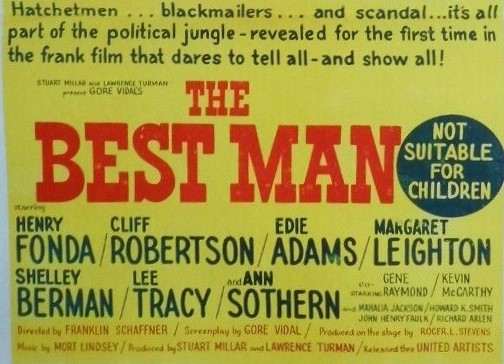
Current openness towards mental health issues has bestowed a contemporary vibe on this lively political drama. The other topic raised here has long ceased to be controversial. Not that far removed from Otto Preminger’s Advise and Consent (1961) in terms of dirty dealing and horse trading, flaw is the weapon used to cut opponents down to size.
The two principal candidates seeking their (un-named) party’s Presidential nomination could not be further apart, William Russell (Henry Fonda) a rich intellectual, Joe Cantwell (Cliff Robertson) a self-styled man of the people. Cantwell chases the populist vote with a campaign built on fulminating against immigration and Communism, driving down taxes and spending more on the military. Russell seems unsuited for the cut-and-thrust of politics, too idealistic, too indecisive.
But he is a good judge of character whereas Cantwell most decidedly is not and in misreading the intentions of President Hockstader (Lee Tracy) shoots himself in the foot and leaves the nomination wide open, triggering his use of the dark arts, planning to circulate a file on his opponent’s problems with mental illness. Existing on a much higher plane, Russell refuses to fight back, although he has access to a witness claiming Cantwell was gay.
Apart from discussing these taboo issues – this was the first time the word “homosexual” was uttered in a movie – what’s interesting is that Russell’s philandering is not deemed damaging as long as his wife Alice (Margaret Leighton) is seen to publicly stand by him. Despite the fact that Cantwell is as clean as a whistle – doesn’t drink or smoke or have a lover – affairs are seen as such a fact of life of politics that Cantwell’s wife Mabel (Edie Adams) assumes he will have one. Cantwell, very much one to go for the jugular, clearly believes the public takes the same non-judgemental view otherwise he would easily skewer Russell on his marital discord.
In some respects, Cantwell is by far the better candidate if you were to judge him on personal behaviour, but he lacks the necessary savvy, “ a tragedy in a man and a disaster in a president.
As you might expect from a script written by novelist Gore Vidal, sometime political heavyweight, there are plenty zingers: “expect 22 minutes of spontaneity”; “I don’t object to you being a bastard, I object you being a stupid bastard;” and “I won’t throw my mud if you won’t throw your mud.”
It may be artistic irony that determined director Franklin J. Schaffner to film in black-and-white since politics is nothing but various shades of grey, but there was probably a more practical reason, to incorporate footage from conventions.
Somewhat surprisingly, both men are honest with their wives, Russell making a pact to divorce Alice if not elected, their marriage long ago defunct, while Cantwell’s wife is fully aware of the slur on her husband’s name. The women here are well-drawn, not quite the submissive types you might expect, certainly not Alice who has every right, given his infidelities, to act the shrew, instead of which she plays the shrewd card. Mabel proves a loving wife but a little indulged to the extent her teetotal husband has no idea how much alcohol she can shift and she reserves her right to keep him waiting. Alice, it might be noticed, is more vicious than her husband should it come to the down-and-dirty.
And there’s a stack of wannabe power-makers from pushy busybody Mrs Gamidge (Ann Sothern) – so full of her own importance that she fails to see the slight in being told that “talking to you is like talking to the average American housewife” – to walking timebomb Sheldon Bascomb (Shelley Berman).
Not so full of arcane American politics as Advise and Consent, and with a more straightforward narrative, it digs the dirt in compulsive fashion on the dirt-diggers. In questioning whether someone with mental health issues could be a worthy national leader, the movie naturally ignores the narcissism and megalomania that seemed essential criteria for any person achieving high office or excessive business success. It’s probably a subject that remains unresolved, although a good many personalities have admitted to such problems.
Cliff Robertson (The Honey Pot, 1967) takes the acting honours if only because we have seen a version of the Henry Fonda (Battle of the Bulge, 1965) political idealist before in Advise and Consent. Robertson essays a character of Donald Trump dimensions and Fonda is clearly modelled on Kennedy, but Robertson comes across stronger and even Fonda may have been getting fed up with being such a straight-shooter as seen by his later villainous choices. Edie Adams has a more complex part here than in The Honey Pot and Margaret Leighton (The Fighting Pimpernel, 1949) can play ramrod-stiff women till the cows come home.
Hollywood veteran Ann Sothern of Maisie fame is terrific as the interfering Mrs Gamidge and Shelley Berman (Divorce American-Style, 1967), making his movie debut, is one of the most irritating characters you will ever see. Kevin McCarthy (Mirage, 1965) plays Russell’s whip-smart aide with Lee Tracy (Dinner at Eight, 1933) in his first movie in nearly two decades as the wily President.
Audiences were denied the first glimpse of Penny Singleton (the Blondie series) in fourteen years when her part was excised. To make up for that, we get to see Mahalia Jackson sing.
Director Franklin J. Schaffner (The Double Man, 1967) keeps characters to the fore rather than relying on the many twists, and does a decent job, complete with aerial helicopter shots, of opening up Gore Vidal’s stage play. Vidal (Ben-Hur, 1959) had stood unsuccessfully for Congress so had an insider’s viewpoint.
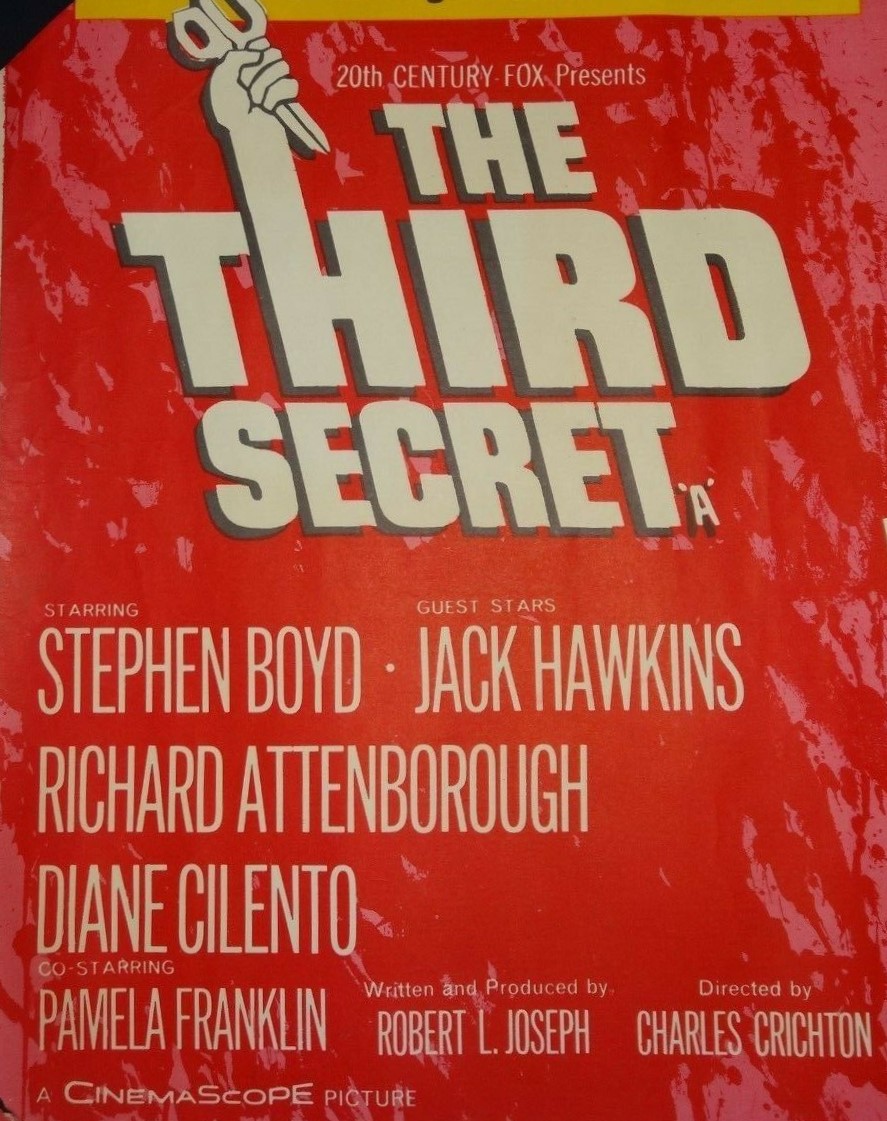
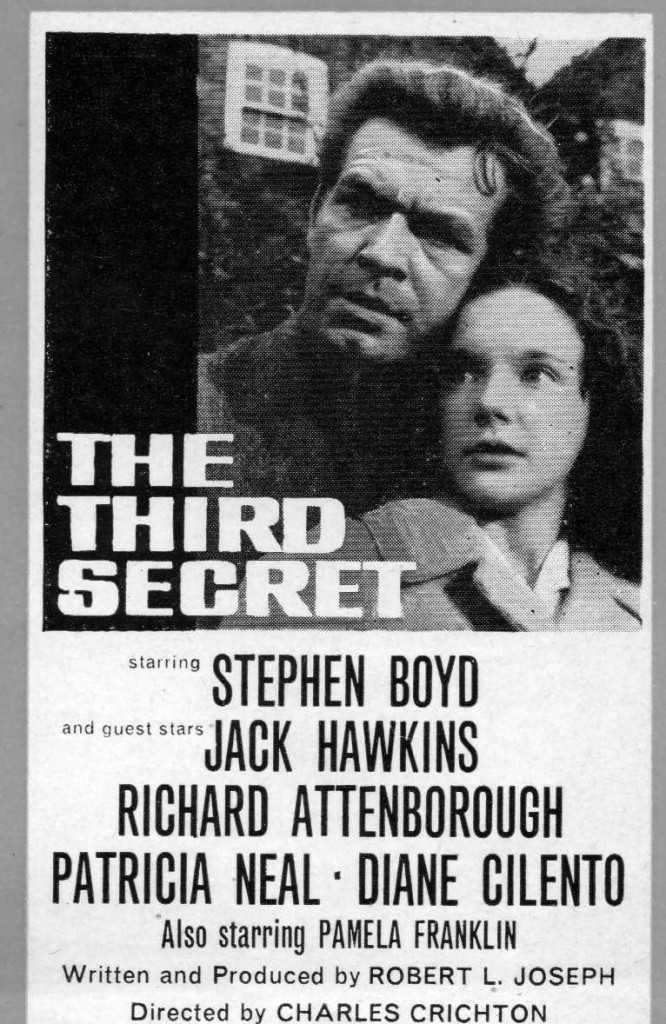
Non-exploitative films about the psychologically vulnerable were thin on the ground during the 1960s and although The Third Secret is a bit talky nonetheless it does explore issues normally dealt with in heavy-handed fashion. Catherine Whitset (Pamela Franklin) the young daughter of a famous psychiatrist convinces television journalist Alex Stedman (Stephen Boyd) to investigate her father’s supposed suicide. Whitset needs the murder verdict because otherwise she will lose her home (no insurance payout on suicide). Stedman, Whitset’s patient, wants a similar outcome because his world would be turned upside down if the psychiatrist had committed a deed which he appeared steadfastly opposed.
The main suspects are all patients of the dead doctor – judge (Jack Hawkins), gallery owner (Richard Attenborough) and secretary (Diane Cilento). Although all outwardly successful socially-functioning upstanding members of society each is mired in mental agony – anger management, sexual inadequacy, depression, low self-esteem among problems addressed – defenses against which are perilously thin. Under sustained pressure each of the individuals will crack to reveal the cowering creature underneath.
But are they the killer or just condemned to torment? With the one man who could keep them sane removed from their lives, who knows what carnage they can self-inflict. All, even Stedman – given to bouts of terrible rage and drunkenness – seem capable of murder and there is every likelihood (as any viewer will guess) that his investigation could lead back to himself.
Director Charles Crichton (The Lavender Hill Mob, 1951) might have been suffering from low self-esteem himself having been unceremoniously dumped from The Birdman of Alcatraz (1962) and certainly the atmosphere is one of severity, not just characters teetering on the brink, but the black-and-white photography rendering London a wasteland, the tide on the Thames always out so the shore is just mud. However, his compositions do have style. The title’s explanation by the way is that the first secret is what you keep from the public, the second is what you hide from yourself, but the third is the truth.
Boyd (Ben-Hur, 1959) and Franklin (The Innocents, 1961) appear often on the point of hysteria, the girl’s high-pitched voice set against his growling outbursts. Attenborough (fresh from the heroics of The Great Escape, 1963) plays against type as a hand-wringing wannabe artist stuck in a role he despises. Hawkins, too, more used to heroic roles, is convincing as a man trying to escape his past. The neurotic Cilento has the best scenes, touching in her efforts to cling to normality. Judi Dench makes her debut in a bit part. The investigation takes the form of character analysis rather than “where were you on the night of…” which gives the picture an unique flavor, but best to know that going in rather than complain about the slow pace. If the psychological does not keep you hooked, there are sufficient twists to keep you watching.
While Hollywood was capable of dealing with mental illness head-on in pictures like Frank Perry’s David and Lisa (1962), Sam Fuller’s Shock Corridor (1963) and Robert Rossen’s Lilith (1964), the British were more inclined to take an alternative approach. The titular characters of Billy Liar (1963) and this film dealt with awkward reality by creating a fantasy world.
Morgan, played by David Warner in his first starring role, is a failed artist and virulent Communist who cannot come to terms with being divorced by rich Vanessa Redgrave who is planning to marry businessman Robert Stephens. Warner forces his way back into his wife’s house and attempts to win her back with nothing stronger than whimsicality and when that fails resorts to kidnap. And it is clear that she shares his fancy for furry animals, responding to his chest-pounding gorilla impression with tiny pats of her own chest. For a slim guy, Warner makes a believable stab at a gorilla, shoulders hunched up under his jacket, chest stuck out. And he has an animal’s sense of smell – detecting his rival’s hair oil.
But Vanessa Redgrave, in her second film and her first starring role, steals the picture, winning her first Oscar nomination (in the same year as sister Lynn for Georgy Girl). She is made of gossamer. Still attracted to a man she knows will only bring her pain, she is far from your normal leading lady. There is a touch of the Audrey Hepburn in her ethereality but she portrays a completely genuine soul, not a manufactured screen personality.
The tone of the film is surreal. Had David Attenborough been a big name then you could have cited him as one of director Karel Reisz’s influences, such was his predilection for inserting wildlife into the proceedings, not just primates but giraffes, a hippo, a peacock and a variety of other creatures. Some are comments on Morgan’s state of mind but after a while it becomes monotonous. The film is clearly intentionally all over the place, the class struggle also taking central stage, but it’s hard work for the viewer.
Having said that, towards the end of the picture there is an extraordinary image – possibly stolen from the opening of La Dolce Vita – of Warner in a straitjacket hanging from a crane. Had that been the film’s starting point, it might have dealt more demonstrably with the subject matter. The whimsy is all very well and Redgrave is delightful and while Warner is clearly on a mental descent the focus on external animals does little to illuminate his internal struggle. Also, having said that, Warner is imminently watchable. He has an intensity that is hard to ignore and usually is cast with that in mind but here his vulnerability, his inability to grasp that he is living in a different reality, is very touching. Even when his imagination is at its most vivid – such as when Redgrave appears at the end supposedly bearing his child – you are partly convinced that this may actually be true. I would have preferred less of the animal imagery and more of Warner’s true reaction to the world around him. It’s a case of performances spoiled by over-direction.
Setting aside the director’s indulgence, the film is remarkable in one other way. It was almost revolutionary to find a British picture that, despite Warner’s working-class agitation, is effectively about joie de vivre as opposed to the more traditional British stiff upper lip, that inbred stoicism afflicting the entire nation regardless of class status. While Lawrence of Arabia (1962) represented an exhibition of flamboyance, again not a British trait, and the truculent Albert Finney in Saturday Night and Sunday Morning (1960) was determined to enjoy life to excess, Warner’s character epitomizes a desire to be free of normal cares in order to live life to the full.
Given the Warner would later be more famous buttoned-down roles – and that, in contrast, Redgrave would later portray another famous flamboyant in Isadora (1968) – it is surprising that this fun aspect of Warner’s screen persona was not called upon more often.
Many of the films from the 1960s are to be found free of charge on TCM and Sony Movies and the British Talking Pictures as well as mainstream television channels. But if this film is not available through these routes, then here is the link to the DVD and/or streaming service.








 The Magnificent 60s