Return of a Stranger (1961) ***

Is going to ring a huge bell with contemporary audiences for its depiction of grooming. Rather a bold approach given those censorious times. But the experience of orphan Pam (Susan Stephen) in welcoming the attentions of the older Homer Trent (Cyril Shaps)  – he drives her around, buys her gifts, treats her as someone special – would chime with the vulnerable young women these days so desperate for attention that they overlook male intent.

Homer has been imprisoned for raping her. Now, several years later, he’s free, and still besotted by her. She’s a middle class mother with a young son. Homer’s reign of terror is of the usual clever kind. There’s a distinct lack of evidence to blame him for calls in the middle of the night and there was no restraining orders in those days so he’s free to bump into her in a supermarket and has legitimate reason for passing her house. The police are apt to dismiss her as a hysterical woman.

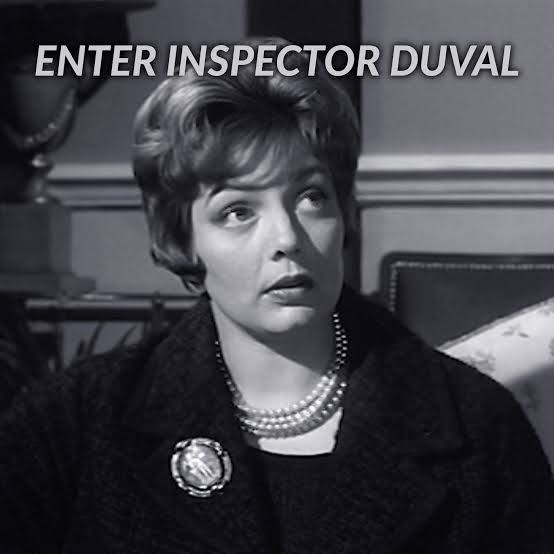
A different stranger without question but I’ve run out of other images.

The tension racks up not just through her, but her American husband John (John Ireland) whose chance of a big promotion at work is jeopardized by the ongoing action. Turns out Homer is planning to not just put the screws on John to wind up his wife, but he’s intending to get rid of him altogether to make the coast clear.

And when Homer kills the wrong person, suspicion falls on John because the victim is the one who beat him to the promotion. Luckily, John, being a Yank, has a gun in his possession, which comes into its own at the climax, though not quite how you’d expect.

For the most part we are restricted to the back of Homer’s balding head and although he’s far from a hulking brute he’s still capable of generating fear, especially when Pam has to come to terms with her earlier experiences where, though in innocent fashion, she encouraged his attention, while John is exposed to the tough world of business where employees have none of the rights they enjoy today and employers are not required to treat their staff with any sympathy.

Not all Renown productions are as tight as this one, which primarily concentrates on threat, and the underlying fear that having raped her once Homer intends to do it again. The bigger-budgeted Cape Fear the following year would take the similar route of revenge via sexual threat. While there’s some of the usual stuff such as phone lines being disconnected, the sabotage of a lift falls into the unusual category while the boardroom contretemps add another element.

Hard to say whether American John Ireland was slumming it or whether he hoped a transAtlantic crossing and the hook of top-billing would boost his career back in Hollywood. In some respects this was a considerable step up for a supporting actor and a big jump from third billing in a previous British thriller Faces in the Dark (1960).

Susan Stephen (The Court Martial of Major Keller, 1961) is the pick of the actors, treading carefully between the guilt of her past (naturally she blames herself), her present position as a middle-class housewife, and replaying her fears.  “You belong to me,” grunts Homer, and although Cyril Shaps (The Kremlin Letter, 1970) in person isn’t so threatening, he’s still more than enough for his victims.

Ably directed by Frenchman Max Varnel (Enter Inspector Duval, 1961) from a script by Brian Clemens (The Corrupt Ones / The Peking Medallion, 1967).

Catch it on Talking Pictures TV.
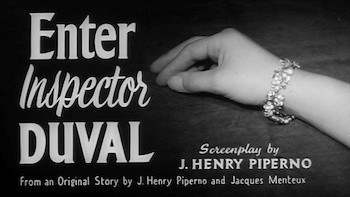
Enter Inspector Duval (1961) ***

The first piece of sleight-of-hand is the title, setting audiences up for the opener in a crime series featuring the eponymous French character. A terrific twist at the climax shows exactly why this would not be turned into a series, though one critic who clearly didn’t watch the whole picture thought otherwise. And you can see why because it’s old-fashioned enough to provide you, Agatha Christie style, with a string of suspects, adding in and leaving out enough information that it’s hard to work out who the criminal mastermind might be.

For four years, a burglar has been terrorizing Europe, stealing diamonds almost at will. The expert on his methods is French cop Duval (Anton Diffring), a debonair confident chap with a distinct Gallic charm, who happens to be in London when the thief – known only as Mr March – strikes again. Only this time, taken by surprise, he murders socialite Alice (Angela McCann). British detectives Insp Wilson (Mark Singleton) and Sgt Hastings (Patrick Bedford) are only too happy to welcome Duval’s assistance, especially as he appears to have the keener eye.

In short order we are introduced to Alice’s maid Doreen (Susan Halliman) who discovers the body. She’s recently entered into a relationship with the disreputable Charley (Charles Roberts) and may have deliberately or inadvertently given away the secret of where Alice hid her diamonds – and it wasn’t in the safe. Alice’s friend Jackie (Diane Hart) enters the equation because her boyfriend Mark (Aiden Grennell) has been trying to tempt Alice into investing in a property deal. And may have been sufficiently annoyed with the brusque way she gave him the brush-off to have killed her. Mark has an alibi for the time of the murder, which took place in the middle of the night. But it’s an odd one. He claims he chose that time of night to pay a visit to his lawyer to discuss a business deal. And his manservant Brossier (Charles Mitchell) is an odd fish.

Jackie is revealed as grasping and only too happy to do Mark’s bidding, which includes some unusual instructions. Doreen is too trusting and somewhat dim. Charley is definitely dodgy and has been paid to provide information extracted from Doreen as to the jewels’ whereabouts.

There’s another complication. Because of the murder, the diamonds are now too hot to handle and can’t be quickly shifted by a dealer in stolen goods.

You can wallow in the nostalgia, pipe-smoking cop, nothing wireless about the telephones, a couple of scenes set in a milk bar with youngsters dancing to a record. There’s even a car chase.

The initial sequence is stylish, with a strong hint in the play of light and shadow of film noir, and though it tends to stick to police procedural there are enough twists and characters with hidden agendas to keep the plot wheels turning, with Duval turning his nose up at the ineptitude of the British copper.

With his haughty features and blond hair Anton Diffring (Counterpoint, 1967) had been typecast as the arrogant Nazi or German officer – so this was something of a career break and I guess if a series had developed he might have found a different niche. This proved to be Diane Hart’s (The Crowning Touch, 1959) only movie of the decade, and Angela McCann’s sole picture.

With an abundance of red herrings and twists, director Max Varnel (A Question of Suspense, 1961) keeps the action moving at a clip. Written by J. Henry Piperno (Breath of Life, 1963).

Worth it for the suave Anton Diffring and the twists.

Catch it on British streamer Talking Pictures TV.

Discover WordPress

A daily selection of the best content published on WordPress, collected for you by humans who love to read.

The Atavist Magazine

by Brian Hannan

WordPress.com News

The latest news on WordPress.com and the WordPress community.