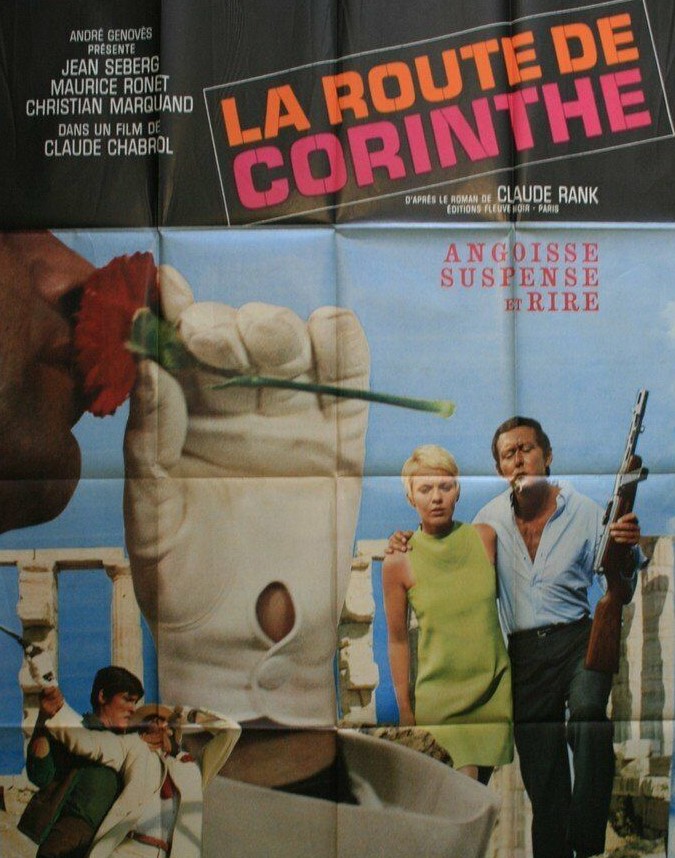
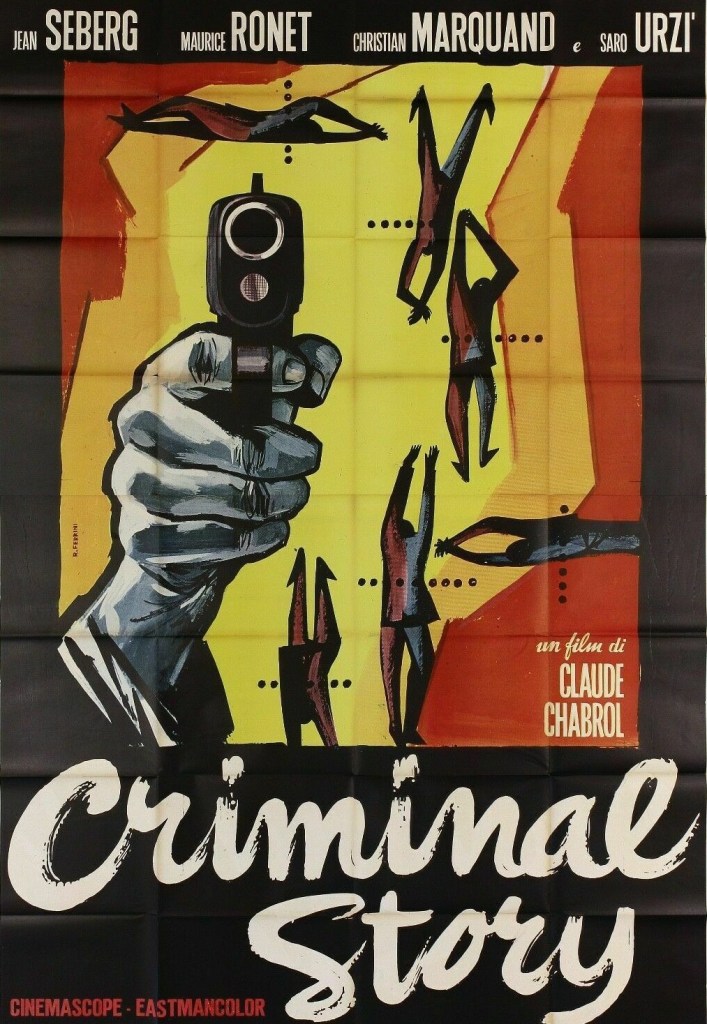
Top-class cast and occasional stylish direction get in the way of a thriller that can’t make up its mind whether it is in reality just a spoof. On the one hand we have a killer in a white suit complete with straw boater and a secret service boss who sells Turkish Delight, on the other hand a story not so much from James Bond but from Bond imitators.
Agent Robert Ford (Christian Marquand) is on the trail of black boxes that prevent missiles launching. When wife Shanny (Jean Seberg) is framed for his murder she determines to uncover the real killer, aided by Dex (Maurice Ronet), and find the maker of the boxes.
But that’s an over-simplification of an over-complicated plot so it’s best to concentrate on the highlights. For example, when customs officials stop a magician they find white rabbits and doves in his vehicle and, despite severe interrogation, he can, magically, release himself from his bonds enough to swallow a concealed cyanide pill. Instead of the usual cute children that proliferate in these kind of films, there’s a really annoying one. Shanny, imprisoned, has to make dolls. Greek Orthodox priests play a significant role.
Throw in kinky secret service boss Sharps (Michel Bouquet) who relishes being slapped for his inappropriate overtures to Shanny, a porn film starring Madame Phiphi, the heroine dangled from a crane and later lashed down to a dumper, and a villain willing to throw up is villainy for the love of a good woman.
But mostly it’s a picture in a rush. There are chases galore and nods to Hitchcock and lush Greek scenery.
It would be easy to assume that in eye-catching outfits Jean Seberg (Moment to Moment, 1966) is mostly there to provide eye candy but she does manage to outwit her pursuers from time to time although she seems equally to have a knack for being caught. Maurice Ronet (Lost Command, 1966), Christian Marquand (The Corrupt Ones, 1967) and especially Michel Bouquet (La Femme Infidele, 1969) bring an air of quality to the proceedings.
Apart from the occasional stunning image, this is not the Claude Chabrol (Les Biches, 1968) that lovers of his thrillers would expect.
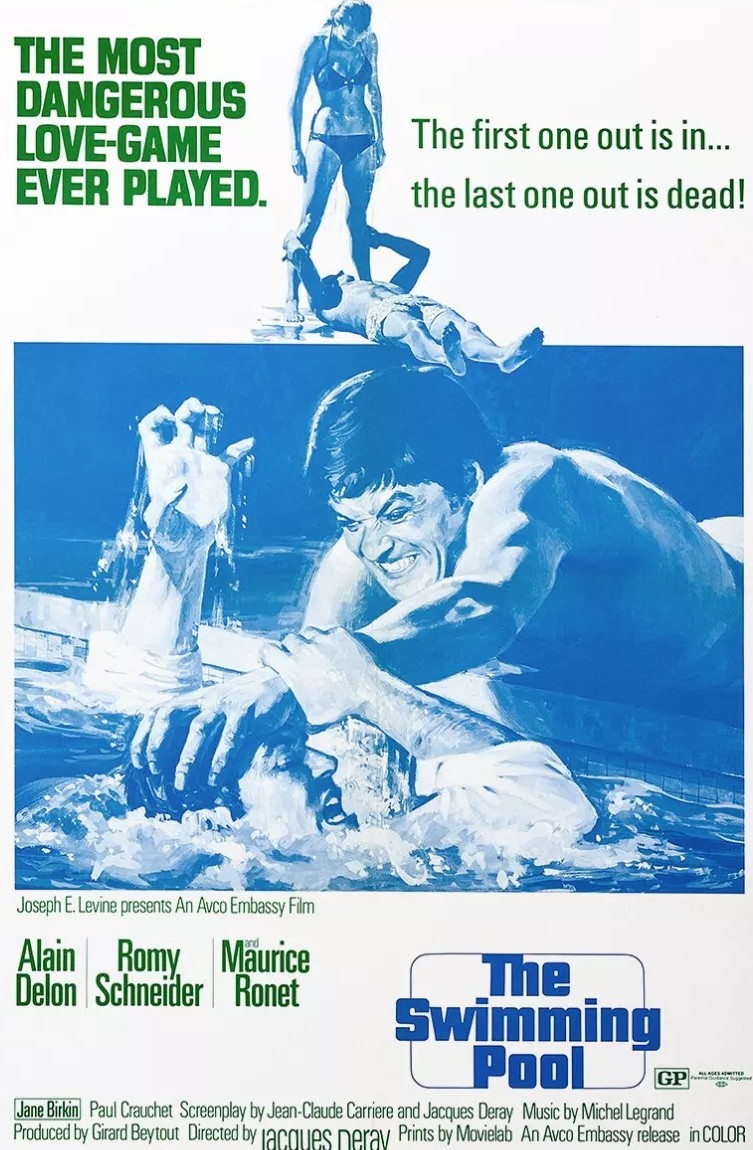
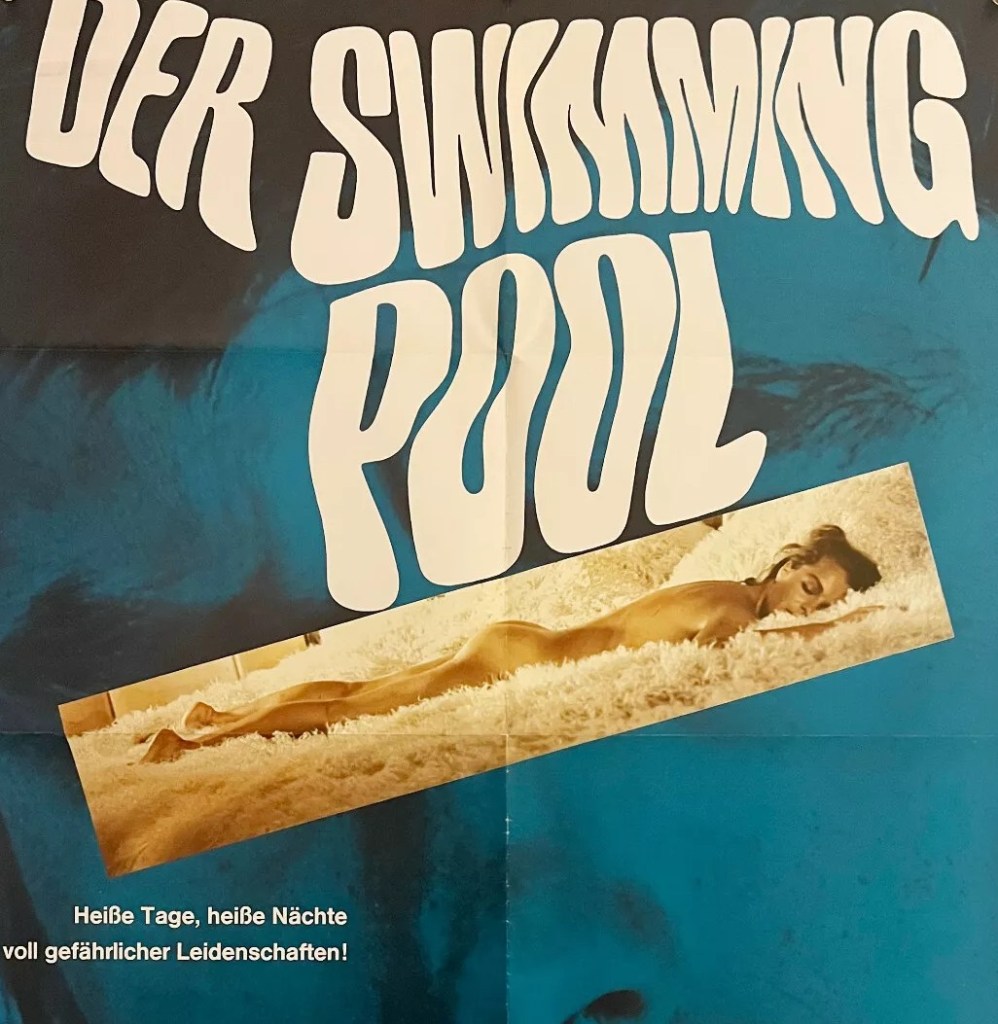
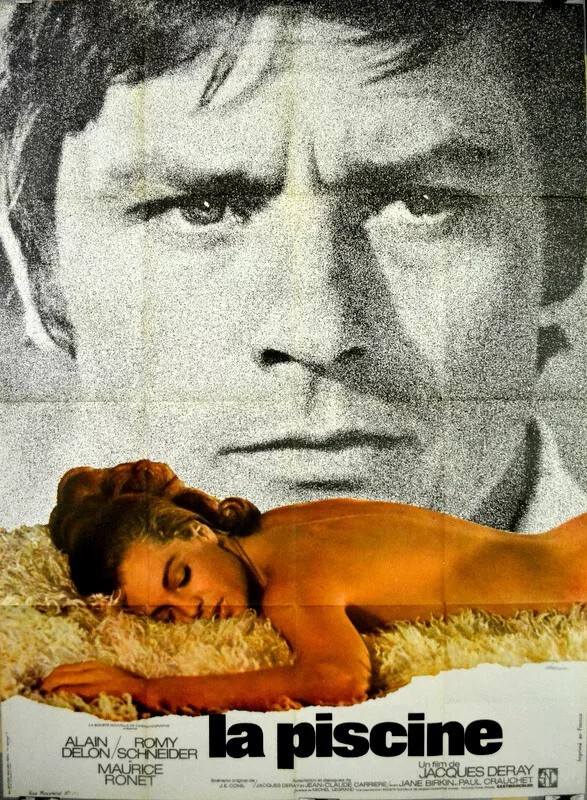
A drunk falls into a swimming pool in the middle of the night and drowns. He has already crashed his car into the gate post of the villa. There’s no sign of foul play. No sign of the fact that his attempts to clamber out are hindered by someone holding his head down under the water until he loses consciousness.
The perfect murder? Well, no, actually, because in the aftermath of the murder, recovering alcoholic killer Jean-Paul (Alain Delon) does about the dumbest thing you’ve ever seen. And that significantly detracts from what otherwise is a superb examination of sexual tension and hidden secrets.
So instead of leaving the corpse of best friend Harry (Maurice Ronet) floating fully clothed in the titular pool, Jean-Paul decides it would look better if it appeared that Harry had foolishly gone for a late night swim. So he pulls the dead guy out, strips off his clothes and decks him out in swimming trunks and slides him back into the watery grave.
He hides the sodden clothes somewhere and at the side of the pool puts a small stack of fresh clothes stolen from Harry’s wardrobe – he was a guest at the villa. But for some reason in pulling off Harry’s shirt he omits to remove his expensive watch which isn’t waterproof. Inspector Leveque’s (Paul Crauchet) suspicions are aroused by that simple fact. Although, theoretically, Harry might have been too drunk to notice, even though, obviously, the watch strap and the bulky watch would have caught on his shirt sleeve as he was taking off the item of clothing.
So the cop, in examining the clothes, is mightily surprised to discover they are fresh, unworn, not a sign of sweat or crumpled-ness, which is odd given Harry had been out dancing and enjoying himself for hours.
Psychologically, most of the aftermath is not just whether the cold-blooded killer – the otherwise very handsome, relatively charming writer Jean-Paul – will get away with it but whether his girlfriend Marianne (Romy Scheider), who has her own suspicions, will stand by him.
They have enjoyed a very intense sexual relationship and she clearly adores him. But she’s also the ex-lover of Harry and when Jean-Paul’s old pal, who is decidedly smooth with the ladies, turns up, the old sexual jealousy is rekindled. Either to get revenge or because he’s in any case that way inclined Jean-Paul has been making discreet moves on Harry’s eighteen-year-old daughter Penelope (Jane Birkin) who clearly despises her father.
We discover that Jean-Paul owes a great deal of his success to Harry who nurtured him through a severe depression that ended in attempted suicide. Rather than making Jean-Paul eternally grateful, it’s turned him into a spoiled brat, focused primarily on his own needs and without a loyal bone in his body when it comes to women.
For quite a while it looks like record producer Harry is going to steal away Marianne, if only for a brief affair, as Jean-Paul gives in to the sulks. But since Jean-Paul is already eyeing up Penelope, you would have thought any slip by Marianne would provide him with justification.
The murder is spur-of-the-moment. Jean-Paul has been drinking again and when Harry turns up drunk and launches into an attack on Jean-Paul’s character and hidden past, that’s when he ends up in the pool. Every time he tries to get out, Jean-Paul pushes him back in and eventually holds his head down underwater.
And he might have got away with the perfect murder except for stripping the body and forgetting about the watch, but when he decides to end his relationship with Marianne, the focus switches to whether she will betray him or not. There are a couple of twists on that score at the end.
So severely flawed psychological thriller. I’m guessing you could argue that anyone who kills someone out of the blue could easily be suffering from the kind of brain overload that prevents him thinking straight, but I didn’t fall for it. It would have been as easy to continue with the psychological stuff enough with Marianne maybe finding the wet clothes and facing the same choices that she eventually does.
What does elevate it are the performances. Austrian actress Romy Scheider (Otley, 1969), who had previously had an affair with Delon, is superb as a woman not sure if she has any principles given she is so easily in the thrall of attractive men. Although Alain Delon (Le Samourai, 1967) had played bad guys and immoral sorts before, this still feels like a fresh approach, the watchful, withdrawn calculating killer masquerading as something else.
Maurice Ronet (Lost Command, 1966) and Jane Birkin (Blow-Up, 1966) make significant contributions.
And director Jacques Deray (Borsalino, 1970) would have turned out another masterpiece had the movie not stumbled over the oddness of the murder. Written by the director, Alain Page (in his debut) and Jean-Claude Carriere (Viva Maria!, 1965).
Top-class cast and occasional stylish direction get in the way of a thriller that can’t make up its mind whether it is in reality just a spoof. On the one hand we have a killer in a white suit complete with straw boater and a secret service boss who sells Turkish Delight, on the other hand a story not so much from James Bond but from Bond imitators.
Agent Robert Ford (Christian Marquand) is on the trail of black boxes that prevent missiles launching. When wife Shanny (Jean Seberg) is framed for his murder she determines to uncover the real killer, aided by Dex (Maurice Ronet), and find the maker of the boxes.
But that’s an over-simplification of an over-complicated plot so it’s best to concentrate on the highlights. For example, when customs officials stop a magician they find white rabbits and doves in his vehicle and, despite severe interrogation, he can, magically, release himself from his bonds enough to swallow a concealed cyanide pill. Instead of the usual cute children that proliferate in these kind of films, there’s a really annoying one. Shanny, imprisoned, has to make dolls. Greek Orthodox priests play a significant role.
Throw in kinky secret service boss Sharps (Michel Bouquet) who relishes being slapped for his inappropriate overtures to Shanny, a porn film starring Madame Phiphi, the heroine dangled from a crane and later lashed down to a dumper, and a villain willing to give up his villainy for the love of a good woman.
But mostly it’s a picture in a rush. There are chases galore and nods to Hitchcock and lush Greek scenery.
It would be easy to assume that in eye-catching outfits Jean Seberg (Moment to Moment, 1966) is mostly there to provide eye candy but she does manage to outwit her pursuers from time to time although she seems equally to have a knack for being caught. Maurice Ronet (Lost Command, 1966), Christian Marquand (The Corrupt Ones, 1967) and especially Michel Bouquet (La Femme Infidele, 1969) bring an air of quality to the proceedings.
Apart from the occasional stunning image, this is not the Claude Chabrol (Les Biches, 1968) that lovers of his thrillers would expect.
There’s a print of this on Youtube. Amazon Prime has this for certain regions. Otherwise it will be Ebay.
Derring-do and heroism were the 1960s war movie default with enemies clearly signposted in black-and-white. This one doesn’t fall into that category, in fact doesn’t fall into any category, being more concerned with the military and political machinations pervasive on both sides in war. Movies about revolutions generally succeed if they are filmed from the perspective of the insurrectionists. When they take the side of the oppressor, almost automatically they lose the sympathy vote, The Green Berets (1968) in this decade being a typical example, although the sheer directorial skill of Francis Coppola turned that notion on its head with Apocalypse Now (1979) when slaughter was accompanied by majesty. In the 1950s-1960s the French had come off worse in two uprisings, Vietnam and Algiers. This movie covers the tale end of the former and the middle of the latter and it’s a curious hybrid, part Dirty Dozen, part John Wayne, part dirty tricks on either side, with a few ounces of romance thrown in.
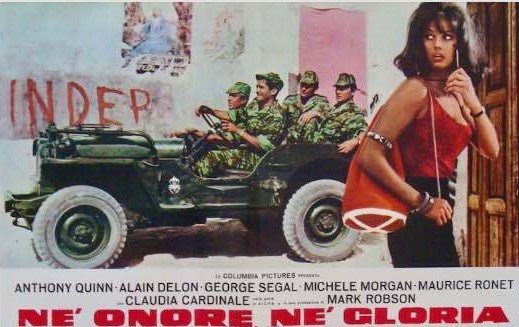
Scene from the Italian photobusta.
Anthony Quinn, in unlikely athletic mode (that’s him leaping in the poster) is the officer of a paratroop regiment who sees out the debacle of the final battle of the French war in Vietnam, loses his commission, and then, reprieved, is posted to Algeria, where the fight for independence is in full swing, with a ragbag of rejects plus some faithful comrades from his previous command. In any spare moment, Quinn can be seen keeping fit, doing handstands, swinging his arms, puffing out his chest, and a fair bit of running, presumably to avoid the contention that he was too old for this part. Alain Delon, a bit too moralistic for the dangerous business of war, plays his sidekick. Quinn is an ideal anti-hero for a hero, an officer who ignores, challenges or just plain overrides authority, adored by his men, hated by the enemy, ruthless when it matters.
Cardinale’s seductive wiles can’t fool Quinn.
The brutal realism, which sometimes makes you quail, is nonetheless the best thing about the picture, no holds barred here when it comes to portraying the ugly side of conflict. The training in The Dirty Dozen is a doddle compared to here, soldiers who don’t move fast enough are actually shot, rather than just threatened with live ammunition, and there’s no second chance for the incompetent – at the passing out ceremony several are summarily dismissed. The only kind of Dirty Dozen-type humor is a soldier who fills his canteen with wine. Otherwise, this is a full-on war. Battles are fought guerilla style, the enemy as smart as the Vietnamese, catching out the French in ambushes, using infiltrators sympathetic to the cause and terrorism. Unlike Apocalypse Now where the infantry appeared as dumb as they come, relying on strength in numbers and superior weaponry, Lost Command at least has an officer who understands strategy and most of what ensues involves clever thinking. The battles, played out in the mountains, usually see the French having to escape tricky situations rather than blasting through the enemy like cavalry, although having sneakily pinched a mayor’s helicopter (though minus Wagnerian overtones) gives Quinn’s team the opportunity to strafe the enemy on the rare occasions when they can actually be found, their camouflage professionally done.
George Segal, unrecognizable under a slab of make-up apart from his flashing white teeth, plays the Arab rebel chief. In terms of tactics and brutality, they are evenly matched, Segal shooting one of his own men for disobeying orders. Claudia Cardinale appears briefly at the start as Segal’s sister and when she turns up halfway through giving Delon the come-on it’s a bit too obvious where this plotline is going. With both sides determined to win at all costs, atrocities are merely viewed as collateral damage, so in that respect it’s an unflinching take on war. The picture could have done with another 15 minutes or so to allow characters to breathe and develop some of the supporting cast. The movie did well in France but sank in the States where my guess is few of the audience would even know where Algeria was. Gilles Pontecorvo’s The Battle of Algiers, out the same year, gave the revolutionaries the leading role. For the most part Quinn is in bull-in-a-china-shop form but his character is more rounded in a romantic interlude with a countess (Michele Morgan), his ability to outsmart his superior officers, his camaraderie with his own soldiers and, perhaps more surprisingly, the ongoing exercise routines which reveal, rather than a keep-fit fanatic, an ageing soldier worried about running out of steam.


 The Magnificent 60s