They Call Me Mister Tibbs (1970) ***

United Artists had reinvented the sequel business, shifting it away from the low-burn low-budget Tarzan adventure or Gene Autry western or any inexpensive picture movie capable of maintaining a series character, to bigger-budgeted numbers like James Bond (four sequels so far), The Magnificent Seven (two), The Beatles (four) and The Pink Panther (two). Even Hawaii (1966) spawned The Hawaiians (1970). So when the company hit commercial and critical gold – five Oscars including Best Picture and Best Actor – with In the Heat of the Night (1967) it seemed too good an opportunity to miss not to try for a repeat.

You might have expected UA to continue with the pairing of Sidney Poitier and Oscar-winner Rod Steiger and locate a sequel again in the Deep South. Instead, Steiger was junked and the Poitier character Virgil Tibbs relocated from his Philadelphia hometown to the more snazzy environs of San Francisco, recently popularized by such items as Bullitt (1968).

But minus the racism element what you’re left with is pretty much a standard detective tale with domestic issues thrown in. Tibbs isn’t the kind of cop we’ve come to expect, sinking into alcoholic oblivion or having thrown away a marriage. Instead, and this would strike a contemporary chord, he’s struggling with fatherhood. His son comes off best in arguments and at one point Tibbs resorts to giving the child a few slaps. That looks initially as if emotions will quickly heal and the repentant dad quickly administers a comforting hug, but any bonding is blown apart when the resentful boy complains, as if this represents betrayal, that his father made him cry.

Tibbs is also the old-fashioned kind of male who believes the only way to teach his son not to fall into bad ways like smoking and drinking is to force him to puff on a big cigar and knock back a stiff one until the child throws up.

But Tibbs does do a diligent enough job of detection, evidence relating to the murder of a high-priced sex worker hinging upon whether the killer had long fingernails. The most obvious suspect is street preacher Rev Logan Sharpe (Martin Landau), who visited the prostitute in his capacity as spiritual adviser and who’s heading up a campaign to clean up the streets. But his alibi holds up.

Next in line is building owner Woody Garfield (Ed Asner), exposed, to the shame of wife Marge (Norma Crane) as being a client of the prostitute, and then a janitor of low intelligence called Mealie (Juano Hernandez) and pimp Weedon (Anthony Zerbe), the kind of hood who enjoys taunting cops.

While Tibbs doesn’t indulge in the blatant maverick approach to the job of the earlier Madigan (1968) or the later Dirty Harry (1971) he’s not above putting the squeeze on witnesses.  

Rather foolishly, but perhaps feeling this has now become de rigeur, there’s a car chase which hardly compares to Bullitt. In fact, we’re stuck in an automobile rather too often but these only result in desultory conversations between Tibbs and his sidekick. While in some respects it’s refreshing that Tibbs isn’t subject to any racism, and the picture doesn’t head down the blaxploitation route, the result lacks edge.

Tibbs’ reactions to his child bring him down sharply from the ivory tower of sainthood from the previous picture, and the family stuff, while building up his character, doesn’t make up for what the story lacks.

Gordon Douglas, who had previously excelled in this genre via Tony Rome (1967), The Detective (1968) and Lady in Cement (1968), found out the hard way that Frank Sinatra was more appealing as an investigator and cop than Sidney Poitier and, without steaminess or wise-cracking to fall back on, the sequel quietly runs out of steam.

Screenplay by Alan Trustman (The Thomas Crown Affair, 1968) and James Webb (Alfred the Great, 1969) from the bestseller by John Ball. Not a patch on the original
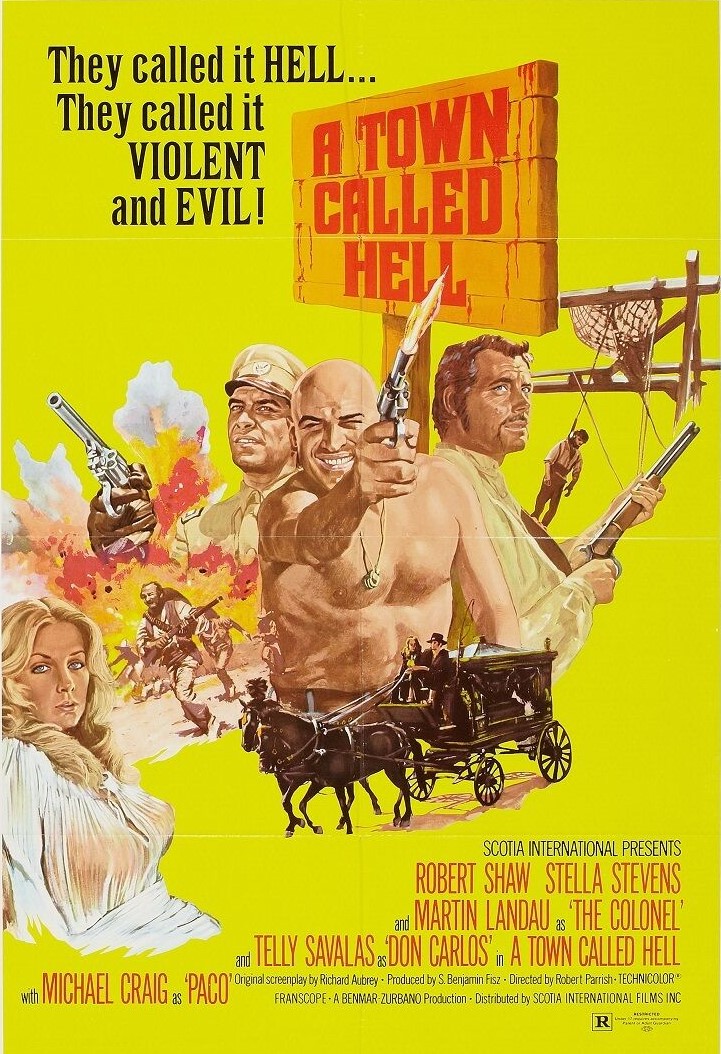
A Town Called Hell / A Town Called Bastard (1970) ***

You think you’re in for something quite stylish when widow Alvira (Stell Stevens) rides into town asleep in a coffin in a hearse. Or when she turns up in a dream as an avenging angel. Or when a rebel, entrusted with funds to buy guns, squanders the cash on women and booze. Or when a Mexican general is so disgusted by informer Paco (Michael Craig) that he refuses to face him. But these are about the only highlights in a bloody, sadistic confusing affair.

And diversity rules. Not only do we have a deaf mute going by the apocalyptic name of The Spectre (Dudley Sutton), there’s also an unnamed blind man (Fernando Rey) who comes in handy because he can recognise people by fingering the contours of their faces.

We begin straightforwardly enough with the massacre in a church of the well-to-do by Mexican rebels led by two unnamed characters (Robert Shaw and Martin Landau). Turns out that’s only the prologue and we cut to a decade later to a town ruled by sadistic sun worshipper Don Carlos (Telly Savalas) who has a tendency to string people up at the drop of a hat. Keeping a low profile is another unnamed character known only as the Priest (Robert Shaw) who may always have been a cleric or who has turned to God after being involved in the massacre. Even so, religion doesn’t prevent him having a mistress.

Alvira is offering a $20,000 reward for the killers of her husband, Montes, a victim of the earlier massacre. To get the money, Don Carlos employs the typical wheeze of framing a couple of villagers, husband and wife, hanging them before their tongues run so loose they can confess it wasn’t them. In a bid to save his own skin, the husband blames his wife.

Don Carlos’s luck turns bad when his sidekick La Bomba (Al Lettieri) decides it might be fun to take over, beginning by shooting off his boss’s fingers before hanging him in the sun. But just when you might think you are getting the hang of what’s going on, the unnamed Colonel (Martin Landau) appears. He’s also looking for information, but not inclined to pay for it. He’s hunting for a rebel leader with, wait for it, an actual name, though this still sounds like a pseudonym, Aguila (Eagle, get it?). For no reason whatsoever, it takes the priest a little while to work out this is his former comrade from the church massacre.

The Yanks were the ones who changed the title from the above. Interesting double bill, though, with Alain Delon as “Le Samourai.” Stella Stevens looks far more provocative
on the poster than she does in the film.

It doesn’t take long for the Colonel to get a grip on the hanging malarkey and with as much relish as Don Carlos, determining to continue hanging the townspeople until they tell him where Aguila is. The two narratives don’t quite mesh, but then what do you expect, this is high on atmosphere, sweating bodies, raw emotions, blazing sun. The Colonel, equally obviously, has given up on being a rebel, presumably because as a government official, he can officially murder people any time he likes without having to round up a gang of rebels to do so.

Every now and then the movie dips into flashback or Paco appears to confuse matters further.

There’s an odd sensibility at work. Maybe this is intended to be one of those down’n’dirty westerns trying to show us how mean the actual West really was (although given it’s set in Mexico, we only need to go as far back as The Wild Bunch, in 1969, to get that point). It doesn’t fit so easily into the spaghetti western canon, either, despite the uniform malevolence.

The oblique tone reminds you more of something that could have been put together by Luis Bunuel, but that would be ranking it far higher than it deserves.

The cast are the biggest plus points, though you might be asking whether Robert Shaw (Battle of the Bulge, 1965) and Stella Stevens (The Mad Room, 1969) were sold a different film entirely. Stevens doesn’t have much to do, except look beautiful and soulful. But Shaw is about the only leading man you’ll come across who so puts his heart into a part that he doesn’t mind being seen actually drooling at the prospect of massacre. In fairness, Telly Savalas (The Assassination Bureau, 1969) and Martin Landau (Nevada Smith, 1966), while not exactly dripping spit, drool in different ways.

There’s enough brooding going on stylistically that you are almost willing it to turn into something not just better but more definable. Alas, no such luck.

Robert Parrish (In the French Style, 1963) does his best with a screenplay  by Robert Aubrey (The One-Eyed Soldiers, 1967) and Benjamin Fisz, in his only writing gig, he was better known as a producer. My guess is they were more script doctors than anything else, the original damage having been done by the uncredited Philip Yordan (Battle of the Bulge).

Could a been something.

https://amzn.to/46Jpk2D

Nevada Smith (1966) ****

Half breed Max Sand (Steve McQueen) has little truck with the notion that revenge is a dish best served cold. But he’s too young and raw, far from Lee Marvin’s callous killer in Point Blank (1969), to properly avenge the slaughter of his family by three outlaws.

This is a coming-of-age tale with a distinct difference. Max’s development includes, apart from initiation into sex of course, learning to read and write so he can make sense of signposts in order to track down the murderers and receiving tuition from gunsmith Jonas Cord (Brian Keith) so that he can at least loose off some shots without doing himself damage. Vengeance burns so deep that he even stages a bumbled robbery so he can be sent to the prison where the second of his targets is incarcerated. Now that’s dedication for you. And along the way he learns the most important lesson of all, how to live, and not destroy himself through vengeance.

Even so, all Cord’s tuition counts for nought when Max needs a knife to dispatch his first victim Coe (Martin Landau). And he’s not yet so slick with a weapon to avoid serious injury himself. Kiowa saloon girl Neesa (Janet Margolin) nurses him back to health at her tribe’s camp. They become lovers but he rejects the wisdom of the elders and the opportunity to make a life with her.

Unfortunately, Bowdre (Arthur Kennedy)  is a jailbird. And worse, held prisoner in a swamp. Probably the worst bank robbery ever committed sends Nevada there. Max enrols another woman, Cajun Pilar (Suzanne Pleshette) working in nearby rice fields – fraternisation between the jailbirds and these women permitted – to steal a boat to help him and Bowdre escape. Bowdre gets his and this time it’s Pilar who is the collateral damage.

A genuine outlaw now, Max has no trouble joining a band of robbers headed by Fitch (Karl Malden), the final prey. By now calling himself Nevada Smith, Max’s plans are thrown into confusion when it becomes apparent Fitch is aware of his true identity. A surprise ending is on the cards whichever way you cut it, and especially thrilling since it occurs during a well-planned gold bullion robbery.

It’s a film of two parts but divided into three if you like, the unusual swamp setting fitting in between two sections of more straightforward western. Though in the hands of director Henry Hathaway (True Grit, 1969), there is little that’s so straightforward given his mastery of the widescreen and his hallmark extreme long shot. He’s capable of moving from the extreme violence of the vicious murder and rape of Max’s mother to the son’s discovery of the bodies shown just through Max’s physical reaction. And there’s some irony at play, too: gold triggers slaughter and climax; mental dereliction not as feared as its physical counterpart.

Although Hathaway was a true veteran, he was not best known for westerns in the manner of John Ford, more at home with film noir (Kiss of Death, 1947), war (The Desert Fox, 1951) and big-budget pictures like Niagara (1954) with Marilyn Monroe and Legend of the Lost (1957) teaming John Wayne and Sophia Loren. In a 30-year career he had only made three westerns of note – The Trail of the Lonesome Pine (1936), Rawhide (1951) and Garden of Evil (1954). So it was something of a surprise that in the 1960s over half his output was in the western genre. And unlike Ford and Howard Hawks who stuck to the formula of action within a defined community, Hathaway tended towards films of adventure, where the main character, often of a somewhat shady disposition, wandered far and wide.

Steve McQueen (The Cincinnati Kid, 1965) carries the picture with some aplomb, moving deftly from the wet-behind-the-ears youngster to a clever and calculated killer and still retaining enough humanity to enjoy a romantic dalliance. There’s enough action here to satisfy McQueen’s fans spoiled by The Magnificent Seven (1960) and The Great Escape (1963) and for those who had come to appreciate his acting plenty to enjoy. This and The Cincinnati Kid, where perforce as a poker player, he had to do a great deal of brooding, solidified his screen persona, a star you can’t keep your eyes off, wondering what on earth is going on in his mind. As much as he’s playing a character finding his feet, this is McQueen at very nearly the top of his game.

Brian Keith (The Rare Breed, 1966) is the pick of the support, adding a little softness to his usual more hard-nosed screen characters. The villains – Karl Malden (The Cincinnati Kid), Martin Landau (The Hallelujah Trail, 1965) and Arthur Kennedy (Claudelle Inglish, 1961) – are all good in their own different ways, and in the hands of excellent actors, easily differentiated. Suzanne Pleshette (Fate is the Hunter, 1964) shines in a too-brief role.

The sterling supporting cast includes Janet Margolin (Bus Riley’s Back in Town, 1965), Pat Hingle (Sol Madrid, 1968) and Raf Vallone (The Secret Invasion, 1964). John Michael Hayes (Harlow, 1965) fashioned the screenplay from The Carpetbaggers by Harold Robbins. 

Although Hollywood had been prone to sequels – Father’s Little Dividend (1951) following Father of the Bride (1950), Return to Peyton Place (1961), Return of the Seven (1966) etc – there had been no perceived market for prequels, so this was something of a first, Alan Ladd having essayed an older and considerably more sophisticated Nevada Smith in the 1964 film of Harold Robbins bestseller. 

Discover WordPress

A daily selection of the best content published on WordPress, collected for you by humans who love to read.

The Atavist Magazine

by Brian Hannan

WordPress.com News

The latest news on WordPress.com and the WordPress community.