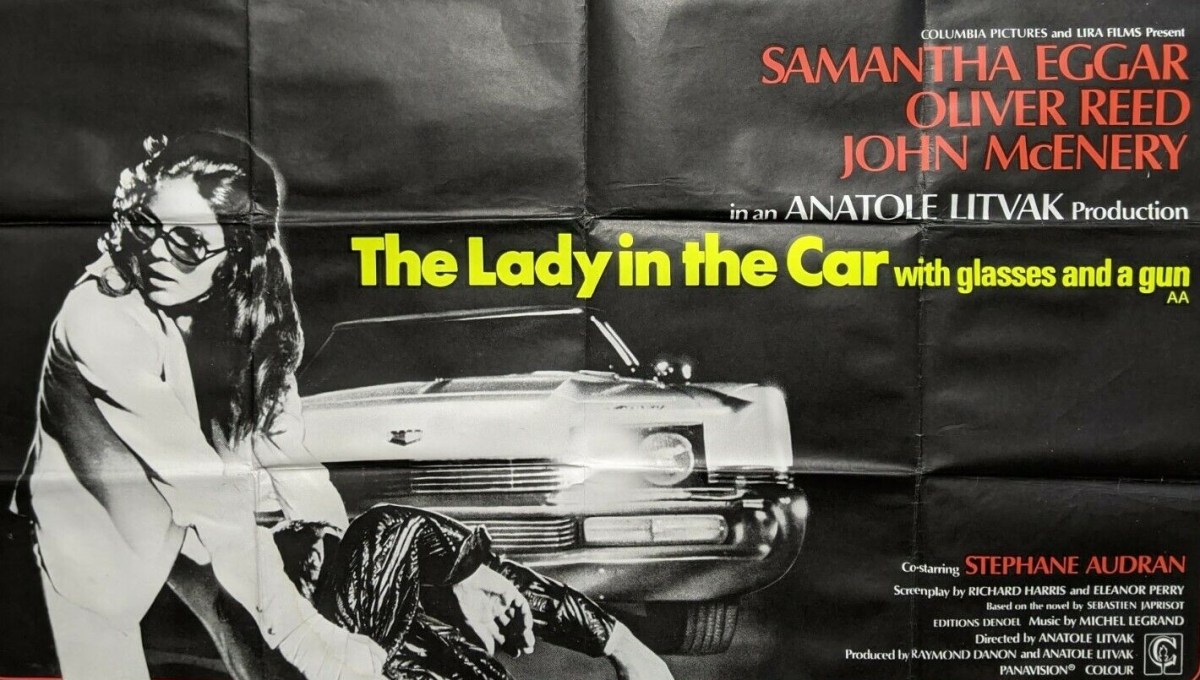
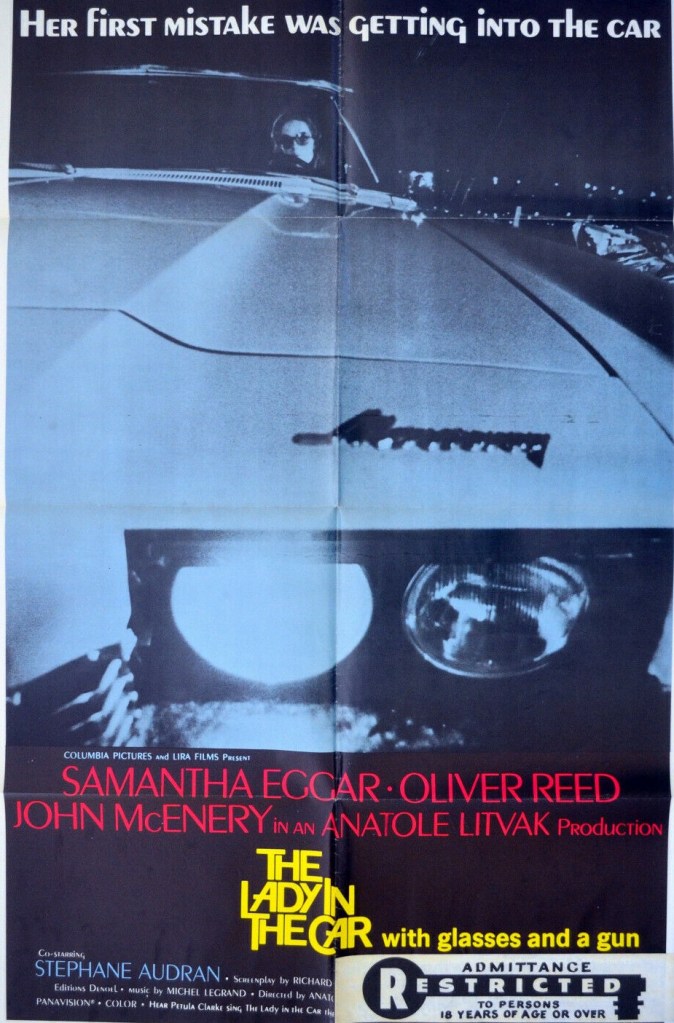
Samantha Eggar (The Collector, 1965) in her first top-billed role and an adapatation of a novel by French cult item Sebastian Japrisot (Adieu L’Ami/Farewell Friend, 1968). You couldn’t get a better mix.
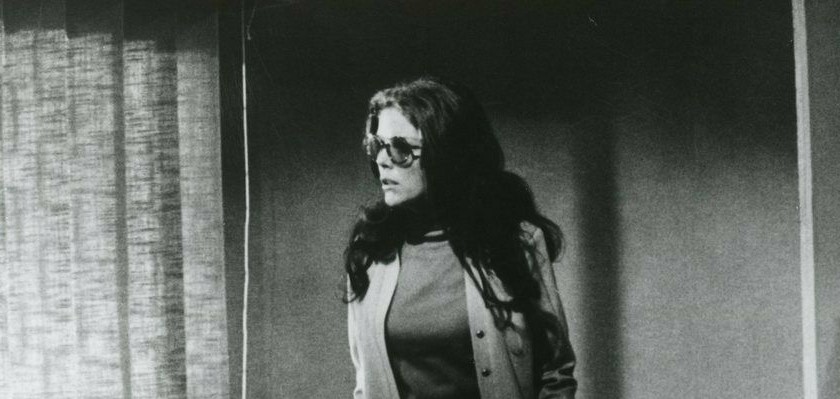
Fashion photographer Danielle (Samantha Eggar) sets off on road trip from Paris to the south of France only to discover everywhere she goes a doppelganger has been there first. She’s on edge anyway because she’s “borrowed” the car of employer Michael (Oliver Reed) and once police start recognizing her she gets jumpier still. The discovery of a body in the boot and the titular gun (a Winchester rifle) don’t help her frame of mind. But instead of reporting the corpse to the police – she’s a car thief after all – she tries to work it out herself. Amnesia maybe, madness because she keeps having flashes of memory – a spooky surgical procedure – or something worse?
She’s got a battered hand she doesn’t know how. Michael’s wife Anita (Stephane Audran) says she’s not seen Danielle in a month though she is convinced she stayed with the couple the previous night. A drifter Philippe (John McEnery) starts helping her out. Eventually she ends up in Marseilles none the wiser.
It’s a tricksy film and like Mirage (1965), recently reviewed, being limited to her point of view means the audience can only work out everything from her perspective. The string of clues sometimes lead back to the original mystery, other times appear to provide a possible solution. The explanation comes in something of a rush at the end.
Despite being the first top-billed role for Samantha Eggar (Walk Don’t Run. 1966), she would not scale that particular credit mountain again until The Demonoid (1981) but she is good in the role of a mixed-up woman struggling with identity. But since it’s based on a novel by Sebastian Japrisot (The Sleeping Car Murder, 1965) there’s a sneaky feeling a French actress might have been a better fit. Oliver Reed (Women in Love, 1969) is not quite what he seems, a difficult part sometimes to pull off, but he succeeds admirably.
Stephane Audran (Les Biches, 1969), jealous of Danielle, a friend whom she views as a rival for her husband’s affections, has the most intense part, using Danielle as an unwitting cover for betraying Michael. John McEnery (Romeo and Juliet, 1968) could almost be a London spiv, blonde hair, impecunious, clearly using women wherever he goes. Watch out for French stalwarts Marcel Bozzuffi (The French Connection, 1971) and Bernard Fresson (The French Connection II, 1975).
There’s certainly a film noir groove to the whole piece, the innocent caught up in a shifting world, and that’s hardly surprising since director Anatole Litvak began his career with dark pictures like Sorry, Wrong Number (1948) while previous effort Night of the Generals (1967) also involved murder. Litvak and Japrisot collaborated on the screenplay.
I expected a project laced with more atmosphere and a host of original characters. In truth, this is less atmospheric than the other two Japrisot adapatations , the interplay between the characters not so tightly woven, nor the climax so well-spun but it was enjoyable enough.
There was a remake in 2025 starring Freya Mayor (The Emperor of Paris, 2018).
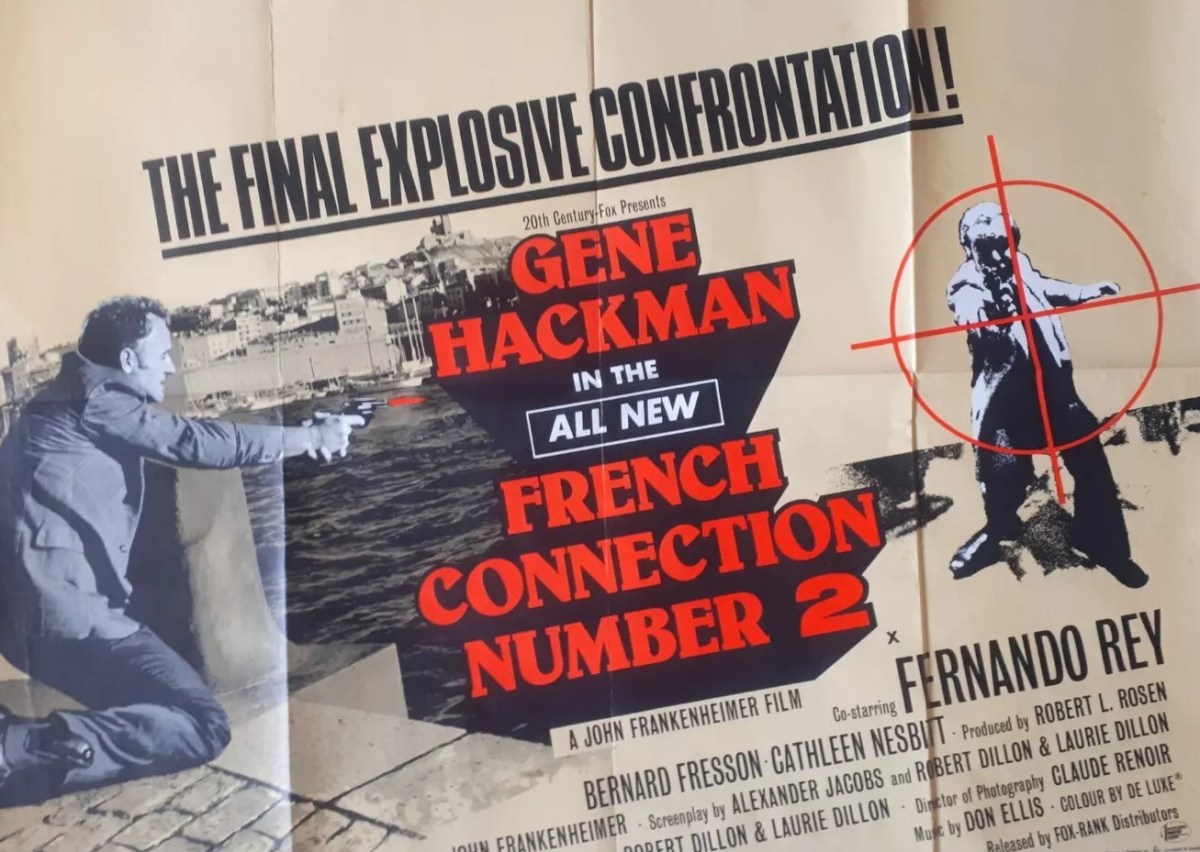
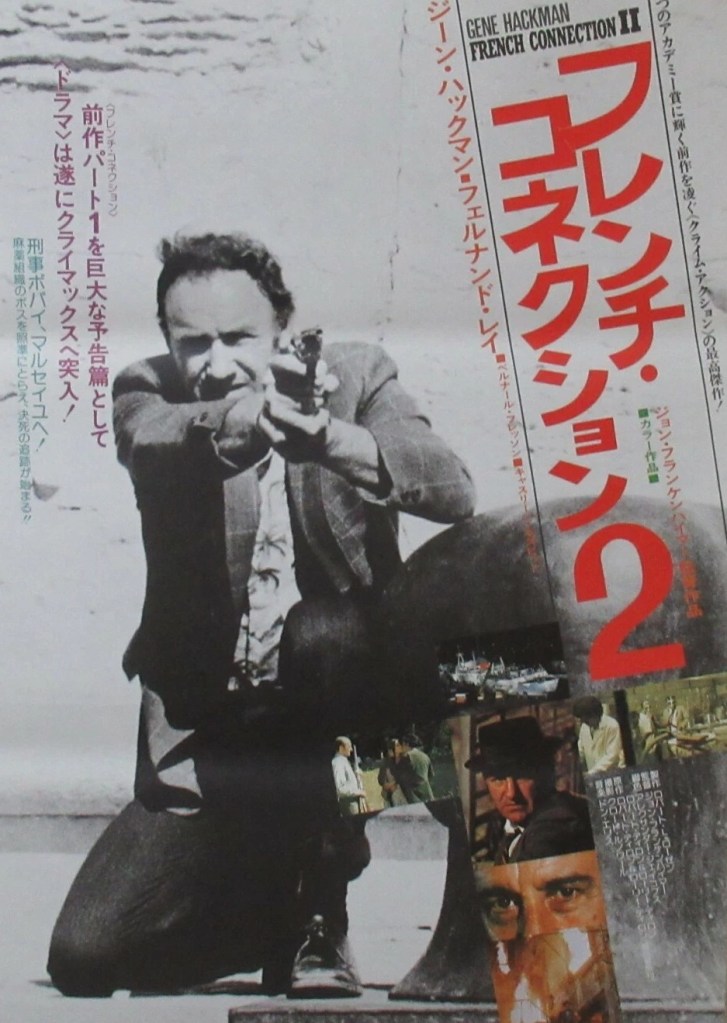
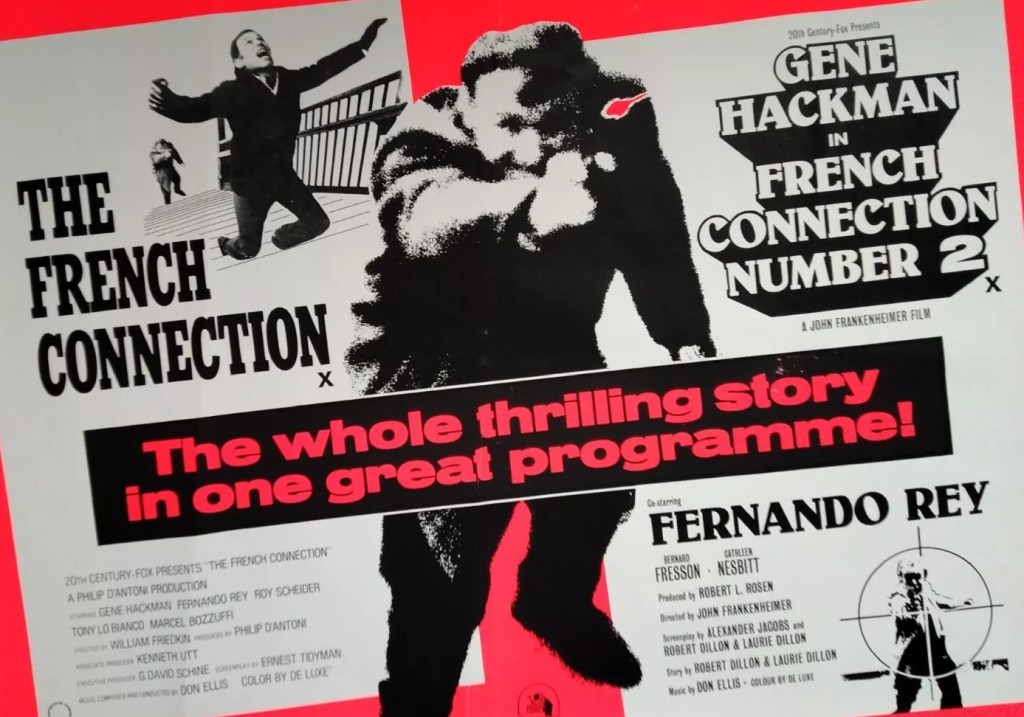
Back to Marseilles four decades on from Borsalino (1970) and a preposterous plot that virtually sinks this fictional sequel to the factual original. For a start, French drugs kingpin Alain Charnier (Fernando Rey) has a very distinctive face, and it could hardly been beyond a cop, accustomed to issuing identikits, to provide the French police and Interpol for that matter with a mugshot, thus eliminating the contention that New York cop Popeye Doyle (Gene Hackman) is the only one who can identify him.
Throw in the fact that, unlike other U.S. exports like Jason Bourne who is fluent in several languages, Doyle is instantly at a disadvantage because, blow me down, the ordinary French citizen doesn’t speak English, ensuring that the cop comes across as one of these witless foreigners who thinks shouting louder in English makes him any more intelligible. And his sole method of detection is to simply wander the streets of a city with a population of 1.3 million hoping to catch sight of his quarry.
Doyle, being a natural rule-buster, soon causes the death of a local cop to add to the five people he’s killed (including two cops) in his home country. The bull-in-a-china-shop is so ham-fisted that it’s embarrassing rather than comedic. And the get-out-of-jail-free card is just as preposterous. Turns out Popeye is bait – this was a trope of 1960s low-budget crime or espionage movies though usually a woman was either the willing or unknowing lure – sent to Marseilles by his own bosses, in the hope that his presence will lure Charnier out of hiding, when, in fact, the Frenchman hides in very plain sight, on his very fancy yacht or dining in very fancy restaurants.
You’d have thought it would be an incredibly simple matter to feed the Charnier’s face into the police system and come up with a match which would then just involve either breaking down doors or taking the more discreet approach of catching him in the act.
What saves this, and only just, is Gene Hackman’s performance, not as the aforementioned bull, but as a junkie going cold turkey. And that in itself is reduced to only a handful of outstanding scenes, when his opposite number Barthelemy (Bernard Fresson) has to listen to his meanderings about baseball and his childhood. The action finale, the equivalent of a dam burst, where the two cops are flooded in a dry dock is good too. But, devoid of the racing automobiles, the climax drags, as Doyle sets up a later action trope of the endless footslog (which Liam Neeson probably thought he had trademarked). This doesn’t even involve any leaping or running across rooftops just a canter along busy streets, down alleys and then along the marina hoping to catch Charnier before he escapes by yacht.
It’s slim on atmosphere, too. Where the original had a down’n’dirty lived-in feel, this comes over as a tourist version of Marseilles if a tourist fancied a stroll down some mean streets. There’s a really dumb scene where Popeye, hoping to scare out the crooks in the hotel where he was imprisoned, sets fire to the place. But he goes upstairs with a jerrycan of petrol, rather than starting at the top and working is way down, no guarantee that when he reaches the roof there’s going to be any avenue of escape left open to him.
Sure, a sequel was always going to be in the works after the success of the original. But why not concentrate on the obvious follow-up, how a cache of heroin with a street value of $32 million seized by Popeye and Co managed to vanish from a police property office.
Director John Frankenheimer (The Gypsy Moths, 1969, also featuring Hackman) hadn’t had a hit in a decade. This didn’t match the original at the box office. Written by Alexander Jacobs (Point Blank, 1967) and Robert Dillon (Bikini Beach, 1964) and Laurie Dillon, their only screen work.
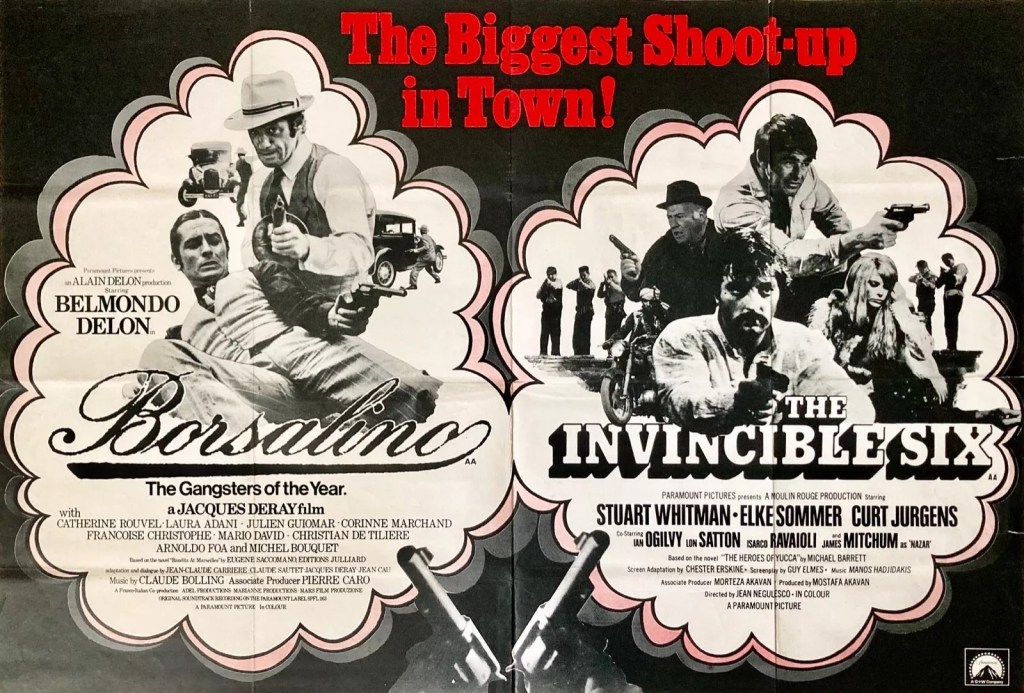
You wonder how much the unexpected success of this French gangster picture encouraged Paramount to invest in The Godfather (1972). The studio had gone down the Mafia route with The Brotherhood (1968) but to a significantly muted response. But where that film was heavy on family and drama, Borsalino went wild with charismatic performances and, as important, machine-gun-driven violence. And you couldn’t ignore the success the previous year of the French The Sicilian Clan (1969).
While Borsalino doesn’t go into the weighty issues and family sensibility that elevated The Godfather in the eyes of critics, its starting point owed more to Butch Cassidy and the Sundance Kid (1969) with two likeable hoods, even, initially at least, sparring over the same girl. The family element here concentrates on fraternity, brothers in crime, rather than the father-son dynamic that drove The Godfather. And it’s just so much goddam fun.
Francois (Jean-Paul Belmondo) and Roch (Alain Delon) are petty crooks in Marseilles in the early 1930s working their way up to the top, initially just with scams like presenting a longshoreman who can’t speak a word of German as a German regional boxing champion, hijacking the favorite in a horse race, setting up a slot-machine business, disrupting the city’s fish market, until graduating to more serious crime and challenging Marello (Arnoldo Foa) and Poli (Andre Bollet), kingpins of the area’s organized crime. They set fire to an abattoir, establish their own fiefdoms, running legitimate businesses like casinos. But the higher they climb the closer they come to a devastating irony which cannot be ignored. Once they’ve eliminated everyone else, their only competition is with each other, and both realize that, inevitably, one will begin to want to become the undisputed top gangster.
Roch is the more thoughtful of the pair, the one looking ahead, sensing opportunity, the strategist, Francois more likely to indulge his playboy instincts, but both enjoy the high life, mixing with celebrities, politicians and archbishops. There’s plenty collateral damage. Try to steal a bigwig’s girlfriend away and you are virtually condemning her to death.
Unexpectedly, for the genre, it’s huge fun, in part helped along by the genial earworm of a score by Claude Bolling, as evocative of the period as Scott Joplin’s rags were to The Sting (1973). We don’t have to suffer any sanctimonious prig on the sidelines offering commentary or the gangsters making out that they’re better than they are because they don’t indulge in certain types of crime. But the biggest contributory factor is the teaming of Alain Delon (Once a Thief, 1965) and Jean-Paul Belmondo (Is Paris Burning?, 1966), the two biggest French male stars of the decade, the former enjoying substantially more success overseas than the latter.
Remember that Robert Redford was a not star when he made Butch Cassidy and the Sundance Kid so the pairing of two huge marquee names was not a regular feature anywhere in the world. It was Alain Delon, in his capacity as producer, who snared his rival, ceding top billing to achieve it.
This was the second of nine movies that Delon made with director Jacques Deray and could not have been more different from their previous outing La Piscine/The Swimming Pool (1969), a claustrophobic psychological thriller. Deray had history with Belmondo, too, Crime on a Summer Morning (1965). The characters were a great fit for their screen personas. And the photography, with some sepia tint, is distinctive.
Written by Jean-Claude Carriere (Viva Maria!, 1965), Claude Sautet (Nelly and Monsieur Arnaud, 1995), Jean Cau (Jeff, 1969) and the director, based on the book Bandits a Marseille by Eugene Saccomano.
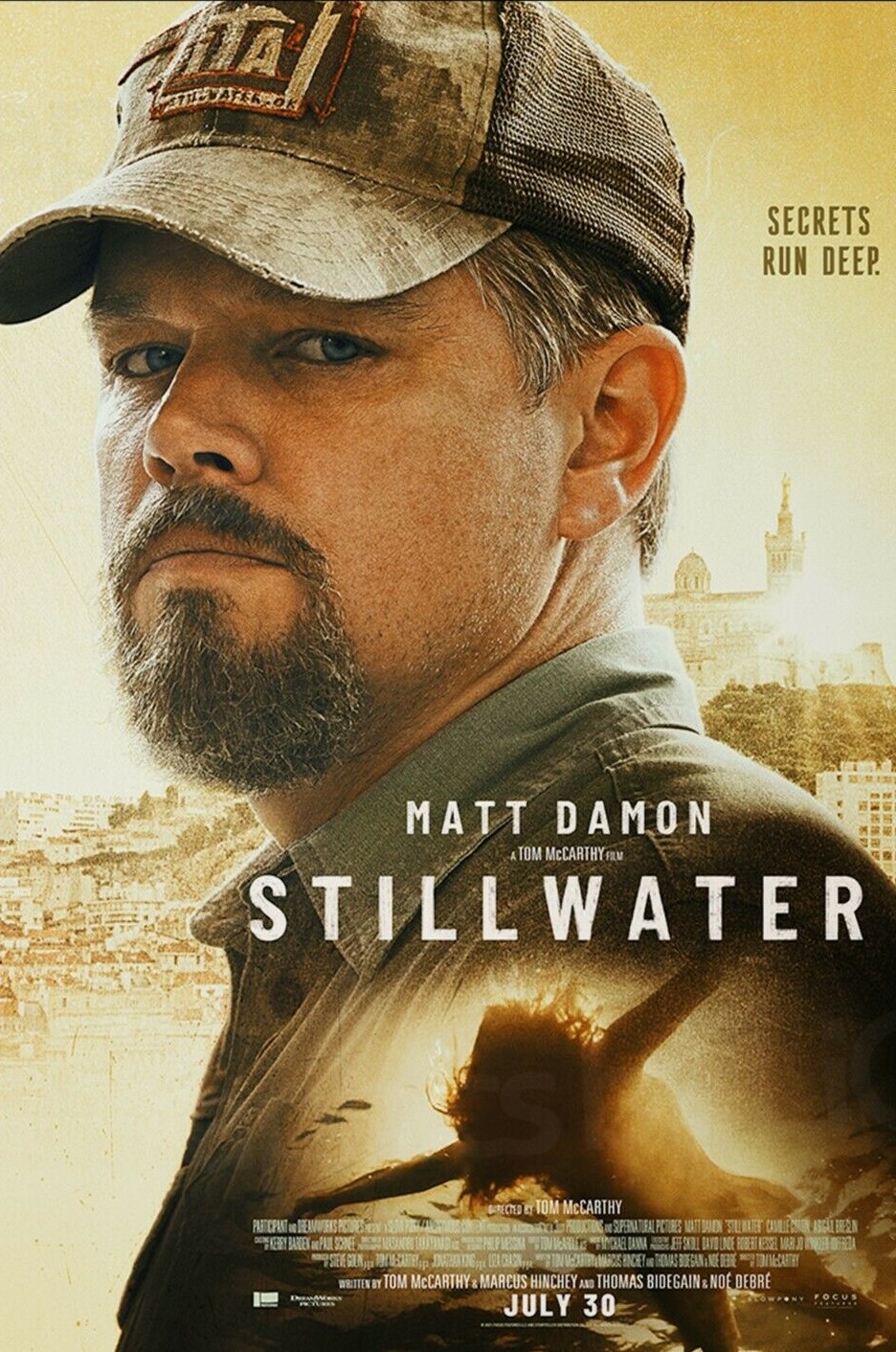
A towering central performance from Matt Damon as a redneck American adrift in Marseilles just about saves this from being a total train wreck. Oscar-nominated director Tom McCarthy (Spotlight, 2015) doesn’t just go off-kilter but dangerously off-piste in a truly bizarre third act that sabotages the entire picture, which already is within touching distance of the jump-the-shark record.
But let’s concentrate on the good stuff. Bill Baker (Matt Damon) is an oil rig worker in Marseilles trying to clear gay daughter Allison (Abigail Breslin) from a murder charge – she has served four years of a ten-year sentence. Normally, he only remains in France for two weeks but this time, frustrated by the French judicial system, attempts his own investigation. He strikes up a relationship with single mother Virginie (Camille Cottin), becoming very attached to her daughter Maya (Lilou Siauvaud).
He becomes a surrogate father to Maya, collecting her after school, taking on babysitting duties to allow Virginie to continue her acting career. He moves in, initially in platonic fashion, but soon they become lovers. Considering he has been a lousy dad to Allison, who still, for good reason, distrusts him, he makes up for it with Maya and soon Virginie, sensing the decent qualities beneath the typical angry American, takes him into her bed.
These relationships are all terrifically well done and it’s almost Bill’s first stab at parenthood since he was absent for most of Allison’s childhood, either away working on oil rigs or out of his skull on drink or drugs. The character exhibits considerable self-awareness and the gradual transformation from bull in a china shop (not exactly how you would describe tough Marseilles, but still) to father and lover is incredibly well done.
So the film could have gone one of two ways. He could have remained in France, working as a general laborer, contributing to the household, watching Maya grow up, perhaps (God forbid!) actually learning some French, and waiting to be reunited with his daughter once freed – she is allowed one day a month out of prison so their relationship is being strengthened in incremental stages.
***SPOILER ALERT***
Or, the director having succumbed to brain fever, Bill could decide to throw all that away by capturing the suspect he has been hunting, slicing off a hunk of hair for DNA purposes, and keeping the prisoner in his basement until the results of such testing comes through. And in the process discovering that his daughter is in fact guilty. It’s as if Damon had realized he was in the wrong picture and slipped into his Jason Bourne alter ego or had been watching too many Taken films.
It would be entirely in character that he hides this unsavory fact from the French police, only confronting his daughter with it once she is safely back home, but it might have been a different, and more satisfying, picture altogether if he had uncovered this evidence in another, simpler, manner and then had to deal with the consequences.
I am making it sound as if the whole picture comes apart in the final section but in truth it is perilously off the rails from the get-go. McCarthy’s contribution to an outdated sub-genre that includes Missing (1982) and Not Without My Daughter (1991) falls into the unacceptable trap of tapping foreign judicial systems as incompetent at best and corrupt at worst. Bill Baker exhibits the worst characteristics of dumb American colonialism as he charges around Marseilles baffled that none of the inhabitants can speak English. It is a truly awful directorial conceit where the eight-year-old Maya is expected to have a better grasp of English than Bill of French. He surely cannot be so dumb that he can’t say “Je t’aime” instead of letting loose an emotional barrage in English to the poor child.
Then there is the very uncomfortable treatment of the locals. Sure, parts of France are certainly racist, and although Bill Baker is comfortable with racists, since he has worked alongside them and he might well have been a Trump supporter had he been allowed to vote instead of being barred due to his criminal record, director McCarthy feels it is his duty as a brave American director shining a spotlight on the country’s nether regions to highlight this aspect of French culture.
Shooting yourself in the foot was never easier than here. The movie bears strong and quite unnecessary similarities to the Amanda Knox case, especially since Allison’s experience with her gay lover comes so close to the facts of the Knox situation.
And that’s not counting the improbabilities. Guess where Bill spots the suspect Akim (Idir Azougli) he has been chasing all his time? Yep, you’ve guessed it. In a crowd of 60,000 people. At a football match. It could only happen in Hollywood. He only needs a sample of the guy’s DNA, a snippet of hair would do, to prove he was present at the scene of the crime and cast sufficient reasonable doubt on his daughter’s conviction. Instead, having floored the guy in the street to get the few strands of hair required, he then locks him up in his cellar – for a week! – until the results of the DNA test comes through.
But someone tips off the cops. But lo and behold when they arrive there is not only no body in the cellar but no evidence that anyone has ever been there because the quick-thinking but very skinny Virginie has improbably managed to untie him and move him to some other unspecified hidden location.
And so we come to the mysterious title. Stillwater is a nondescript backwater in Oklahoma where Allison lived. But for some reason it’s the type of place where not even with a touch of irony canny manufacturers believe its name attached to a necklace would be an unbelievably attractive purchase in a retail outlet at an airport. And that it was worthy not just of being a mere bauble but of being made of gold, and sufficiently valuable that it would be acceptable as part payment to Akim for carrying out a bad deed.
Tom McCarthy has been incredibly lucky to receive a performance of a lifetime by Matt Damon, so sure-footed that there is not even an inkling of his trademark shy smile. Camille Cottin is also excellent. I’m not sure whether Abigail Breslin is meant to be this unlikeable, in which case blame the director, or whether her whiny behavior is a pointer to her guilt. Either way, she is over the top.
However, this is one of those rare instances where if you swallow your disbelief at the plotting, you will uncover a pure gem of a performance.
I saw this at the cinema as part of my Monday night outing. It’s available on Amazon Prime and not the type of picture where the visuals are so outstanding that I would urge you only to watch it on the big screen.
 The Magnificent 60s