Behind the Scenes: Selling the New-Look Paul Newman – Pressbook for “The Hustler” (1961)

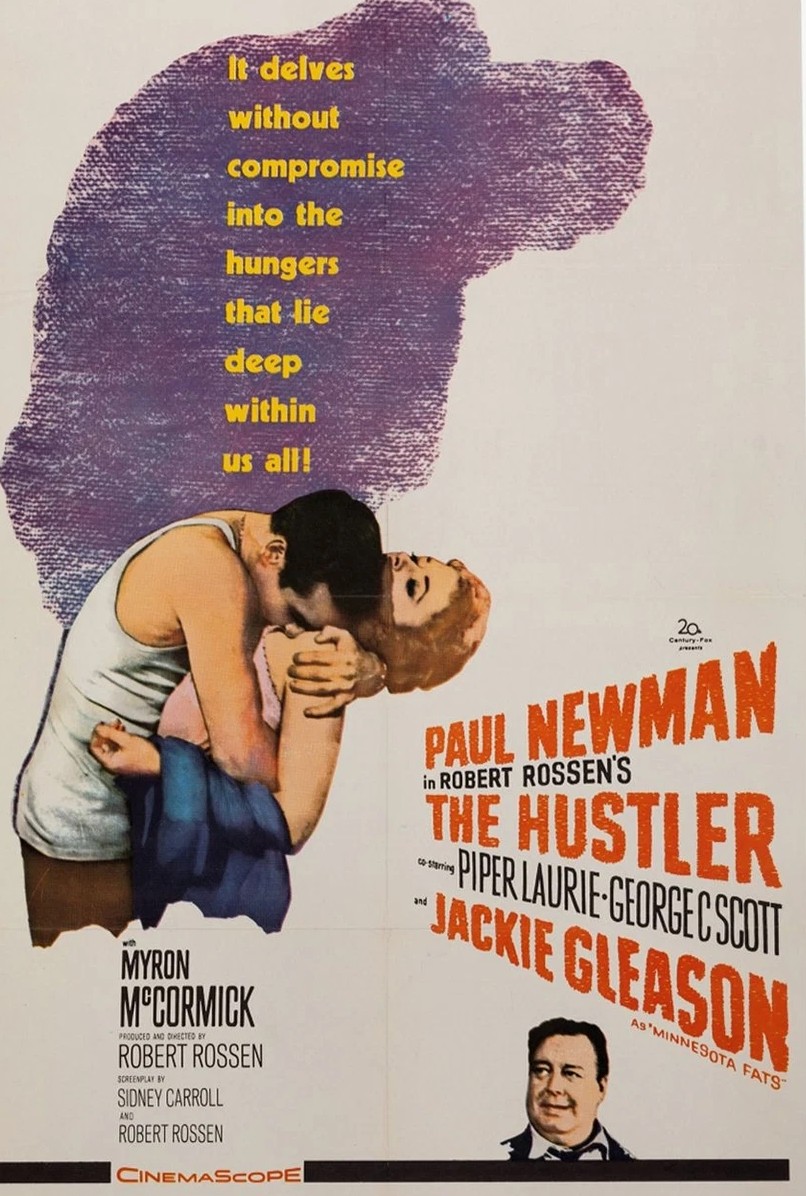
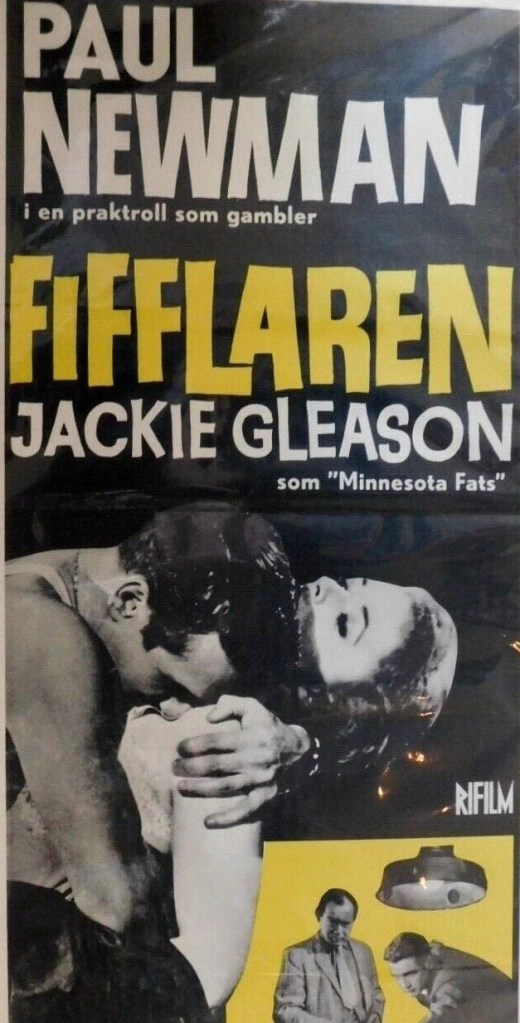
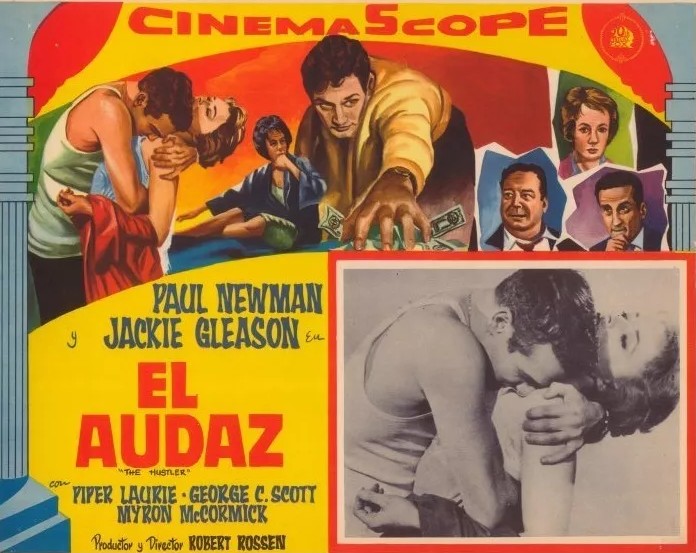
While Twentieth Century Fox head honcho Spyros Skouras initially balked at the title, with its connotations of prostitution, by the time the movie appeared that subject matter was less contentious thanks to critical and commercial big hitters Butterfield 8 (1960) and Never on Sunday (1960). Given that the idea of a movie set in a poolroom was going to be a hard sell to a female audience, despite the marquee lure of Paul Newman, the studio gave marketeers free rein to pitch it as a raw, sex-oriented drama.

There’s little sign of a pool cue in some of the artwork. Instead, we have Paul Newman lustily nuzzling Piper Laurie’s neck or bosom. The taglines promise something far removed from a sports picture.

“It probes the stranger…the pick up…the  savage realities,” screamed the main tagline. Another tempted with: “It delves without compromise into the inner loneliness and hunger that lie deep within us all!” In other words we’re talking about sex, not love, and casual sex at that, the world of the one-night stand between consenting adults for whom marriage is the last thing on their minds. “The word for Robert Rossen’s The Hustler is prim-i-tive” suggested out of control lust.

Fast Eddie Felson (Newman) has “the animal instinct.” Sarah (Piper Laurie) has a “bottle, two glasses and a man’s razor always in her room.” Bert (George C. Scott) is on the look-out for the “sucker to skin alive.”

Those images which did show a cue and pool balls did not suggest an august sport like football or baseball, not with a tagline like “he was a winner, he was a loser, he was a hustler.”

With such talented actors to hand, the Pressbook wasn’t short of good stories relating to the actual movie rather than the kind of snippets that might appeal to an editor on a slow news day. So we learn that Piper Laurie continually limped, Method-style, around on the set. “When I limp in the picture, I don’t want to act it. It’s something that has to be a part of me, something of which I am no longer conscious, apart from its being a physical defect. I must be able to limp as if I had a bad foot from birth.”

Laurie had made so few pictures that her name wouldn’t be on any director’s wanted list and what she was best known for – ingénue roles when a contract player for Universal (who gave out that she bathed in milk to keep her skin soft) opposite  the likes of Tony Curtis – wouldn’t have inspired confidence. Robert Rossen might well have spotted her in two Emmy-nominated performances in successive years including Days of Wine and Roses (1958), but instead said he remembered her for “a sensitive characterization” from a stage production of Rosemary.

Ames Billiards Academy had once been a Chinese restaurant so boasted a balcony. This was unseen in the picture but allowed director Robert Rossen to shoot from widely varied overhead angles. The crew took over the Manhattan Bus Terminal for a day and a night. A row of lunch booths was constructed in front of the existing lunch counter. “It looked so real,” we are told, “that passers-by sat down and waited for their orders to be taken.” A nice story, and the kind often furnished by Pressbook journos, but rather fanciful, since it would be obvious what with the crew milling around and the lights and cameras and miles of cable that this was a movie set with security posted to prevent trespassing.

Just how good a pool player was Jackie Gleason, who came to the picture with a reputation for handling a cue? Well, at one point, the affable television comedian with a top-rated show, potted 96 consecutive balls.

Paul Newman plays the iconic hero as a “figure cut from the fabric of our time.” He had a firm grasp of the character. “With him it’s a question of commitment. He is so wrapped up in his drive to win and be somebody that he has no time to give of himself that which others need. It is a disease of our time, both the ambition and the isolation. I want him to be understood.”

Needless to say there was no mention of author Walter Tevis. That wasn’t so unusual in the make-up of Pressbooks, but if the marketeers these days were looking for something to write about the eclectic Tevis would be prime. He followed up The Hustler, published in 1959, four years later with sci fi The Man Who Fell to Earth, filmed in 1976 with David Bowie. A sequel to The Hustler, The Color of Money, was directed in 1986 by Martin Scorsese with Newman reprising his role and managing Tom Cruise. Tevis also wrote The Queen’s Gambit, turned into an acclaimed television mini-series in 2020 with Anya Taylor-Joy.

Behind the Scenes: Selling Judy Garland – “A Child Is Waiting” (1963) Pressbook

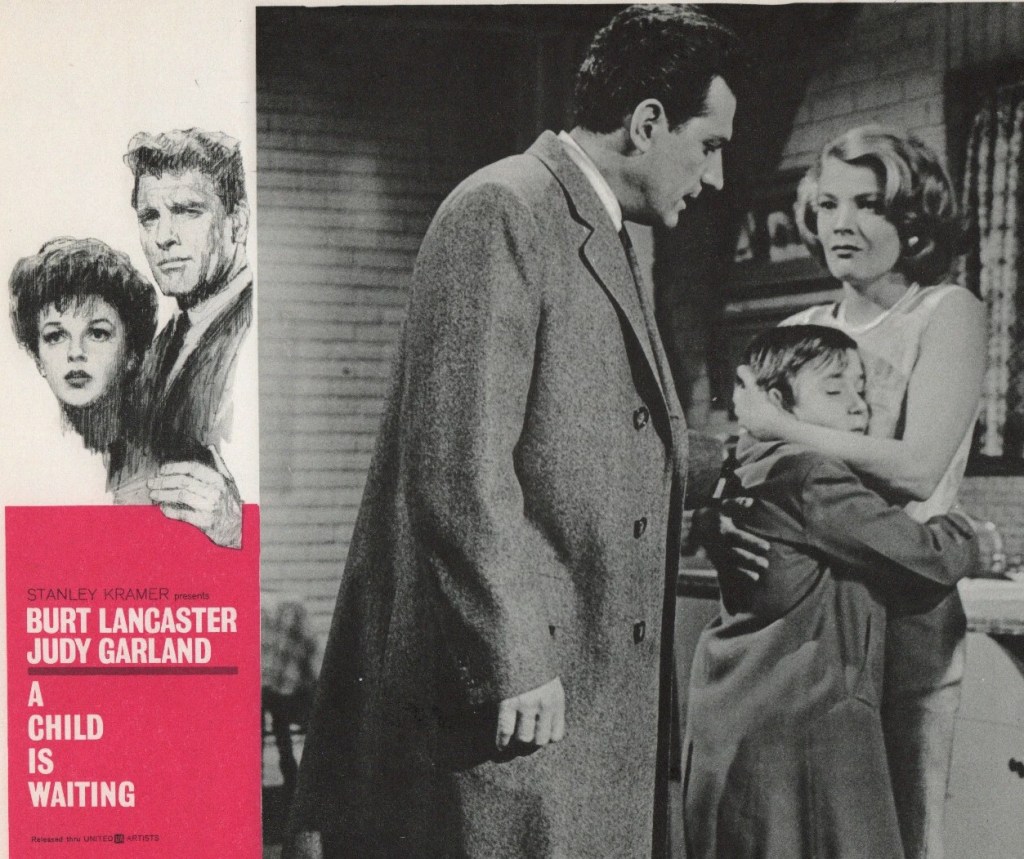
This proved the impossible sell. And Judy Garland was no help. The star was well past her best and if she wasn’t singing it was difficult to attract audience interest. So beyond her name above the title, United Artists did very ittle to use her presence as a distinct marketing tool.

Just like I Thank a Fool the previous year, the subject matter of A Child is Waiting did not lend itself to cross promotion. That did not prevent marketeers doing their level best. However, it was a rather bold suggestion to assume banks would be a natural port of call even under the guise that every child was waiting for their parents to start a savings account to see them through college. 

The title seemed to incite temporary madness in the marketing department. How about this for a tie-in approach to a toy department? “A child is waiting for the most exciting game ever devised – Monopoly.”

Groups most likely to respond were identified as psychiatrists, teachers and PTA members but cinemas were warned to avoid giving the “impression that the film is a clinical or documentary one.”

By far the easiest avenue for promotion was a book tie-in. Popular Library had issued a paperback novelization by Abby Mann of his original screenplay with stars Burt Lancaster and Judy Garland on the cover and at the very least that would receive window displays in bookstores and on the carousels of drugstores.

Also limited were the number of taglines on a poster. In those days a movie could be advertised with as many as a dozen different taglines appealing to different market sectors. United Artists stuck to three main taglines with two subsidiary ones. Sometimes both subsidiaries were on the same poster, other times only one.

“Burt Lancaster and Judy Garland ignite a motion picture that gives so much…goes so far…looks so deep into the feelings of man and woman.” This alternated with “Burt Lancaster and Judy Garland take an untouched theme – and make it touching and unforgettable” and “Only Burt Lancaster and Judy Garland could take this untold story…and make your heart tell it over and over again.”

The subsidiary taglines ran to: “If this were flesh of your flesh – would you hold it close…Protect it…Love it…Or would you turn your back and run” and “A child can be so many things, warmth…love…laughter…and sometimes a child can be heartbreak!”

Mainly what marketeers were asking of Lancaster and Garland was a miracle, as if their names alone could drag audiences into theaters.

Even though the Pressbook was relatively small – eight pages A3 – two-thirds of the space was allocated to repeating the adverts, just in different sizes.

The section normally aimed at getting editors to carry snippets of news about the movie provided scant material. There was little to catch the journalistic eye, nothing new about either of the stars, just a rehash of careers. Usually, cinema managers would scour this section looking for a titbit to offer to a reporter, an unusual hobby, something odd that occurred during filming, details about the location or an element that went wrong during shooting.

If you were relying on this Pressbook to fuel demand from exhibitors, you would be sorely disappointed.

Behind the Scenes: “The Nightcomers” (1972)

Marlon Brando’s box office cachet had crashed. He hadn’t made a picture in two years following the flop of Queimada/Burn (1969) which had followed his debilitating box office trend of most of the decade. While his stock remained high enough to headline such big budget numbers as The Chase (1966) and Reflections in a Golden Eye (1967), thereafter confidence in his marquee value tumbled. Apart from Queimada, he had only been signed up for Night of the Following Day (1968), another loser.

But that last picture had brought him into the orbit of independent producer Elliott Kastner (Where Eagles Dare, 1968) who had been a friend of director Hubert Cornfield (Pressure Point, 1962) when they had both worked as agents at MCA. “Although he was crazy,” recalled Kastner, “I loved his writing and his drive.” Kastner was a fan of Cornfield’s earlier movies especially as they had been delivered on short time schedules. “I wanted to do something with Marlon Brando and he wrote Night of the Following Day.” 

Brando still had clout in Hollywood. His three-picture deal with Universal obliged the studio to pony up for any (financially viable) projects he put to them. Kastner was delighted to hop over from his base in London to the French location and although the movie continued the actor’s poor reception at the box office, the producer enjoyed the experience.

Brando wasn’t averse to the “resting” that most actors endure, stints of unemployment between gigs. So when the actor approached Kastner to work with him again, it took the producer by surprise. “Marlon wanted to do a film,” said Kastner, “which was unusual for Marlon because he hides from work. He wanted to do a film in Europe and he loved staying at my house in the country. I talked to (Brando’s agent) Jay Kanter (who later became Kastner’s business partner) about it and we gave him a screenplay called The Nightcomers…that Michael Winner wanted to direct.”

Kastner had liked Winner’s output and was equally attracted to the fact that he also worked fast. Winner was contemptuous of directors who shot too much footage, especially “coverage”, filming a scene from too many different angles. But he was also a very fast editor. He took an editing caravan with him on location, and after the day’s filming ended at 6pm he spent the next two hours watching rushes and another two hours after that editing. His editor Freddie Wilson said,” His speed of decision in the cutting room saves a great deal of time and money.”

Winner had been sitting on the screenplay by Michael Hastings for some time. “No one was rushing to finance it,” remembered Winner, until Brando showed an interest. Winner arranged to meet the actor at his “modest Japanese-style house” in Los Angeles. However, insurance proved a sticking point following payouts for Quiemada.

“On a personal level,” recollected Kastner, “I thought he (Winner) was a bully with waiters. He was really nasty to people beneath him. I didn’t have much (personal) respect for him but he was very amusing.”

Due to scheduling conflict Vanessa Redgrave (Blow-Up, 1966) turned down the role of Miss Jessel. Winner also offered the part to Britt Ekland (The Double Man, 1967) provided she could bring some financing to the project. In the end, remembered Kastner, “Michael wanted to cast this girl with this big bust who was a halfway decent actor.” Neither Redgrave nor Ekland could compare in the bust measurement department to Stephanie Beacham, so clearly chest size was not a priority.

Kastner reckoned Brando “would bring plenty of poetry” to the project. It was remarkably cheap even for a star of Brando’s fading attraction. The budget was $686,000, of which Kastner received $50,000 as a producer’s fee plus 30% of the profits. Winner deferred his fee, only paid if the movie made money. At that point, Kastner was leading the way in finding funding outside the studio system. Funding for When Eight Bells Toll (1970), for example, was entirely sourced from an American businessman. For The Nightcomers, Kastner located investment of $100,000 from a company called Film & General Investments. Universal was involved through its contract with Brando – paying him his $300,000 salary for this picture to count as the final one on his contract, but declined to distribute the picture. For another producer, this might have been enough to kill off the project, but not for Kastner, who, following his current practice, intending to sell the completed film to a distributor.

As far as Kastner was concerned the movie went into immediate profit. Joe Levine of mini major Avco Embassy, still riding high after the success of The Graduate (1967) and The Lion in Winter (1968), ponied up $1 million for the worldwide rights plus a share of the profits. But Avco also limited its exposure, selling a 40% share to businessman Sigmond Summer for $1 million. (Judging from later legal documents, Universal retained some financial interest in the picture).

Brando had decided Quint was Irish. To learn the dialect, Brando and Winner got together with a group of Irishmen in the back room of a pub, one whom became the actor’s dialog coach on location.

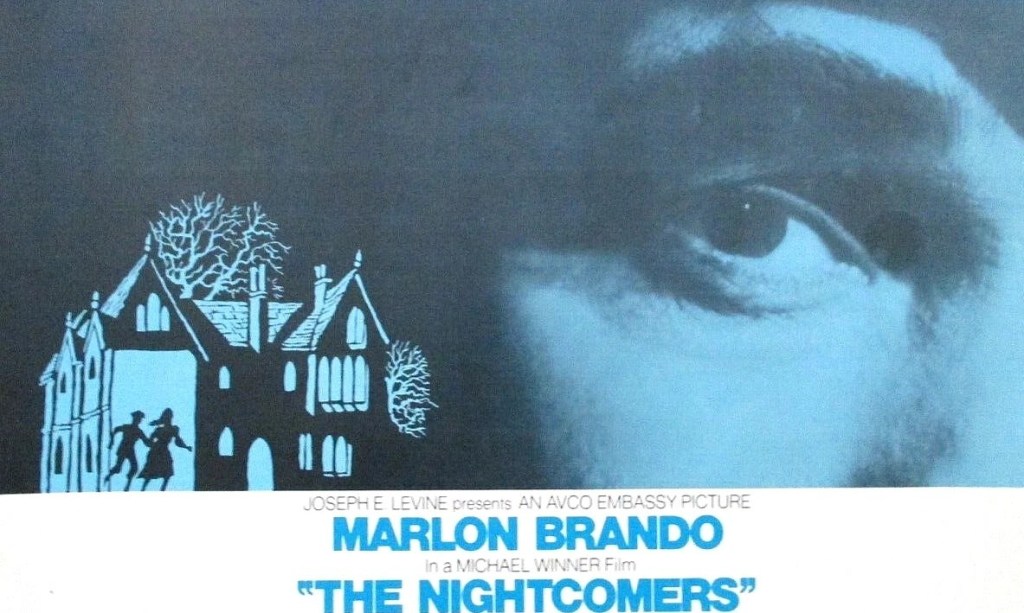
The six-week shoot, on locations in Cambridgeshire, Britain, with Sawston Hall doubling as the mansion, began in January 1971. There was another reason for the speed of the shoot. Winner had contracted with United Artists to make Chato’s Land (1972) and there was no time to spare between the movies. Over 100 actresses auditioned for the role of the female orphan. Winner, seeking “someone over 18 who looked 11,” selected Verna Harvey (she also won a role in Chato’s Land).

Although Winner had gone to some expense to set up a private dining room for the star at Sawston Hall, Brando preferred to eat with the crew. According to Winner, despite Brando’s fearsome reputation, he knew all his lines, immensely patient with his young inexperienced co-stars, concerned about the crew, and, as importantly, arrived on time and even watched rushes, a rarity among the profession. Brando used earplugs to prevent distraction from extraneous noise. During the shoot Francis Ford Coppola flew over to spend time discussing the script of The Godfather with Brando.

Brando initially refused to have stills taken of him during the sex scene and only gave in after considerable persuasion, though he kept his wellington boots on. He wanted to leave the drunk soliloquy to the end of shooting. Though he was actually drunk after consuming a lot of Scotch, “he remembered his lines immaculately…(and) also matched his hand movements and body movements, which is very important in movies,” explained Winner, “because if you have to cut different bits of film together if the body or hands or arms are in a different position you’re in trouble.” 

Jerry Fielding didn’t record his score until July during a three-day session with an orchestra of 80 at Cine Tele Sounds Studio. Despite his editing prowess, Winner realized his final version didn’t work. “The first cut was too fast. For a moody period film I’d just messed up. I put back seven minutes (of footage) and spent another three weeks getting it right.”

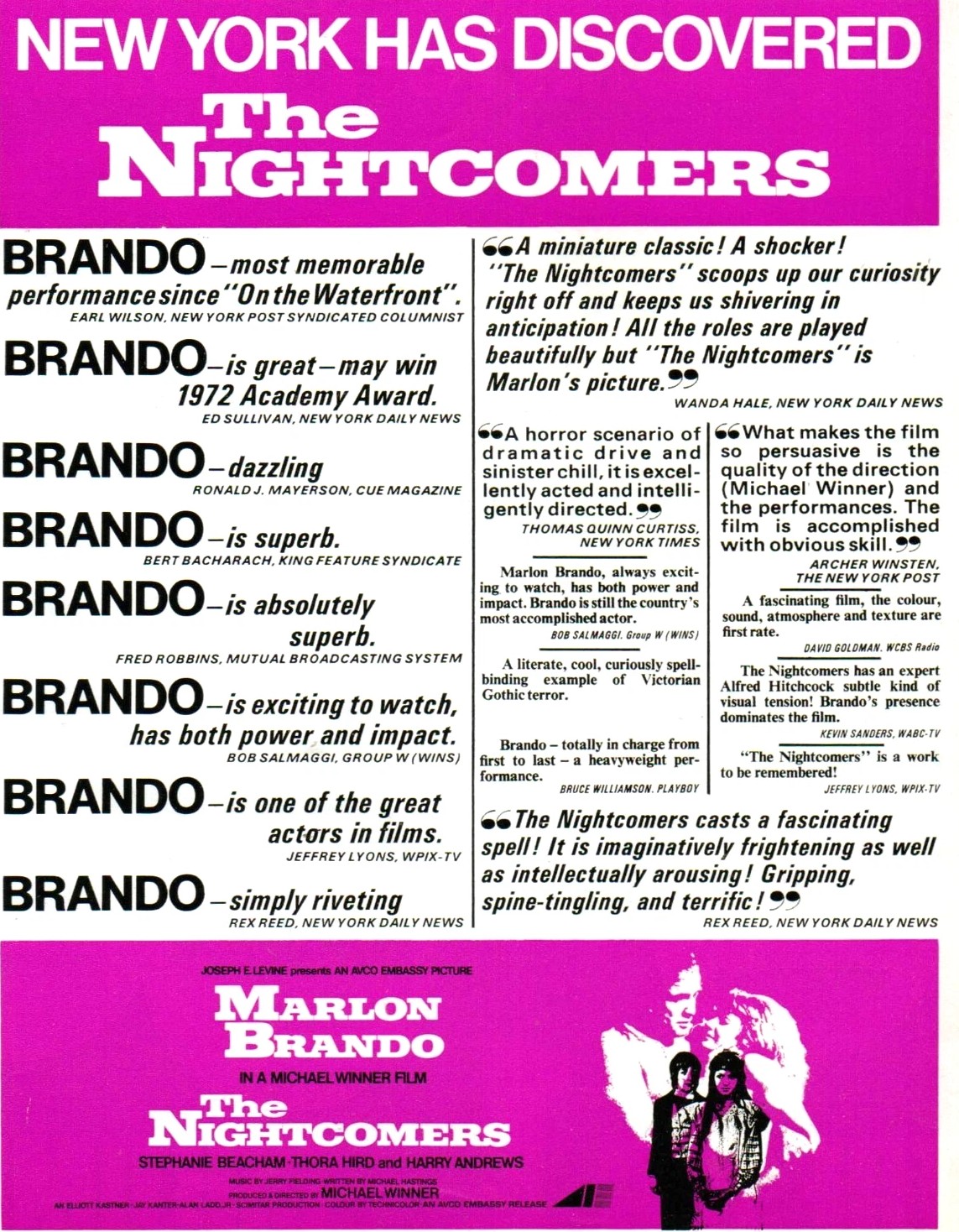
Thanks to its world premiere at the Venice Film Festival alongside the likes of Sunday, Bloody, Sunday (1971), it was touted, perhaps unwisely, as an arthouse picture, rather than majoring on the sex and violence. While Variety tabbed it a “grippingly atmospheric thriller,” only two out of the five most influential New York critics gave it the thumbs-up.

A distribution deal was not struck till the end of 1971. Rather than potentially riding along in the slipstream of The Godfather (1972), which was already attracting huge hype, Avco decided that it was better to come out before the Mafia picture than risk being swamped in its wake. But there was confidence in the project. “Joe Levine thought the film was so brilliant we didn’t have to wait for The Godfather,” related Winner.

It launched first in America, opening in February 1972 – beating The Godfather to the punch by a month – at the 430-seat Baronet arthouse in New York. The opening week of $20,700 was rated “nice” and held well for the second week before plummeting to $11,000 in the third week. It was yanked after six weeks.

By the time it spread out into the rest of the country, The Godfather rollercoaster was well into it stride, but the early release had not particularly gathered any pace and in the aftermath of the Coppola movie it was certainly buried. It opened to $6,500 in Boston compared to The Godfather’s second week of $140,000. There was a “scant” $39,000 from 13 houses in Los Angeles, a “modest” $4,000 in Louisville though $5,000 in San Francisco was rated “brisk” and the same amount in Washington “snappy.

Initially, at least, Britain appeared more propitious. It opened in key West End venue the 1,400-seat Leicester Square Theatre to a “loud” $24,700 and though it dropped $10,100 in the second week, the third and fourth weeks improved on the second. Eight weeks into its West End run, when it was still pulling down $13,300, The Godfather put it to the sword with a record-breaking $191,000 from five West End houses. After that pummelling, The Nightcomers managed only three further weeks.

In fact, the movie did surprisingly well, especially overseas. Total rentals came to $1.69 million, a clear million-dollar profit on the negative cost. While less than half a million came from the U.S., and only $160,000 from Britain, the overseas market kicked in the bulk of revenue – $986,000 – possibly because it was released after The Godfather (1972) rather than, as in the UK and the US, before. In the run-up to and in the wake of The Missouri Breaks (1976), it was included in Brando perspectives at the Museum of Fine Arts, where it was presented as a “novel film…lost in the shadow of The Godfather,”  and Carnegie Hall. But an attempt at commercial  reissue proved disastrous – a “weak” $1200 in Pittsburgh.

Except from a financial perspective, Kastner wasn’t especially impressed, calling it “grim, boring, contemptuous of story, oblique.” Viewers, including me, beg to disagree.

SOURCES: Elliott Kastner’s Unpublished Memoirs, courtesy of Dillon Kastner; Elliott Kastner Archive, courtesy of Dillon Kastner; Michael Winner, Winner Takes All, (Robson Books, 2004); “Production Review,” Kine Weekly, January 23, 1971, p10; “Not So Young,” Kine Weekly, May 22, 1971, p16;“Jerry Fielding,” Kine Weekly, July 17, 1971, p10; “Michael Winner,” Kine Weekly, August 13, 1971, p10; “Nightcomers to Avemb,” Variety, January, 19,1972, p5;  “New York Critics,” Variety, February 23, 1972, p35; “Picture Grosses”, Variety, 1972: February 23-April 26, June 7-14; July 19- Sep 27; “Broadway,” Box Office, February 9, 1976, pE2; “Museum of Fine Arts,” Box Office, October 18.

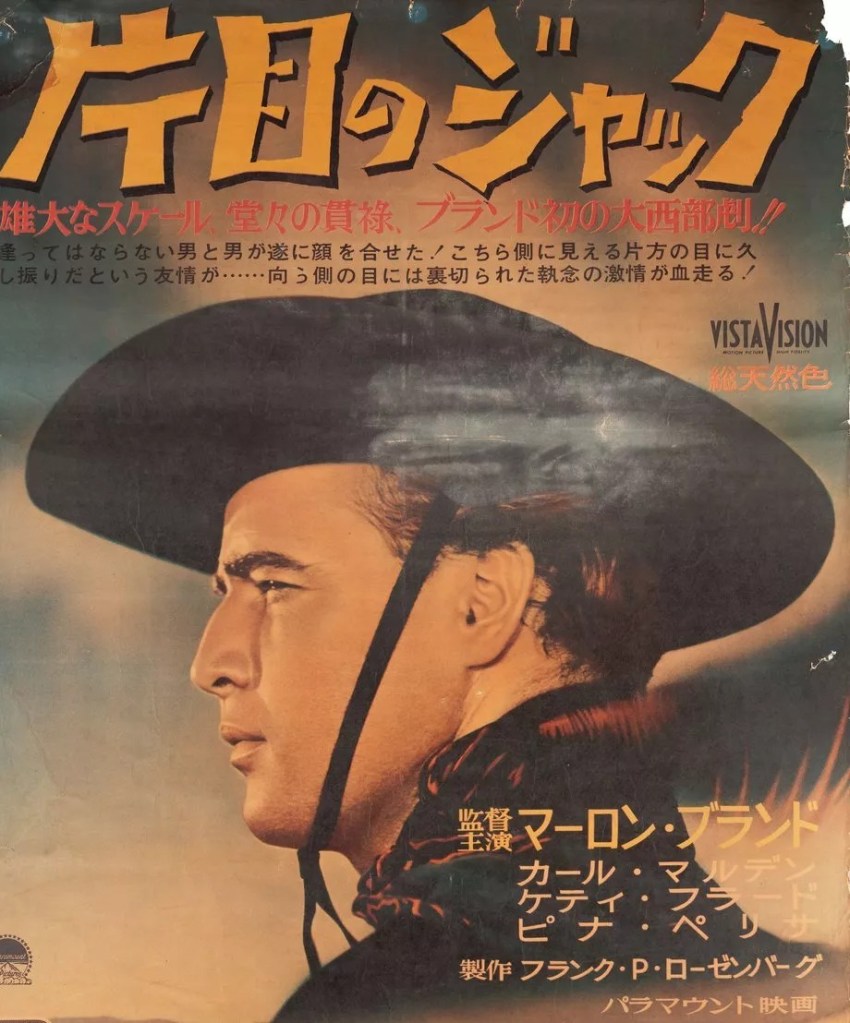
Behind the Scenes: Do As You’re Told: Selling Marlon Brando in “One-Eyed Jacks (1961): The Pressbook

Pressbooks/Marketing Manuals were intended as guides for the better promotion of a picture. At best, they were viewed as suggestive, devised in the spirit of cooperation. Paramount took a different perspective for One-Eyed Jacks. It laid down the law. This was “do as you’re told” under a new guise.

In the first place, it was an uncommonly sumptuous Pressbook, the distinctive cover printed on thick paper. It was larger, too, than the standard A2.

But at the heart of the marketing was almost a command for cinemas to follow a stringent campaign of advertisements running for seven days prior to showing the picture. This was contained in an immeasurably large section, a double fold-out running to 46 inches wide by 19 inches high. In other words so huge it could not help but catch the eye.

Unusually, the campaign was a before-and-after promotion. Of the seven days delineated, five   were in advance of opening, the final two post-opening. Cinemas could choose between four sizes of campaign. Size was measured in “lines” – the unit of measurement rather than inches employed by newspapers. The more lines, the bigger the advert. Thus, Campaign AA was intended to run for 2,700-2,800 lines with the biggest advert reserved for opening day. Campaign 1 was set for 1,900-2,100 lines; Campaign 2 for 800-900 lines; and Campaign 3 for 550-650 lines. The last two campaigns were limited to three days.

The tagline for the opening Advert ran: “The motion picture that starts its own tradition of greatness” with the subsidiary “Marlon Brando’s most brilliant performance as Johnny Rio, the wildest one-eyed jack ever flung into the game of life. Here is love and courage, sin and violence – in one of the most explosively dramatic excitement in screen  history!” In the AA campaign this was twice as wide (14 inches) as it was high.

The Second Day’s advert was much smaller – 9.5 inches wide and 4.5 inches high – and while keeping the main tagline dispensed entirely with the subsidiary.

Day Three was the opposite – the biggest advert yet – at 36 inches wide by 9 inches high. There was a new tagline: “A new experience in excitement…A new height in greatness!” and the subsidiary was just the first sentence of the original.

Day Four was bigger again – 40 inches wide by 8 inches high. The same tagline and subsidiary as Day Three with the addition of: “In vengeance he taught the enemy’s daughter the ways of love. Now the dawn would come up like gunfire.”

Opening Day (Day Five) was the biggest of them all – 57 inches wide by 9.5 inches high. Same tagline and subsidiary as Day Four but with a different addition: “His enemy’s daughter clinging to him in the night…this was just the beginning of his vengeance.”

Day Six (First Day After Opening) was remarkably small – 4 inches by 2 inches – literally just a reminder and carrying only the main tagline. The Final Day was 11 inches by 5.5 inches and with the same tagline.

Anticipating success, the marketeers had supplied adverts that announced “Held over for a 2nd big week.”

Whether cinemas signed up for such a promotional exercise they could be in no doubt about the studio’s commitment. Claiming it was the most publicized picture in recent history, Paramount pointed to articles in Life, Look, Coronet, Argosy, McCalls, Newsweek, Pageant, Glamour, Seventeen, Mademoiselle, American Weekly, Parade, Woman’s Day, This Week and the New York Times Magazine.

Music was a better cross-promotion prospect than anything else with both a soundtrack album and a single on the market. In addition, piano duo Ferrante and Teicher had recorded an instrumental. Two songs from the film were published in sheet music format.

Unusually, presumably assuming the movie had received all the editorial coverage it required – some or all of the articles run in the magazines mentioned would have been syndicated to local and national newspapers – the Pressbook was devoid of the usual run of star biography or journalistic snippets.

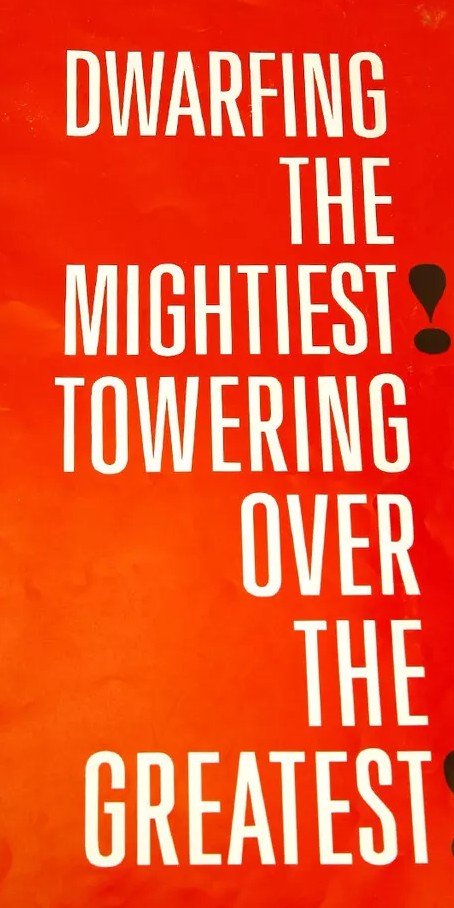
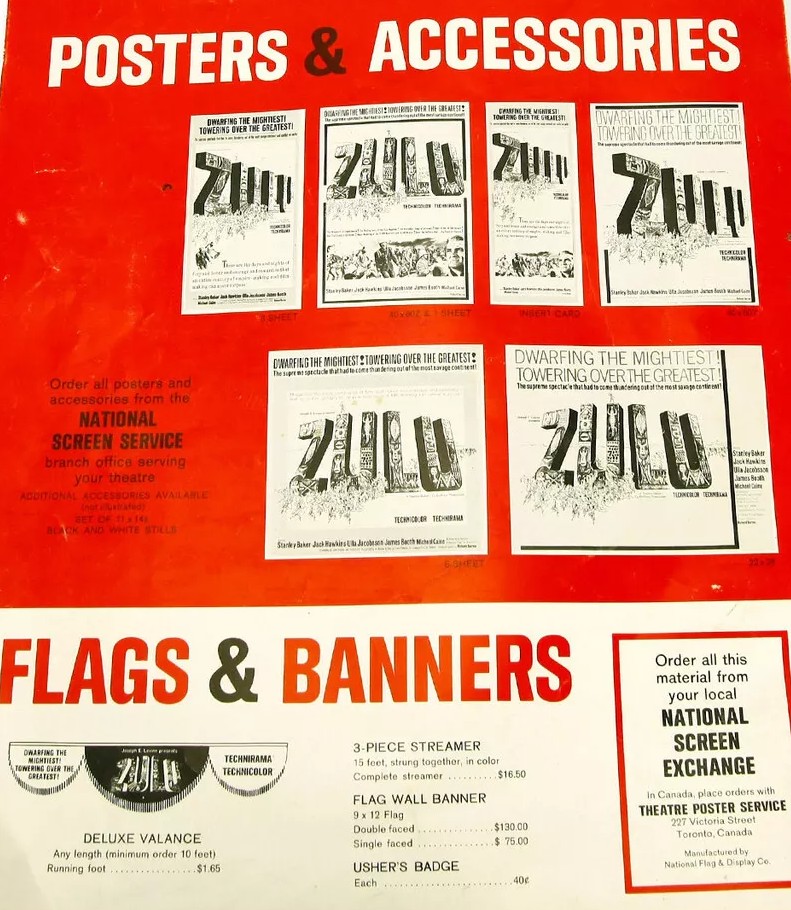
Behind the Scenes: Selling “Zulu” (1964) – The Pressbook

“Dwarfing the Mightiest! Towering over the Greatest!” wasn’t just the movie’s tagline. It could have easily been used to describe the Pressbook. This folded out into a colossal 40 inches wide  by 20 inches high, one of the biggest pressbooks ever produced.

The marketing team produced an impressive list of ideas. Cinema managers were urged to get war correspondents and war heroes involved and to blow up photos of the Victoria Cross. Hanging on the name of the star was a “Baker’s Dozen” competition, inviting people to list the thirteen movies featuring Stanley Baker. Quite how they thought a promotion involving banks would go down is anybody’s guess. Especially as this was the notion: “Zulus are allowed as many wives as they want, provided they can afford to pay for them. The price ranges between six and twenty head of cattle per wife. For an interesting tie-in, get local banks to display money and other barter materials. Give them a montage of still from the picture to display.” Culturally tone-deaf doesn’t cut it.

To attract children there was a coloring-in competition and a school study guide. The movie was available in 70mm Super Technirama so there was a special advertisement linked in to that for cinema going down that route.

Other taglines included: “The supreme spectacle that had to come thundering out of the most thrilling continent!” and “These are the days and nights of fury and honor and courage and cowardice that an entire century of empire-making and film-making can never surpass!”

And in case hyperbole wasn’t enough, one of the ads spelled out the exciting details. “The Massacre of Isandlwana! The Mating Song of the Zulu Maidens! The Incredible Siege of Ishiwane! Night of the 40,000 Spears! Days That Saved a Continent! Mass Wedding of 2,000 Warriors and 2,000 Virgins! Amid the Battle’s Heat…the Flash of Passion!”

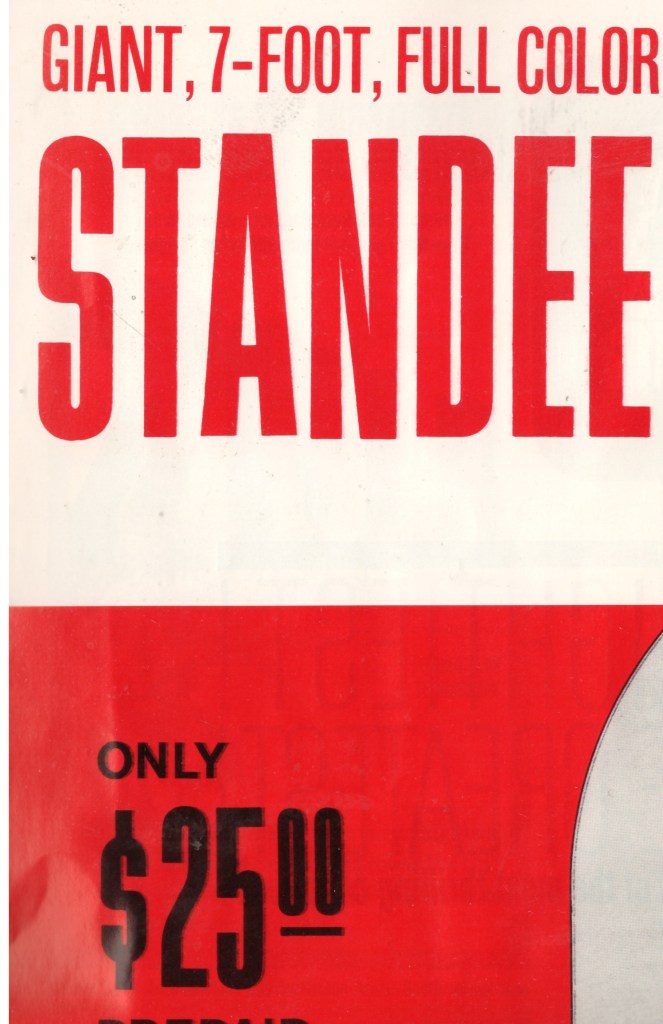
There was a seven-foot high standee and a three-foot 3D illuminated standee.

To help sell the picture to local journalists, little articles were planted that could hook an editor’s interest. For example, when director Cy Endfield glimpsed some soldiers firing their rifles left-handed, he stopped filming, because British soldiers were required to shoot right-handed. The film was shot in the shadows of the Darkensberg Mountains. The river which flowed past Rorke’s Drift was slower than it had been at the time of the battle so the course was altered and dammed to increase the flow. Out of sight of the cameras but essential to filming were the modern villages constructed to house cast and crew, stores, catering and compounds for horses and oxen.

The cast were on set at 6.30am for make-up. The Zulus spent more time in make-up than the British soldiers, as the costume department ensured every aspect of their outfits was historically correct. A total of 100lb of small colored beads was crafted by made by local women for the maidens to wear. A primitive method of making necklaces, strung together with animal sinew and rolled by hand, was employed incorporating a further 100lb of wild syringa seeds which were dyed.

The warrior loincloths of softened animal skins were made the traditional way using stones aqnd animal fat. Shields were also made from animal skin. The teeth of tigers and baboons formed their necklaces. They kept snuff in a small gourd worn round the waist. The purpose of a porcupine quill tucked into their hair was to extract thorns after a long march.

Three cameras were utilized to shoot the blaze that burned down the hospital. “Undress rehearsal” was the name given to the marriage ritual scenes of bare-breasted women.

Though Michael Caine was being touted for stardom, as far as the Pressbook was concerned he was relegated to section below Jack Hawkins, James Booth and Ulla Jacobsen who had smaller parts. The movie was a notable change for Jack Hawkins, who saw action in World War Two. Instead of playing his usual hero, he was a weakling and drunk. It was the second English-language film for Swede Jacobsen after Love Is a Ball / All This and Money Too (1963).

Behind the Scenes: “The Silencers” (1966)

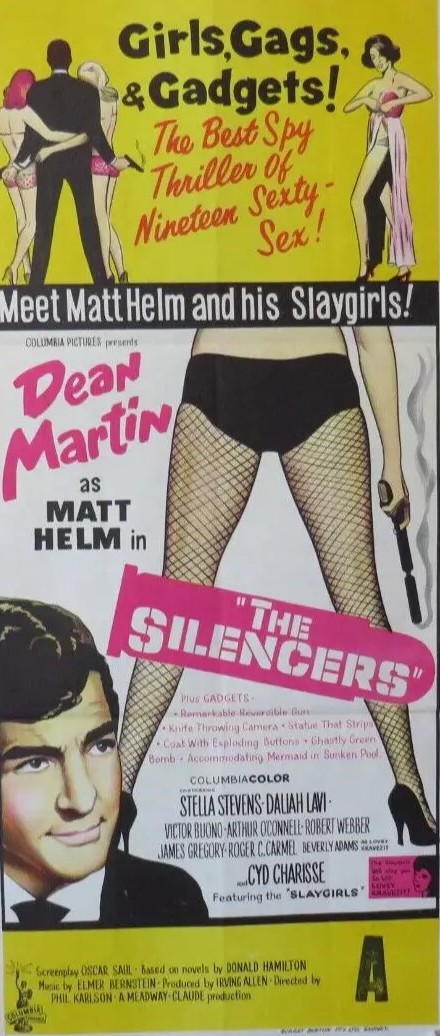
Producer Irving Allen remains best known as the fella who turned down James Bond. While partnered with Cubby Broccoli in Warwick Films, he decided the Ian Fleming books were not big screen material. Their production shingle, based in Britain, had turned out movies like The Red Beret (1953) with Alan Ladd and Fire Down Below (1957) pairing Robert Mitchum and Rita Hayworth. Divorced from Broccoli, Allen headed down the big-budget historical adventure route but neither The Long Ships (1964) spearheaded by Richard Widmark and Sidney Poitier nor Omar Sharif as Genghis Khan (1965) hit the box office target.

Luckily, Allen had already made an investment in espionage, owning the rights to the hard-edged Matt Helm novels, knocked out at the rate of one or two a year since 1960 by Donald Hamilton whose most notable brush with Hollywood was selling the rights to his novel The Big Country (1958) filmed by William Wyler with a top-class cast.  The Matt Helm series was praised by the top thriller critic of the era, Anthony Boucher, who noted that Hamilton brought “sordid truth” to the espionage genre and “the authentic hard realism of Dashiell Hammett.”

Having optioned the books, Allen persuaded Columbia to buy the rights to eight, with the notion of setting up a direct rival to James Bond, that idea given an extra fillip when the Sean Connery series which had appeared on an annual basis skipped 1966. Initially, Allen planned to make films that followed the novel’s serious approach to espionage, intending to cast a  marquee name like Paul Newman (The Prize, 1963) – who ironically proved major competition for the first offering through Hitchcock’s Torn Curtain (1966) – or conversely a relative unknown such as Mike Connors (Harlow, 1965).

To hook Dean Martin, Allen had to make him a partner, resulting in the actor making more dough out of a spy film than Sean Connery did from Bond. Martin was something of a Hollywood enigma. Audiences who flocked to the Rat Pack outings tended to disdain his stand-alone efforts such as Toys in the Attic (1963) and Kiss Me, Stupid (1964) and if he was a current household name that owed much more to his recording and television career.

But Allen shifted the emphasis away from straight adaptation to tongue-in-cheek, setting up the series initially as gentle parody rather than out-and-out spoof though as the movies progressed they fell more into the latter category.

Playing to Martin’s strengths of urbane charm and effortless style, as well as his reputation as a lothario, and accommodating his age (he was 48) by ensuring his character was brought out of retirement, and with comedy writer Herbert Baker brought in at Dean Martin’s behest to beef up Oscar Saul’s script, and by surrounding him with more heavyweight damsels than the Bonds, the series was good to go. Baker had written early Dean Martin-Jerry Lewis vehicles like Jumping Jacks (1952) and Scared Stiff (1953). The script drew upon two Hamilton novels, Death of a Citizen (the first in the series) and The Silencers (the fourth). The idea of Helm being married was dropped to allow him the same sexual license as James Bond.

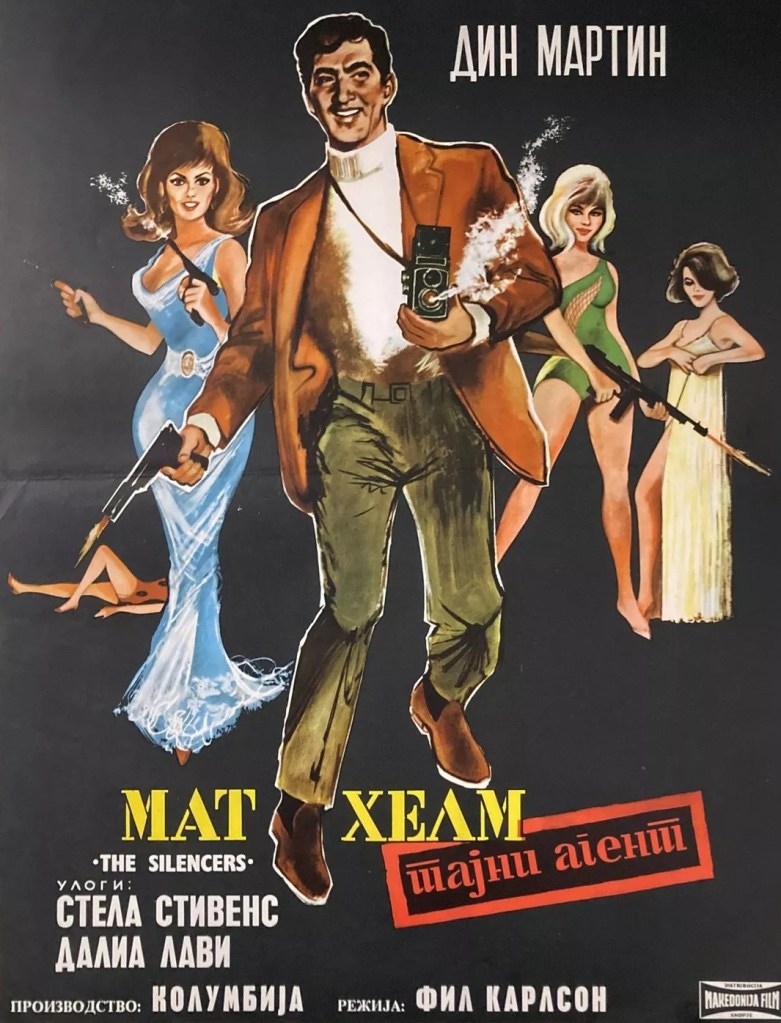
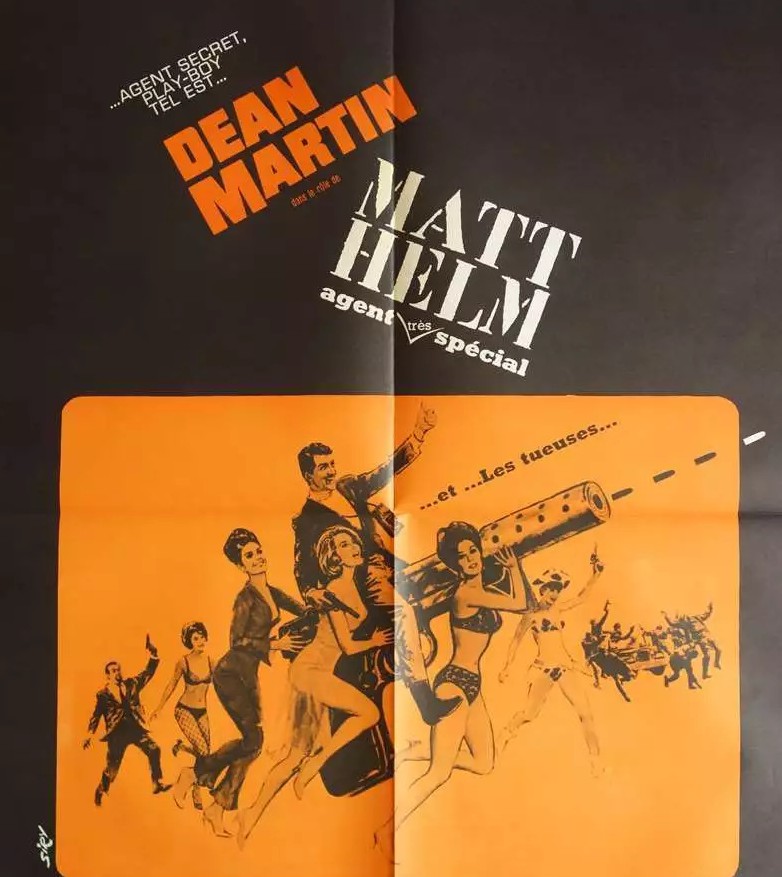
Stella Stevens and Daliah Lavi were unusual choices for the leading ladies of a spy picture, their proven marquee appeal considerably in excess of that of  Ursula Andress (Dr No, 1962), Honor Blackman (Goldfinger, 1964) and Claudine Auger (Thunderball, 1965), that trio of movies opening Hollywood doors for the actresses rather than as with Stevens and Lavi already being welcome attractions. Lavi had starred in The Demon (1963) and Lord Jim (1965) while Stella Stevens had been female lead in The Nutty Professor (1963) and Advance to the Rear (1964). The Slaygirls, however, a direct imitation of the Bond Girls, also owed something to Playboy’s Playmates.

Other cast members had some distinction, Victor Buono Oscar-nominated for Whatever Happened to Baby Jane (1962) and James Gregory acclaimed for his role in The Manchurian Candidate (1962). Both had worked previously with Martin, Gregory on The Sons of Katie Elder (1965) and Buono on 4 for Texas (1963) and Robin and the 7 Hoods (1964).

Martin also called upon President Lyndon B. Johnson’s personal shirtmaker Sy Devore, previously personal clothier to Martin and Lewis, to come up with his stylish attire.

Budgeted at just under $4 million, The Silencers began shooting on 12 July 1965, the 12-week schedule (ending 16 September) taking in locations like Carsbad Caverns, White Sands, El Paso and Juarez with the car chases filmed in Santa Fe and Phoenix, Arizona. Columbia’s backlot was deemed too small for interiors, and two of Desilu’s largest soundstages were joined together to make Big O’s underground HQ.

Director Phil Karlson (The Secret Ways, 1961) and the producer didn’t see eye-to-eye. Despite ostensibly aiming for a comedy, Allen wanted Karlson to adopt the style of the more serious The Ipcress File (1965) and shoot “through chandeliers, under tables.” It turned out that movie’s director Sidney J. Furie had relied on Karlson for most of his cinematic flourishes.

Like Sinatra, Martin preferred one take. “Dean was always great to work with,” recalled James Gregory, “because he never took himself seriously…Dean was always relaxed – if it doesn’t work do it over, but for heaven’s sake you oughta not need more than that one or two times to get it right.”

Despite the easy-going atmosphere, there were casualties. Buono was out of action for four days after slipping while climbing a wall, foot in an unseen cast for the rest of his time on the picture. Supporting actor Arthur O’Connell’s face was sliced open during an explosion. He completed the scene with the bandage covering the wound hidden under a turtleneck sweater. Stunt man Tom Hennessey lost three front teeth. There was a bill of several thousand dollars to cover an unexpected explosion on set, combustible dust igniting after one of the grenades went off on the Big O set.

Astonishingly the movie came in $500,000 under budget and $1 million was recouped from television sales. Columbia was so taken with the end result that prior to its release two sequels were announced.

The Slaygirls featured prominently in promotional activities in the U.S. with six sent overseas to hustle up interest. As well as a movie tie-in paperback and album, merchandising included toy guns from Crescent Toys and Louis Marx. Martin wasn’t available for the Chicago world premiere (he was shooting Texas Across the River, 1966) on 16 February 1966. The movie was gangbusters from the start, clocking up $7.35 million in U.S. rentals (the studio’s cut of the box office), enough for 85th spot (by my exclusive count) on the list of the top earning films of the decade.

SOURCES: Brian Hannan, The Magnificent ‘60s, The 100 Most Popular Films of a Revolutionary Decade (McFarland, 2022); Bruce Scivally, Booze, Bullets and Broads, Behind the Scenes with Dean Martin’s Matt Helm Films of the 1960s (Henry Gray, 2013); William Schoell, Martini Man: The Life of Dean Martin (Cooper Square Press, 2003); Cinema Retro Movie Classics Issue No 9: Matt Helm’s Back in Town.   

Behind the Scenes: Selling The Million-Dollar Marlon Brando – “The Fugitive Kind” (1960) Pressbook

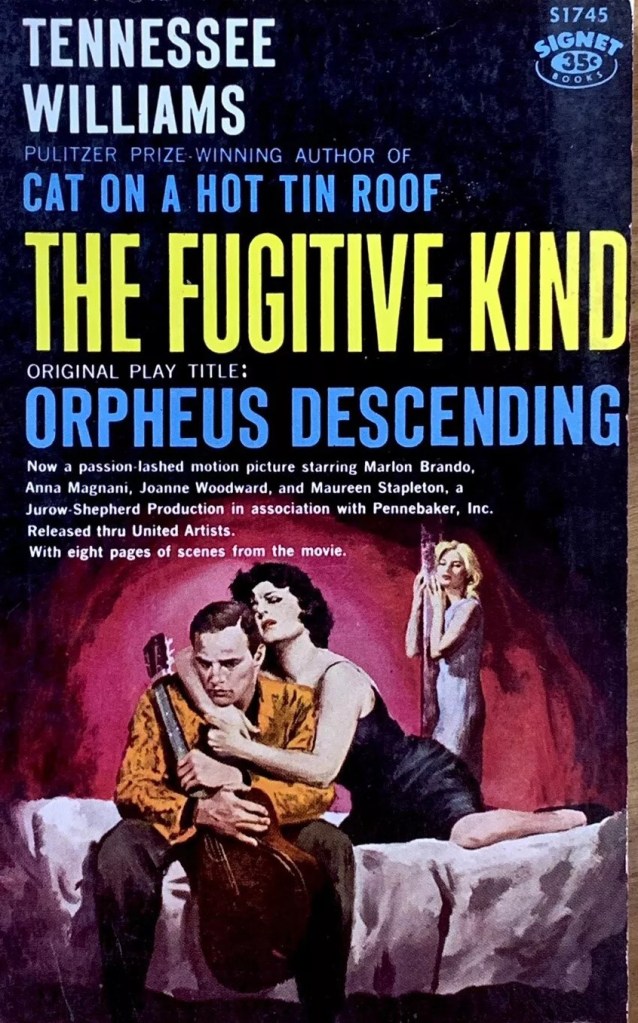
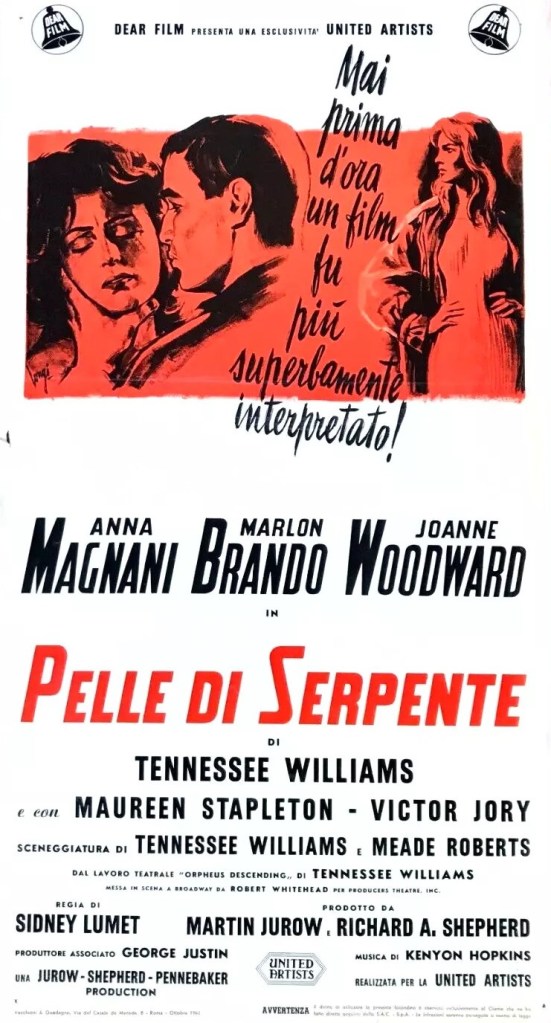
Should have been a darned-easy sell. After all, Marlon Brando had made global headlines after becoming the first actor to be paid a million bucks for a movie, his fee for The Fugitive Kind outstripping by $250,000 the previous record jointly held by John Wayne and William Holden (see Note below) for The Horse Soldiers (1959). And there was no suggestion – as indeed there is not even now – that audiences held against the stars the wealth their talents accrued.

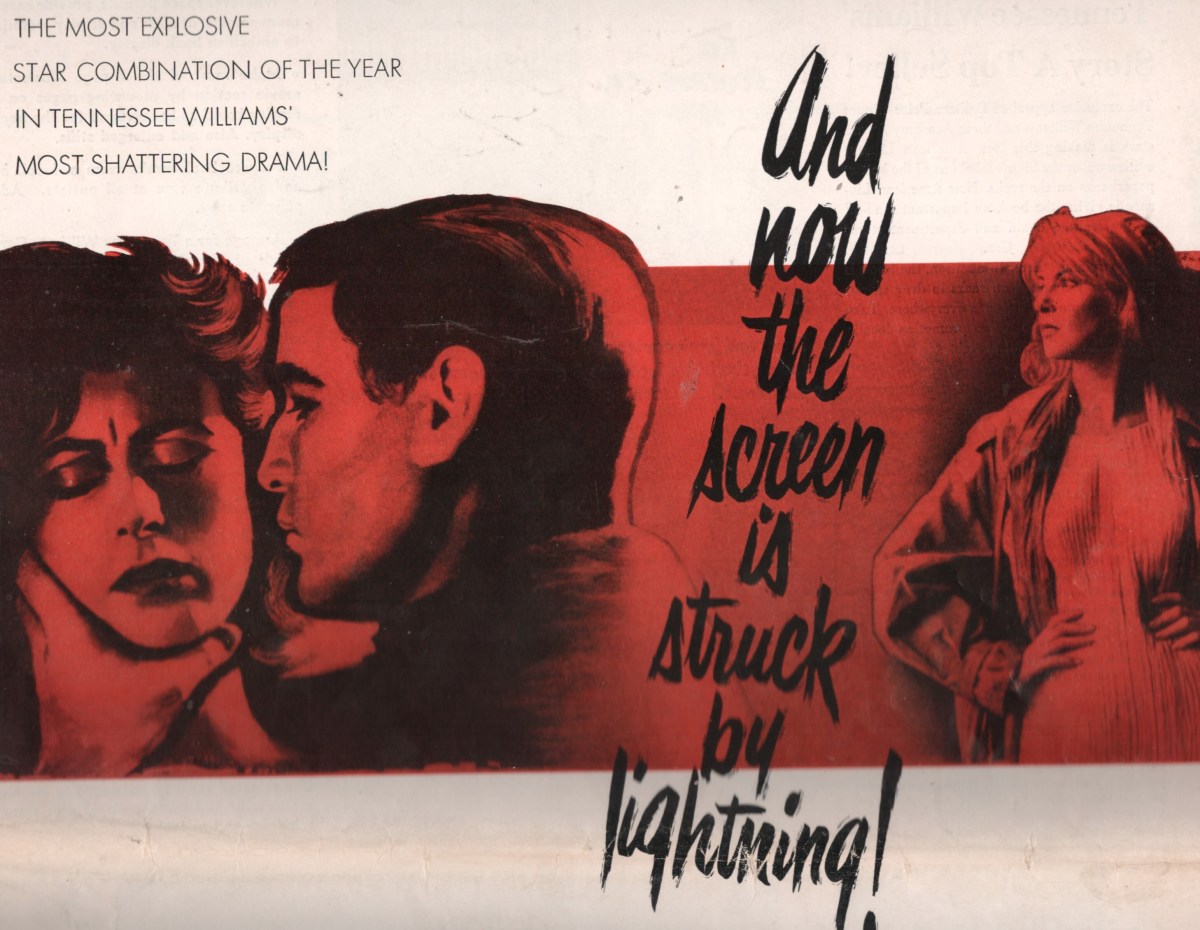
“The Most Explosive Star Combination of the Year” was how this was generally sold, on the back of the Oscars held by each of the principals, Brando, Italian Anna Magnani and Joanne Woodward and the Pulitzer Prize awarded to playwright Tennessee Williams, himself also a two-time Oscar nominee as well as his work providing Oscar wins and nominations by the bucket load for actors and directors.

“Something about the way he looked at a woman, something about the way he handled a guitar” were other notable taglines and marketeers tried to convince the public “the screen is struck by lightning.” And if that was not enough – “their fire…their fever…their desire” was expected to do the trick.

Publicists encouraged exhibitors to make full use of Brando’s accoutrements from the movie, namely his snakeskin jacket, Rolex and Kay Guitar, which in one scene he actually played. Suggestions included auctioning a guitar for charity and running a talent contest. Brando was a reasonably accomplished player, specializing in perennials like “Shenandoah” and “Streets of Laredo.”

How to make a snakeskin jacket was another angle.  The Rolex watch his character wore presented opportunities for marketing tie-ups with jewellery stores. No marketing stone was left unturned to the extent of the Necchi sewing machine, seen in the movie, being offered as a prize in a national competition. Novo Greetings Cards were also seen in passing in Lady Torrance’s store and this company was backing the movie.

Unusually, Signet was using the movie tie-in approach to sell a play, the paperback comprising the source material Orpheus Descending, which included an eight-page spread of stills from the picture. Williams’ position as the most popular playwright of his generation – his only rival Arthur Miller had less success in Hollywood – brought potential access to libraries, book clubs and schools. Military bases around the world were targeted  through marketing material emphasizing Joanne Woodward.

It would certainly have helped if the movie had been able to set a new fashion trend for the wearing of snakeskin jackets. Or revive a trend that had last occurred in the 1930s, “quite a craze” for shoes, bags, hats and belts. “It wouldn’t surprise me,” said United Artists costume designer Frank Thompson, “if Brando wearing this jacket starts the whole thing again.”

Thompson had quite a task making two identical jackets – in case one was damaged during filming. First of all, he had to locate skins that were found in Mississippi. The choice came down to rattler or python. Opting for python, Thompson went through 200 skins before he found three that matched. “Looking for two snakeskins that match identically is like looking for two fingerprints that are exactly the same.”

The film was based on Battle of Angels, written by Williams in 1939, his first full-length work professionally staged (in Boston). He “never quit working on this one…it never went into the trunk, it always stayed on the work bench.” Rewriting about 75% of the play, it was reprised as Orpheus Descending on Broadway in 1957. Although Williams had Brando and Magnani (star of the film version of The Rose Tattoo, 1955) in mind for the stage play, it went ahead instead with Cliff Robertson and Maureen Stapleton. Williams had written The Rose Tattoo for Magnani but again it was Maureen Stapleton who won the role on stage.

Williams had outstanding success in writing roles that were in tune with Oscar sensibilities. A Streetcar Named Desire (1951) won Oscars for Vivien Leigh, Kim Stanley and Karl Malden with Brando nominated. Anna Magnani won for The Rose Tattoo and Marisa Pavan was nominated. Other nominations included Carroll Baker and Mildred Dunnock for Baby Doll (1956), Elizabeth Taylor and Paul Newman for Cat on a Hot Tin Roof (1958), and Katharine Hepburn and Taylor for Suddenly, Last Summer (1959).

Despite its Mississippi location and except for external establishing shots, The Fugitive Kind was shot in the Bronx. Director Sidney Lumet was a notably New York kinda guy, having filmed his first three movies – Twelve Angry Men (1957), Stage Struck (1958) and That Kind of Woman (1959) – in the city.

He argued, “Hollywood’s great attractions have been the technicians and the shooting facilities, With care, men of comparable talent can be found in New York. As for facilities, a sound stage is a sound stage wherever it is. I concede that in California they’re larger and more elaborate, but the same results can be produced elsewhere. And the fabulous back-lots, which counted so heavily in the past, seem to be outmoded today by the sophisticated eye of the audience. You can’t shoot on studio streets and pretend any more. It has to be real.”

NOTE – William Holden pocketed around $3 million in the end as his percentage share of the gross –not the more contentious net – of Bridge on the River Kwai (1957) so he was the decade’s biggest winner until Richard Burton made more on a similar deal from Where Eagles Dare (1968).

Behind the Scenes: “Wild Rovers” (1971)

Director Blake Edwards shouldn’t have been anywhere near Wild Rovers in November 1970 when filming of the western kicked off in Arizona. He should have been making a musical – his second successive one following Darling Lili (1970).  

Versatility had become something of a watchword for Edwards who had segued apparently effortlessly from the gentle romance of Breakfast at Tiffany’s (1961) to thriller Experiment in Terror/Grip of Fear (1962) to alcoholic drama Days of Wine and Roses (1962) to wild comedy The Pink Panther (1963) to slapstick The Great Race (1965) – in 70mm roadshow no less – to the satirical What Did You Do in the War, Daddy (1966). So Hollywood wasn’t enormously surprised when he decided it was time he tackled a musical, Darling Lili, especially when it starred “sure thing” Julie Andrews.

And before the figures for Darling Lili came in, and everyone thought they were onto a winner, small surprise that he was in the front line to direct She Loves Me, the movie adaptation of a 1963 Broadway musical that was the second musical reincarnation – the first being The Good Old Summertime (1949) with Judy Garland – of romantic comedy The Shop around the Corner (1940) starring James Stewart.

But in 1969 – before Darling Lili slumped at the box office – a takeover of MGM by Kirk Kerkorian was imminent and in anticipation of some drastic action studio executives canned its three biggest projects, Fred Zinnemann’s Man’s Fate, the $10m She Loves Me – also to star Julie Andrews (now Edwards’ wife) – and the $12m-$15m Tai Pan. Edwards sued for $4.6 million.

Edwards had other fish to fry – his company Cinema Video Communications had purchased the latest Harold Robbins’ novel The Betsy plus The Peacemaker, the first novel by war historian Cornelius Ryan (The Longest Day). Edwards had plans to film Svengali with Jack Lemmon and Julie Andrews and Kingsley Amis’s novel The Green Man with Richard Burton.

Despite having informed MGM that he would not accept any substitute for She Loves Me, he capitulated when the studio agreed to back his pet project, a buddy western with a serious theme, Wild Rovers. Paul Newman was initially sounded out with the younger character looking a good fit for Michael Witney, expected to be the breakout star of Darling Lili.

William Holden was picky about his projects. He complained that most scripts he received were “aimed at exploitation or titillation.” Though he had not had a hit since the start of the previous decade with The World of Suzie Wong (1960), his global investments had paid off and he was happier spending seven months of the year on his 1,260-acre ranch in Kenya. He was impressed enough with the Blake Edwards script for Wild Rovers and, possibly optimistic about its commercial prospects, to defer part of his salary against a percentage of the gross (he had made a fortune from his percentage on Bridge on the River Kwai). Apart from Wild Rovers, the only movie which had caught his attention was The Revengers co-starring Mary Ure (after it was delayed due to his illness, she pulled out).

Even so, MGM held Edwards on a tight rein financially. While trying to extricate itself from a sticky corner, it had no wish to find itself in the kind of lack of budgetary restraint that had afflicted Darling Lili. And to some extent, Edwards had to prove he was more fiscally responsible. The budget for the below-the-line cast was restricted to $1.5 million. There was considerable physical commitment to the project from the two stars, training for six weeks so the scene taming the wild horse could be completed without stunt men.

MGM had high hopes for the western, backing it with a substantial promotion campaign. In the trades there were three-page ads and a separate advert paying homage to the studio’s “writer cats.” The studio had weathered the Kerkorian storm and the massive write-offs at the end of the previous decade. The mood was buoyant. The first quarter of 1971, bolstered by an unexpectedly good showing by Ryan’s Daughter (1970). While not hitting the highs of Doctor Zhivago (1965) it had done much better than the industry predicted, especially after being savaged by critics. It looked as if MGM had turned a corner. In the first three months of 1971 the studio made $2.5 million profit and was confident that summer offerings Shaft, The Last Run and Wild Rovers would maintain the good run.

After the box office fallouts of recent years, it looked as though the entire industry was on the verge of bouncing back. Released by other studios around the same time as Wild Rovers were the likes of Klute, The Anderson Tapes, Summer of ’42, Willard, and Carnal Knowledge

The reviews weren’t promising. Variety tabbed it “uneven”, only one of the top five New York critics gave it a favorable review. An opportunity to gain some critical headway was spurned when the studio pulled the movie from the annual Atlanta Film Festival in favor of an appearance by the two stars on the Dick Cavett Show.

The version released ran 110 minutes. There was no critical outcry at the film being savagely edited by the studio – nobody cared sufficiently about the picture to be up in arms about it.

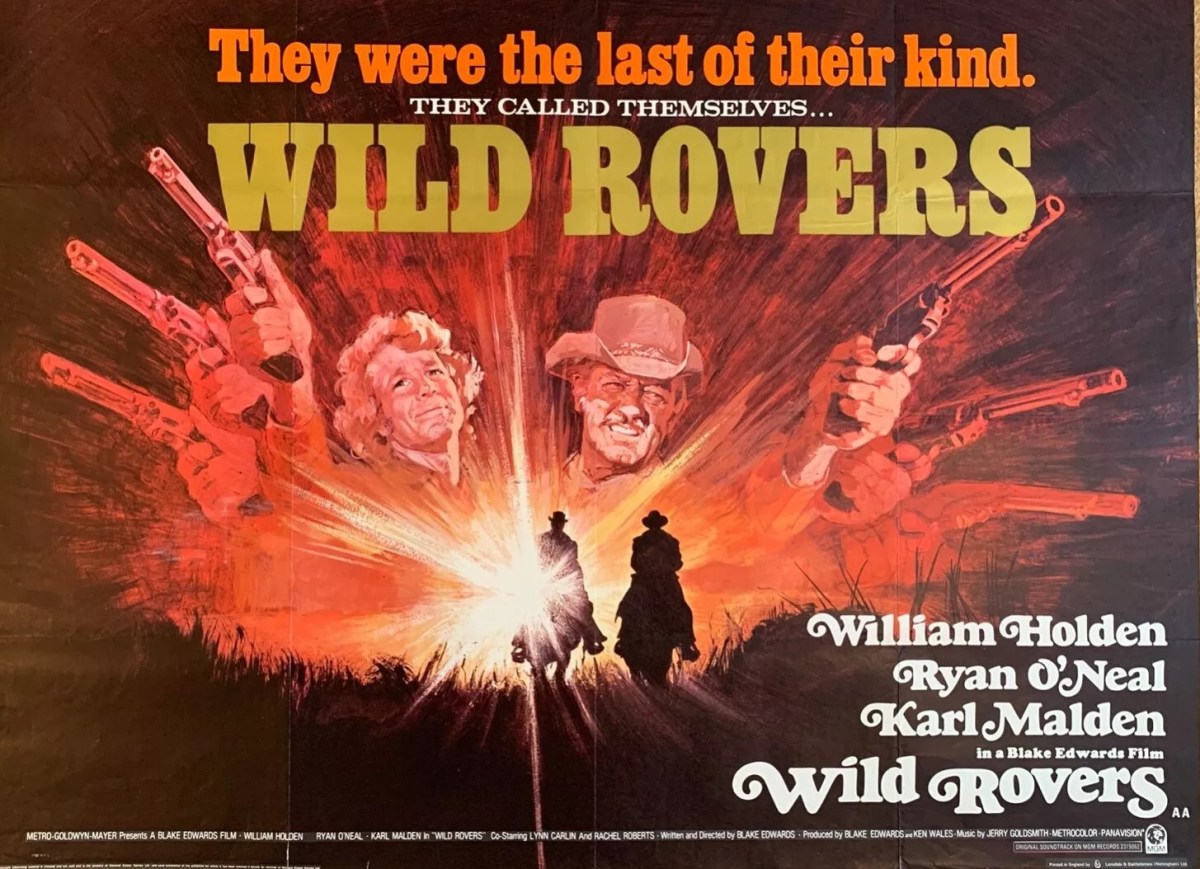
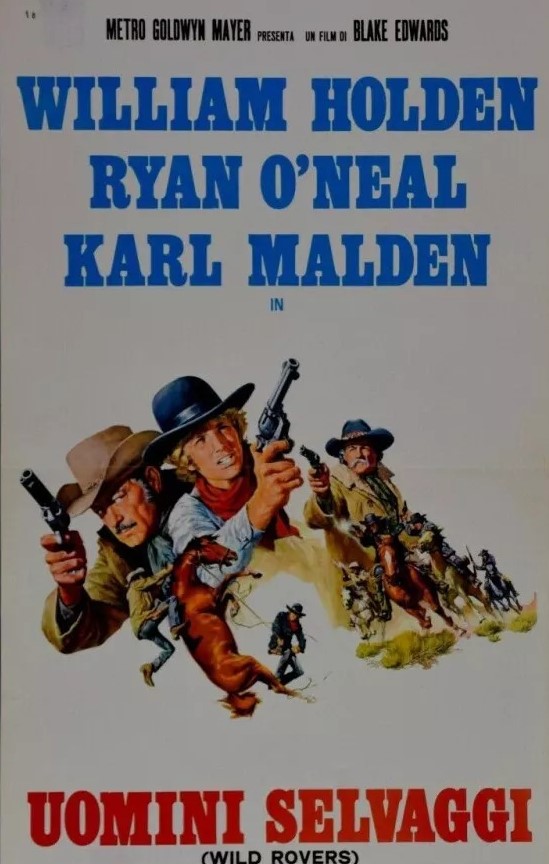
Worse, the marketing campaign was widely derided. The image of William Holden and Ryan O’Neal astride the same horse, the youngster grinning, leaning into the older man’s back, gave off, unintentionally, homo-erotic undertones. Audience dismissal of the advert only became clear to MGM at the end of the movie’s first six days at the first run Grauman’s Chinese in Los Angeles which registered less than $20,000 at the box office. Shocked at the low result, MGM “scrapped its entire pre-release and opening campaign” shifting the emphasis from the “man-to-man image” to “guns, horses and adventure” suggesting an old-fashioned shoot-em-‘up.

The new advertisement was accompanied by anonymous quotes, comparing Holden and O’Neal to Clark Gable and Spencer Tracy – though as Variety acidly noted, without identifying which was which – and describing the shootout as “so electrifying your impulse is…to run for cover.” Phantom quotes had been used before by Avco Embassy for De Sica’s war drama Sunflower (1970) starring Sophia Loren and Marcello Mastroianni. But while Hollywood was fond of editing reviews to find an often-misleading quote, studios generally drew the line at making them up.

The New York release in a trio of first run houses coincided with the showcase outing of Love Story (1970). That movie had played for months in first run and this was the first time it was generally available. Love Story, the hit of the decade so far, would open in 80 suburban cinemas on the same day in June, 1971, as Wild Rovers. In the era before “Barbieheimer”, there was still an expectation of cross-over, that the fans of a new star coming good like Ryan O’Neal would automatically seek out his latest picture. And it may have been that the advertising campaign was specifically designed to ensure his fans did not go to the western expecting another romantic drama.

They weren’t tempted at all. Love Story cleaned up – a gross of $1.25 million from 80 outlets and another $750,000 the following week. Compared to that, Wild Rovers scarcely got out of the gate – a “less than roaring” $20,600 from the three. At the 1,096-seat Astor it was on a par with the fourth week of Escape from the Planet of the Apes (1971) which had just completed its run there.

There was a little solace elsewhere. Its $15,000 in Baltimore was deemed “tall” and $12,500 in Boston “slick” but more reflective of the general interest was a “dim” $65,000 from eight theaters in Detroit, a “mild” $7,500 in Denver and “moderate” $8,500 in Minneapolis. By the end of the year it had amassed $1.8 million in rentals, languishing in 59th place.   

MGM took a different tack in Europe. It wasn’t unusual for movies released in 35mm in America to be shown in 70mm roadshow in Europe – The Dirty Dozen (1967), Where Eagles Dare (1968) and The Wild Bunch (1969) enjoyed up to a year in roadshow before fanning out into general release, getting two substantial bites of the commercial apple. The latter two had done better abroad than at home, in large part due to the roadshow release which turned a movie into an event rather than a routine outing. So MGM sent Wild Rovers out in roadshow. At 110 minutes, even puffed out with a 15-minute interval, it was a mighty slim offering for roadshow.

In London, half the critics came out against it, but only a quarter were favorable, the others having “no opinion.” The consensus was that it would “not survive the rough critical handling.” It opened on October 21, 1971, at the ABC2 in London’s West End. And lasted two weeks, whipped off the screen after generating an opening week of $6,200 and a sophomore of $4,100, replaced by The Last Run starring George C. Scott, another flop.  MGM persevered with the roadshow. It played for five weeks at the Coliseum in my home town of Glasgow.

In the U.S. it shifted quickly to television, part of the CBS program, finishing a lowly 85th for the year in the tabulations of the movies attracting the biggest television audiences.

SOURCES: “Metro’s Loves Me As A Substitute for Former Say It With Music,” Variety, August 6, 1969, p3; Army Archerd, “Hollywood Sound Track,” Variety, October 20, 1970, p6; Army Archerd, “Hollywood Cross Cuts,” Variety, August 5, 1970, p23;  “Holden Pushes for Conservation,” Variety, August 12, 1970, p25; Army Archerd, “Hollywood Sound Track,” Variety, November 4, 1970, p20; “Hollywood Production Pulse,” Variety,  November 18, 1970, p54; Advert, Box Office, March 28, 1971, p3-5;  “Profitable Quarter for MGM,” Kine Weekly, April 24, 1971, p3; Advert, Variety, May 17, 1971, p23-25; Advert, Variety, May 19, 1971, p12; Review, Variety, June 23, 1971, p20; “Col Delivers Atlanta Festival,” Variety, June 23, 1971, p6; “New York Critics,” Variety, June 30, 1971, p7; “Metro Scraps Rovers Campaign,” Variety, June 30, 1971, p27; “London Critics,” Variety, November 17, 1971, p62; “Big Rental Films of 1971,” Variety, January 5, 1972, p9. Box office figures from Variety June 30-August 18, 1971, and November 10-17, 1971.

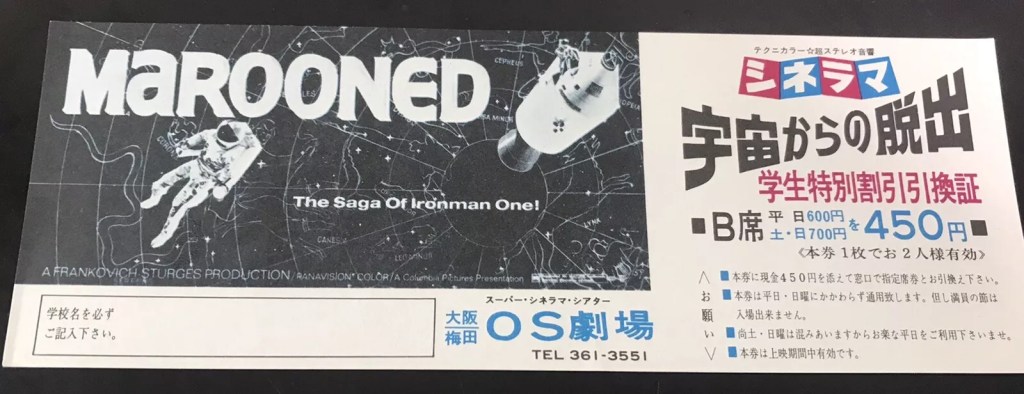
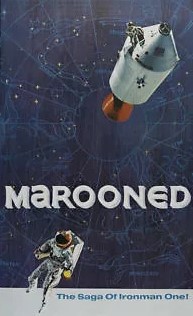
Behind the Scenes: Selling Jeopardy in Space – Pressbook for “Marooned” (1969)

You could come away from the Pressbook/Exhibitors Manual wondering if some of the actors were in the wrong profession, given the number of accomplished pilots on the roster.  James Franciscus held a commercial license for multi-engine planes and had logged three thousand flying hours in three years. Gene Hackman not only had a private flying license but was in the process of building his own biplane.

Producer Mike Frankovich had flown with the US Air Force during World War Two, clocking up 7,000 hours flying time and ending up a colonel. Technical expert George Smith had ejected at 6,000 feet from a plane flying at 800 mph.

Another less well-known fact, Natalie Wood (who was appearing in producer Mike Frankovich’s Bob and Carol and Ted and Alice, 1969) was fluent in Russian and was brought in to translate for a showing of the movie to visiting Russian spacemen. Nancy Kovack, by the way, was equally talented, speaking Persian and other languages.

As much as the main function of the Pressbook was to provide exhibitors with a range of adverts in every conceivable size that they could cut out and take along to their local newspaper, its secondary function was to provide cinema owners with promotional ideas and to provide snippets and articles that could be passed on to a local friendly reporter.  But pickings were slim for jouranlists. Not surprisingly, Gregory Peck didn’t have much say, since whatever he did have to say he’d said already as promotion work for the two other features preceding Marooned this year. And nobody’s spilling the beans on the special effects.

Due to the bulkiness of their space suits, the three actors playing astronauts couldn’t sit down between takes and instead the production employed “the slanted boards usually leaned against by elaborately-gowned female stars to protect their costumes.” (You learn something new about the business every day!). Never mind the bulkiness, the actors spent a chunk of their time in the air and the one day James Franciscus expected to meet acting hero Gregory Peck (they had no scenes together) it proved impossible as when the star visited the capsule set Franciscus was 60 ft in the air.

Richard Crenna got a better response from his young son, who had little concept of what an actor did. But after seeing his dad floating around in space high above him, he reckoned his father was actually a hero

For such a male-oriented picture, Columbia made a big play for the female audience. “The Ladies Love Marooned,” boasted one advert in the 16-page A2 Pressbook/Campaign Manual aimed at exhibitors. Pulling on quotes from critics nobody had really heard of, it managed to present the notion that the picture was as exciting, fascinating, “ingeniously-devised,” and suspenseful for women as much as men, at the same time as focusing on the feminine aspects of the movie – “Lee Grant is a knockout.”

The Pressbook itself allocated editorial space to the three female stars. For Lee Grant the slant was that her talent had been recognized by a host of awards – Emmy, Obie, Best Actress at Cannes plus an Oscar nomination (she would later win an Oscar for Shampoo, 1975). But you have to wonder how an actress would respond to be called, in print, “an egg-head with sex” as was the case with Nancy Kovack. In between turning out such pictures as Tarzan and the Valley of Gold (1966) and this, Kovack had been resident in Iran where she made Diamond 33 (1967) and Night of the Angels (1968). By comparison, Mariette Hartley got off lightly, thanks to her Shakespearian training.

A separate 4-page A2 insert promoted the three Oscar nominations for cinematography, sound and visual effects. “Nominated for 3 Academy Awards,” was the slug accompanying the ads. Never mind the reviews from female critics, much bigger space was devoted here to a rave review form Rex Reed, one of the most famous critics of the day (and star, if that’s the right word, of Myra Breckenridge, 1970), who claimed Marooned was “as exciting, spirited and suspenseful as any spy movie or any cops-and-robbers movie ever made.”

As you might expect, the bulk of the promotional ideas were science-based. Exhibitors were told to target the country’s 2,500 science clubs, the armed forces, the industries that supported the space program and, of course, schools and colleges. Tie-ins had been achieved with 4,500 A&P stores, Jane Parker Donuts, and Philco-Ford dealers.

From a contemporary marketing standpoint, the surprising tie-in was with Omega watches, tagged “the first watch on the moon,” the company’s Speedmaster brand not just worn by the astronauts who did land on the moon in July 1969 but seen in the picture on the wrists of Gregory Peck, Richard Crenna, David Janssen, Gene Hackman and James Franciscus. Over 4,000 dealers were backing the movie.

Model kit manufacturer Revell was offering space suits as prizes in a competition. It distributed more than 42,000 standees and posters and printed five million entry forms. Bantam books was promoting the original novel by Martin Caidin.  That exhibitors would be eager to equip a staff member with an astronaut’s garb and have him/her parade through the streets went without saying. Using lift-off sound effects in a cinema lobby was another idea or turning the entire lobby into a space set.

Rather disconcertingly, the marketing bigwigs thought it would be a clever idea to propose a discussion program on radio or local television on the subject of what would happen if spacemen were marooned, a rather tetchy subject when that became reality.

Unusually, but not surprisingly, the posters stuck with the one tag line: “Three marooned astronauts. And only 55 minutes left to rescue them. While the whole world watches and waits…” and buttressed by some thumbs-up quotes from the likes of reviewers from the New York Times, Redbook, Los Angeles Times and Los Angeles Herald Examiner. In fact, the advertising department took such a shine to Charles Champlin of the LA Times that they cut up his review and stuck snippets of it in three separate ads.

You’ll have seen from the variety of adverts I’ve used to support the review and the Behind the Scenes article earlier in the Blog, that there was a wider range, initially, of adverts, some showing the capsule stuck out in the middle of space. By the time it came to printing this Pressbook, the one for the picture’s general release, all of those were jettisoned in favor of the insipid “thumbs-up” poster with faces to the foreground and the launch in the background, attendant quotes and the “3 Academy award Nominations” slug.

Behind the Scenes: Raquel Welch, Unknown Actress, 1964-September 1966, Gets The “Big Build-Up”

As demonstrated in Madison Avenue (1961), the “big build-up” was code for inflicting on an unsuspecting public an unlikely candidate for acclaim. Of course, for decades, Hollywood hacks had been bombarding fan magazines, weeklies, glossy monthlies and dailies with beefcake and cheesecake photos of promising new talent. But the hook was that these actors were shortly appearing, albeit in a bit part, in a few months’ time in a forthcoming movie.

Modelling was another device to attract the attention necessary to generate a screen career. Sometimes, these (predominantly female) models would be making their first throw of the dice, hoping that some producer in an idle moment might catch a glimpse. Or, they could be women who made a living from selling such snaps to such media.

But, usually, it was one thing or the other: gratis photos handed out by grateful studio marketing teams or photos that an editor paid for in the hope they would increase circulation (in the days when there was no such thing as a giveaway magazine). La Welch appears to have fallen into the latter category.

But it was a heck of a long-term build-up given that with the exception of the virtually unseen Swingin’ Summer (1965), in which she has a bit part, Raquel Welch did not appear in a movie until September 1966. By that point, modelling a skintight number in Fantastic Voyage  – it was December before that iconic fur bikini in One Million Years B.C. set male hearts pumping – it seems that magazine editors the world over were prone to giving her space in the years prior covering 1964-1966 when she was effectively an unknown.

Esquire splash.

Which would go some way to explaining why by the time her first movies hit the screen she was already a familiar face (and body, it has to be said) to many (and not exclusively male) in the audience. The promotional push was supplied by Twentieth Century Fox which had signed her to a five-picture contract, making her, perhaps in their own words, one of the most sought-after actresses in Hollywood.

But deals with studios for new talent were ten a penny, no guarantee the studio would keep its side of the bargain, nor that the contract would run to term, nor that the actress would be handed anything but bit parts. Still, it probably cost relatively little to start pumping out promotional photos with “new rising talent” as the lure. Magazines seemed happy to accept on face value that she was a rising star even though there was no proof that she had the talent to match.

Life magazine proved something of a stepping stone. She was featured in a bikini in its Oct 2, 1964, issue. But you could just as easily have caught her in a leopard-skin dress draped across a cocktail stool, one of several cheesecake pictures taken to promote the starlet.  Parade magazine, in Britain, something of a lower-grade male magazine, far removed from the likes of the glossier Playboy, was among the first to take the bait, in December 1964 (see above) handing the young potential star its front cover. (Her surname was misspelled as Welsh – and her Christian name was misspelled as Rachel when she featured again in March 13, 1965.)

Five of the 10 chosen Deb Stars of Tomorrow. See if you can spot our gal.

But the real boost came at the end of December 1964. That month she was one of ten potential female stars featured in the Dec 27 issue of New York Journal-American under the title “TV’s Magic Wand Taps Girls As Stars of Tomorrow.” She had been chosen to appear on ABC TV’s “Debs Stars of 1965” programme. This show claimed an 85 per cent success rate in picking potential stars, with Kim Novak, Tuesday Weld and Yvette Mimieux among previous winners.*

In April 1965, the distinctly more upmarket – and not male-appealing – McCalls in the U.S. came calling, but that front cover dispensed with the sexy look, presenting her wearing spectacles. By September 1965, the Fox marketeers had been hard at work and won for her – a full year before Fantastic Voyage opened – the front cover and an inside spread in the British edition of movie fan magazine Photoplay. The next month brought another iconic photograph, the “nude” spread in U.S. upmarket monthly Esquire, accompanied by a full-page interview that treated her as the next big thing, again on the word of Fox, nobody having as yet seen so much as an inch of the footage of the sci-fi picture.

The same month in trademark bikini she was on the front cover of U.S. Camera and Travel magazine (surname again misspelled), photographed by Don Ornitz and described as “a rising young actress with many screen and TV credits to her name” without specifying that in fact these were mostly uncredited or in bit parts. Also during 1965 she featured in Turkish magazine SES and Portuguese magazine Plateia.

But there was also the grind. She advertised Wate-On slimming in Screen Stories in 1965,  was the cover model for True Love in September 1965 while for Midnight magazine – and surely this was a story dreamed up by a publicity hound – her front cover picture was accompanied by the heading “Adultery Can Save Your Marriage” and inside she was quoted as saying “A Wife Should Let Her Husband Cheat.”

The big build-up went into overdrive in 1966. She modelled bikinis in two more front covers in Parade (all name errors corrected) in January and July. Australians preferred a more demure – or at least non-bikini – look. In Australian Post (June front cover) she was photographed wearing a “dress of ten thousand beads” from her unnamed next picture (neither Fantastic Voyage nor One Million Years B.C. obviously). There was a slinky pink number for the Australian edition of Photoplay (August, front cover and full-page photo inside) and a quote “I think its important for a girl to exploit her physical attractions – but with restraint.”

She also graced Hungarian magazine Filmvilag and Showtime, both in August. Perhaps the most prescient feature ran in Woman’s Mirror in April 1966. For once she was not granted the cover, but featured on a two-page spread inside under the heading “A Star Nobody Has Seen But Everybody Is Looking For.”

Most of her figure was hidden on the front cover of Pageant (July). SES had something of a scoop in its April edition with some behind-the-scenes photos of Welch in her fur bikini for One Million Years B.C. and she made the cover of German magazine Bunte (June).

Exactly how busy and successful Welch – and her promoters – had been could be gauged from the photo that appeared in the Aug 26, 1966, issue of Life, in which she was pictured in front of a wall of over 40 of front covers she had adorned in the previous two years. Pictorial proof that she was in demand and that magazine editors, long before the public had the chance to witness her screen performance, could recognize a certain kind of charisma. (She was featured in Life again in Dec 1966, in a bikini, but seen sideways, bent over and with her hair in pigtails – and on the cover of its Spanish edition on Nov 21.)

And there was another kind of accolade coming her way in Britain. She was chosen as the first cover model for the first issue of men’s magazine Mayfair in August 1966, the same month as she was positioned in the same prominent spot on Adam, another men’s magazine, and in the more sedate British magazine Weekend, in which she was promoting Fantastic Voyage.  

But she would soon be forever associated with the fur bikini, posters of which were soon plastered over the walls of teenage boys. The fur bikini more than anything else broke the mold in the presentation of a new star, and luckily for Welch, the ground work had been done courtesy of the long-range big build-up.

*The other nine Deb Stars of Tomorrow were Barbara Parkins (Valley of the Dolls, 1967), Mary Ann Mobley (Istanbul Express, 1968),  Margaret Mason (no movies but some television), Wendy Stuart (couple of bit parts), Beverley Washburn (Pit Stop, 1969), Tracy McHale (nothing), Laurie Sibbald ( a few television episodes), Janet Landgard (The Swimmer, 1968) and Donna Loren (a few television episodes). No prizes for guessing who won that particular Deb Star competition.

Discover WordPress

A daily selection of the best content published on WordPress, collected for you by humans who love to read.

The Atavist Magazine

by Brian Hannan

WordPress.com News

The latest news on WordPress.com and the WordPress community.