Frozen Alive (1964) ***

Sometimes the stars fail to align, initial promise fizzling out. Mark Stevens, rising post-war star, top-billed in film noir The Street Has No Name (1948) and Between Midnight and Dawn (1950), paired with Olivia de Havilland in The Snake Pit (1949), seemed all set for major stardom. No go. By the end of the 1950s he was mostly seen in low-budget westerns, and too few of them. September Storm (1960) was his first picture in two years. He had tried his hand at direction, but landed in B-movie hell with titles like Escape from Hell Island (1963) and after a bit part in Fate Is the Hunter (1964) hightailed it to Germany for this.

Not quite the sc-fi or noir number it says on the tin, more an exploration of personal and professional jealousies in the scientific community. You probably didn’t know the World Health Organization ran a Low Temperature Unit engaged in cryogenics experiments. Maybe they did, this being promoted as a timely movie.
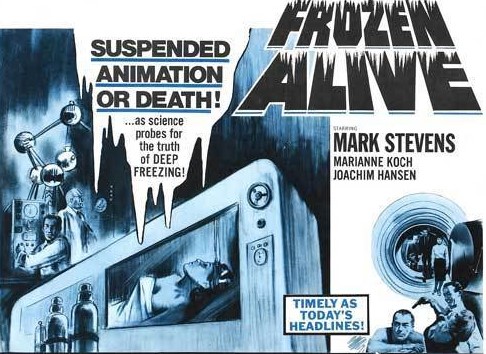
Dr Overton (Mark Stevens) along with lab partner Dr Wieland (Marianne Koch) are on the verge of a breakthrough in their cryogenic experiments with monkeys. Although she has a lover Tony (Joachim Hansen), his unfaithful alcoholic journalist wife Joan (Delphi Lawrence) is jealous of his success and of Wieland and dreads leaving the fast lane for life in  the country and potential motherhood.

Professional jealousy results in the successful scientific team being split up, so before that can be actioned, Overton decides to embark on a human experiment with himself as the guinea pig.

All the tension of watching an inert frozen human being relies on wondering whether he’s going to wake up and will he have all his working parts, brain especially. So, just to heighten that tension, Overton could face a murder charge when he does emerge. And Wieland, in love with him, has to decide whether it’s better to let him die than go to prison.
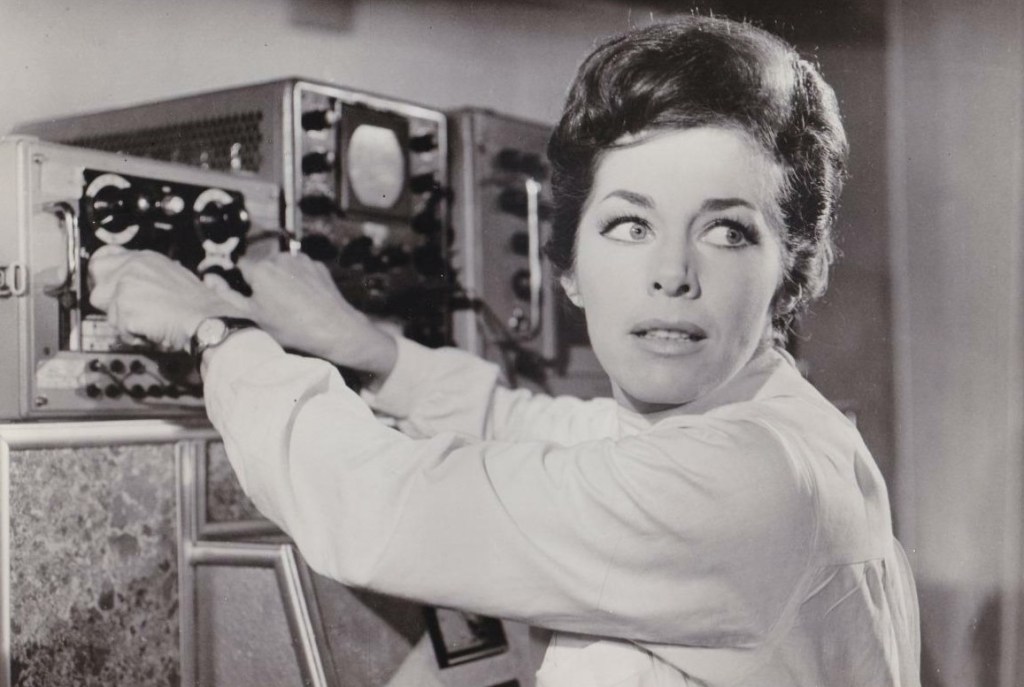
Marianne Koch at the controls. Will she let the suspected murderer live – or die?

The crime aspect is something of an oddity. The time element puts Overton potentially in the frame. And there’s a definite Hitchcockian element to the death, that in one sense robs it of tension, but in the other jacks it up to eleven. Because what we know but Wieland doesn’t is that Joan died by accident, playing with the gun of her lover.

So not only could an innocent man go to jail in the first place, stacked up against him his potential anger at potentially discovering his wife has a lover, but Wieland could let him die only to find out afterwards that he’s innocent all along.

It’s a good job Joan did die because she was stealing the picture. But even being soused in booze doesn’t dampen her zest for life, the kind of woman whose life mostly exists in cocktail bars and smart parties, dressed to the nines, showing enough cleavage to annoy her husband but tease potential suitors, and with enough toughness to dump any lover that gets too close. She’s sassy fun and married the wrong dull guy.

And she’s smart enough with her “intelligent anticipation” to figure out that husband is soon going to cosy up to lab buddy. Overton’s boss notices the signs when he’s not too busy covering his own back. “You sit on the fence and if someone makes a fuss later I take the rap.”

The Mind Benders the previous year covered similar territory but concentrated on the post-experiment after-effects, so this is almost a prologue to that, and interestingly, setting Joan aside, delivered with almost a British stiff upper lip, secret passion kept under wraps, lust revealed in lingering looks, while the cut-throat elements of ambition are played out under the guise of a civil service mentality.

Not quite what you’d expect from the title, but then it’s kind of a cul de sac in sci fi terms, as it’s generally the awakening that produces the problems and this doesn’t go there. But still a decent watch. British actress Delphi Lawrence (Farewell Performance, 1962) steals the show but the simmering turn from Marianne Koch (A Fistful of Dollars, 1964) comes close. Mark Stevens doesn’t have as much to play with and he’s pretty much kept his emotions tamped down up to this point so hardly going to let rip now.  Wolf Rilla (The Secret Ways, 1961) has a small part.

Bernard Knowles (Hell Is Empty, 1967) directed television writer Evelyn Frazer’s only screenplay. You might dwell on the irony that Delphi Lawrence’s star turn here led to nothing as much as Mark Steven’s career dwindled.

Something of a cult possibly because it’s hard to find.

Watchable.

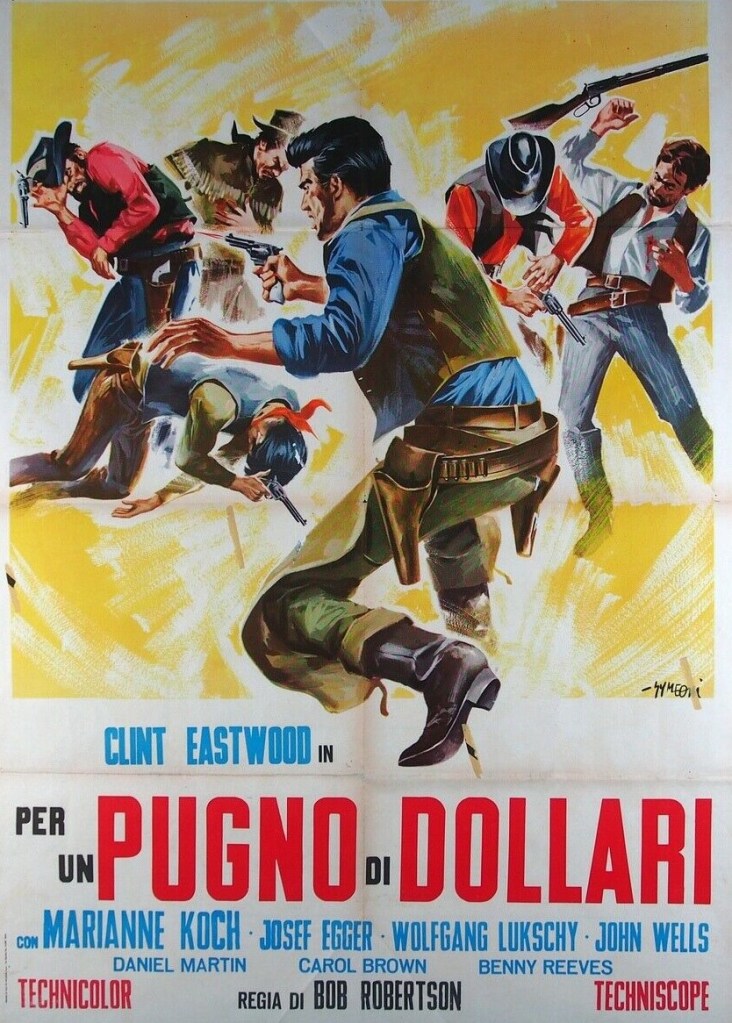
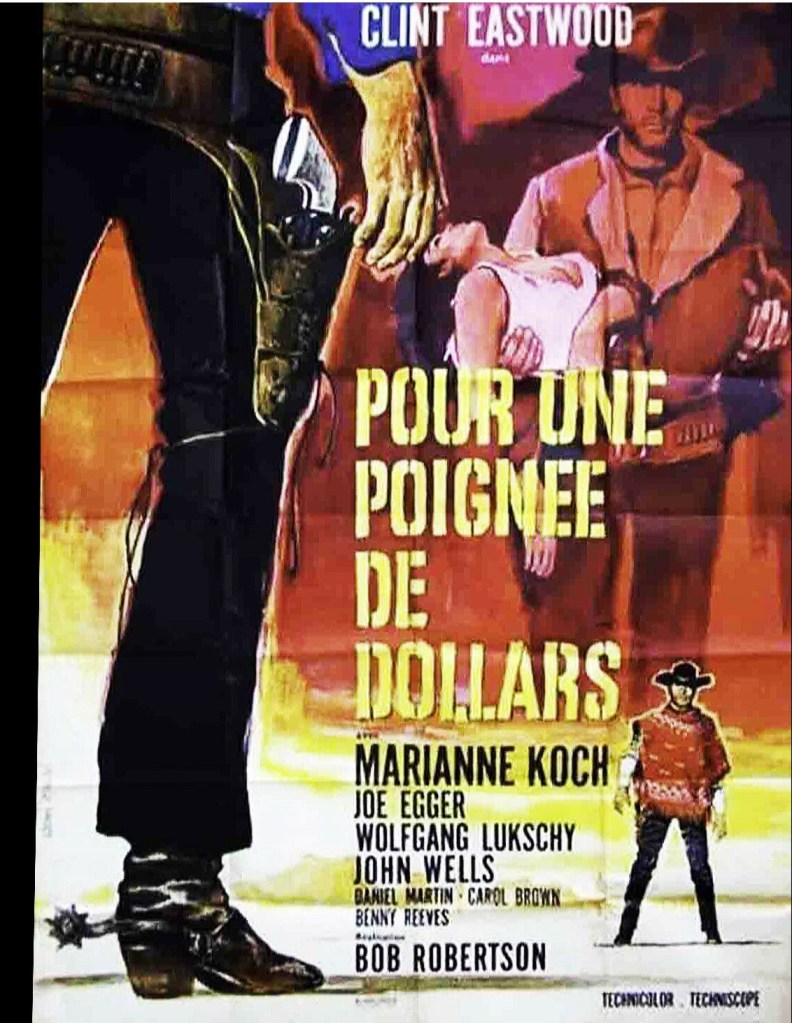
A Fistful of Dollars (1964) ****

Breezy western debut that created five legends: announced the arrival of a new directorial force in Sergio Leone; bestowed screen stardom on Clint Eastwood; instantly created a new mini-genre in the Spaghetti western; provided a platform for the distinctive music of Ennio Morricone; and best of all from the producers’ perspective made a mountain at the box office. You could add in a cavalier attitude to corpses and adding a notch to the development of that 1960s standby, the anti-hero. From now on the good guy could be a bad guy or so morally ambiguous as not to make a difference.

Look no further than the opening scene to note the alternative Leone approach to the western. An anonymous stranger (Clint Eastwood) arriving in town, observes, while drinking water from a well, a gang torment a small boy by firing bullets at his feet. Indifference to the taboo subject of violence to children became a Leone trademark, most evident when children are slaughtered in Once Upon a Time in the West (1969). Most astonishing of all here, the stranger, ostensibly our hero, does not intervene despite, as we shall soon discover, being a ferocious shot.

Who the heck is this Bob Robertson? A pseudonym for Sergio Leone, as if Robertson was particularly any better known than the debut director. Daniel Martin, oddly enough, is correct, but John Wells, Carol Brown and Benny Reeves are all made up.

Instead he learns that the child is being kept from his imprisoned mother Marisol (Marianne Koch), who has been taken from her husband Julio (Daniel Martin) by Ramon Rojo (Gian Maria Volonte). Rather than directly intervene a a good hero should, the stranger decides to profit from the situation. Realizing there are two opposition factions in town, the Rojos and the Baxters, he decides to play them off against each other, taking money in turn from each, demonstrating his credentials by shooting four men. That the Baxter clan includes the town sheriff (Wolfgang Lukschy) shows how powerful the Rojos have become.   

In fact the stranger doesn’t orchestrate a straightforward shoot-em-up as you might expect but cleverly gets them to kill each other first of all by arranging for both families to confront each other in a makeshift cemetery where the stranger has deposited the bodies of two men, the supposed survivors of a massacre of Mexican soldiers escorting a gold shipment. The Rojos win this round.

After appearing as nothing but a ruthless opportunist, the stranger now turns into a hero, freeing Marisol, reuniting her with husband and son, and giving them money to go away. This kind act does not go unnoticed, the stranger captured and tortured, the Baxters massacred on the assumption he was acting on their behalf. The stranger escapes in a coffin, fashions himself some chest armour in a tin mine, and confronts the remaining Rojos in an old-fashioned, though with a typical Leone twist, gunfight.

Setting aside the body count, which enraged traditionalists, including the vast majority of critics who would later endorse the even more violent blood-letting of The Wild Bunch (1969), the trio of Leone, Eastwood and Morricone put their innovative stamp on the western.

Stylistically, it was in a class of its own (until, at last, Leone outdid himself with the further adventures of The Man with No Name and Once Upon a Time in the West). The operatic elements which feature so strongly in his later work, are here confined to the plethora of close-ups, more like portraits and extremely well-lit, the circular camera movement for the climax (again, more evident in Once Upon a Time in the West), and the stillness before the shoot-out, the way tension builds through nothing happening for a considerable amount of time, not through characters shifting to more advantageous position, but simply while the camera sits and broods.

Leone cut out exposition, generally a large part of the beginning of any western, the stranger having no emotional involvement in the situation. A normal western would focus on the forcibly estranged husband attempting to free the imprisoned wife, perhaps as in The Magnificent Seven (1960) hiring someone to do it for him. The stranger, in effect, sets out to profit from misery.

And he doesn’t say much. A character this monosyllabic would be a supporting actor in a traditional western, perhaps fulfilling a comic role or given some elaborate emotional back story for why words were so precious he wouldn’t spend them.

And he’s definitely iconic. In a later scene, Leone has Eastwood materializing out of the swirling dust in a scene that would easily have fitted the traditional western. But for the most part, he relies on audience reaction to a character who dresses in far from traditional fashion, most notably with his poncho and cigars. The western hero didn’t squint either. He walked not situations with his eyes open, indicative of his boldness and ability to face any situation.

Leone avoids classic western confrontation, the one-on-one scenes that usually occur close to the start where the hero either exhibits prowess or is humiliated. In what might be called “the Chicago Way” not only does nobody come to a gunfight with a knife, the bad guys come mob-handed.

Sure, that means the hero is shown to be even more deadly with a pistol, but it also permits Leone to extend the action by focusing not just on two opposing characters but a number of different faces. There are some other motifs at play in Leone’s debut – women are not all as submissive as Marisol, Consuelo, the Baxter matriarch, on hiring the stranger, says “I’m rich enough to appreciate the men my money can buy,” her power and wealth finding later echo in Once Upon a Time in the West.

Last but not least, is the Morricone sound. There had been great western themes before, plaintive as in High Noon (1952) and The Alamo (1960) or stirring like The Big Country (1958) and The Magnificent Seven (1960), but this appeared to arrive from a different orchestral planet.

If ever a movie could claim ownership of the title “a star is born” it’s this one. Perhaps it has remained so special because the triumvirate of Leone, Eastwood and Morricone had such illustrious careers, this merely a starting point rather than, as if often the case when Hollywood anoints a new star, the highlight.

Discover WordPress

A daily selection of the best content published on WordPress, collected for you by humans who love to read.

The Atavist Magazine

by Brian Hannan

WordPress.com News

The latest news on WordPress.com and the WordPress community.