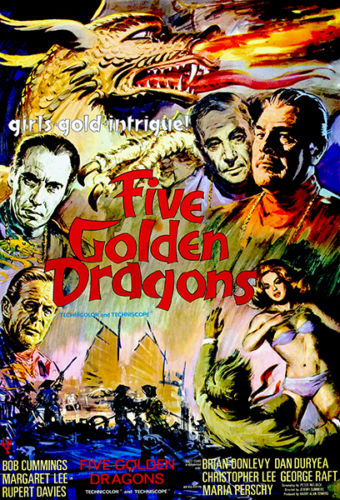
Producer Harry Alan Towers, himself something of a legend, had put together a quite superb cast – rising Eurostar Klaus Kinski (A Bullet for the General, 1967), Hollywood veterans Robert Cummings (Dial M for Murder, 1954), George Raft (Scarface, 1932), Dan Duryea (Black Bart, 1948) and Brian Donlevy (The Great McGinty, 1940) plus British horrormeister Christopher Lee and Rupert Davies (television’s Maigret). Throw in Margaret Lee (Secret Agent, Super Dragon, 1966) and Austrians Maria Perschy (Kiss, Kiss, Kill, Kill, 1966) and Maria Rohm (Venus in Furs, 1969).
And all in aid of an enjoyable thriller set in Hong Kong that dances between genuine danger and spoof. I mean, what can you make of a chase involving rickshaws? Or a race over bobbing houseboats parked in a harbor? There’s a Shakespeare-quoting cop Sanders (Rupert Davies) whose sidekick Inspector Chiao (Tom Chiao) often out-quotes him. And there’s British-born Margaret Lee, a cult figure in Italian circles, belting out the title song and just for the hell of it Japanese actress Yukari Ito in a cameo as a nightclub singer.

A newly arrived businessman is chucked off the top of a building by an associate of gangster Gert (Klaus Kinski) but not before leaving a note that falls into the hands of the police. The note says, “Five Golden Dragons” and is addressed to playboy Bob (Robert Cummings) for no particular reason. No matter. A MacGuffin is still a MacGuffin, and probably best if left unexplained.
Bob is soon involved anyway after falling for two beautiful sisters, Ingrid (Maria Rohm) and Margret (Maria Perschy). Turns out Margret knows more about Bob than he would like, and knows too much for her own good, namely that the titular dragons are the heads of an evil syndicate, specializing in gold trafficking, meeting for the first time in Hong Kong in order to organize the handover of their empire to the Mafia for a cool $50 million
In a nod at the spy genre, there are secret chambers opened by secret levers. There are double-crosses, chases, confrontations, not to mention a a trope of sunglasses being whipped off, voluntarily I might add. Apart from breaks here and there for a song or two, director Jeremy Summers (Ferry Across the Mersey, 1964) keeps the whole enterprise zipping along, even if he is stuck with Cummings.
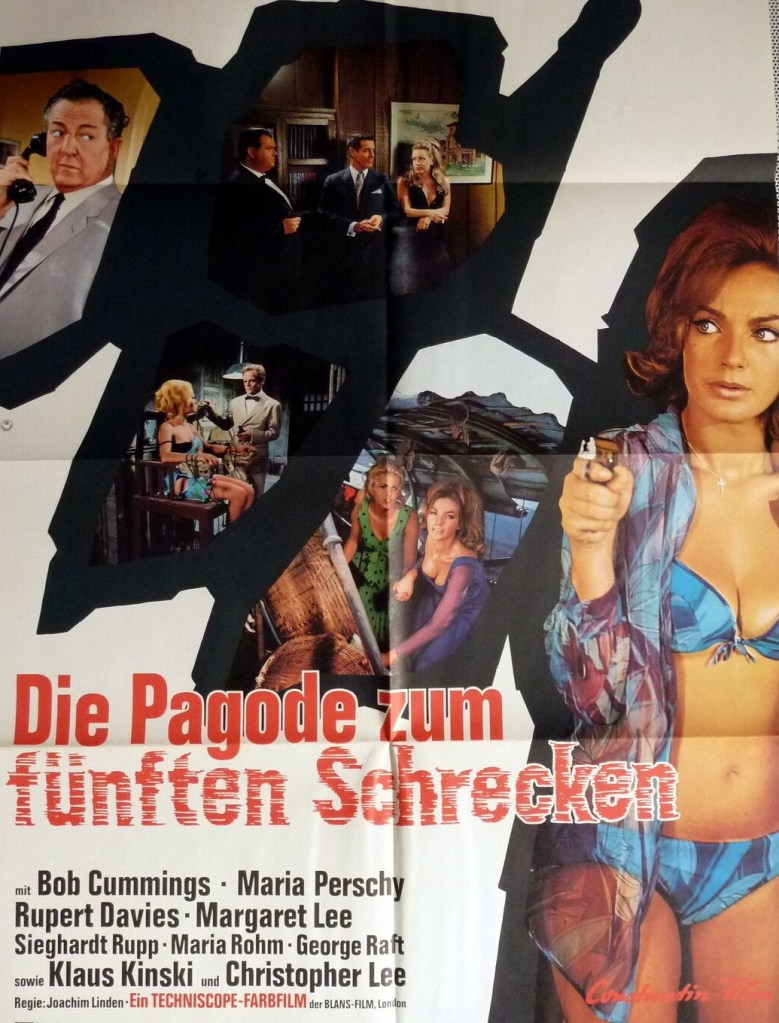
In truth, Cummings (Stagecoach, 1966) is a bit of a liability, acting-wise. While the rest of the cast takes the film seriously, he acts as if he’s a Bob Hope throwback, cracking wisecracks when confronted with danger or beautiful women, or, in fact, most of the time, which would be fine if he wasn’t a couple of decades too old (he was 57) to carry off the part of a playboy and if the jokes were funny.
Towers (under the pseudonym Peter Welbeck responsible for the screenplay, loosely based on an Edgar Wallace story) was a maverick but prolific British producer who would graduate to the likes of Call of the Wild (1972) with Charlton Heston but at this point was churning out exotic thrillers (The Face of Fu Manchu, 1965) and mysteries (Ten Little Indians, 1965) and had a good eye for what made a movie tick. This one ticks along quite nicely never mind the bonus of a sinister George Raft and the likes of Margaret Lee and Maria Rohm (Towers’ wife).
Cult contender that doesn’t take itself too seriously.

 The Magnificent 60s