I Thank a Fool (1962) ***

One of those bonkers pictures whose nuttiness is initially irritating but ends up being thoroughly enjoyable once you give in to the barmy plot and overheated melodrama. Murder, suicide, madness, illicit sex, blackmail – and that’s just the start of this farrago of nonsense. And set in Liverpool before The Beatles made it famous.

Christine (Susan Hayward), a doctor, is jailed when she kills her married seriously ill lover in a mercy killing. She’s not convicted of the murder but of the lesser crime of medical malpractice, but after serving an 18-month sentence finds she is unemployable, even in more lowly professions where her prison stretch counts against her.

When she is hired by the attorney Stephen (Peter Finch) who prosecuted her to look after his mentally ill wife Liane (Diane Cilento), the audience will already smell a rat given that Christine has changed her name and therefore the lawyer must have made considerable effort to track her down. His argument is that since she is no longer a qualified practitioner, she cannot advocate to have his wife committed to a mental institute, as a proper doctor would be required to, since Liane is clearly a danger to herself and other people. Your immediate suspicion is that Christine has been hired to take the rap once Liane is bumped off.

And it doesn’t take long for Christine to work out that not everything adds up. Liane is given enough rope to hang herself, access to a car to cause an accident, access to a horse which could easily bolt or fall.

Liane has been told her Irish father died in an accident where she was driving, the incident that triggered her madness. But when we discover the father, Captain Ferris (Cyril Cusack), is very much alive that’s the cue for a slew of unlikely events. When Liane finds her father, he’s not in the least a candidate for canonization, but an alcoholic. That triggers further mental trauma. And another accident, self-inflicted. After Christine administers pills, the young woman is found dead.

Bit of a stretch to compare it to the movies
mentioned in this poster.

Naturally, an inquest brings up Christine’s past and suspicion falls on her. And that would be par for the course, and it would be up to the condemned woman to find a way to prove her innocence. But that takes us into even murkier depths.

There’s bad blood between Capt Ferris and Stephen and the inference that this was only resolved by the father offering his underage daughter to the lawyer to be followed by the unscrupulous father blackmailing Stephen. Then it turns out there’s no case to answer and that Christine is innocent because, blow me down, Liane committed suicide.

But what should have been a straightforward, if unlikely, murder plot comes unstuck because it can’t make up its mind what it wants to be. Too many ingredients are thrown into the pot and the result is a mess.

Even the queen of melodrama Susan Hayward (Stolen Hours, 1963) can’t rescue this. And the pairing with Peter Finch (Accident, 1966) doesn’t produce the necessary sparks. Despite a variable Irish accent, Diane Cilento (Hombre, 1967) comes off best as the wayward deluded young woman.

Robert Stevens (In the Cool of the Day, 1963) directs from a screenplay by Oscar-nominated  Karl Tunberg (The 7th Dawn, 1964) adapting the bestseller by Audrey Erskine-Lindop.

Had every opportunity to be a star attraction in the So Bad It’s Good sub-genre but fails miserably. Still, if you enter into the swing of things, remarkably tolerable.
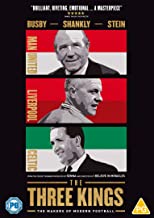
The Three Kings (2020) ****

Not to be confused with David O. Russell’s similarly-titled Persian Gulf War picture starring George Clooney from 1999, from which this picture could not be further removed given that it is the study of three Scottish football managerial geniuses who in their way created the basis for the business empires of Manchester United, Liverpool and Glasgow’s Celtic F.C.

The death of Diego Maradona and the subsequent grief that swept Argentina is the most recent example of the power of football. The Three Kings demonstrates that this is anything but a new phenomenon. And it also very much a story of the 1960s when these three kings of football ascended their thrones.

Jock Stein (of Celtic), Matt Busby (of Manchester Utd) and Bill Shankly (of Liverpool) were born within 30 miles of each other in grim Scottish mining communities. Busby and Shankly played at international level for their country but Stein, after a career in the lower echelons of football, was surprisingly hired by Celtic in the early 1950s where his leadership skills led him to be made captain of a team he subsequently led to the Scottish championship. As managers, they reached fabulous heights, Stein and Busby leading their teams to European Cup glory, Shankly’s Liverpool dominating English football for several seasons.

As much as it is about their individual triumphs and tragedies – Busby lost most of his team and nearly his own life in the Munich Air Disaster, Stein nearly died in a car crash – it is also most pertinently about the importance of football to a community. Shankly saw his team as in service to the city. But it was also about their combined global reach.

This is a personal film for me. I grew up in and around Glasgow just as Stein’s team was reaching its peak. My father used to take me and my brother all over Scotland in his car to support the team. (My knowledge of geography owes much to the teams Celtic played in Scotland and Europe.) We were at Motherwell in 1966 when in the dying minutes Celtic won the game to clinch their first title in a dozen years. We were at Celtic Park the following year when in the dying minutes our team won the quarter-final against the Yugoslavian champions Vojvodina Novi Sad and of course we sat glued to the television on May 25, 1967, when Celtic became the first British team to win the European Cup (the fore-runner of the Champions League).

The film is based on the book by Leo Moynihan.

In winning the European Cup, the first time anyone outside outside the Latin heartlands of Spain and Italy and Portugal did so, Celtic – with a team drawn from 30 miles around Glasgow rather than global galacticos – joined Europe’s elite, in the company of such names as Real Madrid, Benfica, AC Milan and Inter Milan. Celtic’s verve and audacity appealed to neutrals around the world. Manchester Utd’s fabled trio of Best, Law and Charlton, plus the legacy of the Busby Babes killed at Munich, gave that team a global platform. In Shankly Liverpool had a master of the soundbite who talked like James Cagney and did the spadework for the Liverpool teams that would dominate Europe in the 1970s and 1980s.

Whether they realised it or not, the trio put their teams on a pedestal few have reached and the film estimated that a quarter of the globe’s entire population currently supports one of the three. It is also a testament to the burden carried by the managers. By the age of 62 both Busby and Shankly had retired while Jock Stein Stein died from a heart attack in the dying seconds of a vital World Cup qualifying game while managing Scotland.

The film also captures the unique circumstances of each of the working-class cities where football was the lifeblood. All three had other major football teams and it would not be unusual for a quarter of the city’s populations to attend football matches on a Saturday afternoon. Cities that had been destroyed by the Second World War and suffered from a contraction of the workforce in the recessions of the 1960s turned to football as a lifeline. Men who otherwise contained their emotions would let them loose in raucous fashion when following their favoured teams.

Directed with at times great subtlety by Jonny Owen, also responsible for the film about Brian Clough’s Eurropean Cup-winning Nottingham Forest I Believe in Miracles (2015), and incorporating rare archive footage, the documentary looks back to a time when football passion could transcend adversity.

Here’s the link to the DVD: https://www.amazon.co.uk/s?k=the+three+kings+documentary&i=dvd&crid=3MUGTRX0UJTWB&sprefix=the+three+kings%2Cdvd%2C154&ref=nb_sb_ss_ts-a-p_3_15

Discover WordPress

A daily selection of the best content published on WordPress, collected for you by humans who love to read.

The Atavist Magazine

by Brian Hannan

WordPress.com News

The latest news on WordPress.com and the WordPress community.