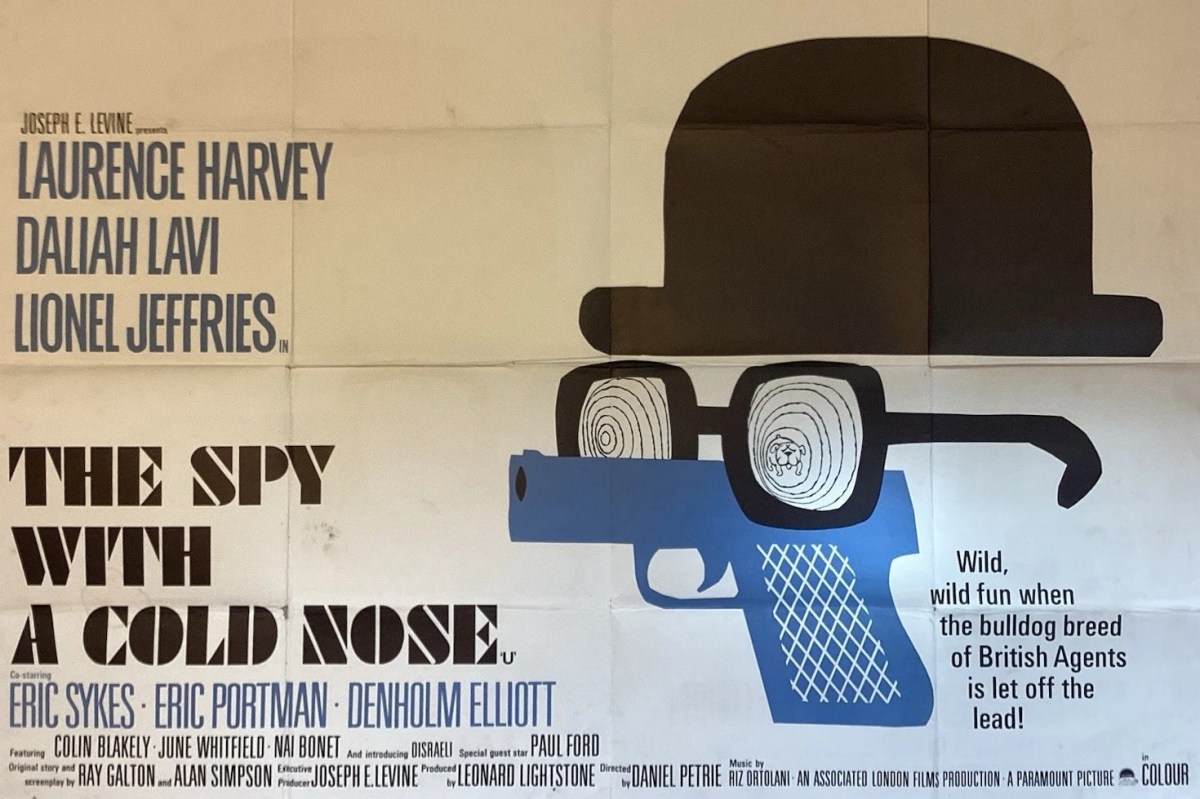
Surprisingly good fun for a flop. A horde of brilliant visual gags, some of considerably subtlety, keep the ball rolling on what must be the most deliriously barmy concept ever – though, you never know, it’s so ingenious someone in the espionage game might well have tried it out.
The problem for audiences back then was that nobody was going to pay good money to see supporting actor Lionel Jeffries (Chitty Chitty Bang Bang, 1968) hog the screen. It’s not as if he is merely scene-stealing. For most of the picture, it’s like the billing has been reversed. Third-billed Jeffries seems to be actually the star, the character around whom the tale revolves, with the top-billed Laurence Harvey (A Dandy in Aspic, 1968) and Daliah Lavi (Some Girls Do, 1969) relegated to the background and their expected sexual combustion a long time coming.
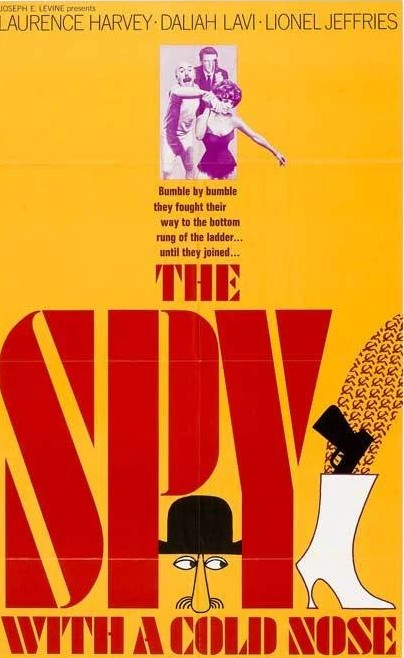
It’s also a particularly British concoction, belonging to the bureaucratic form-filling world of The Ipcress File (1965) rather than the free-wheeling James Bond series. Middle-aged spy Stanley Farquhar (Lionel Jeffries), with little to show for his decades in the Secret Service and no sign of, as he laments, a naked girl in his bedroom, come up with the clever idea of sticking a tiny microphone up the nose of the British bulldog being presented as a gift by the British prime minister to the Russian supremo (Colin Blakely).
Takes a while for Stanley’s snooty bosses to go along with the idea because, don’t you know, it’s just not cricket. The Russian premier is so taken with the dog it accompanies him everywhere and the Brits are soon smashing Russian spy rings. Eventually, the Russians sent their top spy Princess Natasha Romanova (Daliah Lavi), who has half the Russian hierarchy in her seductive pocket, to find out who’s behind this state of affairs.
She alights first on Stanley and naturally seduction turns into male embarrassment as he’s caught with his trousers down for the whole world to see. Eventually, and more than an hour into the picture, she sets her sights on dog whisperer and dog groomer par excellence Francis Trevelyan (Laurence Harvey) who, of course, is nothing to do with the Secret Service but has been blackmailed into fitting the mic into the canine spy.
The tale is so slight and nutty that you’d be heading for the exist doors within 15 minutes except that the movie is propelled along, very nicely thank you, with a string of visual gags. Stanley, being the type of high-ranking official whose briefcase is handcuffed to his wrist, is so distracted by the torments of his kids, that when we first meet him he affixes said briefcase to said hand before he’s put his arm through his jacket, thus being forced to conceal it under a bulky overcoat all the way to the office.
That means driving one-handed and making his colleagues think he has lost an arm. He’s also arrived at work minus his car roof which he’s managed to burn off after mistakenly using the cigarette lighter which has been turned into a flamethrower by the boffins. When he’s handed his instructions at work, he can’t read them. Don’t we have any ordinary pens around here, snaps his boss, realizing at the same time as the audience does, that he’s used a pen with invisible ink. There’s a lovely gag involving the Queen’s corgis. Another of the gadgets, an umbrella that flowers into a parachute, is brought into play at the wrong time.
And his awful children are straight out of the Just William playbook, stealing his breakfast from under his nose and dropping worms into his open mouth when he dozes off in the garden. Aftet the much-publicized episode of his encounter with the Princess, Stanley is landed with a suspicious wife (June Whitfield) accompanying him on his missions.
As you might expect, there’s some slapstick, but except in the case of Wrigley (Eric Sykes), Stanley’s associate, who overdoes it, it’s generally underdone to great effect, the Princess requiring one of her lovers to push out of the door another of her lovers who refuses to accept his time is up. However, the titular dog, thankfully, makes no attempt to steal scenes and remains a very minor figure in the proceedings.
But the idea of the likes of Stanley either getting the better of the Princess or even understanding the notion of being seduced means that, no matter how hilarious the scene, audiences feel hoodwinked at the lack of top-billed male-female action. When Trevelyan eventually gets to make a major contribution it’s too little too late.
But if you go along with it, and are not frustrated by the lack of screen time afforded Harvey and Lavi, it’s a got a good deal to recommend it. Lionel Jeffries’s acting was acknowledged by the Golden Globes, as was the film itself.
Laurence Harvey shows a keen eye for the comic and Daliah Lavi, as ever, steals every scene she’s in. Denholm Elliott (Maroc 7, 1967) and Colin Blakely (The Vengeance of She, 1968) are the pick of the supporting actors.
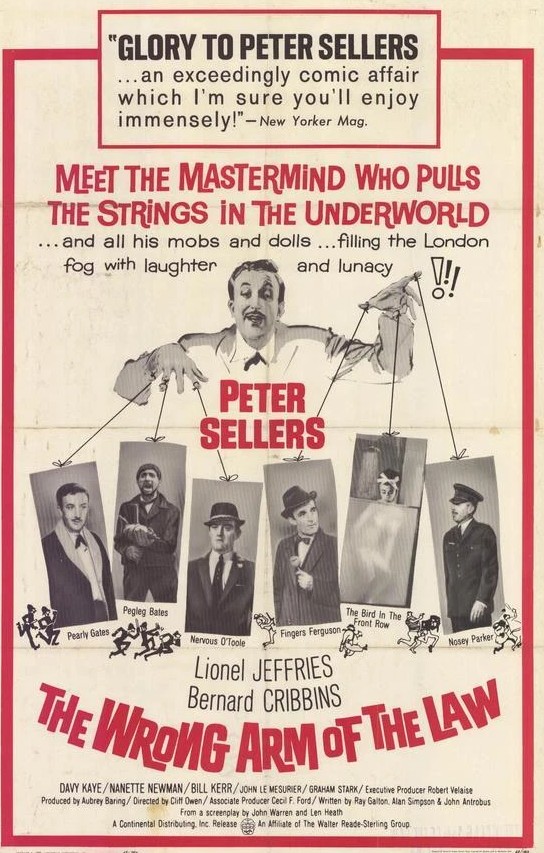
Directed by Daniel Petrie (Stolen Hours, 1963) from a screenplay by Galton & Simpson (The Wrong Arm of the Law, 1963).
Great fun and worth a look.





 The Magnificent 60s