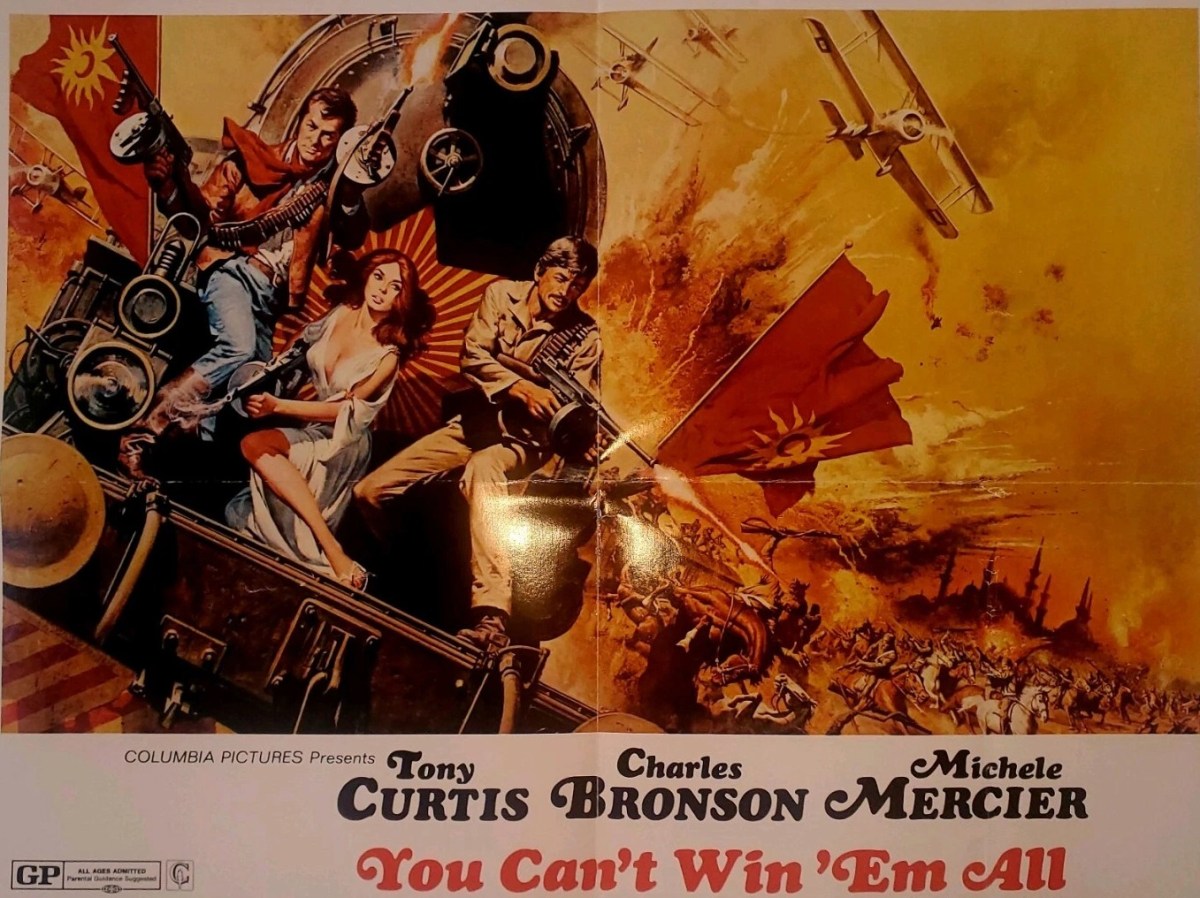
You Can’t Win ‘Em All (1970) ***

Charles Bronson travelogue. Slowest action picture you will ever come across. Director Peter Collinson forgets all he learned about tension from The Penthouse (1967) and action from The Italian Job (1969) and in trying to create a Turkish version of the visual delights of David Lean’s Lawrence of Arabia (1962) comes a cropper, not least because he hasn’t counted on the dust resulting in endless scenes of men on horseback being obscured. There must be about 10-15 minutes of just travelling by horse, train and boat through boring scenery.

There’s an interesting story in here somewhere but you’ll need all your patience to stick with it.  Soldiers of fortune Adam (Tony Curtis) and Josh (Charles Bronson) are the type of characters who buddy up one minute and stitch each other up the next. Their attitudes are ingrained from the outset – Josh robs shipwrecked Adam who takes revenge by stealing his boat. They team up to take advantage of the chaos ensuing in Turkey in 1922 following the collapse of the Ottoman Empire, setting themselves up as mercenaries before their small force of like-minded fellows, armed with Tommy guns,  is hired by Governor Osman Bey (Gregoire Aslan) to escort a consignment of gold to Cairo. They soon discover that’s just a cover. The only gold on the gold bars is as much as it takes to provide a golden sheen to blocks of lead. There are actually more valuable prizes: Bey’s daughters and a trunk of priceless jewellery.
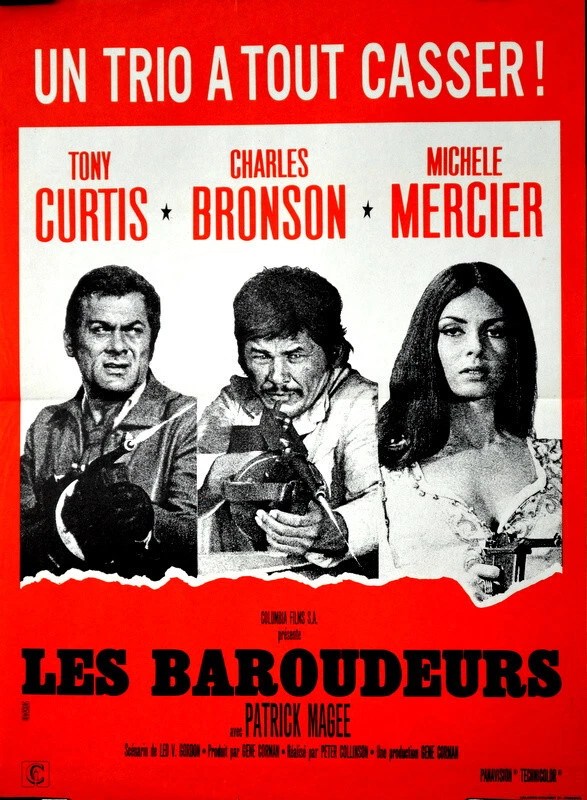
So far, they’ve beaten off various attacks, the submachine guns making short work of rebels armed only with rifles, and this looks as if it’s heading into fairly standard territory whereby the scoundrels will evade their captors and make off with the loot. But halfway through it does a U-turn. We discover that Adam is actually in the country to repossess one of his father’s ships lost in World War One. This is tweaked into an important plot point – the Turks have been blockaded by the Brits but a ship flying an American flag would be permitted safe passage.

Then it twists on its axis once again and we’re dropped into femme fatale land. The daughters are being escorted by the beautiful but wily Aila (Michele Mercier). She’s a step up from the usual two-timing female of the species. She’s a three-timer, attempting to woo in turn the governor, Adam and Josh. Actually, she returns to two-timing when she knifes the governor to death. And her plans go awry when Josh rejects her advances with a vicious slap.

Even so, he’s not averse to teaming up with her to betray Adam and make off with the loot. Adam, who has considered himself worldly wise, is furious and eventually traces Josh and Aila to the port of Smyrna.

It doesn’t end well, Josh and Adam are captured. But then it does end well. Aila, revealed as a spy, negotiates their freedom. After all, inadvertently, they helped her to transport the real treasure, an ancient Koran, while keeping the jewels for herself.
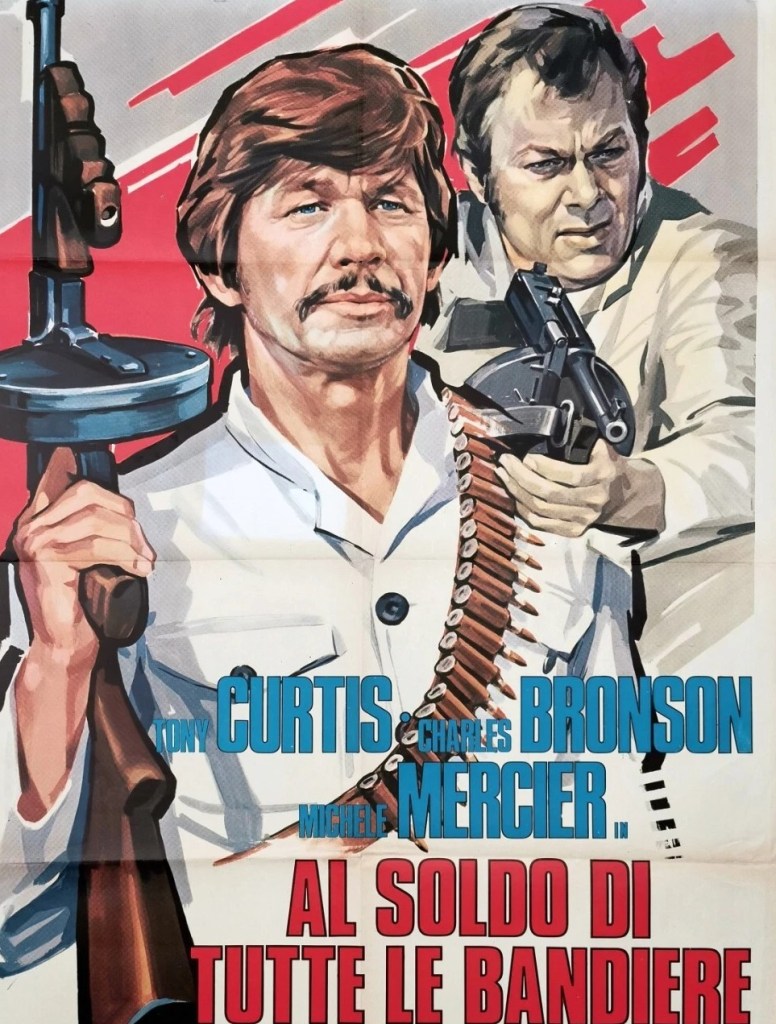
Leo Gordon (Tobruk, 1967) has penned a very wayward screenplay. Charles Bronson (Farewell, Friend, 1968) and Tony Curtis (The Boston Strangler, 1968) play well off each other, occasionally exchanging decent quips, with the kind of personalities that might congeal into an acceptable screen pairing, guys, while minus an honor code, who don’t stray into unacceptable behaviour. And it might have worked equally as well if the Michele Mercier (Angelique, 1964) strand had been introduced at the beginning and we had a three-way romantic dilemma. But director Collinson takes forever to get the two elements of the tale to mesh and wastes countless minutes, as previously noted, as our heroes laboriously grind their way towards their destination. The introduction of Mercier – sudden light catching her eyes in the darkness – is the only composition of note. And while Bronson and Curtis are a sparky pairing most of the time they flounder in an incomprehensible tale.

You can either catch this on YouTube and have your viewing interrupted by an advert every two minutes or on Amazon Prime where such interference is minimal.
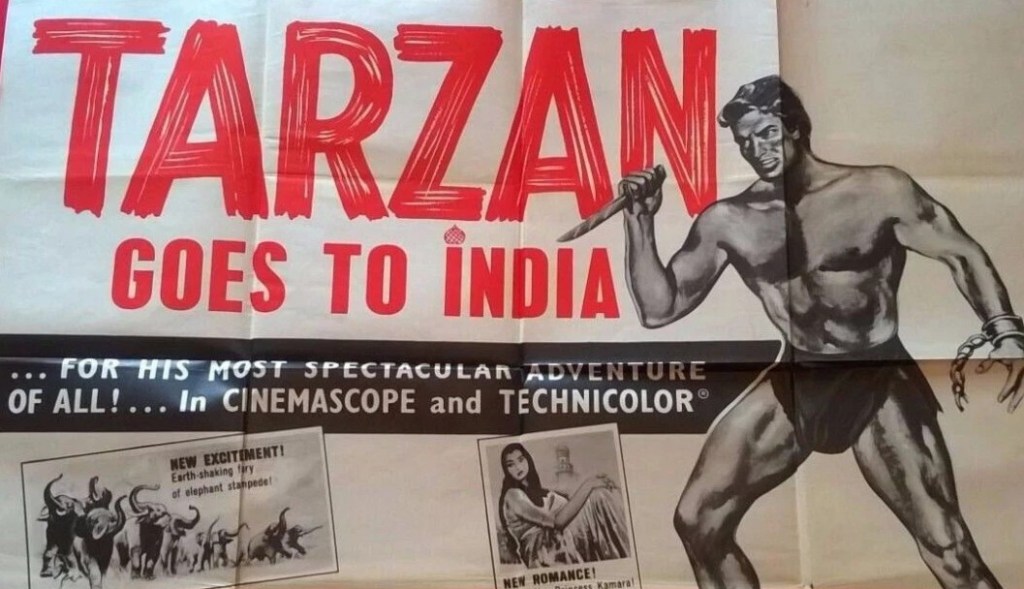
Tarzan Goes to India (1962) ***

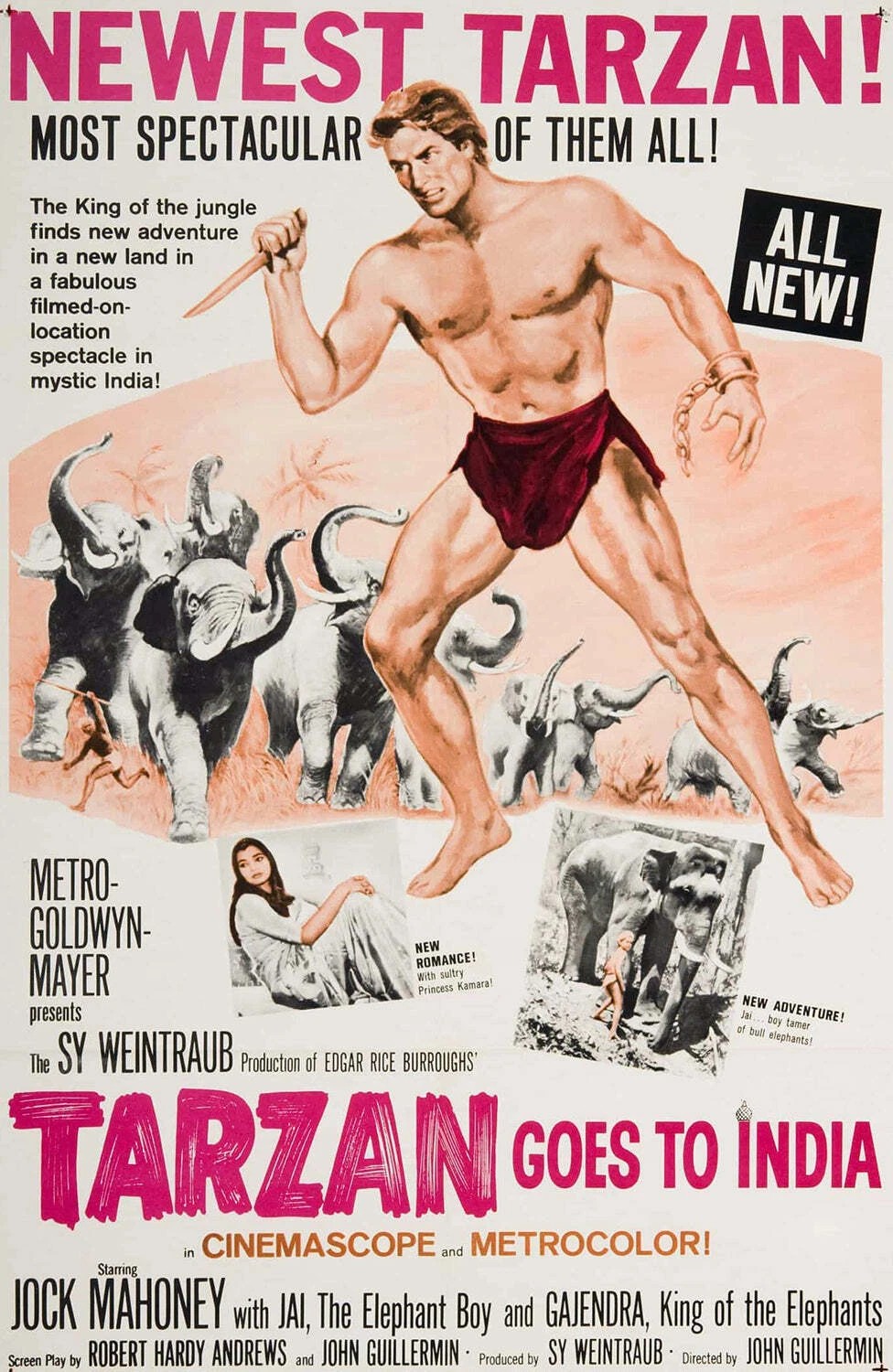
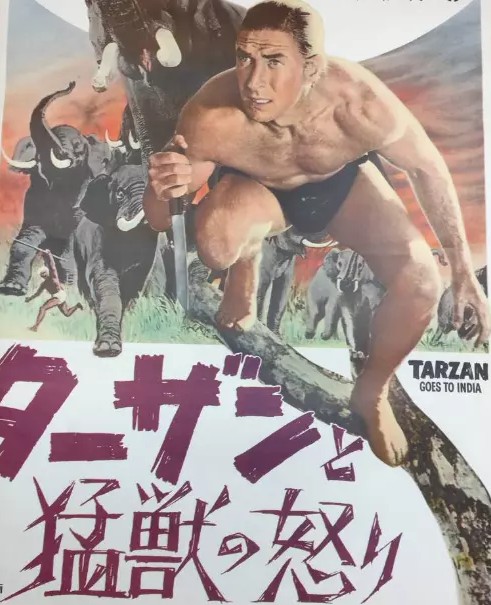
Helluva fillip for reissue and credibility purposes to be able to point to the picture being helmed by the director – John Guillermin – of The Towering Inferno (1974), not to mention King Kong (1976) and The Blue Max (1966) – which suggested top-notch skills if not the budget to match. Guillermin, who also had a share in the screenplay, does a pretty good job of tailoring the picture to highlight issues that in others of the series are treated in more comedic fashion and making tremendous use of the location, far more than subsequent directors do with South American scenery. Elephants go mano a mano, Tarzan has a tussle with a leopard, but for sheer realism there’s little to beat a tiny mongoose putting a cobra in its place.

But what could be more timely for today’s audiences than presenting Tarzan (Jock Mahoney) as an eco-warrior. He is brought in to rescue a herd of 300 wild elephants being drowned when a much-needed hydroelectric dam is opened. Dam engineers Bryce (Leo Gordon) and O’Hara (Mark Dana), who show no compunction about the high death rate among the native laborers, are even less concerned about the fate of the elephants especially as have very tight deadline – the onset of the monsoon season  – to meet. Princess Kamara (Simi Garewal), daughter of an old friend from Tarzan’s Africa days, is trying to get villagers out of the way as well. She’s not helped by Bryce’s top engineer Raj (Jagdish Raj) who sides with Bryce.

The main problem is that elephants can’t climb hills and are led by Bala, a rogue of the species, whom Tarzan determines he’ll have to eliminate. He’s helped by a small boy Jai who rides his own elephant Gajendra. Jai’s not there for comedic purpose and Tarzan helps him grow up, their bond facilitated by Tarzan saving the ivory-tusked beast from Bryce in white hunter mode.

Baits abound. Tarzan is chained to a tree by Bryce to entice a leopard. The boy is used, again by Bryce, as lure to draw Tarzan out into the open at the climax. Raj changes sides on seeing how cheaply Bryce treats life, but there’s no time for him to get lovey-dovey with the princess. Which is just as well because Tarzan’s got a lot on his plate. His plan to put an arrow through Bala’s brain goes awry, triggering the Gajandra-Bala duel, which is very well done.

Although set in India, this feels more like the real thing than the sojourns in South America. We never see Tarzan in a suit but I don’t think anyone thought to compare his entrance, emerging from a river clad only in loin-cloth, with the other more famous screen entrance of the year, that of Ursula Andress in Dr No. Tarzan does plenty of swimming, even employing the breathing through a reed trick, and swings through the trees, and runs a lot barefoot, and gets to ride on the back of an elephant. The absence of his usual animal sidekicks is no hindrance. His scenes with the young boy are touching rather than sentimental or clumsily jokey. The kid’s pretty smart, which helps.

Kamara’s there merely to help along the subplot rather than for romantic purposes. Given the lean running time (86 minutes) that kind of palaver would only get in the way. This was shot entirely on location, and it shows, no awkward switches to studio set-ups, glorious scenery all the way.

Best of all John Guillermin, who also helmed Tarzan’s Greatest Adventure (1959), knows how to construct a scene, and how to get the best out of actors whose acting skills would not be considered their main attributes. So it looks good whichever way you cut it.

Former stunt man and athlete Jock Mahoney makes the switch from Tarzan nemesis (Tarzan the Magnificent, 1960) to Tarzan with ease. Less muscle-bound than his predecessors, he brings a more mature tone to proceedings, exuding thoughtfulness more than being gung-ho.

One of the better Tarzans of the decade.

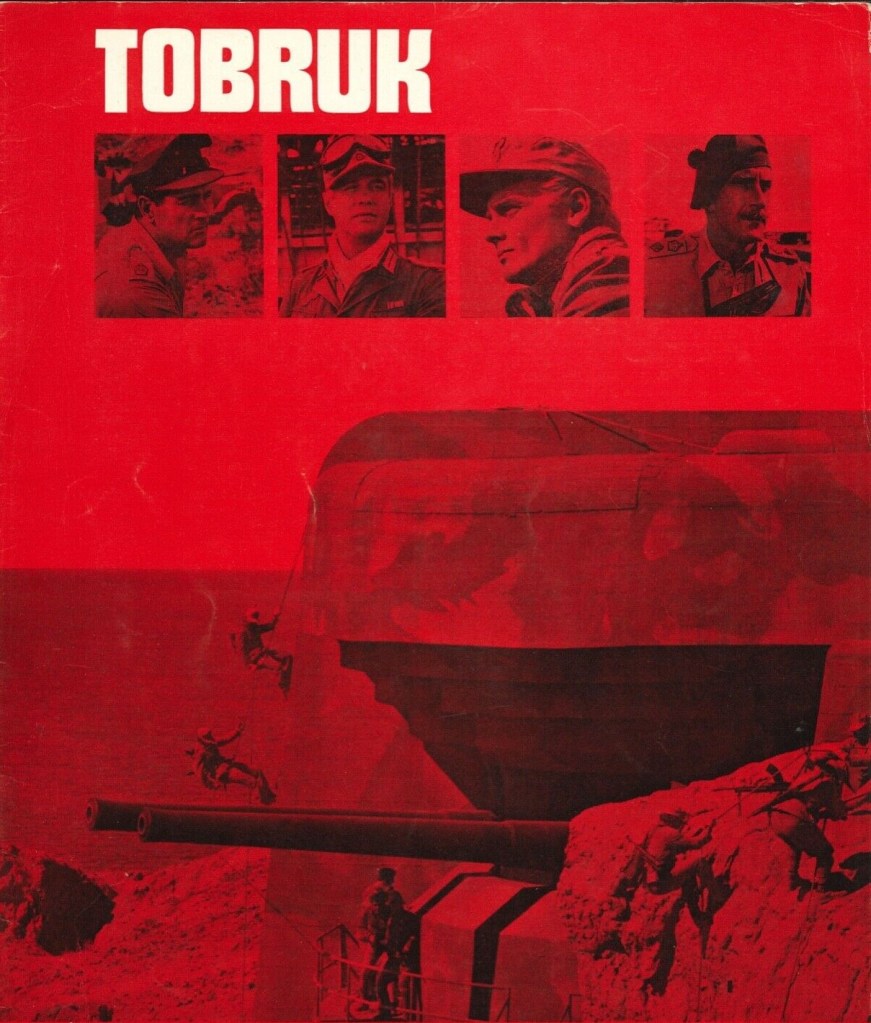
Tobruk (1967) ****

Occasionally ingenious action-packed men-on-a-mission picture that teams reluctant hero Major Craig (Rock Hudson) with Captain Bergman (George Peppard) who heads up a team of Jewish German commandos (i.e good guys). Arthur Hiller (Promise Her Anything, 1966) directs with some skill and to increase tension often utilizes silence in Hitchcockian fashion. He meshes innate antagonism between the two principals and stiff-upper-lip British Col Harker (Nigel Green), two subplots that have a bearing on the final outcome, and explosive battle scenes. In addition, in supporting roles is a Sgt Major (Jack Watson) unusually solicitous of his troops and a grunt (Norman Rossington) with a fund of one-liners.

Craig is liberated by frogmen from a prisoner ship and flown into the Sahara on the eve of the Battle of El Alamein to guide a strike force 800 miles across the desert to blow up Rommel’s underground fuel tanks in Tobruk, Bergman’s outfit providing the perfect cover as Germans escorting British prisoners. “It’s suicide,” protests Craig. “It’s orders,” retorts Harker.

Most action pictures get by on action and personality clashes against authority, but this is distinguished as well by clever ruses. First off, hemmed in by an Italian tank squadron on one side and the Germans on the other, they fire mortars into each, convincing the enemy units to open fire on one another. Craig, on whose topographical skills the unit depends, goes the desert version of off-piste, leading the group through a minefield, personally acting as sweeper with a bayonet as his rudimentary tool, his understanding of how the enemy lays its mines allowing him to virtually explode them all at one. But, ironically, their cover is so complete that they are strafed by a British plane, and equally ironically, have to shoot down one of their own.

Along the way they pick up a stranded father-and-daughter Henry (Liam Redmond) and Heidy Hunt (Cheryl Portman) who are on another mission entirely, to help create a Moslem uprising against the British in Egypt. Their arrival reveals the presence of a traitor in the camp. Naturally, this isn’t the only complication and problems mount as they approach Tobruk and, finding it vastly more populated with German troops than expected, they now, in addition to tackling the virtually impenetrable fuel dumps, have to knock out the city’s radio mast and neutralize the German big guns protecting the beaches.

So it’s basically one dicey situation after another, ingenuity solving problems where sheer force is not enough, and twists all the way to the end.

All the battles are particularly well done, pretty ferocious stuff, flamethrowers especially prominent, but they are also adept at hijacking tanks, and in another brilliant ruse capturing one without blowing it up. The screenplay by Leo Gordon (The Tower of London, 1962) supplies all the main characters with considerable depth. While Craig isn’t exactly a coward, he is not interested in laying down his life for a cause. Although Harker seems a typical officious British officer, he, too, has surprising depths. But it is Bergman who is given the weightiest part, not just a German seeking revenge against his own countrymen for the treatment of Jews but a man looking to a future when Jews will fight for their own homeland in Israel.  

Hudson had begun his career in action films, mostly of the western variety, before being seduced by the likes of Doris Day and Gina Lollobrigida in romantic comedies and this is a welcome return to tough guy form. George Peppard made it two Germans in a row after The Blue Max (1966) but this is far more nuanced performance. There are star turns from Nigel Green, Guy Stockwell (Beau Geste, 1966) as Peppard’s sidekick and the aforementioned Jack Watson (The Hill, 1965) and Norman Rossington.

This was pretty much dismissed on initial release as a straightforward gung-ho actioner and one that tipped Rock Hudson’s career in a downward spiral, but I found it both thoughtful and inventive and had much more of an on-the-ground feeling to it, with nothing going according to plan and alternatives quickly need to be found.

Under-rated and well worth a look.

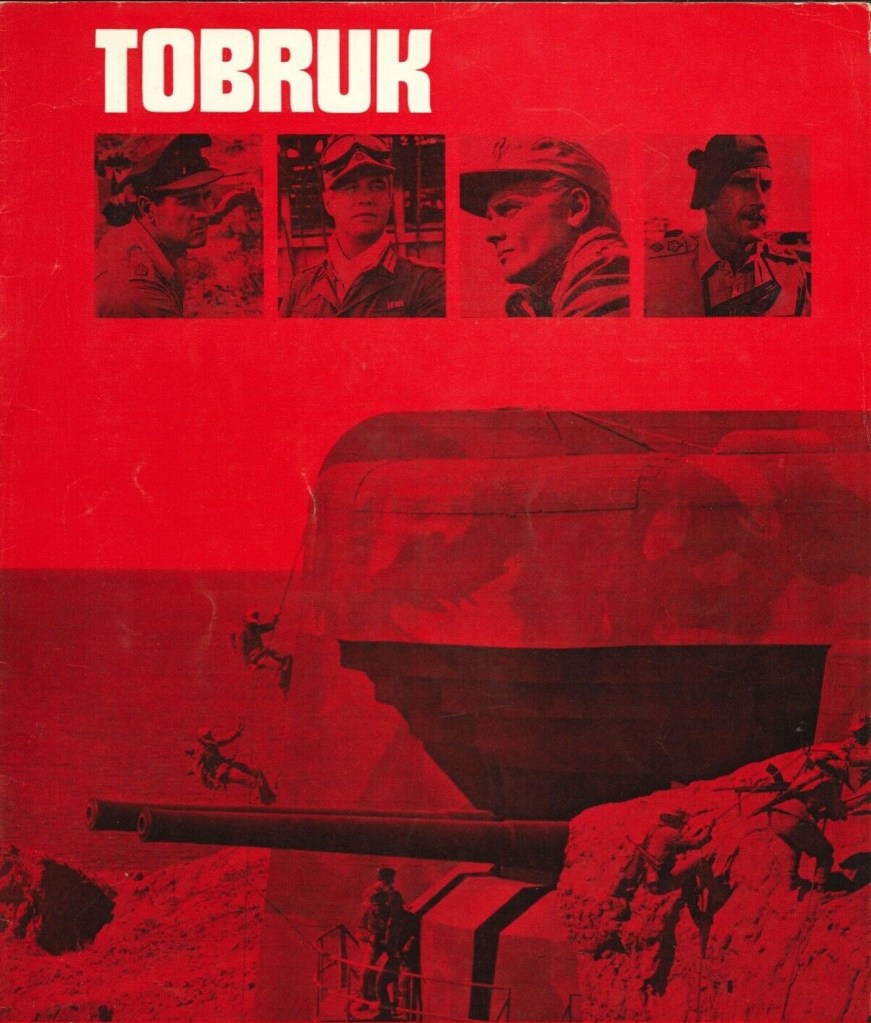
Tobruk (1967) ****

Occasionally ingenious action-packed men-on-a-mission picture that teams reluctant hero Major Craig (Rock Hudson) with Captain Bergman (George Peppard) who heads up a team of Jewish German commandos (i.e good guys). You might think the idea of German-born Jewish commandoes was a dramatic flight of fancy. But, in fact, these guys existed. They were called X-Troop although whether they actually took part in something close to this fictional operation is of course open to question.

Arthur Hiller (Promise Her Anything, 1966) directs with some skill and to increase tension often utilizes silence in Hitchcockian fashion. He meshes innate antagonism between the two principals and stiff-upper-lip British Colonel Harker (Nigel Green), two subplots that have a bearing on the final outcome, and explosive battle scenes. In addition, in supporting roles is a Sgt Major (Jack Watson) unusually solicitous of his troops and a grunt (Norman Rossington) with a fund of one-liners.

Craig is liberated by frogmen from a prison ship and flown into the Sahara on the eve of the Battle of El Alamein to guide a strike force 800 miles across the desert to blow up Rommel’s underground fuel tanks in Tobruk, Bergman’s outfit providing the perfect cover as Germans escorting British prisoners. “It’s suicide,” protests Craig. “It’s orders,” retorts Harker.

Most action pictures get by on action and personality clashes against authority but this is distinguished as well by clever ruses. First off, hemmed in by an Italian tank squadron on one side and the Germans on the other, Harker’s unit fires mortars into each, convincing them to open fire on one another. Craig, on whose topographical skills the unit depends, goes the desert version of off-piste, leading the group through a minefield, personally acting as sweeper with a bayonet as his rudimentary tool, his understanding of how the enemy lays its mines allowing him to virtually explode them all at once. But, ironically, their cover is so complete that they are strafed by a British plane, and equally ironically, have to shoot down one of their own.

Along the way they pick up a stranded father-and-daughter Henry (Liam Redmond) and Heidy Hunt (Cheryl Portman) who are on another mission entirely, to help create a Moslem uprising against the British in Egypt. Their arrival reveals the presence of a traitor in the camp. Naturally, this isn’t the only complication and problems mount as they approach Tobruk and, finding it vastly more populated with German troops than expected, they now, in addition to tackling the virtually impenetrable fuel dumps, have to knock out the city’s radio mast and neutralize the German big guns protecting the beaches.

So it’s basically one dicey situation after another, ingenuity solving problems where sheer force is not enough, and twists all the way to the end.

All the battles are particularly well done, pretty ferocious stuff, flamethrowers especially prominent, but the team are also adept at hijacking tanks, and in another brilliant ruse capturing one without blowing it up. The screenplay by Leo Gordon (The Tower of London, 1962) supplies all the main characters with considerable depth. While Craig isn’t exactly a coward, he is not interested in laying down his life for a cause. Although Harker seems a typical officious British officer, he, too, has surprising depths. But it is Bergman who is given the weightiest part, not just a German seeking revenge against his own countrymen for the treatment of Jews but a man looking to a future when Jews will fight for their own homeland in Israel.  

Hudson had begun his career in action films, mostly of the western variety, before being seduced by the likes of Doris Day and Gina Lollobrigida in romantic comedies and this is a welcome return to tough guy form. George Peppard made it two Germans in a row after The Blue Max (1966) but this is a far more nuanced performance. There are star turns from Nigel Green, Guy Stockwell (Beau Geste, 1966) as Peppard’s sidekick and the aforementioned Jack Watson (The Hill, 1965) and Norman Rossington.

This was pretty much dismissed on initial release as a straightforward gung-ho actioner and one that tipped Rock Hudson’s career in a downward spiral, but I found it both thoughtful and inventive and had much more of an on-the-ground feeling to it, with nothing going according to plan and alternatives quickly need to be found. Under-rated and well worth a look.

Discover WordPress

A daily selection of the best content published on WordPress, collected for you by humans who love to read.

The Atavist Magazine

by Brian Hannan

WordPress.com News

The latest news on WordPress.com and the WordPress community.