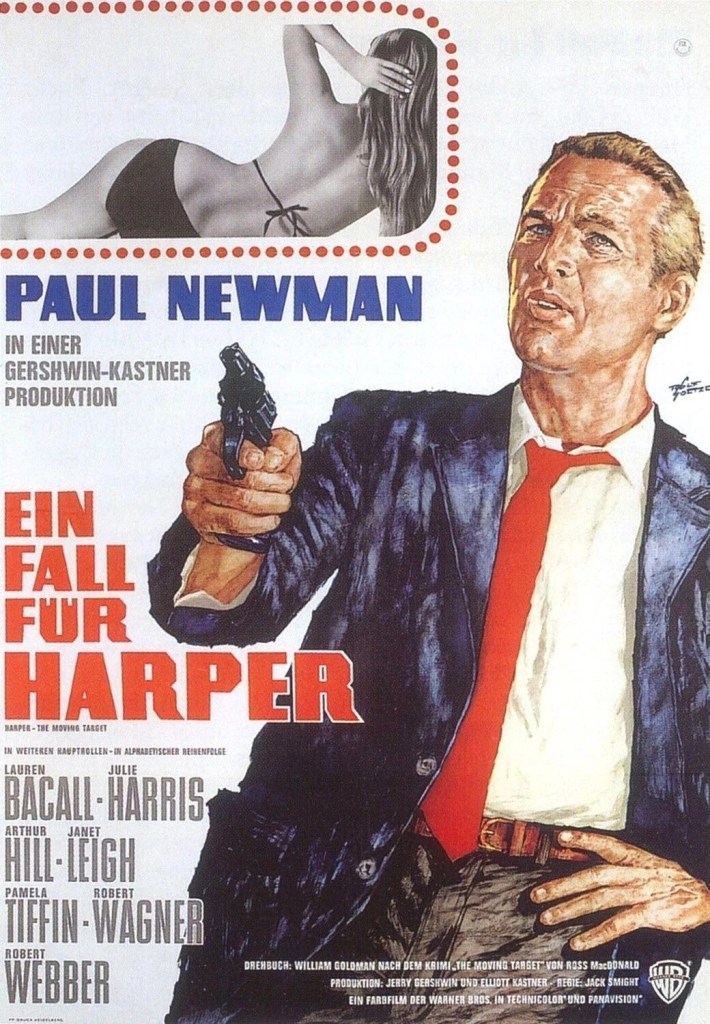
Harper / The Moving Target (1966) ****

Inventive screenplay by William Goldman (Masquerade, 1965), the ideal combination of witty lines and others that strike to the heart, and Paul Newman’s most naturalistic performance, and a family at each other’s throats, create a genuine addition to the private eye genre. Punch-ups are limited, generally the sleuth comes out worse, his skull an easy target apparently for any villain wanting to give him a good biff.

Most people remember the celebrated credit sequence. But, in fact, most people do not. They remember that this is a guy who will reuse old coffee grinds, which is as good a character definition as you’re going to get. But the opening sequence says much more – he sleeps in a pull-out couch, he falls asleep with the television on, dunking his face in ice suggests a hangover, and – the killer – he sleeps in his office. You won’t forget the ending either, the freeze frame, as fed-up Harper (Paul Newman) just gives up on the stupidity of mankind. And just before that there’s a delicious moment when crippled mother Elaine Sampson (Lauren Bacall) trills to the daughter she loathes Miranda (Pamela Tiffin) in a voice that would denote happiness but is anything but, “I’ve got some news for you,” as she looks forward to informing the child that the father she adores and that Elaine equally loathes is dead.

Not surprisingly, Harper’s on the verge of divorce from wife Susan (Janet Leigh), but he still hankers after being a knight in shining armor, those few days every year when he puts the world to rights rather than chasing down errant husbands in seedy hotel rooms.

The tale is a tad convoluted, involving initially tracking down Elaine’s estranged missing millionaire husband that turns into kidnapping and then murder with a side order of a fake cult headed by Claude (Strother Martin) that’s a front for an illegal immigrant operation, and going through the gears, character-wise, with malicious wife, an extremely flirtatious Miranda who gets her come-uppance when she tangles with Harper, faded alcoholic star Fay Estabrook (Shelley Winters) and junkie Betty (Julie Harris) sometime lover of lothario pilot Allan Taggert (Robert Wagner).

Two distinctive thugs Dwight Troy (Robert Webber) – Fay’s husband – and Puddler (Roy Jenson) offset the dumbest of dumb cops led by Sheriff  Spanner (Harold Gould) and lovesick attorney Albert Graves (Arthur Hill), Harper’s longtime buddy, who pines for Miranda.
Torture comes in two guises – the junkie gets the treatment from Dwight and Harper is put through the wringer listening to the endless whining of Fay as he tries to pump her for information. Harper avoids beatings and takes beatings and various characters bounce through doors with a gun – both Taggert and Graves save Harper from being shot.

Harper’s got a slick way about him, but mostly his charm is used to weasel information. He hasn’t got enough of it left to work on his wife.

When Harper’s not racing his sports car along twisting mountain roads, the action shifts to a cult temple, the docks and an abandoned oil tanker. Even when Harper works out who’s in on the kidnapping, it turns out he’s now got a murder to solve since someone’s bumped off the kidnappee.

Despite the endless complications, this whizzes along, helped enormously by Paul Newman’s (Cool Hand Luke, 1967) winning characterization. He’s brought a new trick to his acting arsenal, mastering a method of not listening to a conversation by tilting his head away from the speaker, and there’s a number of novel gestures. The scene where he rejects Miranda is a cracker. Tough guy running short of a soft center, he makes a very believable human being. And he’s got his work cut out because Lauren Bacall (Shock Treatment, 1964) is on scene-stealing duties. As is Pamela Tiffin (The Pleasure Seekers, 1964) though she can hardly match the older woman for arch delivery.

It’s a top-notch cast all the way down. Fans of Strother Martin (Cool Hand Luke) will enjoy his fake healer, Arthur Hill (Moment to Moment, 1966) is engaging, Robert Wagner (Banning, 1967) adds another notch to his rising star bow while Robert Webber (Don’t Make Waves, 1967) emanates menace with his “old stick” routine. Shelley Winters (The Scalphunters, 1968) is a great lush, Julie Harris (The Split, 1968) a junkie trying to pretend she’s not and Janet Leigh (Psycho, 1960), having kicked her husband out, still hoping he might come back in more acceptable form.

Jack Smight (The Third Day, 1965) directs with some zap. This should have had everyone singing the praises of crime writer Ross MacDonald, who in inventing the character (Lew Archer in the original) had inherited the Raymond Chandler mantle, but instead they came away whistling Dixie for screenwriter William Goldman.

Class act.

Shock Treatment (1964) ***

The Stuart Whitman (The Mark, 1961) retrospective sees another great performance as an inmate in a mental institution but perhaps put in the shade by Roddy McDowall (5 Card Stud, 1968) as a murderous gardener and Lauren Bacall, in her first movie in five years, as a psychiatrist in the Nurse Ratchet mold.

Though killing his wealthy boss earns Martin (Roddy MacDowall) a return to the mental asylum, the dead woman’s executor Harley Manning (Judson Laire) believes the gardener is faking it and has hidden a million dollars he says he burned. So Manning hires actor Dale (Stuart Whitman) to fake insanity, thus gaining entrance to the institution and finding out whether Martin is pretending.

Dale is pretty good at the mad act and appears initially to fool resident psychiatrist Dr Beighley (Lauren Bacall). On the other hand, he is sane enough to develop a relationship with another inmate Cynthia (Carol Lynley) whose rejection of men is equally an act.

Turns out Beighley is not fooled by either Martin or Dale. The former she takes under her wing, hoping to discover for herself the missing million bucks, the latter she had sussed out from the start, pointing to the obvious flaws in his role playing. She has a bunch of nasty medicines up her sleeve and when that doesn’t pipe Dale down she has the recourse of sending him in for electric shock treatment.

That doesn’t seem to go so far as the lobotomy in One Flew over the Cuckoo’s Nest (1975) but it renders our hero helpless, or put him out of the picture long enough for her to engage in her unscrupulous scheme of hypnotising Martin to get to the truth.

In reality, this isn’t so much an expose of the goings-on in mental hospitals so much as portrait of femme fatale going overboard. You might think Beighley would be better off getting treatment herself rather than dishing it out so deluded is she in convincing herself that Martin is sane. And there’s an absolutely fabulous pay-off in that department.

For the rest of it, she is the antithesis of the liberal psychiatrists we have mostly seen during this decade, the ones that try to find the good in their patients, helping them along to sanity, or at the very least getting them to understand the depth of their problems. That Beighley and Dr Fleming in Signpost of Murder (1964) conspire to give psychiatrists a bad name is an anomaly when mostly, as with The Mark (1961), they are of an encouraging rather than venal disposition.

Perhaps it was the very nature of the gentle psychiatrist as depicted in Hollywood that gave vent to movies that showed the darker side of the mental institutions where inmates are not only robbed of their freedom but are powerless to prevent being treated either as guinea pigs or being drugged to just shut them up or lobotomised to rid society of their unnerving instincts.

That said, seeing the patients strapped down in gurneys or incapacitated in other ways while the psychiatrist plays God is pretty strong stuff, even viewing it now nearly sixty years later. Some of the other inmates are cliché material, but by concentrating on the three characters with charisma, the enigmatic gardener, the actor attempting to put on the performance of his life and the charming duplicitous psychiatrist there’s enough meat for an entertaining drama with a powerful twist.

Of course, one of the tropes of any prison drama is that someone is innocent of their perceived guilt, and here only Dale really fits that bill, but equally since the rules relating to incarceration in this facility differ entirely from those of a prison, there is every chance that someone sane could be locked up for ever, especially if a powerful psychiatrist deems it so.

Stuart Whitman certainly plays around with his screen persona, the dandified actor entrancing a courtroom and police station with his performance, but fooling them proves easier work than duping the psychiatrist so there’s a couple of great scenes where he realizes this could be a trap of his own making – and there’s a twist in his tale, too. You might well  accuse Roddy  McDowall hamming it up, but actually, although he appears extrovert in fact he is introverted, concerned only with his flowers and plants, his violent side only emerging when that existence is threatened.

But Lauren Bacall (Harper, 1966) steals the show, cleverly concealing her true nature behind a convincing professional front and undone by greed.

Denis Sanders (One Man’s Way, 1964) directs from a screenplay by Sidney Boehm (Rough Night in Jericho, 1967) based on the bestseller by Winifred von Atta.

Riveting performances drive this one more than the expose elements.

PREVIOUSLY REVIEWED IN THE BLOG: Stuart Whitman in Murder Inc (1960), The Mark (1961), Rio Conchos (1964), Signpost to Murder (1964) and Sands of the Kalahari (1965); Joanne Woodward in From the Terrace (1960) and A Fine Madness (1966); and Carol Lynley in The Cardinal (1963), The Pleasure Seekers (1964), Harlow (1965) Bunny Lake is Missing (1965); Danger Route (1967) and The Maltese Bippy (1969).

Discover WordPress

A daily selection of the best content published on WordPress, collected for you by humans who love to read.

The Atavist Magazine

by Brian Hannan

WordPress.com News

The latest news on WordPress.com and the WordPress community.