The Beckett Affair / L’Affare Beckett (1966) ***

More down’n’dirty Eurospy than the more pervasive high-gloss alternative and with some interesting directorial touches, especially in relation to POV, a narrative that leads you a merry dance but mostly down the road of grubby international politics, plus an eclectic score from Nora Orlandi. Even with actors I’d never heard of, and no idea how the DVD even ended up in my collection, it works well.

Opening Parisian sequence a standout. Gunman bursts through an office door, marches older occupant towards the exit. Outside, however, it’s the older man who emerges, climbs into a waiting car and again it’s he who comes out of that, leaving slit throats in his wake. The survivor, with a ramrod-stiff demeanor, turns out to be Col Segura (Gianni Solaro), wanted by the authorites for clandestine activites in Cuba in 1961 and for instigating too many apparent suicides.

Agent OS47 Cooper (Lang Jeffries), drafted in to track him down, does so by means of a letter supposedly written to his mistress Claire Beckett (hence the title) who is nowhere to be found. Next best thing is her secretary, blonde bombshell Helen (Nathalie Nort), who is already on Segura’s radar and is promptly kidnapped and then used to lure Cooper to a breaker’s yard where various tough guys want to beat him to death. Beckett, it transpires, ain’t going to be found unless you fancy digging graves.

The good guys are as villainous as the villains, torturing a suspect. As you might expect, there’s a heap of double-crossing, another agent as well as a cop in the pay of the opposition. Cooper’s sidekick Paulette (Krista Nell) is as tough as anyone, her beauty belying her fighting skills. The plot’s somewhat complicated and leads Cooper to being hired by Segura to assassinate a Nicaraguan leader, the notion of liberating Cuba just a front to mislead Segura’s pursuers.

Action sequences are more limited than the normal run of spy pictures, but when they come they pack a punch. The tussle in the breaker’s yard might appeal more than that in Mickey One (1965) for resisting the temptation to go down the existential or metaphorical route. Like the rest of the film it’s a down’n’dirty scrapyard. In the best action sequence, with an idea I’ve seen later stolen, the music playing that you assume to be the film’s score abruptly ends halfway through the fighters destroying an apartment, because they’ve trashed the object emitting the music. That takes a moment to digest so the sudden silence after the loud music strikes a stylistic note.

While Cooper isn’t as active sexually as James Bond, he does, like 007, get intimate with woman who might prove useful. Segura is good bit more normal than your usual espionage supervillain, with more flaws than you’d expect, especially after our introduction to him. There’s also unusual depth in subsidiary characters, Helen jealous of her boyfriend, secondary villains seeking social advancement and not always following orders, Paulette proving more than a second-potato character.

Theoretically set in France, Switzerland and South America, only the first locale appears authentic, with many outdoor shots, but not reliant on steeotypical tourist tapestry.

One of the alternative titles, The Spy Pit, better catches the tone of the picture, everyone caught in an espionage trap, and, ironically, given the constantly changing world of international politics, much of the background here has been superseded by real events. I’m putting the moodiness down as deliberate not just the state of the DVD.

Canadian Lang Jeffries (The Revolt of the Slaves, 1960) is a decent ersatz Sean Connery, Austrian Krista Nell (The Million Eyes of Sumuru, 1967) a capable sidekick, Gianni Solari (Seven Seas to Calais, 1962) comes across as efficient businessman rather than demented villain, Mali-born Nathalie Nort (Succubus, 1968) proves equal to an enlarged supporting role.

While you wouldn’t call it a directorial triumph, and it could do with some narrative clarification, Osvaldo Civirani (Return of Django) has more stylistic flourishes in his armory than you’d expect. Written by veteran Roberto Gianviti (Zorro and The Three Musketeers, 1963) who had over 100 movie credits.

Interesting take on the Eurospy subgenre.
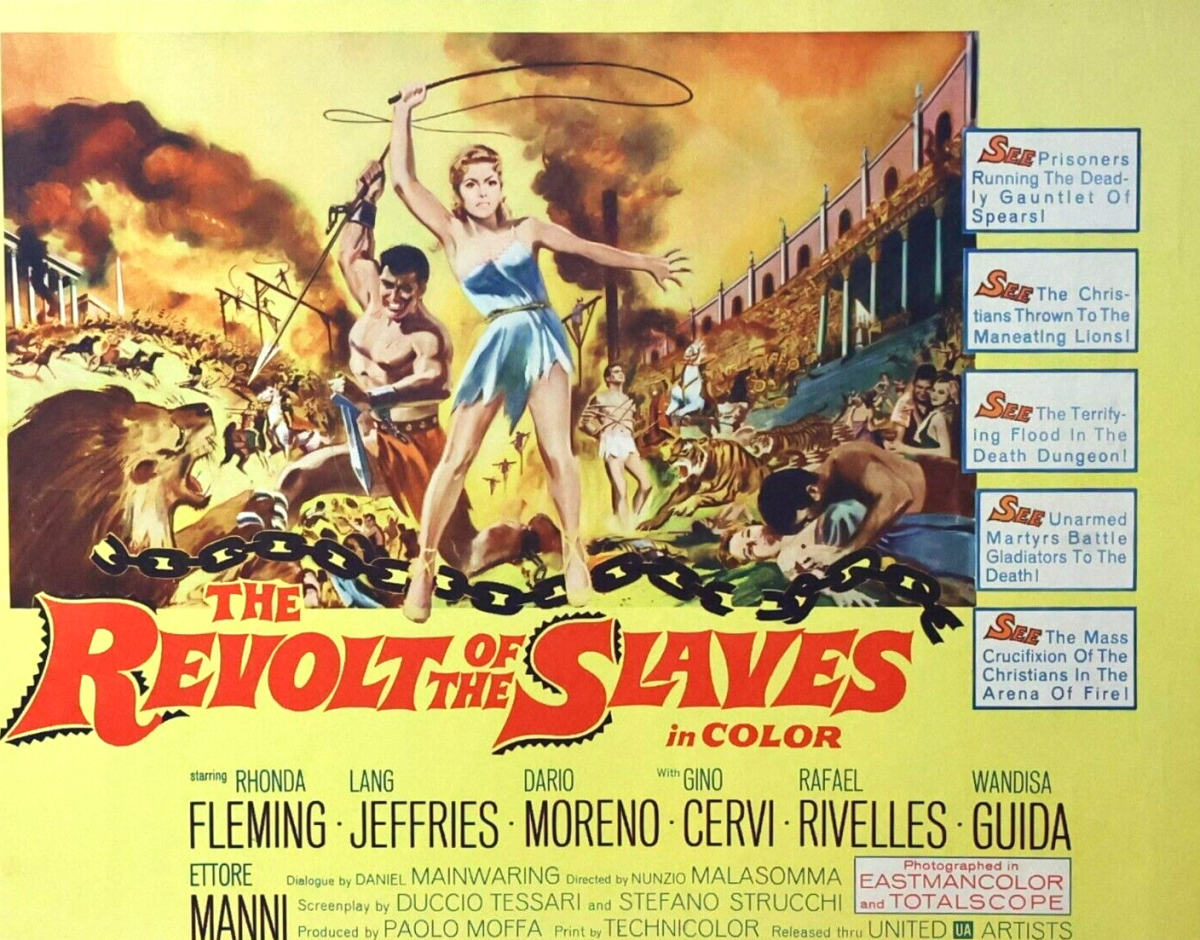
Revolt of the Slaves (1960) ****

Time has been very kind to this underrated handsomely-mounted hugely enjoyable historical romp about victimised Christians in ancient Rome. Virtually a last hurrah for 1950s redhead Rhonda Fleming (Gunfight at the OK Corral, 1957), known as The Queen of Technicolor and here  gifted lines like “the whip will do him good.” Fernando Rey (The French Connection, 1971) is thrown into a pit of ravenous hounds. Singer and serial lothario Serge Gainsbourg, immortalised by late Sixties bedroom anthem “Je t’aime,”  plays a sadistic villain.

Despite the occasional over-the-top religious references – a character called Sebastian (Ettore Mane) is pinioned to a tree by arrows because the overseer (“don’t aim for the heart”) wants to prolong his agony, a prisoner facing death is baptised in a convenient flood – the piety is largely kept under wraps because these Christians refuse to turn the traditional cheek and inflict considerable damage on their masters. A voice that sounds like the Voice of God is revealed as an ordinary mortal. And there are nods to modern politics, the powers behind the throne.

Cool Hand Luke couldn’t have come up with better plans for escape, filling a cell with water from the sewer till inmates, except the aforementioned late convert, float to the hatch in the ceiling. A sojourn along a river is enough to put the pack of chasing hounds off the scent. Pursuers are trapped in the catacombs by the simple device of bringing down the roof.

After wealthy patrician Claudius (Gino Cervi) saves the life of escaped slave Vibio (Lang Jeffries) his arrogant daughter Claudia (Rhonda Fleming), introduced driving a chariot along packed streets with little regard for public safety,  finds every excuse to humiliate him.

The plot is triggered when Claudia’s cousin/niece (the English translation is unclear) Agnese (Wandisa Guida) is followed by spy Corvino (Serge Gainsbourg) to a Christian hideout. Claudia becomes implicated when Agnese seeks refuge and for a good while she’s on the run, eventually committing her first act of unselfishness after falling for Vibio. But, to save her family, Claudia denounces the Christianity she has begun to accept, only to become involved in the finale in the arena where Christians are killed one by one, not by the waiting lions, but by spear.  

It’s mostly heady and bloody action, the driving narrative only pausing now and then to make a religious point. The Emperor, like any leader in Game of Thrones, is afflicted with illness which makes his face burst out in spots. There’s some excellent use of music. In one sequence the hunters with a soundtrack of barking dogs are contrasted with a peaceful scene of the Christians not realising their pursuers are so close until the barking infuses their scene.

Fair bit of poetic license here. No tigers!

Star of the show is undoubtedly Rhonda Fleming. A huge post-war marquee idol, she starred opposite the likes of Bing Crosby (A Connecticut Yankee in the Court of King Arthur, 1949), Glenn Ford (The Redhead and the Cowboy, 1951), Dana Andrews (While the City Sleeps, 1956) and Burt Lancaster (Gunfight at the OK Corral). But she was equally well-known as the top-billed star of adventures like The Golden Hawk (1952), Serpent of the Nile (1953) and Those Redheads from Seattle (1953). It was once said of her by a cinematographer that her beauty was so flawless she was stunning from any angle.

Quite why roles had dried up so much that she headed across the Atlantic to Italy for this is anybody’s guess. It certainly failed to revive her career, possibly because the religious aspects would have been more grating for audiences of the period whereas now they are less dominant.

Oddly enough, it was virtually a last hurrah also for veteran Italian director Nunzio Malasomma (The White Devil, 1947) who didn’t make another picture – his last – for seven years. But he handles the whole venture with aplomb, interspersing humor with action, moving along at a terrific pace, and making the most of a dream cast. In his debut Lang Jefferies (Don’t Knock the Twist, 1962) shows some acting talent among the flash of muscle. But it’s Rhonda Fleming’s picture.

Note: dubbing into English has changed some names. In the Italian version Claudia is named Fabiola – it’s a remake of the earlier Fabiola (1949) starring Michele Morgan – and her father Fabio, so stand by for confusion on imdb.

Certainly a cut above the sword-and-sandals epics flourishing at the time. I’d add that it’s an ideal matinee feature except I watched it late at night and it was just as entertaining. Highly recommended as an easy watch or just to see Rhonda Fleming at her best. The rating might err a little on the high side but every now and then we are allowed our guilty pleasures.

Discover WordPress

A daily selection of the best content published on WordPress, collected for you by humans who love to read.

The Atavist Magazine

by Brian Hannan

WordPress.com News

The latest news on WordPress.com and the WordPress community.