Taste of Excitment (1969) **

Must-see for all the wrong reasons. An epic of confusion, appalling acting and dodgy accents make this thriller a prime contender for the “So-Bad-It’s-Good” Hall of Fame. Director Don Sharp (The Devil-Ship Pirates, 1964) jibed at star Eva Renzi (Funeral in Berlin, 1966) when he should have concentrated on a script that is over-plotted to within an inch of its life. A couple of kidnaps, casino visit, a sniper, and a vertiginous cliff-top maneuver are thrown in before a truth serum lights up the climax in spectacularly hilarious fashion.

Promising material goes badly awry. English tourist Jane Kerrell (Eva Renzi), floating around the South of France, is being targeted for unknown reasons. A white Mercedes has tried to drive her off the road, mysterious phone calls and visions make her believe she is going mad, that prognosis helped along by handy psychiatrist Dr Forla (George Pravda). And before you can say Surete, Scotland Yard and NATO she is the chief suspect in the murder of a man called Chalker on the ferry to France. Assistance comes in the form of handsome artist David Headley (David Buck) – preposterously famous “I’m David Headley” “The painter?” – who nearly does what’s she’s been complaining everyone else is trying to do, namely knock her down with his car. He specialises in painting nude women and for no reason at all, given he is identified immediately as a lothario, he resists her attempts to take her to bed.

Turns out Jane is something of a boffin, as any self-respecting computer expert would be known in those days, and a millionaire businessman Beiber (Paul Hubschmid), one of Headley’s rich clients, enlists the painter to offer her a job. Of course, he has something else in mind. His company is being accused to shipping unnamed goods to the unnamed opposition, hence the involvement of NATO chap Breese (Francis Matthews).

But nobody is to be trusted, especially as the French police have dismissed her fears as nonsensical. Scotland Yard’s Inspector Malling (Peter Vaughan) throws flames on the fire by not coming to her rescue but planning to arrest her since she is the last person to see Chalker alive. Then it turns out Chalker must have given her a code or secret message before he died. The police take apart her red Mini Cooper in clinical French Connection style but find nothing. That just shows how dumb they are. It never occurred to them, as it does instantly to Headley, to check the carburretor.

By now you’ll have guessed consistency is not this movie’s strong point. You never even know who the sniper Gaudi (Peter Bowles) is targeting his aim is so appalling. There’s even a sinister secretary Miss Barrow (Kay Walsh) with a pronounced Scottish accent in the Jean Brodie class. Headley comes up with an idea to disguise her – by changing her hairstyle (that’ll fool them!! – and astonishingly, in keeping with the bizarre tone, it does).

For someone who is meant to be paranoid Jane is surprisingly trusting, toddling off with clearly-identified villains when fed a line.
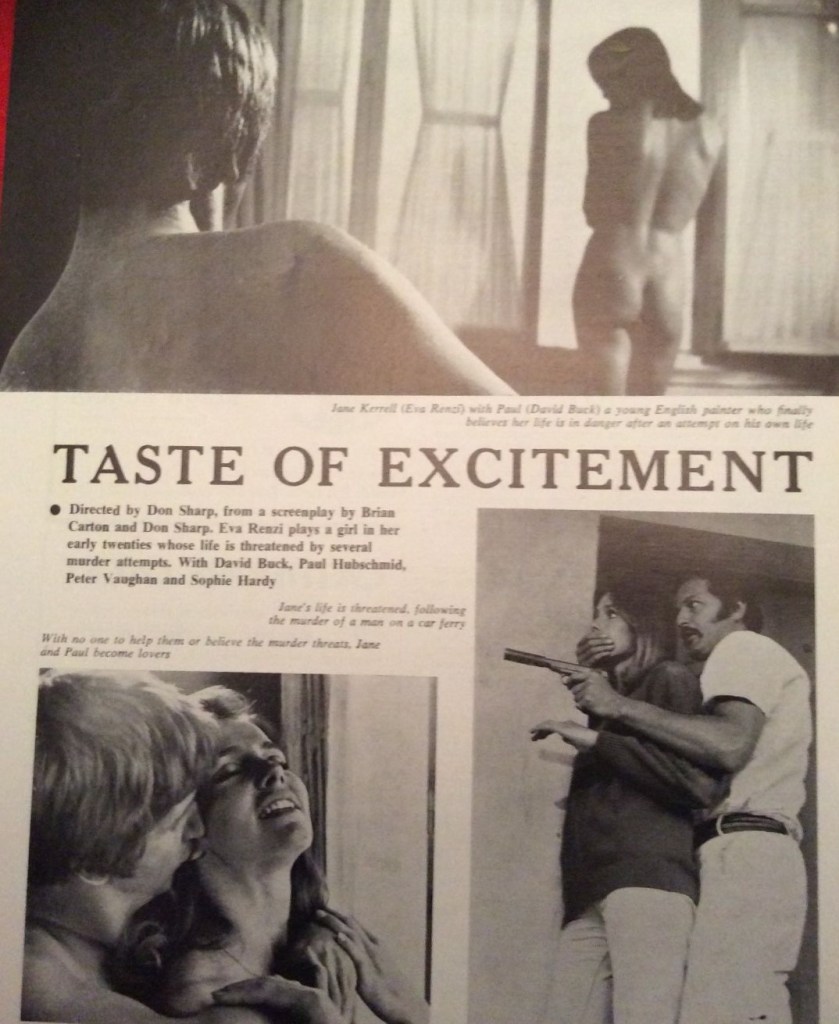
Most of the advertising, including this spread in “Films and Filming” magazine, made play of the sight of Eva Renzi’s naked derriere but ignored the unusual gender equality when it came to the nudity since in this scene David Buck gets out of bed and stands as equally starkers by the window.

You won’t be surprised when Jane ends up trussed and gagged, in her bikini naturally, in a fabulous house with an electrified fence. I can’t resist telling you about the truth serum. Before the evil psychiatrist has the chance to question her he is bopped on the head, Headley having sneaking in before (the dolts!) Gaudi thought to switch on the electric fence. (The electric fence is nullified by the police who just switch off all the electricity in the area.) But when she escapes, still full of the truth drug, when Gaudi calls out to find out where she is hiding, the serum forces her to give the correct answer. In the midst of the danger, Headley takes the opportunity to get an honest answer to the question of whether she loves him. And that’s not the best bit. The final line, given there hasn’t been a decent line all the way through, is a cracker. “Never believe a woman when she is telling you the truth” certainly gives you something to ponder.

So much is held back from the audience that there is never a chance, unlike Charade (1963), of genuine tension. Even the one gripping moment, taking a shortcut along a perilous cliff road, which is well done, is undercut by their pursuer beating them to their destination. The whole thing has an air of being improvised or being devised by someone who thought that twists counted more than characterisation, plot development or relationships.

The acting is so uniformly bad that Eva Renzi actually looks good. David Buck (Deadfall, 1968) is miscast in the slick Cary Grant role. While it is entertaining to see Peter Bowles (The Charge of the Light Brigade, 1968) drop his plummy English accent, his Italian accent fails to pass muster. Peter Vaughan (Alfred the Great, 1969), saddled with the bulk of the murky exposition, does his best. In a bit part, veteran Kay Walsh (A Study in Terror, 1965), holds the acting aces but she doesn’t have much competition.

Director Don Sharp also had a hand in the screenplay so it’s difficult to know who must take most blame, him or colleagues Brian Carton and Ben Healey. This was the alpha and omega of this pair’s movie career.

If you want to see how not to handle a potentially classy thriller tune in.  Can’t make up my mind whether to give this two stars for being so bad or four stars for being so bad it’s good. You decide.

And you can do so for free on Flick Vault. Be warned that you have to get past some adverts first. And if you’re wondering what happened to the opening credits, there ain’t any.
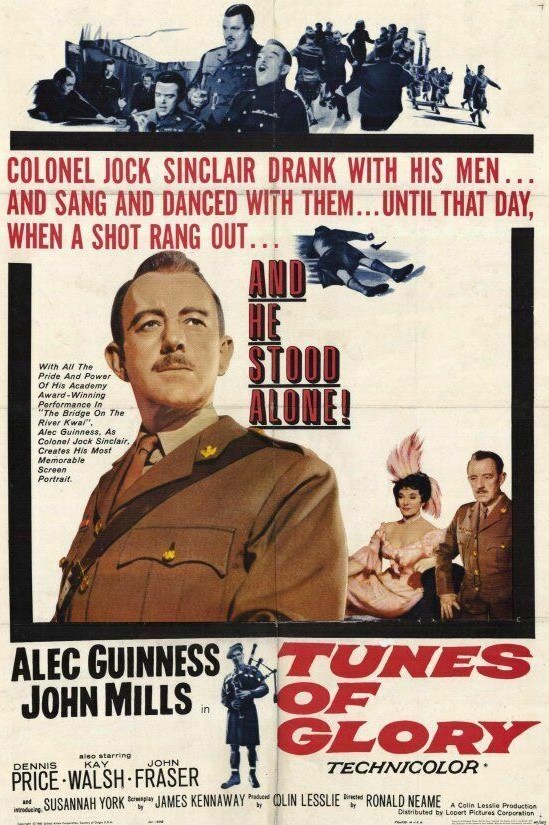
Tunes of Glory (1960) ****

Fans of Succession will appreciate this power struggle in a Scottish army regiment set in 1948. In a reverse of The Godfather (1972) where the Corleones complain about needing a “wartime consigliore,” here the powers-that-be have decided this unnamed distinctly Highlander company requires a commanding officer with skills more appropriate to peace time.

Major Jock Sinclair (Alec Guinness) has been in charge of the battalion since the North Africa campaign in World War Two when the original commander was killed. But he has never been promoted to full Lt. Col. Naturally, having been in charge for six years, he feels the job should be his. At a time when the currency of command was wartime experience he’s less than pleased when he loses out to Col. Barrow (John Mills) who spent most of the war as a Japanese POW.

It doesn’t help that they are complete opposites. Sinclair is a tough, hard-drinking, attention-seeking Scotsman who enlisted as an ordinary soldier and rose through the ranks winning two medals for courage during the conflict. Barrow is Oxford-educated English upper-class, a lecturer at Sandhurst Military Academy, and recalls his war experience with terror rather than the braggadocio of Sinclair. Worse, he doesn’t drink.

It doesn’t take long for the pair to clash. Sinclair, who has ruled as much by preying on weakness as force of personality, is quick to start to look for flaws in his opponent’s make-up. Barrow feels discipline has been slipping and enforces tougher measures. That might make him unpopular but an army is built on discipline so soldiers can hardly complain.

But Barrow slips up by misreading the men. He chooses the worst of all issues to make a stand. For the first post-war official barracks party, Barrow insists the soldiers embark on traditional Highland dancing in regulation fashion rather than in their normal exuberant, not to say rowdy, manner. The soldiers are infuriated when Barrow insists they take lessons.

He has just lit the fuse. Naturally, nothing goes according to plan. Barrow is humiliated, Sinclair triumphant. But victory does not turn out the way Sinclair expected.

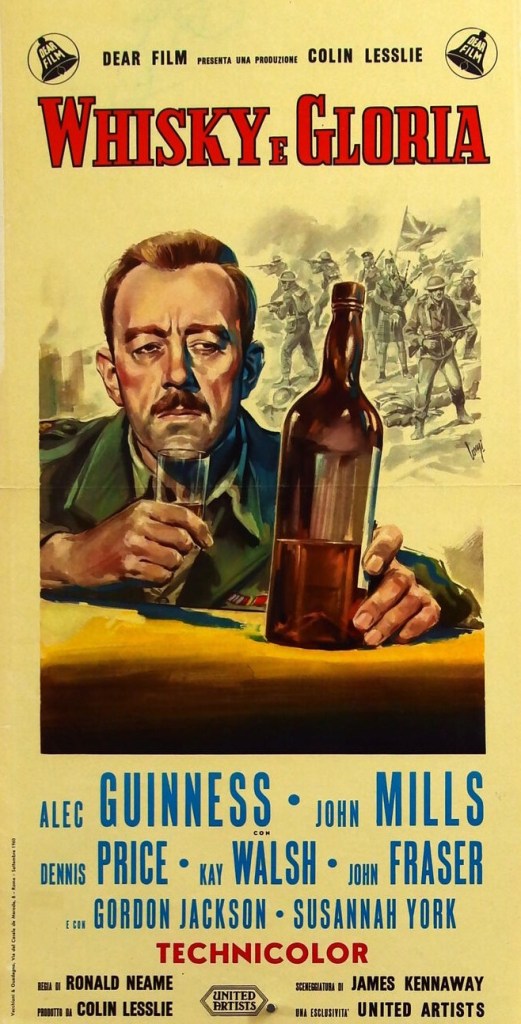
Somewhat cynical rebranding of the film in Italy as “Whisky and Glory,” possibly trying to cash in on the success of “Whisky Galore” and also misleading in suggesting actual conflict with the fighting in the background.

The main thrust of the narrative, as you might expect, is the stand-off between Sinclair and Barrow and the tensions felt all round, as would be the case in any business (Succession, now, of course the classic example) when a new boss takes control. While everyone might expect, and perhaps fear, change, in the military (as in the navy) there is always the danger, should the new broom try to sweep too clean, of mutiny.

This might not amount to a raising of arms. But there are other effective methods of mounting opposition – laxity, questioning or outright refusal to obey orders – or giving the new chief the cold shoulder. Here, in the background, are other simmering tensions. Not everyone is comfortable with Sinclair’s very laddish approach to command, the back-stabbing and double-dealing Major Charles Scott (Dennis Price) ready to pounce at any opportunity.

Sinclair is also having to deal with his daughter Morag (Susannah York) asserting her independence, having the temerity not just to take a boyfriend, Corporal Fraser (John Fraser), but one from the ranks rather than the officer class. And he feels the harsh tongue of his own paramour Mary (Kay Walsh).

Emotional isolation is rarely commented upon in matters of the armed forces and yet it is so much a driving force. If not adequately compensated by camaraderie, a man at the top can be very lonely indeed, and prone to the most vicious self-torment.

Director Ronald Neame (The Prime of Miss Jean Brodie, 1969) superbly invokes an army atmosphere away from the more usual battleground backdrop. The picture is anchored by brilliant performances all round and a roll-call of strong supporting characters. An unflinching look at power, especially leadership and the personal toll it takes. And it was astonishing that the movie could hit the target so well without relying on the usual round of sex, violence or that old stand-by the comic subordinate. It also probes the issues of what happens – in any industry – when the wrong person is put in charge. No less an authority than Alfred Hitchcock called it “one of the best films ever made.”

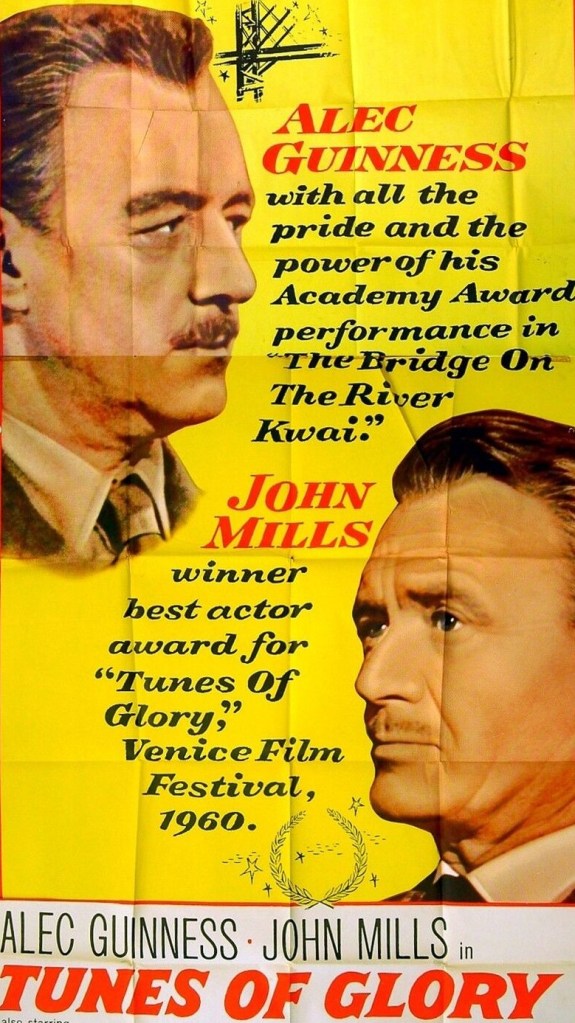
The sparring between Oscar-winning Alec Guinness (The Quiller Memorandum, 1966) and John Mills (The Family Way, 1966), who won the Best Actor Award at the Venice Film Festival for this role, is of the highest quality. Dennis Price (The Comedy Man, 1964) is the pick of the support while Susannah York (Sands of the Kalahari, 1965) makes an auspicious debut.

Few films could boast a better supporting cast: former British leading lady Kay Walsh (A Study in Terror, 1965), Gordon Jackson (The Ipcress File, 1965), Duncan Macrae (Best of Enemies, 1961), John Fraser (Tamahine, 1963), Gerard Harper (Adam Adamant Lives!, 1966-1967, TV series) and Peter McEnery (The Moon-Spinners, 1964).

James Kennaway (The Shoes of the Fisherman, 1968) wrote the screenplay based on his own novel.

Dr Syn, Alias The Scarecrow (1963) ****

The mysterious masked Scarecrow was the creepiest character thus far put on celluloid by Disney. A lot of the action takes place at dusk so it is soaked in crepuscular atmosphere. Filmed against the sky, every horse seems to thunder past. Gallows swing ominously. Coupled with a strong storyline and clever ruses by alter ago the mild-mannered clergyman Dr Syn (Patrick McGoohan), this is one for the Under-Rated Hall of Fame.  

While the character has antecedents in folk-hero Robin Hood, the Scarecrow is more rooted in the brutal reality of Britain in the mid-1700s when to fund a host of foreign wars King George taxed already-impoverished peasants to the hilt, making smuggling essential to survival. The Scarecrow is not just the underworld kingpin but has operational skills a spy would be proud of, coded messages, secret rendezvous et al.  

Ruthless General Pugh (Geoffrey Keen), sent to rid the countryside of this menace, makes no bones about putting the squeeze on the wives of villagers to force them into providing the information he requires. Outwitted from the off by Dr Syn, the infuriated general begins torching houses. Helped unwittingly by local squire and judge Thomas Banks (Michael Hordern), the general acquires an informer Joseph Ransley (Patrick Wymark).

This is not the bucolic England of Robin Hood or other historical yarns of Hollywood invention featuring glorious scenery and ample female cleavage. Here, a barmaid is likely to use a meat cleaver to defend herself. This was also the era of press gangs, where government-appointed hoodlums would raid a village and carry off young men as unwilling recruits for the Royal Navy. It was a time of imminent insurrection, the King’s subjects in the North American colonies on the point of sedition. And when money – or its lack – infected every area of society.       

Although like any super-hero the Scarecrow occasionally comes to the rescue, the movie is distinguished by the fact that is more often Dr Syn who subverts the General through cunning subterfuge. Victory through force of arms is impossible since violence visited on the king’s troops would result in a multiplication of their numbers. So it is more a battle of wits. In addition, the Scarecrow faces a dilemma – how to punish a traitor with such severity his authority is never questioned again while at the same time upholding the principles of Dr Syn. Just how these issues and others are resolved make for a very involving picture.

Minor subplots – a romance between the squire’s daughter and an officer, a deserter from the Navy and the presence of an American (Tony Britton) – serve the main story. So the narrative remains taut. And, interestingly, that hangs upon what characters have to lose rather than gain. It is not about greed but survival.

For a Disney picture there is considerable directorial vigor, not just the depiction of the smuggling and pounding hooves accompanying peril or escape, but two terrific trial scenes, a masterly escape conducted in the complete absence of on-screen music and, of course, the terrifying vision of the Scarecrow himself.

The acting has a sterling quality. While Michael Hordern was a stage star, the film primarily called upon actors who later achieved fame on British television programs. Patrick McGoohan headlined The Prisoner (1967-1968), George Cole was in Minder (1979-1994), Patrick Wymark and Alan Dobie in The Plane Makers (1963-1965) Geoffrey Keen in Mogul (1965-1972), and Tony Britton in Robin’s Nest (1977-1981). McGoohan had a previous television incarnation as Danger Man  (1960-1961) and Cole had been a con man in the St Trinian’s films. You can also spot in small roles Kay Walsh, a former British leading lady, and a young Richard O’Sullivan, later star of Man About the House (1973-1976).

Director James Neilson was a Disney favorite, having helmed Moon Pilot (1962), Bon Voyage! (1962) and Summer Magic (1963). But these were all lightweight features and it is to his credit he met the challenge of turning Dr Syn, Alias the Scarecrow into a dramatic actioner. British writer Robert Westerby (The Square Ring, 1953), who also created the source material for Kali-Yug, Goddess of Vengeance (1963),  fashioned the screenplay from the books of William Buchanan and Russell Thorndike

Although Disney had cannibalized the Davy Crockett television series in the 1950s, stitching together episodes for feature films, this was something of a reversal. As part of its The Magical Wonderful World of Disney U.S. television program the studio had shown The Scarecrow of Romney Marsh as a three-part mini-series while Dr Syn, Alias the Scarecrow was released as a movie in Britain.  

You will need to go onto ebay or other secondhand sources to find the movie. The television mini-series can be found below.

Discover WordPress

A daily selection of the best content published on WordPress, collected for you by humans who love to read.

The Atavist Magazine

by Brian Hannan

WordPress.com News

The latest news on WordPress.com and the WordPress community.