Behind the Scenes: “Man’s Favorite Sport” (1963)

Should have been, as you might have guessed, Cary Grant (Charade, 1963) in the lead. Should have featured, which you won’t have guessed, Ursula Andress (She, 1965). Should have run, which you’d be amazed to learn, for 145 minutes, almost as long as your standard epic. Should have appeared, like Hatari! (1962), under the Paramount banner.

In fact, the most likely studio destination was Columbia. Hawks’s agent Charles Feldman had  spent 16 months trying to thrash out a very good deal for his client. Feldman, who owned the rights to Casino Royale, was also keen on Hawks directing a James Bond picture. That got as far as discussing Cary Grant as the handsome spy and Hawks’ enlisting the aid of his favorite screenwriter Leigh Brackett (Hatari!).

But instead of moving studios, Hawks decided to stay put, sitting on a three-picture deal worth a hefty $200,000 plus a 50 per cent profit share. First item on the new agenda could have been reuniting Rio Bravo (1959) alumni John Wayne and Dean Martin for The Yukon Trail. But that was before Hawks expressed interest in a romantic short story, The Girl Who Almost Got Away, published in Cosmopolitan magazine, and an ideal fit for Cary Grant.

But Grant, something of the entrepreneur himself, would only sign up if Hawks in turn agreed to direct one of the actor’s pet projects, The Great Sebastian. But the director didn’t like the idea of being a gun for hire and Grant’s attention meanwhile had wandered in the direction of Charade. Rock Hudson, borrowed from Universal, was seen as an ideal replacement. For the female lead Hawks initially enthused about Joanna Moore (Walk on the Wild Side, 1962) until he chanced upon Paula Prentiss (Where the Boys Are, 1960), an MGM contract player.

Paramount balked at a relative unknown. Hawks balked at anyone balking at his choice and switched the project to Universal. While toying with Casino Royale, Hawks had a sneak preview of Dr No (1962) and espied a natural for the second female lead in Ursula Andress. But her management team reckoned the Bond movie would open bigger doors. Instead, Hawks plumped for Austrian blonde Maria Perschy (The Password Is Courage, 1962). Charlene Holt (If A Man Answers, 1962) made such an impression on Hawks that she not only won the part of Rock Hudson’s fiancée but the role of regular girlfriend to the director and parts in his next two pictures.

Leigh Brackett  was brought in to pep up the original script by John Fenton Murray (It’s Only Money, 1962) and Steve McNeil (Red Line 7000, 1965). Unusually, she was rewriting on the hoof, earning $1,000 a week to refashion the lines scene by scene as production unfolded. Everything except the opening scene set in San Francisco was shot on the Universal backlot. Even then, neither Hudson nor Prentiss was transported to San Francisco, their close-ups while driving cars filmed at the studio and inserted as process shots. Hawks didn’t leave the studio either, entrusting that initial footage to associate producer Paul Helmick and cinematographer Russell Harlan.

Like Otto Preminger, Hawks liked a lot of takes. Paula Prentiss didn’t, in part because she felt he was trying to mold her into a screwball comedy heroine of the past, and in part because every take not printed impinged on her confidence. Although Hawks lacked the reputation as a bully of the Otto Preminger variety, nonetheless the inexperienced Prentiss found herself in tears more than once. Cary Grant dropped by one time for a friendly chat. He was made welcome. Angie Dickinson, expecting a similar welcome, received a curt put-down, Hawks making it clear he preferred as a brunette.

While the credit sequence by photographer Don Ornitz was deemed sexist since it comprised 33 models in sports or beach gear, it was actually the opposite because the women were proving how superlative they could be at sports generally considered the preserve of men. But there was no doubt the reaction Hawks expected when he spent $20,000 on black scuba outfits for Prentiss and Perschy, using molds made from their bodies to achieve the skin-tight effect. Hawks was notoriously slow, the picture taking three and a half months.

The initial version of the film attracted at a sneak preview the most positive responses the studio had ever received. The only problem was – it ran 145 minutes, considered an impossible length for a light romantic comedy. Although the next version was shorter, the audience response was decidedly worse. Even so, Universal insisted on further cuts until the movie came in at the two-hour-mark.

Not everyone went along with the official Hawks version of events. Others remembered the response to the various cuts not being so different. The film wasn’t released until six months later and there is no evidence that Hawks fought hard to retain his edit. Although he would later complain that the movie was “sabotaged,” that may have been his automatic default position once the movie proved a relative commercial failure, with only $2.35 million in U.S. rentals

Leigh Brackett had more right to feel disgruntled. She was denied a credit by the Writers Guild of America who contended her work was a polish rather than an original contribution.

I have to say I’m out of step with some of the critical opinion. Molly Haskell reckoned the film was actually some kind of Adam and Eve deal with Hudson “a virgin who has written a how-to book on sex while harbouring a deep fastidious horror of it.” The Haskin critique allows that fish are phallic symbols, therefore giving sexual credence to the scene about learning to handle a fish.

It might just be more straightforward to say that, of course, this isn’t as good as Bringing Up Baby but then, nothing ever was, and just enjoy what Hawks did manage to conjure up with very likeable leads.

SOURCES: Todd McCarthy, Howard Hawks, The Grey Fox of Hollywood (Grove Press, 1997), p595-603; Joseph McBride (editor), Focus on Howard Hawks (Englewood Cliffs); Molly Haskell, “Howard Hawks: Masculine Feminine,” Film Comment, March-April 1974.  

Humphrey Bogart: 1960s Revival Champ

When Billy Wilder’s Sabrina (1954) was reissued in 1963 the star attraction was undoubtedly Audrey Hepburn, hot after Breakfast at Tiffany’s (1961) and Charade (1963), rather than William Holden, tumbling down the box office charts, or Humphrey Bogart, six years deceased. When the film was reissued two years later on the back of an even hotter Hepburn after My Fair Lady (1964), Bogart was assuredly the star. What happened in between was one of the oddest twists in motion picture history and one that would turn the actor into the biggest revival star of the 1960s.

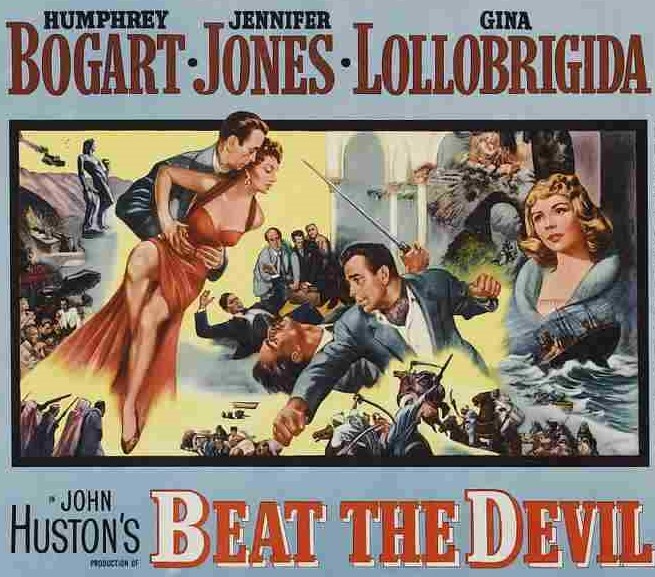
But if you were to select the Bogart picture most likely to reignite public interest in the star, it would not be John Huston’s Beat the Devil (1953), a flop on initial release and by 1965 for legal reasons never shown on television. But in one of those quirks of programming the old Bogart found a new lease of life. Opening in spring 1964 at the 250-seat Avenue Cinema in New York it racked up $7,000 – equivalent to $65,000 today, totting up $30,000 ($279,000 equivalent) in a six-week run – phenomenal amounts for such a small venue. It shifted over to the 55th St Playhouse where it remained for another four weeks. The Art Cinema chain picked it up for wider release, sending it out in its thirty-six houses with, once again, outstanding results ($7,000 in one week in Boston, $5,000 in Washington). In Philadelphia it ran simultaneously in two houses.

In 1965 Dominant Films, part of United Artists, reissued a package of nineteen Bogart oldies, available on a rental rather than fixed price basis, and bookings were conditional on cinemas undertaking a two-week engagement, one film for the whole fortnight or the entire supply over the period, or any kind of program arrangement in between. There was no shortage of takers, especially after it became known that the 8th St Playhouse in New York, generally a second-run arthouse, and the 495-seat Carnegie in Chicago had each seen receipts hit the $10,000 ($93,000 equivalent) mark. The former double-billed fourteen pictures from the selection available, switching programs every two days.

Demand for the program was so high, prints were rationed. In the next fourteen cinemas on the release schedule, venues were allocated a maximum of six movies over the two-week period, sometimes limited to just two. When it became obvious that this gold mine was being given away too cheaply, a new strategy emerged: weekly double bills. In what amounted to a Humphrey Bogart greatest hits package the Carnegie in Chicago cleared nearly $15,000 ($139,000 equivalent) over three consecutive weeks with the following programs: The Petrified Forest (1936)/Key Largo (1948), Treasure of the Sierra Madre (1948)/Casablanca (1942), and The Maltese Falcon (1941)/High Sierra (1951).

These grosses were even more astonishing in light of the fact that nearly all his seventy-five pictures were available on television, free of charge, on constant rerun, demand highest in the late-late slot. In 1966, United Artists Associates, a division of UA TV, referred to its portfolio of forty-five Warner Brothers features as “the most significant phenomenon of this era of entertainment history” It was estimated that screenings of his movies totalled two hundred per year.

Although there had been sporadic screenings of golden oldies in the U.S., exhibitors did not appear to share the same penchant for classics. Certainly, the U.S. lagged behind Europe in that respect. Wuthering Heights (1939), a huge rerun favourite in Europe, in 1963 in Paris attracted 30,000 admissions in three days in a trio of cinemas. In February 1963 half the cinemas in the French capital were given over to classics.

The most successful classics operator in the U.S. was MGM which in the early 1960s set up the Perpetual Program Plan. Investing in new prints of MGM oldies and a distinct marketing plan, the studio offered a package on an innovative basis. Rather than tying cinemas down to one-week or two-week contracts, as would be standard for arthouses, and therefore limiting potential bookings over fears that audience demand would peter out after a few days, MGM had hit on the idea of showing the films once a week on the same day of the week – Wednesday the most popular – for a season of six-eight weeks. Patrons could book a “season ticket” to see all the films. This approach made it far more appealing to the ordinary cinema, rather than the arthouse specialist, since a special showing could lift the midweek quiet period.

The first offerings from the Perpetual Program Plan were “Golden Operettas” – Rose Marie (1936), The Merry Widow (1934), The Great Waltz (1938), Sweethearts (1938), The Chocolate Soldier (1941) and The Student Prince (1954). The package played in over 3,500 cinemas. Expecting little more than $60 for their Wednesday income, cinemas found themselves taking in $300-$900 a night. The Chocolate Soldier could bring in as much as $2,200 a night, The Student Prince $1,500. MGM followed up with a program of films based on famous books such as Little Women (1949) and a third package revolved around musicals like Singing’ in the Rain (1952) and The Bandwagon (1953).  

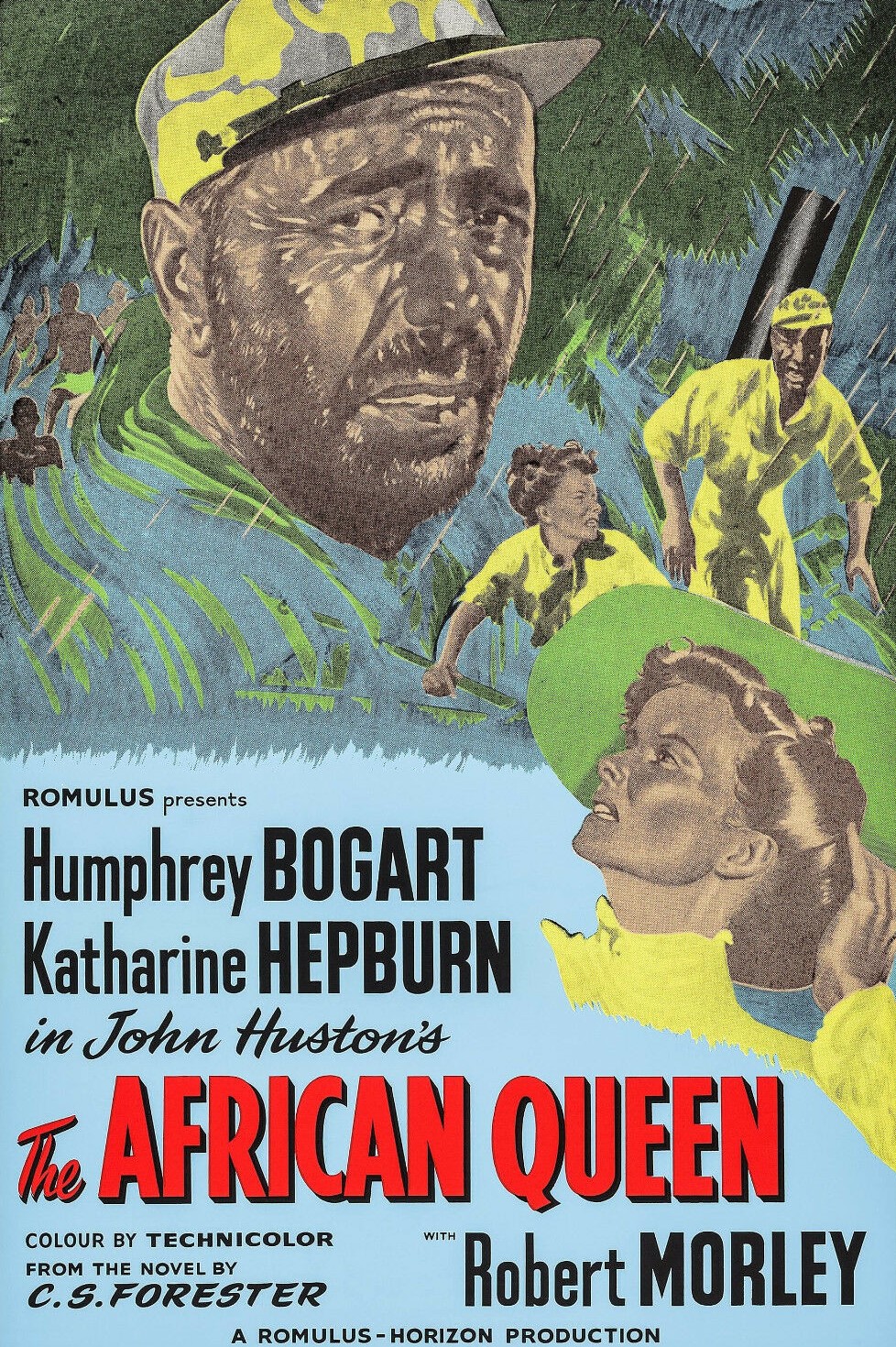
The Humphrey Bogart concept was a considerable step up from this once-a-week program. The Bogart craze reached its commercial height in 1967. But there was one Bogart picture that audiences had been denied a showing for a decade. The African Queen (1952) had been made by British company Romulus and distributors had been put off taking up an option to show it due to a technical issue with the color prints. The impetus for its revival was the tenth anniversary of Bogart’s death, an event that stimulated an avalanche of newspaper articles and books. Producer Sam Spiegel sold reissue rights for The African Queen to Trans-Lux, a small arthouse chain in expansion mode planning to move into distribution. When the Los Angeles Times held a poll to identify the oldie most moviegoers wanted to see, The African Queen topped the poll. The buzz surrounding Guess Who’s Coming to Dinner (1967) created massive interest in the picture’s co-star Katharine Hepburn.

It was no surprise that The African Queen launched – in November 1967 – at a New York arthouse, the 600-seat Trans-Lux East, but the box office blew the industry away. An opening week of close on $20,000 ($186,000 equivalent) put the oldie into the cinema’s all-time top ten. What was astonishing was that it received as many bookings outside the expected release route of arthouses and the college circuit and was taken up by local theaters all over the country, shown in four houses in San Mateo, for example. It formed double and triple bills with other Bogart films, as well as The Quiet Man (1952) and topped bills that included films like Waterhole 3 (1967). After the first flush of first run and nabes, it turned up as support to contemporary pictures like Dark of the Sun (1968) and underwent another revival in 1969 before being sold to television in 1970.

SOURCE: Brian Hannan, Coming Back To A Theater Near You; A History of Hollywood Reissues, 1914-2014 (McFarland, 2016) p127-133, 198-206.

Discover WordPress

A daily selection of the best content published on WordPress, collected for you by humans who love to read.

The Atavist Magazine

by Brian Hannan

WordPress.com News

The latest news on WordPress.com and the WordPress community.