Blood Demon / Blood of the Virgins / The Torture Chamber of Dr Sadism (1967) **

Heavy on atmosphere but not much else, a gender-switch take on the Countess Bathory horror tale (made by Hammer as Countess Dracula, 1971), which sees Count Regula (Christopher Lee) as, oddly enough, being one virgin’s blood short of achieving immortality, thirteen being the vital number, when he is arrested. Condemned to die in traditional fashion, first of all face impaled on a golden iron maiden then body torn apart by a quartet of horses, but not before casting a curse on the prosecutor.

Thirty years later or thereabouts Roger von Marienberg (Lex Barker), son of the prosecutor, turns up seeking the family castle only to find no one will show him the way. And that when he does get going it’s through intermittent fog, past burnt-out buildings and a forest strung with corpses and, it has to be said, a countryside that occasionally takes on an artistic hue, such as one sequence where the coach rides through the countryside with the sky above solid red and the land below solid green.  
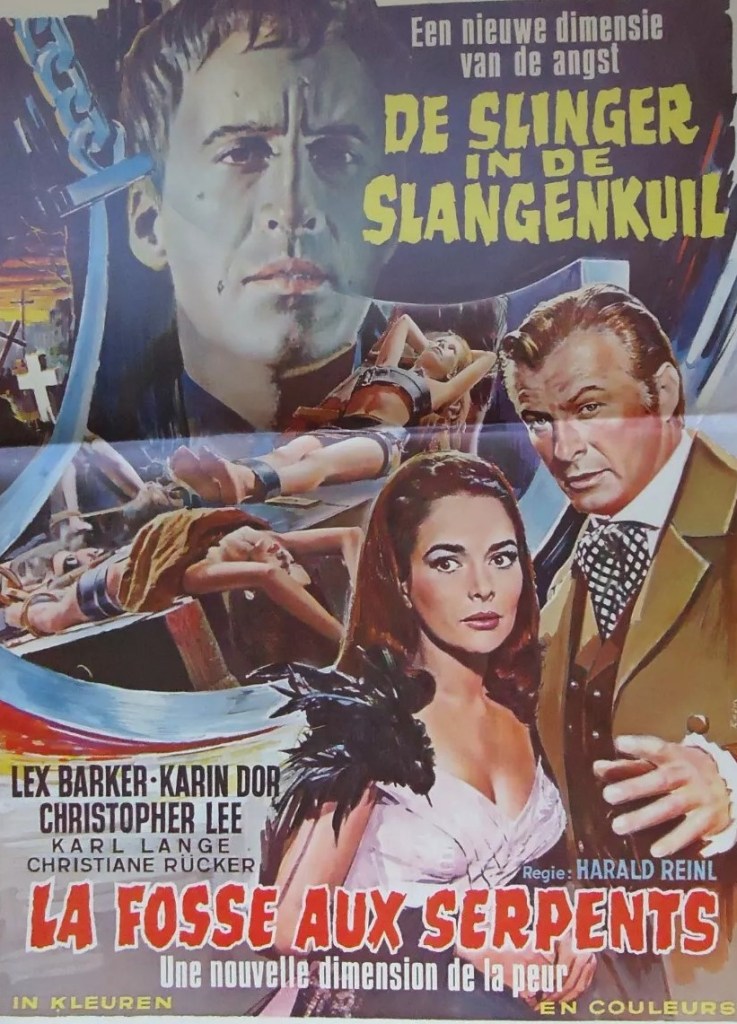
Along the way he encounters Baroness Lilian (Karin Dor) – the daughter of the evil count’s intended victim number thirteen – and her maid Babette (Christiane Rucker) who go through a routine of being captured and rescued, captured and rescued. When finally, halfway through, we reach the castle, we find the count in a glass coffin awaiting rebirth.

And then it’s like a reality tv show as the visitors undergo a series of torturous obstacles, Babatte hung over a bed of knives while time runs out, Lilian encountering rats and spiders and potentially dropping into a nest of (rather disinterested) snakes, Roger taking a leaf out of the Edgar Allan Poe playbook and facing either the pit or the pendulum.

The count – his awakening shown in shadow the best sequence in the movie – looks like a survivor from A Quiet Place, face desperately white, and frantic to fulfill his quest, with Lilian designated the unlucky thirteenth. Of course, although it took an iron mask and four stout horses to bring him to heel three decades before, he’s not so familiar with the rules governing the undead and a crucific is all it takes to unhinge him.
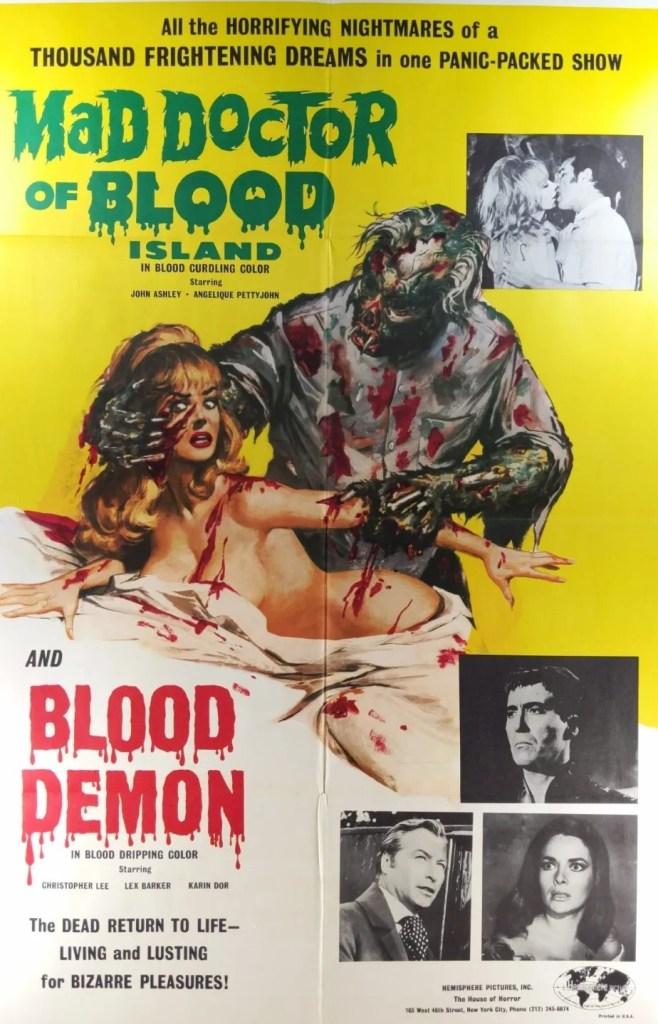
Very much horror by the numbers without much pizzazz. Lex Barker (Old Shatterhand, 1964) looks as if he’s more worried about his quiff being out of place than anything else. Christopher Lee (The Devil Rides Out, 1968) isn’t in it often enough and, minus the fangs, hasn’t the wherewithal to drum up a scare. Karin Dor (Topaz, 1969), beautiful though she is, doesn’t quite make it as a Scream Queen.

Atmosphere is the best element here, from the opening march from dungeon to execution through long echoing corridors to the Hieronymous Bosch-inspired backdrop of the castle, and the bodies that appear to have dived headling into trees rather than merely dangling from them.

Lex Varker is the key that this is German-made, directed without requisite suspense or fright, by Harald Reinl (Winnetou, 1963).

But like the fog everything is too strung-out

Topaz (1969) ****

Authentic, atypical, engrossing, this grittier Hitchcock mixes the realism of Psycho (1960) and Marnie (1964) with the nihilism of The Birds (1963), a major departure for a canon that previously mostly spun on innocents or the falsely accused encountering peril. The hunt for a Russian spy ring by way of the Cuban Missile Crisis of 1962 forms the story core but the director is more interested in personal consequence, so much so that even the villain suffers heart-rending loss. Betrayal is the other key theme – defection and infidelity go hand in hand.

The tradecraft of espionage is detailed – dead letter drops, film hidden in typewriting spools, an accidental collision that is actually a sweet handover. In a transcontinental tale that shifts from Copenhagen to New York to Cuba to Paris, there is still room for classic sequences of suspense – the theft of secret documents in a hotel the pick – and Hitchcock at times simply keeps the audience at bay by employing dumbshow at key moments.     

In some respects the director was at the mercy of his material. In the documentary-style Leon Uris bestseller (almost a procedural spy novel), the main character is neither the trigger for the plot nor often its chief participant and is foreign to boot. So you could see the sense of employing using a cast of unknowns, otherwise an audience would soon grow restless at long absences from the screen of a Hollywood star of the caliber of Cary Grant or Paul Newman, for example.

It is a florist (Roscoe Lee Browne) who carries out the hotel theft, a small resistance cell the spying on Russian missiles in Cuba and a French journalist who beards one of the main suspects, not the ostensible main character, French agent Andre Devereux (Frederick Stafford), not his U.S. counterpart C.I.A. operative Michael Nordstrum (John Forsythe) nor Cuban villain Rico Parra (John Vernon).

Unusual, too, is the uber-realism. The main characters are fully aware of the dangers they face and of its impact on domestic life and accept such consequence as collateral damage. It is ironic that the Russian defector is far more interested in safeguarding his family than Devereux. Devereux’s wife (Dany Robin), Cuban lover Juanita (Karin Dor) and son-in-law (Michel Subor) all suffer as a result of his commitment to his country.

And that Juanita, leader of the Cuban resistance cell, is more of a patriot than the Russian, refusing to defect when offered the opportunity. Hitchcock even acknowledges genuine politics: the reason a Frenchman is involved is because following the Bay of Pigs debacle in 1961 American diplomats were not welcome in Cuba.

I have steered clear of this film for over half a century. I saw it on initial release long before the name Hitchcock meant anything to me. But once it did I soon realized this film did not easily fit into the classic Hitchcock and had always been represented as shoddy goods. So I came to it with some trepidation and was surprised to find it so engrossing.  

Frederick Stafford (O.S.S. 117: Mission for a Killer, 1965) was excellent with an insouciance reminiscent of Cary Grant and a raised eyebrow to match that star’s wryness. John Vernon, who I mostly knew as an over-the-top villain in pictures such as Fear Is the Key (1972), was surprisingly touching as the Cuban bad-guy who realizes his lover is a traitor. And there is a host of top French talent in Michel Piccoli (La Belle Noiseuse, 1991), Philippe Noiret (Justine, 1969), Dany Robin (The Best House in London, 1969) and Karin Dor (You Only Live Twice, 1967).

As you are possibly aware, three endings were shot for this picture and I can’t tell you which without spoiling the plot. In any case, this is worth seeing more than just to complete trawl through the entire Hitchcock oeuvre, a very mature and interesting work. Based on the Leon Uris bestseller, screenplay by Samuel A. Taylor (Vertigo, 1958).

Underrated.

Topaz (1969) ****

Authentic, atypical, engrossing, this grittier Hitchcock mixes the realism of Psycho (1960) and Marnie (1964) with the nihilism of The Birds (1963), a major departure for a canon that previously mostly spun on innocents or the falsely accused encountering peril. The hunt for a Russian spy ring by way of the Cuban missile crisis forms the story core but the director is more interested in personal consequence and even the villain suffers heart-rending loss. Betrayal is the other key theme – defection and infidelity go hand in hand.

The tradecraft of espionage is detailed – dead letter drops, film hidden in typewriting spools, an accidental collision that is actually a sweet handover. In a transcontinental tale that shifts from Copenhagen to New York to Cuba to Paris, there is still room for classic sequences of suspense – the theft of secret documents in a hotel the pick – and Hitchcock at times simply keeps the audience at bay by employing dumbshow at key moments.    

In some respects the director was at the mercy of his material. In the documentary-style Leon Uris bestseller (almost a procedural spy novel), the main character is neither the trigger for the plot nor often its chief participant and is foreign to boot. So you could see the sense of employing a cast of relative unknowns, otherwise an audience would soon grow restless at long absences from the screen of a Hollywood star of the caliber of a Cary Grant or Paul Newman. It is a florist (Roscoe Lee Browne) who carries out the hotel theft, a small resistance cell the spying on Russian missiles in Cuba, a French journalist who beards one of the main suspects, not the ostensible main character, French agent Andre Devereux (Frederick Stafford), not his U.S. counterpart C.I.A. operative Michael Nordstrum (John Forsythe) nor Cuban villain Rico Parra (John Vernon).

Unusual, too, is the uber-realism. The main characters are fully aware of the dangers they face and of its impact on domestic life and accept such consequence as collateral damage. It is ironic that the Russian defector is far more interested in safeguarding his family than Devereux. Devereux’s wife (Dany Robin), Cuban lover Juanita (Karin Dor) and son-in-law (Michel Subor) all suffer as a result of his commitment to his country. And that Juanita (Karin Dor), leader of the Cuban resistance cell, is more of a patriot than the Russian, refusing to defect when offered the opportunity. Hitchcock even acknowledges genuine politics: the reason a Frenchman is involved is because following the Bay of Pigs debacle in 1961 American diplomats were not welcome in Cuba.

In terms of bravura Hitchcock, the pick of the scenes are the hotel theft and the death of one of the principals, filmed from above.

I have steered clear of this film for over half a century. I saw it on initial release long before the name Hitchcock meant anything to me. But once it did I soon realized this film did not easily fit into the classic Hitchcock and the critics on whom I relied had always represented it as shoddy goods. So I came to it with some trepidation and was surprised to find it so engrossing.  

Frederick Stafford (O.S.S. 117: Mission for a Killer, 1965) was excellent with an insouciance reminiscent of Cary Grant and a raised eyebrow to match that star’s wryness. John Vernon, who I mostly knew as an over-the-top villain in pictures such as Fear Is the Key (1972), was surprisingly touching as the Cuban bad-guy who realizes his lover is a traitor. And there is a host of top French talent in Michel Piccoli (Belle de Jour, 1967), Philippe Noiret (Justine, 1969) Dany Robin (The Best House in London, 1969) and Karin Dor (You Only Live Twice, 1967).

As you are possibly aware, three endings were shot for this picture and I can’t tell you which I saw without spoiling the plot. If you want to know, read tomorrow’s Blog.

In any case, this is worth seeing more than just to complete a trawl through the entire Hitchcock oeuvre, a very mature and interesting work.

Discover WordPress

A daily selection of the best content published on WordPress, collected for you by humans who love to read.

The Atavist Magazine

by Brian Hannan

WordPress.com News

The latest news on WordPress.com and the WordPress community.