Behold a Pale Horse (1964) ***

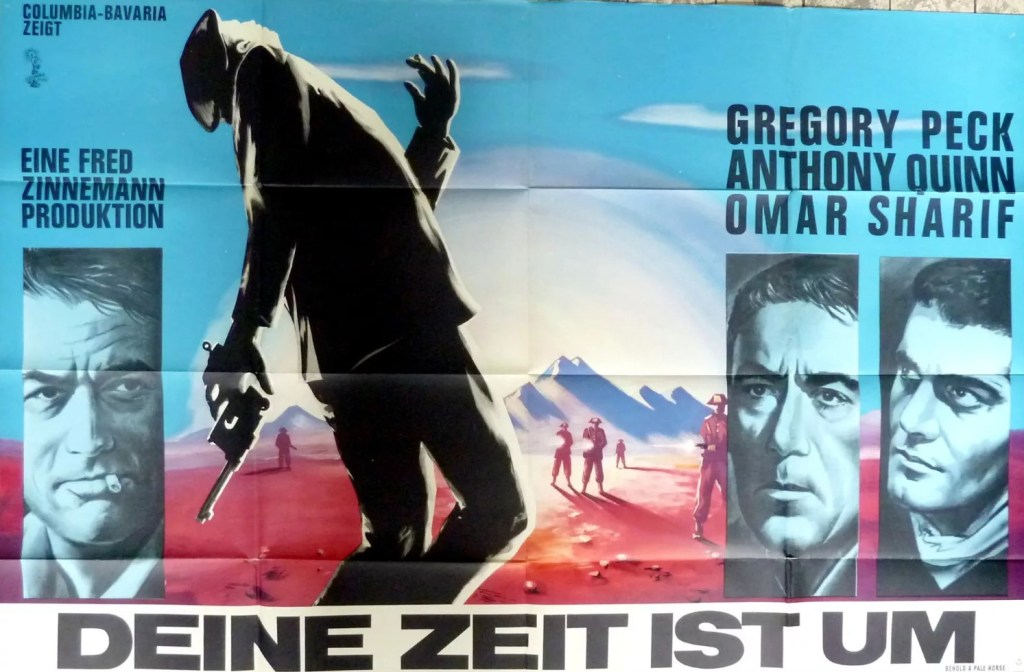
Old causes never die but they do go out of fashion and interest from movie audiences in the issues surrounding the Spanish Civil War had fallen from the peak when they attracted artists of the caliber of Ernest Hemingway and Pablo Picasso. But passions surrounding the conflict remained high even 20 years after its conclusion as indicated in this Fred Zinnemann (The Sundowners, 1960) drama.

Manuel Artiquez (Gregory Peck) plays a disillusioned guerilla living in exile in France, who has ceased raiding the Spanish border town under the thrall of corrupt Captain Vinolas (Anthony Quinn). Artiguez has two compelling reasons to return home – a young boy Paco asks him to revenge the death of his father at the hands of Vinolas and his mother is dying. But Artiquez is disinclined to do either. Heroism has lost its luster. He has grown more fearful and prefers to live out his life drinking wine and casting lustful glances at young women.
In France he enjoys a freedom he would be denied in Spain. He is not hidden. Ask anybody in the street where he lives and they will tell you. This is a crusty old soldier, unshaven, long past finding refuge in memories, but not destroyed either by regret. There is a fair bit of plot, some of it stretching incredulity. The action sequence at the end, conducted in complete silence, is very well done, but mostly this is a character piece.

This is not the upstanding Gregory Peck of his Oscar-winning To Kill a Mockingbird. He is a considerably less attractive character, burnt-out, shabby, grizzled, lazy, easily duped, unwilling to risk his life to see his mother. We have seen aspects of the Anthony Quinn character before but he brings a certain humanity to his villain, bombastic to hide his own failings, coarse but occasionally charming, suitably embarrassed when caught by his wife visiting his mistress and praying earnestly to God to deliver Artiquez into his hands. Omar Sharif has the most conflicted character, forced by conscience to help an enemy of the Church.

However, two elements in the picture don’t make much sense. Paco tears up a letter (critical to the plot) to Artiquez which I just cannot see a young boy doing, not in an era when children respected and feared their elders. And I am also wondering what was it about Spain that stopped directors filming it in color. This is the third Spain-set picture I have reviewed in this blog after The Happy Thieves and The Angel Wore Red. For the first two I can see perhaps budget restrictions being the cause, but given the stars involved – Rex Harrison and Rita Hayworth in the first and Ava Gardner and Dirk Bogarde in the second – hardly facing the production dilemmas of a genuine B-picture.

But Behold a Pale Horse was a big-budget effort from Columbia and while black-and-white camerawork may achieve an artistic  darkness of tone it feels artificial. This was never going to be the colorful Spain of fiestas and tourist vistas but it would have perhaps been more inviting to audiences had it taken more advantage of ordinary scenery.

J.P. Miller (Days of Wine and Roses, 1962) adapted the film from the novel Killing a Mouse on Sunday by Emeric Pressburger who in tandem with Michael Powell had made films like Black Narcissus (1947) and The Red Shoes (1948). The film caused calamity for Columbia in Spain, the depiction of Vinolas with a mistress and taking bribes so upset the authorities that all the studio’s movies were banned.   
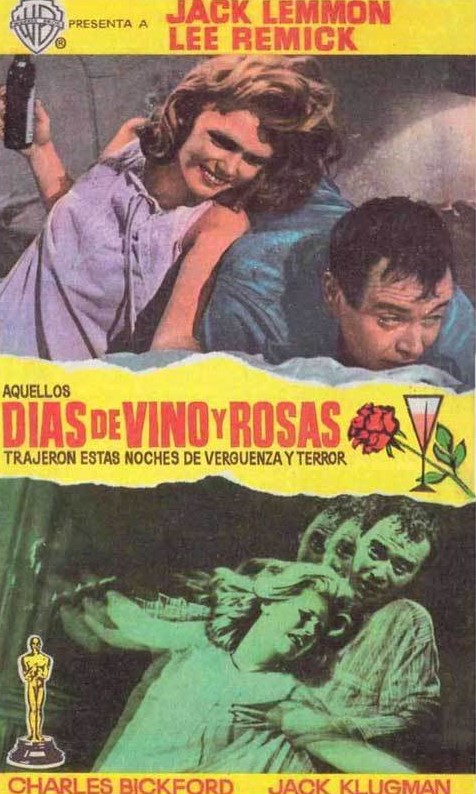
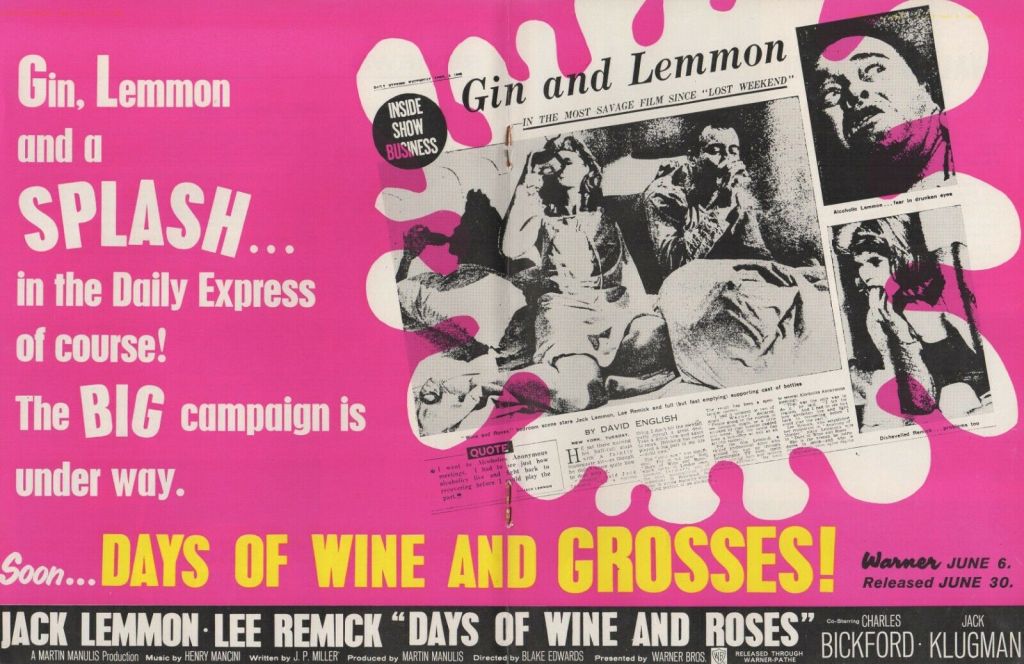
Days of Wine and Roses (1962) *****

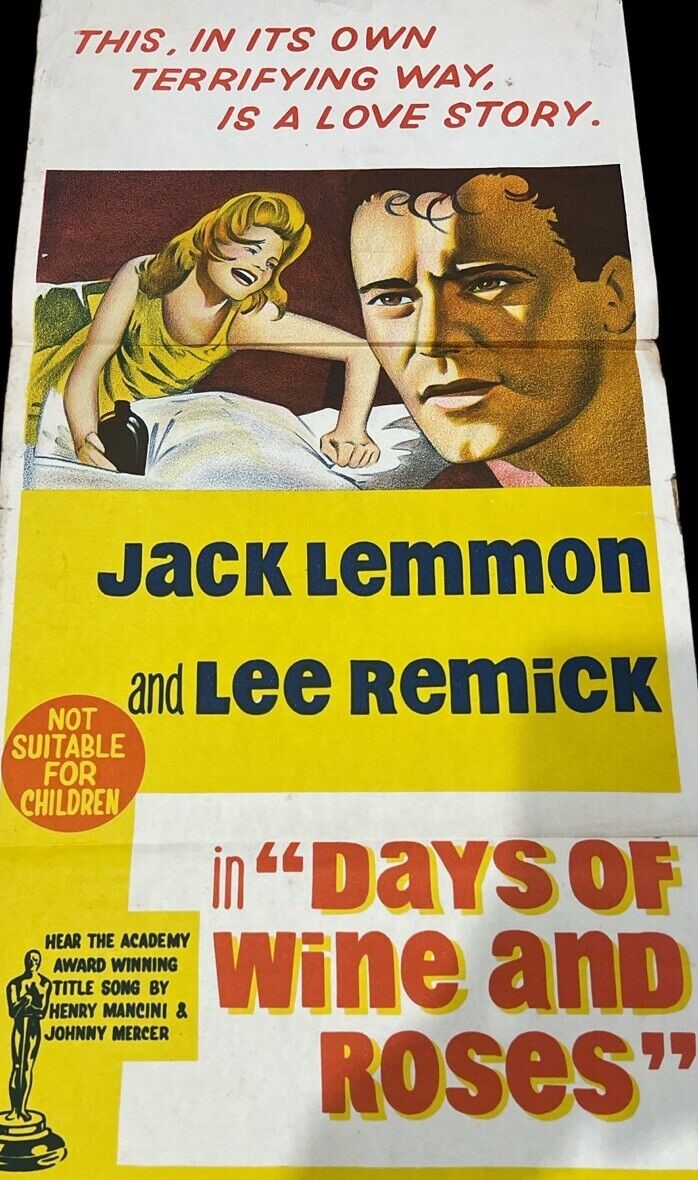
A touch of Mad Men satire adds a contemporary bite to tale of the destructive power of alcohol. Not since Billy Wilder let loose on The Lost Weekend (1945) did Hollywood finance a no-holds-barred examination of alcohol addiction.  

But let’s start with the amoral world of advertising or, in this case, public relations. When we are introduced to executive Joe (Jack Lemmon) he’s little more than a pimp for his client, rounding up a plethora of blondes who can be salivated over by wealthy men on a big yacht. When we first meet Kirsten (Lee Remick) she is initially mistaken by Joe as a blonde worth salivating over only to learn that actually she is the prim, though pretty, secretary of his client to whom the idea of a potential pawing on a big yacht has no appeal, regardless of how wealthy the pawing hands might be.

Romance should never have got off the ground as they insult each other in turn, but in the way of such tales, one of his barbed comments strikes home and she consents to be taken to dinner. Astonished to discover she doesn’t drink, he alights upon her weakness for chocolate as a way of getting her to sample Brandy Alexander (as stiff with chocolate as alcohol). That’s all it takes. While she begins to lose her inhibitions, he, ironically, adopts a principled stance towards the aforesaid pimping and is moved to another account.

After they marry, she stays off the sauce once a baby arrives, he, petulant at taking second place to the baby, gets deeper into the stuff. Eventually, he wears her down, and they have a whale of a time getting drunk and ignoring the child. Meanwhile, he is sliding lower down the company pyramid thanks to his drinking. Matters come to a head when she sets the apartment on fire.

Eventually, jobless, Joe throws himself on the mercy of Kirsten’s stern father Ellis (Charles Bickford) and they manage a good few months on the wagon until in a drunken spree he manages to destroy a greenhouse at his father-in-law’s landscaping business.  Joe ends up with the DTs, committed to a sanatorium and determines to mend his ways. But that means admitting his addiction and joining Alcoholics Anonymous. Kirsten, meanwhile, is not such a softie, refusing the believe she is an alcoholic.

Their bright future darkens by the minute as squalidness and selfishness take over. In some senses, this is a case study of the alcoholic, the one who can fight the demons and the one who can’t be bothered to fight anything since the bottle is the easiest cure.

Made at a time when Hollywood was not predisposed to this kind of sharp shock of reality, not even with attractive stars to make the tale more palatable, this is easily the highlight of director Blake Edwards’ career, the comedies and even the romanticised Breakfast at Tiffany’s (1961) seeming like so much fluff in comparison. He manages to avoid being either sentimental or sanctimonious and possibly the only time he holds back is when the fire takes place off-screen. Otherwise, it’s light years ahead of The Lost Weekend, whose protagonist seems more easily than humanly possibly to beat the addiction.

If you think Jack Lemmon (How To Murder Your Wife, 1965) is usually a hyperactive character anyway on screen, wait till you see what’s he’s like with a drink in him, just as if he doesn’t know when to stop, consequence never entering his consciousness, as like any drunken maniac he’s living in a fantasy world. But because she starts out on a different dramatic plane, and her slide into incoherence is more sobering, Lee Remick  (No Way to Treat a Lady, 1968) beats him to the critical kudos. Terrific performances from both and from those tasked with keeping them in line, Charles Bickford (The Unforgiven, 1960) and Jack Klugman (Goodbye, Columbus, 1969) as the recovering alcoholic trying to get Joe to face up to his condition.

In all the literature devoted to twentieth century humanitarians, you’ll find few busting a gut to highlight the work of Bill Wilson (better known as Bill W), the founding father of Alcoholics Anonymous. But this self-funded organisation that created a community for the addicted probably did more in the last century to cure a terrible disease than any scientist inventing a drug. Incidentally, James Garner played Bill in a television biopic My Name Is Bill W (1989).

Sometimes I think actors take on roles aiming to enhance their reputation by playing difficult unsympathetic characters. But I imagine Lemmon and especially Remick got the shock of their lives on seeing the completed movie because their character disintegration is so total it would have required teams of public relations executives to put a good spin on a picture that shows human beings in such a depressing light, almost disempowered by their addictions. First appearing as teleplay in 1958, writer JP Miller (The Young Savages, 1961), while adding more gloss for the movie adaptation, nevertheless does not shrink of the unpalatable truths.

Superb all-round effort.

Discover WordPress

A daily selection of the best content published on WordPress, collected for you by humans who love to read.

The Atavist Magazine

by Brian Hannan

WordPress.com News

The latest news on WordPress.com and the WordPress community.