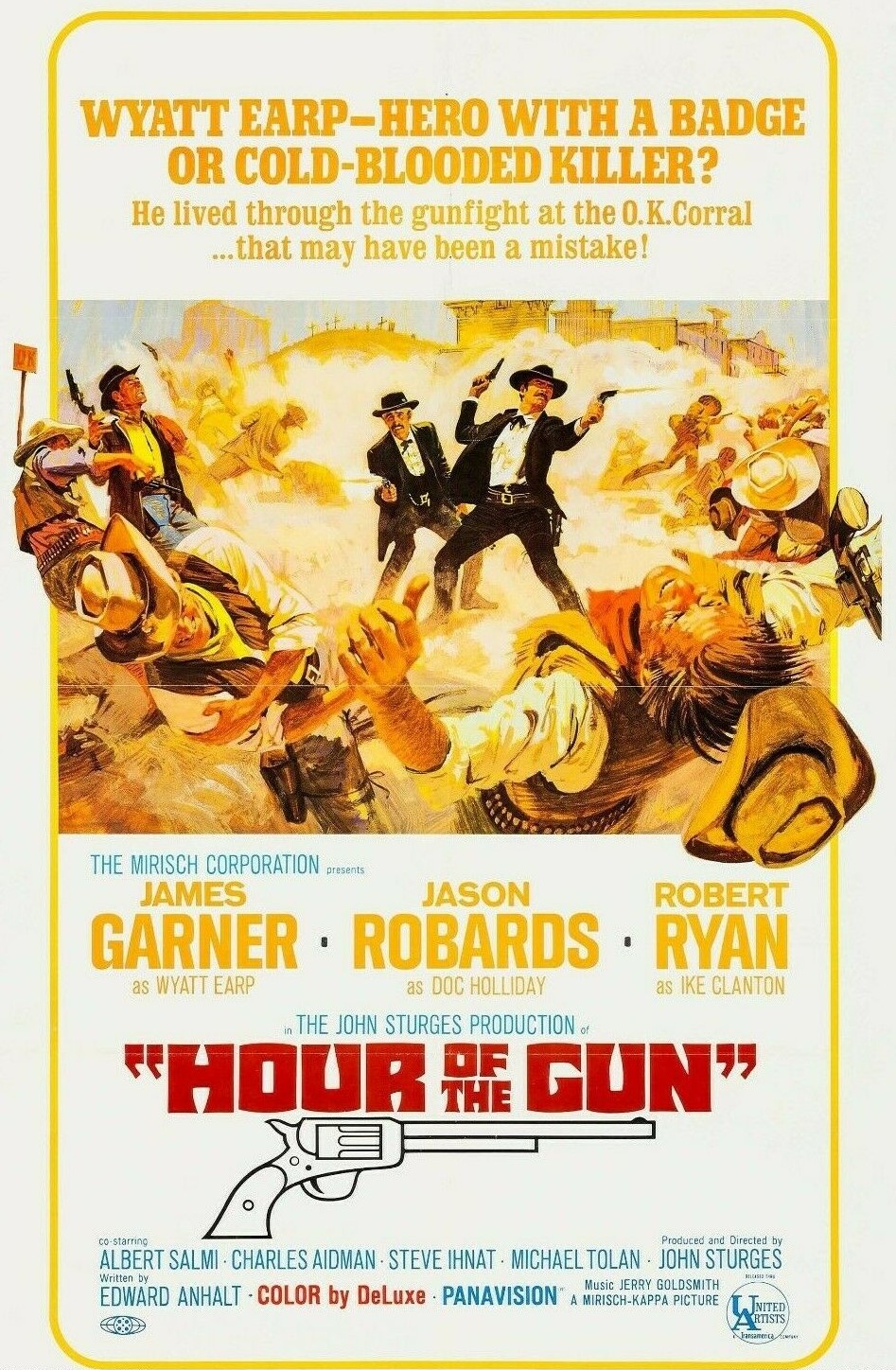
Hour of the Gun (1967) ****

The second version of the Gunfight at the O.K. Corral follows on from the Burt Lancaster-Kirk Douglas 1957 version also directed by John Sturges and precedes Doc (1971) reviewed yesterday. Good chance to compare the differing approaches.

Destroy a legend at your peril. Mythic western hero Wyatt Earp (James Garner) goes down’n’dirty after the death of his brother, spurning law and order to turn bounty hunter, which is legitimate, and then vigilante, which is not, in pursuit of Ike Clanton (Robert Ryan). A revisionist western, then, with director John Sturges substantially reimagining the image of Earp he had been instrumental in creating through Gunfight at the O.K. Corral (1957), a box office smash starring Lancaster as Earp and Douglas as sidekick Doc Holliday.

The first change is to keep Clanton alive, having been a casualty in the previous picture. The opening sequence sets the record straight. But corruption and the law acting in conjunction pull Earp and Holliday (Jason Robards) up on criminal charges though they are found innocent. When corrupt law fails to work, Clanton resorts to ambush, killing Earp’s brother. Clanton organises a posse of twenty men to kill Earp while the lawman sets up his own, smaller, team of bounty hunters.

It soon transpires Earp’s warrants are little more than “hunting licenses” and although marginally he errs on the side of fairness the odds, courtesy of his superior gunplay, remain substantially stacked in his favour and he picks off the villains one by one, pursuing Clanton into Mexico.

This is the story of Wyatt Earp in transition, shifting into lawlessness, at a time – 1881 – when the West itself was undergoing dramatic change, big business from the East forcing greater acceptance of the law (and using it for their own purposes), the growth of the cattle barons and the gradual elimination of the gunslinger, gunfighter and criminal gangs. There’s no room for romance as there was in O.K. Corral and The Magnificent Seven (1960) just pitiless determination to revenge. But there’s little of the all-male camaraderie that informed The Great Escape (1963). Earp and Holliday remain tight but the others in their gang have been somewhat forcefully enlisted.
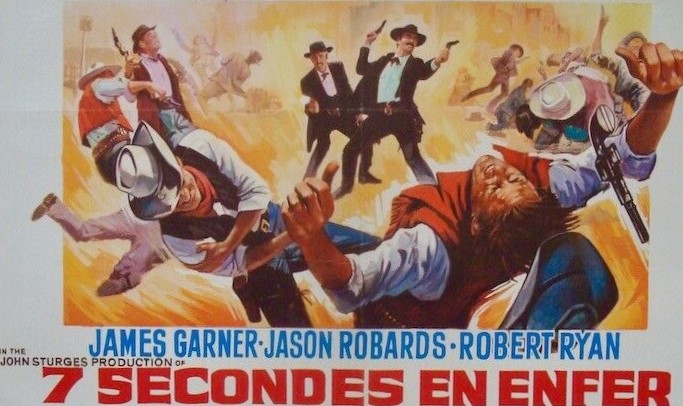
The poster is very misleading, giving the impression of an all-action
gun-toting movie rather than one of somber reflection.

The best scenes are the result of Earp conniving, revealing a streak Machiavelli would have envied, even duping Holliday, until it’s clear the Earp of legend has been vanquished. Sturges congratulates himself on telling the “truth.” But that’s the problem. The truth involves a lot of background that slows the picture down. And presenting Earp as transitioning is pretty much a blatant lie. Earp was clearly as ruthless killer at the O.K. Corral as he is now and no amount of pointing to corrupt law can eliminate the fact that the lawman prefers to kill villains rather than see them face justice. So there’s really no transition. Earp is a more civilized version of The Man With No Name. But at least he accepts it. There’s no hypocrisy involved.

The two principals are superb, shucking off the mannerisms that previously defined their screen personas. Gone is the trademark James Garner cheeky chap, the grin and even the slicked-back hairstyle. He is your father in a continually bad mood now rather than your favorite uncle full of japes. How much Sturges pinned back Robards’ capacity for over-acting can be seen by comparing this with the actor’s performance in Once Upon a Time in the West (1968).

Full marks for Sturges in trying to tell a complex, morally ambivalent, story, and he avoids the more grandiose approach to changes in the West as instanced in Once Upon a Time in the West. The early courtoom scenes slow down the narrative when a couple of lines of dialog could have done the same job. But it is exceptionally true in its depiction of Earp. There is not a bone of redemption in his body. He is going on a killing spree and he doesn’t care who knows it or how it damages his reputation, still high enough before the final episode of the revenge hunt for him to be touted as a future lawman-in-chief for Arizona.

Nor does Doc Holliday offer anything in the way of consolation. This isn’t like The Wild Bunch where a ruthless band of robbers convince themselves they have a code of honor and provide rough camaraderie as a way of filling in the emotional gaps in their lives. Holliday mistakenly sees Earp as man who could not exist outside the law without destroying himself, but that would only concern an Earp who was still interested in rules. Holliday, a self-confessed killer, over 20 deaths to his name, seeks redemption by saving Earp from himself. But in keeping with the raw truth, he is wasting his time. “I’m through with the law,” proclaims Earp, somewhat redundantly, once he dispatches his final victim.

It was a different kind of western at a time when in mainstream Hollywood there was no such thing. Although elegiac in tone, it cuts to the mean. And it was the forerunner of other, more critically acclaimed, westerns like Will Penny (1968), The Wild Bunch (1969) and Pat Garrett and Billy the Kid (1973) and in a sense it was precursor to Dirty Harry (1971) where in order to obtain justice Harry Callahan has to throw away his badge.

Many reasons have been advanced for the film’s commercial failure, most erroneously assuming that the genre had fallen into disrepair and was not revived until the glory year of 1969, but as I point out in my book The Gunslingers of ’69, that was far from the case. The same year as Hour of the Gun, John Wayne had ridden high on the box office hog with The War Wagon to follow the previous year’s El Dorado and Paul Newman as Hombre had been a big hit. The first two spaghetti westerns, only released in the U.S. in 1967, were also given as instrumental in the failure of Hour of the Gun, but neither was a massive box office hit. Revisionism had not quite hit the target with the public either as witness Cheyenne Autumn (1964).

The most likely reason was the fact that Sturges set out to dispel a myth that the public were happy with, that the movie was slow moving, and the characters essentially unlikeable. John Ford averred that when the legend became fact you printed the legend, but the opposite was patently not true here.  Edward Anhalt (The Satan Bug, 1965) wrote the screenplay based on the straight-shooting biography Tombstone’s Epitaph by Douglas D. Martin. who had previously written about the Earps.

It might be cold, and at times meandering, but it offers up a fascinating character study and although Earp’s transition could be construed as tragedy, the destruction of a good man, Sturges takes no refuge in such an idea. This is Sturges boldest, most courageous, picture and he does nothing to soften the killing. Where The Magnificent Seven, another bunch of killers, ride into Mexico on the back of a bombastic theme tune, this is a much leaner effort, and all the richer for it.

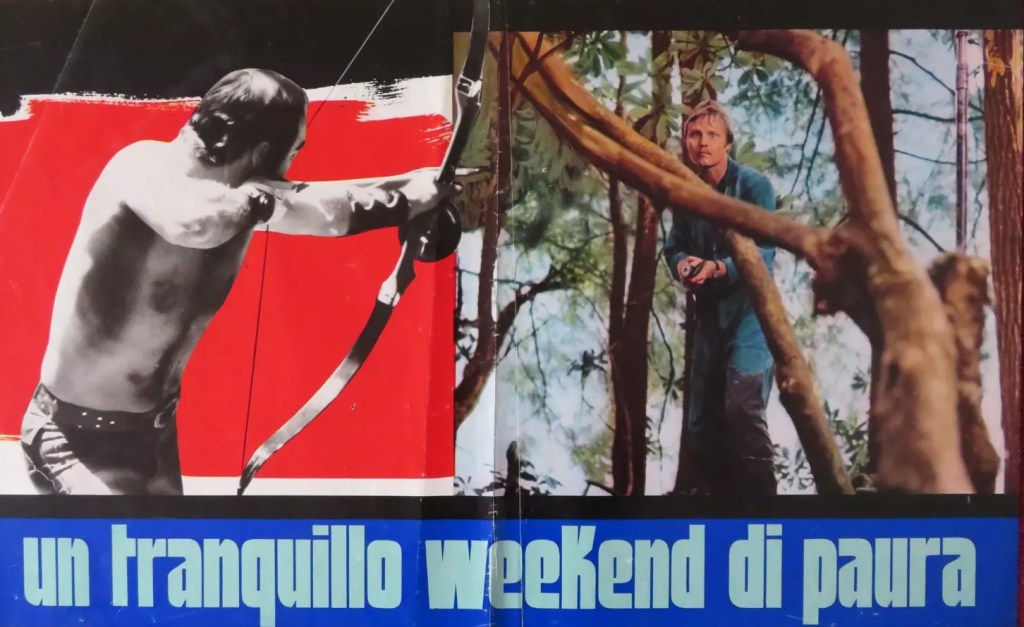
Behind the Scenes: “Deliverance” (1972)

You couldn’t make it like that now, so the ill-informed tale goes. Actors doing their own paddling in canoes, climbing a cliff. But anyone who has watched Leonard DiCaprio and Kate Winslet half-drowning in Titanic (1997) is well aware that it’s just not always possible to use a stand-in for key sequences. Or, for that matter, William Holden breaking in a horse in Wild Rovers (1971).

For a start, there actually were four stunt men on Deliverance, one who was star Jon Voigt’s stunt double. None were credited in the picture, not so unusual in those days, and anyone who knows anything about filming climbing scenes, not least the one where actors are actually crawling across a floor, or where there are, out of sight of cameras, safety facilities underneath, will know that the actors here, though it might get a tad tough, were not risking life and limb. Greater injuries were endured by the stars during the storm scenes of The Guns of Navarone (1961). That said, the movie does benefit from sufficient shots of the actors braving the waters and Ned Beatty nearly drowned and Burt Reynolds cracked his tailbone.

But, of course, danger in moviemaking is relative. There’s scarcely any equivalent to the numbers of deaths that occur in other professions, mining, for example, or industry, and I’m always suprised how easily the Hollywood PR machine is so easily accepted by the public when the peril mentioned is rarely actually perilous at all.

For the scene where the canoe broke, director John Boorman had found a more serene location on a river which was dammed, so he was able to close the sluice gates and lay a rail on the river bed. However, in the event, the sluice gates were opened too soon and the actors engulfed in an avalanche of water.

Should any of the actors show temerity, Boorman would leap into a canoe himself, and paddle downriver over and around various obstacles to show how easy it was.

Deliverance was an unexpected bestseller in 1970, the author an unlikely candidate to hit the commercial jackpot or even to pen such a tale. Ex-adman James Dickey was known for his poetry. Warner Bros bought the book pre-publication about “four decent fellows killing to survive” for $200,000 and more for Dickey to pen the screenplay without working out how it could be filmed. The studio was going through a major transition. In 1970 only three releases had cleared $1 million in rentals; in 1971 the number tripled and the studio was high on a release slate that included Death in Venice, A Clockwork Orange, Summer of ’42, Klute, The Devils, Dirty Harry and Billy Jack.

The studio alighted on John Boorman because he had made Hell in the Pacific (1968) starring Lee Marvin and Toshiro Mifune, that, while a certified flop, was made under arduous physical conditions in the western Pacific.

After the surprise success of Point Blank, British director Boorman had helmed two flops, Leo the Last (1970) being the other, so he was in the market for the kind of hard-nosed project with which he had made his name. Warner “felt I was the man to take it on,” explained Boorman.

At one point, Warner Brothers planned to team up Jack Nicholson (hot after Easy Rider, 1969, and Carnal Knowledge, 1971) and Marlon Brando, still largely in the pre-The Godfather wilderness. The studio tried to tempt Charlton Heston, who turned it down (“I probably won’t have time to do it”) but consoled himself that WB considered him “employable.” Donald Sutherland also gave it a pass. Dickey agitated for Sam Peckinpah to direct and Gene Hackman to star while Boorman was keen to work a third time with Lee Marvin. Theoretically, Robert Redford, Henry Fonda, George C. Scott and Warren Beatty were considered, but such big names would hardly be compatible with the lean budget.

The final budget was a mere $2 million, not sufficient to attract big name – or even to pay for a score. WB had reservations about a picture without any women in lead roles. Jon Voigt was not a proven marquee name, despite the success of Midnight Cowboy (1969). He only had a bit part in Catch 22 (1970) and his other films, Out of It (1969) and The Revolutionary (1970) had performed dismally while The All-American Boy was sitting on the WB shelf, only winning a release to cash in on Deliverance.

Despite a less than buoyant career, Voigt was reluctant to commit. He resisted making the movie till the last minute. Even after trying to convince himself about the film’s worth by reading out the entire screenplay to his girlfriend Marcheline Bertrand (Angelina Jolie’s mother), it took a telephone call from the director and Boorman demanding a decision before he counted to ten before Voigt signed up. Voigt viewed the film as about how men “lose part of their manhood by hiding, coddling themselves into thinking we’re safe.”

Burt Reynolds was treading water in action B-films like Skullduggery (1970), as the second male lead in bigger films like 100 Rifles (1969) and in television (Dan August, 1970-1971). In his favor, he had the lead in offbeat cop picture Fuzz (1972). But it looks like Voigt and Reynolds took casting to the wire. Both were announced for the film a few weeks before it began shooting on May 17, 1971.

Whether it boosted his career is open to question, but Burt Reynolds’ name achieve notoriety in April 1972, a few months before Deliverance opened, by becoming the first male centerspread in Cosmopolitan.  Billy Redden, as the banjo player, was hired for his physical appearance, clever use of the camera disguising the fact that there was a genuine banjo player concealed behind him doing all the playing. Boorman used snatches of the banjo music instead of coughing up for a proper score. While the credits claimed the “Dueling Banjos” number had been devised by Eric Weissberg and Steve Mandel, Arthur Smith, writer of “Feudin’ Banjos” in 1955, took the studio to court and won a landmark copyright ruling. The tune had received a gold record for sales.

Setting aside any inherent danger in the water, the shore could just be as perilous. A script altercation between Dickey and Boorman ended with the director losing four teeth. Cinematographer Vilmos Zsigmond got into a spat with his union and was slapped on the wrists for operating the camera too often. Filming of the rape scene was uncomfortable for all concerned, even observers. When Reynolds complained the director let the sequence last too long, Boorman countered that he let it run till he reckoned Reynolds, in his character, would intervene.

Despite WB including it in a promotion to its international partners in May 1971 Deliverance, filmed between May 17 – a week later than originally envisaged – and August 1971, sat on the shelf for nearly a year before being premiered at the Atlanta Film Festival in July 1972 with Playboy picking up the tab for flying Reynolds to the event.

These days it would be called a platform release. Deliverance opened in one small house in New York – the 558-seat Loews Tower East – at the end of July and except for Los Angeles didn’t go any wider until early October. Reviews were good, four faves out of five in New York. But it was the box office that caught the eye. An opening day record and an eye-popping $45,000 for the first week took the industry by surprise. It remained at Loews until December. Chicago led the applause in October with a “brawny” $49,000. Everywhere it was hot – “lusty” $26,000 in Washington DC, “socko” $21,000 in Philadelphia were typical examples of the public response.

In what these days would be called counter-programming it went into the New York showcases at Xmas – making off with a huge $589,000 from 46 the first week and $500,000 the second. WB had predicted it might hit $15 million in rentals. The studio was wrong. It scrambled up $21 million. The 1973 tally made it the second best at the box office that year.

SOURCES: Phil Hoad, “How We Made Deliverance,” The Guardian, May 29, 2017; Oliver Lyttleton, “5 Things You Might Not Know about Deliverance, Released 40 Years Ago,” IndieWire, July 30, 2012; Charlton Heston, The Actor’s Life (Penguin, 1980); “Bow and Arrow Party,” Variety, May 20, 1970, p30; “Dickey Ga-Bound,” Variety, January 21, 1971, p4; “Reps of 45 Flags,” Variety, April 14, 1971, p5; “Voigt in Deliverance,” Variety, May 12, 1971, p14; “Runaway Robert Altman,” Variety, December 15, 1971, p4; Advert, Variety, August 9, 1972, p23; “Big Rental Films of 1972,” Variety, Janaury 3, 1973, p7; “Big Rental Films of 1973,” Variety, January 9, 1974, p19. Box office figures from Variety October 11, 1972.

Deliverance (1972) ****

Packs a considerable punch even at the remove of half a century. In fact, the reversal of the ultimate male-domination trope – rape – will reverberate even more in a contemporary society more attuned to abuse. A quartet of macho posturing guys – except for one more at home overseeing a barbecue pit – not only get their come-uppance but have to sit on a very thin fence when the morality clause comes into play.

Much of the patronising attitudes towards the poor and bereft will not have evaporated with time. The better-educated, the very ones who should know better, still make fun of the less well-off and their accents – such scoffing by the privileged recently made headlines in the UK. The hillbillies represented here are not making fashion statements with their clothing or attribute their scrawny physiques to weight-loss therapy. This is poverty in the raw – and yet our quartet treat the wilds as a playground.

You want swagger?

Presumably expecting campfire singalongs Drew (Ronny Cox) has brought his guitar, forgetting it might not be so easily transported through the rapids, but he thinks he’s made contact with the inhabitants when he duets with a banjo player (Billy Redden). Macho Lewis (Burt Reynolds), easily identified as the toughest of the quartet by his visible chest hair and archery set, is at one with nature, assuming that the beasts he presumably intends to kill are okay with that. He believes he’s got one-up on the natives when he beats a local down to $40 for moving their cars to the finish-point, not considering for a moment that the fellow would probably have done it for half.

Ed (Jon Voigt) is the calm one, the peacemaker, keeping the volatile Lewis and the nervous Bobby (Ned Beatty), inclined to poke fun, in check. Turns out the locals don’t take kindly to this kind of invasion and two ambush Ned and Bobby, rape the former, but before they can work their way round to the latter, are interrupted by Lewis who puts an arrow through one of the mountain men. The toothless one escapes.

This is where it gets tricky. Lewis, inner Clint Eastwood to the fore, justifies his slaying. Chances are, if he’d fired a warning shot, the rapists would have scarpered. The chances, too, of Bobby reporting the crime are a big fat zero because the humiliation would be unendurable, even if the local cops accepted a crime like male rape even existed, and given the general lack of police interest in female rape no guarantee it would even be investigated.

Course, you kill one of “them” and you’re setting yourself up as a target for revenge. Our quartet would skedaddle but the only way out is downriver. Drew, in complete shock, topples overboard and drowns, the canoes crash into each other, Lewis breaks his leg, leaving Ed to lead them to safety.

He climbs a cliff, armed with the archery kit, in case they are being stalked by the other hillbilly.  When he spots him, he fires, killing the hillbilly. So Ed has to get the injured Lewis and the useless Bobby to safety and hope nobody finds the bodies, one buried in the ground, the other dumped into the river. The cops do come calling, but the trio brave it out.

And the audience is left with a moral quandary – an even more resonant one these days. Are the killers morally justified? In, they presume, a lawless patch, where men are as likely to rape their own gender as women, are they permitted to take the law into their own hands? Stand up for themselves? Be a man? Rather than waiting for someone else to clean up their mess.

Or are they obnoxious over-entitled tourists who can pillage their way through the countryside? They had assumed that the hillbillies would not call in the law in case the cops were hunting for illicit stills. As if the mountain men didn’t have families who would hold them dear, no matter their crimes.

Sure, they get away with it, but don’t the rich always get off scot-free, one rule for the wealthy, another for the poor? Back in the day, I’m sure Americans feared these kinds of hinterlands, where mountain men ran wild, and the idea of ecology was a whistle in the wind. Our guys aren’t campaigning against the loss of the wilderness, but enjoying one last trip before the scenery is flooded.

Some standout moments – the duelling banjos (a hit single), “squeal like a pig,” the white water canoeing, Ed ramming his fingers in the corpse’s mouth to check for give-away missing teeth, the nightmare at the end that set a trend for what today would be termed a post-credit sequence.

Director John Boorman (Point Blank, 1972) easily sits astride his own fence. If all you’re looking for is action in an unusual setting and the Western trope of pacific man roused to anger, then you can go home happy. If you’re sniffing around for something deeper, for the ease with which the morally upright defend the indefensible, then you’ll have plenty to talk about. Poet James Dickey, author of the original unexpected bestseller, turned in the screenplay.

Tough thriller that asks tough questions.

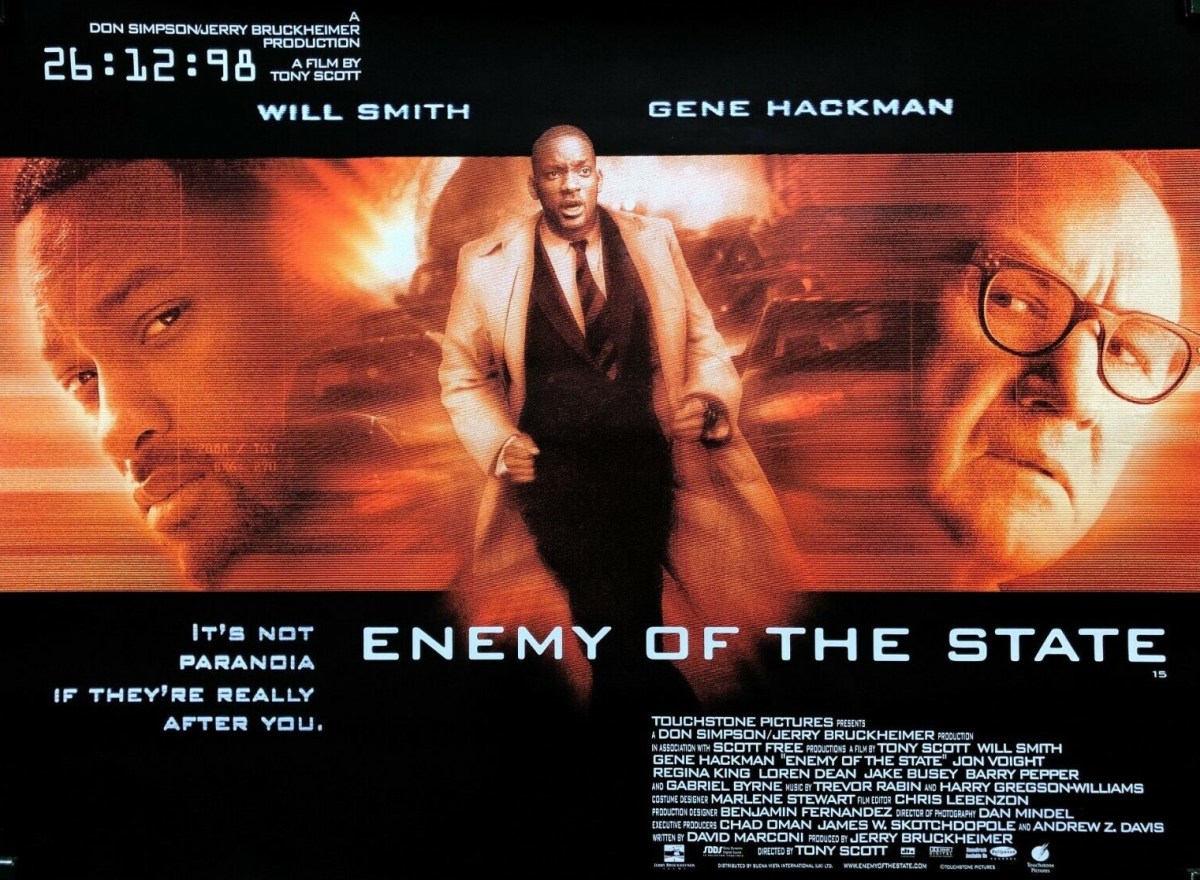
Enemy of the State (1998) ****

You are the star of the show so the last thing you want is to team up with a scene-stealer, but if you want to work with such an renowned talent, what can you do but let him steal.

It says a lot for Gene Hackman’s legendary status that, long past his box office peak in this fast-paced surprisingly contemporary paranoia thriller, his appearance late in the day turns up the heat on Will Smith at an early career pinnacle and at his charming best. You need someone as easy on the eye as Smith to lead the audience through a tortuous plot, centering on the collusion of big business and government to push through a commercially-motivated U.S. Government Act promoting greater surveillance, and someone as inherently gutsy as Hackman to carry the film over the line.

Ironically, the McGuffin is surveillance of the most benign kind, a camera trained on ducks at a river inadvertently picking up evidence of corrupt politician Reynolds (Jon Vogt) overseeing the murder of Representative Hammersley (Jason Robards) who stands in his way. The tape finds its way to an investigative reporter who, pursued by Hammersley’s goons, drops it into the shopping bag of labor lawyer Robert (Will Smith).

Unaware of the reasons why, Robert’s life unravels, Hammersley’s guys fabricating evidence that he has revived an affair with former lover Rachel (Lisa Bonet) and  is involved in Mafia money-laundering, resulting in wife  Carla (Regina King) throwing him out and being fired from his job. Bank accounts frozen (natch!), Robert turns to Rachel for help and she puts him in touch with her source Brill a.k.a Edward Lyle (Gene Hackman), an undercover communications expert who has been feeding Rachel information. When Rachel is eliminated, Lyle teams up with Robert and together they come up with a daring plan to incriminate Reynolds and absolve Robert.

Although brim-full of twists and turns, and a relentless government hit squad, the real joy of the picture is Tony Scott’s direction. Using his trademark speedy cuts, and scaring the life out of the audience regarding the depth of available surveillance, this is a thriller tour de force. The Top Gun (1986) director is at the top of his game, seamlessly shifting keys, racketing up the tension, the NSA’s encroachment on civil liberty so extensive it appears nobody can escape a web that is inexorably drawn tighter.

And it’s a fabulous double act, the innocent but slick Robert coupled with the world-weary but clever Lyle, the non-stop-talker versus the virtually silent. It’s the cat and mouse game where the mice turn out to hold the aces. Just brilliantly done and at such a speed. A plot that could easily become convoluted is superbly handled.

Will Smith (Independence Day, 1996) is given free rein and he’s good value for money, holding audience attention seamlessly, and until Gene Hackman (Crimson Tide, 1995) enters the frame he is running away with the picture. Their acting styles are completely different and you shouldn’t really be comparing them but when it comes to the crunch Hackman nails it every time and with hardly doing anything. Lisa Bonet (Angel Heart, 1987) makes a welcome return to the big-budget Hollywood scene. Jon Voigt (Midnight Cowboy, 1969) enjoys one of his better supporting roles.

The screenplay by David Marconi (The Dark Side of the Moon, 2015) is quite superb, not just with a whole series of riveting set-pieces and some terrific dialogue, but also with more humane touches, such as Robert’s encounter with his kids or his embarrassment shopping for lingerie in Victoria’s Secret.

And if there were not bonuses enough, there’s a virtual smorgasbord of talent in the supporting cast starting with 26-year-old Regina King (Boyz in the Hood, 1991) through Barry Pepper (Saving Private Ryan, 1998), Scott Caan (Ocean’s Eleven, 2001), Jake Busey (Starship Troopers, 1997), Jason Lee (Vanilla Sky, 2001) and Jamie Kennedy (Scream, 1996)  all the way to Gabriel Byrne (The Usual Suspects, 1995), Ian Hart (Backbeat, 1994) and Jack Black (School of Rock, 2003).

Stone cold classic not to be missed and worth another watch if you have viewed it already.

Discover WordPress

A daily selection of the best content published on WordPress, collected for you by humans who love to read.

The Atavist Magazine

by Brian Hannan

WordPress.com News

The latest news on WordPress.com and the WordPress community.