Judith (1966) ***

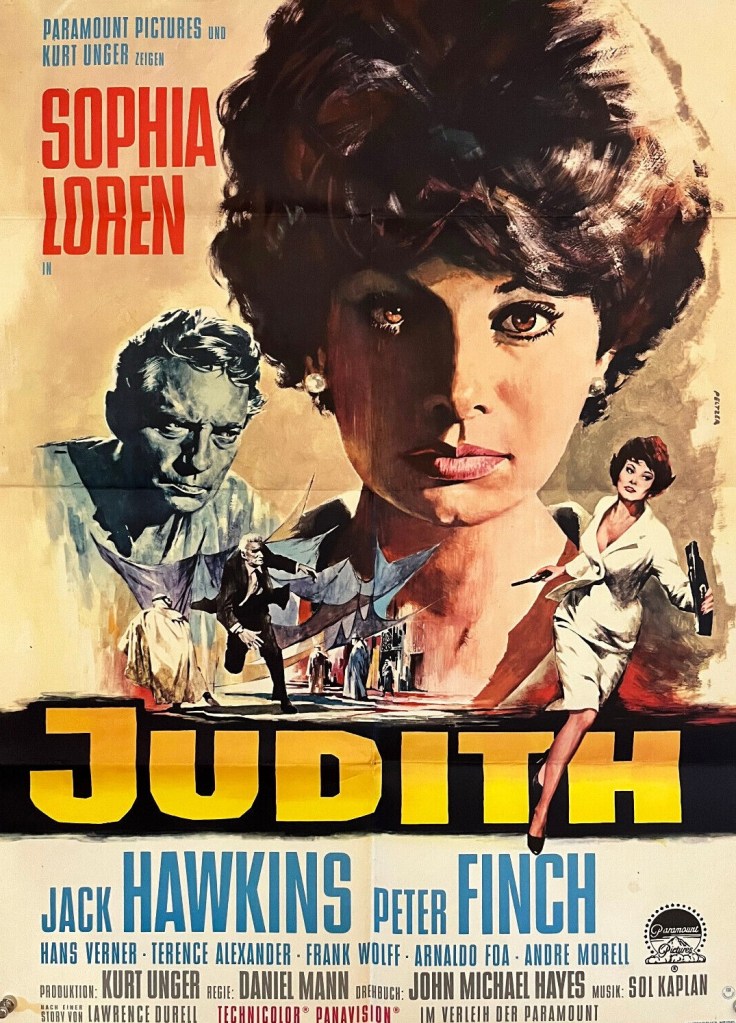
This is why you hire Sophia Loren. In the middle of a complicated story she provides the  emotional anchor.. And she can do it without words. A few close-ups are all you need to guess at her inner turmoil in a world where, as with Play Dirty (1968), the individual is disposable. The good guys here, Israelis fighting for survival at the rebirth of their country, are every bit as ruthless as the commanding officers in the World War Two picture.

And it’s just as well because the tale is both straightforward and overly complex. Like Cast a Giant Shadow, out the same year, or the earlier Exodus (1961), it’s about the early migrants staving off Arab attempts to destroy the tenuous foothold Jewish immigrants on the land with  the British, stuck in the role of maintaining law and order, cracking down on illegal landings of refugees and arms smuggling.  But where the earlier movies take the war to the enemy, this is all about defence, holding on to hard-won positions.

Israeli leader Aaron (Peter Finch) discovers General Schiller (Hans Verner), a former German WW2 commander wanted for war crimes, currently in charge of the Arab tank regiment, is planning imminent assault. After locating Schiller’s wife Judith (Sophia Loren), he smuggles her into Israel with the intention of using her as bait to kidnap the general.

This would be no romantic reunion. The general had abandoned his wife, a Jew, and she spent the war in Dachau where she survived as a sex worker. She wants nothing more than revenge. But it takes a fair while for the cloak-and-dagger elements to warm up. First of all she has to seduce British Major Lawton (Sophia Loren) into revealing details of her husband’s whereabouts.

Turns out Lawton is the only principled official on show, out of general decency and a British sense of fair play (unlike the soldiers, for example, in Play Dirty)  turning down the offer of her body in return for his aid.  But it also transpires that Judith also lacks any notion of fair play and stabs her husband at the first opportunity, making it virtually impossible for his captors to discover the specifics of the planned attack. You wouldn’t need much of a sense of irony to share the Israeli anger when uner interrogation the captured general tosses back at them the Geneva Convention.

Judith’s involvement in the hunt for the general had the potential to be a very fine film noir on its own, especially had the wife been required to show willing to the husband in order to lure him out into the open.

Unfortunately, that’s not the tack the movie takes. Instead, we follow a series of forgettable characters either espionage agents, or at the kibbutz or effectively just there in passing, on the edge of the action, even when they might be in the heart of the real action either being unloaded into the surf or under attack from Arabs. There’s a sense of trying to cram too much historical incident into what would have worked best as a straightforward thriller. How far would Judith go to extract revenge? And, can Aaron stop her ruining his delicately-balanced plans?

Plenty of room for maneuver too on the sticky point of country vs individual. Where Aaron is happy to sacrifice or exploit Judith to satisfy his agenda, albeit to the greater glory of his country, so, too, is Judith unwilling to surrender her individuality for that more beneficial cause.

So what we get is a riveting mess. When Sophia Loren (Operation Crossbow, 1965) is onscreen you can’t take your eyes off her. When the action switches to the sub-plots, you keep on wondering where she’s got to and when will she next turn up. Judith is a fascinating character, batting away contempt about the way she survived the concentration camp, arriving in an old-fashioned cargo container with the corpse of a companion who failed to last the journey, and before long sashaying through the kibbutz delighted to attract male attention.

Yet, despite the hard inner core, and keeping one step ahead of both Aaron and Schiller, as if she had long ago stopped trusting men, she is emotionally vulnerable and proves easily manipulated when either pierces the carapace.

That director Daniel Mann feels duty bound to attempt to tell the bigger story of the Israeli struggle is  somewhat surprising since he was best known as a woman’s director. Under his watch both Shirley Booth and Terry Moore were Oscar-nominated for  Come Back, Little Sheba (1953), both Susan Hayward and Anna Magnani Oscars winners for I’ll Cry Tomorrow and The Rose Tattoo, respectively.

John Michael Hayes (Nevada Smith, 1966) cooperated with Lawrence Durrell (Justine, 1969) on the screenplay.

Worth it for Sophia Loren’s stunning performance.

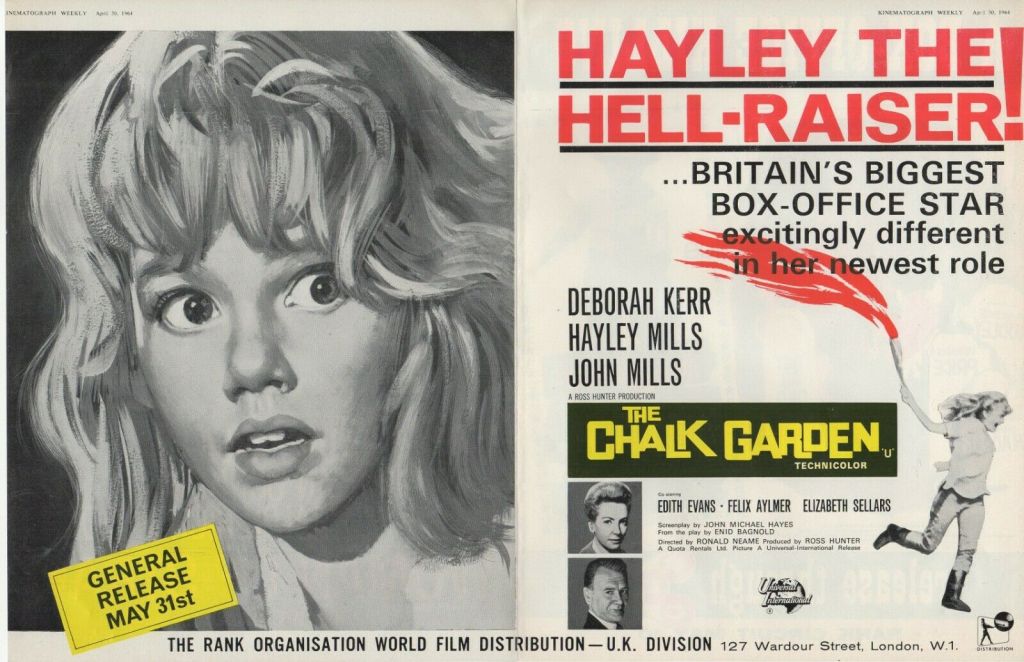
The Chalk Garden (1964) ***

You couldn’t make a movie like this now because (plot spoiler, I’m afraid) even the dottiest of old ladies would make at least a better attempt at collecting a reference from a prospective employee for fear she might be hiring someone disreputable. Though I doubt if many employers would expect a governess to turn out to be a murderess.

That this movie chimes with a contemporary trope – the criminal wanting to prevent others from following in their footsteps – makes it far ahead of its time. Made today, of course, the unruly child rather than merely threatening to unleash her arson impulses would probably have burned the house down.

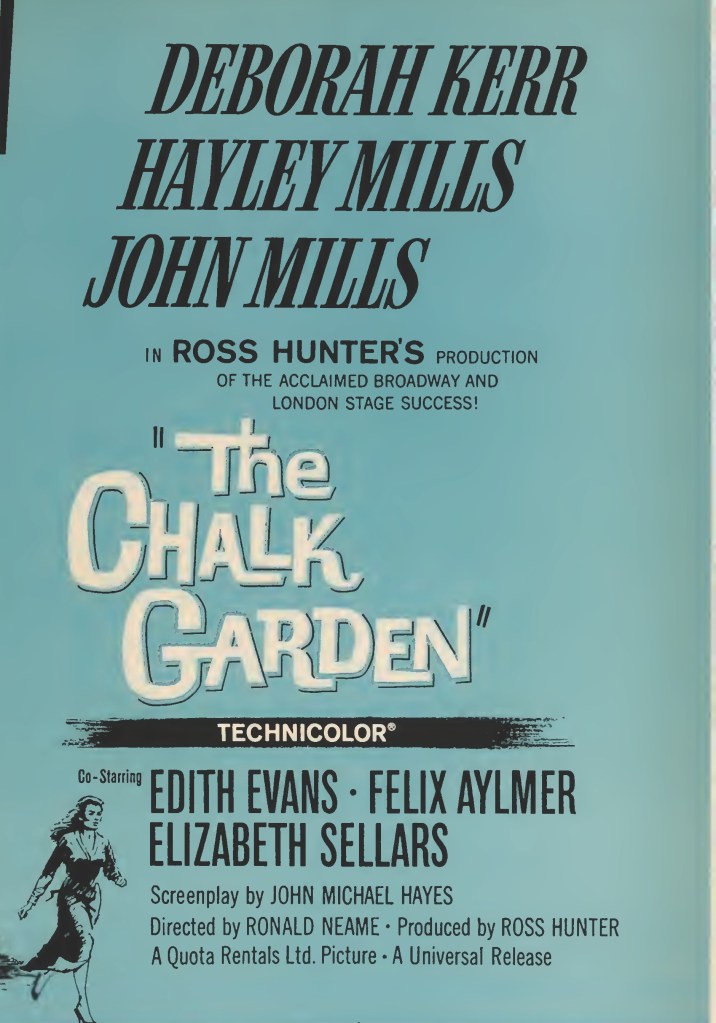
So it’s more a drama of manners, if you like. Very presentable but clearly down-on-her-luck Miss Madrigal (Deborah Kerr) is taken on by Mrs St Maugham (Edith Evans) as governess for her grandchild Laurel (Hayley Mills) because nobody else wants the job. Laurel’s outrageous behavior has sent a score perfectly well qualified ladies scurrying. Madrigal is hardly fazed by anything Laurel can get up to.

But the child is clearly suffering abandonment issues, her beautiful mother Olivia (Elizabeth Sellars) having gone off with another man. Grandmother incites grandchild to hate the mother. But Olivia’s maternal instincts have kicked in and she wants her child back. While Madrigal can deal with Laurel’s tantrums she is less fortified against the child’s inveterate snooping. Finding a mysterious suitcase leads Laurel to fantasize about Madrigal’s past.

Mostly the film is a four-hander, butler Maitland (John Mills) playing a significant role in proceedings, not least in his effortless management of the wild child. Quite why a such a pragmatic and assured gentleman should end up in this remote mansion is another mystery and thankfully there is no attempt made at playing up the cliff-top location in a suspenseful manner.

Mrs St Maugham is imperious but not entirely practical, either in setting child against mother or in trying to grow flowers in such chalky soil, though Madrigal appears to have sufficient horticultural knowledge to set her straight on the latter and attempt to intervene on the former.

There’s a deadline of sorts. Olivia is coming to remove the child. Whether she goes willingly or not doesn’t matter. Madrigal sees her role as trying to prepare a child to love her mother and be more grown-up than the adults around her and forgive her.  

Madrigal’s guilt unnecessarily causes her to reveal that she had been jailed for murdering her stepsister, having been as resentful and jealous of the girl as Laurel currently is of her mother. Mrs St Maugham had called on old acquaintance Judge (Felix Aylmer ) for legal advice on how to prevent Olivia getting the child. He was the presiding judge in Madrigal’s case. Imagining he had not forgotten the trial – which of course he has – she feels duty bound to blurt out the truth before she is humiliated.  The confession helps Laurel realise how dangerous a path she is on and pushes her towards reconciliation rather than revenge.

It has all the making of a well-made play which is hardly surprising since it is based on Enid Bagnold’s Broadway success, at one time mooted as a film to star Joanne Woodward and Sandra Dee. So it moves along in the traditional three-act manner, plenty space given to establishing characters, introducing the undercurrents and leading to revelation and resolution.

So, mostly, it depends on the acting. Luckily, it is excellent. This was Hayley Mills in transition, far removed from Disney saccharine of The Parent Trap (1961) and about the same distance from the full-blown adult bottom-baring of The Family Way (1966). She projects a great deal more torment than in either of those films and comes across as believable, not exactly a young hoodlum but left to her own devices and starved of parental love only a matter of time before she would commit a crime of some kind.

Deborah Kerr hadn’t made a film in three years but her screen persona had shifted from the passionate – From Here to Eternity (1953), An Affair to Remember (1957), The Sundowners (1960) – to the repressed. Her spinster introduced in The Innocents (1961) had a great deal in common with her spinster of The Night of the Iguana (1965). But this is a different kettle of fish. Here, she exudes capability but with a self-awareness that undercuts such confidence, trying to keep a lid of emotions she struggles to handle.

John Mills (Tunes of Glory, 1960) casts a sardonic eye on the household while Edith Evans (The Whisperers) portrays a sorely wounded matriarch. Director Ronald Neame (Gambit, 1966) cleverly opens up the play, using the cliffs, gardens and rocky beach to considerable effect, but keeps the drama taut. John Michael Hayes (Nevada Smith, 1966) produced a workable screenplay.

Apologies for giving away the story, a good watch more for the acting than the twist.

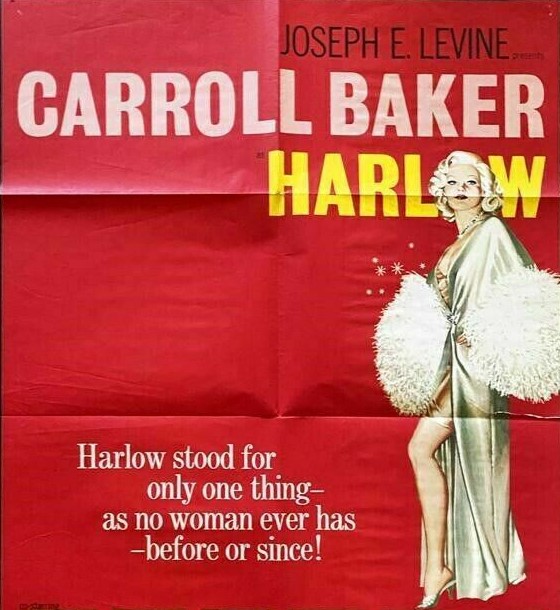
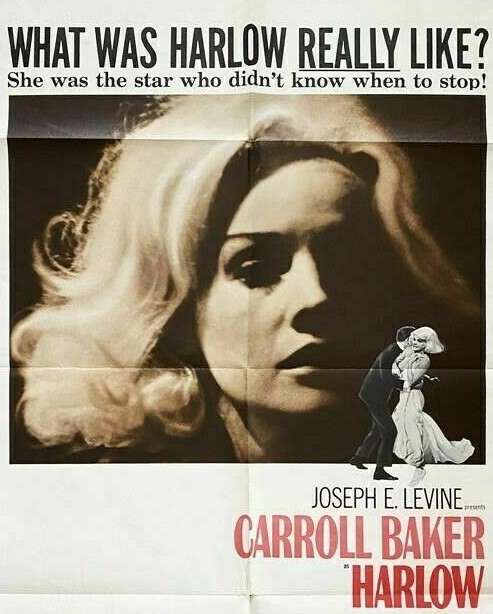
Harlow (1965) ***

Harlow presents such a convincing picture of Hollywood abuse that I was astonished to discover that it was not entirely truthful where the title character was concerned.

Jean Harlow was a hugely popular star in the 1930s before her untimely death at the age of 36. This film depicts her as a virgin (not true) who turns neurotic (not true) after her impotent husband commits suicide (debatable) on their wedding night (not true) leading to her go off the rails and die from pneumonia (not true). But in terms of the Hollywood system a great deal rings true and if the Me Too movement had existed in the late 1920s the finger would be pointed at a huge number of men.

The film is at its best when dissecting the movie business. A five-minute opening sequence demonstrates its “factory” aspect as extras and bit players clock in, are given parts and shuffle through great barns to be clothed and made up, often to be discarded at the end of the process.

No sooner has this version of Jean Harlow (Carroll Baker) been given a small part than she encounters the casting couch, operated by a lowly assistant director, who bluntly offers five days’ work instead of one if she submits to his advances. When she turns him down, work is hard to come by and she resorts to stealing lunch before rescued by agent Arthur Landau (Red Buttons). After tiny parts that mostly consist of her losing her clothing, receiving pies or eggs in the face and displaying her wares in bathtubs, she geta a big break only for that producer to demand his pound of flesh – “I’ve already bought and paid for you.” Here she has “the body of a woman and the emotions of a child” and ends up choosing the wrong suitor which leads to a calamitous outcome.

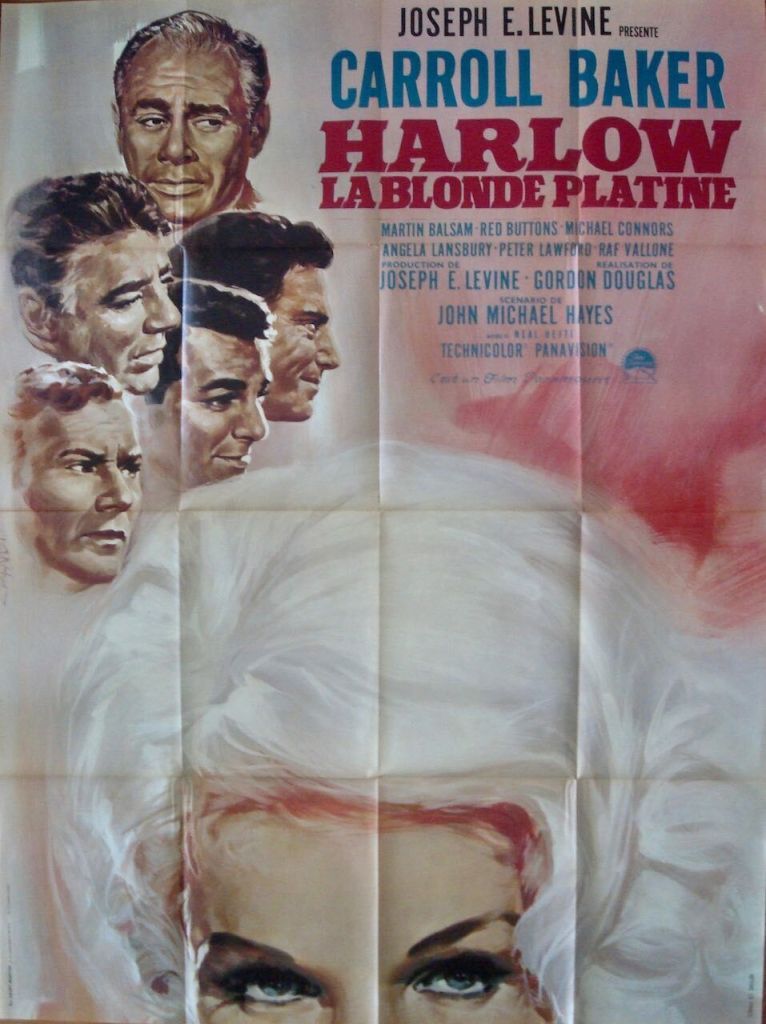
However, the pressures of stardom are well-presented: she is the breadwinner for her unemployed mother Jean (Angela Lansbury) and lazy stepfather Marino (Raf Vallone) and soon box office dynamite for studio chief Everett (Martin Balsam) who sees in her the opportunity to sell good clean sex. The negotiations/bribery/blackmail involved in fixing salaries are also explored.

But the film earns negative points by mixing the real and the fictional. The agent and husband Paul Bern (Peter Lawford) existed but most of the others are invented or amalgamations of different people. MGM is represented as “Majestic” and among her films there is no Red Dust (1932) or China Seas (1935) but lurid inventions like Sin City

Director Gordon Douglas was a versatile veteran, with over 90 films to his credit, from comedies Saps at Sea (1940) and Call Me Bwana (1963) to westerns The Iron Mistress (1952) and Rio Conchos (1964) and musicals Follow That Dream (1962) and dramas The Sins of Rachel Cade (1961) and Sylvia (1965) which also starred Baker. The opening scene apart, which is a seamless construction, he is adept at this kind of helter-skelter drama. John Michael Hayes (Rear Window, 1954) has produced a punchy script based on the book by Arthur Landau and Irving Shulman.

In the title role Carroll Baker (Sylvia) has probably never been better, comedian Red Buttons (Stagecoach, 1966) excellent in a straight role while the smarmy Raf Vallone (Nevada Smith, 1966) is the stand-out among an excellent supporting cast that also includes Angela Lansbury (In the Cool of the Day, 1963), Peter Lawford (Sylvia), Leslie Nielsen (Beau Geste, 1966), Martin Balsam (Seven Days in May, 1964) and Mike Connors (Stagecoach, 1966).

Except that virtually none of the movie is true, I would have given it four stars for its portrayal of Hollywood but I have come to expect that biopics, while moving facts around for dramatic purposes, are required to be good more faithful to their subjects than this. 

Nevada Smith (1966) ****

Half breed Max Sand (Steve McQueen) has little truck with the notion that revenge is a dish best served cold. But he’s too young and raw, far from Lee Marvin’s callous killer in Point Blank (1969), to properly avenge the slaughter of his family by three outlaws.

This is a coming-of-age tale with a distinct difference. Max’s development includes, apart from initiation into sex of course, learning to read and write so he can make sense of signposts in order to track down the murderers and receiving tuition from gunsmith Jonas Cord (Brian Keith) so that he can at least loose off some shots without doing himself damage. Vengeance burns so deep that he even stages a bumbled robbery so he can be sent to the prison where the second of his targets is incarcerated. Now that’s dedication for you. And along the way he learns the most important lesson of all, how to live, and not destroy himself through vengeance.

Even so, all Cord’s tuition counts for nought when Max needs a knife to dispatch his first victim Coe (Martin Landau). And he’s not yet so slick with a weapon to avoid serious injury himself. Kiowa saloon girl Neesa (Janet Margolin) nurses him back to health at her tribe’s camp. They become lovers but he rejects the wisdom of the elders and the opportunity to make a life with her.

Unfortunately, Bowdre (Arthur Kennedy)  is a jailbird. And worse, held prisoner in a swamp. Probably the worst bank robbery ever committed sends Nevada there. Max enrols another woman, Cajun Pilar (Suzanne Pleshette) working in nearby rice fields – fraternisation between the jailbirds and these women permitted – to steal a boat to help him and Bowdre escape. Bowdre gets his and this time it’s Pilar who is the collateral damage.

A genuine outlaw now, Max has no trouble joining a band of robbers headed by Fitch (Karl Malden), the final prey. By now calling himself Nevada Smith, Max’s plans are thrown into confusion when it becomes apparent Fitch is aware of his true identity. A surprise ending is on the cards whichever way you cut it, and especially thrilling since it occurs during a well-planned gold bullion robbery.

It’s a film of two parts but divided into three if you like, the unusual swamp setting fitting in between two sections of more straightforward western. Though in the hands of director Henry Hathaway (True Grit, 1969), there is little that’s so straightforward given his mastery of the widescreen and his hallmark extreme long shot. He’s capable of moving from the extreme violence of the vicious murder and rape of Max’s mother to the son’s discovery of the bodies shown just through Max’s physical reaction. And there’s some irony at play, too: gold triggers slaughter and climax; mental dereliction not as feared as its physical counterpart.

Although Hathaway was a true veteran, he was not best known for westerns in the manner of John Ford, more at home with film noir (Kiss of Death, 1947), war (The Desert Fox, 1951) and big-budget pictures like Niagara (1954) with Marilyn Monroe and Legend of the Lost (1957) teaming John Wayne and Sophia Loren. In a 30-year career he had only made three westerns of note – The Trail of the Lonesome Pine (1936), Rawhide (1951) and Garden of Evil (1954). So it was something of a surprise that in the 1960s over half his output was in the western genre. And unlike Ford and Howard Hawks who stuck to the formula of action within a defined community, Hathaway tended towards films of adventure, where the main character, often of a somewhat shady disposition, wandered far and wide.

Steve McQueen (The Cincinnati Kid, 1965) carries the picture with some aplomb, moving deftly from the wet-behind-the-ears youngster to a clever and calculated killer and still retaining enough humanity to enjoy a romantic dalliance. There’s enough action here to satisfy McQueen’s fans spoiled by The Magnificent Seven (1960) and The Great Escape (1963) and for those who had come to appreciate his acting plenty to enjoy. This and The Cincinnati Kid, where perforce as a poker player, he had to do a great deal of brooding, solidified his screen persona, a star you can’t keep your eyes off, wondering what on earth is going on in his mind. As much as he’s playing a character finding his feet, this is McQueen at very nearly the top of his game.

Brian Keith (The Rare Breed, 1966) is the pick of the support, adding a little softness to his usual more hard-nosed screen characters. The villains – Karl Malden (The Cincinnati Kid), Martin Landau (The Hallelujah Trail, 1965) and Arthur Kennedy (Claudelle Inglish, 1961) – are all good in their own different ways, and in the hands of excellent actors, easily differentiated. Suzanne Pleshette (Fate is the Hunter, 1964) shines in a too-brief role.

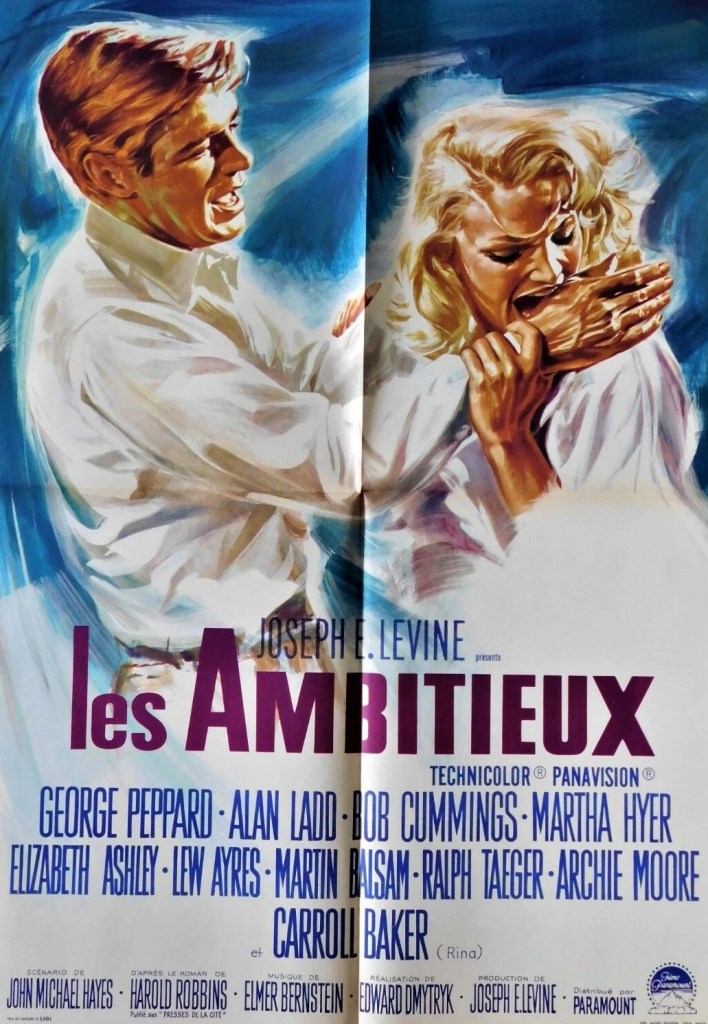
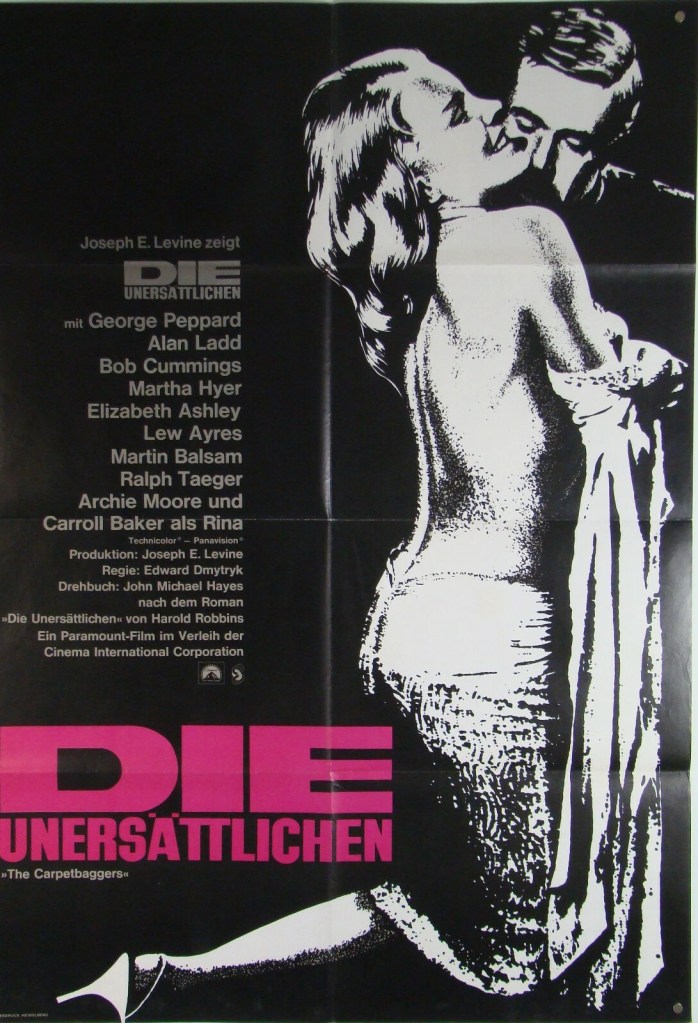
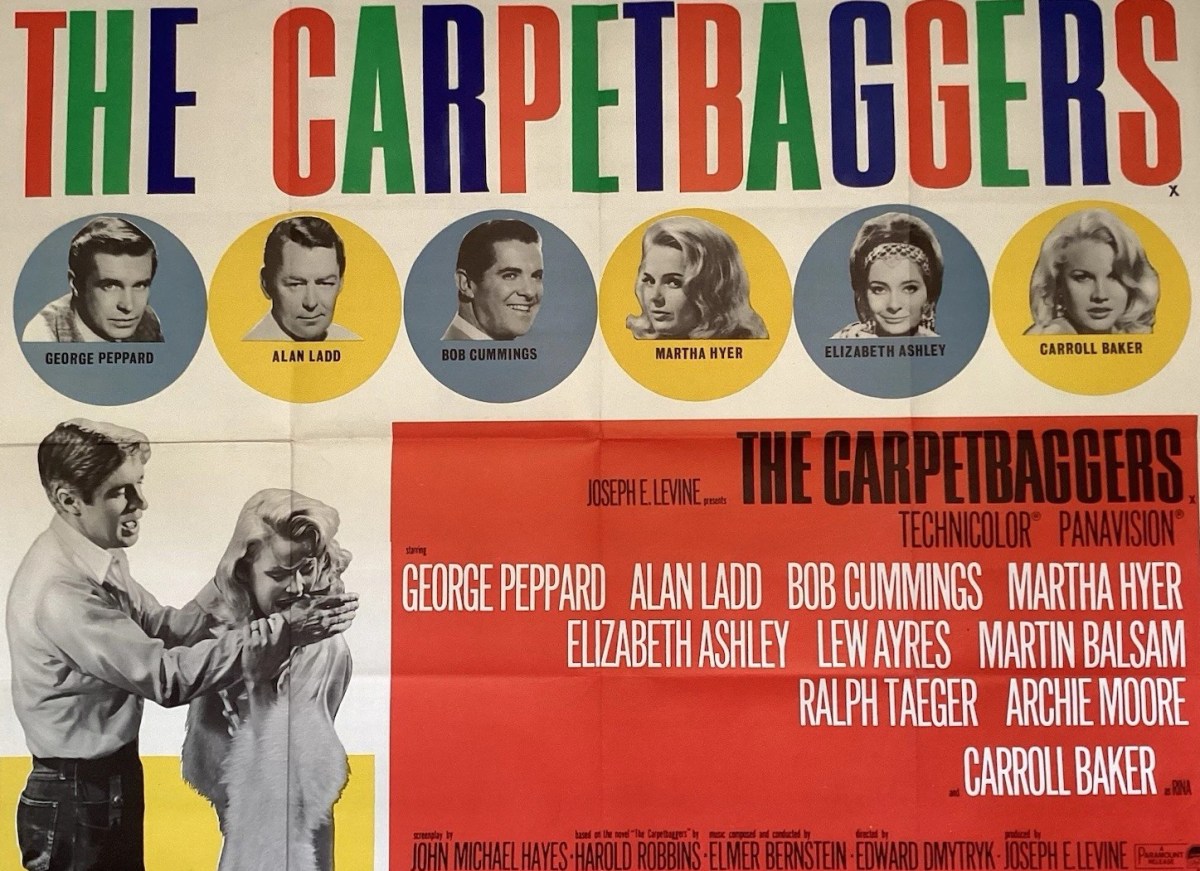
The sterling supporting cast includes Janet Margolin (Bus Riley’s Back in Town, 1965), Pat Hingle (Sol Madrid, 1968) and Raf Vallone (The Secret Invasion, 1964). John Michael Hayes (Harlow, 1965) fashioned the screenplay from The Carpetbaggers by Harold Robbins. 

Although Hollywood had been prone to sequels – Father’s Little Dividend (1951) following Father of the Bride (1950), Return to Peyton Place (1961), Return of the Seven (1966) etc – there had been no perceived market for prequels, so this was something of a first, Alan Ladd having essayed an older and considerably more sophisticated Nevada Smith in the 1964 film of Harold Robbins bestseller. 

Discover WordPress

A daily selection of the best content published on WordPress, collected for you by humans who love to read.

The Atavist Magazine

by Brian Hannan

WordPress.com News

The latest news on WordPress.com and the WordPress community.