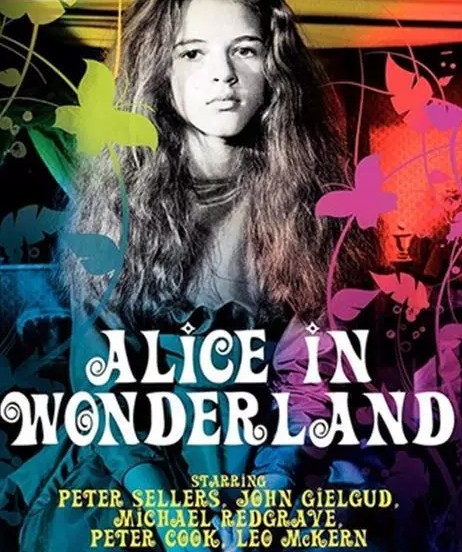
Young bucks wanting to make a bigger splash are apt to rampage through sacred texts and treat unwary audiences to avant-garde notions. Thus, Jonathan Miller (Take a Girl Like You, 1970), in his debut, set aside all expectations and in fairness purists had decried Walt Disney’s 1951 telling of the Lewis Carroll classic. In truth audiences weren’t so in love with the Disney version either, an unusually low hitter for the company, and one that only really found its niche when reissued to catch a whiff of the stoned hippies who had drooled over 2001: A Space Odyssey (1968).
This 1966 reimagining might have been buried in the vaults after its initial showing except that Jonathan Miller went on to become something of a British institution, renowned directed of opera and stage plays, writer and presenter of a number of highly-regarded television projects and a regular on the talk show circuit. That his career had begun in sensational fashion, one of the hands on the tiller of the satirical Beyond the Fringe stage show (a hit in the West End and Broadway) and television program, meant that when he decided to spread his wings into the movies, no expense was spared.
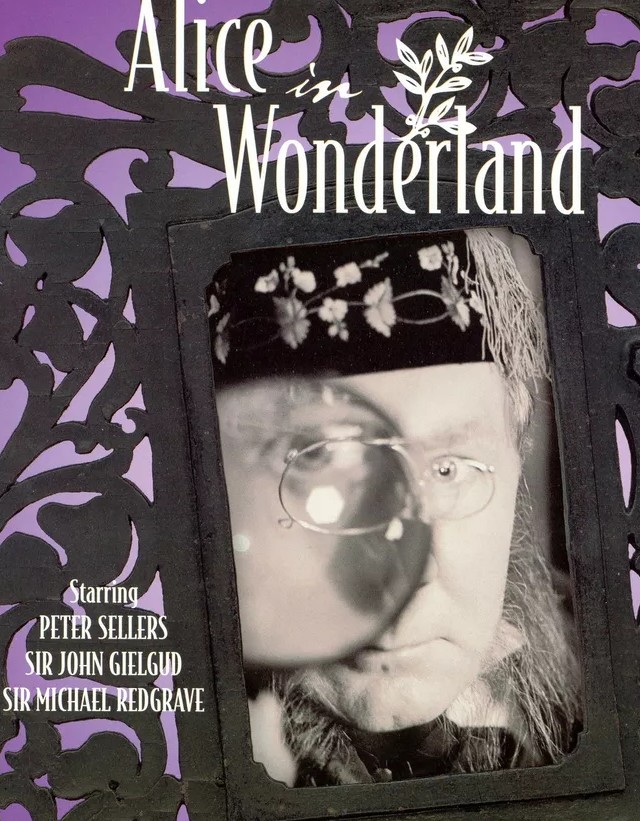
Big stars flocked. What other neophyte could attract stars of the caliber of Peter Sellers (The Pink Panther, 1964), John Gielgud (Khartoum, 1966), Michael Redgrave (Goodbye, Mr. Chips, 1969), Leo McKern (Bunny Lake Is Missing, 1965), Peter Cook (The Wrong Box, 1966) and playwright Alan Bennett (The Madness of King George, 1994)? All admittedly in small parts but that was the nature of the all-star enterprise.
And that would have been fine if they had all been employed to supply the voices. Or if audiences had the fun of trying to determine who was who when hidden under the ton of make-up required to turn them into White Rabbits or Mock Turtles or Caterpillars or Lobsters cutting a quadrille.
But Miller had determined that not only was the Disney version short of the mark but for too long readers had missed the entire point of the Lewis Carroll book. He decided the point of the story wasn’t humor at all, nor a succinct exploration of the pitfalls of language, but about a young girl adrift in a adult world of confusion. So that was bye-bye to the cuteness.
He even broke a cardinal role. Alice doesn’t fall down a rabbit hole. The whole thing is a dream.
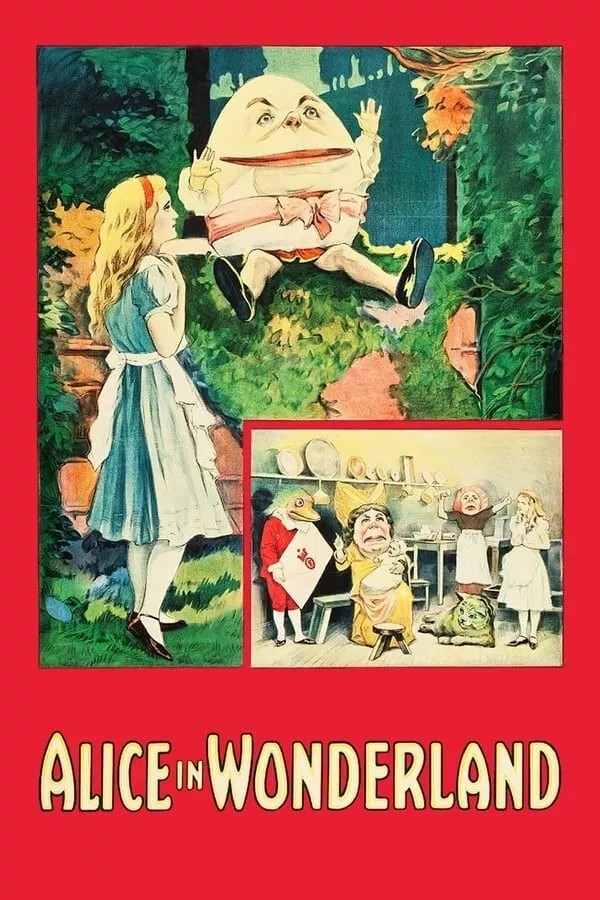
They’ve been adapting the book since the early days of cinema. This poster dates from 1915.
So you need to listen carefully to find out, with the lack of make-up, which actor is playing which fantasy character. And this isn’t set in any fantasy world either, certainly far removed from the famous illustrations that accompanied the book. It takes place in Victorian times which, yes, reflects the era in which the book was written, but, no, seems an extremely odd decision to give what is still fantasy some kind of realism.
It’s as if the director didn’t really have the courage of his convictions. That said, if he was catering to the arthouse mob, it’s got that kind of cinematic sensibility, with voice-over and unusual compositions.
Just to help you out, let me tell you that Peter Sellers plays the King of Hearts, John Gielgud the Mock Turtle, Michael Redgrave the Caterpillar, Alan Bennett the Mouse, Finlay Currie the Dodo, Leo McKern the Duchess and Peter Cook the Mad Hatter. The part of Alice went to 13-year-old Anne-Marie Mallik who never made another movie.
While it retains enough of the original to be recognizably based on the book – with all the catchphrases, “off with their heads” etc – the locale is just totally at odds with the story. And while it’s a tonic to hear the mellifluous tones of John Gielgud uttering the author’s immortal words, it would have been better just to hear his voice.
My guess is this is only still available because Miller made such a name for himself. You can catch it on Talking Pictures.
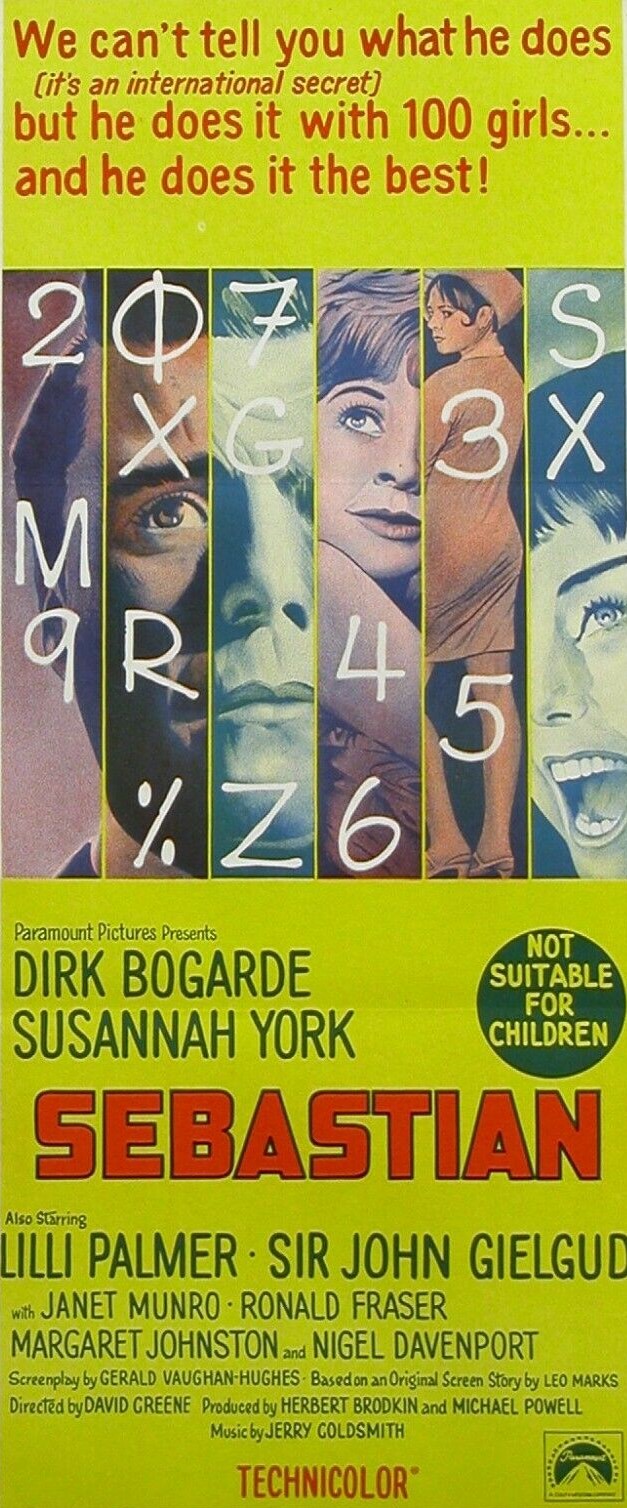
Decoding the emotional life of mathematics professor Sebastian (Dirk Bogarde) lies at the heart of a spy thriller mainlining on loyalty and trust. The presence of a flotilla of potential Bond girls has opened this picture up to charges of being a spoof, but I saw the mini-skirted incredibly-bright lasses as being a reversal of the standard secretarial pool. And a supposed representation of the “swinging sixties” would hold true if shot in the environs of Carnaby St rather than the bulk of locations being arid high-rise buildings.
In roundabout fashion, intrigued after literally bumping into him in Oxford, Rebecca (Susannah York) is recruited into an espionage decoding department staffed entirely by gorgeous (but brainy) women. Among the older employees is chain-smoking left-winger Elsa (Lili Palmer) whom security chief General Phillips (Nigel Davenport) suspects of passing on secrets. When romance ensues with SY, Sebastian dumps dumb pop singer girlfriend Carol (Janet Munro) who is already having an affair and spying on Sebastian.
Although there is no actual beat-the-clock codes to be unraveled, tensions remains surprisingly high as in best Turing manner, breakthroughs are slow. There’s an undercurrent of electronic surveillance, eavesdropping on recruits, bugs planted in the houses of even the apparently most trusted personnel, seeds of distrust easily sowed, codes shifting from numbers to sounds. The occasional nod to the contemporary, a disco, pop songs, Rebecca doing a fashion shoot in the middle of traffic, is background rather than center stage
Sebastian, though worshipped by is female staff, is “more whimsical than predatory.” Nonetheless, introspective and often morose, unable to deal with emotions, it falls to Rebecca to take on the task of sorting him out which naturally leads to complications.
Most reviewers at the time complained it was a victory of style over substance, but somehow they managed to overlook the essential questions about trust the picture asked. That said, it does follow an odd structure, the third act dependent on directorial sleight-of-hand.
Dirk Bogarde (Hot Enough for June/ Agent 8 ¾, 1964) is always highly watchable and Susannah York (Sands of the Kalahari, 1965) catches the eye with an impulsive, slightly kooky character who turns out to be down-to-earth. Nigel Davenport (Play Dirty, 1969) brings his usual cynical malevolence to the party but with the twist of not knowing whose side he is really on. John Gielgud (Becket, 1964) is a delight. There’s a brief appearance by a pipe-smoking Donald Sutherland (The Dirty Dozen, 1967). Miss World Ann Sidney is one of “Sebastian Girls”
David Greene’s (The Shuttered Room, 1967) direction is mostly competent but the opening aerial tracking shots set the precedence for occasional bursts of style. Jerry Fielding supplied the score. Written by Leo Marks (Peeping Tom, 1960) and Gerard Vaughan-Hughes (The Duellists, 1977).
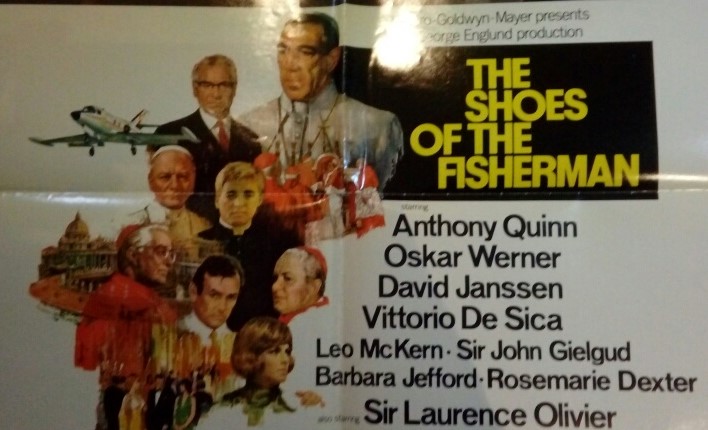
Another nod to Conclave. Thought-provoking drama with a contemporary slant set against the grandeur of the Vatican amid geo-political turmoil. At a time of global crisis, dissident Russian archbishop Lakotov (Anthony Quinn) is unexpectedly freed from a labor camp by the Russian premier (Laurence Olivier). Arriving at the Vatican, he is promoted to Cardinal by the dying Pope (John Gielgud) before becoming an unexpected contender for Papal Office.
The spectacular wealth of the Catholic Church is contrasted with the spectacular poverty of China, on the brink of starvation due to trade sanctions by the United States, nuclear war a potential outcome. The political ideology of Marxism is compared to the equally strict Christian doctrine, of which Lakotov’s friend Father Telemond (Oskar Werner) has fallen foul. There is a sub-plot so mild it scarcely justifies the term concerning television reporter George Faber (David Janssen) torn between wife Ruth (Barbara Jefford) and young lover Chiara (Rosemary Dexter).
Lakotov is drawn into the Russian-Chinese-American conflict and the battle for the philosophical heart of the Christian faith while bringing personal succor to the lovelorn and performing the only modern miracle easily within his power, which could place the Church in jeopardy, while condemned to the solitariness of his position.
The political and philosophical problems addressed by the picture, which was set 20 years in the future, are just as relevant now. The film’s premise, of course, while intriguing, defies logic and although the climax has a touch of the Hollywood about it nonetheless it follows an argument which has split the church from time immemorial.
You would not have considered this an obvious candidate for the big-budget 70mm widescreen roadshow treatment, but MGM, after the Church not surprisingly refused access to the Vatican, spent millions of dollars on fabulous sets, including the Sistine Chapel. The roadshow version of the picture, complete with introductory musical overture and an entr’acte at the intermission, is leisurely and absorbing, held together by a stunning – and vastly under-rated – performance by Anthony Quinn (The Lost Command, 1966) who has abandoned his usual bombastic screen persona in pursuit of genuine humility and yet faces his moments when he questions his own faith.
Ruth has a pivotal role in bringing Lakotov down to earth but George has the thankless task, setting aside the quandaries of his love life, of talking the audience through the sacred ceremonies unfolding sumptuously on screen as the cardinals bury one Pope and elect another.
You wouldn’t think, either, that Hollywood could find room in such a big-budget picture for philosophical discussion but questions not only of the existence of God but whether he has abandoned Earth are given considerable scope, as are discussions about Marxism and practical solutions to eternal problems. None of these arguments are particularly new but are given a fair hearing. There is a hint of the Inquisition about the “trial” Telemond faces. Oskar Werner (Interlude, 1968) carries off a difficult role.
David Janssen (Warning Shot, 1967) is mere window dressing and Rosemary Dexter (House of Cards, 1968) mostly decorative but Barbara Jefford (Ulysses, 1967) is good as the wounded wife. Laurence Olivier (Khartoum, 1966) is the pick of the sterling supporting cast which included John Gielgud (Becket, 1964), Burt Kwouk (The Brides of Fu Manchu, 1966) Vittorio de Sica (It Happened in Naples, 1960), Leo McKern (Assignment K, 1968), Frank Finlay (A Study in Terror, 1965), Niall McGinnis (The Viking Queen, 1967) and Clive Revill (Fathom, 1967). In a small role was Isa Miranda, the “Italian Marlene Dietrich,” who had made her name in Max Ophuls’ Everybody’s Woman (1934) and enjoyed Hollywood success in films like Hotel Imperial (1939) opposite Ray Milland.
Michael Anderson (Operation Crossbow, 1965) directed with some panache from a script by veteran John Patrick (The World of Suzie Wong, 1960) and Scottish novelist James Kennaway (Tunes of Glory, 1960) based on the Morris West bestseller.
I found the whole enterprise totally engrossing, partly because I did not know what to expect, partly through Anderson’s faultless direction, partly it has to be said by the glorious backdrop of the Vatican and the intricacy of the various rites, but mostly from the revelatory Quinn performance. And even if the plot is hardly taut, not in the James Bond clock-ticking class, it still all holds together very well. From the fact that it was a big flop at the time both with the public and the critics, I had expected a stinker and was very pleasantly surprised.
If only British director Tony Richardson had seen fit to add some meat to the bones, this satirical look at the American funeral business might have emulated the dramatic impact of Elmer Gantry (1960). As it is, the director is so preoccupied with the funereal inanities that it doesn’t so much lose sight of the plot as pretty much ignore it.
So, yes, the burying of a loved is big business and just like weddings some of the trimmings would make your toe curl. But even when reality intrudes, feet swell after death so require larger shoes and the only way to fit a suit on a corpse is to slit open the back, these are treated in humorous fashion.
And that would all be fine if this was the laff-fest Richardson intended but even with a puffed-out roster of cameos – Liberace as a salesman and James Coburn (Hard Contract, 1969) as a truculent customs officer the pick – this ends up as more documentary than movie. And that’s it’s main attraction for a contemporary audience who might be less concerned about the director’s almighty fall from grace after the stunning critical and commercial success of Tom Jones (1963).
In fact, it’s a shame the story goes anywhere near internment because the initial section concentrating on Hollywood is more successful in achieving a modicum of gentle satire. Wannabe poet Dennis (Robert Morse) has won a trip to America as a prize and lands on upper crust uncle Sir Francis, a Hollywood veteran, tasked with improving the elocution of cowboy Dusty (Robert Easton) so that he can play a British spy akin to James Bond.
That section entails gorillas turning up outside telephone booths, all sorts of monsters dawdling through the studio canteen, and head honcho (Roddy McDowell) running his father’s studio by the seat of his pants until he comes unstuck, resulting in Sir Francis being fired after 31 years. There’s some interesting, almost British, issue-dodging and Sir Francis in true British style, unable to deal the embarrassment of being sacked, commits suicide, leading the nephew into the arms of Whispering Glades funeral operative Aimee (Anjanette Comer). She’s in love with the creepy Joyboy (Rod Steiger) leaving Dennis to woo her using other people’s poems.
There’s another nutcase dropping out of the woodwork every two minutes, and occasionally there’s a mild piece of slapstick or physical comedy. Of course, using rampant sex as the basis for comedy, as with Tom Jones, works far better than death. In the absence of a decent narrative or interesting characters, once the initial heavy-handed points have been made there’s nowhere else to go except be more heavy-handed.
Until Brideshead Revisited (1981) was turned into a triumphant mini-series, the works of British author Evelyn Waugh had difficulty being transferred to the screen. In part, this was due to his idiosyncratic style and in part that, even at his most serious, he was viewed as a comedy writer.
Screenwriter Terry Southern (Candy, 1968) wouldn’t have been my first choice to translate the Waugh essence for the big screen, but co-writer Christopher Isherwood (Cabaret, 1968) was no more successful.
Robert Morse (Guide for the Married Man, 1967) offers little beyond mild buffoonery. While Anjanette Comer (Guns for San Sebastian, 1968) is surprisingly good as the angelic ditzy object of his affections, she can’t carry the entire picture. Robert Morley (Genghis Khan, 1965) manages to keep a straight face while delivering his lines.
Without doubt hits the immediate target but somehow misses the bulls-eye.
Even so, there’s one element of the picture that would have contemporary Hollywood salivating. And that is a producer not frightened of taking risks, willing to go outside the envelope in a bid to deliver the different kind of movie that audiences obsessed over with Barbie and Oppenheimer.
Martin Ransohoff had an enviable track record in the 1960s. For MGM, he was the mastermind behind movies as offbeat as The Americanization of Emily (1964), The Cincinnati Kid (1965) Eye of the Devil (1966) and Castle Keep (1969) as well as big-budget offerings The Sandpiper (1965) and Ice Station Zebra (1968). His name was on such later diverse titles as The Wanderers (1979) and Jagged Edge (1985). As you can see from this random selection, his movies didn’t always come off, but at least they were different.
Two stars in impeccable form, an intriguing tale of betrayal and redemption, and a sharp reminder that Britain was once a conquered nation. Given the original play was written by a Frenchman, Jean Anouilh, I wondered how much of the experience of France being occupied by Germany during World War Two informed the work.
Becket (Richard Burton) is dabbed a collaborator for having anything to do with King Henry II (Peter O’Toole), not just in his gainful employ and rising to positions of enormous power, but in accepting his friendship being viewed as a traitor to his countryman. England then, 100 years after the invasion of William the Conqueror, was divided into Normans, who ruled, and Saxons, the indigenous population, who obeyed. The only source of rebellion was through the Catholic Church which could claim, in its prime allegiance to God, to place religion above ruler.
Initially, it’s the story of two unprincipled men, who drink and lust to their heart’s content, until Henry, misreading his friend’s personality, appoints him Archbishop of Canterbury, the most important religious leader in the country, assuming that Becket would continue in his hypocritical ways and bring the clergy to heel. Unfortunately, in taking on the position, Becket takes to heart everything it stands for and instead of extending his power Henry finds it challenged.
It’s classic narrative, fast friends turned bitter enemies, the American Civil War in a nutshell. The more Becket sticks to his guns, the more his life is imperilled. Since the story is based on historical actuality, anyone who saw it at the time would be aware of the famous outcome, but the teaching of history and English history at that, either having fallen in abeyance or being given the revisionist treatment, viewers coming at afresh will be surprised at the political and moral twists and turns.
Nor is it of the “thee” and “thou” school of historical drama. The language is modernised, it is filled with humor, and spiced through with irony. Caught in a downpour during a hunt and sheltering, wet and bedraggled, in a peasant hut in a wood, Becket explains to the king that anyone who dared light him a fire would be hanged for taking precious wood out of the forest, a law laid down by Henry to make more money from his forests.
Likeable though Henry is, full of energy and fun, he is also sly and mean. On the basis of what’s mine is yours, he passes on a peasant lass to Becket, but in demanding the favour returned insists that Becket allow him to have sex with his fiancee, who promptly commits suicide rather than submit.
Henry wheedles as much as he demands, needing to keep his nobles in line if they are to fund his lifestyle and wars. There is always the tricky business of making alliances with untrustworthy rivals. This almost a template for Game of Thrones, the business of ruling as much about the velvet glove as the iron fist, negotiation and concession as important as outright demonstrations of strength.
Even when in an inferior position, there is always diplomatic recourse. The French king (John Gielgud), deliberately keeping waiting a British contingent, explains that the delay will allow them time to be measured for some fashionable French clothing. Now that is a barb served in silk.
It’s possibly as big a surprise to Becket, as indulgent in drinking and whoring as the king, to discover that he has principles. The clergy was known for abusing its power and, despite taking a vow of poverty, living high on the hog. So he stuns both his fellow priests and bishops as much as the king when he gives away all his possessions to fulfil that basic vow. There’s almost an element of naivety. Having played the game so far, suddenly he refuses, to the consternation of everyone in power.
For a time it becomes a battle of wills and that eternal question of who is more important, the invisible God or the human king, and Becket to some extent becomes a pawn.
And it’s brilliantly acted. In his first role since coming to global attention with Lawrence of Arabia (1964) Peter O’Toole creates a more down-to-earth conniving ruthless character. Richard Burton (Cleopatra, 1963), trying to prove he can attract an audience without the help of Elizabeth Taylor, matches him every step of the way. The fiery oratory is replaced by introspection.
Director Peter Glenville (The Comedians, 1967) resists the temptation to open up the stage play, which he also helmed on Broadway (where it won the Tony for Best Play), and for a historical picture set in warring times it’s surprisingly lacking in battles. But it’s easily one of the best historical pictures ever made and it’s a travesty that the Oscar for Best Actor went to neither O’Toole nor Burton, both nominated who split the vote, but to Rex Harrison for My Fair Lady. John Gielgud (The Charge of the Light Brigade, 1968) was a whimsical quirky delight, so different to his normal screen persona.
Out of 12 Oscar nominations, it won only for screenplay, by Edward Anhalt (The Satan Bug, 1965).
Does what historical movies so rarely accomplish: thoughtful, stylish, brilliantly structured with superb acting and direction.
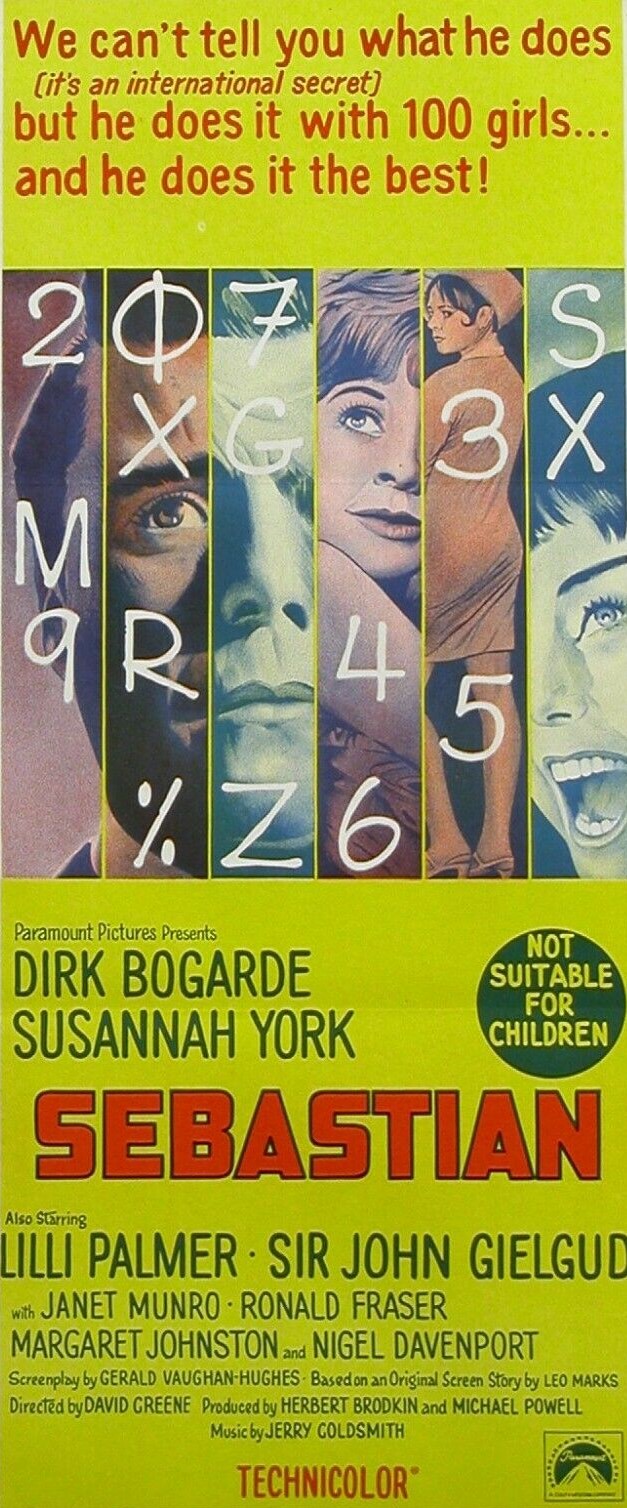
Decoding the emotional life of mathematics professor Sebastian (Dirk Bogarde) lies at the heart of a spy thriller mainlining on loyalty and trust. The presence of a flotilla of potential Bond girls has opened this picture up to charges of being a spoof, but I saw the mini-skirted incredibly-bright lasses as being a reversal of the standard secretarial pool. And a supposed representation of the “Swinging Sixties” would hold true if shot in the environs of Carnaby St rather than the bulk of locations being arid high-rise buildings.
In roundabout fashion, intrigued after literally bumping into him in Oxford, Rebecca (Susannah York) is recruited into an espionage decoding department staffed entirely by gorgeous (but brainy) women. Among the older employees is chain-smoking left-winger Elsa (Lili Palmer) whom security chief General Phillips (Nigel Davenport) suspects of passing on secrets. When romance ensues with Rebecca, Sebastian dumps dumb pop singer girlfriend Carol (Janet Munro) who is already having an affair and spying on Sebastian.
Sebastian and girlfriend.
Although there is no actual beat-the-clock codes to be unraveled, tensions remains surprisingly high as in the best Alan Turing/Bletchley manner, breakthroughs are slow. There’s an undercurrent of electronic surveillance, eavesdropping on recruits, bugs planted in the houses of even the apparently most trusted personnel, seeds of distrust easily sowed, codes shifting from numbers to sounds. The occasional nod to the contemporary, a disco, pop songs, Rebecca doing a fashion shoot in the middle of traffic, is background rather than center stage.
Sebastian, though worshipped by is female staff, is “more whimsical than predatory.” Nonetheless, introspective and often morose, unable to deal with emotions, it falls to Rebecca to take on the task of sorting him out which naturally leads to complications.
Most reviewers at the time complained it was a victory of style over substance, but somehow they managed to overlook the essential questions about trust the picture asked. That said, it does follow an odd structure, the third act dependent on directorial sleight-of-hand.
Rather unique meet-cute: Sebastian, all set to attend a function at Oxford University, gives Rebecca a word-game test.
Dirk Bogarde (Accident, 1966) is always highly watchable and Susannah York (The Killing of Sister George, 1968) Rebecca catches the eye with an impulsive, slightly kooky character who turns out to be down-to-earth. Nigel Davenport (The Third Secret, 1964) bring his usual cynical malevolence to the party but with the twist of not knowing whose side he is really on. John Gielgud (The Shoes of the Fisherman, 1968) is a delight. There’s a brief appearance by a pipe-smoking Donald Sutherland (The Dirty Dozen, 1967). Janet Munro (Bitter Harvest, 1963) decidedly rids herself of her Disney persona. Miss World Ann Sidney is one of “Sebastian Girls”
In his second picture after The Shuttered Room (1967) David Greene’s direction is mostly competent but the opening aerial tracking shots set the precedence for occasional bursts of style. Jerry Fielding supplied the score.
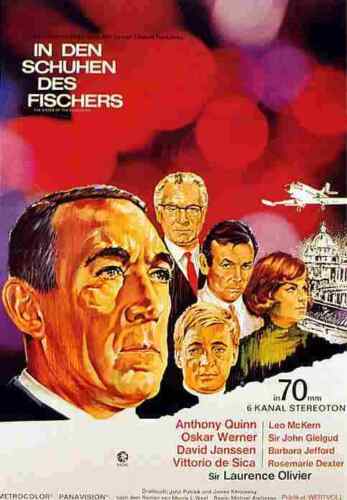
Thought-provoking drama with a surprisingly contemporary slant set against the grandeur of the Vatican amid geo-political turmoil. At a time of global crisis, dissident Russian archbishop Lakotov (Anthony Quinn) is unexpectedly freed from a labour camp by the Russian premier (Laurence Olivier). Arriving at the Vatican, he is promoted to cardinal by the dying Pope (John Gielgud) before becoming an unexpected contender for Papal office.
The spectacular wealth of the Catholic Church is contrasted with the spectacular poverty of China, on the brink of starvation due to trade sanctions by the United States, nuclear war a potential outcome. The political ideology of Marxism is compared to the equally strict Christian doctrine, of which Lakotov’s friend Father Telemond (Oskar Werner) has fallen foul. There is a sub-plot so mild it scarcely justifies the term concerning television reporter George Faber (David Janssen) torn between wife Ruth (Barbara Jefford) and younger lover Chiara (Rosemary Dexter).
Lakotov is drawn into the Russian-Chinese-American conflict and the battle for the philosophical heart of the Christian faith while bringing personal succour to the lovelorn and performing the only modern miracle easily within his power, which could place the Church in jeopardy, while condemned to the solitariness of his position.
The political and philosophical problems addressed by the picture, which was set 20 years in the future, are just as relevant now. The film’s premise, of course, while intriguing, defies logic and although the climax has a touch of the Hollywood about it nonetheless it follows an argument which has split the Church from time immemorial.
You would not have considered this an obvious candidate for the big-budget 70mm widescreen roadshow treatment, but MGM, after the Church not surprisingly refused access to the Vatican, spent millions of dollars on fabulous sets, including the Sistine Chapel. The roadshow version of the picture, complete with introductory musical overture and an entr’acte at the intermission, is leisurely and absorbing, held together by a stunning – and vastly under-rated – performance by Anthony Quinn (The Lost Command, 1966) who has abandoned his usual bombastic screen persona in pursuit of genuine humility and yet faces his moments when he questions his own faith.
Ruth has a pivotal role in bringing Lakotov down to earth but George has the thankless task, setting aside the quandaries of his love life, of talking the audience through the sacred ceremonies unfolding sumptuously on screen as the cardinals bury one Pope and elect another.
You wouldn’t think, either, that Hollywood could find room in such a big-budget picture for philosophical discussion but questions not only of the existence of God but whether he has abandoned Earth are given considerable scope, as are discussions about Marxism and practical solutions to eternal problems. None of these arguments are particularly new but are given a fair hearing. There is a hint of the Inquisition about the “trial” Telemond faces. Oskar Werner (Interlude, 1968) carries off a difficult role.
David Janssen (Warning Shot, 1967) is mere window dressing and Rosemary Dexter (House of Cards, 1968) mostly decorative but Barbara Jefford (Ulysses, 1967) is good as the wounded wife. Laurence Olivier (Khartoum, 1966) is the pick of the sterling supporting cast which included John Gielgud (Becket, 1964), Burt Kwouk (The Brides of Fu Manchu, 1966), Vittorio de Sica (It Happened in Naples, 1960), Leo McKern (Assignment K, 1968), Frank Finlay (A Study in Terror, 1965), Niall McGinnis (The Viking Queen, 1967) and Clive Revill (Fathom, 1967). In a small role was Isa Miranda, the “Italian Marlene Dietrich,” who had made her name in Max Ophuls Everybody’s Woman (1934) and enjoyed Hollywood success in films like Hotel Imperial (1939) opposite Ray Milland.
Michael Anderson (Operation Crossbow, 1965) directed with some panache from a script by veteran John Patrick (The World of Suzie Wong, 1960) and Scottish novelist James Kennaway (Tunes of Glory, 1960) based on the Morris West bestseller.
I found the whole enterprise totally engrossing, partly because I did not know what to expect, partly through Anderson’s faultless direction, partly it has to be said by the glorious backdrop of the Vatican and the intricacy of the various rites, but mostly from the revelatory Quinn performance. And even if the plot is hardly taut, not in the James Bond clock-ticking class, it still all holds together very well. From the fact that it was a big flop at the time both with the public and the critics, I had expected a stinker and was very pleasantly surprised.
At the age of 19 while working on the “Glasgow University Magazine” I managed to gain an audience with director Lindsay Anderson just after the release of “O Lucky Man!”in 1973. That was at the same time as I did an interview with Albert Finney (previously printed in the Blog). While Finney graciously agreed to a sit-down interview in a nearby café, Anderson was not quite so obliging and the interview was more of a guerrilla affair as I kept on ambushing him while he was working on a new play by David Storey at the Royal Court Theatre in London. To consider Anderson as a film director first and foremost that would be to ignore his exceptional work on the stage – at that time he had completed three full-length feature films compared to five times as many stage productions. This article was published in the October 1973 edition of “Glasgow University Magazine” and runs here in an edited version.
“AROUND LINDSAY ANDERSON: LIVE AT THE ROYAL COURT”
Lindsay Anderson, one of Britain’s foremost film directors, co-founder of the short-lived film magazine Sequence, pioneer of the “Free Cinema” movement, maker of Corn Flakes commercials, was back at work in the theatre – where for over a decade he has established a notable reputation – working on The Farm, the fifth David Storey play to be under his direction.
“When Lindsay Anderson comes to the Royal Court, it’s an event,” says his assistant Hugh Thomas, who had roles in If.. and O Lucky Man!. “He makes everyone work three times as hard. He’s an impossible perfectionist, but he’s very fair.”
Many times during the day you will hear Anderson asking the rehearsing staff: “Why can’t it be better?” and demanding of the photographer John Haines, who is taking the photographs for the official press release, if he is satisfied with the lighting. And if the photographs are okay, how okay is that? Anderson demands precision, concision, honesty, loyalty, total commitment. If you don’t possess these, then don’t go near him. Garrulousness is not tolerated; once a conversation has been milked of its essence, Anderson will cut it short, turning his attention to something else. That is not to say he is not capable of carrying on two or three conversations at once.
If you are clumsy or nervous, Anderson’s attitude will exacerbate your condition. Hugh Thomas is nervous: there is a little dance when they are talking a few feet away from each other – when Thomas speaks he moves quickly, a couple of steps forward; when he stops, he jumps back. There is not, however, any bowing. When he questions you there can be no dishonesty. He will shoot a question at you without warning, demanding an answer which will satisfy him. When Thomas told Anderson I had seen the actor’s performance in Diary of a Madman at the Close Theatre in Glasgow), the director asked if I like it. I said I thought it was good. What did that mean, Anderson demanded. Okay? No, I said, I enjoyed it. Good, was it? Quite good, yes.
Later he demanded to know of me who Rosa Luxemborg was (there is a reference to her in the Storey play). Can you say, yes, I know, and hope that you will not be pursued? Or do you say no, realising that he brooks no lie. And even though he is mildly contemptuous that as a student I am unaware of this personality, he is willing to explain to me her importance. (She was a socialist revolutionary and economist).
Anderson is a great general: he has lunch while working, refusing to let any minor details slip past him. If his army is not good, he will make it so. If it is good, he demands better. He chases after production staff to ensure all the cast get tea. The production is midway through its run so his work today is tightening up various aspects. The previous night had seen a couple of calamities. First was a delay in an actor changing costume. Anderson demanded to see the dresser but was informed that she was not present that afternoon because she was not paid to work until evening. Anderson berated the management. “If they wish to put on plays of the calibre with this cast, they have to pay for it. A change of costume is as important as anything else,” he said. At the previous night’s performance, the man whose task was to raise the theatre curtain had fallen asleep at his post. Anderson told me that had the curtain not been raised in time he would have gone on stage and apologised to the audience.
“I’m very pernickety about detail on the stage. I think it draws the audience out to you.” A David Storey play usually requires a great deal of detail. For The Contractor (1969), Anderson painstakingly rehearsed his cast in the erection of a tent that was the basis of the action. Home (1970) was more austere, but a completeness, because the details had been filled in. The Changing Room (1971), set in the dressing room of a rugby league team, was a masterpiece of naturalism.
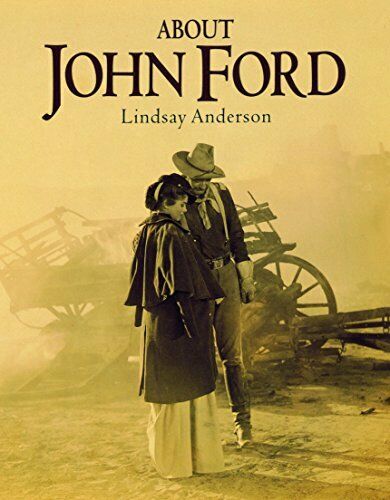
Born in Bangalore, India, 1923, son of a British officer, but three-quarters Scottish – to which he attributes his moral intransigence and refusal to compromise. In the magazine Sequence he lashed out at the British cinema and swore blind by John Ford (he would later write a book on the director). He won an Oscar for the documentary short Thursday’s Children. In 1956 he organised a season at the National Film Theatre (the precursor of the BFI) in London to show the work of new film makers, incurring a great deal of hostility in the process.
But initial acclaim came from the stage. His second production (the play) The Long and the Short and the Tall (by Willis Hall and Keith Waterhouse) at the Royal Court (in 1959) was a major success and he remained there for the next few years, directing plays like Serjeant Musgrave’s Dance (by John Arden, 1959) and an adaptation of Gogol’s Diary of a Madman (1963).
With the commercial success of Tony Richardson’s Saturday Night and Sunday Morning (1960), the commercial cinema was ready to accept his powerful film This Sporting Life (1963) from a screenplay by David Storey based on his own novel. Although the rugby background to the film was rough and hard, Anderson was up to it, producing a movie about the ambiguity of Frank Machin (superbly played by Richard Harris) who has a tortured impossible affair with his landlady – as bleak as the puritan frustrated north in which it is set.
Anderson continued working in the theatre, in television commercials, venturing into cinema only when he found it possible to do so without losing artistic freedom. He emerged with two short films, The White Bus, from a Shelagh Delaney screenplay, and The Singing Lesson, made in Poland, by which period he was already work of the script of If… with David Sherwin. He was originally attracted to the script’s original title The Crusaders with its overtones of “idealism, struggle and the world well lost.” He also had the guiding lights of John Ford, Jean Vigo and Bertolt Brecht. “When I worked on the original script with David Sherwin,” he said, “we divided it into chapters. I think we felt from the beginning that If… would be an epic film in the Brechtian sense of the word.”
The basic tensions between hierarchy and anarchy, independence and tradition, liberty and law were highlighted in that semi-autobiographical account of a public school and the three rebels, old-fashioned heroes without being aware of it – who spout “we must be free or die” – who arrive at their own beliefs and stand up for them against the world, if necessary. There are symbolic instances of love and war before the final action set against the ritual of the (school’s annual) Crusaders Day. Mick (played by Malcolm MacDowell) and friends are fighting with their backs against the wall when the Establishment counter-attacks. It is one of the most liberating sequences ever shot, this defeat.
The decision to shoot some of the sequences in monochrome was partly a financial one since the director of photography Miroslav Ondriceck felt he could not guarantee on his lighting budget to produce an overall colour scheme. Anderson incorporated this into the artistic structure of the film, creating the necessary atmosphere of poetic licence while preserving a classic shooting style. Anderson believes it is his job to create the film, his prerogative as an artist. He refuses to go along with modern ideas that the audience creates a film for itself. What interests him most are the qualities of rhythm, balance and composition with a simple technique.
With a Cannes Grand prix for If… Anderson returned to the theatre of David Storey. “We have a very easy relationship and a very good one. I don’t work with him on the writing of his plays and we make very few changes. The first of his plays I did (In Celebration, 1969) was cut a great deal and Home was cut in rehearsal. But David knew that was necessary and we did it with the actors. On a production like The Farm, he comes to the rehearsals and attends the auditions and he enjoys that and if I ever need to refer to him I do. Sometimes he has suggestions to make which are very good and actually he can cut corners for us, certain things he understands better and can explain to us more quickly. There are other things he doesn’t particularly understand because he writes intuitively, too, and we just have to work them out.”
In Celebration and The Farm are plays about families and very obviously about Storey’s own family. Anderson commented: “I remember when we were doing In Celebration it was most painful. On the evening when his parents came to see it David was very worried. I went to Constance Chapman who was playing the mother sand said ‘play her nice.’ How much is from real life I wouldn’t like to guess. Jesus Iscariot, the first novel by his brother (Anthony Storey, also a rugby player), is a cruder form of In Celebration with the child that died at birth etc.”
After lunch the cast comes in to be given notes on the previous evening’s performance. Anderson is very thorough. He told me: “It’s very difficult to tell people they’re good. It’s a director’s failing.” A couple of minutes later, he added, “I think the beginning of Act Three was very good – there you are.” As the actors go away to get changed, Anderson does comment on Bernard Lee who plays the working-class father. “I think he’s brilliant. Bill Owen (who played a similar role in The Contractor and In Celebration) wasn’t convincing enough. It’s hard to cast this (kind of) part because all the elderly actors in England come from a different class, a pre-war class when the working-class weren’t actors. Larry (Olivier) can put on accents but it’s all acting. But John (Gielgud) is very human, very warm. When he comes on he is the character; when he cries in Home it is John crying.”
He is not too pleased with the treatment meted out by Warner Brothers to O Lucky Man! and there is a sense he is reining himself in. “Since I signed a contract to make a film that was two hours and seven minutes long and delivered one that was three hours long I wasn’t in a very good position. It wasn’t my picture. It belonged to Warner Brothers.” Perhaps he is being a bit unfair. He had a budget of $1.5 million for O Lucky Man! as opposed to the £250,000 from Paramount for If…which arrived 56 hours before shooting was about to begin after Columbia suddenly withdrew their support. Perhaps he had a better time than he supposes.
Like the black leather jacket he has been wearing since If… Anderson works with people he can rely on, with whom he has worked before. Malcolm MacDowell who played Mick in If… plays Mick again in O Lucky Man! this time as a naïve coffee-salesman who strikes it lucky in several veins and each time a prospect collapses shifts to new ground, ending up with a smile that is an acceptance of reality but not necessarily compromise. The faces Mick meets are the same actors playing multiple roles, actors Anderson has used before – Ralph Richardson from Home, Arthur Lowe from If… and This Sporting Life, Rachel Roberts from the latter film. Cinematographer Miroslav Ondricek from The White Bus and If… is also on board.
Much of what Anderson brings to bear in constructing a film bears comparison to his stage work and vice-versa. “When I read a play for the first time, I don’t spend an awful lot of time analysing it. I just read it and receive an impression. I usually choose things instinctively anyway. Naturally, if a play is good it’s worth experiencing a number of times but certainly I hope that anyone coming to see a production for the first time is going to have a clear and full understanding of the play than just by reading it or certainly than I did when I read it for the first time. The process of putting a play on the stage is the process of understanding and interpreting it. That is very different from experience of actually sitting and seeing a play directed and performed in front of you.”
The brusque, short, thick-set man whose teeth you never see is still on the ball as the afternoon draws to a close and, eclectic to the last, starts whistling the theme tune of John Ford’s 1944 war picture They were Expendable.






 The Magnificent 60s