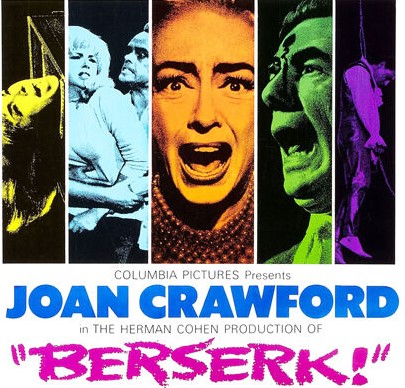
Berserk! (1967) ***

“Murder is good for business,” declares magnificently callous circus boss Monica (Joan Crawford). And so is nostalgia. Interrupting the action every ten minutes or so with the kind of circus act – courtesy of legendary British ringmaster Billy Smart – that you couldn’t see these days is probably going to win more viewers than seeing Joan Crawford in late vintage nastiness. Roll up, roll up for the elephants ridden by glamorous lasses, death-defying (or not so much) high-wire acts, prancing horses, knife-throwing, cutting a woman (and who better than a sequined Diana Dors) in half, and “intelligent” poodles (is there any other kind?).

Step aside John Wayne (Circus World, 1964), whose magnificent showmanship has nothing on circus master Monica, calling the shots and not just in the ring. She rides roughshod over business partner Albert (Michael Gough), pushes back into his box newcomer Frank (Ty Hardin), and packs daughter Angela (Judy Geeson) off to boarding school to shut the book on maternal instinct in case it gets in the way of running the show.

Throw in a good few hapless coppers, including a toff – Monica being such a big noise it requires the involvement of a Commissioner (Geoffrey Keen) and a Superintendent (Robert Hardy) – who pop up sporadically and show surprisingly little skill for detection beyond standing over a corpse or murder implement and making a pronouncement. Naturally, such an atmosphere is riven with jealousy and it doesn’t take much to start a cat fight, no surprise to see Matilda (Diana Dors) in the thick of it.

When her star act dies (murdered) on the high wire and Monica looks around for a replacement, she happens upon pushy Frank (Ty Hardin) who not only walks across the tightrope blindfold, but operates without a safety net and should he fall will land on a series of nasty spikes. He wants to share her bed and her business, but has some dodgy backstory, hints of some incident in Canada seven years ago.

So just as Monica reckons the thrill of possibly seeing death occur in front of their eyes will pull in the punters, that could be (though I doubt it) an ironic nod at the cinema audience since, as in all serial killer pictures, viewers are calculating who will be killed next, and not so much who the murderer is, but who will survive at the end. Luckily, this is British and made in times when the censor exerted a tighter rein, so you can be sure nobody’s going to meet a sticky end just because they’ve had illicit sex.

As if her employees were scary beasts, Monica beats them into submission, though, in fact, outside of Frank, nobody’s got the guts to challenge her. And it being the 1960s and forensics not much in evidence and, frankly, the producers not much interested in rounding up any suspects, you just sit back and wait to see who will be next. Will someone scare the prize elephant into misplacing a foot and crushing to death the beauties lying on the ground so that it can daintily step over them? Will the knife-thrower miss his marks or the spinning wheel containing his human target be rigged to go awry?

My money was on the poodles attacking their mistress for making them jump over a skipping rope. I hadn’t quite seen coming Albert being foolish enough to lean against a post with his head positioned exactly beside a hole so that from behind someone could hammer a spike into it. That should have made Monica a suspect because he wanted out of the business, except she has stolen and burned their contract and not a single soul in the entire circus appears to know that he even was her business partner.

Angela, when she turns up accompanied by a headmistress, appears to be a chip off the old block, turfed out of yet another school for “causing trouble.”  Monica looks as if she was born to be trouble, and you can imagine the machinations that led her to owning a circus. There’s a surprisingly tender mother-daughter reunion and the daughter is soon enrolled in an act.

The ending seems straight out an Agatha Christie novel, take the least likely contender and make them the villain, with psychobabble as justification.

I have to say that I enjoyed this, as much for the circus acts as for seeing noir queen Joan Crawford (Mildred Pierce, 1945) returning to the tough-as-they-come persona of Johnny Guitar (1954) rather than the theatrics of Whatever Happened to Baby Jane (1962). A pre-lugubrious Michael Gough (Batman, 1989) and a non-blousy Diana Dors (Hammerhead, 1968) add to the treats. Maybe Sidney Sweeney (Immaculate, 2024) consulted the Judy Geeson (Prudence and the Pill, 1968) playbook in assessing the career value of appearing in a horror movie. Ty Hardin (Custer of the West, 1967) is miscast, especially in his high-wire wobbles, though anyone thinking they can act Ms Crawford off the screen should be taken away and locked up.

Jim O’Connolly (Vendetta for the Saint, 1969) directed from a script by the team of Aben Kandel and producer Herman Cohen  (Black Zoo, 1963).

Nostalgic fun.

Behind the Scenes: Raquel Welch on “Myra Breckenridge” (1970)

In 2012, Raquel Welch was accorded a ten-film tribute at the prestigious Film Society of the Lincoln Center for the Performing Arts in New York and turned up in person to be interviewed on stage prior to various screenings. One of these was Myra Breckenridge (1970). Though interviewer Simon Doonan kicked off proceedings by mistaking her for Ann-Margret (yep). Graceful as our star was, she didn’t storm off the stage.

She admitted she wasn’t first choice for the picture. “I didn’t get a call,” she explained. “I had heard about the movie. I had read the book. The book was absolutely hysterical, so funny, and I thought it was very innovative because it was the first time I had seen somebody like Gore Vidal, who was really a genius, deal with the duality of the nature of both the male and the female. I never saw that before.

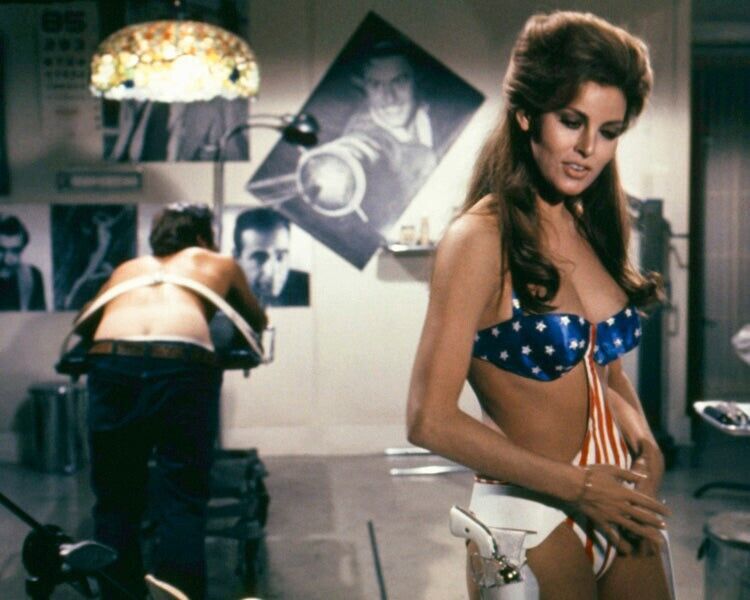
Is that a gun or a are you just pleased to see me?

“I was interested in how they were going to do this movie and then I heard through the trade that Anne Bancroft (after the success of The Graduate, 1969) had turned it down. So I thought, hmmm, I wonder what they’re going for. A little bird told me to call Dick Zanuck (head of 20th Century Fox) so I called Dick, who I was in contract with, and asked what kind of actors they were looking for in this role. I was thinking if a guy was going to change his sex and wanted to be like a movie star kind of girl, don’t you think he might want to look like me? And he said, oh my god, that’s a thought, let me talk to David – that was David Brown (later, producer of Jaws, 1975) and I’m sure Helen Gurley Brown (his wife and editor-in-chief of Cosmopolitan) got in on it too. And then I did get the call and they asked me to come in and talk to them and they gave me the role.

“I had not seen the script, it’s true. As much as I loved doing Myra, I was kind of disappointed in the outcome of the movie because the narrative never did really string together. It was very disjointed and it didn’t really tell the story of Myron the film critic who was enamored of all the very very strong swashbuckling women of the golden age of film from Joan Crawford to Bette Davis and Myrna Loy.

“He wanted really to be one of those superwomen and I think that’s where the superwomen thing started because it was women then who used to go to the movies. They used to bring the guys to the movies. That was the way it went then more than it does now…The dialog was both male and female and I felt like now I’m playing the girl’s part. Rex Reed is playing Myron and there’s really hardly any relationship between the two. They’re not one person so there’s no idea of the duality and nature. One minute she likes girls and the next minute she likes studs and the older men are just to use and abuse.”

Asked about how she developed her character, Raquel replied: “The real thing – I know this is going to sound very shallow – but Theodora Van Runkle (who had swept to national fame by starting a fashion trend with her outfits for Bonnie and Clyde, 1967) did these beautiful period costumes which did emulate all of the great film stars…I felt these clothes kind of evoked this attitude.

“I did want to meet Mae (West). I did go out and research her and find out all about her and it turned out she had never made a color movie before. I asked for an audience. (In her apartment) I noticed all her furniture was white and also noticed all these 25-watt pink bulbs (to keep the room dim).”

Raquel had observed of movie stars, “There’s a screen persona and a real side. Mae didn’t have a real side. She was wearing a long peignoir and lots of eyelashes. This was noon. She didn’t bring the chimps out (she was rumored to have a menagerie of them…and young men, and neither were in evidence).”

(On set) “The other thing that got to me a little bit was that Mae never worked before 5pm. Also she never really moved by herself. (The limousine that had driven her to the studio) also brought her on to the set. I kissed her hand and one false fingernail fell to the floor and then I thought I’m getting a vibe, I think she’s a man. She refused to appear in the same frame as me. At 77 (Mae’s age) all bets are off and you’re not going to be able to doll it up that much.”

While stars being able to veto a director and perhaps refuse to work with certain other stars was still a perk for the highest-paid movie actors, Welch discovered that Mae West had a very distinctive unheard-of perk. She had costume approval. Van Runkle had designed a Garbo-esque black dress that Raquel was looking forward to wearing. But when it came time for that particular scene she discovered it had been “confiscated….nobody got to wear non-color (West was always dressed in white) except Mae.”

“Very early on (I realized) this isn’t Gore’s book. Nobody’s going to undertsand it…they hired Michael Sarne who’s only claim to fame was Joanna (1969), a visual montage kind of thing and that’s what he did to this movie. The fact that it had dialog was secondary. He used to carry round this little rectangular box and he used to say, I’ve got this little box for you, Raquel.

“It was sad fun, I didn’t want to make a movie that didn’t make any sense. I thought we were going to make something that was revolutonary. I did think it was kind of a landmark that said it’s very likely that world culture will change from this point on.”

You can catch this interview and another one discussing The Three Musketeers on Youtube.

The Karate Killers (1967) ****

What a hoot! A sheer blast! The most brilliant yet of the madman dominating the world schemes, autogyros to out-Bond Bond, a fabulous cast and of course the most incompetent spies this side of Get Smart.

You can’t get better than a scientist inventing a way of turning water into gold. Takes chutzpah to even think of that as a plot. No having to batter your way into Fort Knox as poor Bond did in Goldfinger (1964), you just turn on the tap. But, wait, the formula is lost and our intrepid heroes have to – heaven forbid! – track down five gorgeous women to find it. Was there ever a more onerous proposal?

I never saw any of these films when they came out. At the time I guess they would have been viewed as small screen rivals to James Bond. But although 007 in every picture would eventually be trapped in the madman’s lair, he spent most of the film beating the sh*t out of the bad guys. In sharp contrast, The Men from U.N.C.L.E. seem always to be on the wrong side of a beating, number one hero Napoleon Solo (Robert Vaughn) more hapless than number two Ilya Kuryakin (David McCallum).

With hindsight, it looks like this was never meant to be taken seriously and without going into over-spoof plays exceptionally well as a light-hearted romp. Solo seems to be constantly outwitted with Kuryakin invariably coming to the rescue, the former too often duped by beauty, the latter a bit more discerning. There’s a lovely moment here in their reactions to the instruction by boss Mr Waverley (Leo G. Carroll) to hunt down a dead scientist’s quintet of daughters/step-daughters; Solo gives a knowing smirk, Kuryakin shows disdain.

Must be the best cast yet assembled: legendary Joan Crawford, suddenly hot again after Whatever Happened to Baby Jane (1962) and Strait-Jacket (1965), Curd Jurgens (Psyche ’59, 1964), Herbert Lom (Villa Rides, 1968), Telly Savalas (The Dirty Dozen, 1967), Kim Darby (True Grit, 1969), Terry-Thomas (How To Murder Your Wife, 1965)  and Jill Ireland (Mrs Charles Bronson) as you’ve never seen her before.    

The U.N.C.L.E. duo are in a race against T.H.R.U.S.H. operative Randolph (Herbert Lom) to track down the missing formula. Randolph has a head start. He has been having an affair with the scientist’s wife Amanda (Joan Crawford) who is shocked to discover his charming exterior conceals a ruthless interior.

Solo and Kuryakin track down the scientist’s daughter Sandy (Kim Darby), a good bit brighter than your average eye-candy spy girl, who points the way to the step-daughters and to the possibility that each has one part of the missing formula. Was there ever an easier justification for introducing such a random set of characters?

First up is stark naked Countess (Diane McBain) locked away by jealous impoverished husband (Telly Savalas) in a castle in Rome. Then we’re onto Imogen (Jill Ireland), a flamboyant lass shaking her booty at any opportunity, arrested by a constable (Terry-Thomas) for indecent exposure, and involved in a punch-up in a London night-club where Solo is nearly drowned (yup!) and Randolph instructs the band to keep playing since the ruckus is nothing to do with them.

Then we’re off to Switzerland and Yvonne (Danielle De Metz) and a machine-gun ski chase down a mountainside (beat that, Mr Bond). And so on until all the clues, contained in photographs of the dead father, have been found and, wait for it, the puzzle remains incomplete. Eventually it’s unravelled and the final showdown is on.

But what a way to go. Never mind the ski chase, the picture opens with the duo being attacked by a fleet of autogyros (one-man mini helicopters, the “Little Nellie” of the later You Only Live Twice, 1967 ), and as usual someone, this time Kuryakin, is trapped on a low-tech machine, this time on a ice-block travelator where blocks of ice are smashed to bits by nasty spikes.

Randolph is the most droll villain alive. “Don’t be so melodramatic, my dear,” he informs Amanda when she uncovers his villainy and is about to be murdered. The whole jigsaw is exceptionally appealing, the global whizzing about, Japan also included not to mention one of the poles where T.H.R.U.S.H. has established its HQ.  

The action is a good bit more thrilling, the aerial and ski sequences very well done on a budget a fraction of the Bonds, and there’s more than enough going on to keep interest levels high, not just where to go next, and who to encounter, but the gathering of the clues,  and working out of the final mystery, which offers a nice emotional touch.

Kim Darby is more of a typical ingenue here, sparkier than you might expect but not offering the originality of character expressed in True Grit, while Jill Ireland is a good bit more sassy than she ever appeared thereafter. Barry Shear (Wild in the Streets, 1968) directed.

This is the best so far that I have seen on the series. My interest had begun to flag but, thus fortified, I will continue with my endeavors to watch them all. on your behalf, of course.

Female Earnings – The Inconvenient Truth

Last week’s headline-grabbing articles about how few women featured in the rankings of top-earning movie stars, suggesting this was an age-old problem, overlooked one inconvenient truth. A century ago, actresses were the biggest earners in Hollywood.

In fact from Hollywood’s inception around 1910 and for the next sixty years actresses from Mary Pickford in the 1910s to Elizabeth Taylor either out-earned or equalled the male pay packets. I know. I wrote a book about it – When Women Ruled Hollywood (Baroliant, 2019). It was subtitled – “How Actresses Took on the Hollywood Hierarchy – and Won.”

The simple fact of the matter is that a woman – Florence Lawrence – in 1910 became the first Hollywood star, on the princely (or should I say princessly) salary of $50 a week, at a time when 77% of the female workforce survived on less than $7 a week. She was the equal highest-paid earner of the day.

Taylor earned $3 million for Cleopatra.

When movies began, movie stars were not as highly paid as those who worked on stage. But, again, women were by far the highest paid earners. The number one star in vaudeville – the U.S. version of music hall – was Gertrude Hoffman on, wait for it, $3,000 a week (about $90,000 equivalent now).  In 1911 the number one spot was shared – by two women. Sarah Bernhardt and Gaby Deslys now took home $4,000 a week. The following year Bernhardt was top dog again, on $9,000 a week and the next year again as the highest earner she pulled in $22,000 a week.

Movie stars of neither gender were earning that much but everyone knew what vaudeville stars earned so there was no shortage of precedent for actresses in the burgeoning movie business to ask for more. They employed a simple technique. They held studios to ransom. Give me more money or I jump ship.

In 1915, Mary Pickford broke all records for movie star earnings by taking in more than $150,000 a year. This was far more than male sensation Charlie Chaplin and even as his salary leapt upwards so did hers. In 1918 she picked up $1.8 million a year.

Despite the advent of top males in the 1920s of the calibre of Valentino, Lon Chaney, Tom Mix, Harold Lloyd and John Gilbert, women topped the earning chart once again. Gloria Swanson would have easily been the top-ranked earner had she accepted an offer of $18,000 a week but turned it down preferring to retain her independence. In her absence Corinne Griffiths came out of top with a $13,000 a week salary at First National.

Hepburn was on a cool $1 million per picture.

In the early 1930s Greta Garbo topped the heap with $500,000 a year – for a 40-week deal. In 1935 Mae West took home $480,000, not just the highest earner in the movies, but the second highest earner, $20,000 behind publishing magnate William Randolph Hearst, in the whole of the United States.

In 1936, when Gary Cooper came top with Ronald Colman second, women occupying the next three spots. In 1937 when Fredric March took the top spot, women placed, second, third, four, fifth and sixth. In 1938 Claudette Colbert was number one and Irene Dunne the topper in 1939.

Bing Crosby topped the bill in 1940, and the next year it was Colbert again. The war inflicted a number of anomalies on the business, mainly the arrival from radio of Abbott and Costello, top earners in 1942, with Fred MacMurray, without even taking top billing in most of his films of the period, hitting the earnings peak for both 1943 and 1944.  Ginger Rogers was top in 1945, Joan Crawford in 1946 and except for a parachute payment to stop him leaving Warner Brothers Humphrey Bogart would have been pipped at the post by Bette Davis, with chanteuse Deanna Durbin top of the heap in 1948.

With demise of the studio system in the 1950s, female earnings tumbled except for Marilyn Monroe who ran top earners John Wayne and William Holden close. But in the 1960s Elizabeth Taylor out-earned everyone by a huge margin and Audrey Hepburn, Doris Day and Julie Andrews either earned or equaled the earnings of top male attractions like John Wayne, Steve McQueen and Paul Newman.

The advent of action pictures, which sold more easily around the world than comedies or dramas, ensured that from the 1970s onwards men mostly ruled the earnings game. But still stars like Barbra Streisand, Jane Fonda, Julia Roberts and Sandra Bullock held their own. And it was not so long ago that it was the likes of Jennifer Lawrence, thanks to The Hunger Games franchise, beat everyone.

You can buy my book on Amazon for about £10 and $12.

The Blogger Speaks

This weekend I am one of the very few male speakers at the “Doing Women’s Film and Television History” international conference being hosted by Maynooth University, Dublin, on July 10-11. Naturally it is a virtual conference but it is packed with speakers from all over the world who have been researching issues relating to women working in film and television. I am not an academic so it is signal honor for me to be invited to speak at a university-run conference.

My topic is “When Women Ruled Hollywood” which looks at female salaries in the movie business from 1910 to 1970. Although most people think women were hard-done-by in Hollywood and generally considered as second-class citizens, I found this was not at all the case. In the 1910s, Mary Pickford earned double the earnings of Charlie Chaplin. In the 1920s, the top earning star of either gender was Corinne Griffith.s

At the start of the 1930s, Greta Garbo was the dominant figure when it came to salaries. In 1935 Mae West was the second-highest earner in the whole of America, beaten only by William Randolph Hearst, immortalised as Citizen Kane.

In the annual salary league for the remainder of the 1930s and 1940s, Claudette Colbert (twice), Irene Dunne, Ginger Rogers, Joan Crawford and Deanna Durbin all topped the rankings and in the years when males came out on top the female stars were not far behind.

While female salaries dipped in the 1950s, by the 1960s women were again beating the males at the salary game, Elizabeth Taylor way ahead of everybody, Audrey Hepburn on $1 million a picture, Julie Andrews out-earning Paul Newman in Torn Curtain and newcomer Barbra Streisand reaching unheard-of commercial heights.

I had written a couple of business histories of Hollywood, the research for which took me back to 1910 and in the course of writing those books I discovered information about salaries that would have been out of place in those works, so I dug around some more and came up with the information for this talk.

If you want an idea of my speech, you can check out this short sample on Youtube.

Books – Behind the Scenes of “Valley of the Dolls” (1968)

Behind-the-scenes books generally benefit from as much scandal as possible. Using that criteria, Dolls! Dolls! Dolls! by Stephen Rebello leaps to the top of the list. Rebello had been primarily responsible for turning Valley of the Dolls (1968) into a camp classic by hosting repeated showings of the picture from the 1990s onwards and making it number one in his book Bad Movies We Love.

The novel Valley of the Dolls by Jacqueline Susann was a record-breaking bestseller on the “sex/sin/salvation literary rodeo” but nothing that came out of the fevered imagination of Harold Robbins could match the Susann book, an insider’s look at the murky goings-on in Hollywood with drug abuse at the top of the heap. Unfortunately for Susann, Twentieth Century Fox struck a deal for the film rights pre-publication, long before it became a sensation, so she earned only $85,000 upfront, a quarter of what was paid for Peyton Place which sold far fewer copies. Mark Robson who had brought Peyton Place to the big screen was hired as director.

Stars clamoring for roles included Natalie Wood, Bette Davis, Debbie Reynolds and Kim Novak. The list of those who turned it down was longer: Lee Remick, Jane Fonda, Julie Christie, Raquel Welch, Candice Bergen. Christopher Plummer and James Garner were screen-tested. Sharon Tate, Barbara Parkins, Judy Garland and Patty Duke won the main roles.

Movies had done away with the “any similarity” disclaimer but it was upfront in all ads for the film as well as in the pre-credits on the film, whether as a publicity ploy or to head off potential legal action is unknown.

The screenwriters were as appalled at the material as the censor. But that was just the beginning of strife central. The personal enmity between Duke and Parkins rivalled that of Bette Davis and Joan Crawford. Screaming matches and hissy fits abounded. Duke suffered from drug and alcohol abuse, mood swings and nervous skin conditions and constantly clashed with the director. Plus, despite cutting some singles and albums, she had to mime.  Tate was forced into take after take for the normally economic director. The three young stars, believing this was a career-making picture, took no prisoners. Robson used a stopwatch when filming, as if he was already editing the film in his head, pushing the actresses to speak the lines faster, or undertake actions exactly on a time cue, a humiliating procedure in one scene for Tate. She refused to cry in case it messed up her make-up, which would cause further delay and further infuriate Robson. Tate was also embarrassed by publicity photos taken during her pornographic scene.

Garland was in no fit state to make a movie. She was drinking wine by the bucketload, dropping pills, slurring her lines, missing her cues and turning up late for work. Finally, it got too much and she was fired. Fans bombarded the studio with irate messages. Ginger Rogers rejected the role on account of the language.  Robson put in a personal phone call to Susan Hayward, who had quit Hollywood, and turned down several comeback roles including Mrs Robinson in The Graduate. When Hayward was finally persuaded for a hefty fee, the producers had to shred Garland’ s costumes. They were different sizes. Hayward’s wardrobe was redesigned from scratch. The last straw on the troubled production was producer David Wiesbart dropping dead. That wasn’t quite the last straw. Critics trashed the picture. Luckily, audiences didn’t and lined up in droves.

Discover WordPress

A daily selection of the best content published on WordPress, collected for you by humans who love to read.

The Atavist Magazine

by Brian Hannan

WordPress.com News

The latest news on WordPress.com and the WordPress community.