The Valley of Gwangi ****

The special effects are in the five-star range while the movie into which they fit is really worth no more than three stars so I’ve compromised, hence the four-star rating. Actually, the story and characters are interesting enough, and there are some stunning cowboy stunts,  though where is a fur-lined bikini when you need one. Although we are treated to prehistoric monsters, humans fail to have managed the transition to the hidden valley where the creatures have kept out of sight for millions of years. Instead, we are in turn-of-the-twentieth-century Mexico.

However, one specimen, a miniature horse, known as El Diablo, has been found and now resides in a rodeo, property of T. J. Breckenridge (Gila Golan) whose showstopping turn involves leaping on horseback from a high platform through a ring of fire into a pool of water.  Ex-flame and sleek salesman Tuck (James Franciscus) and archaeologist Professor Bromley (Laurence Naismith) follow gypsies who aim to return the horse to the Forbidden Valley. T.J. and a band of cowboys are in pursuit.

Widening a tiny gap into the unknown world also of course means it’s not big enough for the monsters to escape. The valley is ruled by Gwangi, an Allosaurus, which to most of the audience looks remarkably like a T. Rex. Various battles ensure. A Pteranadon swoops down from the sky and captures one of the cowboys but is killed by Carlos (Gustavo Rojo). Gwangi fights an Ornithomimus and a Styracosaurus. Even if your knowledge of prehistoric monsters  isn’t up to identifying each creature, no matter, the fights are very well done, and a step up in terms of special effects from similar tussles in Harryhausen’s previous venture in One Million Years B.C. (1966) especially as we are less distracted by females attired in fur bikinis.

Naturally, the intent is to capture Gwangi and put him on show a la King Kong (1933) and it’s equally obvious how this particular maneuver is going to work out. That the story follows this particular angle is down to the fact that this movie was the original idea of Willis O’Brien, the special effects genius to created King Kong. After considerable development, RKO shelved the project on the assumption the public was not interested in dinosaurs.

Meanwhile, back in the human tale, the previously principled T.J. lets greed get the better of her and begins resisting Tuck’s overtures. Even if you can guess the finale, it is pretty well done.
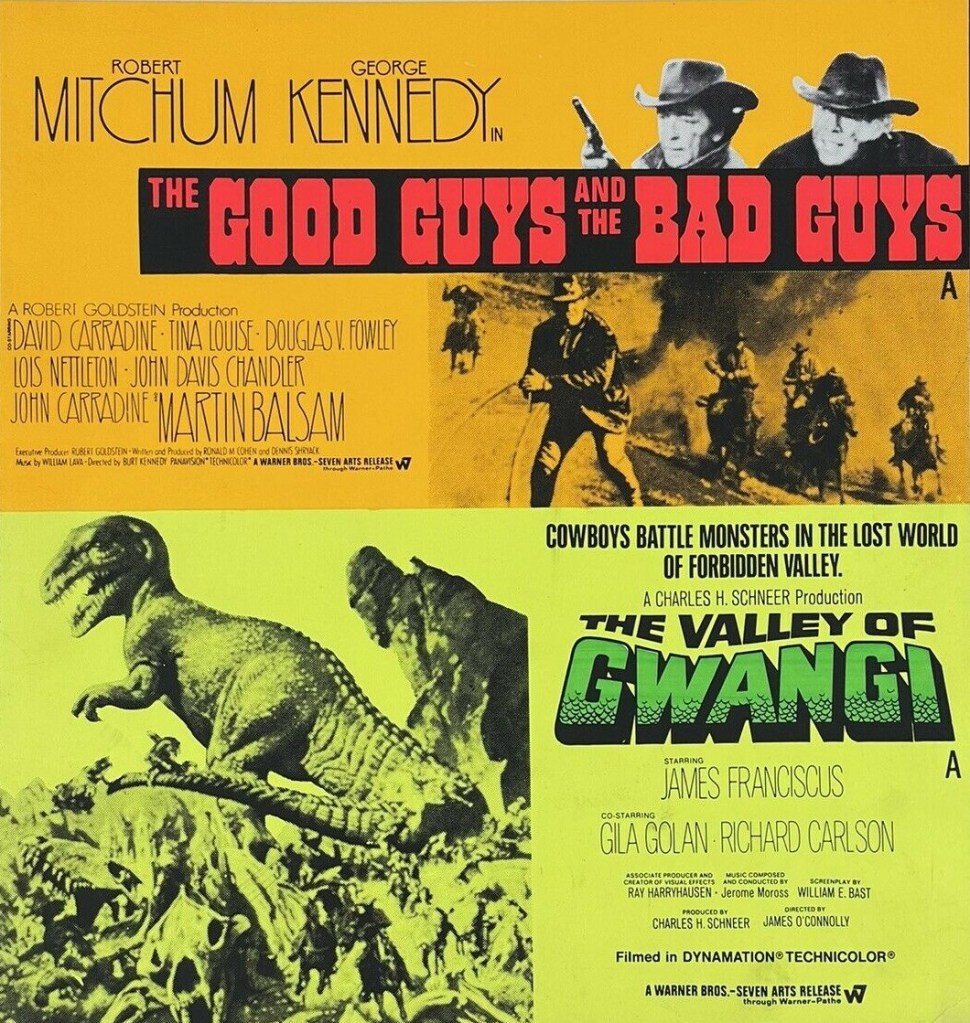
Ray Harryhausen only had a limited fanbase in the 1960s, otherwise this picture would not have done the rounds as the supporting feature to Robert Mitchum western The Good Guys and the Bad Guys (1969). You can tell it lacked the budget of One Million Years B.C. because the creatures fail to remain a consistent color. Even so, this ranks as one of the top special effects achievements and these days Harryhausen’s work is much more appreciated.

Unless you are Raquel Welch, it’s difficult for an actor to compete with prehistoric monsters. At least here, the stars had decent dialog and the tangled romance provides entertainment as do the host of stunning stunts in the rodeo and a bull running amok. Charlton Heston look-alike James Franciscus (Youngblood Hawke, 1964) is a plausible love interest who doesn’t let romance get in the way of a fast buck. The role of Gila Golan (Our Man Flint, 1966) extends to more than eye candy and there’s not a bikini in sight or disrobing of any sort. Richard Carlson (Creature from the Black Lagoon, 1954) was a sci-fi veteran and Laurence Naismith had appeared in Jason and the Argonauts (1963). British actress Freda Jackson (The Third Secret, 1964) plays a witch.

Director Jim O’Connolly (Vendetta for the Saint, 1969) keeps the human elements rolling along and once monsters join in the fun there’s scarcely time to draw breath. William Bast (Hammerhead, 1968) pulled together the human and monster elements for the screenplay.

Harryhausen fans will have a ball.
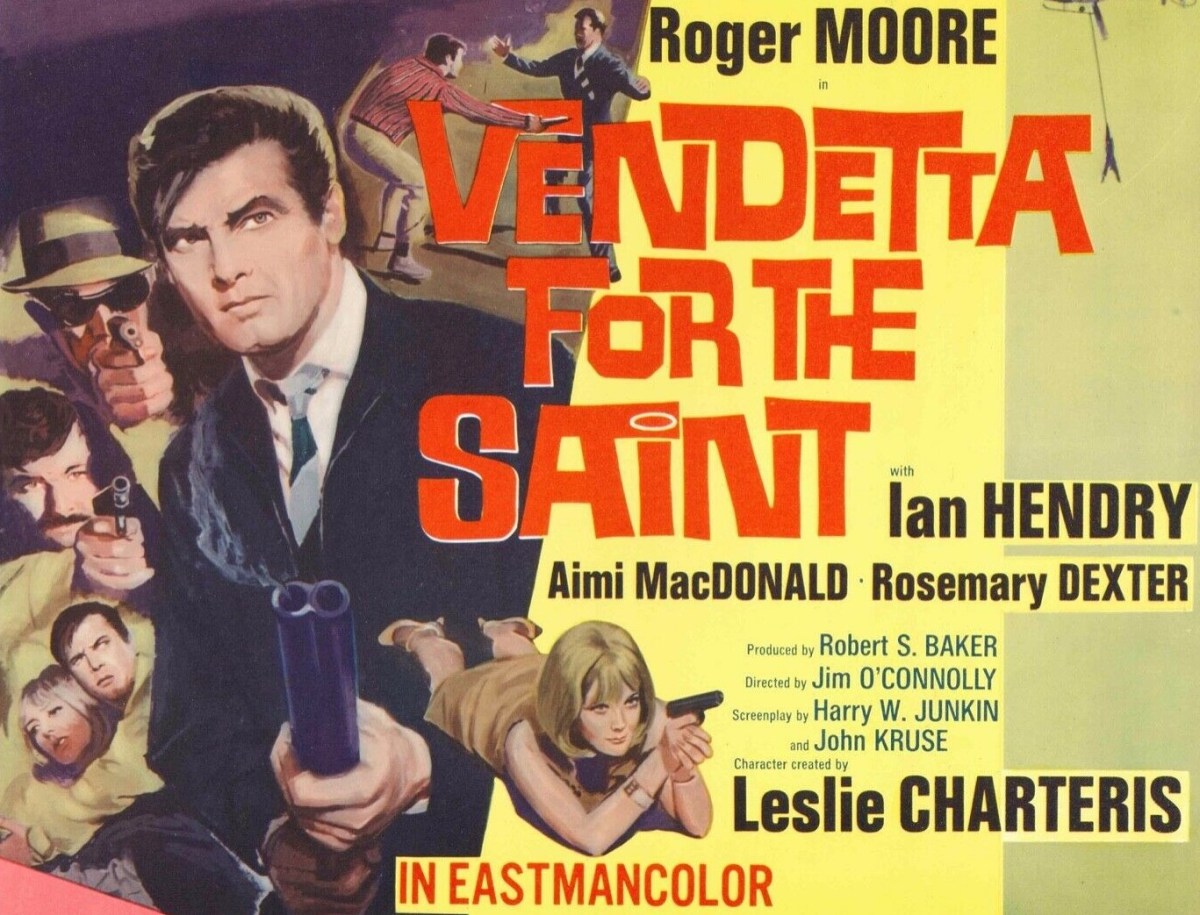
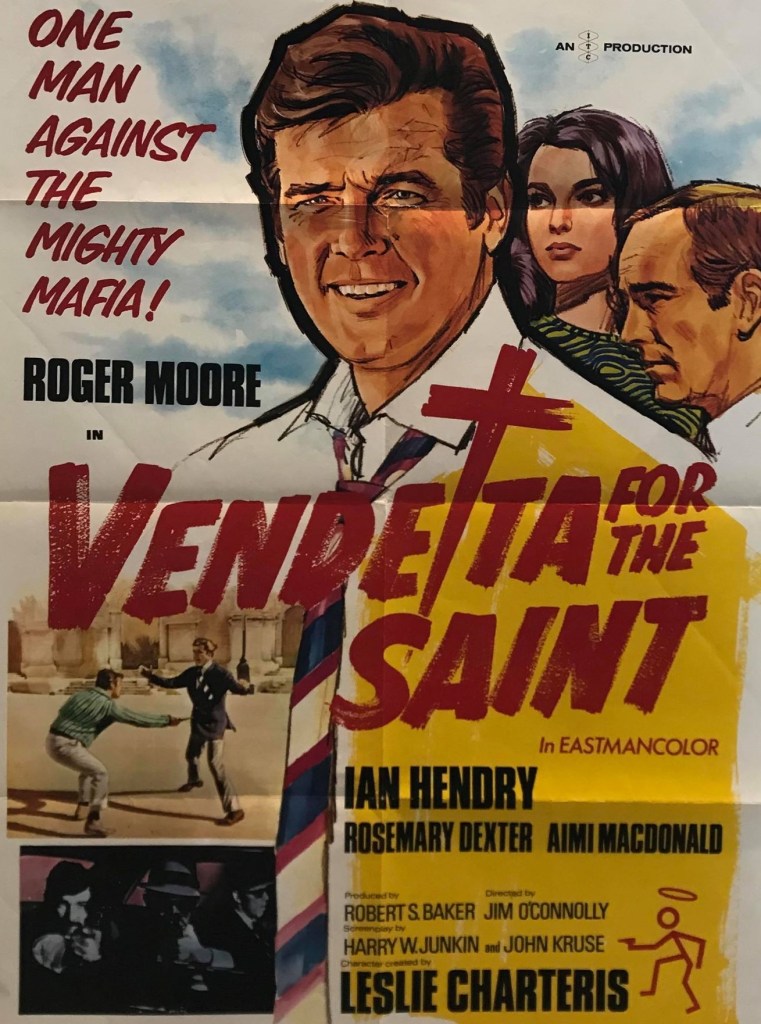
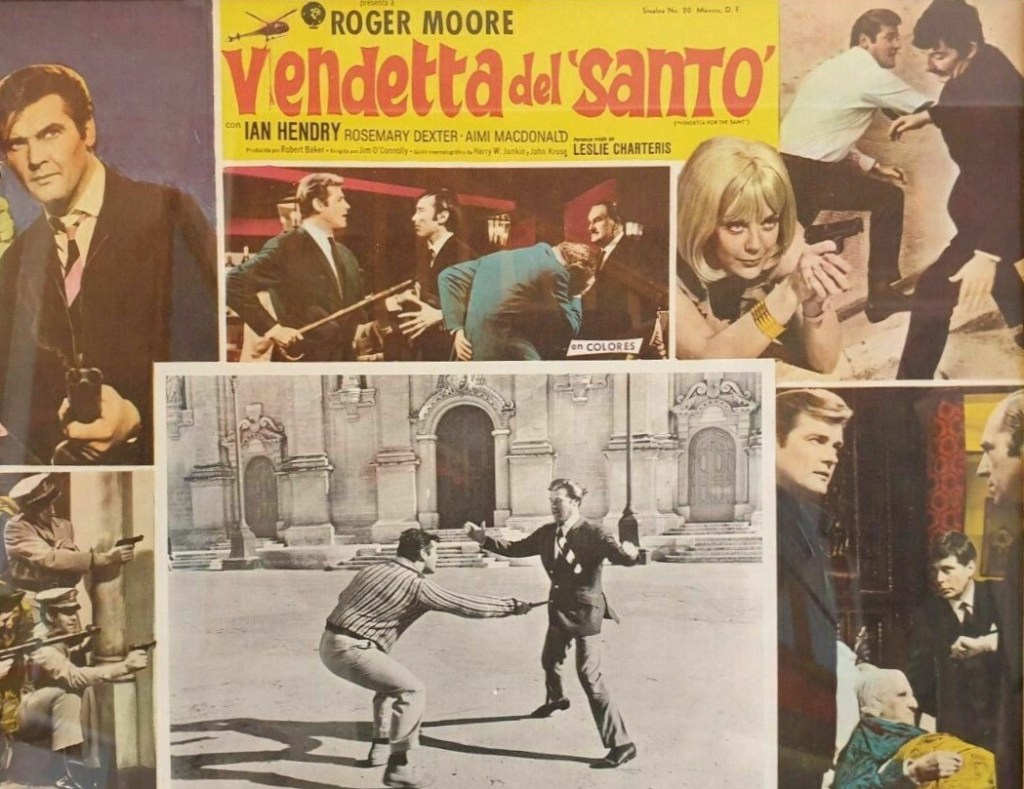
Vendetta for the Saint (1969) ***

This big-screen version of a small-screen hero is as pleasant a diversion as you can get. Nostalgia pretty much gives it a free pass and in any case the action, which punctuates the drama at regular intervals, was always going to be budget-restricted. Despite being in almost constant danger the insouciance of gentleman thief Simon Templar dictates that the pace is no more than languid.

As the title suggests, we’re in Mafia country, Templar (Roger Moore) drawn into a Cosa Nostra succession scenario as the result of a casual encounter with  former bank clerk Houston (Fulton Mackay), later found dead. Houston has cast doubts on the real identity of  Mafia Don Destiamo (Ian Hendry), one of several contenders to become the next Mafia overlord. Templar sneaks into Destiamo’s world by pursuing his niece Gina (Rosemary Dexter). Although outwardly respectable, Destiamo a bit too fond of using his cigar as a weapon of disfigurement, threatening his blonde English moll Lily (Aimi MacDonald) in this fashion.

Part of Templar’s attraction is that, although he has a nefarious side, he is happy to walk those mean streets and has a strict moral code. And he moves in such elevated circles that he has a nodding acquaintance with dying Mafia chieftain Don Pasquale (Finlay Currie) who has yet to pick his successor.

The other part of his attraction is that he’s played with such suaveness by Roger Moore. For a good chunk of the time someone is trying to knife him, shoot him, blow him up, capture him, jab him with a truth serum, and generally trying to stop him. In fending off such attacks, or out-smarting the villains, there’s rarely a hair out of place. It’s not so much devil-may-care as devil-is-wasting-his-time with such an imperturbable fellow.

Although the action is pretty straightforward, Templar is not above a clever ruse – jamming a bus in a gateway preventing his pursuers continuing the chase – nor an old one such as tying sheets together to climb out of a window. While Malta stands in for Italy, the locations still look authentic enough, ancient stone buildings, the occasional horse pulling a cart. When the action/drama eases up, there’s always pleasant scenery.

Following MGM’s success in stitching together into a movie two episodes of The Man From U.N.C/L.E. television series (which of course had pinched the idea from Walt Disney’s cinematic re-presentation of Davy Crockett episodes) it was no surprise that ATV, then under the control of future movie mogul Sir Lew Grade (Raise the Titanic, 1980), decided to adopt the same idea. Although The Saint had been showing on British television since 1962, by the end of its run in 1969 it had stepped up to bigger budgets, 35mm and colour. Given each episode lasted around 50 minutes, it was relatively simple to devise a two-part programme shown over consecutive weeks on ITV in Britain and then release it throughout the rest of the world as a feature film. The first such project was The Fiction Makers (1968) followed by Vendetta for the Saint.

Roger Moore’s movie career had been in limbo since Romulus and the Sabines (1961) and there’s no doubt that his performance as Simon Templar and later in another glossier British television series The Persuaders (1971-1972) made him a candidate for James Bond. While his interpretation of Templar, especially the wry delivery, does bear some similarities to his incarnation as 007, that only holds true as long as you set aside the year’s supply of Brylcreem dumped on his hair, the shoulder-padded shoulders and the fact that he had not yet perfected his trademark move, the raising of the single eyebrow.

While no match for the quips prevalent in James Bond, Canadian screenwriter Harry W. Junkin – best known for his television work, his only other movies being a similar melding of television episodes of The Persuaders – and John Kruse (Hell Drivers, 1957) – had some neat one-liners. Despite the obvious limitations, director Jim O’Connelly (Berserk, 1967) does a decent enough job.

But Moore carries the show. Ian Hendry makes a passable villain but not a passable Italian. In general, not surprisingly since most characters were played by British actors, the accents are all over the place though Moore, courtesy of squiring Luisa Mattioli (later his wife) manages to deliver his Italian lines in an acceptable accent. Otherwise, the only one who comes close is Rosemary Dexter (The Shoes of the Fisherman, 1968) and that’s because she was Italian. Worth checking out in the supporting cast are Finlay Currie (Ben Hur, 1959) and Fulton Mackay (BBC series Porridge, 1974-1977).

You can find a lot wrong with this without looking very hard but if you switch off your over-critical faculties you will be pleasantly surprised.

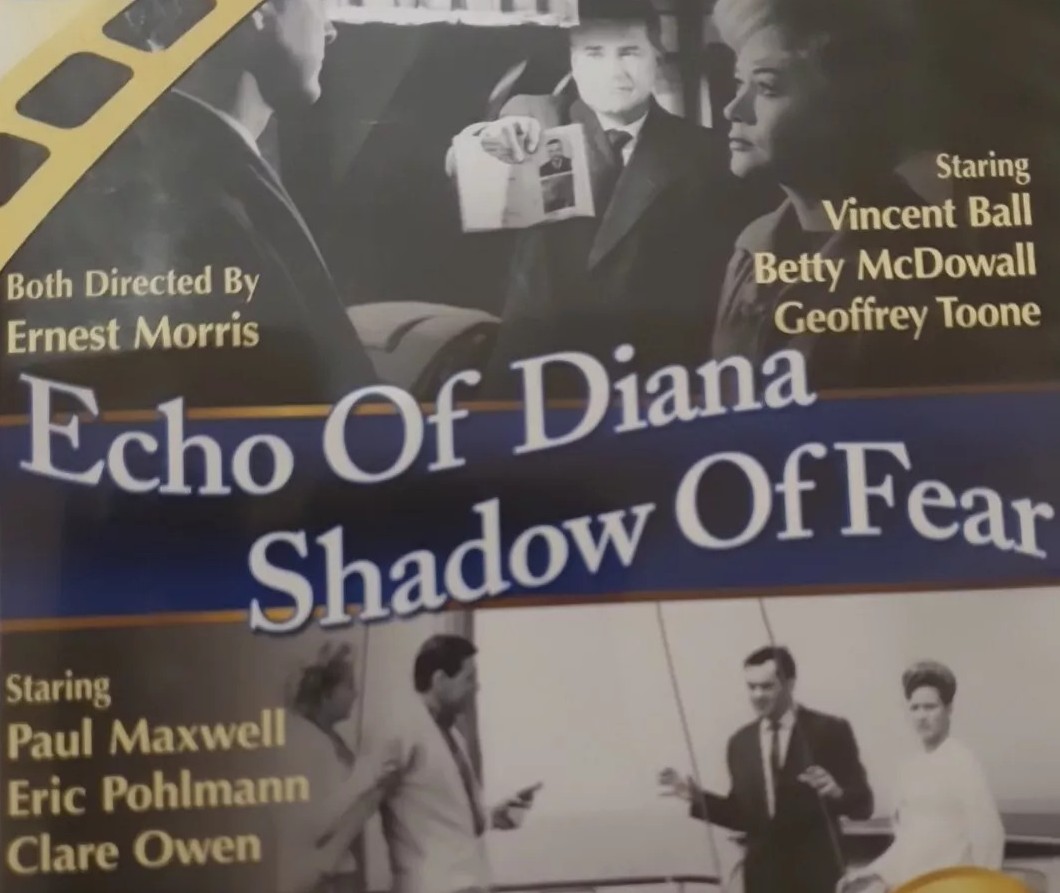
Shadow of Fear (1963) **

The Eady system at its worst. I’ve been singing the praises of quite a few of these British crime B-movies, made to take advantage of the Eady Levy cashback system and a Governmental dictat that cinemas had to show a certain proportion of British-made features. Generally, they were intended to fill the supporting feature slot, providing cinemas with a double feature. In the course of writing this Blog, I’ve uncovered a few minor gems, brisk, well-directed thrillers, good acting not necessarily essential.

The best this has to show for it is the ruthlessness of British spy chiefs in using an innocent couple as bait for foreign spies. Otherwise, beyond the initial twist, it’s too desultory for words, with too much time – even in a 60-minute feature – spent on too little.

American oilman Bill Martin (Paul Maxwell), flying back to London from Baghdad, agrees to carry a coded message for Jack Carter (Antony Wager), a casual British acquaintance. On landing at Heathrow Bill discovers Jack has been murdered. He’s accosted by a couple of cops, taken to a seedy hotel to wait for a fellow called Oliver, accepting all this oddness because he assumes he’s delivering a message for British Intelligence. After handing over the message he makes the mistake of telling Oliver that not only did he read the message, although failing to decode its content, but, having a photographic memory, had committed it to his brain.

Cue imprisonment. He escapes only because someone attempts to kill him and in turning the tide finds a way out. He flees to girlfriend Barbara (Clare Owen) and she whizzes him in a nifty sports car to her Uncle John (Colin Tapley) who knows somebody who knows somebody and it soon emerges that the fellow called Oliver was actually a fellow called Sharp (John Arnatt), a spy of unknown affiliation.

Assuming the bad guys would still want to eliminate our hero, the real Oliver (Reginald Marsh) reckons this is too good an opportunity to miss – the end justifying the means and all that rather than the more traditional British notion of fair play – and gets Bill and Barbara to agree to act as bait to trap the spies.

This doesn’t go as neatly as the good guys might expect and the baddies make further attempts on the couple’s lives and finally manage to kidnap them and take them out to sea with the intention of dropping them overboard. Luckily, the Brits are able to call in the Coastguard – armed for the occasion – to intercept and it all ends happily.

There’s not enough of anything to keep this moving – scarcely a red herring – and there’s about a dozen characters who flit in and out, various thugs, a top thug called Warner (Alan Tilvern), a femme fatale Ruth (Anita West) who is given no chance to exert her femme fatale wiles, and sundry MI5 and FBI characters and various others along the way. From the amount of time spent focusing on the belly dancer (Mia Karam) in the Baghdad hotel, you might have expected that she would have a role to play because she had more screen time than Ruth.

Nobody went on to greater things. Canadian Paul Maxwell (Man in the Middle / The Winston Affair, 1964) specialized in playing Americans in British films and television, even had a running part in soap opera Coronation Street and if you look closely you’ll see him pop up in A Bridge Too Far (1977).

Director Ernest Morris (Echo of Diana, 1963) can’t do much with the script by Ronald Liles (Night of the Big Heat, 1967) and Jim O’Connolly (Smokescreen, 1964) based on a tale by T.F. Fetherby.

Dull whichever way you cut it.

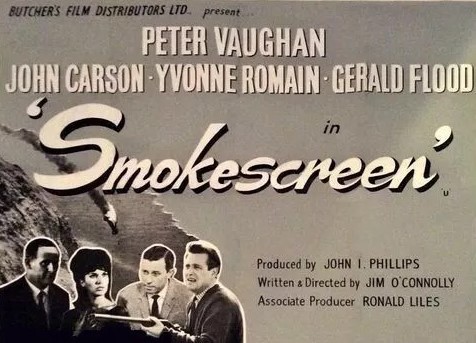
Smokescreen (1964) ***

Little gem with a terrific central performance. We tend to be condescending to these old British crime B-features. Occasionally one achieves cult status but mostly critics these days are as dismissive as back in the day. You might be surprised to learn that audiences treated them with a good deal more respect. In making up the support on a double bill, they represented value for money.

It’s also easy to forget that at this point the public were not inundated with television detectives and the true-crime genre had not been invented. Tales like this one, while lacking a big budget, proved very satisfactory viewing, especially if they were as clever as this. I could see the plot of Smokescreen being easily remade for a television one-off or as part of a series.

Main character, insurance agent rather than police detective, in his personal awkward demeanor, reminds me a great deal of the current BBC hit Ludwig.

Significant effort has gone into developing Roper (Peter Vaughan). For someone meant to be upholding the law, he skirts the rules in the matter of his personal expenses, ensuring he always finds the correct price for a taxi or a hotel meal before doing without and claiming it. So he doesn’t at all come across as an attractive character. He looks sly, sleekit, and he’s not smart enough to know how to butter up the office secretary Miss Breen (Barbara Hicks), who always wants minor attention, a postcard or similar.

Like Charles like Nothing but the Best (1964), he’s a sponger, without that character’s class or charm. Sent out on a case to Brighton on England’s south coast, hoping to find a missing man still alive and his wife making a false claim, he ensures that a professional colleague Carson (Trevor Bayliss) does all the driving, saving Roper on taxi fares which he can illicitly claim back. There’s an excuse for this unattractive behavior, but I preferred him less obviously redeemed.

Anyway, he’s a joy to watch, a real person with ordinary flaws rather than the usual ones afflicted contemporary detectives such as alcohol or drug abuse or failing marriage or an affair or requiring serious redemption for past major error.

All the characters have been well fleshed out. Carson nurtures secret feelings for supposed widow Janet (Yvonne Romaine). But she doesn’t at all come across as a femme fatale, which goes against the actress’s screen persona. There’s a great scene with a doctor (Derek Francis) whom his colleague upsets – Roper tiptoes away from the trouble – and who then demands a fee for being professionally consulted even if it’s only a few minutes in his garden.

Local cop Insp Wright (Glynn Edwards) is similarly offhand and down-to-earth, there’s a nice piece of comedy with a station master (Derek Guyler) and a great scene where Roper is way out of his element – and his league – trying to pump information out of a very attractive secretary (Penny Morrell) by getting her drunk, and wincing every time she puts an expensive cocktail on the bill.

Roper’s diligence pays off in the end, but there’s no grandstanding, as there is with Ludwig or any other cop, when he solves the case.

It’s a very clever story well told, enough interest to keep an audience feeling it has been entertained and if the main feature comes up to scratch back in the day would come out of the cinema very satisfied indeed. Roper manages proper detection, miffed when said colleague is correct in an assumption Roper dismissed, and the diligence that requires.

With little of a budget to speak of, these B-features had to make up for the lack of expensive location shots or camera tricks by ensuring the script not just ticked along nicely and provided an interesting resolution but that the characters appeared real, making up for lacking the cosmetic of attractiveness by reminding an audience of real people. Everyone would know a penny-pincher like Roper’s boss or a snippy secretary who can bring employees to heel or a sleekit colleague who’s doing a minor bit of ducking and diving.

This is a particularly significant turn by Peter Vaughan – who you might remember as the elderly Maester in Game of Thrones – because he made his name playing villains generally lacking any nuance. He was the titular evil criminal mastermind in Hammerhead (1968), a thug in Twist of Sand (1968),  a nasty piece of work in Straw Dogs (1971). Although he found regular work as a character actor, he might find it somewhat disappointing that he was never again let near anything quite as finished as this piece.  Yvonne Romain (Return to Sender, 1963) toys with her screen persona. Future British television dependables pop up everywhere, Gerald Flood and Sam Kydd in addition to Glynn Edwards and Deryck Guyler

Writer-director Jim O’Connolly (The Valley of Gwangi) writes some great stuff and is lucky to have the actors who can pull it off.

Great characters, solid detection and excellent twists.

Discover WordPress

A daily selection of the best content published on WordPress, collected for you by humans who love to read.

The Atavist Magazine

by Brian Hannan

WordPress.com News

The latest news on WordPress.com and the WordPress community.