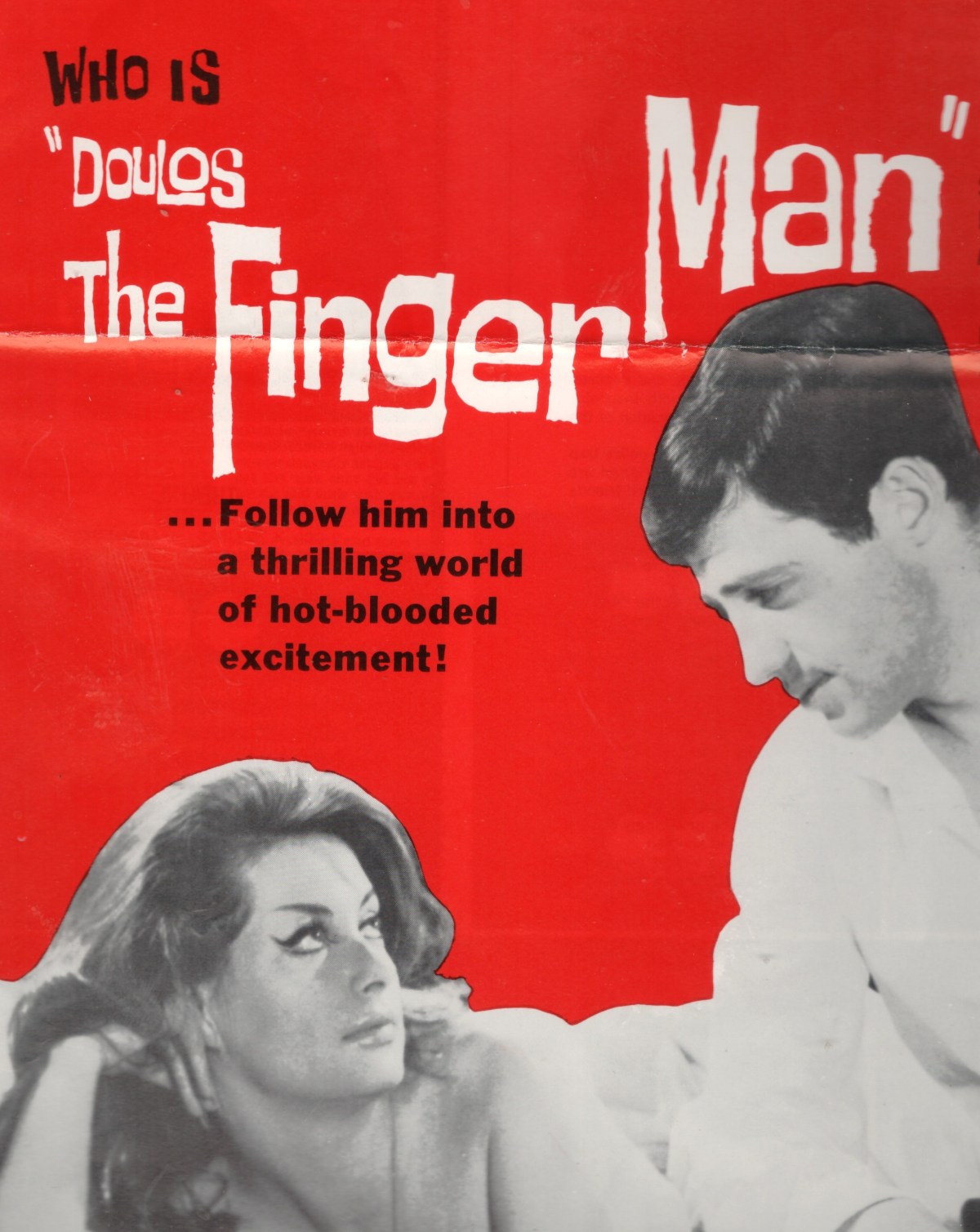
The Finger Man / Le Doulos (1962) *****

Stunning tour de force combining narrative complexity with technical audacity. Set up the template for later crime epics like Reservoir Dogs (1992) and The Usual Suspects (1995) and influenced Scorsese and Coppola. For the likes of me who revels in technical achievement, a delight, long tracking shots, two scenes over five minutes long shot in single takes, and rare use of the wipe. But technique is nothing without story. Luckily, here we are offered a  riveting tale of double crossing, honor, revenge and that rare beast, irony. There’s a veritable tsunami of twists at the end but all the way through there’s the kind of sleight-of-hand that deserves a round of applause.

Jean-Pierre Melville hadn’t named his picture The Informer for the obvious reason of it being considered, erroneously, a remake of the John Ford 1935 Oscar-winning classic or just the danger of being unfavorably compared with it. But the pre-credit titles tell us that Le Doulos is underworld slang for an informer so we’re prepared for that element of the story. What we’re not prepared for is what comes next.
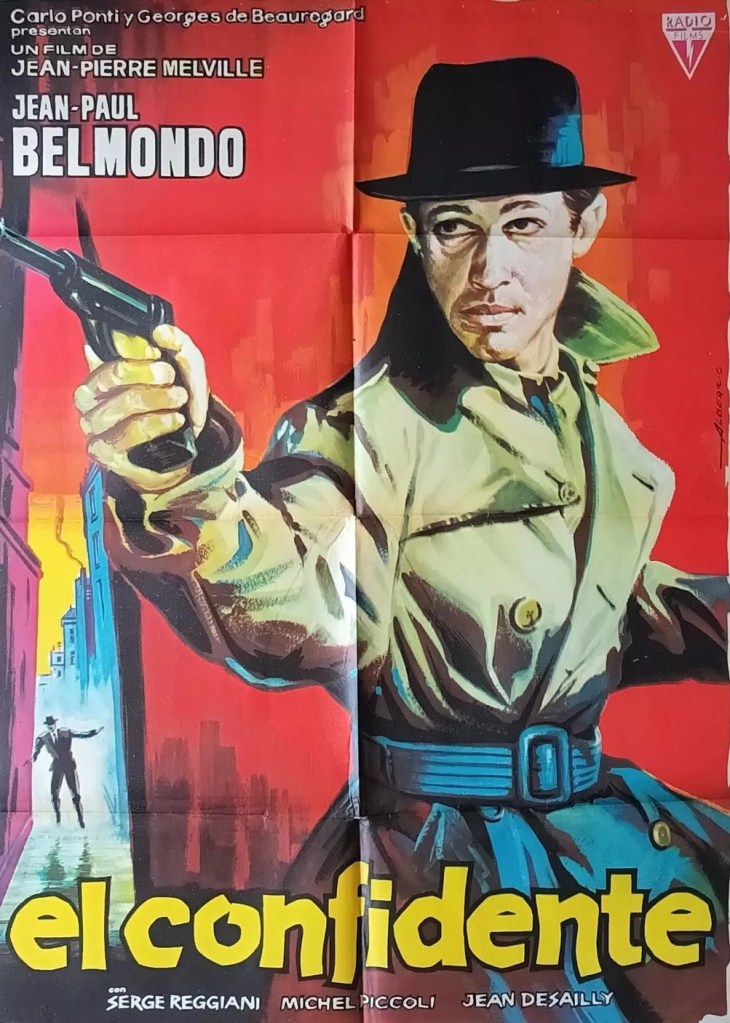
Maurice (Serge Reggiani), just out of prison after serving a six-year sentence, turns up at the house of fence Gilbert (Rene Lefevre) who’s helped him get back on his feet by setting him up with a safe-cracking job. Gilbert is appraising a cache of stolen jewels. Maurice shoots him, steals the jewels and a bundle of cash, burying the loot under a lamppost.

Maurice meets up with his partner Remy (Philippe Nahon) and another gangster Silien (Jean-Paul Belmondo), previously considered untrustworthy, who supplies the tools for the planned heist. While Maurice and Remy set off to burgle a house, Silien phones a cop, Inspector Salignari (Daniel Crohem). Silien viciously beats up Maurice’s girlfriend Therese (Monique Hennessey) and kills her.

The robbery doesn’t go according to plan, the cops turning up unexpectedly. In the shoot-out, Salignari and Remy are killed, Maurice wounded. Maurice passes on details of where he buried the loot to another buddy Jean (Philippe Marche).

Silien is picked up by the police as a known associate of Maurice. The interrogation scene, which lasts five or six minutes, is a piece of cinematic bravura. Shot in a single take the camera follows chief interrogator Clain (Jean Desailly) as he paces round the room, Silien only coming into view when the cop stops in front of him and asks him a question. While refusing to rat on Maurice, Silien agrees, under pressure from the cops who threaten to expose his drug racket, to phone around the various bars where Maurice might be holing up. This triggers another virtuoso piece of filmmaking as Melville employs the wipe. Maurice is located, reading a newspaper report on Therese’s death.
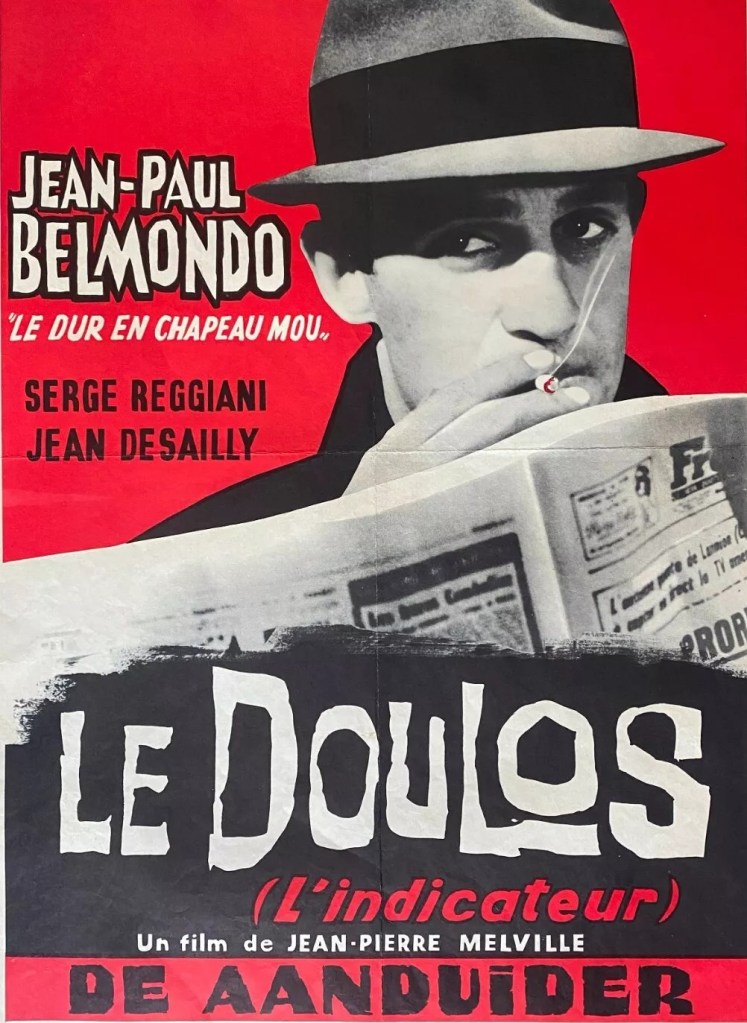
There follows another colossal technical achievement, Maurice interviewed in another long single take, this time the interrogator pacing in front of the prisoner. Maurice is jailed, where he shares a cell with an assassin.

Meanwhile, Silien gets hold of the jewels and cash. He enrols old girlfriend Fabienne (Fabienne Dali), currently the unhappy squeeze of top gangster and club owner Nuttheccio (Michel Piccoli), and hatches a scheme that makes little sense to the audience. So we just have to watch. Silien breaks into Nutthecio’s club and in the guise of selling the gangster the jewels gets him to hold some of the items, thus, we quickly realize, covering them with his fingerprints.

Silien kills Nuttheccio then waits for the club-owner’s partner Armand (Jacques de Leon) to arrive, kills him and stages the scene to look like they killed each other over the jewels which he deposits in the safe. One of the jewels was found at the failed robbery so that’s enough to free Maurice.

Then we play out the revelation, the same kind of scenario repeated in The Usual Suspects, where the audience learns the truth. Therese was the snitch. That’s why she was killed. Gilbert was shot by Maurice because the dealer in stolen goods had drowned Maurice’s previous girlfriend Arletty. Even though you could argue that was justified, Maurice not being a good judge of character and not aware, as Gilbert was, that Arletty was also a police informer.

It was pure coincidence that Silien phoned Salignari on the night of the burglary. Despite being on opposite sides of the law, they were friends and the gangster was merely inviting the cop to dinner.

Silien proves to be such a straight-up guy that he hands all the stolen cash to Maurice. Silien plans to get out of the business and retire with Fabienne to a house in the country. Then we learn that Maurice has distrusted Silien after all and arranged for the assassin he met in jail to kill Silien. To try and prevent that, he races to the country house, fortuitously arriving before Silien and is, ironically, shot by the assassin. When Silien arrives shortly afterwards he, with more savage irony, is also despatched.

I watched this initially thinking what a huge risk Jean-Paul Belmondo (Borsalino, 1970) was taking in playing, as I initially believed, not just a police informer, but stealing from Maurice the buried loot and leading the police to him. It would have been a hell of a note if the narrative had continued in the same hard-nosed vein especially after Silien’s absolutely brutal treatment of Therese. The slap he administered came out of nowhere and resounded like a gunshot. He then tied her up, again venomously, and poured a bottle of whisky over her head. 

That it turned out to be a story of honor among thieves was perhaps the biggest twist of all.

Jean-Paul Belmondo is outstanding in an underplayed role, Serge Reggiani (The Leopard, 1963)  convincing as the two-timing crook.  

Deservedly recognized as one of the most influential crime pictures of all time, this is nothing short of a masterpiece by Jean-Pierre Melville (Army of Shadows, 1969). Written by the director from the novel by Pierre Lesou.

Beg, borrow or steal this one.
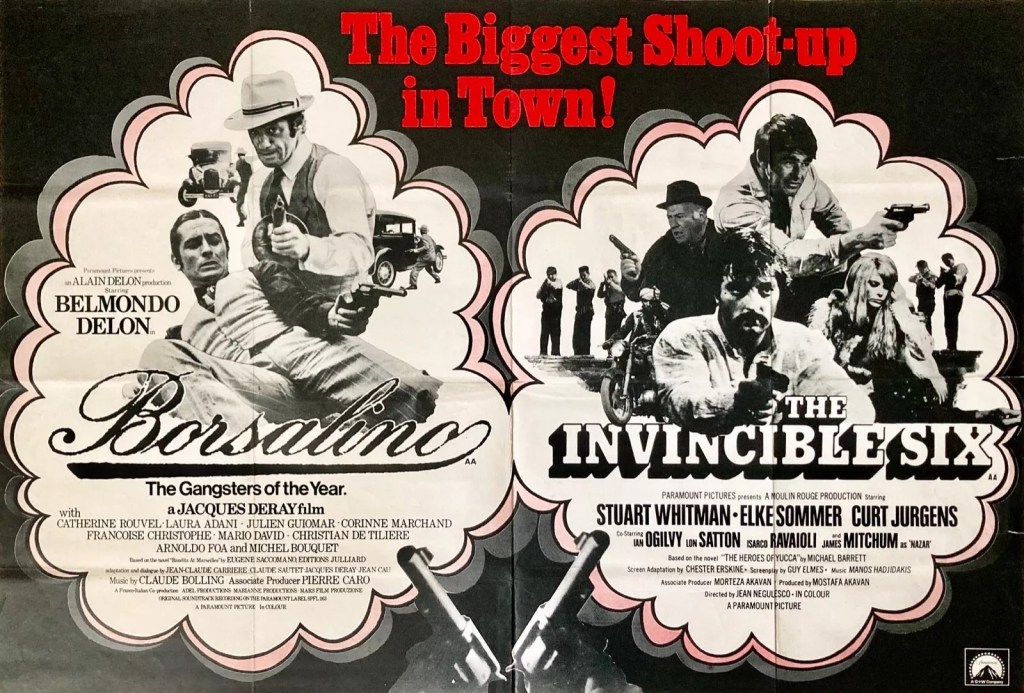
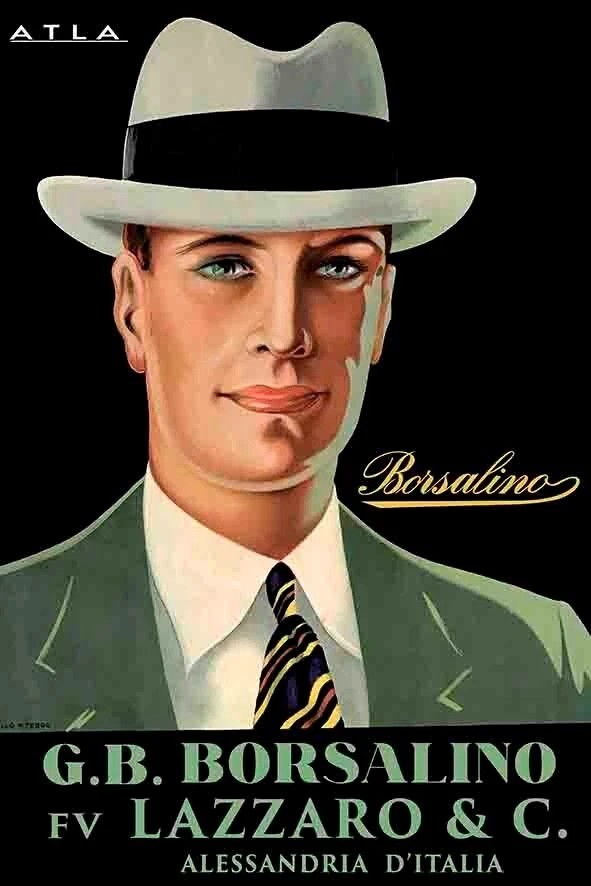
Borsalino (1970) ****

You wonder how much the unexpected success of this French gangster picture encouraged Paramount to invest in The Godfather (1972). The studio had gone down the Mafia route with The Brotherhood (1968) but to a significantly muted response. But where that film was heavy on family and drama, Borsalino went wild with charismatic performances and, as important, machine-gun-driven violence. And you couldn’t ignore the success the previous year of the French The Sicilian Clan (1969).

While Borsalino doesn’t go into the weighty issues and family sensibility that elevated The Godfather in the eyes of critics, its starting point owed more to Butch Cassidy and the Sundance Kid (1969) with two likeable hoods, even, initially at least, sparring over the same girl. The family element here concentrates on fraternity, brothers in crime, rather than the father-son dynamic that drove The Godfather. And it’s just so much goddam fun.  

Francois (Jean-Paul Belmondo) and Roch (Alain Delon) are petty crooks in Marseilles in the early 1930s working their way up to the top, initially just with scams like presenting a longshoreman who can’t speak a word of German as a German regional boxing champion, hijacking the favorite in a horse race, setting up a slot-machine business, disrupting the city’s fish market, until graduating to more serious crime and challenging Marello (Arnoldo Foa) and Poli (Andre Bollet), kingpins of the area’s organized crime. They set fire to an abattoir, establish their own fiefdoms, running legitimate businesses like casinos. But the higher they climb the closer they come to a devastating irony which cannot be ignored. Once they’ve eliminated everyone else, their only competition is with each other, and both realize that, inevitably, one will begin to want to become the undisputed top gangster.

Roch is the more thoughtful of the pair, the one looking ahead, sensing opportunity, the strategist, Francois more likely to indulge his playboy instincts, but both enjoy the high life, mixing with celebrities, politicians and archbishops. There’s plenty collateral damage. Try to steal a bigwig’s girlfriend away and you are virtually condemning her to death.   

Unexpectedly, for the genre, it’s huge fun, in part helped along by the genial earworm of a score by Claude Bolling, as evocative of the period as Scott Joplin’s rags were to The Sting (1973).  We don’t have to suffer any sanctimonious prig on the sidelines offering commentary or the gangsters making out that they’re better than they are because they don’t indulge in certain types of crime. But the biggest contributory factor is the teaming of Alain Delon (Once a Thief, 1965) and Jean-Paul Belmondo (Is Paris Burning?, 1966), the two biggest French male stars of the decade, the former enjoying substantially more success overseas than the latter.

Remember that Robert Redford was a not star when he made Butch Cassidy and the Sundance Kid so the pairing of two huge marquee names was not a regular feature anywhere in the world. It was Alain Delon, in his capacity as producer, who snared his rival, ceding top billing to achieve it.

This was the second of nine movies that Delon made with director Jacques Deray and could not have been more different from their previous outing La Piscine/The Swimming Pool (1969), a claustrophobic psychological thriller. Deray had history with Belmondo, too, Crime on a Summer Morning (1965). The characters were a great fit for their screen personas. And the photography, with some sepia tint, is distinctive.

Written by Jean-Claude Carriere (Viva Maria!, 1965), Claude Sautet (Nelly and Monsieur Arnaud, 1995), Jean Cau (Jeff, 1969) and the director, based on the book Bandits a Marseille by Eugene Saccomano.

Buddy movie breakout. Highly enjoyable.

The Burglars (1971) ****

First half pure Walter Hill of The Driver vintage – virtually silent heist, blistering car chase – second half rachets up tension with corrupt cop, femme fatale, getaway stymied and a payoff you won’t see coming.

French jewel thieves led by Azad (Jean-Paul Belmondo) using electronic wizardry crack open a safe in Athens full of emeralds while the owner is away. Passing cop Abel (Omar Sharif) happens by but after conversing with Azad, who claims his car has broken down, seems to be satisfied nothing untoward is going on inside the house. But getaway plans are momentarily foiled when the ship they are due to leave on is unexpectedly berthed for repairs, leaving them with five days on their hands.

Azed’s disappointed girlfriend Helene (Nicole Coffen), who acts as watch for the gang, lolling about a swimming pool with too much time on her hands, attracts unwanted male gaze. Azad, followed by the cop, decides to outrun him, fast car style, and soon they are hurtling through the streets of Athens. Thinking that he’s shaken off his pursuer, and seeking a bit of relaxation himself, Azad chats up glamor model and night-club stripper Lena (Dyan Cannon) without realizing she is in cahoots with Abel.  The cop wants in on the action and is willing to trade by letting Azad off scot-free while dumping the crime onto his confederate Ralph (Robert Hosein).

So, mostly, it’s cat-and-mouse stuff between Azad and Abel, as the latter closes the doors, and the former is unaware of just how cunning a corrupt cop can be. There’s some hair-raising action as Azad has to jump between two buses, and a pursuit in a fairground, Abel naturally on horseback, and as if this was one of those cheap films that always had a shoot-out in a quarry, Azad ends up in one, though, thankfully, not for climactic reasons. The climax takes place in a wheat warehouse (I guess the makers of the later Witness, 1985, took a few clues from this.)

Mostly, it’s the character interplay. Two big stars in one film often results in scenes involving  both kept to a minimum – think Paul Newman and Steve McQueen in The Towering Inferno (1974) or Robert De Niro and Al Pacino in Heat (1995) –  but here’s it’s the opposite and watching Belmondo and Sharif dancing around each other, one or other always in the ascendancy or with a neat trick in the back pocket or a get-out-of-jail-free card for later, works a treat.

Sharif, especially, had widened his scope, running away from the matinee idol tag and this came at the end of an impressive stint that included the villain in Mackenna’s Gold (1969), The Appointment (1969), The Last Valley (1971) and The Horsemen (1971). As shabby as Columbo, but with a bit more chic, he knows he’s got to keep one step ahead of Azad, though he could indulge in a few smirks, since he’s so far ahead of the criminal, Abel won’t know what hit him when he realizes he’s been played for a dupe by Lena.

Dyan Cannon (Bob and Carol and Ted and Alice, 1969) plays her role to perfection, hints of sadness that her life is not as glamorous as she might want, possibly considering betraying her real partner, but as seductive as all-get-out. This was a bold career choice, because she had mostly been allotted wife/girlfriend parts rather than, as here, central to the machinations.

Jean-Paul Belmondo (Breathless, 1960) never appealed as much to the American audience as countryman Alain Delon, mostly because he refused to take the Hollywood coin, preferring to do his own thing in France, but he is excellent here and he would have been ideal in plenty mainstream U.S. pictures.

Hats off once again to Henri Verneuil (Guns for San Sebastian, 1968). The heist is deftly done, running a full 24 minutes, give or take a few moments for tense  conversation with the nosey cop. The second unit filmed the chase, of course, but Verneuil is a master at this particular tune. He co-wrote the script with Vahe Katcha (Two Weeks in September, 1967) from the novel by David Goodis (Shoot the Piano Player, 1960). Bonus of an Ennio Morricone score.

Sizzling set pieces, cracking characters.

Behind the Scenes: “Breathless / A Bout de Souffle” (1960)

The story of Breathless is usually told from the triumphant perspective of director Jean-Luc Godard, expressed in messianic terms as the young Frenchman who saved the turgid movie industry and inspired a new generation of filmmakers. For star Jean Seberg it provided partial redemption and a sharp plunge into a harsh reality.

Where she had been at the mercy of Otto Preminger in her previous two films, Saint Joan (1957) and Bonjour Tristesse (1958), and for all that she loathed aspects of that experience, she was still in the Hollywood system, where a whole phalanx of people attended to your needs. Preminger had had enough of the woman he believed he could turn into a star. Both movies had flopped, her acting talent questioned.

It’s generally understood that Preminger dumped her and sold her contract to Columbia. But the antipathy went both ways. Her husband, lawyer Francois Moreuil, approached Preminger to negotiate a release from her contract. She might have wished just to be set free for nothing but given Preminger’s investment, not just salary when she wasn’t working but all the build-up that went into turning an unknown talent into a star, that was never on the cards. So, he passed her on to Columbia, to whom he was contracted, and which would take her on as a favor.

But Columbia had little idea what to do with her either. As far as that studio was concerned she was far from the finished article, a long way away from stardom. The best she could hope for was a supporting role in a prestigious production, rebuilding her career under a more sympathetic director. That appeared the most likely outcome when her name was linked to a supporting part in Carol Reed’s Our Man in Havana (1959) starring Oscar-winning Alec Guinness and Maureen O’Hara. But she wasn’t even auditioned.

When Columbia finally found something for her to do it was in the low-budget British-made The Mouse That Roared (1959), leading lady to Peter Sellers, his first as star. After that though, as far as Columbia was concerned, it would be a tumble down the credits in the American Let No Man Write My Epitaph (1960) starring Burl Ives. The British film set had none of the highwire tension of a Preminger film. She was taken acting lessons which restored some of her confidence after the mauling she had taken from Preminger.

As luck would have it, while awaiting a summons from Columbia, she was ensconced in Paris in a romantic idyll with Moreuil, who had vague notions of turning to film direction and had therefore made the acquaintance of the Cahiers du Cinema gang of critics who harbored the same dream. That brought him into contact with Godard, who was, much to her surprise since her performances had generally been lambasted, a big fan.

She was impressed by his short Charlotte et son Jules starring former boxer Jean-Paul Belmondo. Her role in his debut feature, said Godard, was based on the character she had essayed in Bonjour Tristesse. “I could have taken the last shot of  Preminger’s film and dissolved to a title ‘Three Years Later’,” he explained. Still, even though there was nothing on the horizon from Columbia, she hesitated.

Godard was an unknown quantity, there was no script, and making a movie outside the Hollywood comfort zone would be a trial, a miniscule budget – $90,000 – scarcely a fortieth of that of a Preminger picture – would ensure no retinue of assistants. She would be largely on her own. Tippi Hedren had felt the same cold shock when she maneuvred herself out of her Hitchcock contract and discovered that rather than being waited on hand-and-foot by the industry’s best costume designers she had to wear her own clothes for her first job, in television.

Financially, Godard was in bad shape. Without a name – Belmondo scarcely counted – the film would be abandoned. In the absence of anything else, she signed up. But first she needed Columbia’s approval. The studio was offered $12,000 for her services and half the worldwide rights but when they stalled her husband pulled a fast one, announcing that since he was rich (untrue) Seberg need never work again and threatening that she would simply retire.  Columbia took the money and ignored the rights, which cost them several million dollars.

Seberg was paid $15,000 – around $5,000 a week (the shoot lasted 23 days) – a hefty sum for an ingenue if you took that as a potentially weekly rate ($250,000 a year), but even if that was all she earned it was still six times more than the average U.S. employee was paid in a year. That was still an improvement on the $250 ($13,000 per annum) paid by Preminger in 1957.

But there was a dramatic switch in power politics. With Preminger, she kowtowed, doing what she was told, failing to stand up to the director. On Breathless, she had no trouble expressing her views and wielding her power. She walked off the set on the first day of shooting after a disagreement with Godard. That was resolved by the director chasing after her. A couple of days later she was ready to quit.

And she argued vehemently against his interpretation of her character’s actions in the final scene. Godard wanted Patricia (Seberg) to steal the wallet of Michel (Belmondo) as he lay dying. She refused to do it on the grounds that it was not in character, but later explained that it was more personal, she did not want to play a thief on screen. She had reservations about taking off her clothes for the sex scene, resolved by the couple being hidden under the bedsheets and Seberg remaining full clothed. And if she fancied a day off – a considerable indulgence on a film on so tight a deadline – she took one. Godard saved face by allowing everyone a day off.

Cameraman Raoul Coutard observed, “She didn‘t let herself be pushed around but she did cooperate.” And without the normal armada of backroom staff attending to make-up and ensuring she looked her best in every scene, Coutard fell back on the fact that she was imply photogenic and did not require the full Hollywood treatment to look her best.

Perhaps the guerrilla style of movie making appealed. Instead of rehearsals with a script set in stone and lines learned weeks in advance, Godard made up the film as he went along, turning up in the morning with a students’ notebook filled with ideas and dialogue. At times there was no written script, Godard speaking lines and the actors repeating them.

Although at one stage after a spat he threatened to deny her a close-up, in reality budget restrictions –  a close-up would require filming a scene several times over – put paid to most of those. The scene in the car where the camera focuses on her an example of taking clever advantage of circumstance as the sequence, in its daring, appealed to the avant-garde.

But Godard did take the trouble to ensure that Patricia was true to her origins. As an American, her character should not speak fluent French, but make mistakes here and there, especially with gender. “It became much more colloquial and much more foreign in a way,” she said.

And much as she hated the way Preminger had imposed his ideas so strictly upon her, when left to her own devices, thanks to Godard’s improvisational style, she was at a loss. “She was very disabled because there wasn’t a script,” explained Francois. When she asked Godard for directions he would tell her to do what she wanted. Eventually, assuming the film was a mistake and would flop, she decided to “sit back and have fun.”

Although under time pressure, that was a less frightening experience than having a hundred pairs of eyes fixed on her as she spoke lines according to the Preminger dictat. But she had to come to terms with just how far down the production ladder she had fallen, a café toilet doubling as a make-up room, her wardrobe purchased from a discount store.

Godard’s inventiveness knew little bounds. For the final tracking shot, the director was pushed along in a rented wheelchair. The shot of the Champs-Elysess came from employing a postal cart. Filming began on August 29, 1959 and most of the film was shot consecutively.

Innovations included extensive use of the jump cut, hand-held camera and low lighting. Although deemed an arthouse movie by the rest of the world, Breathless opened at a commercial chain of cinemas in Paris where it was an instant hit, selling a quarter of a million tickets in its first four weeks.

While Godard and Belmondo basked in a critical and commercial triumph, for Seberg it was only part-redemption. Except at the end of the decade she was never the leading lady in big Hollywood productions, but she became an acknowledged star of French cinema, a couple of years later the third-highest paid actress  in France, earning $1,750 a week ($91,000 a year).

SOURCE: Garry McGee, Jean Seberg: Breathless, Her True Story (2018), pp60-68.

Breathless / A Bout de Souffle (1960) ****

I’m conscious of puncturing a sacred arthouse cow. While applauding the cinematic bravura of Jean-Luc Godard’s debut feature that launched the French New Wave, what are we to make of a leading man who is a sexist pig? Michel (Jean-Paul Belmondo) refers to women repeatedly as “dogs”, complains about their driving skills, accuses them of cowardice, steals from them, forbids them to see other men, chases after them in the street to lift their dresses, constantly gropes his sometime girlfriend Patricia (Jean Seberg), and boasts of other sexual conquests.

While attempting to ape hero Humphrey Bogart, he hasn’t a shred of that star’s romantic inclination, all his energy directed towards getting sex from the nearest available female with nary a notion of love.  He’s not just hard-boiled, he’s hard work, as close to the despicable males of Guide for a Married Man (1967) as you could get.

I’m no proponent of woke, but I guess audiences these days who happily accept him as thief and murderer will draw the line at his attitude to women. I found myself squirming at times at being asked to swallow this amoral character in what was otherwise a homage to the Hollywood B-picture. And it says a lot about the directorial skills that he ends up with any audience sympathy at all. And part of that certainly comes from his proximity to the more existential-minded arty Patricia. Not for the first time are we asked to re-examine our instinctive reaction to a charming thug because a sympathetic woman in either loving him or appearing to offer him understanding provides a conduit between audience and character, asking us to see him from her less judgemental perspective, no matter how misguided that might be.

You can see the connection between the Cecile of Bonjour Tristesse (1958) and Patricia here but it’s hardly as clear-cut as Godard suggests. Patricia has qualms not just a nice comfort blanket of guilt. She’s not, as Michel wishes, some kind of sidekick or accomplice. He fails  to unlock her criminal tendency as Clyde would later in the decade with Bonnie in Arthur Penn’s gangster picture. But, just as Cecile rids herself of a rival in Bonjour Tristesse, Patricia finds it relatively straightforward to turn in to the police a man for whom she has no feelings and who would prove, without the parachute of love, an irritation in her life.

Certainly, Michel is the quintessential bad guy but with entitlement issues. He wants it all, or nothing. If Santa came knocking, top of his wish list would be death. He’s a dab hand at stealing cars, can whack anybody over the head, and not above rifling through a girlfriend’s purse. But, essentially, he’s the delinquent who never grew up and Patricia is one of the many saps he’ll try to con throughout his life.

But, in fact, if you were making this today, the angle would be different. It would be the vengeful woman, as epitomized by Jenna Coleman in television mini-series Wilderness, relishing the prospect of being tagged a “bunny boiler” or predatory wolf. Much as Patricia is happy to spend some time with Michel while working out her feelings towards him, given that he is the father of her unborn child, she is far from the soft touch he imagines, betrayal in her genes.

I’m guessing budget issues contributed to much of the cinematic bravura. It’s much cheaper to eliminate close-ups, and to film outdoors where light is less of an issue than indoors, and where nobody’s bothering to seek civic approval to shoot. So, there’s certainly a freshness, a boldness, the kick in the pants that stuffy Hollywood with its insistence on certain procedures required.

The camera is restless, not just in the tracking shots (especially the famous final one), but in bobbing around, as if questioning just what was the Hollywood obsession with nailing everything down, keeping it fixed, as if the camera was merely a tool rather than a means of directorial expression. And Godard does bring to exceptional life characters who would otherwise be passersby, dreamers who are more likely to fail than succeed, who try to provide themselves with codes as if that will assuage inner doubt.

Except for her self-preservation instincts and urge for independence, there’s every chance that Patricia would end up the dissatisfied housewife, especially with baby in tow. Michel is a dumb criminal, not the heist genius of so many other movies. Cocking a snook at authority  might be the only true freedom he ever attains.

I’m not sure this was part of Godard’s thinking, but it’s plain to me that Michel’s biggest problem is crossing over into the real world. The minute he comes up against a woman who lives an ordinary life, albeit with elevated expectation, he comes a cropper because she doesn’t subscribe to his limited world-view. It’s not exactly a clash of cultures, because, in reality, she’s every bit as vicious as him. If she loved him, it might be a different story. But as with Jenna Coleman in Wilderness, fail to safeguard that love and it’s curtains.

Without doubt a singular earthquake of cinematic proportions, freeing up a generation to filmmakers to challenge the hierarchy, but requiring reassessment in view of its dubious attitude to women.

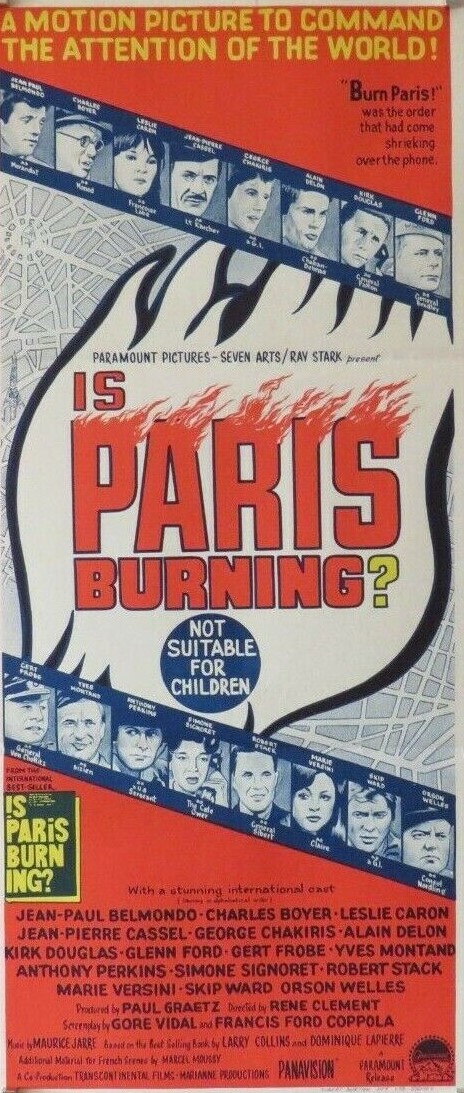
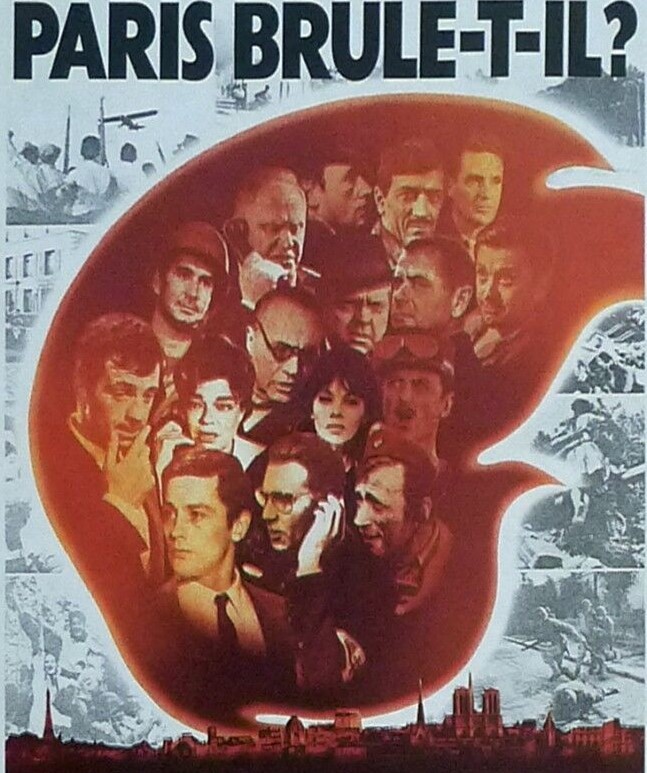
Is Paris Burning (1965) ****

Politics don’t usually play a part in war films of the 1960s but’s it’s an essential ingredient to Rene Clement’s underrated documentary-style picture. Paris has no strategic importance and after the Normandy landings in 1944 the Allies intend to bypass the German-occupied French capital and head straight for Berlin.

Meanwhile, Hitler, in particular vengeful mood after an attempt on his life, orders the city destroyed. Resistance groups are splintered, outnumbered and lacking the weaponry to achieve an uprising. Followers of General De Gaulle, the French leader in exile, want to wait until the Allies send in the troops while the Communists plan to seize control before British and American soldiers can arrive. 

When the Communists begin the fight by seizing public buildings, the Germans retaliate by planting explosives on the Eiffel Tower, the Louvre, and other famous buildings and all the bridges across the River Seine. German commandant Von Choltitz (Gert Frobe), no stranger to slaughter having overseen the destruction of Rotterdam, holds off obeying his orders because he believes Hitler is insane and the war already lost.

The Gaullists dispatch a messenger to persuade General Omar Bradley to change his mind and send troops to relieve the city. Director Clement, aware how little tension he can extract from the question of whether von Clowitz will press the destruct button (history tells us he did not) so he takes another route and documents in meticulous detail the political in-fighting and the actual street battles that ensued, German tanks and artillery against Molotov cocktails and mostly old-fashioned weaponry.

The wide Parisian boulevards provide a fabulous backdrop for the fighting. Shooting much of the action from above allows Clement to capture the action in vivid cinematic strokes. Like The Longest Day (1962) the film does not follow one individual but is in essence a vast tapestry. Scenes of the utmost brutality – resistance fighters thrown out of a lorry to be machine-gunned, the public strafed when they venture out to welcome the Americans – contrast with moments of such gentleness they could almost be parody: a shepherd taking his flock  through the fighting, an old lady covered in falling plaster watching as soldiers drop home-made bombs on tanks.

This is not a film about heroism but the sheer raw energy required to carry out dangerous duty and many times a character we just saw winning one sally against the enemy is shot the next. The French have to fight street-by-street,  corner-by-corner, bridge-by-bridge,   enemy-emplacement-by-enemy-emplacement, tank-by-tank.

And Clement allows as much time for humanity. Francophile Sgt Warren (Anthony Perkins), an American grunt, spends all his time in the middle of the battle trying to determine the location of the sights he longs to see. Bar owner Simone Signoret helps soldiers phone their loved ones.

Like The Longest Day and In Harm’s Way (1965), the film was shot in black-and-white, but not, as with those movies for the simple reason of incorporating newsreel footage, but because De Gaulle, now the French president, objected to the sight of a red swastika.

Even so, it permitted the inclusion of newsreel footage, which on the small screen (where most people these days will watch it) appears seamless. By Hollywood standards this was not an all-star cast, only fleeting glimpses of Glenn Ford (Fate Is the Hunter, 1964), Kirk Douglas (A Lovely Way To Die, 1968), Robert Stack (The Corrupt Ones / The Peking Medallion, 1967), Orson Welles (House of Cards, 1968) and George Chakiris (West Side Story, 1961).

But by French standards it was the all-star cast to beat all-star casts – Jean-Paul Belmondo (Breathless, 1960), Alain Delon (Lost Command, 1966), Yves Montand (Grand Prix, 1966), Charles Boyer (Gaslight, 1944), Leslie Caron (Gigi, 1958), Michel Piccoli (Masquerade, 1965), Simone Signoret (Room at the Top, 1959) and Jean-Louis Trintignant (A Man and a Woman, 1966).  Director Rene Clement was best known for Purple Noon (1960), an adaptation of Patricia Highsmith’s The Talented Mr Ripley starring Alain Delon

At $6 million, it was the most expensive French film ever made, a six-month shooting schedule, shot on the streets of the city including famous locations like Etoile, Madeleine and the Louvre. Big hit in France, it flopped in the United States, its box office so poor that Paramount refused to disclose it.

Discover WordPress

A daily selection of the best content published on WordPress, collected for you by humans who love to read.

The Atavist Magazine

by Brian Hannan

WordPress.com News

The latest news on WordPress.com and the WordPress community.