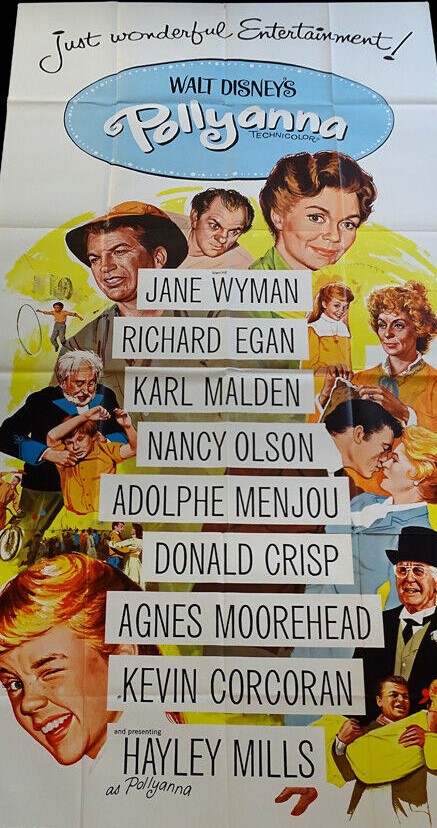
Walt Disney discarded much of Eleanor H. Porter’s original best seller not to mention a great deal of the tear-jerking section that played to superstar Mary Pickford’s strengths in the silent 1920 adaptation. Pickford was in her late 20s at the time and a movie mogul to boot (having launched United Artists) so had a depth of emotion Hayley Mills (aged 13 during filming) could not hope to match.
The screenplay, by David Swift (Love Is A Ball, 1963) is an object lesson in how to retain the essential element of a story – a positive-thinking orphan alleviates the gloom in an embittered town – while providing enough worthwhile for adult audiences. Disney assembled an awesome cast with three Oscar-winners – Jane Wyman (Best Actress, Johnny Belinda, 1948), Karl Malden (Best Supporting Actor, A Streetcar Named Desire, 1952) and Donald Crisp (Best Supporting Actor, How Green Was My Valley, 1942) – plus four-time nominee Agnes Moorehead and Adolph Menjou.

Despite no Oscar recognition Nancy Olsen had been leading lady to the likes of Bing Crosby (Mr Music, 1950), John Wayne (Big Jim McLain, 1952) and William Holden (Force of Arms, 1951). In effect, parents would be very familiar with the stellar supporting cast.
Orphan Pollyanna (Hayley Mills) – British accent explained by parents being missionaries – , majoring on optimism, tries to enliven a town torn apart by dissent and petty feuds and in thrall to her intimidating aunt and fading spinster Polly Harrington (Jane Wyman). While she tries to see the good in everyone, the rest of the population is forever pointing out the bad. The main source of contention is a derelict orphanage. The townspeople want it demolished and a new one erected. Polly Harrington wishes it preserved in its dilapidated state as a monument to her father who had built it. It’s the kind of attitude someone would take who was just plain determined to get their own way. Pollyanna tries to sway opinion against her aunt, resulting in no end of trouble.
Various sub-plots include stifled romance, Harrington has driven away boyfriend Dr Chilton (Richard Egan), fire-and-brimstone preacher Rev Ford (Karl Malden),another orphan Jimmy (Kevin Corcoran), the reclusive Mr Prendergast (Adolphe Menjou) coaxed back into communal life, and the mayor (Donald Crisp) trying to repair the rifts.

Unusually for a kid’s picture, Wyman, Malden and Crisp each are given a reflective moment to prove they are doing more than taking an easy salary cheque, bearing some of the weight of the narrative, Malden especially allocated more screen time than would be normal in a movie aimed at kids.
I have never read the book nor (to my shame) seen the Pickford version, so I came to the movie with low expectations, anticipating a lazy, maudlin effort. So I was quite surprised to discover how much I enjoyed it and was shocked by the final piece of action which turned the movie on its head. Sure, it relies on a feelgood drive but there is some decent stuff here – Pollyanna’s determination to find goodness in every event and every person takes her into some strange avenues, the rainbow playing on the walls, the “good parts” of the Bible – that these days makes for an entertaining matinee.
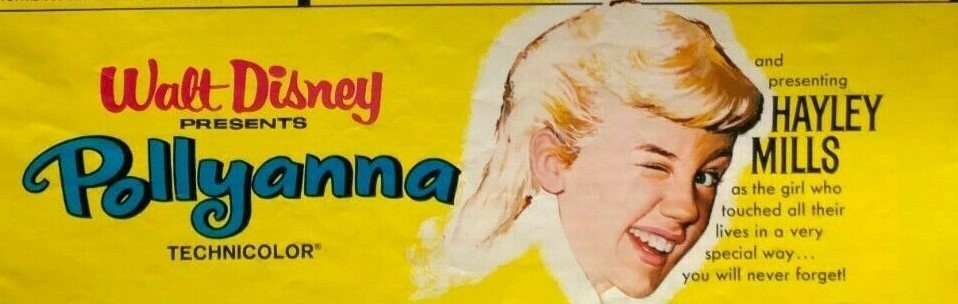
At least in Hollywood terms (Mills made her debut the year before in the British Tiger Bay, 1959) Pollyanna falls into the a-star-is-born category. The actress acquits herself well, with her expressive face, while hearing the emotion she packs into the word “gorgeous” is word admission alone. Being older than the usual child star, she was one of the few who made the transition into adult roles. Karl Malden is the pick of the supporting cast but he is given a good run for his money by Jane Wyman. Disney’s trick of peppering a children’s film with actors well-known to the adult audiences was one he would use again.
Swift, in dual capacity as director (and making his movie debut) played down the saccharine nature, making the main character less just automatically bouncing with happiness and more striving to make the best of difficult situations.
Surprisingly adult for a children’s picture.

 The Magnificent 60s