Kaleidoscope (1966) ***

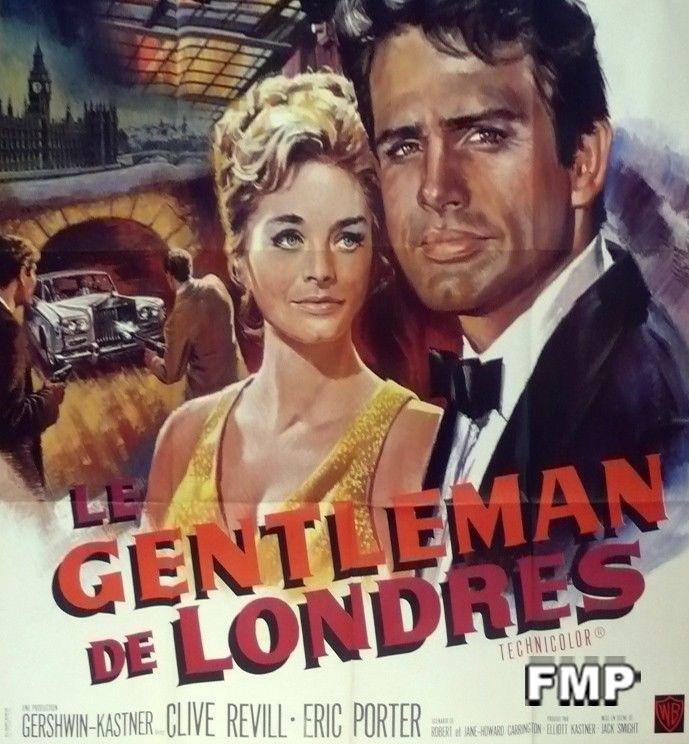
Amazing the tension that emanates from the turn of a card. Or, more correctly, waiting for one. Only problem is we’re two-third through the movie before high-stakes poker begins – the pot nudging £250,00 (close on a cool £5 million now). Mostly, the earlier tension derives from not knowing what the hell is going on in this enjoyable thriller made at the height of the Swinging Sixties as playboy gambler Barney (Warren Beatty), a walking Carnaby St model driving an Aston Martin DB5, tilts the odds dramatically in his favor.

Barney is a gambler but the problem with gambling is the odds. They can be against you too much. So Barney decides to turn himself into a burglar, the kind that can clamber over rooftops, abseil between buildings, and break into – a printing business called Kaleidoscope. This just happens to print the playing cards supplied to all the major European casinos. So Barney does a little doctoring of the master printing plates. Bingo, the odds are a bit more even now that he knows what cards are coming out of the shoe – he plays chemin de fer (as it is known in posh casinos, pontoon or 21 to you and me).

While cleaning up he bumps again into fashion designer Angel (Susannah York) – their original meet-cute taking place in a traffic jam – who he dated once in London. Unbeknownst to him, she is on a scouting mission, looking to snare the kind of high-rolling gambler who can take on and completely fleece the drugs kingpin Harry (Eric Porter) being pursued by cop Manny (Clive Revill), her father who, rather than waste so much time collecting the required evidence to put the villain behind bars, decides it would easier done by making him broke. Unable to pay his debts, some other villain would put him out of business in the traditional cemented-boot fashion.

It takes a while for the movie to line up all its ducks in a row, mainly by holding on to the information the audience requires. But the audience is privy to details of the way Manny works that Barney is not. Even for ruthless villains, Manny has a peculiar calling card, one that would make any gambler think twice about entering his lair. Of course, it doesn’t take long for Manny to rumble Barney’s game so the stakes are much higher than the charming gambler imagines.
Throw in as much fashion as London was capable of generating at this time, the burgeoning romance, some exotic European locations, a castle with a moat, and the usual tourist guide stuff of red buses, Big Ben, Piccadilly Circus, pubs and Tower Bridge and you have all the ingredients of an easy on the eye thriller.

It’s a movie that relies on star power but Beatty and York deliver. That is, if you don’t need Beatty to do much more than be Beatty, all teeth and charm. At this point in his career Beatty looked as if his career was fast approaching its end. The box office success of Splendor in the Grass (1961) had been followed by a string of flops, romantic dramas and comedies that should have had audiences queuing up plus an occasional wild card like Arthur Penn’s Mickey One (1965), the biggest flop of all. He does make an engaging crook, and he never loses his screen charisma here, but there ain’t quite the right number of twists that moviegoers weaned on the likes of Topkapi (1964) had come to expect.

Hollywood had been doing its best to position Susannah York as a top box office attraction and she had snagged the female lead in The 7th Dawn (1964) opposite William Holden and Stanley Baker in Sands of the Kalahari (1965)  but she was recovering from the colossal flop of Scruggs (1965) by ‘poet of the cinema’ David Hart.  Kaleidoscope offered  the kind of role York could do with her eyes closed. So while the screen pair were not exactly sleep-walking it was not the kind of story that was going to create sparks.

Character actor Clive Revill (Fathom, 1967) and Eric Portman (The Pumpkin Eater, 1964) take more leeway with their roles, the latter almost chewing he scenery, the former content with just chewing his lips. Look out for Jane Birkin (Blow-Up, 1966) and British television stalwarts Yootha Joyce, George Sewell and John Junkin. 

The title would have been more enigmatic, original meaning of images twisted out of shape, had it not also applied, straightforwardly, to the card-making company. Giving Harry the surname of Dominion seems overkill.

Director Jack Smight (No Way to Treat a Lady, 1969) came to this after twisty private eye picture Harper/The Moving Target (1966), a big hit starring Paul Newman. This is too lightweight a feature to command such interest, but he does keep the story rolling along and it’s an effortless watch and it has a certain offbeat quality. The screenplay was fashioned by Robert Harrington and Jane-Howard Harrington, making their movie debut, who also co-wrote Wait until Dark (1967). It was also the debut for Winkast Productions, the Jerry Gershwin-Elliott Kastner production team who went on to make Where Eagles Dare (1968).
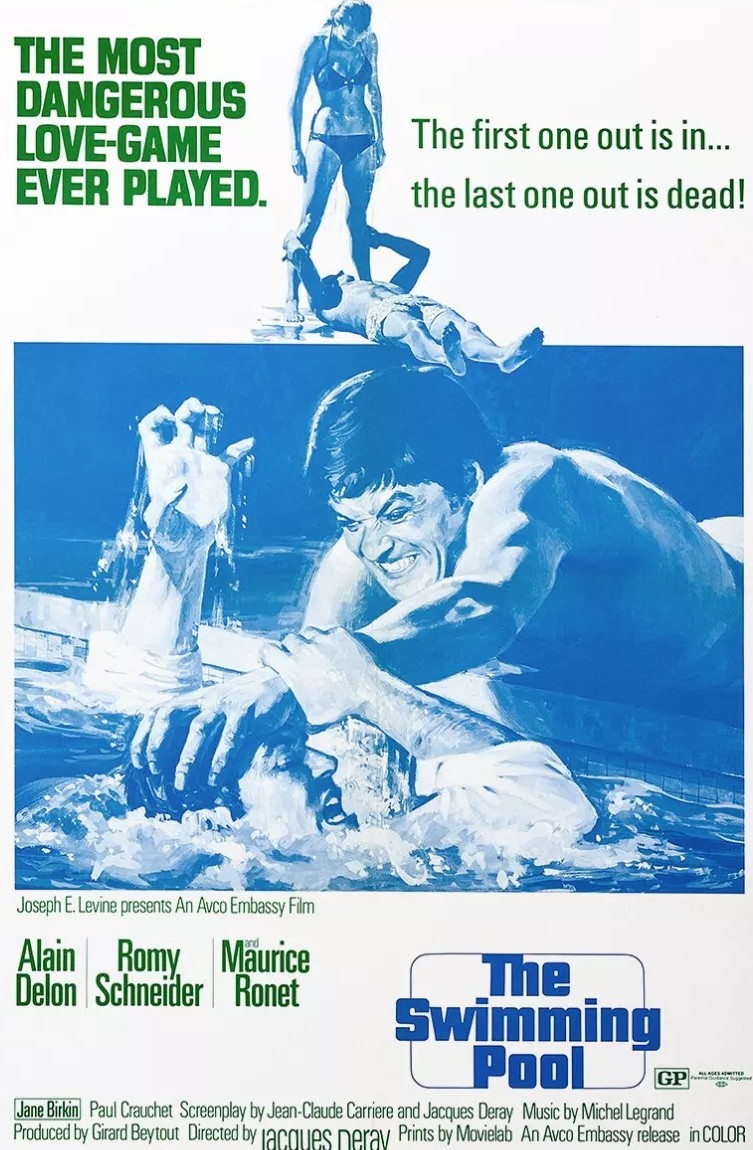
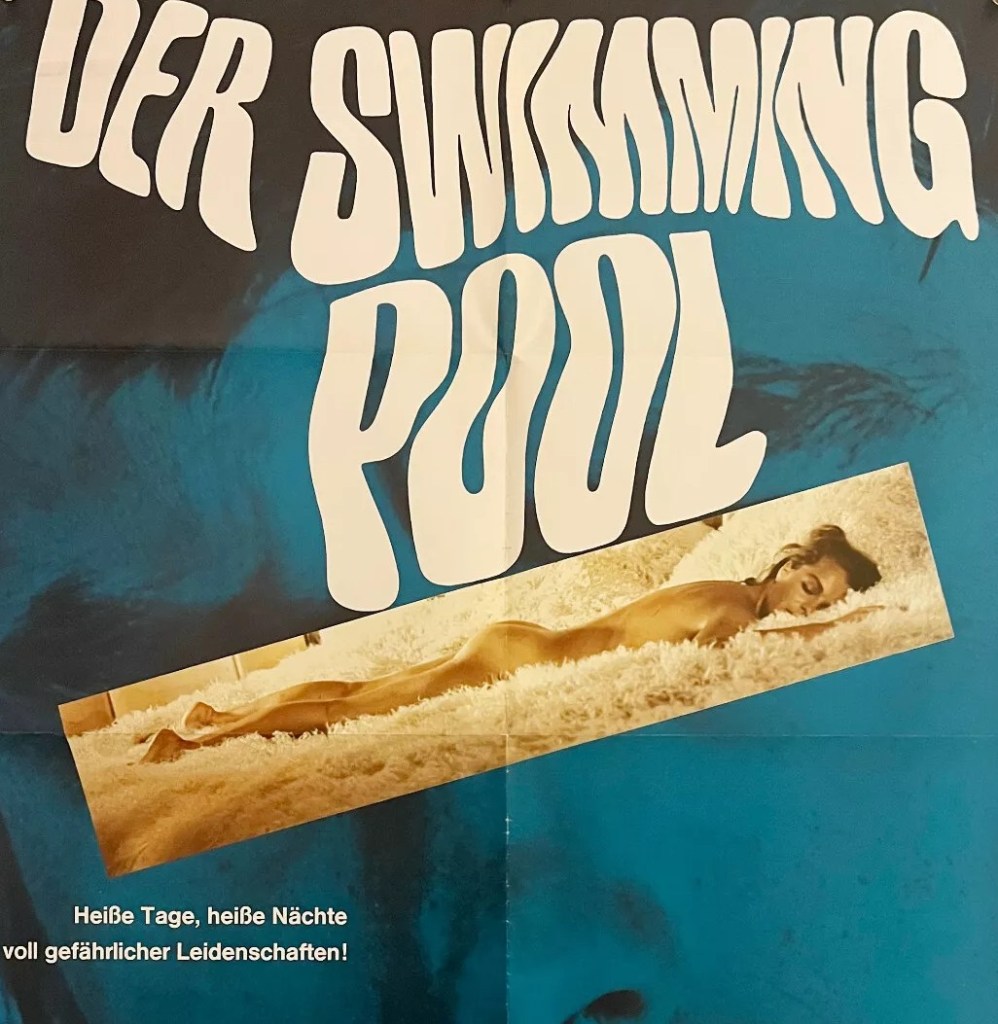
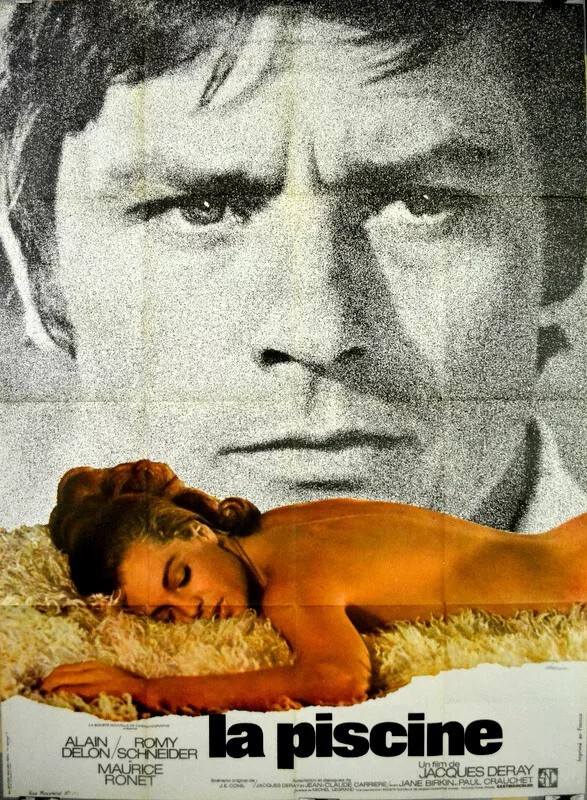
The Swimming Pool / La Piscine (1969) ****

A drunk falls into a swimming pool in the middle of the night and drowns. He has already crashed his car into the gate post of the villa. There’s no sign of foul play. No sign of the fact that his attempts to clamber out are hindered by someone holding his head down under the water until he loses consciousness.

The perfect murder? Well, no, actually, because in the aftermath of the murder, recovering alcoholic killer Jean-Paul (Alain Delon) does about the dumbest thing you’ve ever seen. And that significantly detracts from what otherwise is a superb examination of sexual tension and hidden secrets.

So instead of leaving the corpse of best friend Harry (Maurice Ronet) floating fully clothed in the titular pool, Jean-Paul decides it would look better if it appeared that Harry had foolishly gone for a late night swim. So he pulls the dead guy out, strips off his clothes and decks him out in swimming trunks and slides him back into the watery grave.

He hides the sodden clothes somewhere and at the side of the pool puts a small stack of fresh clothes stolen from Harry’s wardrobe – he was a guest at the villa. But for some reason in pulling off Harry’s shirt he omits to remove his expensive watch which isn’t waterproof. Inspector Leveque’s (Paul Crauchet) suspicions are aroused by that simple fact. Although, theoretically, Harry might have been too drunk to notice, even though, obviously, the watch strap and the bulky watch would have caught on his shirt sleeve as he was taking off the item of clothing.

So the cop, in examining the clothes, is mightily surprised to discover they are fresh, unworn, not a sign of sweat or crumpled-ness, which is odd given Harry had been out dancing and enjoying himself for hours.

Psychologically, most of the aftermath is not just whether the cold-blooded killer – the otherwise very handsome, relatively charming writer Jean-Paul – will get away with it  but whether his girlfriend Marianne (Romy Scheider), who has her own suspicions, will stand by him.

They have enjoyed a very intense sexual relationship and she clearly adores him. But she’s also the ex-lover of Harry and when Jean-Paul’s old pal, who is decidedly smooth with the ladies, turns up, the old sexual jealousy is rekindled. Either to get revenge or because he’s in any case that way inclined Jean-Paul has been making discreet moves on Harry’s eighteen-year-old daughter Penelope (Jane Birkin) who clearly despises her father.

We discover that Jean-Paul owes a great deal of his success to Harry who nurtured him through a severe depression that ended in attempted suicide. Rather than making Jean-Paul eternally grateful, it’s turned him into a spoiled brat, focused primarily on his own needs and without a loyal bone in his body when it comes to women.

For quite a while it looks like record producer Harry is going to steal away Marianne, if only for a brief affair, as Jean-Paul gives in to the sulks. But since Jean-Paul is already eyeing up Penelope, you would have thought any slip by Marianne would provide him with justification.

The murder is spur-of-the-moment. Jean-Paul has been drinking again and when Harry turns up drunk and launches into an attack on Jean-Paul’s character and hidden past, that’s when he ends up in the pool. Every time he tries to get out, Jean-Paul pushes him back in and eventually holds his head down underwater.

And he might have got away with the perfect murder except for stripping the body and forgetting about the watch, but when he decides to end his relationship with Marianne, the focus switches to whether she will betray him or not. There are a couple of twists on that score at the end.

So severely flawed psychological thriller. I’m guessing you could argue that anyone who kills someone out of the blue could easily be suffering from the kind of brain overload that prevents him thinking straight, but I didn’t fall for it. It would have been as easy to continue with the psychological stuff enough with Marianne maybe finding the wet clothes and facing the same choices that she eventually does.

What does elevate it are the performances. Austrian actress Romy Scheider (Otley, 1969), who had previously had an affair with Delon, is superb as a woman not sure if she has any principles given she is so easily in the thrall of attractive men. Although Alain Delon (Le Samourai, 1967) had played bad guys and immoral sorts before, this still feels like a fresh approach, the watchful, withdrawn calculating killer masquerading as something else.

Maurice Ronet (Lost Command, 1966) and Jane Birkin (Blow-Up, 1966) make significant contributions.

And director Jacques Deray (Borsalino, 1970) would have turned out another masterpiece had the movie not stumbled over the oddness of the murder. Written by the director, Alain Page (in his debut) and Jean-Claude Carriere  (Viva Maria!, 1965).

Excepting the murder mishmash, superb.

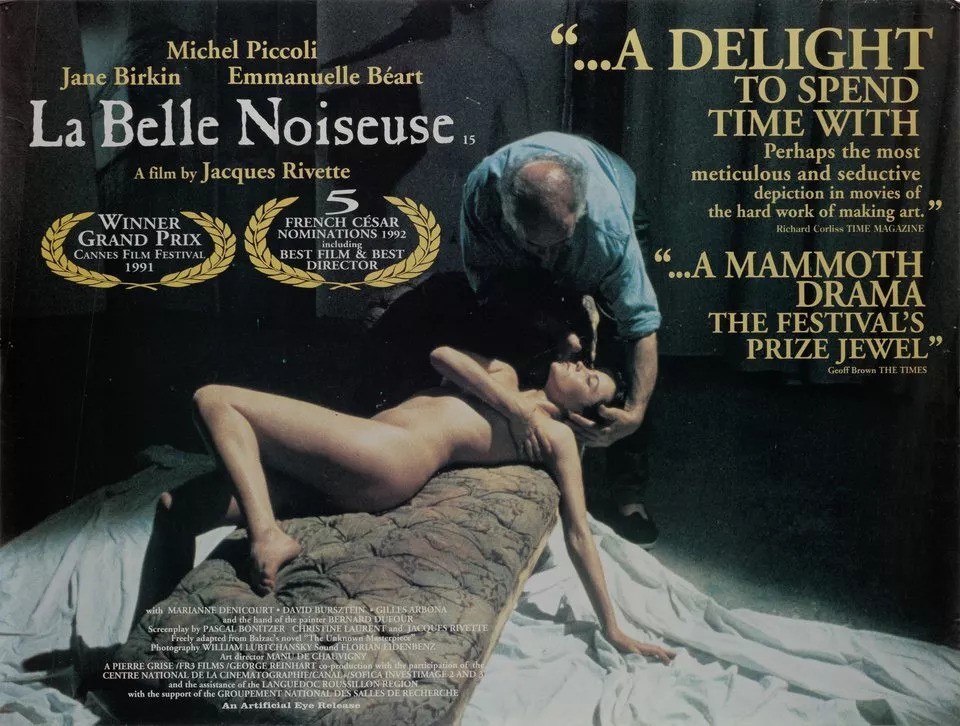
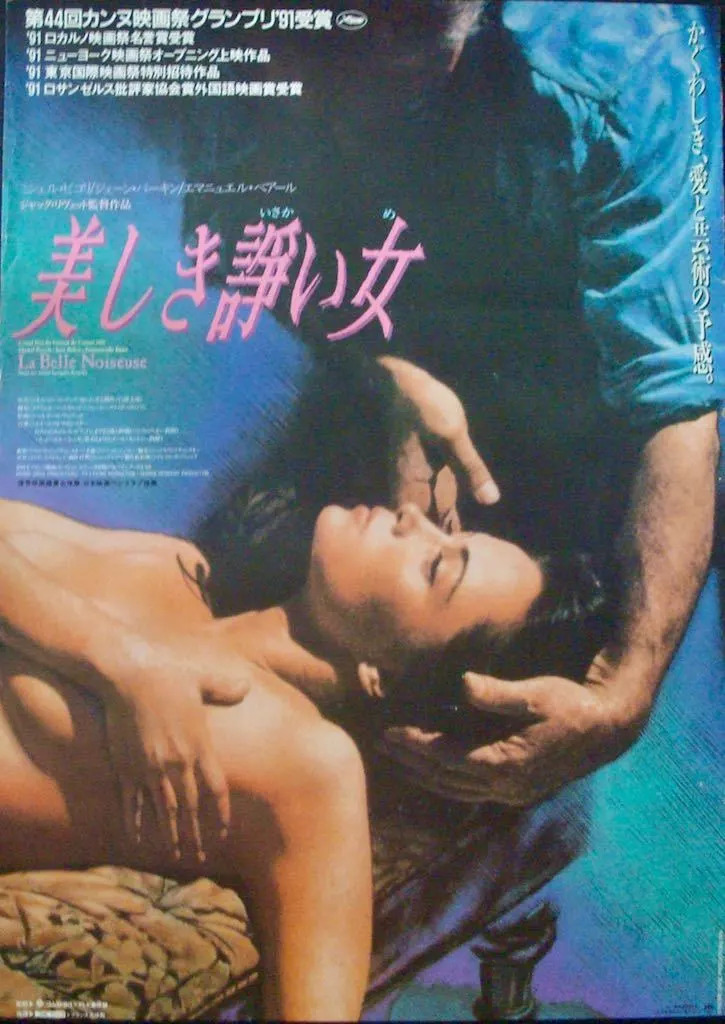
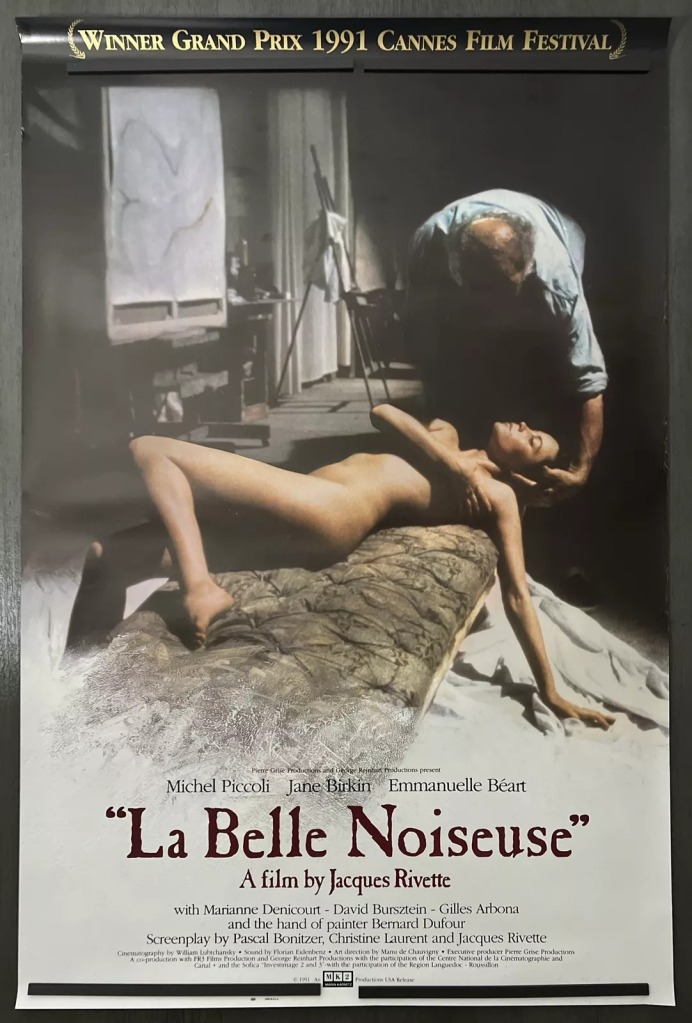
La Belle Noiseuse (1991) ****

I’m taking the Jacques Rivette test. Aka the bum-on-seat test. How easily can you sit through a four-hour intimate epic is often seen as the true test of your credentials as a critic. I have to confess I’ve failed this test once. Twice, to be truthful. I walked out – twice – of Celine and Julie Go Boating Go Boating (1974). But as I’m partial to tales of creative endeavor, a sucker for any story about an artist, this seemed more promising.

This director does something so clever you wonder why the idea wasn’t applied before. Maybe it was, but nobody fessed up. The star of this show in many ways is neither Michel Piccoli (Topaz, 1968) as artist  Frenhofer nor Emmanuelle Beart (Mission: Impossible, 1996) as model Marianne but the real-life painter Bernard Dufour. We never see Dufour’s face, only his hands. For it’s he who sketches and paints, not the actor. So we don’t have any of that nonsense where an actor purportedly spent a year preparing for the role, learning to play an instrument or whatever and then showing all too obviously that he/she is doing something by rote rather than inhabiting the skin of a true artist.

But that does also mean we don’t have to skate over a lifetime’s worth of painting or music or whatever to get to the painting or piece of music for which the character became famous and we don’t need to dwell on background or career development or any other issue that might have hindered /affected/ charged their progress.

This is, beyond a couple of introductory scenes, the story of how an artist paints and his relationship with the model and how that changes both of them. Rivette, having given himself all the time in the world, takes all the time in the world, so we go from initial sketches, ink on crackling paper, to an outline of an idea, to the false steps, wrong steps and true steps.

The awkwardness between artist and model is cleverly captured. Marianne feels she has been traded. Her boyfriend Nicolas (David Bursztein), a rising artist, hopes to win favor with the established artist by pushing her into the project without first asking her approval. Quite what makes her accept the (unpaid) job is unclear but then there are no academic studies on amateur models to provide clarification beyond a sense of excitement at being asked.

She takes in her stride the perfunctory reality that she will be naked virtually the whole time. That aspect of the film might have been viewed as somewhat prurient, but, in fact, it sheds light on just what a model does, what is asked of her, and why, and the idea is killed off right away that an artist always has a clear idea of his composition before he embarks on a painting.

Here, Frenhofer spends as much time trying to get to the heart and soul of his subject, to understand the shape and lines of her body, as he does on the actual picture. He wants to combine her characteristics with whatever he has in his head. There’s another element to the story. He tried to paint a similar picture a decade before, with his wife Liz (Jane Birkin) as the model. For reasons unstated, he abandoned the painting.

Although there’s a twist at the end, there’s not much more to the story than a painting being created from start to finish, including all the finicky bits like deciding on the pose and the size and shape of the canvas and the colors etc.

Yes, it’s incredibly long and not long in the way of Christopher Nolan or Martin Scorsese or Ridley Scott where length is the result of trying to cram in too much, characters, details, storylines, complications or visualisations a director could not resist. But it’s endlessly fascinating and for many the best movie ever made about the creative process, all the more so because although documentary in style it’s not documentary in execution.

Both actors are superb, not least for the concentration this must have taken, since development would have taken place in minute detail.

I think I passed the Rivette test. Celine and Julie….hmmm, still not so sure.

Well worth four hours of your time.

Blow-Up (1966) ****

Movies can break all sorts of rules but they can’t cheat.

A film has to stick to an internal logic. For example, it can’t portray a photographer so obsessed with his calling that he even takes a camera with him to an antique shop and starts shooting off roll and after roll capturing the area’s rundown streets but then the one time he really could do with a camera – to prove there is a corpse at his feet – he is somewhat remiss. Especially when that the movie turns on that plot point.

Setting aside what’s a somewhat contrived snapshot of “Swinging London” there’s a lot to admire here. The absence of music for one thing. Most of the movie runs without musical accompaniment, a bold move since so often we rely on the soundtrack to provide guidance for a scene or an overlay for the entire film. Here, Michelangelo Antonioni (Zabriskie Point, 1970) makes us falls back on our own interpretation.

David Hemmings (The Charge of the Light Brigade, 1968), all mop-top and intense stare, is a high-flying high-living fashion photographer in the David Bailey mold (casual sex with wannabe models a perk) who turns investigator on being confronted in a park by Vanessa Redgrave (Hemmings’ adulterous love interest in The Charge of the Light Brigade) after taking snaps she wants back. Tension is sustained by her sudden appearance at his studio, willing to pay with her body for the return of the photos, and then by Hemmings’ careful, photo-by-photo blow-up-by-blow-up analysis that slowly comes closer to the truth.

Everything in his world is judged through a lens, as if he can capture elusive truths, and he has aspirations to being more than a mere fashion adjunct, having spent time taking portraits of down-and-outs. He judges Redgrave as he would a model, she has a good stance and sitting posture. Even by the standards of the permissive society, he is a bit of sexual predator, taking advantage of two giggly model wannabes – Jane Birkin (Wonderwall, 1968) and Gillian Hills (Three, 1969).

But the photography scenes are well done and Antonioni captures the intimacy between model and photographer that create the best images. If you want to see what a model brings to modeling check out real-life model Veruschka posing in an outfit held together by the thinnest of threads, bringing to life the much-touted notion that a model makes love to a camera. If you can get past the cheat and the deliberate obtuseness this creates – and the tsunami of artistic interpretations it inspired about the director’s intent – then it remains intriguing.

This isn’t Hemmings’ greatest work – Fragment of Fear is much better – but it certainly provided him with a marketable movie persona. Redgrave is excellent as the nervy woman willing to do what is required and the movie might have worked better had she had been allocated more screen time and their duel had continued through other scenes. But then that would have been Hitchcock and not Antonioni.  

Sarah Miles (The Ceremony, 1963), Peter Bowles (The Charge of the Light Brigade) and John Castle (The Lion in Winter, 1968) have small parts. The film certainly captures the electricity of a photo shoot between a skilled photographer and pliant model, but it also works as an extended metaphor about the elusiveness of cinematic truth.

Despite my misgivings about the “cheat,” an intriguing and satisfying exploration of an artist seeking to jettison the fripperies of his art yet unable to avoid the temptation of enjoying the easy sexual benefits.

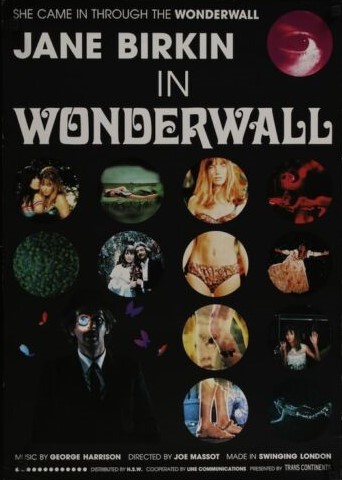
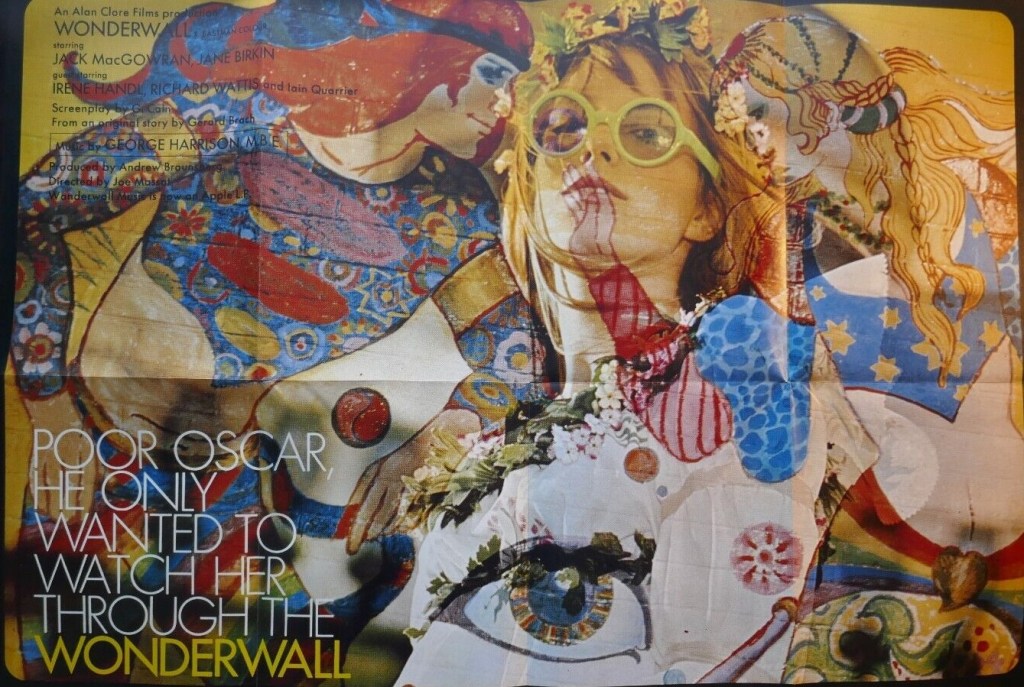
Wonderwall (1968) **

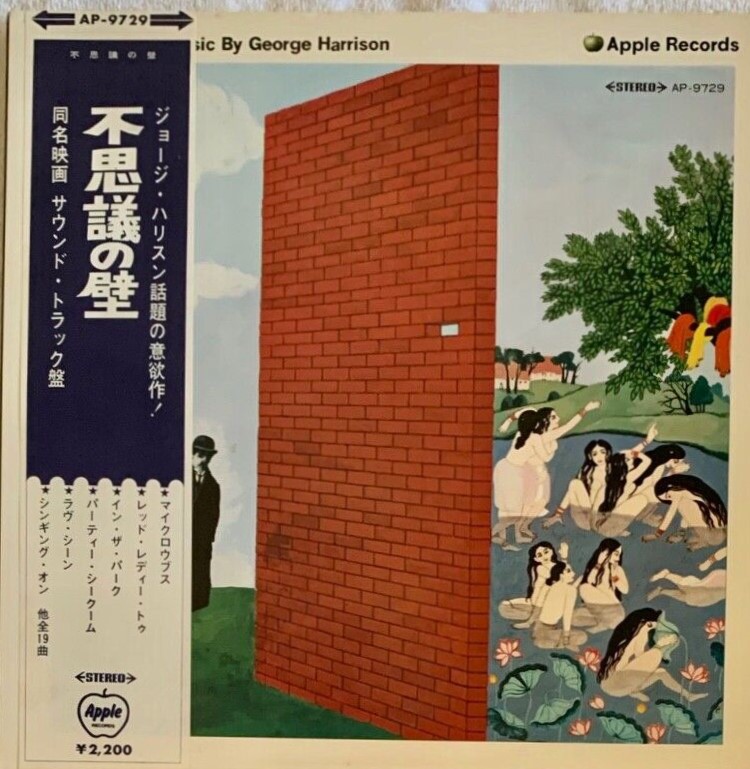
While psychedelic forays were all the rage in the late 1960s it’s hard to see how that excuses a movie that appears to exalt a peeping tom. Or at the very least appear to give him a free pass because he’s a barmy scentist and, more likely, because he saves the object of his spying from suicide. And you have to wonder what prompted George Harrison (at the time still a Beatle) to volunteer to provide the soundtrack.

Of course, the title has been popularised by the catchy Oasis song and star Jane Birkin achieved notoriety also on the musical front when her single “Je T’Aime” was banned by the BBC the following year (censorship having the opposite effect and sending it to the top of the charts, as any good marketing analyst could have predicted).

But there’s not much going on here that purports to be narrative and the psychedelics and fantasy sequences fail to remove discomfort over the context.

Professor Collins ( a wild-haired Jack MacGowran) spends his days glued to a microscope studying amoebas and perhaps in a nod to other less than savoury literary characters (Lolita, 1962 and The Collector, 1965, in case you haven’t guessed) collects butterflies and spends the evening in a chaotic apartment stacked high with old magazines (their content, given his later behavior, not what you might expect).

Disturbed by the noise of a party upstairs, he throws something at the wall, knocks something loose and finds a hole-sized light streaming into the darkness of his apartment. With nothing else to keep himself occupied, he peers through and is entranced by the long legs of model Penny Lane (Jane Birkin). Soon, he is checking out a photo shoot, a party, Penny making love to boyfriend (Iain Quarrier), the model rejecting her lover’s suggestions of a threesome with another equally lithe model (Anita Pallenberg), and later discovering she is pregnant.

In between, Collins has various fantasies about challenging the boyfriend to a duel. Initially, this is in the formal manner, with duelling pistols or rapiers, but soon takes the form of giant fountain pens or giant cigarettes. Occasionally, there’s a butterfly motif. Once, he imagines Penny as a mermaid swimming among the amoebas. His dead mother appears in a puff of smoke to tell him off.

And he didn’t get to being a professor without showing some initiative. So when he realises that a tiny hole limits his viewing pleasure, he starts to knock the wall down and watch the woman in widescreen, though somehow the wall is made of glass, thus preventing him intruding, and equally somehow the neighbors never seem to notice.

Of course, you could take it all as fantasy, that a lonely old man just wants to befriend a young woman, as if there was anything less creepy about that.

Naturally, if you’re inclined to ignore the creepiness, you might be tempted to start to praise the psychedelic, but I’m not sure that’s a very good starting point. If you’re into sitar music or George Harrison you will probably enjoy the score.

Jack MacGowran (Age of Consent, 1969) didn’t seem to feel he needed to do any more with the character than dress him as an eccentric. There’s certainly no sense of shame. If anything, thanks to the ending, he is afforded redemption. Jane Birkin (Blow-Up, 1966) isn’t called upon to do anything except appear soulful, and, of course, from time to time, nude. British character actors like Irene Handl and Richard Wattis appear in stock roles.

Joe Massot (The Song Remains the Same, 1976) directed and Gerard Brach (Repulsion, 1965) and Guillermo Cain (Vanishing Point, 1971) wrote the screenplay. But while Massot was a debutant, Brach’s involvement would have indicated something perhaps creepier still but with a more relevant outcome. A case study on how this got the green light in the first place would be most appreciated.

Kaleidoscope (1966) ***

Amazing the tension that can emanate from one turn of a card. Or, more correctly, waiting for one. Only problem is we’re two-thirds through the movie before high-stakes poker begins – the pot nudging £250,00 (close on a cool £5 million now). Mostly, the earlier tension derives from not knowing what the hell is going on in this enjoyable thriller made at the height of the Swinging Sixties as playboy gambler Barney (Warren Beatty), a walking Carnaby St model driving an Aston Martin DB5, tilts the odds dramatically in his favor.

Barney is a gambler but the problem with gambling is the odds. They can be against you too much. So Barney decides to turn himself into a burglar, the kind that can clamber over rooftops, abseil between buildings, and break into – a printing business called Kaleidoscope. This just happens to print the playing cards supplied to all the major European casinos. So Barney does a little doctoring of the master printing plates. Bingo, the odds are a bit more even now that he knows what cards are coming out of the shoe – he plays chemin de fer (as it is known in posh casinos; pontoon or 21 to you and me).

While cleaning up he bumps again into fashion designer Angel – their original meet-cute taking place in a traffic jam – who he dated once in London. Unbeknownst to him, she is on a scouting mission, looking to snare the kind of high-rolling gambler who can take on and completely fleece drugs kingpin Harry (Eric Porter) being pursued by her father Manny (Clive Revill), a cop who, rather than waste so much time collecting the required evidence to put the villain behind bars, decides it would easier done by making him broke. Unable to pay his debts, some other villain would put him out of business in the traditional cemented-boot fashion.

It takes a while for the movie to line up all its ducks in a row, mainly by holding back the vital information the audience requires. But the audience is privy to details of the way Manny works that Barney is not. Even for ruthless villains, Manny has a peculiar calling card, one that would make any gambler think twice about entering his lair. Of course, it doesn’t take long for Manny to rumble Barney’s game so the stakes are much higher than the charmer imagines.

Throw in as much fashion as London was capable of generating at this time, the burgeoning romance, some exotic European locations, a castle with a moat, and the usual tourist guide stuff of red buses, Big Ben, Piccadilly Circus, pubs and Tower Bridge and you have all the ingredients of an easy on the eye thriller.

A bit over-reliant on star power. That is, if you don’t need Beatty to do much more than be Beatty, all teeth and charm. At this point Beatty’s career looked as if it was fast approaching its end. The box office success of Splendor in the Grass (1961) had been followed by a string of flops, romantic dramas and comedies that should have had audiences queuing up plus an occasional wild card like Arthur Penn’s Mickey One (1965), the biggest flop of all. He does make an engaging crook, and he never loses his screen charisma here, but there ain’t quite the right number of twists that moviegoers weaned on the likes of Topkapi (1964) had come to expect.

Hollywood had been doing its best to position Susannah York as a top box office attraction and she had snagged leading female roles in The 7th Dawn (1964) opposite William Holden and Stanley Baker in Sands of the Kalahari (1965)  but she was recovering from the colossal flop of Scruggs (1965) by ‘poet of the cinema’ David Hart.  Kaleidoscope offered  the kind of role York could do with her eyes closed. So while the screen pair were not exactly sleep-walking it was not the kind of story that was going to create sparks.

Character actor Clive Revill (Fathom, 1967) and Eric Portman (The Pumpkin Eater, 1964) take more leeway with their roles, the latter almost chewing he scenery, the former content with just chewing his lips. Look out for Jane Birkin (Blow-Up, 1966) and British television stalwarts Yootha Joyce, George Sewell and John Junkin.  

The title would have been more enigmatic, original meaning of images twisted out of shape, had it not also applied, straightforwardly, to the card-making company. Giving Harry the surname of Dominion seems overkill.

Director Jack Smight (No Way to Treat a Lady, 1969) came to this after twisty private eye picture Harper/The Moving Target (1966), a big hit starring Paul Newman, but this is too lightweight a feature to command such interest, but he does keep the story rolling along and it’s an effortless watch and it has a certain offbeat quality. The screenplay was fashioned by Robert Harrington and Jane-Howard Hammerstein, making their movie debut, who also co-wrote Wait until Dark (1967). It was also the debut for Winkast Productions, the Jerry Gershwin-Elliott Kastner production team who went on to make Where Eagles Dare (1968).
Discover WordPress

A daily selection of the best content published on WordPress, collected for you by humans who love to read.

The Atavist Magazine

by Brian Hannan

WordPress.com News

The latest news on WordPress.com and the WordPress community.