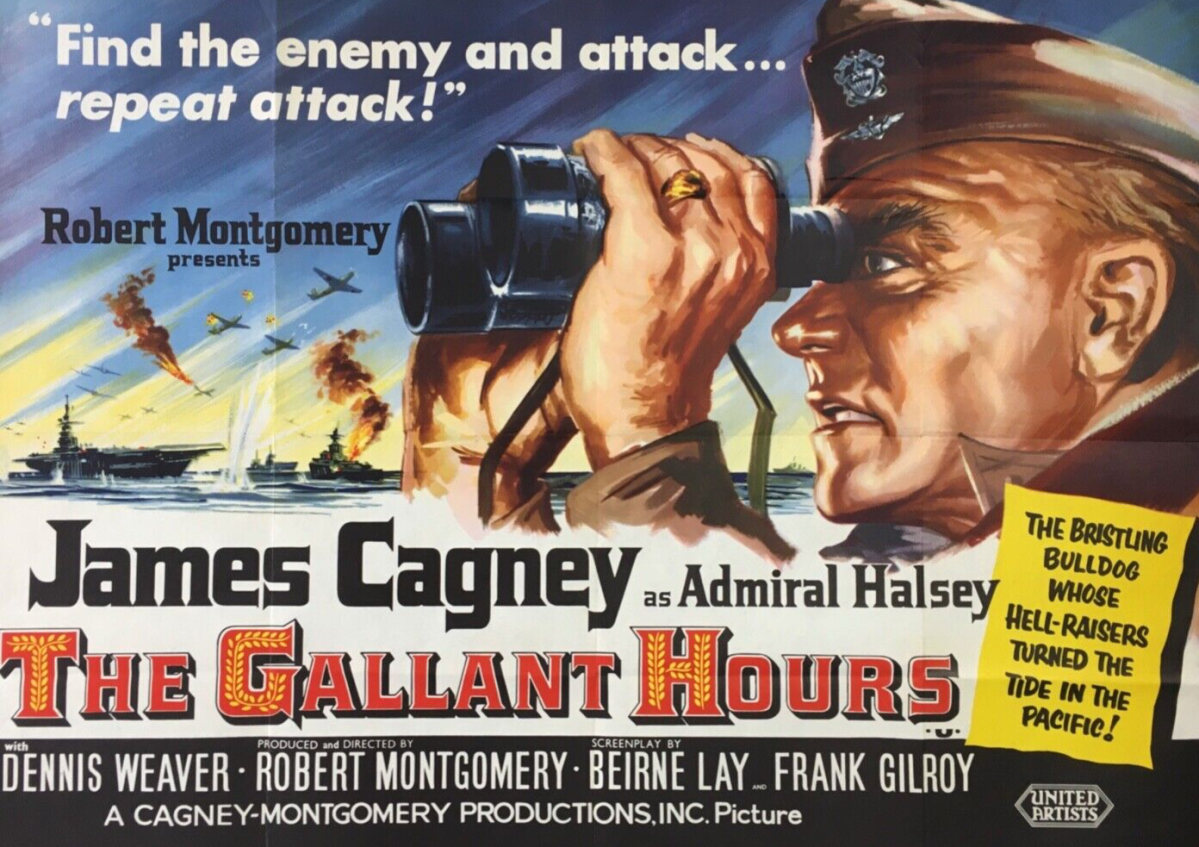
A curiosity. Something of vanity project for star James Cagney (One, Two, Three, 1961) – in his penultimate leading role – who doubled up as producer. But more of a documentary than a war picture. Witness, no scenes of actual World War II combat for a start. And going down the same annoying route as The St Valentine’s Day Massacre (1967) where the voice-over pretty much tells you what everyone had for breakfast and in that vein goes on to tell you whether or not they survived the conflict and maybe became a relatively famous politician thereafter.
Basically recounts the turnaround in U.S. fortunes at the Battle of Guadalcanal in the South Pacific in 1942-1943. The Americans had invaded the island but were coming under increasing pressure from the Japanese. In case you don’t know your Second World War history, this was the first major American land offensive following Pearl Harbor. Though the Americans had thwarted the Japanese at The Battle of the Coral Sea and the Battle of Midway, these were nautical triumphs. Guadalcanal was the first objective in the American island-hopping strategy.
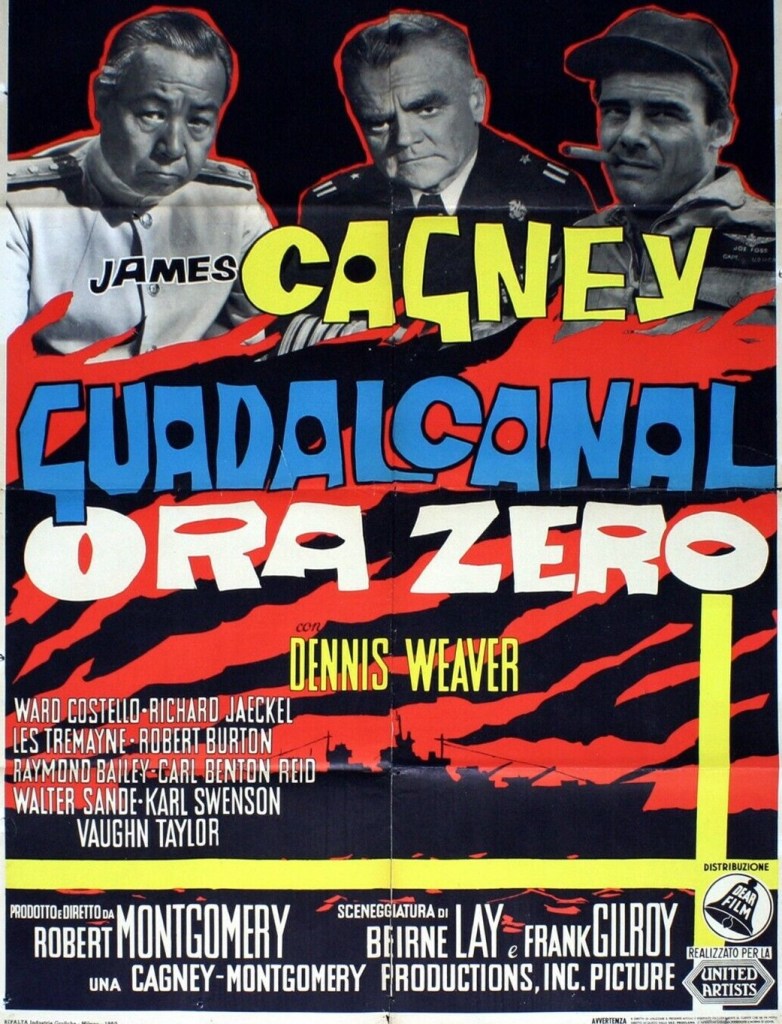
Here, I’m getting all information-overload myself, because all you really need to know is that the Americans parachuted in (actually, he landed by flying boat) Admiral “Bull” Halsey (James Cagney) at a critical moment to revitalize their operation and prevent the expected Japanese attack. The Japanese were so convinced that victory was imminent that they had drawn up operational details of the surrender ceremony they planned to impose on the vanquished Americans.
The Yanks managed to intercept and decode Japanese radio transmissions and in the only real dramatic moment, after capturing the surrender document, Halsey pins it to a tree so his troops can read it and stiffen their resolve.
But mostly this is a bunch of guys in a bunch of rooms talking about what they were going to do and how difficult, what with lack of support and casualties and low morale, their challenge was going to be. There’s no shortage of detail but every time a scene starts to become dramatically interesting up pops our resident voiceover (director and co-star Robert Montgomery if you want to know) to provide us with some unnecessary detail about some character in the room.
On the debit side, this is pretty irritating. On the plus side, it’s fascinating, a potted history of various personnel without having to resort to the usual sub-plots, often inane in themselves, often of the romantic persuasion, that crop up in an otherwise intriguing war picture so as to provide the audience with people to root for. If you were American, you would recognise some of the characters depicted, some true-life heroes (ace pilots, courageous soldiers) who made their name on the field of battle or contributed to the victory off it.

Of course, if you’re from anywhere else you won’t have a clue who anybody is – and not that much interested either, preferring the old-fashioned approach of sub-plot and romance – but stick with it because, once you realize this is a determinedly novel approach for the genre, it does become pretty interesting especially as Cagney, despite his character being nicknamed “Bull,” dispenses with his usual acting tricks, the strangulated voice and the aggressive demeanor, in favor of a more rounded personality.
Nobody tends to hold up a critical mirror to battles that end in victory, unlike Pearl Harbor, so it’s never going to degenerate into verbal fisticuffs, and much of the pressure the audience might detect comes from the other side, the cocky Japanese, who are presented in a very even-handed manner, despite, or perhaps because, their leader Admiral Yamamoto (James T. Goto), who led the attack on Pearl Harbor, was highly respected by the Americans. This is where maybe Violent City (1970) got the idea of ignoring subtitles, but at least here we can rely on Mr Voiceover to keep us posted on what the Japanese were actual up to.
Cagney holds it all together and you might spot Dennis Weaver (Duel, 1971) and Richard Jaeckal (The Dirty Dozen, 1967) among the supporting cast. Sixth and final directorial outing for star Robert Montgomery (though he limits his onscreen involvement here to just the narration) who had experimented with voiceover in Lady in the Lake (1945). Whether you fall in with his take on this one, he pretty much delivers what he intended, a semi-documentary account of leaders in battle. Screenplay by Beirne Lay Jr (The Young and the Brave, 1963) and Frank D. Gilroy (The Subject Was Roses, 1968).
Not compelling, but interesting enough.
 The Magnificent 60s