Three (1969) **

More interesting for the personalities involved – Sam Waterston, Charlotte Rampling, an ex-fighter pilot, an Australian pop star and a model – than the film itself, which presents a European arthouse take on youngsters freewheeling around Europe looking for their share of the free love purportedly available everywhere.

There’s not really any story, mostly it’s scenery, and whatever tension there is rarely rises to the point of drama. However, it is refreshing to see a picture not steeped in angst that reflects the normality of life rather than superficially-imposed heightened confrontation. On a tour of Italy, American college buddies Taylor (Sam Waterston), the shy, gawky one, and Bert (Robie Porter), the better-looking confident one, take up with British girl Marty (Charlotte Rampling). The guys make a pact not to compete for the girl’s attentions, but that idea doesn’t last long. The title suggests she might end up with one – or both. In trying to sell the film, the marketeers felt obliged to make that idea more implicit.
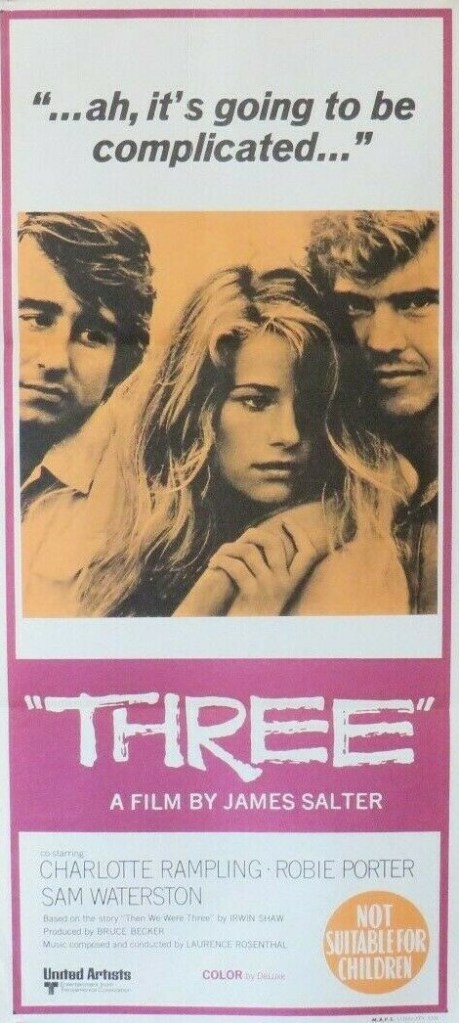
The guys make plays for other girls they meet but seem to find little genuine action and in that sense it is more true to life than other films of the period which suggested sex was there for the asking. But none of the characters are particularly interesting and while that is also more realistic it diminishes enjoyment. The highlight is a naked Taylor attempting to save a girl from drowning in the sea, but in keeping with the film’s tone he is beaten to it by a boat.

There’s not much sign here of the intense dramatic style Oscar nominee Sam Waterston would later bring to the movies. This was his third film after small parts in The Plastic Dome of Norma Jean (1966) and Dick Van Dyke vehicle Fitzwilly (1967) and he wouldn’t hit his stride until The Great Gatsby (1974).

Perhaps the oddest movie fate befell Charlotte Rampling, also a later Oscar nominee. How else to explain that she followed up this picture with Luchino Visconti’s The Damned (1969) and preceded it with Roger Corman’s Target: Harry (1969). With a career that at this point appeared to follow no particular pattern, after making an impact in Georgy Girl (1966) as a libidinous flatmate, she took a small role in The Long Duel (1967) before reaching leading lady status opposite Franco Nero in Italian thriller Sequestro di Persona (1968). Her languid screen persona was turned on its head with The Night Porter (1974). And then she was swept up in Alistair MacLean thriller Caravan to Vaccares (1974).

Who was Robie Porter you might very well ask and why did he only make two pictures, the other being The Carey Treatment (1972)? He was an Australian pop star, specializing in instrumentals on a steel guitar, with a series of hits including two at number one. He chanced his arm in Britain, without repeating that success, then moved to the U.S. and landed parts in television series Daniel Boone and Mannix. After Three, he returned to the music business, as part-owner of record label Sparmac and producing for the band Daddy Cool.

Other names in Three, in bit parts only, none making any discernible impact in the picture, included model Edina Ronay, daughter of celebrated food critic Egon Ronay, who had appeared in A Study in Terror (1965) and Prehistoric Women (1967). Equally as celebrated, if for other reasons, was Gillian Hill, best known as one of the girls cavorting naked with photographer David Hemmings in Blow Up (1966).

Writer-director James Salter was a genuine Hollywood curiosity. He hit a peak of cinematic activity in 1969, with two screenplays filmed – Downhill Racer (1969) and The Appointment (1969). This is pretty much a companion piece to Downhill Racer (1969) which has a bunch of professional skiers on a similar scenic tour and often sitting around with not much to do although that film builds in confrontation and more standard love affair.

Generally considered a “writer’s writer” – i.e. adored by his peers more than the public – his first novel The Hunters (1958), based on his Air Force experiences, was turned into a movie starring Robert Mitchum. He dabbled in documentary film-making, whose impact can be seen in his feature films, but was better known for a short erotic novel A Sport and a Pastime set in Europe. None of his 1969 trio were hits, he ended up in Hollywood limbo, and he didn’t reappear on the movie credits list until Richard Pearce’s sci-fi Threshold (1981) starring Donald Sutherland.   
Downhill Racer (1969) ***

Robert Redford rarely took the easy option. Even his big romantic number, The Way We Were (1973), with Barbra Streisand had a serious center, Jeremiah Johnson (1972) focused on ecology and he used his star power to get studio backing for All the President’s Men (1976). Even starting out, and before Butch Cassidy and the Sundance Kid (1969) anointed him a star, when he could, or should according to some observers, have been capitalizing on his good looks he did not shrink from playing unlikeable characters.

Idealizing heroes is endemic. Most films which portray sport stars with feet of clay generally begin with an attractive personality who presses the self-destruct button through alcohol, sex or drugs (or all three) such as Number One (1969) with Charlton Heston. The general consensus is that this approach to the sports movie was not rescinded until the brutal boxer exposed in Scorsese’s Raging Bull (1980).

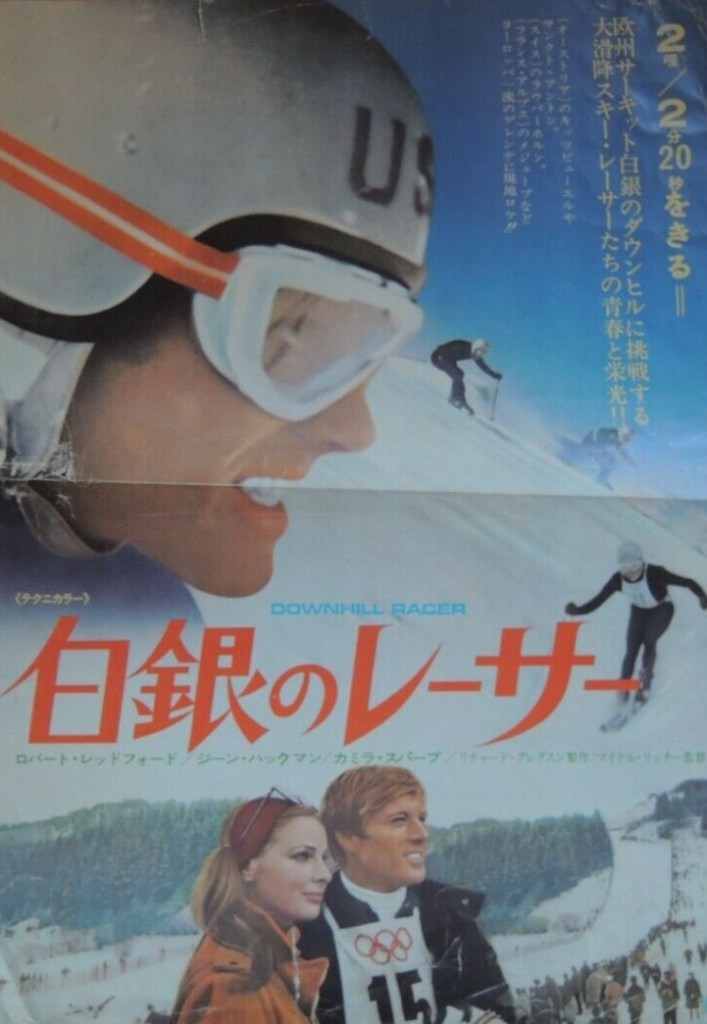
But it turns out Scorsese was not the first. In this ski drama Chappellet (Robert Redford) is a loner who cares for no-one but himself. Alienated from his father (Walter Stroud), his girlfriend at home little more than a sex object, the obsessed skier proves a constant source of friction for his national team manager Claire (Gene Hackman) and not above the kind of dirty tricks as typified in Slap Shot (1977). He sees nothing wrong with making no bones about the fact that he is in the game for fame.

Totally lacking in self-delusion, he’s a farm boy and few steps up from being illiterate. The world of the professional skier was hardly the obvious subject for a sports drama. There’s certainly an excitement in the action that couldn’t be captured on television, but the essential competitive element, the race against the clock, is not so riveting as the last-minute touchdown or winning home run.

Pretty much Chapellet’s only attractive feature is that he is played by Robert Redford, and the film plays upon the conceit that as handsome a man as this will at some point turn into a good guy.  There’s an interesting debate – and one that would last decades – about whether Redford’s looks got in the way of the characters he portrayed. Imagine Robert Duvall in the part, for instance, and relentless determination would not be called into question.

This leaves the film with only pity as a way to provide the character any sympathy, the sense that if he turns into a loser the audience will warm more to him than if he is a champion, but that arrives outside the competitive circle, and perhaps is even more touching, when his hopes of genuine romance with top-notch blonde Carole (Camilla Sparv) are dashed. 

Michael Ritchie (The Candidate, 1972), making his directing debut, opts for a documentary-style approach, so minimalist it’s almost perfunctory. This is a decent option given there’s very little going on beyond lonely hotel rooms, and an endless round of competitions and an occasional outburst from the manager. The skiing scenes, sensational at the time, are boosted by Blu Ray. Although it gained good reviews, audiences failed to respond although Redford was on a career high after Butch Cassidy and the Sundance Kid (1969).

While it was a brave choice for the actor, the script by James Salter (Three, 1969), based on the Oakley Hall bestseller, doesn’t bring enough insight, though you could argue it was intended to keep the character at arm’s length.  A novel can be engaging enough just by opening up an unusual world, but a movie needs to do more. This is pre-chuckle Gene Hackman (The Gypsy Moths, 1969)   and at this point you would probably have bet on him remaining a supporting player.

Redford, the thinking man’s actor, in embryo.

https://amzn.to/3MonLzM

Three (1969) **

More interesting for the stars involved – in particular Sam Waterston and Charlotte Rampling as well as an ex-fighter pilot, an Australian pop star and a model – than the film itself, which presents a European arthouse take on youngsters freewheeling around Europe looking for their share of the free love purportedly available everywhere.

There’s not really any story, mostly it’s scenery, and whatever tension there is rarely rises to the point of drama. However, it is refreshing to see a picture not steeped in angst that reflects the normality of life rather than superficially-imposed heightened confrontation. On a tour of Italy, American college buddies Taylor (Sam Waterston), the shy gawky one, and Bert (Robie Porter), the better-looking confident one, take up with British girl Marty (Charlotte Rampling). The guys make a pact not to compete for the girl’s attentions, but that idea doesn’t last long. The title suggests she might end up with one – or both. In trying to sell the film, the marketeers felt obliged to make that idea more implicit.

The guys make plays for other girls they meet but seem to find little genuine action and in that sense it is more true to life than other films of the period which suggested sex was there for the asking. But none of the characters are particularly interesting and while that is also more realistic it diminishes enjoyment. The highlight is a naked Taylor attempting to save a girl from drowning in the sea, but in keeping with the film’s tone he is beaten to it by a boat.

There’s not much sign here of the intense dramatic style Oscar nominee Sam Waterston would later bring to the movies. This was his third film after small parts in The Plastic Dome of Norma Jean (1966) and Dick Van Dyke vehicle Fitzwilly (1967) and he wouldn’t hit his stride until The Great Gatsby (1974).

Perhaps the oddest movie fate befell Charlotte Rampling, also a later Oscar nominee. How else to explain that she followed up this picture with Luchino Visconti’s The Damned (1969) and preceded it with Roger Corman’s Target: Harry (1969). With a career that at this point appeared to follow no particular pattern, after making an impact in Georgy Girl (1966) as a libidinous flatmate, she took a small role in The Long Duel (1967) before reaching leading lady status opposite Franco Nero in Italian thriller Sequestro di Persona (1968). Her languid screen persona was turned on its head with The Night Porter (1974).

Who was Robie Porter you might very well ask? And why did he only make two pictures, the other being The Carey Treatment (1972)? He was an Australian pop star, specializing in instrumentals on a steel guitar, with a series of hits including two at number one. He chanced his arm in Britain, without repeating that success, then moved to the U.S. and landed parts in television series Daniel Boone and Mannix. After Three, he returned to the music business, as part-owner of record label Sparmac and producing for the band Daddy Cool.

Other names in Three, in bit parts only, none making any discernible impact in the picture, included model Edina Ronay (daughter of celebrated food critic Egon Ronay) who had appeared in A Study in Terror (1965) and Prehistoric Women (1967). Equally as celebrated, if for other reasons, was Gillian Hills, best known as one of the girls cavorting naked with photographer David Hemmings in Blow Up (1966) and as the titular Beat Girl (1960)

Writer-director James Salter was a genuine Hollywood curiosity. He hit a peak of cinematic activity in 1969, with two other screenplays filmed – Downhill Racer (1969) and The Appointment (1969). This is pretty much a companion piece to Downhill Racer (1969) which has a bunch of professional skiers on a similar scenic tour and often sitting around with not much to do although that film builds in confrontation and a more standard love affair.

Generally considered a “writer’s writer” – i.e. adored by his peers more than the public – his first novel The Hunters (1958), based on his Air Force experiences, was turned into a movie starring Robert Mitchum. He dabbled in documentary film-making, whose impact can be seen in his feature films, but was better known for a short erotic novel A Sport and a Pastime set in Europe. None of his 1969 trio were hits, he ended up in Hollywood limbo, and he didn’t reappear on the movie credits list until Richard Pearce’s sci-fi Threshold (1981) starring Donald Sutherland.   
It’s not a stinker, but it’s not much of anything else either.

Discover WordPress

A daily selection of the best content published on WordPress, collected for you by humans who love to read.

The Atavist Magazine

by Brian Hannan

WordPress.com News

The latest news on WordPress.com and the WordPress community.