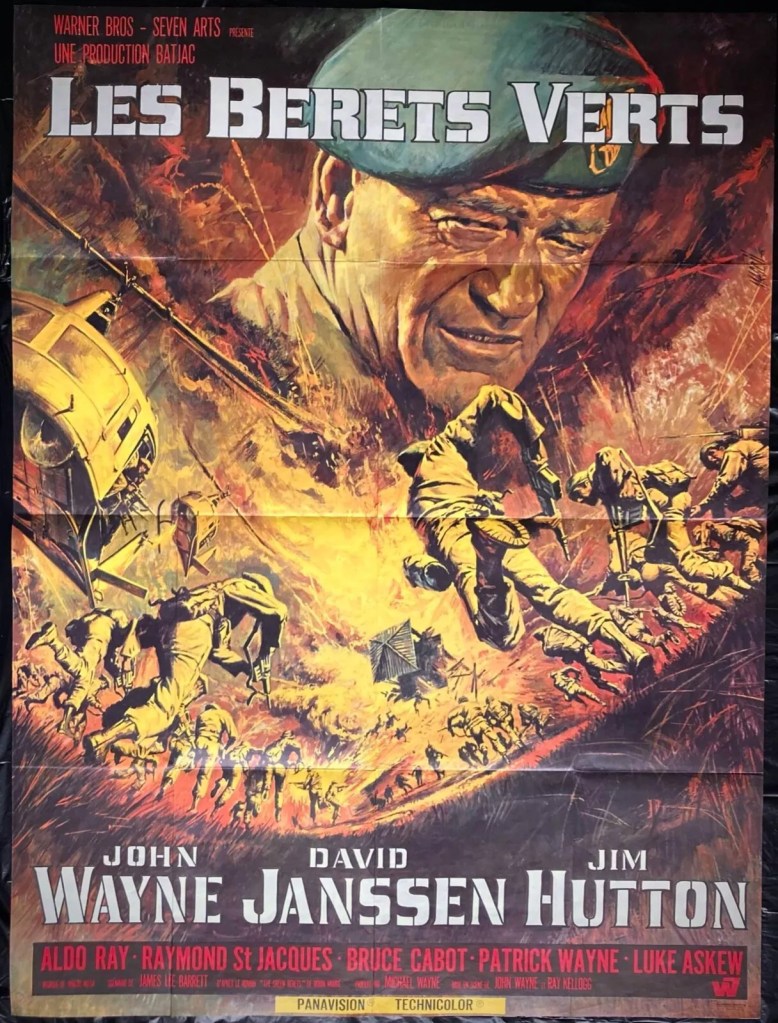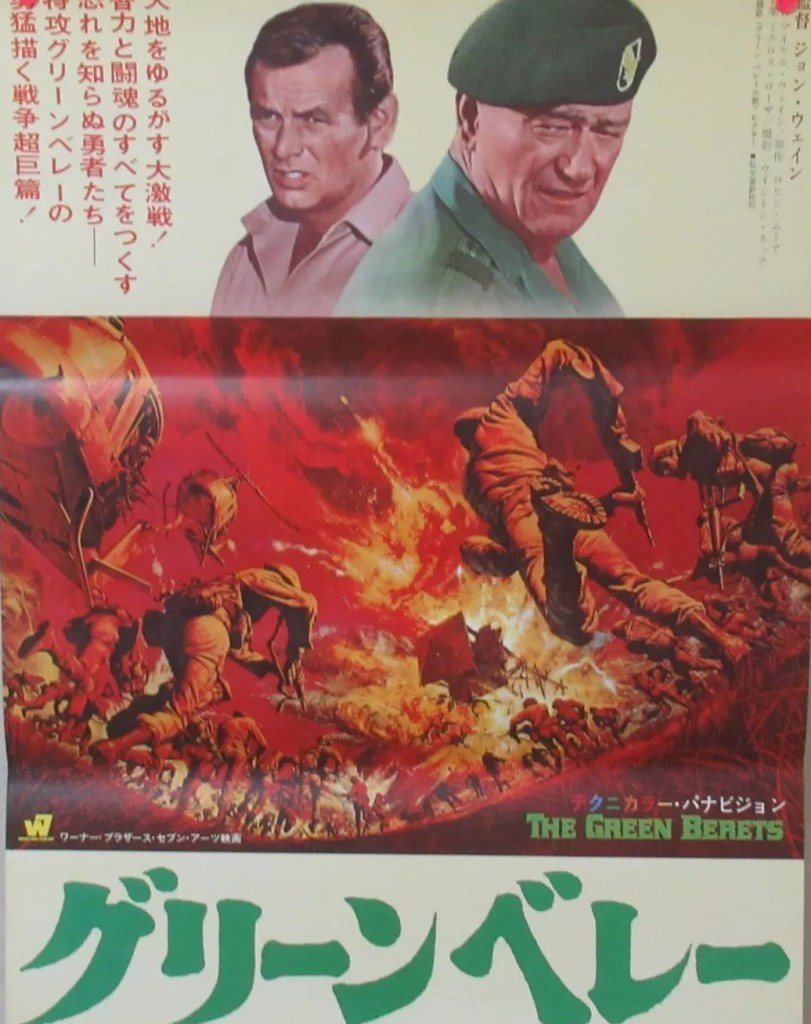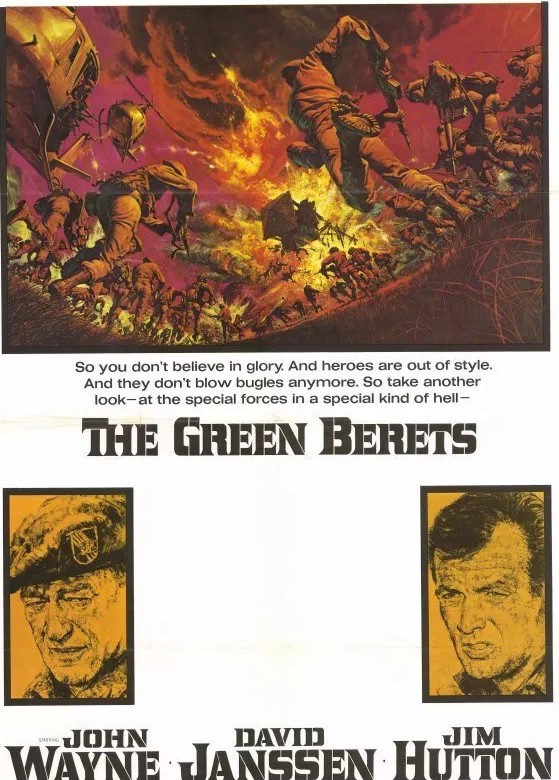
Behind the Scenes: “The Green Berets” (1968)

As if John Wayne hadn’t endured enough directing The Alamo (1960), he took on an even weightier task with this Vietnam War picture which, from the start, was likely to receive a critical roasting given the actor’s well-known stance on the conflict and his anti-Communist views that dated back to the McCarthy Era of the 1950s. Wayne had enjoyed a charmed life at the box office with three successive hit westerns, Henry Hathaway’s The Sons of Katie Elder (1965) with Dean Martin, Burt Kennedy’s The War Wagon (1967) co-starring Kirk Douglas, and best of all from a critical and commercial standpoint Howard Hawks El Dorado (1967) pairing Robert Mitchum. Outside of box office grosses, Wayne’s movies tended to be more profitable than his box office rivals because they were generally more inexpensive to make.

Columbia had been the first to recognize the potential of the book by Robin Moore and purchased the rights pre-publication in 1965 long before antipathy to the war reached its peak. A screenplay was commissioned from George Goodman who had served in the Special Forces the previous decade and was to to return to Vietnam on a research mission. But the studio couldn’t turn out a script that met the approval of the U.S. Army. Independent producer David Wolper (The Devil’s Brigade, 1968) was next to throw the dice but he couldn’t find the financing.
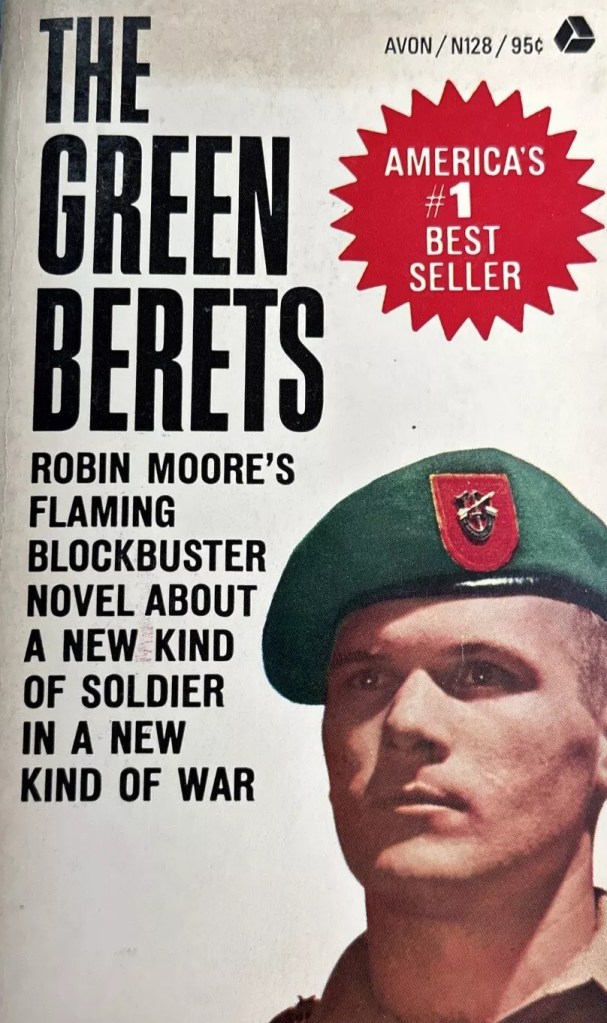
In 1966 Wayne took a trip to Vietnam and was impressed by what he saw. He bought the rights to the non-fiction book by Robin Moore (who also wrote The French Connection) for $35,000 plus a five per cent profit share. While the movie veered away in many places from the book, the honey trap and kidnapping of the general came from that source, although, ironically, that episode was entirely fictitious, originating in the mind of Robin Moore.

Universal originally agreed to back The Green Berets with filming scheduled for early 1967 but when it pulled out the project shifted to Warner Bros. And as if the director hadn’t learned his lesson from The Alamo, it was originally greenlit for a budget of $5.1 million, an amount that would prove signally inappropriate as the final count was $7 million. Wayne turned down the leading role in The Dirty Dozen (1967) to concentrate on this project. Wayne’s character was based on real-life Finnish Larry Thorne who had joined the Special Forces in Vietnam in 1963 and was reported missing in action in 1965 (his body was recovered four decades later).

As well as John Wayne, the movie was a platform for rising stars like Jim Hutton (Walk, Don’t Run, 1966), David Janssen (Warning Shot, 1967) and Luke Askew (Easy Rider, 1969) who replaced Bruce Dern. Howard Keel, who had appeared in The War Wagon, turned down a role.

Wayne holstered his normal $750,000 fee for acting plus $120,000 for directing. But it turned out The Alamo had taught him one important lesson – not to shoulder too much of the responsibility –  and Ray Kellogg for the modest sum of $40,000 was brought in as co-director. It was produced by Wayne’s production company, Batjac, now run by his son Michael. But neither Wayne nor Kellogg proved up to the task and concerned the movie was falling behind schedule and over budget the studio drafted in veteran director Mervyn Leroy – current remuneration $200,000 plus a percentage – whose over 40 years in the business ranged from gangster machine-gun fest Little Caesar (1931) to his most recent offering the Hitchcock-lite Moment to Moment (1966).
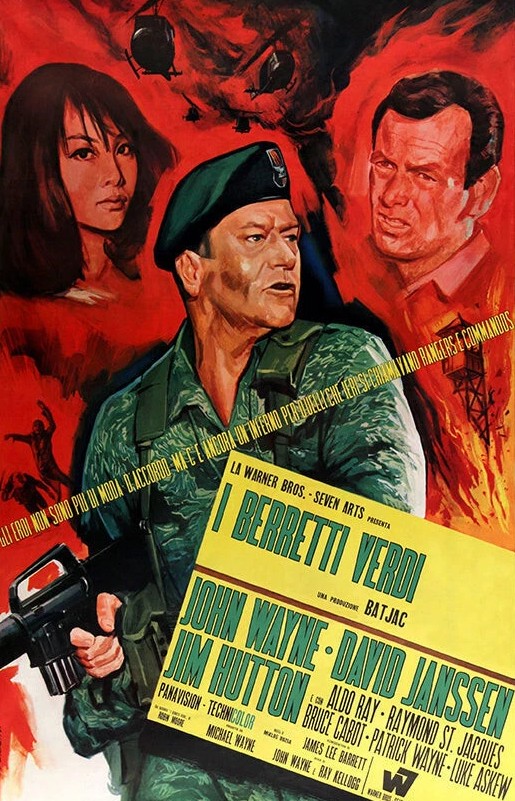
But exactly what LeRoy contributed over the next six months was open to question. Some reports had him directing all the scenes involving the star; others took the view that primarily he played the role of consultant, on set to offer advice. Even with his presence, the movie came in 18 days over schedule – 25 per cent longer than planned. Unlike the later Apocalypse Now (1979), it didn’t go anywhere near South-East Asia so the location didn’t add any of Coppola’s lush atmosphere, though the almost constant rain in Georgia, while a bugbear for the actors, helped authenticity.

It was filmed instead on five acres of Government land around Fort Benning, Georgia, hence pine forests rather than tropical trees.  President Lyndon B. Johnson and the Department of Defense offered full cooperation. But that was only after the producers complied with Army stipulations regarding the screenplay. James Lee Barratt’s script was altered to show the Vietnamese involved in defending the camp and the kidnapped was switched from being over the border. Also axed, though this time by the studio, was Wayne’s wish for a romantic element – the studio preferred more action. Sheree North (Madigan, 1968) was offered the role of Wayne’s wife but she also turned it down on political grounds. Vera Miles (The Hellfighters, 1968) was cast but she was edited out prior to release.

The Army provided UH-1 Huey helicopters, the Air Force chipped in with C-130 Hercules transports,  A-1 Skyraiders and the AC-47 Puff the Magic Dragon gunship and also the airplane that utilized the skyhook system. Actors and extras were kitted out in the correct jungle fatigues and uniforms. Making a cameo appearance was Col Welch, commander of the Army Airborne School at Ft Benning. The sequence of soldiers doing drill was actually airborne recruits.

The attack on the camp is based on the Battle of Nam Dong in 1964 when the defenders saw off a much bigger enemy unit.

This set was built on a hill inside Fort Benning. The authentic detail included barbed wire trenches and  punji sticks plus the use of mortar fire. While the camp was destroyed during filming the other villages were later used for training exercises. .

The pressure told on the Duke physically – he lost 15lb. But the oppressive heat and weather of that location – it was mostly shot in summer 1967 – was nothing compared to the reviews. It was slated by the critics with Wayne’s age for an active commander called into question, never mind the parachuting, the gung-ho heroics and the dalliance in an upmarket nightclub.

“In terms of Wayne’s directorial career,” wrote his biographer Scott Eyman, “The Alamo has many defenders, The Green Berets has none.” That assessment, of course, would be to ignore the moviegoers around the world who bought tickets and put the picture into reasonable profit.

Wayne was clear in his own mind about the kind of movie – “about good against bad”  – he was making and accommodated neither gray areas nor took note of current attitudes to the war as exemplified by nationwide demonstrations. Co-stars David Janssen, Jim Hutton and George Takei were opposed to the war. Takei, a regular on the Star Trek series, missed a third of the episodes on the second season; his lines were written to suit the character of Chekov, who went on to have a bigger role in the television series. Composer Elmer Bernstein turned down the gig as it went against his political beliefs. “The Ballad of the Green Berets,” heard over the opening credits was not composed for the film, having been released two years earlier.

Most critics hated it – “Truly monstrous ineptitude” (New York Times); “cliché-ridden throwback” (Hollywood Reporter); “immoral” (Glamour). Even those reviews that were mixed still came down hard: “rip-roaring Vietnam battle story…but certainly not an intellectual piece” (Motion Picture Exhibitor). Not that Wayne was too concerned. At the more vital place of judgement – the box office – it took in $9.5 million in rentals (what’s returned to the studios once cinemas have taken their cut) – $8.7 million on original release and a bit more in reissue – in the U.S. alone plus a good chunk overseas.

It was virtually impossible to examine a movie like this without taking a political stance. Other movies covering the same topic were allowed greater latitude regarding authenticity, audiences and critics like appearing to accept that creating watchable drama often took precedence over the facts. Both The Deer Hunter (1978) and Apocalypse Now, considered the best of this sub-genre, clearly ventured away from strict reality. With over half a century distancing the contemporary viewer from those inflammatory times, it’s worth noting that it still divides critics. Or, rather, critics and the general public take opposing views.

Although Rotten Tomatoes deems it “an exciting war film”, the critics voting on that  platform gave it a lowly 23 per cent favourable report compared to a generally positive 61 per cent from the ordinary viewer. That contrasts, for example, with a more even split for the likes of Exodus (1960) – 63 per cent from critics and 69 per cent from audiences. However, The Green Berets attracts twice as much interest, collaring 9,000 votes compared to just 4,300 for Exodus.

After this, Wayne’s fee went up to a flat million bucks a picture. “He wasn’t a guarantee of success,” explained his son Michael, “he was a guarantee against failure.” At this point in his career, he was gold-plated. Where other stars in his commercial league suffered the occasional box office lapse – Paul Newman’s career in the 1960s, for example, was riddled with flops like The Secret War of Harry Frigg (1968) – he did not. Especially with a global following, his pictures never lost money.

SOURCES: Michael Munn, John Wayne, The Man Behind the Myth, Robson, 2004; Scott Eyman, John Wayne, The Life and Legend, Simon and Schuster, 2014; Brian Hannan, The Magnificent 60s, The 100 Top Films at the Box Office, McFarland, 2023; Robin Moore, Introduction, The Green Berets, 1999 edition, Skyhorse Publishing; Laurence H. Suid, Guts and Glory, University of Lexington Press, 2002; The Making of The Green Berets, 2020; Review, Hollywood Reporter, June 17, 1968; Review, Motion Picture Exhibitor, June 19, 1968; Renata Adler, “The Absolute End of the ‘Romance of War’”, New York Times, June 30, 1968; Glamour, October 1968; “Big Rental Pictures of 1968,” Variety, January 8, 1969.
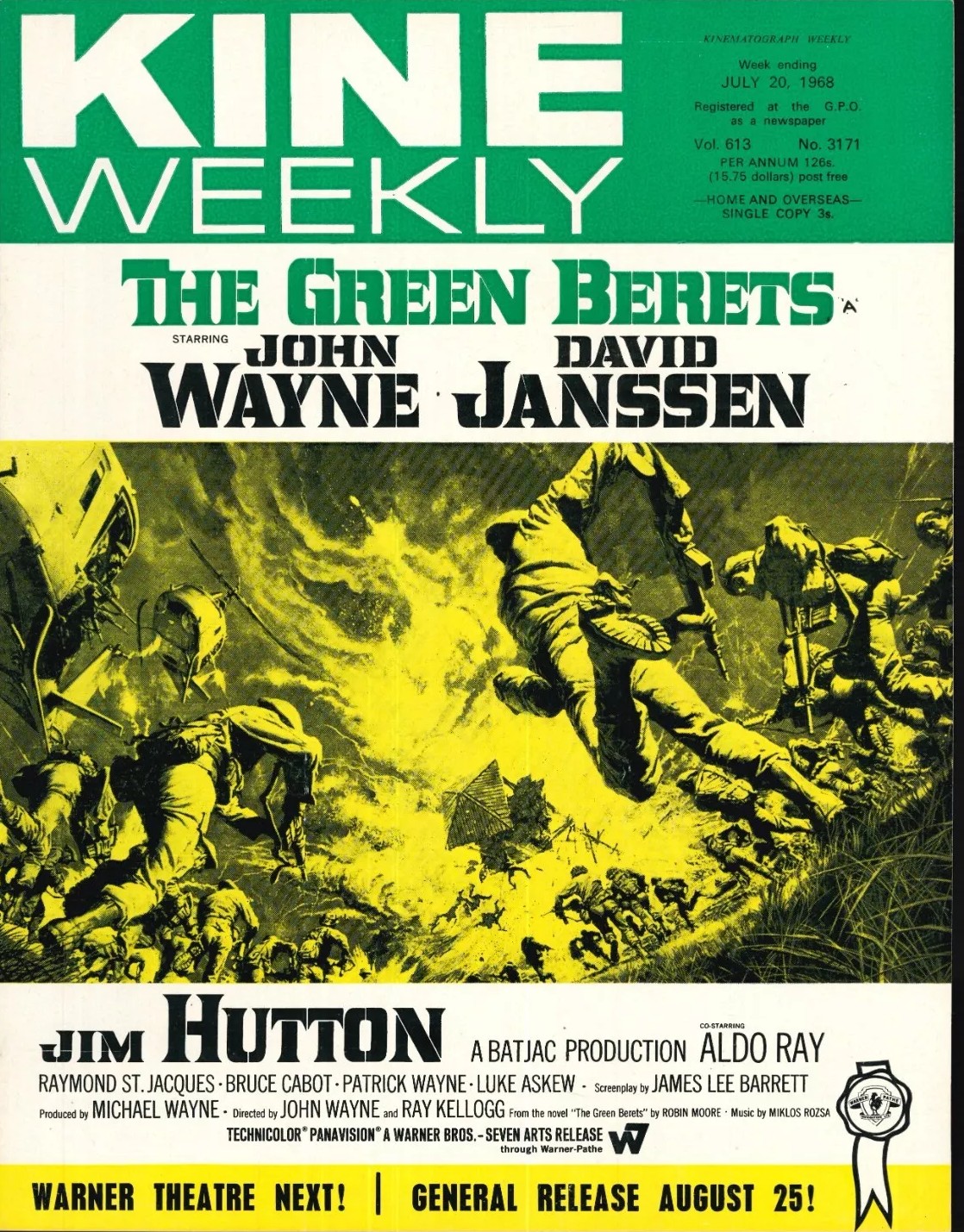
The Green Berets (1968) ***

Apart from attempts to justify the Vietnam War and a hot streak of sentimentality, a grimly realistic tale that doesn’t go in for the grandiosity or self-consciousnesss of the likes of Apocalypse Now (1979), The Deer Hunter (1978) and Platoon (1978). It’s been so long since I’ve watched this that my DVD is one of those where you had to turn the disc over in the middle.

The central action sequence is a kind of backs-to-the-wall Alamo or Rorke’s Drift siege. There’s no sense of triumphalism in the battle where the best you can say is that a reasonable chunk of the American soldiers came out alive but only after evacuating the staging post they were holding, more like Ridley Scott’s Black Hawk Down (2001) where survival is all there is to savor. It’s all pretty brutal stuff, the Americans handicapped by having to also look after the fleeing Vietnamese villagers taking refuge in their camp.

There are plenty grim reminders of how war has become even more devastating in the aftermath of World War Two. The Vietcong take, literally, no prisoners, seen as killing civilians as easily as soldiers. The Americans, for their part, have no compunction in using more sophisticated weaponry, with the addition of targeted air strikes.

Into the mix, somewhat unnecessarily, comes left-wing journo George (David Janssen) whose main job is to change his mind about the work the soldiers are doing, though admitting that to report the truth will lose him his position. He’s slung into the middle of a defensive action headed up by Col Kirby (John Wayne) to hold a position under threat against superior (in numbers) forces. There’s a fair bit of the detail of war but virtually zero about the strategy, whether that’s the U.S. Army’s plan to defeat the enemy or this individual unit’s method of defending this position. Apart from extending the perimeter of the camp to create a more effective killing zone, it’s hard to work out what the heck is going on, no matter how often orders are barked through field telephones or walkie talkies. There are squads out in the field and units in the camp and how the whole operation is meant to mesh is beyond me.

There’s not much time to flesh out the characters, save for “scrounger” Sgt Peterson (Jim Hutton) who adopts an orphan, Vietnamese soldier Capt Nim (George Takei) and Sgt Provo (Luke Askew). The rest of the motley bunch are the usual crew of monosyllabic tough guys and friendly medics and whatnot.

Though the emotional weight falls on Lin (Irene Tsu), fearing shame and being ostracized by her family for befriending the Vietcong general who killed her father and for whom she now lays a honeytrap, Kirby expresses guilt at having to kill anybody.

Despite being sent out to reinforce the position, the Americans are forced to retreat and enjoy only a Pyrrhic victory when the cavalry, in the shape of an airplane, arrives to mow down the enemy after they have captured the position.

The fighting is suitably savage, and there is certainly the notion that the Americans are not only being out-fought but out-thought and that no amount of heavy weaponry is going to win the day.

Possibly to prevent the idea of defeat destabilizing the audience, the movie shifts into a different gear, more the gung-ho commando raid picture that the British used to do so well, where Kirby heads up an infiltration team to capture the Vietcong general who has been seduced by Lin. This sets up a completely different imperative, all stealth and secrecy, the kind of operation that in the past would have been a whole movie in itself rather than the tag-end of one.

While the prime aim of this is to have the audience leave the cinema happier than if they had just witnessed the retreat from the camp, in fact it also serves two purposes. One is worthwhile, to emphasize the sacrifices made by the Vietnamese. Lin, having agreed to prostitute herself, fears being cast out as a result. But the other outcome of this mission is to kill off Sgt Peterson thus leaving the little Vietnamese lad even more orphaned than before.

John Wayne (The Sons of Katie Elder, 1965) doesn’t attempt to gloss over the weariness of his character. Jim Hutton (Walk, Don’t Run, 1966) shifts with surprising ease from comedy to drama. Even as a cliché David Janssen (Warning Shot, 1966) is underused. Watch out for Aldo Ray (The Power, 1968), George Takei (original Star Trek series), Raymond St Jacques (Uptight, 1968), Luke Askew (Flareup, 1969) and Irene Tsu (Caprice, 1967).

Three hands were involved in the direction: John Wayne, veteran Mervyn Leroy (Moment to Moment, 1966) and Ray Kellogg (My Dog, Buddy, 1960). Written by James Lee Barrett (Bandolero!, 1968) from the book by Robin Moore. Worth pointing out the score by triple Oscar-winner Miklos Rosza (The Power, 1968) especially the low notes he hits to provide brooding tension.     

Certainly a mixed bag, the central superb action sequence weighted down by the need to find something to shout about.

The Truth about Spring (1965) ***

Although a truly innocent movie about young love, wrapped up in a sunken treasure scenario, the marketeers then and now could not resist trying to inject elements of sexuality, the poster for the original movie highlighting what would be Hayley Mills’ second screen kiss (following a smacker from Peter McEnery in The Moon-Spinners the year before), the poster for the DVD sticking the star in a bikini that she does not wear in the film.

The film was based on the 1921 novel Satan: A Romance of the Bahamas (filmed as Satan’s Sister in 1925 with Betty Balfour) by Henry de Vere Stacpoole, who had previously dallied with young love in The Blue Lagoon.  Despite the title, there was a complete absence of the demonic. In the book, she is sailing with her brother. That character was eliminated in favour of a father.

The 1960s teen movie that could as easily morph into angst (Splendor in the Grass, 1961), blackmail (Kitten with a Whip, 1964) or madness (Lilith, 1964) was generally more at home with innocence. The beach party movies and series like Gidget rarely involved more than a stolen kiss, the characters all clearly virgins, and certainly did not go down the brazen sexuality route that would mark the second half of the decade.

Hayley Mills is on charming form as tomboy Spring Tyler (hence the title) sailing the Caribbean as mate to her conman father Tommy (played by her real-life father John Mills). Their idyllic life is heading for the rocks since the father didn’t “figure on the little girl growing up.” With one eye on providing a suitor for his daughter, the skipper takes on board a Harvard Law School graduate William (James MacArthur) ostensibly to give him experience of fishing.

True love takes its time since the girl has no intention of growing up and prefers a life of independence. Initially, they are sparring partners – she mocks the fact that he wears pyjamas. But once the story kicks off, they find they have more in common.

The sunken treasure element, while slim, is enlivened by some over-the-top acting by Jose (Lionel Jeffries) and Judd (Harry Andrews). The three leads are actually quite good, John Mills (Tunes of Glory, 1960) totally convincing as a effectively a spiv on the high seas with Hayley Mills (The Family Way, 1966) as the independent woman (“I’m me so don’t expect anything else”) and the confident sailor becoming entangled in unexpected emotions.

Surprisingly, James MacArthur, also a graduate from the Disney acting school, though a decade older than Hayley Mills, shows unexpected subtlety, and this would be a springboard to more demanding roles in cold war thriller The Bedford Incident (1965) and WW2 epic Battle of the Bulge (1965). Cocky and rich, he is quickly brought down earth when she proves a faster swimmer and plays tricks on him. But he soon proves his worth.

Director Richard Thorpe’s career was winding down after four decades in the business and this was a far cry from MGM spectaculars Ivanhoe (1952) and Knights of the Round Table (1953) and even Jailhouse Rock (1957) but he keeps a tight rein on the narrative, makes good use of the scenery (Spain doubling for the Caribbean) and walks the delicate line of allowing the adolescents to explore their feelings with tipping over into anything more overt.

He was a better director than the material deserved, but then so was writer James Lee Barrett who the same year would receive screen credit for The Greatest Story Ever Told and western Shenandoah. However, their involvement made it an accomplished little picture and gave audiences a taste of what Hayley Mills could do in a film that did not tether her to child star mode.

The New York Times second-string reviewer Howard Thompson, in tagging the star “this delectable miss, now all of 18” opined (review, June 17, 1965) that the “two young people are the most winning advertisement for young love in a long time.”

https://amzn.to/3SKJ4Q2

Behind the Scenes: “Bandolero” (1968)

A western dream team. Beginning with Winchester ’73 (1950) James Stewart had revived his career post-World War Two with a string of tough westerns and had made seven movies in the genre in the 1960s including The Man Who Shot Liberty Valance (1962) and Shenandoah (1965). Starting with Rio Bravo (1959) Dean Martin had made six including The Sons of Katie Elder (1965). Genre debutante Raquel Welch had hit the box office running with One Million Years B.C. (1966) and Fantastic Voyage (1966). Following McLintock (1963) and Shenandoah, director Andrew V. McLaglen was considered one of the hottest western directors around.

Legendary Twentieth Century Fox producer Darryl F. Zanuck put together the cast and director as a “package” before calling in screenwriter James Lee Barrett (Shenandoah) to shape an idea by producer Stan Hough. McLaglen explained: “It was a Zanuck thing from the beginning.” He was working on another picture when he took a call from Zanuck. “I got a six-page outline for a western,” said Zanuck, “and I figure you ought to direct it. James Lee Barrett out to write it and Jimmy Stewart, Dean Martin and Raquel Welch ought to be in it. Nobody else. That’s the combination I want.” McLaglen took Hough’s six-page outline to Barrett who wrote it based on the actors involved.

Originally entitled Mace after the James Stewart character, the movie quickly became Bandolero!, the exclamation mark possibly to differentiate it from the 1924 Spanish picture of the same name which had been made for Metro-Goldwyn (as the studio was then known).

Despite the success of the Matt Helm spy pictures and a number of decent westerns, Dean Martin ceded top billing to James Stewart (had they shared the billing, Martin would have come first in the traditional alphabetical order).

Marc Eliot, one of Stewart’s biographers, arrived at a more unlikely scenario for the movie being greenlit, concluding that because Martin and Stewart had got on so well when the latter appeared on the former’s television show they decided to make a picture together. Given the show was taped in summer 1967 and the movie went into production a few months later it left an improbable amount of time for the picture to be set up.  

Director Andrew V. McLaglen would be reunited with two of his favorite movie characters – screenwriter James Lee Barrett and James Stewart, both key to Shenandoah. The actor had been the driving force behind McLaglen’s recruitment for that Civil War picture. “I just loved working with him,” said the director, “it got to the point where any time he did a movie he wanted me to direct it.” He viewed Barrett as “one of the best dialog writers I’ve ever known in movies.”

Although theoretically, the movie was set up as a package, with stars and director in place, Dean Martin remained a doubt since he was already committed to a film with Columbia that might clash. And Stewart might easily have dropped out if producer Frank McCarthy’s plans for Patton, with Burt Lancaster in the title role and Stewart as General Omar Bradley, had come to early fruition.

Raquel Welch was on a publicity high, featured on 400 magazine covers, generating such industry buzz that she had been named “International Star of the Year 1967” by U.S. cinema owners, her growing screen popularity ranking her eleventh in Box Office magazine’s female “All-American Favorites of 1968.” Dean Martin, incidentally, came ninth on the corresponding male chart, two places above Clint Eastwood, Paul Newman topping the poll.

George Kennedy (Cool Hand Luke, 1967) had small parts in Shenandoah and The Sons of Katie Elder before graduating to second male lead in McLaglen’s previous western The Ballad of Josie (1967). McLaglen, you might like to know, was highly regarded by the trade as “more concerned with entertaining the public than making intellectual and emotional demands on the audience.” Just after the movie’s launch the director signed a two-picture deal with Fox, The Undefeated (1969) next on his dance card.

One of the few studios to persist with a talent school – Welch claimed as the most recent high-flying graduate – Fox gave current student Clint Ritchie a role in Bandolero!, others in the Class of 1968 including Jacqueline Bisset (The Sweet Ride, 1968) and Linda Harrison (Planet of the Apes, 1968). Relative newcomer Andrew Prine had acted with Martin in Texas Across the River (1966) and enjoyed a supporting role in McLaglen war picture The Devil’s Brigade (1968).

As well as genre newcomers Welch and Ritchie, the cast included western character actors like Will Geer (Winchester ’73), Don “Red” Barry (The Adventures of Red Ryder, 1940) and  Harry Carey Jr. who had appeared in three previous McLaglen westerns. Even current “Tarzan,” Jock Mahoney, who played Maria’s husband, had a string of B-westerns in his portfolio. Possibly as important was the presence of James Stewart’s horse Pie, his onscreen companion for two decades.

Shooting began in Paige, Arizona, on October 2, 1967, before shifting two weeks later to Brackettville and the Shaban ranch where The Alamo (1960) was filmed. Parts of the San Antonio de Bexar set were revamped as the Texan town of Val Verde where the hanging in the film took place, while The Alamo doubled as the Mexican village of Sabinas which provided the action for the climax. Seven buildings were added to the San Antonio set including the jail, while a curio shop was transformed into a bank, a gift shop became a hotel and, conversely, an old hotel was turned into a general store. Thirty-five thousand traditionally-cast adobe bricks were made on site to create the dozen buildings required for Sabinas plus the locale’s arch, fountain, wells and wall.  

Other locations included Arizona, Utah and Texas with interiors filmed at the Fox studios. The shootout between the posse and the outlaws was filmed near Turkey Mountain in Texas. The Rio Grande was forded at Devil’s River but Mace crossed the river at Pinto Creek. Glen Canyon National Recreation Area was utilized for the bandit attack and, naturally enough,  for sequences requiring canyons. Other scenes were shot at Lee’s Ferry in Arizona, Balanced Rocks, and Big Water in Utah. But the first time we view Sabinas is an effects shot.

You do wonder why this film entered the studio books as costing $5 million. None of the principals were in the million-dollar salary range and the cost of 40 days shooting at the Shaban ranch was put at $25,000 a day.

The principals eventually enjoyed on-set camaraderie. Initially, Welch was too serious for the others, bombarding the director and more experienced actors with questions about her character’s motivation and psychology. “I wouldn’t say creativity was the primary concern on that picture,” commented the actress. “Barrett was there mainly because everybody said nobody could write dialog for Jimmy like he could. As far as other things in the script were concerned, they weren’t really supposed to be questioned.

“And with McLaglen it was all by the book. McLaglen created a very constrained atmosphere. It was an inoffensive nine-to-five project with a lot of very senior people, the old John Ford gang. Very cliquish. Except for Jimmy who’d always kind of throw out little things. I felt pretty lonely the whole shoot.”

To “loosen her up,” the two stars invited her out to dinner and “got her good and drunk.” Remembers McLaglen, “Dean and Jimmy and I would take Raquel Welch to dinner and we’d kid around with her.” Quite whether that was sufficient to rid Welch of her feelings of alienation was never established. However, she did register that she was surrounded by talent. Stewart “could cry on cue. No mess, no fuss. Just like that you could see tears in his eyes.

McLaglen equally enjoyed an esprit de corps with the male stars. “When I think of my time with Dean, there’s nothing but joy in my heart…without doubt the most conscientious actor I have ever worked with,” adding, “I think Jimmy had more fun on that location than he ever had.”

Texas was chosen for the June 1968 launch on the grounds that Shenandoah had done so well there. Instead of a city-by-city premiere lasting a week with many stars in attendance, the studio opted for a “new kind of premiere,” opening night at the Majestic in Dallas accompanied by a 30-minute live telecast broadcast to 23 Texas television stations. Also available was a 16mm featurette on Welch promising “an intimate look at a new star.” Welch contributed her vital statistics and preferences to a computer program that would help select the winner in a beauty contest to find the woman closest to the star in looks and personality.

Stewart, of the tub-thumping generation, believed stars should hit the publicity trail, public appearances adding 10 per cent to the gross, rather than insisting it was beneath their dignity or not worthy of their time. He claimed publicity tours were “good for the soul. Unless he has a real bitter selfish attitude (an actor) has to enjoy getting out to different parts of the country and meeting people.” Raquel Welch was one of the stars he chided for adopting the wrong attitude with autograph hunters.

Little of the weaponry seen on screen was from the period, the movie being set in 1867. And even the supposed Remington 1858 New Army revolver used by Martin, Kennedy and Welch, was improvised from another pistol. But Stewart used a genuine Single Action Army “artillery” revolver. There was some cheating going on, Martin firing a Winchester 1892 saddle ring carbine, and others using a Winchester model 1892 rifle and a Winchester Model 1873 carbine.

Despite claims by James Stewart biographer Gary Fishgall that the “film opened to near-instant obscurity” Bandolero! proved a solid box office success in the United States, where it was the top western for the year, finishing 18th in the annual chart, collecting $5.5 million in rentals (not gross) and performing very well overseas. It was a signal year for westerns, though some languished. Hang ‘Em High was 20th with $5 million, The Good, The Bad and the Ugly 24th ($4.5 million), Five Card Stud 34th ($3.5 million) and The Scalphunters 43rd ($2.8 million).  In the flop category were Will Penny in 54th spot ($1.8 million), Villa Rides 75th ($1.2 million), Firecreek 79th ($1.2 million) and Shalako 85th ($1.1m).

SOURCES: Gary Fishgall, Pieces of Time, The Life of James Stewart, (Scribner, 1997) p314; Marc Elliot, James Stewart, A Biography, (Aurum, 2007, paperback) p365; Howard Hughes, “Welch Out West Part 1,” Cinema Retro, Vol 11, Issue 31, 2015, p10-17; internet movie firemarms database; “Raquel Welch To Get Int’l Star Award,” Box Office, February 19, 1967, p4; “Mace Retitled Bandolero!,” Box Office, August 7, 1967, pE6; “Cast Patton and Bradley,” Variety, September 20, 1967, p13; “Bandolero! Moves to Texas Oct 16,” Box Office, October 16, 1967, pC1; “Filming of Bandolero! Ending at Bracketville,” Box Office, December 4, 1967, pSW1; “Fox On Texas Trail for Kickoffs,” Variety, May 15, 1968, p32; “James Stewart: Stars Should Tout Films in Television Age,” Variety, May 29, 1968, p19; “Now There’s A New Kind of Premiere,” advertisement, Variety, June 12, 1968, p17; “Bandolero! Dallas World Premiere Covered Live By 23 TV Stations,” Box Office, June 24, 1968, pSW1; “Fox’s Talent School,” Variety, June 26, 1968, p13; “20th-Fox Signs McLaglen to Two-Picture Pact,” Box Office, August 26, 1968, pW1; “Big Rental Films of 1968,” Variety, January 8, 1969, p15.

Discover WordPress

A daily selection of the best content published on WordPress, collected for you by humans who love to read.

The Atavist Magazine

by Brian Hannan

WordPress.com News

The latest news on WordPress.com and the WordPress community.