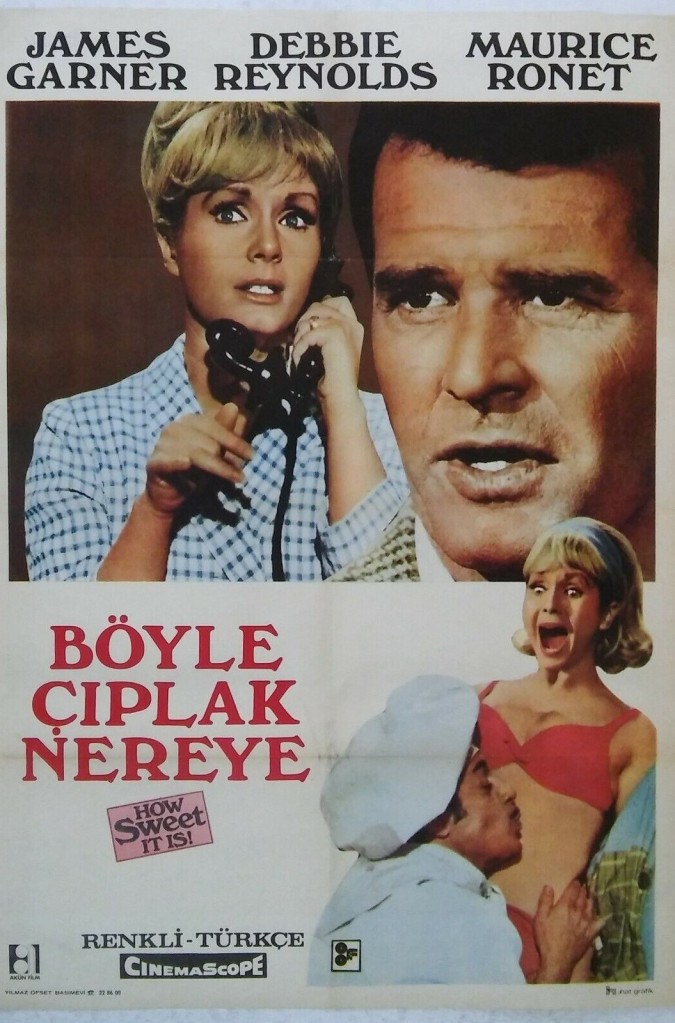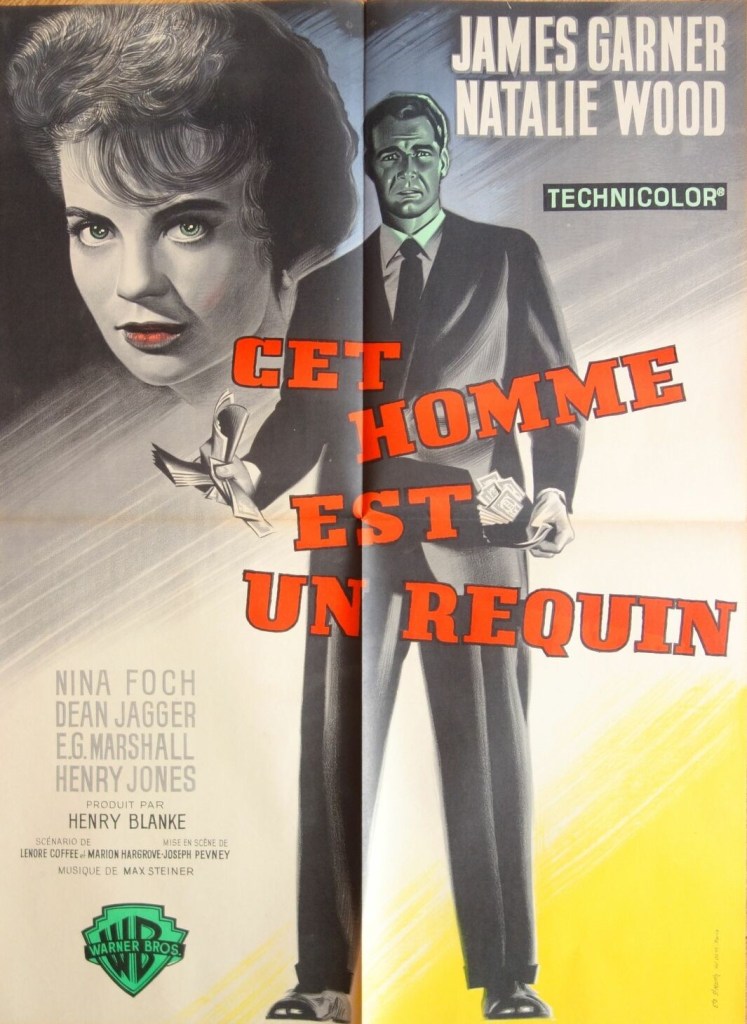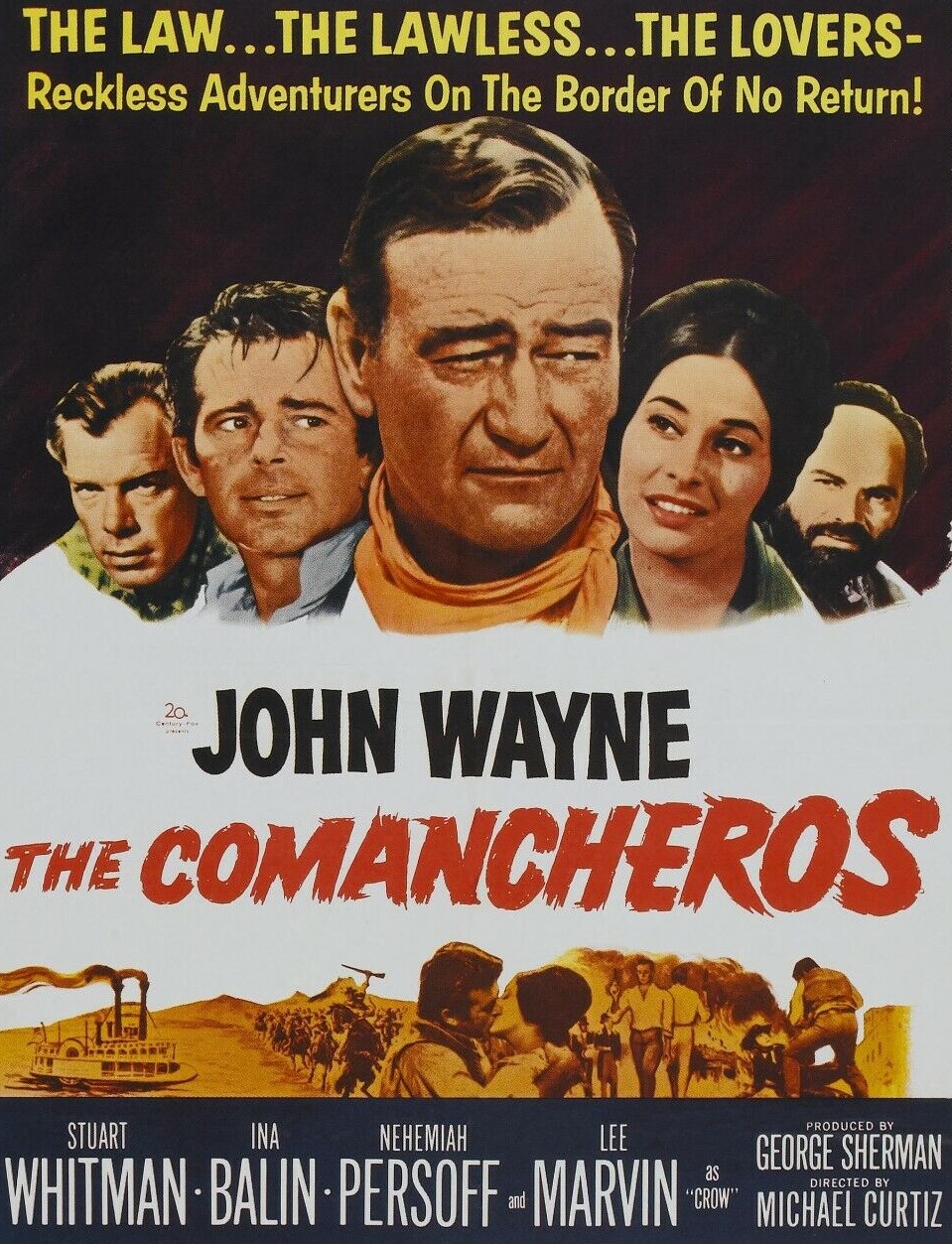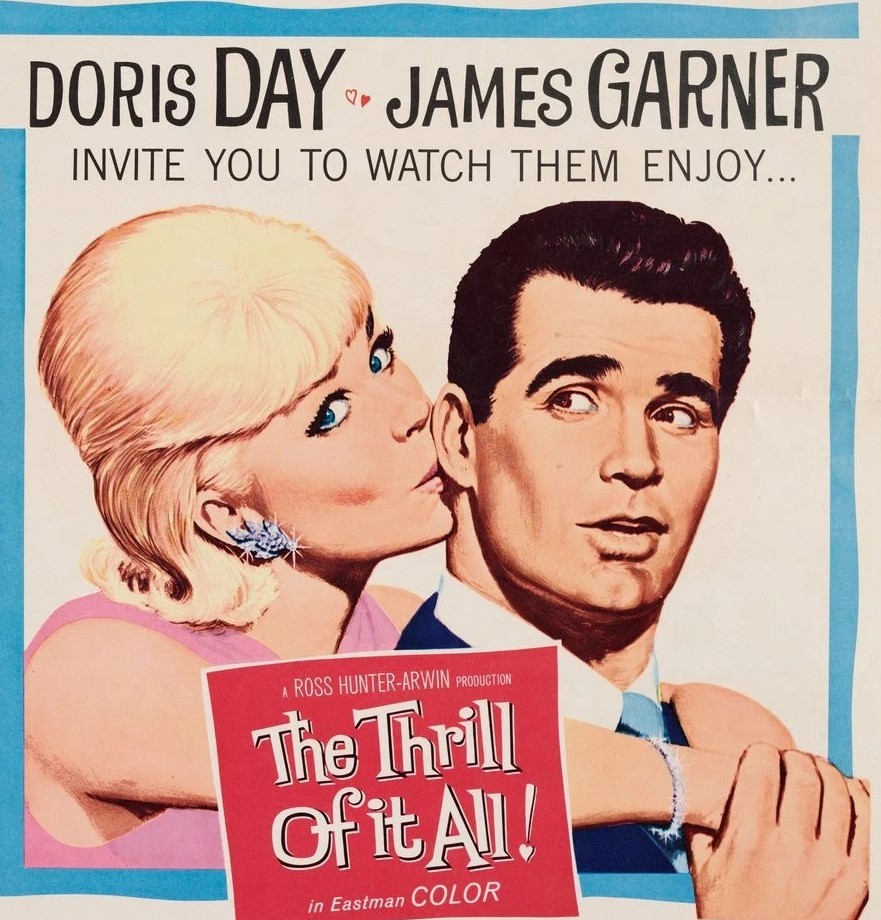
The Thrill of It All (1963) ****

Has three unusual distinctions for a Doris Day comedy. First of all, it’s feminist. Secondly, it’s prophetic. Third, and perhaps most interesting of all, is that it plays exactly into  expectations – for completely different reasons – for audiences sixty years apart. Only the ending would split the audiences.

And this is a somewhat mature Doris Day. Having shucked off Rock Hudson and Cary Grant, she was no longer stuck in a relatively mindless, however charming, love story following the usual formula of girl-meets-boy girl-loses-boy girl-gets-boy. Here she’s contented housewife Beverly Boyer married to successful obstetrician Dr Gerald Boyer (James Garner) with two kids apt to cause disruption but whose main purpose, equally unusually, is to make caustic comment about grown-up behavior. There is one magnificent outlandish set-piece involving soap powder but the slapstick is toned down and there’s a gentle satire of the television industry and advertising.
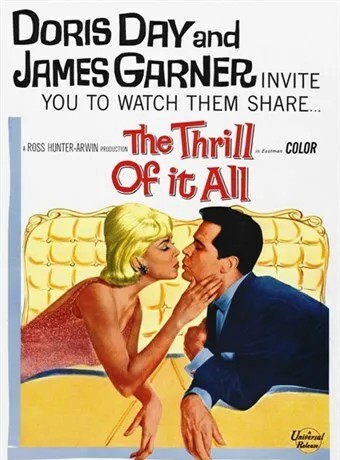
There’s only one downside to the marriage, her husband is being called out at all hours to deliver babies and that’s such a worthy calling what decent wife could complain about such absences even if it means spoiled dinners and missing events.

However, everything is turned upside down when by pure chance Beverly takes on the role of becoming the onscreen spokesperson for a brand of soap called Happy Soap. This being in the days of live television – so this is set strictly in the 1950s hence the more pronounced tone of a woman’s place being in the home – she has to do the advertisement live on air and her fumbling and inexperience touch a chord with audiences who respond with such vigor that she is offered a contract that puts her in the position of earning substantially more than her husband. How dare she?

Naturally, the demands placed upon her by the advertising company turns the domestic tables. She’s the one coming home late and he’s the one seen as her adjunct. The soap powder boss is so determined to keep her he fulfills every whim – even when such wishes are not made with any seriousness. So she wakes up one morning with a swimming pool in the back yard which virtually demands that a car drive straight into it.
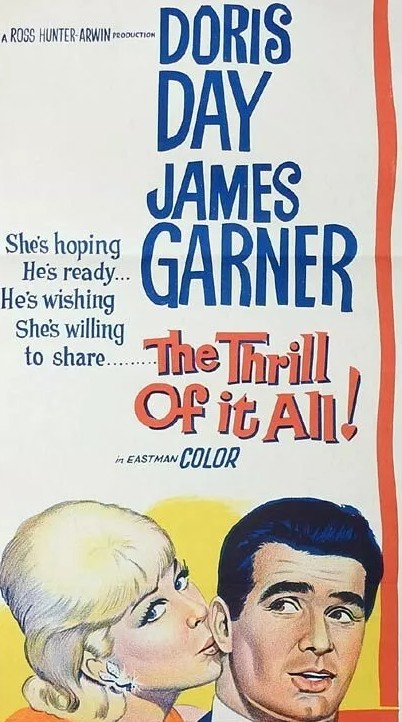
The battle of the sexes comes down a battle of women’s rights (yes, they are mentioned) against men’s rights, in other words freedom vs toeing the line. Rather than delighted at her extra dough, he’s infuriated that she’s infringing on his perceived role as being the sole provider for the family.

Eventually, he decides the only way to bring her to her senses is to arouse her jealousy by being seen in the company of other women. But that only works up to a point. And she only gives in when she is made to realize – by the only narrative misstep as far as the contemporary audience is concerned – that his job is much more important than hers.

While this is the first of two pairings – the other being Move Over, Darling the same year – between Doris Day and James Garner (Hour of the Gun, 1967) is lacks the purer screen chemistry she found with Cary Grant and Rock Hudson and you feel the plot has been written to accommodate this deficit. There’s little requirement for intimacy or proper wooing, much less for the misunderstandings that fueled the previous pairings.

Doris Day’s haplessness is put to a different use, as it is initially the reason why she proves so appealing to television audiences.

Whether women in the 1960s had to keep to themselves their rooting for the career women in Beverly being given a chance to shine, or whether – the beginnings of the modern feminist movement dating from the publication of The Feminine Mystique by Betty Friedan published in 1963 – she was seen as a poster girl for the movement I’m not qualified to judge.

These days, however, Beverly would be viewed as an early champion of women’s rights and that, regardless of how important it was that a man tasked with delivering babies had a woman at home to make his dinner and mop his brow, his demands should not take priority.

While there aren’t as many outright laffs as in previous Doris Day comedies, the feminist angle provides the picture with an unusual worthiness, not something you’d go looking for in Day’s portfolio.

Directed by Norman Jewison (The Thomas Crown Affair, 1968) and written by Carl Reiner (The Art of Love, 1965).

Passage of time has made this more important than the material might suggest. Gets extra marks for serious intent.
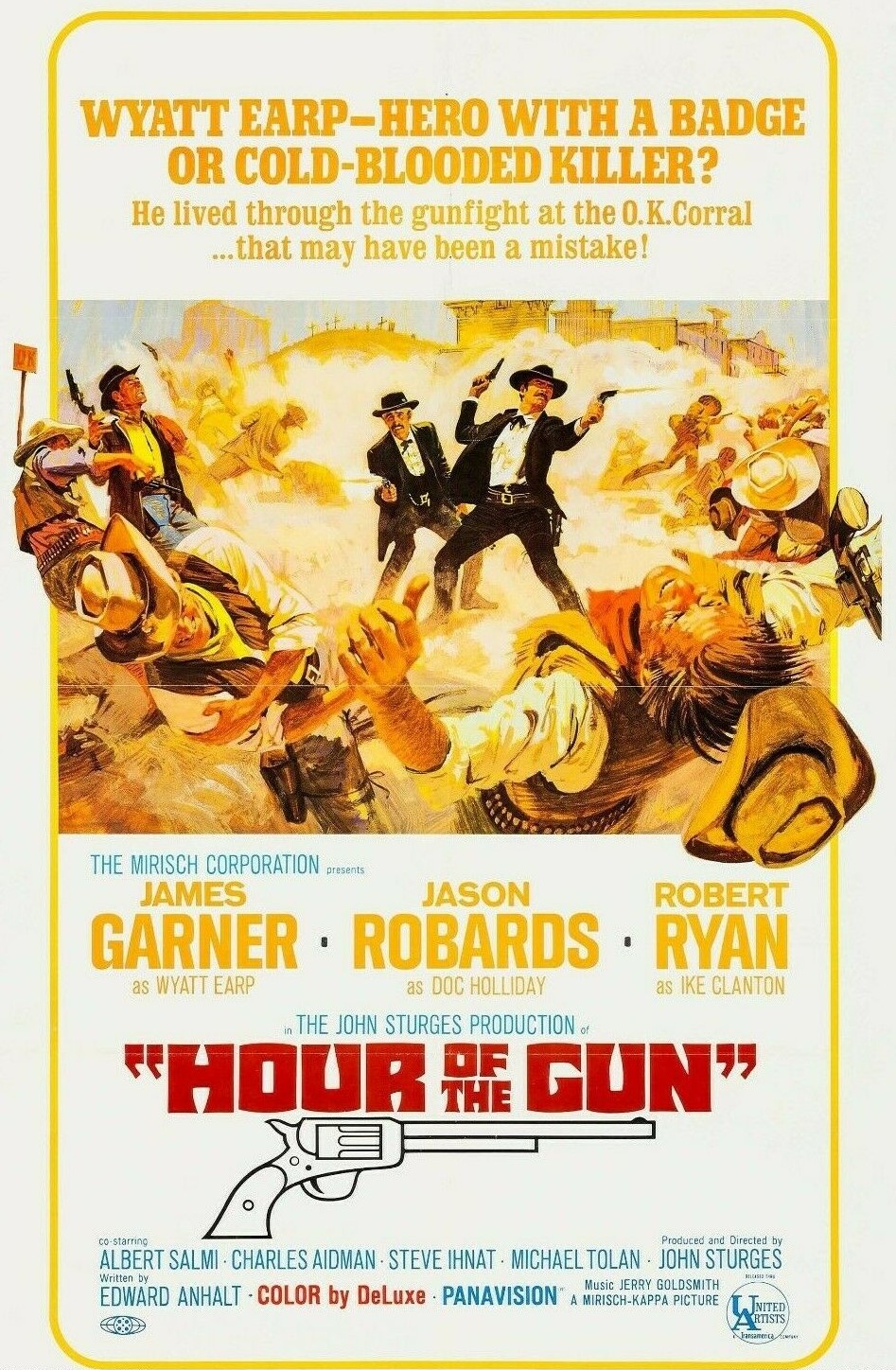
Hour of the Gun (1967) ****

The second version of the Gunfight at the O.K. Corral follows on from the Burt Lancaster-Kirk Douglas 1957 version also directed by John Sturges and precedes Doc (1971) reviewed yesterday. Good chance to compare the differing approaches.

Destroy a legend at your peril. Mythic western hero Wyatt Earp (James Garner) goes down’n’dirty after the death of his brother, spurning law and order to turn bounty hunter, which is legitimate, and then vigilante, which is not, in pursuit of Ike Clanton (Robert Ryan). A revisionist western, then, with director John Sturges substantially reimagining the image of Earp he had been instrumental in creating through Gunfight at the O.K. Corral (1957), a box office smash starring Lancaster as Earp and Douglas as sidekick Doc Holliday.

The first change is to keep Clanton alive, having been a casualty in the previous picture. The opening sequence sets the record straight. But corruption and the law acting in conjunction pull Earp and Holliday (Jason Robards) up on criminal charges though they are found innocent. When corrupt law fails to work, Clanton resorts to ambush, killing Earp’s brother. Clanton organises a posse of twenty men to kill Earp while the lawman sets up his own, smaller, team of bounty hunters.

It soon transpires Earp’s warrants are little more than “hunting licenses” and although marginally he errs on the side of fairness the odds, courtesy of his superior gunplay, remain substantially stacked in his favour and he picks off the villains one by one, pursuing Clanton into Mexico.

This is the story of Wyatt Earp in transition, shifting into lawlessness, at a time – 1881 – when the West itself was undergoing dramatic change, big business from the East forcing greater acceptance of the law (and using it for their own purposes), the growth of the cattle barons and the gradual elimination of the gunslinger, gunfighter and criminal gangs. There’s no room for romance as there was in O.K. Corral and The Magnificent Seven (1960) just pitiless determination to revenge. But there’s little of the all-male camaraderie that informed The Great Escape (1963). Earp and Holliday remain tight but the others in their gang have been somewhat forcefully enlisted.

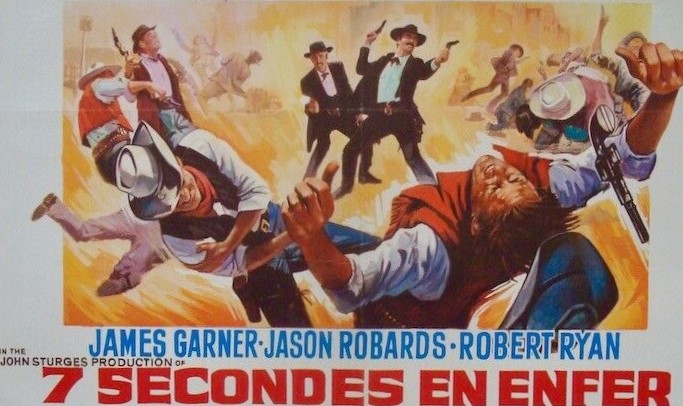
The poster is very misleading, giving the impression of an all-action
gun-toting movie rather than one of somber reflection.

The best scenes are the result of Earp conniving, revealing a streak Machiavelli would have envied, even duping Holliday, until it’s clear the Earp of legend has been vanquished. Sturges congratulates himself on telling the “truth.” But that’s the problem. The truth involves a lot of background that slows the picture down. And presenting Earp as transitioning is pretty much a blatant lie. Earp was clearly as ruthless killer at the O.K. Corral as he is now and no amount of pointing to corrupt law can eliminate the fact that the lawman prefers to kill villains rather than see them face justice. So there’s really no transition. Earp is a more civilized version of The Man With No Name. But at least he accepts it. There’s no hypocrisy involved.

The two principals are superb, shucking off the mannerisms that previously defined their screen personas. Gone is the trademark James Garner cheeky chap, the grin and even the slicked-back hairstyle. He is your father in a continually bad mood now rather than your favorite uncle full of japes. How much Sturges pinned back Robards’ capacity for over-acting can be seen by comparing this with the actor’s performance in Once Upon a Time in the West (1968).

Full marks for Sturges in trying to tell a complex, morally ambivalent, story, and he avoids the more grandiose approach to changes in the West as instanced in Once Upon a Time in the West. The early courtoom scenes slow down the narrative when a couple of lines of dialog could have done the same job. But it is exceptionally true in its depiction of Earp. There is not a bone of redemption in his body. He is going on a killing spree and he doesn’t care who knows it or how it damages his reputation, still high enough before the final episode of the revenge hunt for him to be touted as a future lawman-in-chief for Arizona.

Nor does Doc Holliday offer anything in the way of consolation. This isn’t like The Wild Bunch where a ruthless band of robbers convince themselves they have a code of honor and provide rough camaraderie as a way of filling in the emotional gaps in their lives. Holliday mistakenly sees Earp as man who could not exist outside the law without destroying himself, but that would only concern an Earp who was still interested in rules. Holliday, a self-confessed killer, over 20 deaths to his name, seeks redemption by saving Earp from himself. But in keeping with the raw truth, he is wasting his time. “I’m through with the law,” proclaims Earp, somewhat redundantly, once he dispatches his final victim.

It was a different kind of western at a time when in mainstream Hollywood there was no such thing. Although elegiac in tone, it cuts to the mean. And it was the forerunner of other, more critically acclaimed, westerns like Will Penny (1968), The Wild Bunch (1969) and Pat Garrett and Billy the Kid (1973) and in a sense it was precursor to Dirty Harry (1971) where in order to obtain justice Harry Callahan has to throw away his badge.

Many reasons have been advanced for the film’s commercial failure, most erroneously assuming that the genre had fallen into disrepair and was not revived until the glory year of 1969, but as I point out in my book The Gunslingers of ’69, that was far from the case. The same year as Hour of the Gun, John Wayne had ridden high on the box office hog with The War Wagon to follow the previous year’s El Dorado and Paul Newman as Hombre had been a big hit. The first two spaghetti westerns, only released in the U.S. in 1967, were also given as instrumental in the failure of Hour of the Gun, but neither was a massive box office hit. Revisionism had not quite hit the target with the public either as witness Cheyenne Autumn (1964).

The most likely reason was the fact that Sturges set out to dispel a myth that the public were happy with, that the movie was slow moving, and the characters essentially unlikeable. John Ford averred that when the legend became fact you printed the legend, but the opposite was patently not true here.  Edward Anhalt (The Satan Bug, 1965) wrote the screenplay based on the straight-shooting biography Tombstone’s Epitaph by Douglas D. Martin. who had previously written about the Earps.

It might be cold, and at times meandering, but it offers up a fascinating character study and although Earp’s transition could be construed as tragedy, the destruction of a good man, Sturges takes no refuge in such an idea. This is Sturges boldest, most courageous, picture and he does nothing to soften the killing. Where The Magnificent Seven, another bunch of killers, ride into Mexico on the back of a bombastic theme tune, this is a much leaner effort, and all the richer for it.

Grand Prix (1966) *****

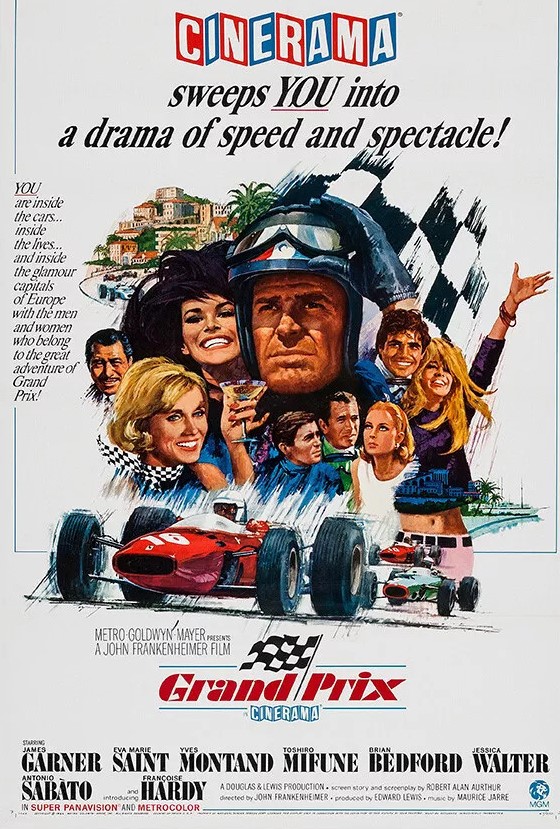
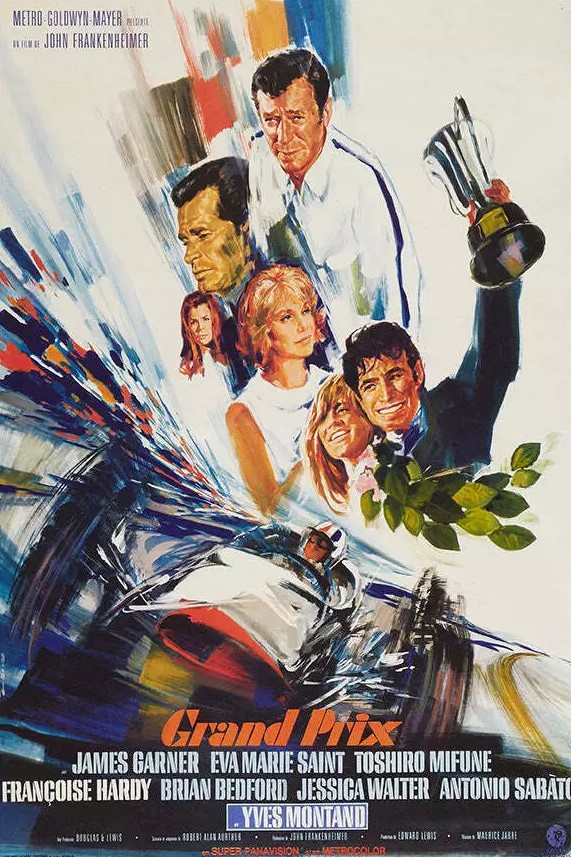
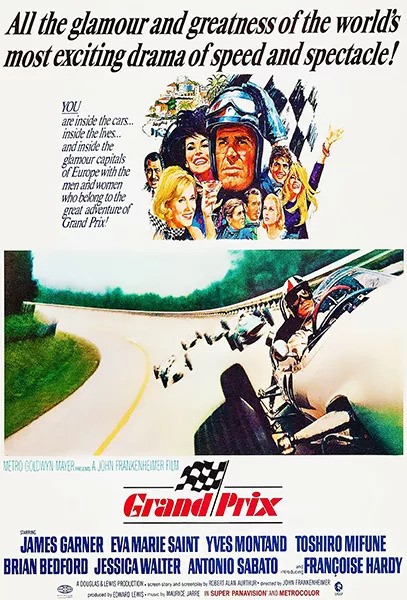
If ever there was a case to be made for six-track stereophonic sound or, for that matter, split screen Grand Prix would form the first line of defense. That it was made in Cinerama 70mm was merely a bonus. Most roadshow movies start with an overture, a ten-minute or so musical introduction that would thematically at least give the audience some indication of the picture they were about to watch. Thrumming and roaring engines formed the montage opening to Grand Prix, a noise that almost shook a cinema to its foundations.

Cinerama had been built on its ability to create almost primeval effects. There was always a downward rush, a runaway train, a roller coaster, something to set an audience on the edge of its seat in pure exhilaration. But the visual had nothing on the aural and what set Grand Prix apart was danger, that constant thrum of engines rising to impossible crescendos. Split screen allowed the director to tell several stories at once as competitors chased each other round perilous circuits at a time when death was a racing driver’s constant companion and in fact of the thirty-two professional participants including Graham Hill, Jim Clark, Juan Fangio and Jack Brabham five were dead within two years of the movie’s completion. Nobody needed to remind an audience how hazardous the sport was, they could read about the continuous carnage in the newspapers, but what was less easy to convey, although such events were well attended, was the pure thrill of being at a race meeting. Grand Prix set out to rectify that problem.

At nearly three hours long it had room to tell several stories and in that respect it was more of an ensemble picture than something like Lawrence of Arabia (1962) which took even more time to tell just one story. Many of these stories came to an abrupt end as the character died in an accident.

Steve McQueen and Paul Newman, both racing aficionados, were front runners for the leading role but it went instead to James Garner, also a racer who did all his own driving (though not necessarily at the speeds indicated). And to properly represent the competition it required an international flavor so other drivers were played by Yves Montand (The Wages of Fear, 1953) in a part first offered to Jean-Paul Belmondo and Antonio Sabato (in his second film) with Adolfo Celi (Thunderball, 1965) as the Ferrari boss and Toshiro Mifune (Seven Samurai, 1954) as a Japanese team owner. Swedish star Harriet Andersson (Through a Glass Darkly, 1961) was cast as the female lead but dropped in favour of Eva Marie Saint (Exodus, 1960) in a role turned down by Monica Vitti (Modesty Blaise, 1966).

Garner and Saint had previously worked together in thriller 36 Hours (1964) and it said a lot for his marquee credentials that he was still best known for The Great Escape (1963). Although he had reached top billing status, films like The Art of Love (1965) and Mister Buddwing (1966) did not deliver commercially. Saint’s career had been as peripatetic after Exodus (1960) as before, star of All Fall Down (1962) but third-billed in The Sandpiper (1965) and second-billed in The Russians Are Coming, The Russians Are Coming (1966), the latter two both big hits.

Frankenheimer had directed Saint in All Fall Down and enjoyed a distinguished career with The Birdman of Alcatraz (1962), The Manchurian Candidate (1962) and Seven Days in May (1964) although the high regard in which he was generally held was somewhat tarnished by The Train (1965) and thriller Seconds (1966), the latter a spectacular flop. Grand Prix was not only the biggest film of his career, though The Train had given him a grounding in action, but also his first in color.  The movie was filmed on existing legendary circuits with Formula 3 racing cars adapted to look like Formula 1 and a thousand other incidental details including an appearance by a Shelby Mustang (with Carroll Shelby as technical adviser) that made it an accurate depiction of the sport. Eighteen cameras were used to film the races.

The narrative arc follows the Grand Prix season and while the actual competition dominates the movie it is against the background of the emotional turmoil the sport wreaks on the drivers and the wives and girlfriends who have to live with the knowledge that their partners might not come home at the end of the day. Garner is considered too reckless for the top spot in a racing team and in a bid for redemption signs for a new company. Former world champion Montand is coming to the end of his career. English actor Brian Bedford makes his mainstream movie debut as a driver recovering after a horrific crash caused by Garner. The emotional subplots comprise Garner having an affair with Bedford’s wife (Jessica Walter); Montand embarking on an affair with Saint who plays a magazine writer, with French actress  Francoise Hardy (better known as a chanteuse) involved with Sabato. In addition, there are some telling sequences in which the drivers unload about their fears.

Frankenheimer does a terrific job in marshalling all the effects and the minute details, and the fact that there is no big star in the mix makes the battles between the characters more realistic.  

How Sweet It Is (1968) ***

You’d have thought by now leading men would be running shy of Debbie Reynolds, aware just how easily she would steal the picture out from under the top-billed star (witness Goodbye Charlie, 1964). But she had producers clamouring for the fizz she brought. Her comic skills, and willingness to entertain slapstick, were matched only by Doris Day. Especially helpful when she’s saddled with a convoluted plot that’s one-third generation gap comedy, one-third If It’s Tuesday It Must Be Belgium and one-third the kind of creative thinking that determines that somehow or other the female star must end up in a brothel. Throw in some flower power, split-screen, stills montage and slow-mo and you’ve covered all the bases.

In this hit-and-miss line-up, by far the most amusing element is that it’s the adults – photographer Grif (James Garner) and wife Jenny (Debbie Reynolds) – who are sex-obsessed, sneaking away at every opportunity for a bit of hanky-panky, trying to avoid the disapproving eyes of their virginal teenage son Davey (Donald Losby).

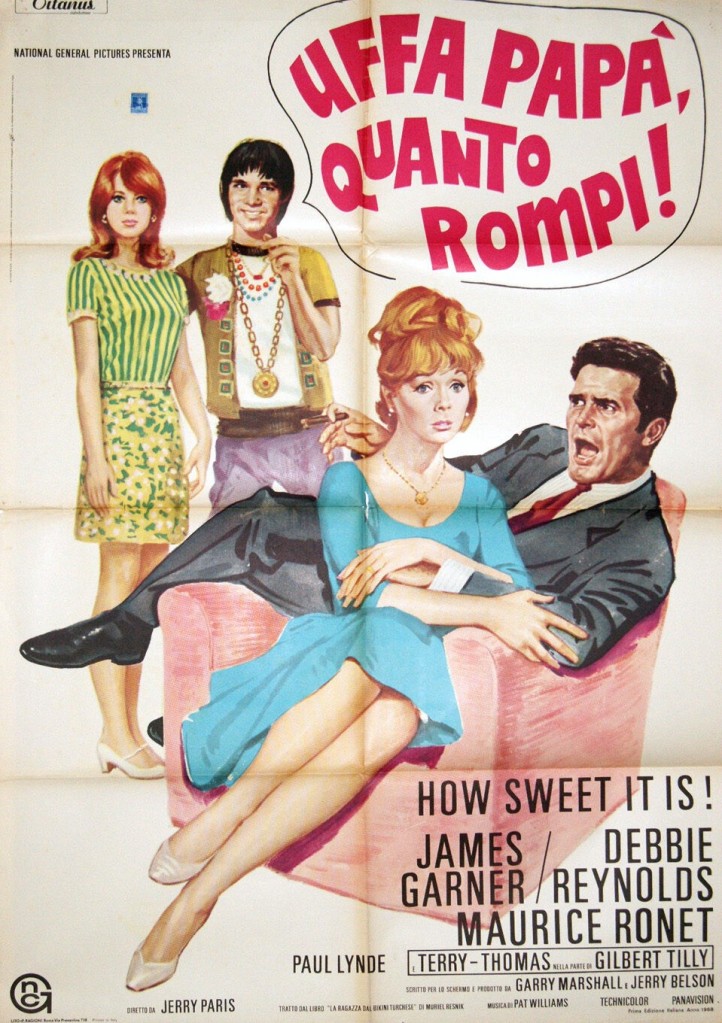
An odd example of creative license here. Poster designers had decided that red was the color no matter what. In the last section of the movie Debbie Reynolds parades in a blue – not red – bikini and the book on which it is based is called “The Girl in the Turqoise Bikini.” I’m not sure the color of the bikini is that much of a plot point unless it’s to hook readers of the original novel, but it’s mighty strange for the poster people just to change the color.

The narrative determines that Davey joins girlfriend Bootsie (Hilarie Thomson) and her lithe gal pals on a tour of Europe accompanied by Grif who has been commissioned to photograph the trip. Much to Grif’s horror, Jenny decides she’s going to follow them and hires out a swanky pad where the grown-up lovebirds can make a nest at some undetermined point.

The picture quickly loses interest in Grif and the girls, beyond an attractive tour guide making a pass at Grif and of course their bus getting stuck in the mud. Not only is the Jenny segment more intriguing – turns out she’s been conned by Gilbert Tilly (Terry-Thomas) into handing over a thousand bucks for a chalet he’s not entitled to hire out – because she gets romanced in high French style (champagne and flowers in case you’re bursting to know) by legal lothario Philippe (Maurice Ronet) and every now and then finds herself wearing little more than a bikini and sometimes nothing at all.

Takes a heck of a long time for the two stories to dovetail so that Grif can flounce off in a huff, punch the living daylights out of the Frenchman, and give the screenwriter the excuse to plonk Jenny down in a brothel (that part, I have to admit, is neatly done). There’s also some unusual class comedy at the chateau, Philippe initially being mistaken for a butler, then having to bunk down with his servant because (guess what) this mansion has only one main bedroom.

For no apparent reason there’s an odd section at the start. Instead of flying to Europe, they take the ship and for no apparent reason they’re stuck on C-deck with a lip-pursing purser (Paul Lynde) who insists males and females must sleep apart and share cabins with strangers. Slot into the miss department the opening with the old trope of the husband coming home to find his wife in bed with another man, except it’s Davey and the parental lovers are enjoying some afternoon delight, though quite how you can stretch that to Davey taking a carving knife up the stairs beats me.

James Garner is no more convincing a photographer than he was in The Pink Jungle (1968) and he hardly gives Debbie Reynolds a run for her money, as if he doesn’t know how to bring this character to life. Except for excelling at the risqué, and she a willing accomplice, he’s coming over like the straight man to her comedienne. Debbie Reynolds is superb, reactions honed to the bone, throwing herself into the part, undergoing whatever humiliation will snare a laugh.

Garner briefly resurrected his career with Support Your Local Sheriff (1969) before he hit the slide (see the previous Behind the Scenes article) and to my astonishment this signalled pretty much the end of Reynolds’ screen career, nothing for the next decades except What’s the Matter with Helen (1971) and a bit part (as herself) in The Bodyguard (1992). You can hardly blame her for screenwriters not coming up with the right material to take advantage of her supreme comedic gifts. Alexandra Hay (The Model Shop, 1969) is wasted, you might just as well have dabbed her role “the sexy blonde.”

Director Jerry Paris (Never a Dull Moment, 1968) throws everything he can at the screen without much success. Future director Garry Marshall (Pretty Woman, 1990) and producer Jerry Belson (Fun with Dick and Jane, 1977) in his movie debut formulated the screenplay from the bestseller by Muriel Resnik.

Far from the last comedy hurrah you would have wished for the actress, but all you’re going to get.  

The Pink Jungle (1968) ***

Near miss rather than the spectacular crash dive the poor box office returns suggested. Though it’s scarcely surfaced in five decades. Espionage adventure-cum-treasure hunt is slightly undone by knowing winks to the camera and it won’t take an eagle eye to spot that most of the action doesn’t take place in the jungle at all, although the title is explained in a clever twist at the end.

Shame the script goes AWOL and you might be left lamenting what might have been had it been a hit and the boost it could have given the careers of George Kennedy (Cool Hand Luke, 1967), playing ebulliently against type, and Eva Renzi (A Taste of Excitement, 1967) who proved to have lot more screen charisma than her ensuing roles suggested. Not to mention James Garner (Duel at Diablo, 1966), marquee value taking a hit after a string of flops.   

However, if you can accept James Garner as a fashion photographer, and a gag that sees all three male principals decked in out varying shades of lipstick, and shut out the noise of Garner’s character offering commentary on what is about to happen, it’s a pleasant, non-demanding ride, with a believable central romance.

And I learned diamond arithmetic: five carats equals one gram, 28 grams is one ounce so you’re talking a phenomenal amount for a diamond weighing a few ounces never mind a 20lb haul which is where the endless MacGuffins lead. And if Ann-Margret can elect to shoot a fashion spread against the backdrop of motocross (C.C. and Company, 1970), choosing the South American jungle as the ideal spot for a lipstick advert is scarcely a stretch.

The long-winded tale begins with photographer Ben (James Garner) having his consignment of lipstick confiscated by police chief Ortega (Michael Ansara) who suspects they conceal hidden microfilm from the C.I.A. for rebel insurgents. When model Alison (Eva Renzi) arrives by helicopter that’s promptly stolen by South African illegal diamond dealer Ryderbeit (George Kennedy). The stranded couple repair to the nearest town, followed by the cops and by a pair of thugs, where Ryderbeit connects them to Englishman Capt Stopes (George Rose) who boasts a map leading to the lost diamond haul.

There’s no great reason for Ben to get involved, and the script offers nothing compelling, but let’s go for the ride, so suitably prepared (cigars and whisky essentials apparently) they set off with mules into the desert (yep, no jungle) where the model demonstrates her rodeo skills. There, they encounter Australian McClune (Nigel Green), the supposed deceased partner of Stopes, but he dupes them, leaving them stranded without water or mules, in the desert and heads off to find the loot himself. Of course, that does mean he has to come back the same way so the inevitable shootout, compounded by villains and cops, ensues.

Though determinedly sluggish in parts and the introduction of McClune adding little to the scenario, for the most part, although treading a thin line between cliches, it’s enjoyable enough. Ben is surprisingly handy with his fists, Alison has unusual depths and Ryderbeit is an engaging conman.

For a time there’s a bit of a tussle over Alison, as she’s clearly at times more attracted to the “masterful” adventurer Ryderbeit, a cool dude especially when he demonstrates his dance moves, than the cynical Ben. McClune takes a more predatory interest in Alison. But the growing romance between Ben and Alison is gentle stuff and almost required acting of the highest caliber given that the two actors hated each other according to the scuttlebutt.

Guilty of over-plotting and trying hard not to take the scenario seriously enough, even when it’s clear it won’t work unless that does occur, and that as a previous Garner episode proved, as in A Man Could Get Killed (1966), you can easily skirt around dense narrative and espionage malarkey without getting too bogged down. Over-populated, though, with characters and accents vary.

I’m used to Garner’s schtick by now, but Eva Renzi and George Kennedy were revelations, as was Nigel Green (Fraulein Doktor, 1969) also having a ball as a duplicitous character far removed from his usual ramrod-straight persona.

Oscar-winning director Delbert Mann (Mister Buddwing / Buddwing, 1966) does his best but he could have moved it on a bit for the pace seriously slackens at times. Charles Williams (Joy House, 1964) contributed the screenplay based on the novel by namesake Alan Williams.

Far more enjoyable than I expected and worth it for Renzi and Kennedy.

PREVIOUSLY REVIEWED IN THE BLOG: James Garner in Cash McCall (1960), The Wheeler Dealers (1963), Move Over, Darling (1963), The Americanization of Emily (1964), 36 Hours (1965), The Art of Love (1965), A Man Could Get Killed (1966), Duel at Diablo (1966), Buddwing/Mister Buddwing (1966), Grand Prix (1967), Hour of the Gun (1967), Marlowe (1969); Eva Renzi in Taste of Excitement (1969); George Kennedy in Lonely Are the Brave (1962); Charade (1963), In Harm’s Way (1965), Mirage (1965), Shenandoah (1965), The Sons of Katie Elder (1965), The Flight of the Phoenix (1965), Hurry Sundown (1967), Cool Hand Luke (1967), Bandolero! (1968), Guns of the Magnificent Seven (1969); Delbert Mann directed A Gathering of Eagles (1963), Buddwing/Mister Buddwing (1966), Fitzwilly/Fitzwilly Strikes Back (1967).

Cash McCall (1960) ***

As time wore on and attitudes to corporate skull-duggery hardened – Wall Street (1987), Other People’s Money (1991), The Big Short (2015)  – it was no longer necessary to soften a venal character with romance. And I guess the ruthless Cash McCall (James Garner) falling in love with Lory (Natalie Wood), daughter of takeover target Grant (Dean Jagger), provides the movie with a soft underbelly, intended presumably to show the inhuman businessman’s more human side, but instead diverting the picture away from delivering a massive punch against the asset-stripping proliferating too fast in American business.

Otherwise, it is a good assessment of the double-dealing and pitiless behavior of business sharks preying on weaker businesses. Then complaining when the tables are turned. Anti-Trust investigators would have a field day, but I’m not sure if the U.S. Securities & Exchanges Commission, set up in the wake of the 1929 Wall St Crash, was as powerless as today, usually turning up when the damage is done rather than stepping into prevent it.

Grant decides to sell up when his biggest customer Schofield Industries, run by retired Army General Danvers (Roland Winters), holds him to ransom. Cash McCall swoops in but, after finding a flaw in Schofield Industries, determines through clever maneuver to add that to his mountain of companies and make an immediate $1 million profit on Grant’s company which he purchased for $2 million.

The romance resistance that is standard for such pictures pivots on Lory having been rejected (on a stormy night) by Cash the previous summer. Ironically (though I doubt if the makers noticed the irony), Lory is viewed as a bonus in the deal, Cash’s wealth making him an ideal catch in the eyes of her parents, despite the abhorrence he inspires.

A contemporary audience might expect her to be the fly in the ointment, especially as she owns ten per cent of her father’s company, offering an opportunity to stand up to Cash on  principle. But that’s not envisaged here. And you can’t expect her, in those sexist times, of complaining that her father is depriving her of her inheritance and the chance to run a big company.

It’s at its best in the financial chicanery. Danvers comes unstuck when Cash discovers that Grant holds an unexpected ace and can run his company into the ground. Every time anyone tries to get the drop on Cash it turns out he owns their company or nullifies their intent by knowing what they’re up to. He recruits or increases the salary of anyone who stands in his way. Money not only talks it minimises and even forgives or elevates heinous action.

The only person who bests him is a hotel assistant manager Maude (Nina Foch) who, misreading the signals, believes herself to be his love interest. In revenge, she scuppers his  burgeoning romance with Lory.

In fairness, Cash is as upfront about his intentions as Gordon Gekko in Wall Street. He describes himself as a “thoroughly vulgar character – I enjoy making money” while confessing he doesn’t buy businesses to run them but to sell them or break them up into more viable smaller pieces.

But the James Garner (The Americanization of Emily, 1964) charm gets in the way. He wants to have his cake eat it. Move into serious roles without falling foul of the public. Romance is seen as the tool.

Garner evolved a sneaky screen persona, attempting to be rascal who got away with it thanks to his charm, best personified in The Great Escape (1963) and The Americanization of Emily, in both films his escapades endorsed by the authorities. But it would be hard to find any redeeming qualities in a ruthless business buccaneer who exalted in the chaos he caused, little regard for the wrecked lives left in his wake.

The film attempts to get by this via the romance – a beautiful woman couldn’t possibly end up with a scoundrel, could she – and by setting up virtually every other character excepting Grant as dodgy (and even Grant ends up congratulating him on his clever schemes).

As an insight into corporate malfeasance, it’s interesting enough, and bold for the times, and certainly gets points for not falling back on the old trope of the little guy fighting big business. This features grown-ups knowing exactly what they are letting themselves in for.

A couple of sections jar – the flashback and a labored explanation that “Cash” is not a nickname but a Christian name. On the other hand, it could as easily be perceived as a romance that just happened to take place against the unusual backdrop of the boardroom.

It’s worth noting that Garner himself was not above unscrupulous dealing. Having convinced Warner Brothers to fund his first three movies, he then proceeded to sue the studio over his contract, leaving them with the bill for his flops.

Nina Foch (Spartacus, 1960) and Dean Jagger (Firecreek, 1968) are the pick of the supporting actors. The most interesting aspect of Joseph Pevney (The Plunderers, 1960) was that he directed a quartet of films in this single year and then not another for the rest of the decade.

The final screenplay from celebrated writer Lenore Coffee, whose career spanned forty years, an astonishing feat for a female in Hollywood, and was at one time the highest-paid screenwriter in the industry. It was co-written by Marion Hargrove (40 Pounds of Trouble, 1962) from the bestseller by Cameron Hawley.

Would have been a better picture if it had stuck to the knitting and not wandered into romance, so good in parts rather than a major success.

Behind the Scenes: “The Comancheros” (1961)

The making of this could have been a movie in itself. The novel, published in 1952, suffered from a long gestation involving four directors with seven actors at various points either signed up or mooted for the two top main roles.

Journalist-turned-author Paul Wellman specialized in westerns and historical non-fiction with a western bent. The Comancheros was the last of the half-dozen of his near-30 novels to reach the screen, following Cheyenne (1947) with Jane Wyman, The Walls of Jericho (1948) with Cornel Wilde and Linda Darnell, Alan Ladd as Jim Bowie in The Iron Mistress (1952), Burt Lancaster as Apache (1954) and Glenn Ford as Jubal (1956).

Originally earmarked by George Stevens as a follow-up to his Oscar-nominated Shane (1953), it was scheduled to roll before the cameras on completion of Giant (1956) in a Warner Bros production that contemplated re-teaming Vera Cruz (1954) pair Gary Cooker and Burt Lancaster.  When that failed to gel, next up were Gary Cooper and James Garner. That was kind of a tricky proposition given that Garner had taken on the might of Warner Brothers in a lawsuit in a bid to extricate himself from his contract.

But the producer didn’t seem to care as the day the actor won the lawsuit he received the script. “I didn’t like it, I didn’t want to do it,” recalled Garner, “but a couple of days later I heard Gary Cooper was going to do it,” resulting in a speedy change of heart. However, despite his verbal acceptance, no contract appeared and never hearing from Fox again assumed foul play from Warner studio head Jack Warner.

Meanwhile, Stevens’ interest had cooled and after settling on The Diary of Anne Frank (1959) he sold the film rights off to Twentieth Century Fox for $300,000, more than he had originally paid the author. Fox hired Clair Huffaker (Hellfighters, 1968) to write the script with Cooper’s sidekick role assigned to the up-and-coming Robert Wagner (Banning, 1967). But Cooper’s ill-health prevented that version going ahead.

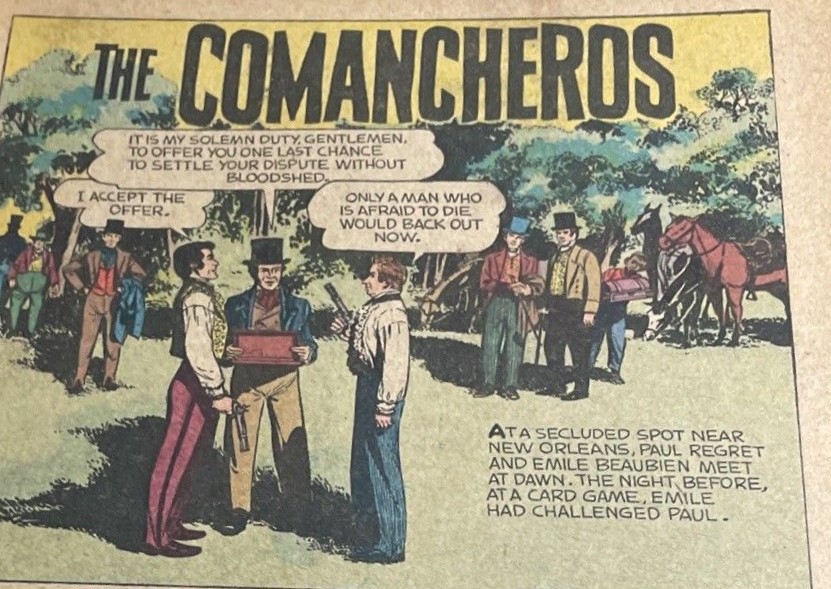
Comic specialist Dell was a bit slow on the uptake, it’s tie-in copy (Issue 1300)
not appearing until three months after the movie opened.

Television director Douglas Heyes (Beau Geste, 1966) was set to make his feature film debut with the plum cast of John Wayne and Charlton Heston, fresh off global monster hit Ben-Hur (1959). Ironically, Wayne could have made this movie years before, in 1953 having been sent the novel by then-agent Charles Feldman (who had clearly also contacted Stevens).

Wayne had come back into the equation after signing a three-picture deal with Fox. But Heston,  on reflection, decided it would not be in the interests of his career at this point to take second billing and dropped out.

Wayne’s involvement meant re-shaping the script. In the novel the main character was Paul Regret, the Louisiana gambler wanted for murder for killing a man in a duel. Wayne was too old to play him so to puff up his part the Huffaker script was rewritten by James Edward Grant, better known originally as a short story writer, who had begun working for Wayne on The Angel and the Badman (1947) and would continue to do so for another 11 projects ending with Circus World (1964). 

Another newcomer, Tom Tryon (The Cardinal, 1963), was lined up to play Regret. Then Heyes dropped out leaving the way clear for the final teaming of Hungarian director Michael Curtiz (Casablanca, 1942), now a freelance after decades with Warners, and John Wayne.  

Stuart Whitman (Murder Inc, 1960) arrived from left field. While starring as Francis of Assisi (1961) he was shown the script by that film’s director, Curtiz. Tryon was eased out after Whitman managed to secure an interview with Wayne and the pair hit it off.

That Curtiz was already suffering from cancer was obvious to Whitman. Whatever sympathy his illness might have attracted was scuppered by the director’s rudeness. He had a predilection for sunbathing in the nude and blowing his nose on tablecloths, the actions of a powerful figure letting everyone know he could get away with it. His illness meant he restricted working to the mornings. After lunch he fell asleep in his chair, the crew placing umbrellas over his head to protect him from the sun.

While the director dozed, Wayne took over the directorial reins. When Curtiz was hospitalized, the actor finished the picture. It is estimated that he filmed over half of it, including the climactic  battle.

Ina Balin, a Method actor, found her acting style cut little ice with Wayne. When she demanded rehearsals and long discussions about her character, he simply shot the rehearsal. “Cut. Print. See how easy this is,”  explained the actor after wrapping her first scene with him using the rehearsal take.

“Duke was a terrific director,” observed Stuart Whitman, “as long as you did what he wanted you to do. Shooting with him was very easy although Ina Balin…pissed him off. Before each shot, she’d dig down and get emotional and he was a little impatient: get the goddam words out, he’d mutter to himself.”

Jack Elam, playing one of the heavies, had won in a poker game with their handler a pair of camera-trained vultures. The daily fee for the birds to sit on a branch was $100. Elam thought he’d get cute and ramp up the price to $250. That notion didn’t sit well with Wayne and he soon reverted to the original price.

While on the set, Curtiz fired third assistant Tom Mankiewicz, later a screenwriter, but currently  just a lowly nepo, owing his job to the fact he was son of director Joseph L. Mankiewicz. Tom’s downfall was arguing with Curtiz over his plans for the stampede scene for which he had rented dozens of Wayne’s prized longhorns. Asking the cattle to go over a 5ft drop and scramble up the other side was a good way of breaking their legs. Having informed Wayne of the director’s proposal, he was told by the star to turn up for work the next day, by the time the actor had finished chewing out the director that would be the least of his problems.

Despite friction with Curtiz, Wayne was surrounded by old friends and colleagues, including producer George Sherman, cinematographer William Clothier and screenwriter James Edward Grant. “Duke and George Sherman grew up together working at Republic for $75 a week and all the horses you could ride,” explained Clothier. “They were old friends. Duke didn’t understand old Mike Curtiz very well and I must say he didn’t try very hard. Mike was just plain out-numbered and I felt sorry for him.”

Although set in Texas in 1843, parts of the film were shot in Utah and the cast used weapons such as the Winchester lever-action rifles and the Colt Peacemaker which were not in production for another three decades.

Michael Curtiz, after nearly half a century directing movies, died shortly after the film’s release. The Comancheros, a box office smash, helped balance Wayne’s finances after the financial hit of The Alamo and solidified the notion that as far as is career went he was better concentrating on westerns than anything else.

For some reason, U.S. box office figures are sketchy but it was a huge hit around the world, finishing seventh for the year at the British box office for example, and re-emphasizing the Duke’s resounding global popularity.

SOURCES: Scott Eyman, John Wayne, His Life and Legend, (Simon and Schuster paperback, 2014) p352-357; Howard Thompson, “Wagner Steps Up Work In Movies,” New York Times, January 21, 1961, p18; Lawrence Grobel, “James Garner, You Ought To Be in Pictures,” Movieline, May 1, 1994

The Art of Love (1965) ****

Priceless. Effortless comedy from the same director, Norman Jewison, as Send Me No Flowers (1964) but minus the box office powerhouses of Doris Day and Rock Hudson and perhaps it’s their absence that makes this work so much better. Or perhaps you get more comedic leeway in Paris. Although the scripts were written by different people, I sense a directorial insistence that the supporting characters are believable, not just there to oil the plot.

The story here is fraud, penniless artist Paul (Dick Van Dyke) faking his own death to give his paintings the necessary burst of publicity to make them hot items. Except he doesn’t fake his death. He dives into the Seine to save a drowning girl Nikki (Elke Sommer) and his buddy Casey (James Garner), a wannabe writer for whom Paul is a meal ticket, and who you would have to say was instrumental in suggesting such a scam, assumes he has committed suicide.

Paul goes along with the scheme for as long as it takes art dealer Zorgus (Roger C. Carmel) to make a killing (no pun intended) from his paintings. Nikki ends up a housemaid at a risqué nightclub (though it being Paris what other kind is there) run by Madame Coco (Ethel Merman) where, coincidentally, heavily disguised, Paul hides out. Meanwhile, in the final piece of the complication jigsaw, Paul’s fiancée Laurie (Angie Dickinson), turns up. A bit like the lecherous friend in Send Me no Flowers, Casey knows how to make the most of the opportunity to give a potential widow a shoulder to cry on. “How can you make a play for this girl?” he asks his reflection, but she’s too gorgeous for qualms.

You can pretty much guess where it will go from here.

It works so well because none of the principals is permitted to milk their roles (though Van Dyke can’t resist making a meal out of a sneeze) and the supporting cast drive it along with selfish action. Dick Van Dyke (Divorce American Style, 1967) has none of his usual zaniness or limbs that refuse to obey orders. James Garner, though in part cloning his character from The Americanization of Emily (1964), plays it as drama. Elke Sommer (The Venetian Affair, 1966) is the best I’ve seen her, no longer the pouting sexpot but a girl-next-door from the suburbs fallen on hard times. Angie Dickinson (Jessica, 1962), further down the billing than I’d expect, has to play it for drama, almost the foil for Casey’s seductive tendencies.

There are some superb running gags. Paul is furious to find a red-headed woman in the bed of flat-mate Casey. But, sight gag number one, it belongs to a mannequin. The wig, sight gag number two, is used to disguise Paul. Casey gets ride of the mannequin by stuffing it into a furnace only it doesn’t fit so he has to saw off its legs and is discovered from above by a waiter, sight gag number three, who naturally thinks he is sawing a woman in half. (I always think the beauty of a good comedy is that you can see the gag coming and you still laugh.) That gag has even more miles to run.

The supporting cast, as I said, are all given just delicious lines. Paul and Nikki, soaking wet, are saved by a passing barge. Paul hangs out her clothes to dry. When the naked woman in the wheelhouse calls for her clothes, the barge skipper, enjoying the prurient scene, implores,  “Don’t give her her clothes back.” And when, after a row, that allows her to leave the barge, the skipper whines, “I told you not to give her her clothes back.”

. “I don’t want you to think I came for the rent you owe,” says Casey’s landlord. “What did you come for,” asks Casey. “The rent you owe, but I didn’t want you to think it.” The landlord’s wife comforts the grieving Casey (at this point he thinks Paul is actually dead) with some chicken soup. Casey admits the suicide was his idea. The woman snatches back her soup.

Having put Nikki on a bus, Paul, handing over few coins, asks the driver to keep an eye on her. Comes the reply, “I would whether you pay me or not.”

Sure, Ethel Merman (There’s No Business Like Show Business, 1954) gets to sing. Audiences expected that. But that’s understandable. What a voice. When you wonder why Ann-Margret wasn’t given more opportunity to sing in proper musicals, this is the answer. She lacks the voice of an Ethel Merman, Julie Andrews or Barbra Streisand.

The sly screenplay was concocted by Richard Alan Simmons (Della, 1965), William Sackheim (First Blood, 1982) and Carl Reiner, who had written for both Dick Van Dyke (his eponymous television show) and James Garner (The Thrill of It All, 1963).

The stars play proper roles, not just one-note characters driven by plot. Doesn’t take much to work out where it’s going all right but that doesn’t lessen the enjoyment of the journey.

I always wondered why, after making his name in comedy, Norman Jewison was selected for more serious works like The Cincinnati Kid (1965) or In the Heat of the Night (1967), but when you see the care he takes with each character, far more than standard directors in the fun genre, how he carefully builds the narrative, you do tend to agree he’s wasted in comedy.

A pure delight.

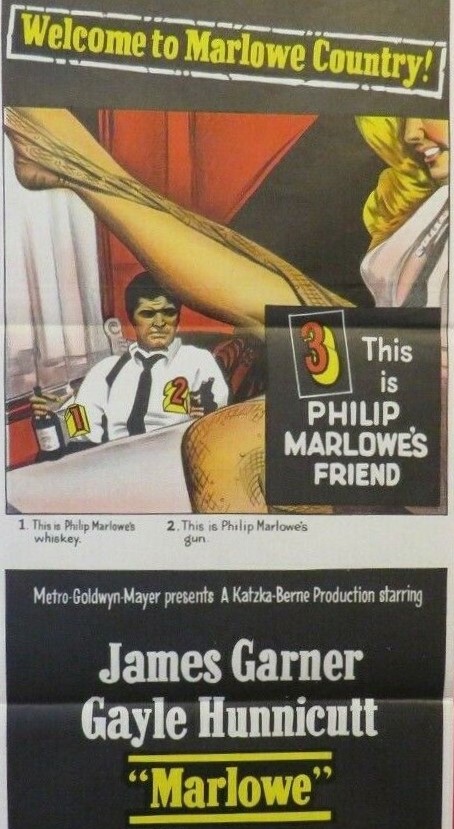
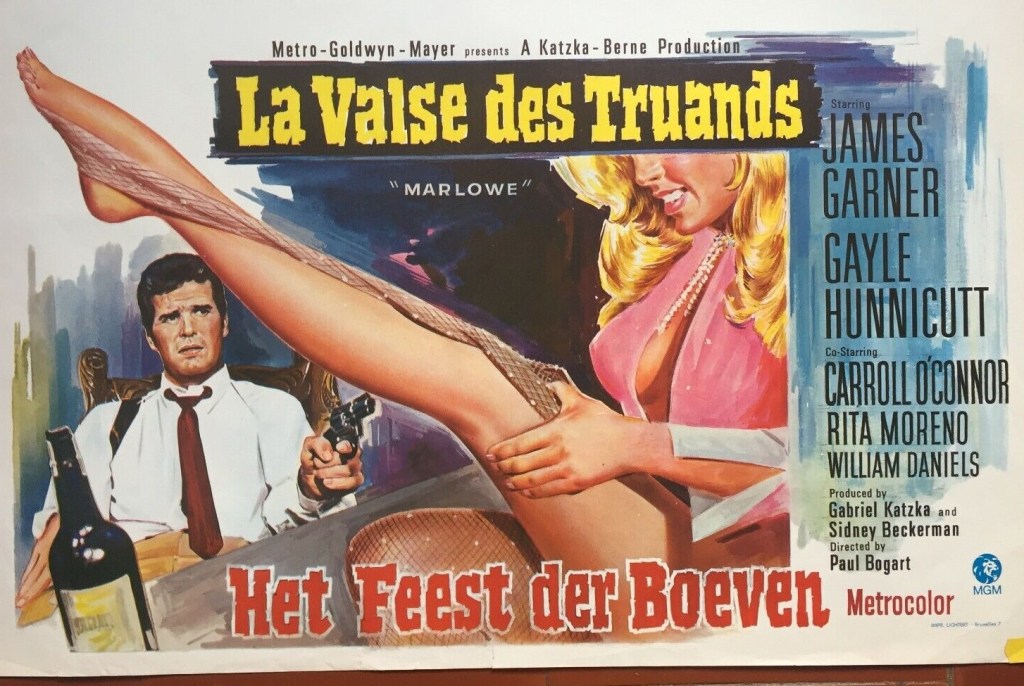
Marlowe (1969) ***

Anyone breaking into the private eye market in the late 1960s had to content not only with the ghost of Humphrey Bogart but a heavyweight slugger name of Harper (1966) whom Paul Newman had fashioned into the most likely contender for the Bogart crown. Ironically, it was growing interest in Bogart that spurred on an imitator. His movies, screened two hundred times a year on television, created an initial cult following, his persona maximized to the full by the reissue on the tenth anniversary of his death of 45 of his pictures plus the half-dozen biographies that appeared in a three-month stretch.

As it happened a couple of Raymond Chandler novels, The Little Sister and The Long Goodbye never before filmed and theoretically at least avoiding comparison with the past, were up for grabs. The Little Sister was the chosen vehicle. But, anyone chancing their arm in the role of Philip Marlowe was likely to be met with jibes of “he’s no Humphrey Bogart.”

That’s not the only problem here. The story is awfully convoluted, it’s been updated to a modern Los Angeles complete with hippies and gym work-outs and screenwriter Stirling Silliphant has chucked away the bulk of the original dialog. So, little remains of what made the character compulsive viewing in the first place.

Marlowe (James Garner) is investigating the disappearance of the brother of Orfamay Quest (Sharon Farrell), a young woman from Kansas, when he stumbles upon a couple of ice-pick murders and a pack of incriminating photos that depict television sit-com star Mavis Weld (Gayle Hunnicutt) – no slouch herself at knocking people out – in a compromising situation with top-line gangster Sonny Steelgrave (H.M. Wynant) whose speciality had been killing people with an ice-pick. So it’s a murder/blackmail double whammy.

The plot thickens when Winslow Wong (Bruce Lee) tries to pay him off and when that fails wrecks his office by demonstrating the kung fu skills that would later make that actor a star.  Detective Lt French (Carroll O’Connor) is the typical dumb cop that Marlowe runs rings round. Also entering the fray is exotic dancer Dolores (Rita Moreno), a friend of Mavis, and to liven things up for the gumshoe a girlfriend Julie (Corinne Camacho) who has some nifty one-liners when Ofamay attempts to seduce her boyfriend. And there’s any number of Steelgrave’s thugs who make any number of attempts to scare Marlow off.

Eventually, after being drugged by Dr Vincent Lagardie, Marlowe finds the missing brother, Orrin, who, while dying, attempts to kill the detective with an ice-pick. Assuming that clears up both cases, Marlowe then discovers that Orrin, Mavis and Orfamay are siblings.

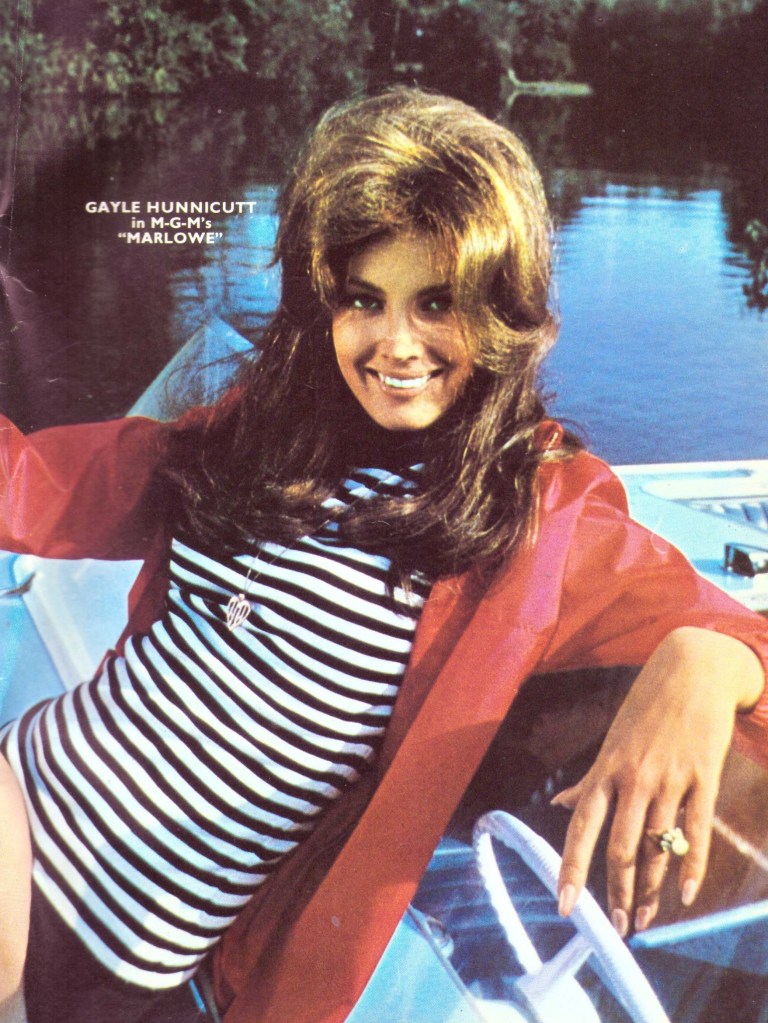
Hunnicutt is given the pin-up treatment in ABC Film Review.

But the tale still has some way to go, uncovering a hornet’s nest of spite and revenge among the warring siblings. There’s way too cute an ending though whether that was Silliphant’s invention or the tack taken by Chandler I have little interest in finding out, exhausted as I am by a seemingly endless series of twists and turns.

I’m not exactly sure what’s missing from this except a femme fatale – Mavis makes no moves on Marlowe, though her sister, who hardly qualifies as a femme fatale, does. It’s unfair in a sense to complain that it’s not following the Chandler template when so much effort has gone in to trying to initiate something new. If it had been called anything else, or the name Marlowe substituted by Smith, then we wouldn’t be thinking so much of the source material or the imitable Bogart.

Confusingly, there is a Bogart involved, director Paul Bogart (The Three Sisters, 1966 – from the Checkov play and no relation to The Little Sister) and although he keeps the plot ticking along – who wouldn’t with so much plot to tick – that’s pretty much all he does, in the cold light of Los Angeles hardly able to emulate the film noir setting.

So, effectively, it’s up to James Garner (Mister Buddwing, 1966) to pull the whole movie together, or put another way, keep it from falling apart. Audiences, much taken with the actor’s reinvention of his screen persona in his previous picture, comedy western Support Your Local Sherrif (1969), didn’t bring sufficient box office support. Garner is okay but sorry to say he’s no Bogart.

Rita Moreno (Night of the Following Day, 1969) is the pick of the supporting cast. Gayle Hunnicutt (Eye of the Cat, 1969), given the type of billing that elevated Lauren Bacall to super-stardom, doesn’t do enough to achieve the same.  Interestingly, both Garner and Hunnicutt went down the shamus route in television in the future, the former in The Rockford Files (1974-1980), the latter in an episode of Philip Marlowe, Private Eye (1983).

If you’re a fan of Garner a reasonable watch. If you’re a fan of Chandler or Bogart you’d be inclined to give it a miss.

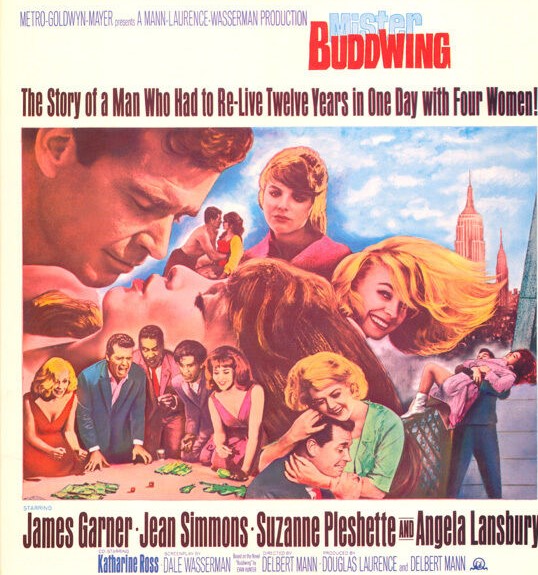
Mister Buddwing/Buddwing (1966) ****

Perhaps it was something in the ether that this very under-rated Kafkaesque examination of fractured identity emerged the same year as John Frankenheimer’s equally maligned Seconds and the year after the more successful Mirage. A superb opening sequence transports us to a world of alienation and discordance, often the only sound that of a man’s footsteps.

Face unseen, yet camera in his point of view, in the early morning a man (James Garner) examines the pockets of his suit, pulling out some pills and a piece of paper with a telephone number, pulls off a ring with the inscription “from G.Y.” He begins to walk, shakily, camera still in his POV until he arrives at an upscale New York hotel and sees himself in the mirror. That doesn’t help. He still doesn’t recognize himself. Using the lobby phone, he calls the telephone number.

It’s a woman called Gloria (Angela Lansbury). She calls him Sam. She gives him her address because that, too, has slipped his memory. Visual stimuli outside make him think his name is Buddwing. Sam Buddwing has a reassuring feel to it.

But when arrives at Gloria’s apartment, she doesn’t recognize him. Though married, she “puts out” so he could be a casual sexual acquaintance. When she pours him coffee, unable to remember how he takes it, he bursts into tears.

And so begins a disturbing odyssey, “a tug of war in his mind,” as he tries to piece together his memory and find his lost self.  Memory is triggered by the sight of a woman across the street getting into a cab. Instinct tells him this is Grace. He follows in another cab, encountering a disgruntled customer who tells him an odd tale about taking a drunken woman to Oyster Bay. She disappears inside Washington Square College. He thinks he might be the escaped mental patient Edward Volloch mentioned in a newspaper headline. Unasked, a man called Schwarz sits down at this table in a cafeteria and suggests he must be Jewish.

He finds “Grace” (Katharine Ross) on a park bench. Even though she fails to recognize him and tells him her name is Janet, he drifts back to his time with the real Grace who cuts his hair on a beach, runs from a downpour into a church. He tells her he wants to become a composer.

When Janet evades him he is confronted by a cop but, of course, has no proof of identity. The scene turns ugly and uglier still when chased by a vagrant  and he starts to see double.

And so it goes on. He finds two more versions of Grace. On hearing of his condition, the first, an actress (Suzanne Pleshette), encourages him to “be what you want to be” while Buddwing opines “we are all impersonating an identity.” The second, a drunk (Jean Simmons) appears to be the source of cab driver’s story

The actress attempts suicide after becoming pregnant, the drunken woman takes him to a crap game, where, taking turns rolling the dice, they win a heap of cash.   

All in all it’s a brilliant jigsaw, avoiding the sci-fi elements of Seconds and the thriller aspects of Mirage, but with the brooding atmosphere of both. But where the character in the Frankenheimer makes a deliberate decision to change identity and Gregory Peck in Mirage is able to put together the various pieces of his life, Buddwing simply stumbles along, totally unconvinced of his identity – at one point he is “nobody” – building up an idea of his life only as an adjunct to the mysterious Grace who keeps changing shape and personality until it seems completely incongruous that the first innocent Grace (Ross) could merge into the more blustery, sexually aggressive, Grace (Simmons).

Of course, when he does discover the truth, by random connection, that’s as shocking as anything else, shattering the somewhat idealized picture of the self he has contrived from the various jumbled meetings with the various disconnected women. Equally, the ending could be another illusion.

This might also play out as a metaphor for the screen life of James Garner (The Americanization of Emily, 1964) who had been trying to rid himself, not entirely successfully, of his previous persona as Maverick in the television series. His company, Cherokee, co-produced the picture, which smacks of the same determination to be taken more seriously as Rock Hudson with Seconds, a move that did not go down well for either with public or critics. But Garner is every bit as good as Hudson and he spends much of the film either in  hollow-eyed bafflement or in idyllic circumstance on the cusp of turning sour.

Once Angela Lansbury appears, you get the sense this is going to be episodic and that the female cast will appear in the reverse order of their billing. But Katharine Ross (Tell Them Willie Boy Is Here, 1969) apart, a newcomer, the other three more experienced actresses rip up their screen personas. Angela Lansbury (Harlow, 1965) is an addled woman of easy virtue.  Suzanne Pleshette (A Rage to Live, 1965) takes her character to suicidal levels while Jeans Simmons (A Rough Night in Jericho, 1968), especially notable, essays her inner dirty-mouthed drunken Elizabeth Taylor.

And this is hardly the stuff director Delbert Mann (Fitzwilly, 1967) is made of, despite an Oscar for Marty (1955) better known for light comedy. But he never takes the easy way out, sticking it to Buddwing as a man endlessly tormented by himself. Dale Wasserman (Quick Before It Melts, 1964) wrote the tantalizing script from the bestseller by Evan Hunter (Last Summer, 1969).

A mesmerizing watch and time it was given the same retrospective treatment as the cult Seconds.

Discover WordPress

A daily selection of the best content published on WordPress, collected for you by humans who love to read.

The Atavist Magazine

by Brian Hannan

WordPress.com News

The latest news on WordPress.com and the WordPress community.