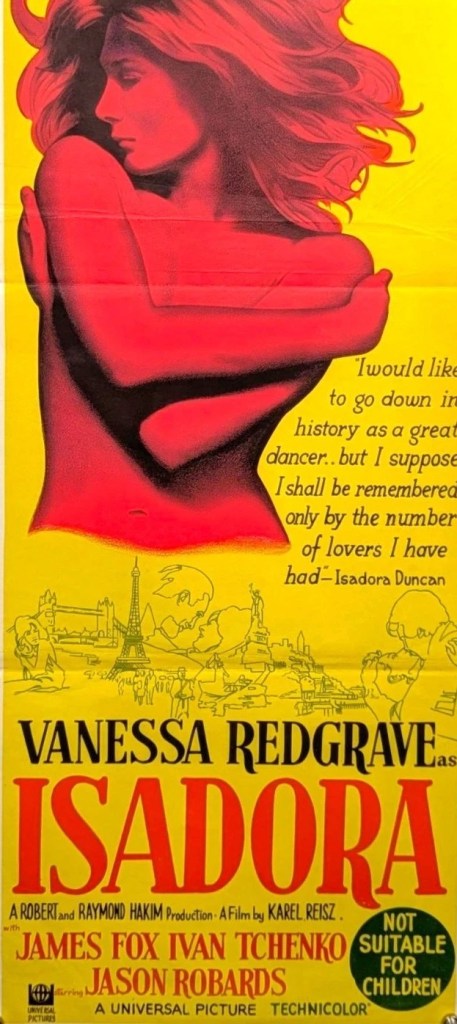
Isadora / The Loves of Isadora / The Incomparable Isadora (1968) ***

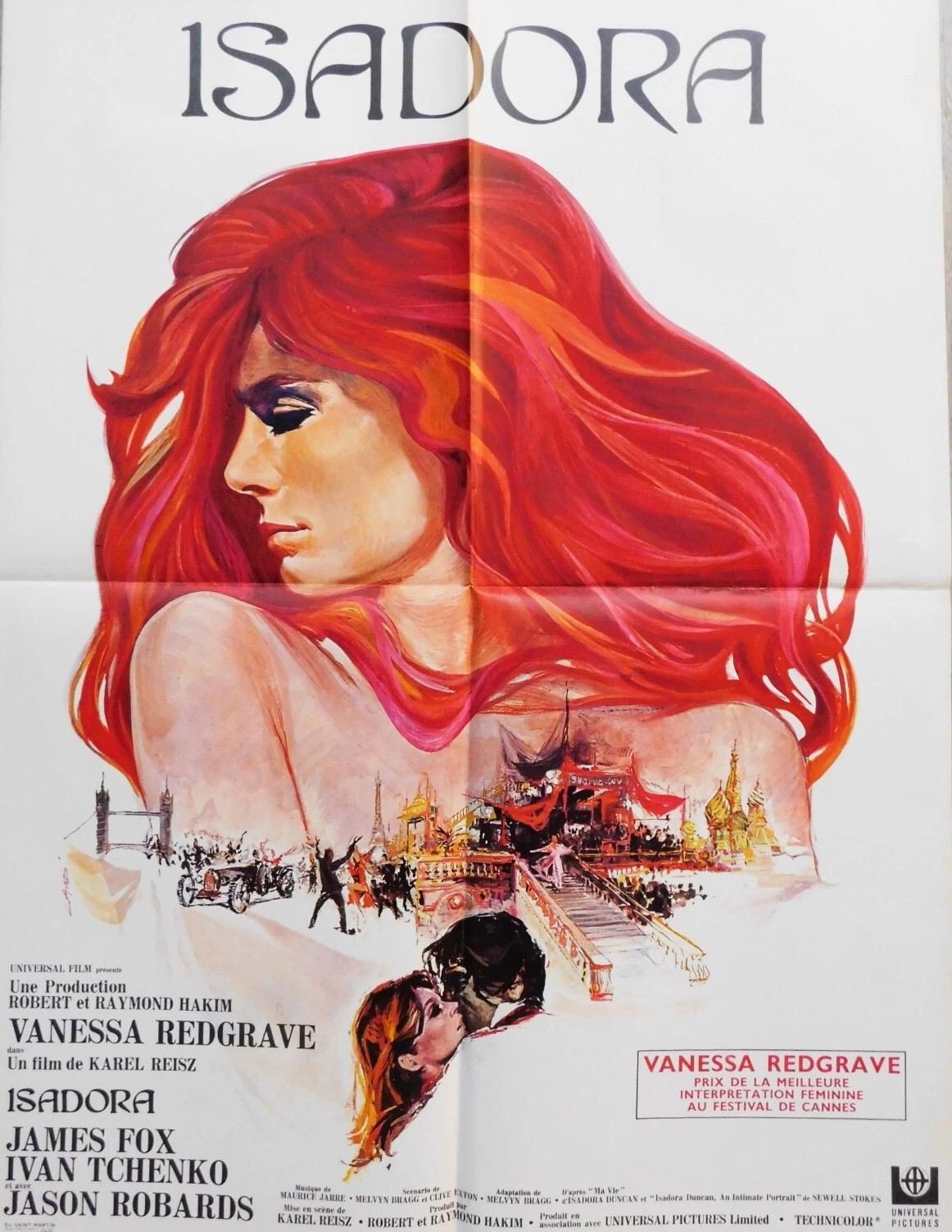
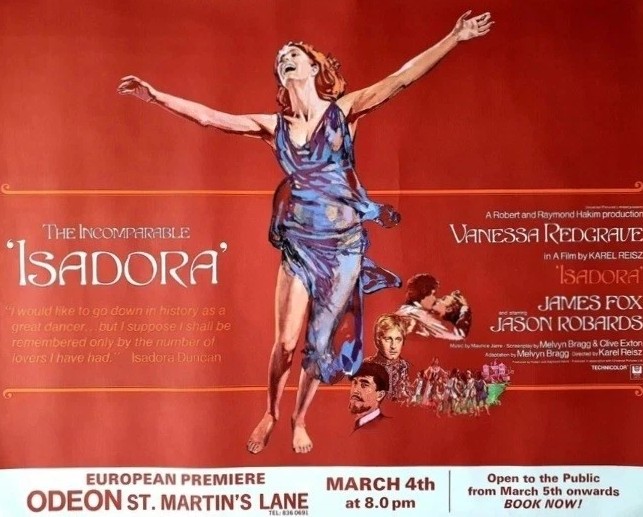
We’re two years away from the 100th anniversary of the death of feminist icon and pioneering dancer Isadora Duncan, but this movie has been in cold storage virtually since its release, so I’m wondering whether its sudden appearance on Amazon will trigger any interest in this long-forgotten, heavily edited, commercial flop of a movie.

Due to the clumsy structure it’s occasionally heavy going. We start off in Nice in the South of France where Isadora (Vanessa Redgrave) is dictating her memoirs to journalist (not lover) Roger (John Fraser) and the whole picture is rendered in flashback. And there’s something morbid about this structure, because essentially we’re waiting for her to die. Unfortunately, what she is most remembered for is getting her trademark long scarf tangled in the wheels of a moving Bugatti and snapping her neck. So we’re sitting around waiting for her to hop into a passing Bugatti with a Bugatti (Vladimir Leskovar).

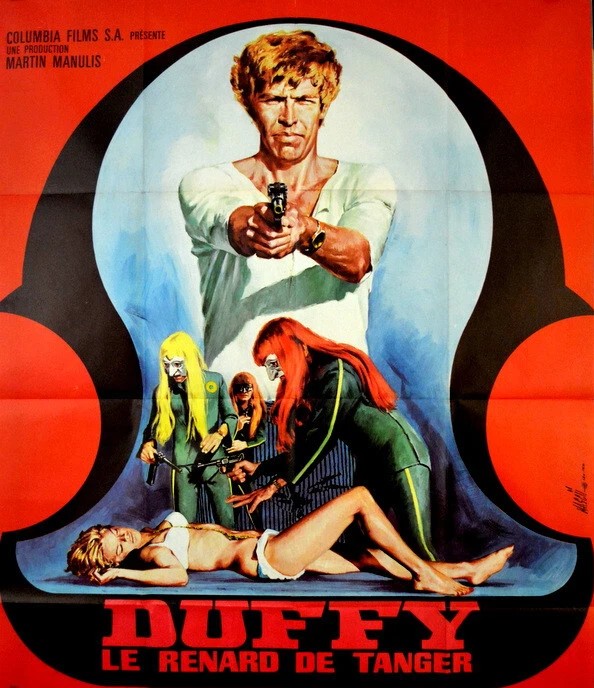
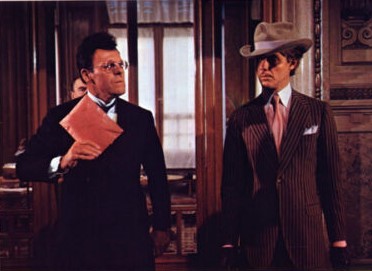
The rest of her life was somewhat fractured, consisting of her leaping from one lover/husband – Gordon Craig (James Fox), Paris Singer (Jason Robards), Romano Romanelli, Sergei Essenin (Ivan Tchenko) – to the next so characters appear and then disappear. Never mind her rebellious nature and determination to forge her own way  and reinvent dance, her life was peppered with tragedy – all three of her children died, two drowning in the Seine (a fact repeated in a variety of ways to get the full emotional punch) – so there’s more than enough angst.

Her dancing is exuberant and uninhibited – she wore flowing dresses which looked as though any minute they would slip off her slender frame and there was scandal at one point when she bared her breasts during a performance. The first time she hits the stage is exceptionally ho-hum because it’s in a Paris nightclub and she’s a conventional, if very attractive, dancer of the ooh-la-la persuasion. But when she gets into her stride as a serious dancer, then visually it’s a treat, as she commands the stage – and screen- in a series of sexually provocative sinuous movements.

But, unfortunately, once is enough. You’d have to know a lot more about artistic dance than I do – and I guess the bulk of the original and contemporary cinematic audience – to know what changes she implemented and how, apart from her individual style (she danced solo not as part of an ensemble), her act developed and how it impacted on dance. She ran her own dance schools which probably liberated a ton of young women who were in the mood to be liberated.

But, as a biopic, even with 30 minutes knocked out, it’s way too long at the remaining 140 minutes, and the rest of the cast struggle to offer any competition to the lustrous Isadora.

Vanessa Redgrave, Oscar-nominated, is the best reason to watch and she is certainly compelling and, oddly enough, though there is plenty of incident and drama it somehow isn’t dramatically compelling.

She is generally naïve in her politics and her innocence in this department works to the advantage of the character. But mostly, we flit like a mobile time capsule through different periods, each well defined cinematically, and even though it’s clearly much harder to (in visual terms on film) convince as a genuine dancer than as, for example, a pianist, unless you were an expert on dance you wouldn’t know what to complain about.

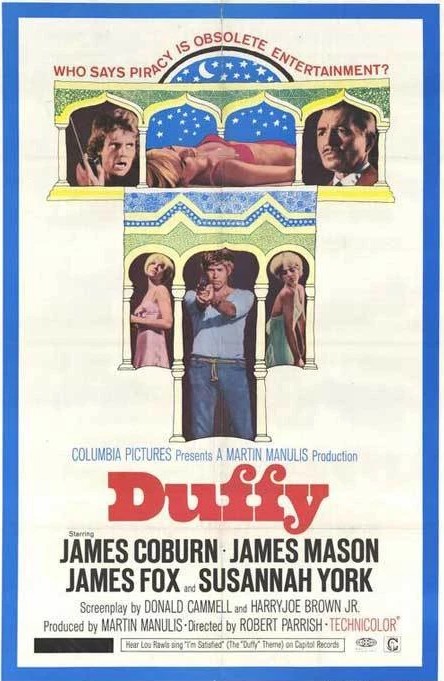
You end up with a biopic about an interesting woman rather than a fascinating biopic. Vanessa Redgrave (Blow-Up, 1966) delivers another of her flawed characters and holds the screen effortlessly. The same cannot be said of the insipid males, James Fox (Thoroughly Modern Millie, 1967) and a miscast Jason Robards (Hour of the Gun, 1967).

Hard to know what the plans were of director Karel Reisz (Morgan!/Morgan, A Suitable Case for Treatment, 1966) because this isn’t his 168-minute version (the one that was released in the U.S. after disastrous opening weekend was trimmed to 128 minutes and in the UK to 140 minutes). Written by Melvyn Bragg (Play Dirty, 1969) and Clive Exton (10 Rillington Place, 1969) from a number of sources.

Sheds an interesting, but not enough, light on a legendary character.

Tamahine (1963) ****

Columbia sold this as if Nancy Kwan was a Bond girl with massive images of the star in a bikini (see above) – the advert in the trade magazine comprised a drop-down A2 pull-out i.e. three times the size of a normal page. But anyone expecting a salacious time would have been in for surprise. For although Kwan swam underwater during the credits (not Helen Mirren style as in The Age of Consent, 1969) and did reveal a naked posterior, you could not have imagined a more innocent, joyous, movie.

Tahitian teenager Tamahine (Nancy Kwan) wreaks havoc on the British stiff upper lip when after the death of her father she is sent to the all-male English public school run by his cousin Poole (Dennis Price), a widower. But it’s not a sex comedy with all the misunderstandings and double entendres that genre normally entails. Instead, it’s a clash of cultures, free love and expression versus prudery and repression. Poole has trouble enough on the female front, his daughter Diana (Justine Lord) inclined to enjoy a gin-soaked afternoon and in the middle of an affair with art master Clove (Derek Nimmo).

The advertising department, however, could not resist the temptation
to stick a double entendre in the poster.

Without mischievous intent, Tamahine causes chaos, assuming an artist’s model would be naked she scandalizes the petrified Clove and egged on by a gaggle of schoolboys whose hormones are off the scale she jams a chamber pot on the school weather vane. The plot, if there is one, is mostly Tamahine fending off suitors, Clove and Poole’s son Richard (John Fraser), and attempting to persuade Poole to take a paternal interest in her well-being.

But mostly it’s about how a sweet-hearted woman struggles to survive in a world where attitudes to sex remain Victorian and in which the avowed aim of education is to build character through manly pursuits such as beating the living daylights out of each other rather than teaching them to express emotion. And certainly the movie takes a more benevolent view of public schools than the later, brutal, If…(1968).

While endorsing free love, Tamahine draws the line at crossing the line in the matter of Richard, whom she deems a relation, no matter how distant. Challenging all conventions, she takes part in sports day.

But the comedy is so gentle and Tamahine so charming that this is best described as a delight. I found myself chuckling throughout and I felt I had just watched a genuine feel-good movie. On paper it certainly doesn’t sound so potentially good, especially when you consider the clichéd portrayals you might expect from the supporting cast, but in reality it exerts an extraordinary appeal.

Hardly off-screen, Kwan (The World of Suzie Wong, 1960), in only her fourth film, easily carries the movie as if she scarcely felt the weight of stardom on her shoulders and is a revelation as the imparter of tender wisdom. What aids the film enormously is that Dennis Price and Derek Nimmo play more interesting parts than their movie personas suggest. Price (Tunes of Glory, 1960), in a far cry from his Ealing comedy heyday, dispenses with his wry delivery and cynical demeanor. Unusual for a character actor, his character actually has a story arc and turns what could have been a stereotypical role into a moving performance. Before his strangulated vowels got the better off him, Derek Nimmo (The Liquidator, 1965), too, delivers probably his best performance.

Justine Lord (Night after Night after Night, 1969) is good as the rebellious daughter but James Fox offers none of the intensity he brought to the screen a year later in The Servant (1964) and neither does John Fraser (El Cid, 1961) light up the screen. In small parts you can spot Michael Gough (Batman, 1985) and Coral Browne (The Killing of Sister George, 1968).

Full marks to director Philip Leacock (The War Lover, 1962), himself a former public school boy, for not taking the easy way out with loutish comedy but instead crafting a film full of sensitivity and sensibility. Denis Cannan (Why Bother to Knock, 1961) based his screenplay on the Thelma Nicklaus novel.

You might be surprised at the four-star rating and I do confess it is a shade optimistic but it is worth more than three stars. It’s worth taking a moment to examine the whole issue of ratings. You might be asking how can Tamahine be given four stars, the same as The Battle of the Villa Florita and a tad below the very few I deem five-star pictures. The answer is I compare like with like. If the best films in your opinion must concern social comment or excel technically, then there will be little place in your world for a sheer confection like Tamahine. But if you watch a wide variety of films and recognize those that contain a high enjoyment factor then you will want to draw attention to such. Hence, the rating.

It’s true that sometimes we do want movies to tackle difficult issues or take us into other worlds, but other times there is nothing to beat an old-fashioned good-hearted picture like this.

The Russia House (1990) ****

The amateur spy – the innocent caught up in espionage malarkey – had scarcely graced the screen for a couple of decades, Hot Enough for June/Agent 8¾ (1964) or Masquerade (1965) possibly the highpoints of that subgenre. That it turns up at all is probably due to spymaster John le Carre’s Cold War comfort zone evaporating following glasnost and perestroika in Russia in the late 1980s. Of course, the West didn’t entirely trust the Soviets to reform, and had no intention of pensioning off its battalions of secret agents.

The plotline is largely irrelevant here, acting more as a MacGuffin than anything else, because audiences will have long forgotten what was sacred to the West three decades ago. And the picture is devoid of the usual car chase and there’s not even the kind of foot-race that became de rigeur to prove our ageing superstars could still physically hack it – Clint Eastwood in In the Line of Fire (1993) or Liam Neeson in Taken (2008).

So what we’re left with is probably what le Carre was hoping for in the first place – a character study. It may have passed your notice that among the highest ranks of the superstars only Sean Connery could match Tom Hanks in actually changing his appearance – different hairstyle, different beard (yep, you didn’t think that could define character, did you) – to depict character. Of course, nobody was expecting Stallone or Schwarzenegger to alter their look; Harrison Ford got a buzzcut once; but Paul Newman, Burt Lancaster, Kirk Douglas, even going further back to James Stewart, Gary Cooper, their hairstyle remained untouched, and until Connery made it part of his persona Hollywood believed that moustaches were box office disaster.

Barley (Sean Connery) is an upmarket publisher whose business is on the slide, so much so that he doesn’t attend an annual book fair in Moscow. So when Russian single mother Katya (Michelle Pfeiffer) turns up looking for him, she ends up handing a manuscript to Penguin’s representative who, naturally, turns it over to MI6.

Takes a while what with interrogation and flashback to work out why Barley has been selected. Unwittingly, on a previous sojourn to Russia, he had made the acquaintance, over a drunken dinner, with Dante (Klaus Maria Brandauer) who turns out to be Katya’s long-ago first love and, more importantly, a nuclear scientist with secrets to sell or give away. Barley is hooked into returning to Russia to gain the confidence of both Katya and Dante and provide access to secrets  the British Secret Service and their Yank counterparts desire.  

That it doesn’t go the way the high-ups want is because Barley is a “decent human being” and when he realizes he has compromised Katya, and endangered the lives of her two young children, he turns traitor and trades their safety for secrets.

Given the plot and counter-plot thesis, and the various axes that need to be ground over nuclear weapons accumulation and inherent corruption, this cinematic enterprise could have proved way too unwieldy for a contemporary audience. Instead, the very fact that much of the background is now meaningless clears the way for the movie to stand on its own two feet, as yet another wonderful character study in the largely unheralded Sean Connery (The Hill, 1965) portfolio. And with Michelle Pfeiffer turning in a Golden Globe-winning performance, the  movie hinges more on the characters than the espionage.

There’s a fabulous scene where the initial narrative is just turned on its head. You’re already thinking MI6 must be hard put to be even thinking of employing Barley, given he’s a bit of a boozer, the kind of guy who knocks one whisky straight down before sipping the next. Katya, attempting to establish his bona fides and suspicious that he’s actually a spy, asks him, “Are you alone?” Meaning, has he come alone, is he acting independently?

Barley takes a different meaning from the question. “Never been more alone,” he replies, barely concealing the despair in his eyes. “I let people down,” he confesses at another point.

His life is headed in all the wrong directions. He’s fluffed too many lines and no guarantee he’s even capable of looking for redemption. And Katya’s way too wary. He’s like an enthusiastic schoolboy when he falls in love with her. When he dives in for a kiss, she tilts her head so he can only kiss her cheek in the Russian fashion.

His romancing comes unstuck when instead of responding to his ardor she recounts her experiences with Dante. It’s her scene and yet Connery steals it with his slow-burn despair. Her wariness shows in her face. The purported new freedoms her country promotes mean little more than citizens can more freely complain.

While you might not go along with his self-deprecating description of himself as a “large unmade bed” – his physical grace always going to make this unlikely – nonetheless he is a shambles of a man. Even Connery can’t make fashionable the duffel coat, his perennial outfit of choice, an item of clothing that to generations epitomized the unfashionable, a garment worn by those who couldn’t care less about their appearance.

Connoisseurs of Connery’s hair and beard will notice a certain rumpled element compared to the stylish beard he wore in Rising Sun (1993) or the confident full version of The Hunt for Red October (1990).

Outside of the Connery-Pfieffer axis, although the narrative stumbles in accommodating their manoeuvring, the movie boasts a phalanx of interesting supporting actors, some fallen from the marquee heights like Roy Scheider (Jaws, 1975) and James Fox (Thoroughly Modern Millie, 1967), others who would make their mark in television like John Mahoney (Frasier, 1993-2004), Martin Clunes (Men Behaving Badly, 1992-2014), David Threlfall (Shameless, 2004-2013) and Michael Kitchen (Foyle’s War, 2002-2015) and topped up with a wild-eyed indulgent performance from director Ken Russell (Billion Dollar Brain, 1967).

Rather devoid of screenwriter Tom Stoppard’s (Shakespeare in Love, 1998) trademark humor except in a couple of aural jokes about odd sounds emanating from hidden microphones. The first movie to be filmed in Russia after glasnost so a bit more authentic location work than usual. To his credit director Fred Schepisi (The Chant of Jimmie Blacksmith, 1978) allows Connery and Pfeiffer full rein rather than getting bogged down in the inescapable politics and office backstabbing.

Watch it for Connery and Pfeiffer.

Be warned: I feel a Connery binge coming on.

Arabella (1967) ***

Under-rated comedy, set in 1928 Italy, had me chuckling all the way through. An episodic structure sees Arabella (Virna Lisi) duping an Italian hotel manager, British general and an Italian Duke (all played by Terry-Thomas) out of their cash in order to pay off the mounting tax debts of her grandmother Princess Ilaria (Margaret Rutherford) while trying to avoid the attentions of the mysterious Giorgio (James Fox).

Her scams are quite ingenious, beginning with arranging for a public urinal to be erected outside a five-star hotel and, pretending to be the lover of Benito Mussolini, convincing the manager that, for a price, she could arrange its removal. There’s nothing particularly original about faking a breakdown to attract the attention of  the general, a royal flunkey, but the blackmail trap she sets is elaborate.

But just as you think you know here this is going, it sprints off in another direction altogether, Arabella being the mark, and it’s one twist after another. She is rooked by Giorgio with whom she falls in love. The Duke, whom she sees as easy meat, instead uses her. Her grandmother’s ploy to burn down her mansion and claim the insurance money is foiled by a cat.  

All sorts of sly observations come into play. The hotel manager and his pals siphon off a large chunk of the cash they have taken from the safe to pay her off. The general, operating incognito, has his cover blown by a piece of music. The Duke turns the tables on his domineering wife and his son has an exceptionally clever ploy to keep mama sweet while enjoying his sexual independence. And it appears that every time Arabella gives in to entreaty, she is exploited. In other words, show weakness, give a loser an inch and they’ll take you for all you’ve got.

Terry-Thomas as a bumptious hotel manager with James Fox looking mysterious.

There’s no desperate reason for it to be set in the 1920s and, beyond the Charleston and costumes, it makes little attempt to evoke the era except perhaps to make the point that the world was not full of submissive women. And you might find inappropriate the trope about using a sexy woman to turn a gay man straight. It’s a sex comedy in the Italian style where just about anything goes and the act, rarely consummated, instead involves humiliation.

But Virna Lisi (How To Murder Your Wife, 1965) certainly commands the screen, carrying the show, fashionably stylish rather than overtly sexual, a born comedienne. Terry-Thomas (How To Murder Your Wife), while initially appearing under his trademark persona, completes a transition for the Duke, almost another twist if you like, audiences expecting a similar duffer to his previous parts. Lisi and Terry-Thomas clearly have rapport, almost a synergy, not the charisma of a screen couple, as in romantic pairing, but work very well with each other.

Margaret Rutherford (Murder Ahoy!, 1964) and James Fox (The Chase, 1966) let the side down with such insipid portrayals you wonder why they signed up.  It’s almost as if they couldn’t be bothered working on their characterisations. Cigar smoking and general ditziness is as far as Rutherford, in her final role, goes. Fox just looks fey and the one flaw in the narrative is why Arabella could look at him twice. As the Duke’s son, duping his mother, a pre-gaunt Giancarlo Giannini (The Sisters, 1969) is very entertaining.  

To enjoy this you have to suspend your ideas about comedy based on the British and Hollywood tradition. It aims for farce, no attempt to make larger comment on life.  

Mauro Bolognini (He and She, 1969) hangs this together in a decent enough fashion, confident enough of his material to lead the audience into a bait-and-switch. In his debut Giorgio Alorio (Burn!/Queimada, 1969) and Adriano Baracco (Danger: Diabolik, 1968) wrote the screenplay with British playwright Alan Hackney (Sword of Sherwood Forest, 1960) spicing up the English dialog. Ennio Morricone provided the score.

Discover WordPress

A daily selection of the best content published on WordPress, collected for you by humans who love to read.

The Atavist Magazine

by Brian Hannan

WordPress.com News

The latest news on WordPress.com and the WordPress community.