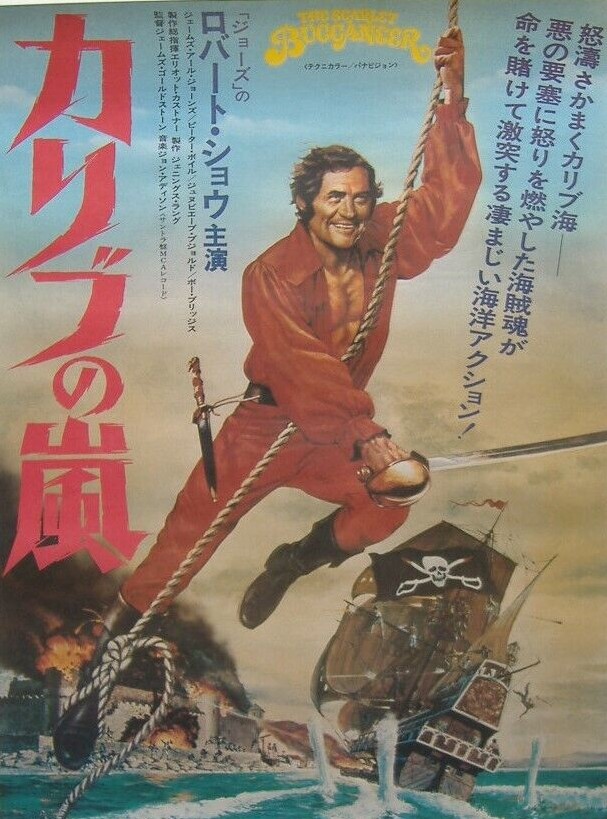
Swashbuckler (1976) **

Red faces all round. Uneasy pirate spoof that misses all its targets, coming close to resembling the kind of movie that gives turkeys a bad name and saved only by a spirited performance by Genevieve Bujold. Uber-producers Jennings Lang (Rollercoaster, 1977) and Elliott Kastner (Where Eagles Dare, 1968) should have known better but were seduced by the tantalizing returns for Richard Donner’s The Three Musketeers (1974) and its sequel which had revived the moribund swashbuckling genre.

Robert Shaw (Custer of the West, 1967) was nailed-on for the leading role since had made his name playing a pirate in British television series The Buccaneers (1956-1957) and was as hot as he was going to get after the double whammy of The Sting (1973) and Jaws (1975). However, the movie takes its cue from one of the chief supporting actors Major Folly (Beau Bridges).

It’s color-coded. In case we can’t tell a good guy from a bad guy, we’ve got the Man in Red, pirate Ned Lynch (Robert Shaw), shaping up against the Man in Black, unscrupulous Jamaican governor Lord Durant (Peter Boyle). Ned is presented as a seagoing Robin Hood, Durant as the wicked Sheriff of Nottingham, his ruthlessness somewhat undermined by his predilection for playing with toy boats in his bath and for getting his hairy back waxed.

Twin narratives quickly unspool. Ned rescues from being hanged shipmate Nick Debrett (James Earl Jones) while Durant jails island chief justice Sir James Barnet (Bernard Behrens) and steals his treasure.

Stolen treasure being fair game, Ned and Nick hijack a coach-load of it, while Sir James’s on-the-run daughter Jane (Genevieve Bujold) ends up in their hands. Not being as black-hearted as his nemesis, Ned puts Jane ashore, but still a bit black-hearted humiliates her in a swordfight, and is disinclined to help her save her imprisoned father.

However, Jane has a trump card. For reasons unknown, Durant is heading back to England with a cargo of 10,000 dubloons, too tempting a target for any pirate. Naturally, nothing goes as planned but, as you might expect, there is a happy ending.

This might have worked, since all the ingredients are there, the laughing cavalier, the spirited woman, the humorous sidekick, the unprincipled villain. You’ve got an historically-accurate pirate ship for once, unlikely romance between high-born woman and charming scallywag, simple rescue-imprisonment-rescue scenario, and ample scope for swordplay.
Except the dialog is awful, the ship too small to accommodate any fighting so the pirates are landlubbers for the most part, and except for the duels between Ned and Jane and Ned and Durant, the swordfights are all kind of bundled together, and every now and then the action stops so we can hear a verse or two of a sea shanty sung by nobody in particular.

Though Ned and Nick trade cringeworthy, and in one case downright offensive, limericks, the best (only) laugh comes when Ned chucks Jane off a roof onto a canopy and follows up with the line “It worked.”  It doesn’t help that Durant’s pederastic tendences are played as a joke. Everywhere you look people are turning cartwheels or are “blithering idiots” or “pawns” and as you might expect there’s a cat-fight and a monkey around to relieve a jailer of his keys. You are just praying for a shark to come along to put the cast out of their misery.

In the midst of this feast of over-acting along comes Genevieve Bujold (Anne of the Thousand Days, 1969) who must think she’s in a different picture. She is a feisty one all right, not above putting a knife to a man’s cojones, or kneeing them in that region, and, given the lawless state of the island, branded a criminal for wounding a rapist.   At least she takes the whole thing seriously rather than as if being in a Mel Brooks picture.

It’s hard to know who to blame: the stars for acting as if enjoying a holiday from more serious fare; director James Goldstone (Winning, 1969) for failing to get the recipe right and employing a jaunty score that undercut everything, or writers Jeffrey Bloom (11 Harrowhouse, 1974) and Paul Wheeler (Caravan to Vaccares, 1974) for making a mess of the ingredients in the first place.

Of course, I am hardly blameless in drawing your attention to this, a sudden enthusiasm for pirate pictures sending me dashing into the wrong decade.

Watch for: Robert Shaw making a bid for the all-time Golden Raspberry; an unrecognizable Peter Boyle (Taxi Driver, 1976); Beau Bridges (Gaily, Gaily, 1969) doing his best Frankie Howerd impression; James Earl Jones (The Comedians, 1967) sounding normal, minus the deep-throated vocal tic on which he made his name; and so many inanities it falls easily into the So Bad It’s Good category.  

The Comedians (1967) ***

Over-long, over-hyped and over-cast. Pretty much an early example of virtue-signalling, exposing corruption in a dictatorship (Haiti), but offering more through the singular self-deception of the main characters. An element of sleight-of-hand is also practiced on an audience enticed by four big stars “above the title” comprising three Oscar winners and one multiple nominee. Luckily, the ironic in-joke of naming characters with traditional English names – Smith, Jones and Brown – would probably pass most people by.

Brown (Richard Burton), a hotelier, is present throughout but Major Jones (Alec Guinness) appears only briefly at the beginning then disappears until late on to spike the plot. Martha (Elizabeth Taylor), the adulterous love interest, pops up sporadically as does her husband Ambassador Pineda (Peter Ustinov). There’s not much of a story, Brown, cynical about the dictatorship, is friendly with a rebel leader, Jones is an ineffectual arms dealer, and missionary couple the Smiths (Paul Ford and Lillian Gish) offer comic relief until barbarity rears its head.

Great play is made of naivete but the film suffers from the Hollywood curse of only being able to examine foreign politics through the prism of a (white) American or Englishman. At the time it might have been shocking to see brutality so convincingly dispensed, and there is, also, in Mondo Cane fashion, too much time spent on strange ritual, but at the same time, of course, the U.S. was inflicting its own barbarities on the Vietnamese.

On the other hand, Brown is exactly the kind of foreigner who believes things must improve because, damn it all, he’s British and bad things can’t happen to a Brit in a strange land. He is convinced he will be able to sell a hotel located in a war-torn country, persists in believing Martha will abandon husband and son, and convinces himself he is the very man the rebels have been looking for.

Jones mistakenly believes everyone is taken in by his hail-fellow-well-met routine and his tales of heroism in World War Two jungles, thinks he is in with a chance with Martha and that his gun-running activities will avoid detection. The ambassador thinks his wife will not leave him as long as he turns a blind eye to her affairs. And Martha, probably wondering why she married such a buffoon, can’t work out to dump him. Everyone who has much to lose appears to be continually on a precipice and it’s hard to see what they could gain from their actions. 

They are all misfits, “comedians,” stuck in the rut of their own destiny, unable to change.

Nobody is more gullible than those who dupe themselves and the film comes into its own when it sets personal delusion against political naivete. In narrative terms Jones is the most obviously unmasked but the others are no less shown to be foolhardy in their expectations.

This had all the hallmarks of a prestige picture, initially planned as a roadshow,  around $2 million spent on the above-the-line cast, another chunk on buying the rights to the Graham Greene bestseller and assigning the author the screenplay, location shooting in Dahomey.

Don’t expect oratorical fury from Richard Burton (The Bramble Bush, 1960) nor outbursts of angst from Elizabeth Taylor (Secret Ceremony, 1969). There’s something almost comically homely in their deception and in the outwardly confident Brown perceiving Jones as a love rival.  Alec Guinness (The Quiller Memorandum, 1966) is the big treat, an upmarket con man, his boisterous voice and mannerisms far removed from his more usual introspective performances. Peter Ustinov (Topkapi, 1964), a bit too fidgety for my liking, nonetheless attracts sympathy as the man who is batting above his weight in snaring a trophy wife he knows he cannot hold onto.

Burton was the odd one out in the Oscar rankings. Despite five nominations by this stage, he had never taken home the statuette. Elizabeth Taylor, by contrast, had won twice, for Butterfield 8 (1960) and Who’s Afraid of Virginia Woolf (1966), Guinness once for Bridge on the River Kwai (1957) and Ustinov also twice Spartacus (1961) and Topkapi.  

However, in some senses if you remove the star turns, you are left with a rawer picture, and director Peter Glenville (Becket, 1964) captures much of the personal intensity of the novel. Taylor, in particular, misses the mark. Although playing a German, she never once bothers attempting an accent. Had Burton been the sole star, the movie would have worked much better since his low-key playing would not have been so much at odds with other actors.  

There’s a host of striking turns from supporting stars, ranging from silent film star Lillian Gish (The Unforgiven, 1960) to Roscoe Lee Brown (Topaz, 1969), James Earl Jones (The Great White Hope, 1970), Raymond St Jacques (Uptight, 1968) and Cicely Tyson (Sounder, 1972).

Discover WordPress

A daily selection of the best content published on WordPress, collected for you by humans who love to read.

The Atavist Magazine

by Brian Hannan

WordPress.com News

The latest news on WordPress.com and the WordPress community.