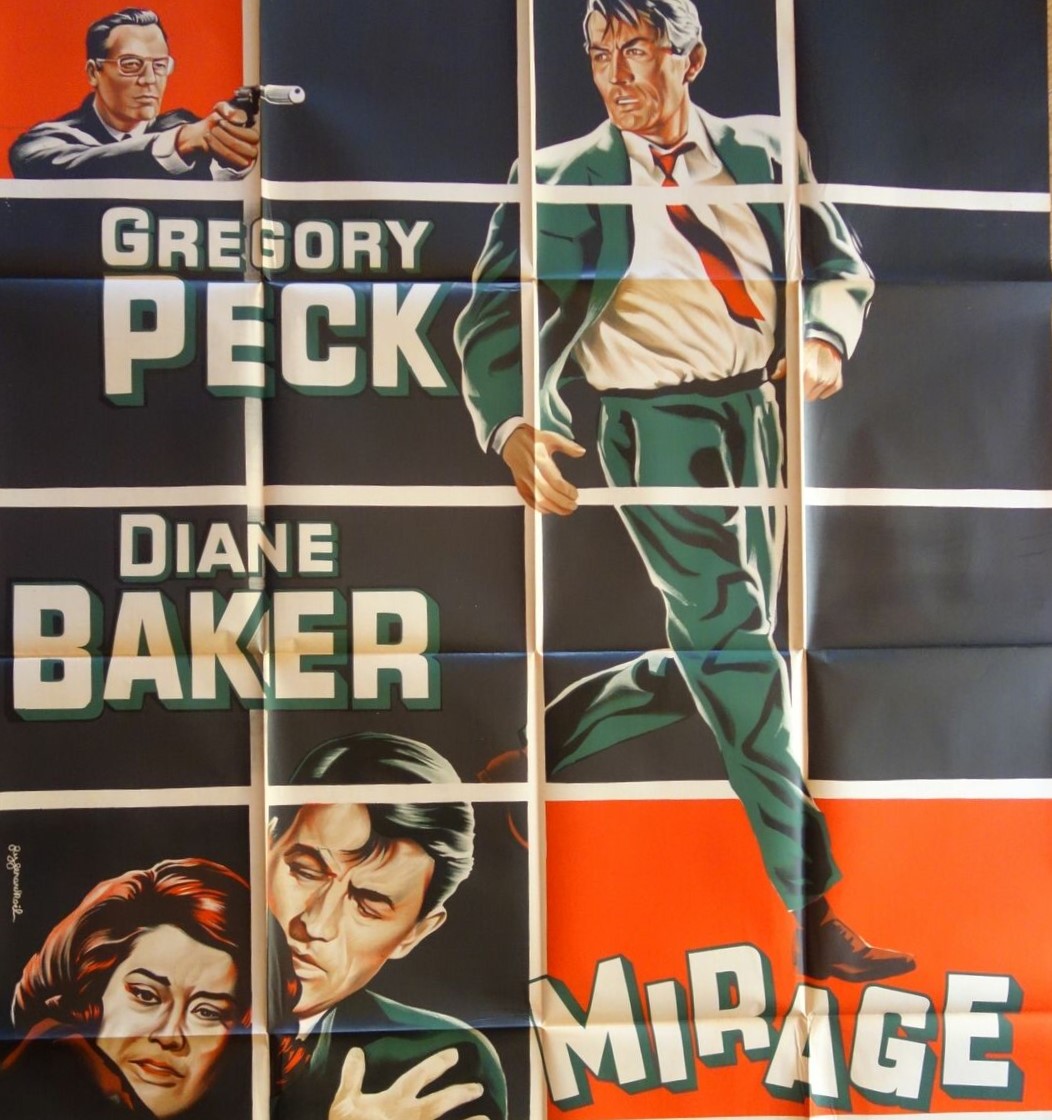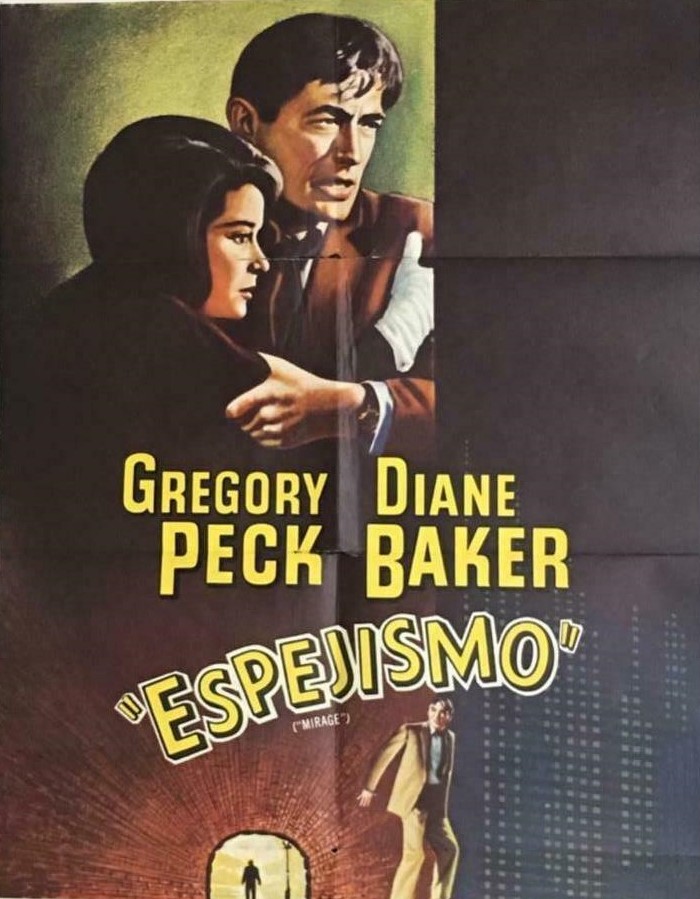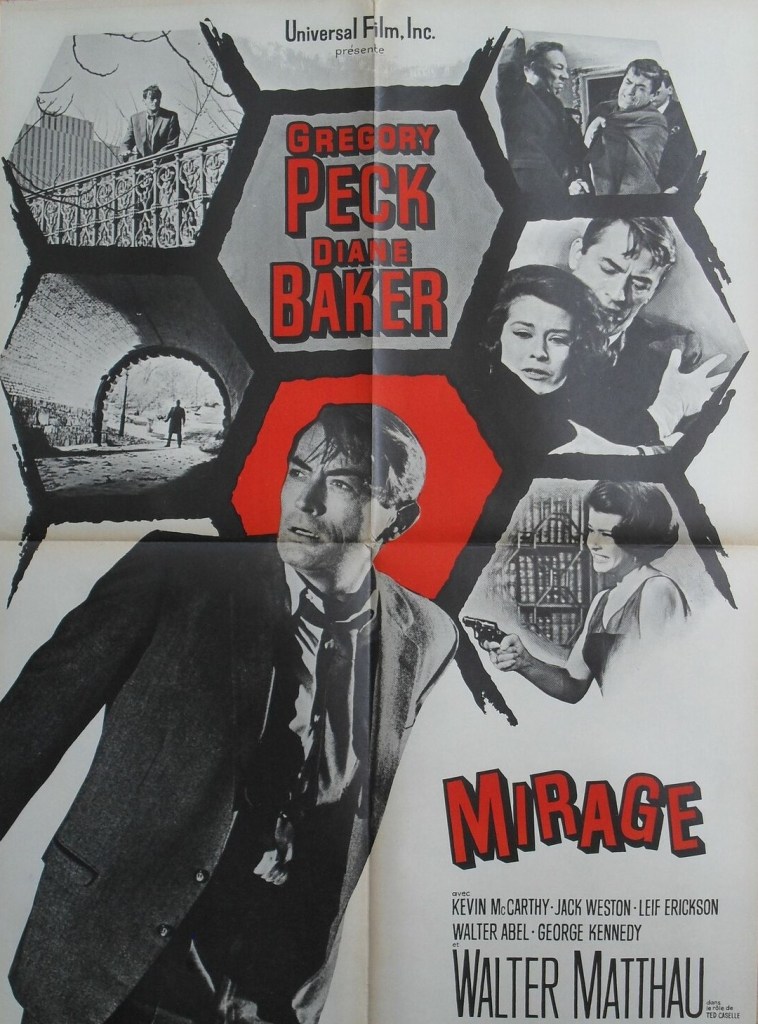
Mirage (1965) ****

“I owe you some pain,” barks the heavy to hero in one of the memorable lines in this classy thriller with surprisingly contemporary overtones. Underlying this tale of amnesiac David Stillwell (Gregory Peck) recovering his memory are themes of personal commitment, commitment to cause (“if you’re not committed to anything you’re just taking up space”), of individuals taking a stand against powerful forces seeking to thwart democracy, and of malevolent pandemic, the oldest of them all, greed, that infects even the most philanthropic enterprises.

The structure is brilliant. To every question David Stillwell (Gregory Peck) asks in trying to establish his identity, the answers are mystifying. He doubts his sanity and is plunged into a  life-threatening conspiracy.   

The film opens superbly. The camera pans across a New York skyline at night, every skyscraper lit up. Suddenly, one of the buildings goes dark. Cut to confusion inside as workers deal with the electricity cut-out. Among them Stillwell who is surprised to meet a woman on the stairs, Shela (Diane Baker), who not only recognizes him but seems to know a lot about him that is unfamiliar to him. They end up in the fourth level of the basement and on leaving discover that Charles Colvin (Walter Abel), a name that’s only vaguely familiar to Stilwell, has committed suicide by jumping from the building.

When he gets home to his apartment he is accosted by gunman Lester (Jack Weston) who tells him “The Major” wants to see him. Stillwell escapes but on reporting the incident to the police can’t remember his date of birth. After his amnesia being rejected by a psychiatrist he turns to private eye Ted Caselle (Walter Matthau) who takes up the case. But in Stillwell’s apartment a fridge he recalls as being empty is now full, the same with a dispatch case, the opposite with a closet, and in the building where he thinks he works there is now a wall where his office should be.

Stillwell believes he was employed as a cost accountant without a notion what that job entails. The building has no fourth level. Another gunman Willard (George Kennedy) is also in pursuit. Corpses pop up with increasing regularity. To add to the mystery, nobody actually wants him dead. He is too valuable alive. He has a secret only he doesn’t know what. The police connect him to the suicide.

And so the movie plays out brilliantly, with the audience only knowing what Stillwell knows, as confused as he, until piece by piece the jigsaw comes together although at times with cunning sleight-of-hand the pieces are the wrong shape or, worse, don’t fit the jigsaw in hand. There’s an emotional jigsaw to be put back together too, one that requires proper commitment, Shela’s “togetherness is not enough” could have been a mantra for today’s generation.

All the time Shela bobs in and out, hard to tell whether she is a victim or conspirator, whether to be trusted or merit suspicion, and she has an interesting philosophy of her own in terms of the trapped and caged.

As in the best thrillers we have been given the clues all the time, just not realized them for what they were, and in a series of brilliant scenes you cannot help but applaud the entire mystery is carefully stitched together. You will never in a million years guess the cause of Colvin’s mysterious death.

The ending is satisfying on a variety of levels. Yes, mystery solved, the secret Stillwell holds a good one, but the climax involves characters taking sides, displaying commitment, challenging their consciences, circumstances reflecting very much the world in which we find ourselves now.

One of the beauties of the movie is how it plays with our expectations. Peck has done amnesia before in Hitchcock’s Spellbound (1945) but since then his screen persona has been men of upstanding character, Atticus Finch in To Kill a Mockingbird (1962) the personification, confusion not a trait readily identified with him. Equally, the heavies look anything but,  Jack Weston small and rotund, George Kennedy bespectacled and slim.

Diane Baker, enigmatic throughout, far from the glamorous thriller female lead (think Audrey Hepburn in Charade or Sophia Loren who partnered Peck on Arabesque or Claudia Cardinale in Blindfold teamed with Rock Hudson), describes herself as a “lonely woman with a low opinion of herself due to many mistakes.” In the middle of the high tension, with Stillwell being pursued by cops, there is a wonderful scene where a little girl lets him hide in her apartment and on making him coffee it turns out to be the pretend coffee little girls make.

Gregory Peck (Arabesque, 1966) is superb, his face absorbing shock at his condition, at once welcoming unravelling mystery at the same time as doubting its source, wending his way through a past he cannot believe is true, a personality that occasionally appears abhorrent, and having to make the same decisions that he feared making in the past. Diane Baker (Marnie, 1964) has a difficult role, introspective where most heroines in this kind of film are more voluble, and frightened of her own vulnerability.

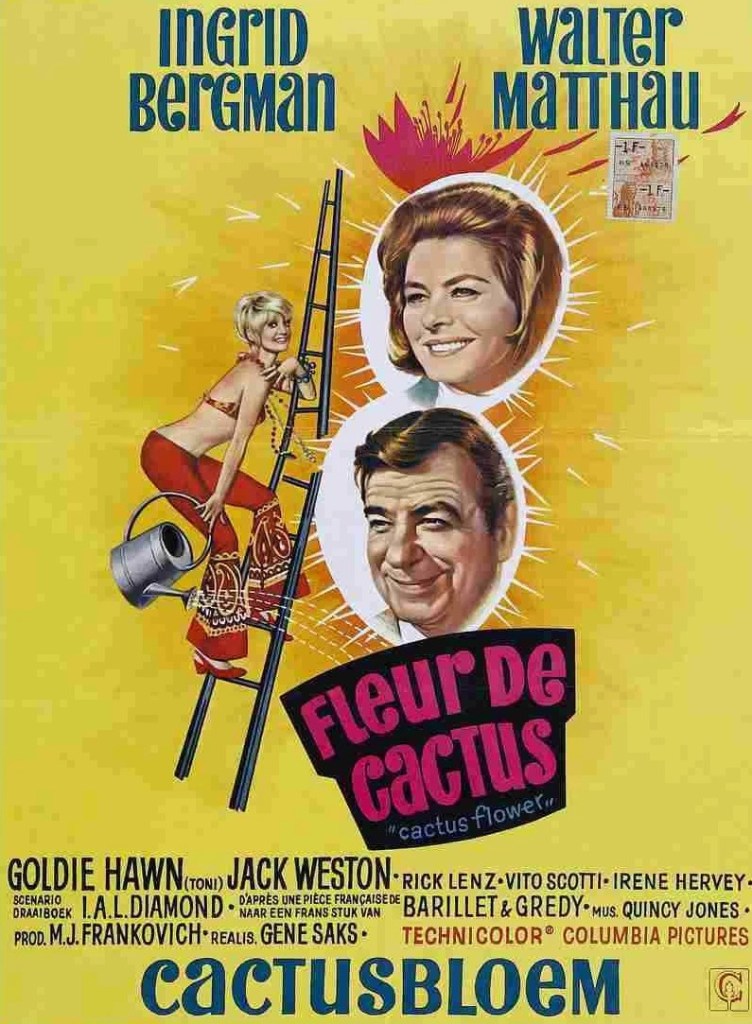
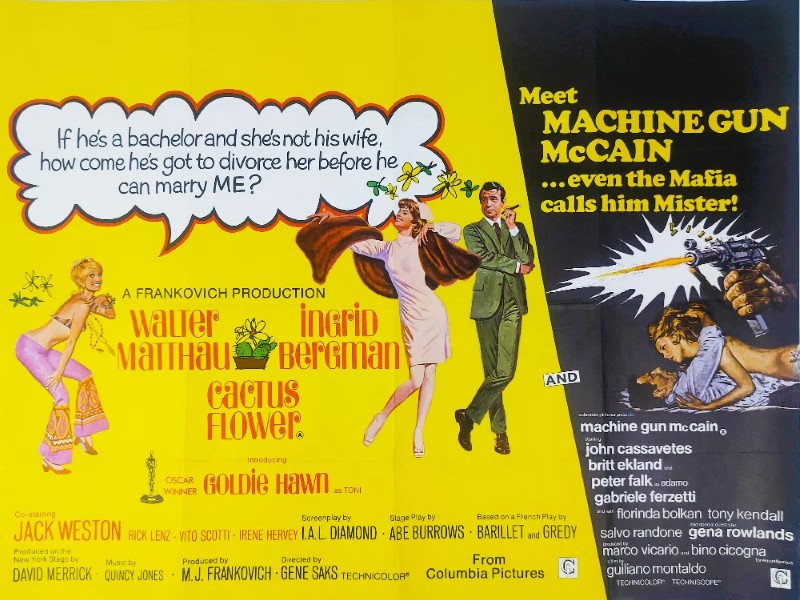
You can see from here how much George Kennedy bulked up for his breakthrough movie Cool Hand Luke (1967). Walter Matthau, too, was a stage away from interesting supporting roles to full-blown star in The Fortune Cookie (1966). Jack Weston might have been rehearsing his role as the stalker in Wait until Dark (1967). I am not going to mention the other sterling supporting players since that will give the game away.

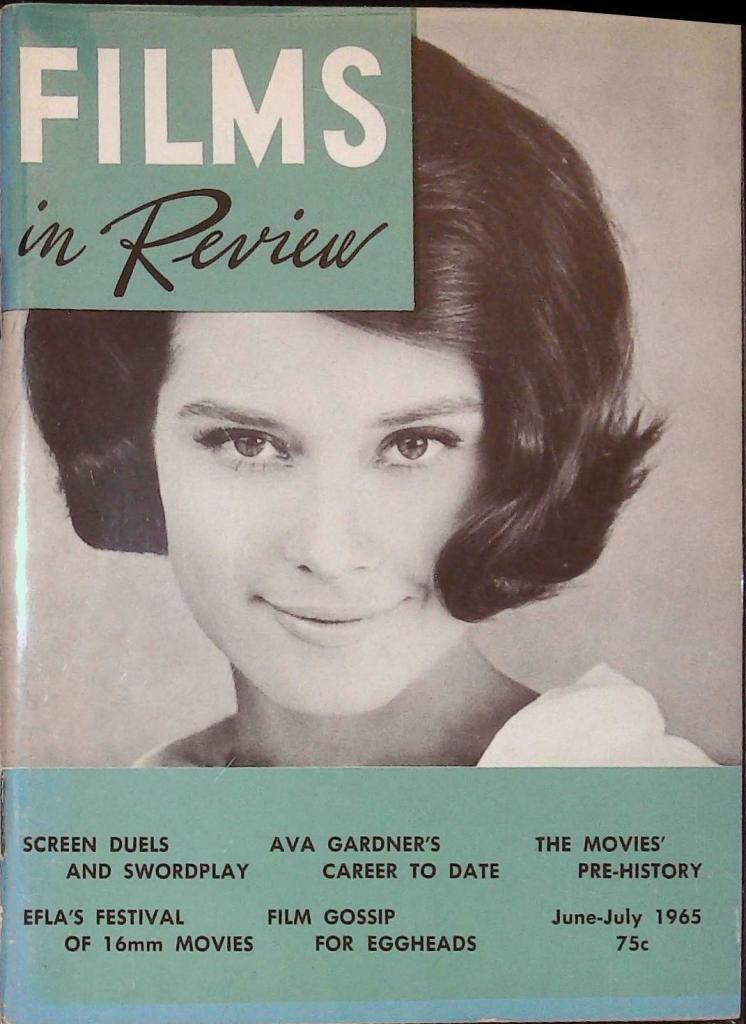
Diane Baker makes the cover of Films in Review magazine.

Veteran director Edward Dymytryk (Alvarez Kelly, 1966) is on song, stringing the audience along beautifully, extracting wonderful performances, not frightened to give the film deeper meaning. The theme of commitment, of standing up to malevolent forces, seems an odd one for a straightforward thriller but it reflected Dmytryk’s experience as a victim of the anti-Communist witch-hunt of the 1950s.  

On the debit side, I can’t see any reason why this was made in black-and-white and it certainly served to put off the public, the film’s box office poor, but I dispute the criticism of what appeared too-frequent flashbacks. Rather than re-emphasizing plot points for the audience, I saw this instead as Stillwell holding up a mirror to a memory he doubted he could trust.  

Top-notch screenplay by Peter Stone who knows his way around this genre, having previously written Charade and with Arabesque round the corner, from the novel called Fallen Angel by ,surprisingly, given he is best known for Spartacus, Howard Fast under the pseudonym Walter Ericson. At least a dozen quotable lines included this cracker relating greed to a pandemic: “You’re a carrier, you infected him and he died from it.”

All told, an excellent thriller with modern resonance.

Oddly enough, Mirage was remade a couple of years later as Jigsaw (1968), directed by James Goldstone and starring Harry Guardino.

P.S. I see you that the “I owe you” line was adapted for use by Willow in the Buffy, The Vampire Slayer TV series. There’s even a link to that scene on YouTube. Glad to see it has found some kind of immortality. It’s the kind of line that should be a gimme for t-shirt manufacturers.  

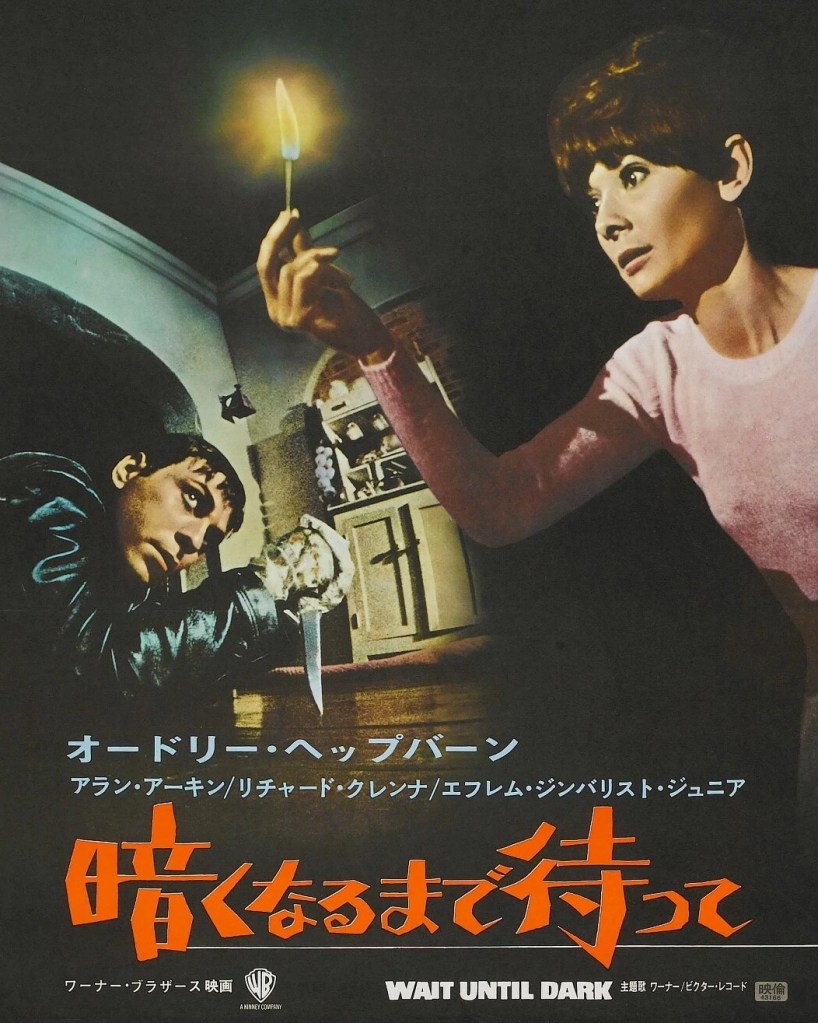
Wait Until Dark (1967) ****

You wouldn’t have figured Audrey Hepburn – she of the model looks (Breakfast at Tiffany’s, 1961)  and upmarket twang and belonging to the highest echelons of the movie business – for a Scream Queen. But there were precedents – Doris Day had at times been screaming fit to burst in Midnight Lace (1960) and Lee Remick, though not in either’s marquee league, had been terrified to bits in Experiment in Terror / The Grip of Fear (1962). By this point in pictures, the screen was awash with Scream Queens, courtesy of lower-budgeted efforts from Hammer, AIP and Amicus, so asking a top star to exercise her lungs in similar fashion might have been career suicide.

As it was, which would have come as a surprise to her legion of fans, this turned out to be pretty much the star’s swansong. She wouldn’t make another movie in nearly a decade and only another three after that. But here she certainly hits a dramatic peak.

The story’s a bit muddled and initially requires unraveling. Drug mule Lisa (Samantha Jones) passes a doll packed with heroin to fellow passenger Sam (Efrem Zimbalist Jr.) on a plane. She had been planning to steal the dope and set up on her own with Mike (Richard Crenna) and former cop Carlino (Jack Weston). There’s a bit missing from the tale but you have to assume that somehow Lisa got talking to Sam and he gave her his address and that she has turned up at his apartment looking for the doll, which wasn’t there.

Mike and Carlino turn up and have no luck searching the apartment. They don’t look hard enough because if they’d looked in the closet they’d have found the corpse of Lisa, killed by her employer Roat (Alan Arkin) who arrives to confront the pair and then hire them to help him find the heroin and dispose of the body.

So with all that out of the way we come to the meat of the story. And it follows the same premise as Man in the Dark / Blind Corner (1964) –  though, luckily, so few people saw that it wouldn’t be at the forefront of the audience mind at the time – of not so much a blind person being terrorized in their home but being largely played for a fool. The audience knows more than the blind person does and much of the story is not their vulnerability but just how long it will take for them to twig what’s going on.

In the case of Susy (Audrey Hepburn), as with the composer in Man in the Dark, her ears are her radar. She is on the alert after hearing the same pair of squeaky shoes on different people and wondering why people are opening and closing her blinds so often. Mike and Carlino masquerade as good guys, cops investigating the murder of Lisa for which her husband Sam is a suspect. She helps them tear apart the apartment looking for the doll.

She trusts Mike implicitly, less so Carlino, and when she starts to put two and two together she has an ally, teenager Gloria (Julie Herrod) who lives upstairs – they communicate like jailbirds by banging on the pipes. Although her eyes are denied sight, they still express her emotions – trust, relief, gratitude, fear.

But there’s not just one game of cat-and-mouse. There’s three. You know damn well that Mike and Carlino plan to squeeze Roat out of the equation just as you know damn well that he is planning to play them for patsies, apt to take revenge when double-crossed.   

Gradually, her suspicions ramp up. She’s pretty smart working out the various clues. And then we hit two dramatic peaks. Firstly, when she discovers Mike is a bad guy. Secondly, when Roat kills Mike and turns on her, splashing petrol about the place, exploiting her terror of fire. She’s still got a couple of moves to turn the tables, at least temporarily but when absolute darkness does descend – she’s smashed all the lights out – and theoretically they are both in the same boat, and advantage her because of her keener hearing, it doesn’t quite work out the way she’s expected because he knows how to exploit sound.

I won’t tell you where the doll is hidden because that’s a very clever twist in itself, but apart from the few plotholes at the outset (how did Lisa manage to break into Susy’s apartment for a start and leave no trace, for example) once the narrative takes hold it exerts a very strong bite.

Audrey Hepburn is on top form. Alan Arkin (The Russians Are Coming, The Russians Are Coming, 1966) and Jack Weston (Mirage, 1965) are a bit too obvious for me, but the smoother Richard Crenna (Marooned, 1969) is excellent.

Directed with both an eye to character and tension by Terence Young (Dr No, 1962) and adapted by Robert and Jane-Howard Carrington (Kaleidoscope, 1966) from the Broadway play by Frederick Knott (Dial M for Murder, 1954).

Top notch.

The Thomas Crown Affair (1968) *****

Employs Hitchcock’s trick of having you rooting for the bad guy. The caper picture remade. Steve McQueen (Nevada Smith, 1966) reinvented. Faye Dunaway (The Extraordinary Seaman, 1969) making the most stunning entrance this side of Ursula Andress in Dr No (1962). The technological dream of the split screen. Film noir filmed in bright sunshine with a femme fatale on the right side, only just, of the law.

Takes the insurance agent of Psycho (1960) and switches the gender. Nabs the Hitchcock crown (Notorious, 1942) for the longest screen kiss. Steals from Ingmar Bergman (The Seventh Seal, 1957) the title of best chess scene.

Female sleuth at a time when I don’t think the idea of a female detective crossed anyone’s minds in Hollywood. And one so sexy, stylish and uber-confident that she attracts not one sexist remark. Not dumb enough either like Lila in Psycho to walk into a trap.

And, incredibly, given wealth has been a movie trope since day one, luxuriates in a lifestyle – gliders, dune buggies, polo – never seen before. Not just a mesmerising song (“The Windmills of Your Mind”) but an absolutely outstanding score from Michel Legrand (Play Dirty, 1968). Almost works as a visual greatest hits collection, one memorable scene after another, a cat-and-mouse scenario, twists aplenty and smart, smart dialog.

Ignores back story and dark hidden secrets. Dispenses with the usual robbery cliches of planning the heist and the robbers irritating the hell out of each other. Theft here is carried out with mathematical precision, the crew members never meeting, mastermind Thomas Crown (Steve McQueen) hidden from view at initial interview behind a bank of blinding lights. But the investigation is clever, too, donkey work – tracking everyone who flew to Geneva (where the stolen cash is banked) – coupled with instinct, insurance agent Vicki (Faye Dunaway) choosing Crown as the most likely criminal from his photograph, and a piece of inspiration, offering a huge reward for anyone noticing their spouse had been in Boston on the day of the robbery and been behaving oddly.

Crown is a fabulous invention, savvy businessman, bursting with competitive instinct, unable to prevent himself crowing, his opening line – “you overpaid” – puncturing the triumph of businessmen who believed they bettered him in a deal. But he’s bored, riches and all the toys that brings including sexy girlfriend Gwen (Astrid Heeren) not enough, and he seeks to test himself against the law.

But he’s always testing himself, regardless of how high or how low the stakes. He’s the kind of guy who just bets for the thrill. The only reversal in the whole movie is a golf match where he employs the old sucker punch, double-or-quits routine, to be able to repeat an unexpectedly successful shot. When he loses spouts another brilliant line, “What else can we do on Sunday?”

But he’s up against as steely a competitor. Has any character ever delivered such an immortal line with such panache – “I’m immoral” – as Vicki who has no qualms about invading Crown’s house on a flimsy pretext or  kidnapping the son of one of the gang. “You won that round,” she tells Crown after bringing gang member Erwin (Jack Weston) in for questioning and stationing him in the same room as Crown, hoping to elicit recognition.

You’d hardly be surprised to discover she’s more than capable of using her body as a weapon, but you’d be hard put to work out who is seducing who. For both, part of the attraction must be danger, being up close (and very personal) with your rival. It wouldn’t take much to imagine this is a reversal, that Vicki is being hunted, that in the throes of romance she will give away too much. Or that the arrogant Crown believes he can have his cake and eat it. He doesn’t need the money, he can give it back, avoid arrest and sail off into the sunset with a woman his match in style and intellect.

If there’s one flaw in the spellbinding narrative, it’s here. We all know insurance exists outside the law. Retrieving money for clients is the sole aim, justice not on the agenda. No bank chief executive wants to suffer the embarrassment of being hauled into a courtroom to explain just how fallible their security systems are. Hand back the money, bury the publicity and all’s well. I’m not entirely sure why Vicki had to seek the approval of detective Eddy (Paul Burke), leading the police side of the investigation, when she could as easily have bypassed him and picked up her ten per cent of the money as reward and sailed off into the sunset.

Unless, of course, it’s not a flaw. And that for Vicki, as resolute a competitor as Crown, she requires official recognition of victory and to prove her superiority over the criminal by allowing him to be set free, giving her if you like the upper hand in the relationship.

Director Norman Jewison was on a box office roll after turning conspiracy upside down with The Russians Are Coming, The Russians Are Coming (1966), and exploring racism with In the Heat of the Night (1967). Where most critics prefer directors who reveal thematic consistency, Jewison seemed to be headed every which way – although in the cat-and-mouse stakes you could look at The Cincinnati Kid (1965) – with elan his ace in the hole.

And if you ever sat in a movie theater and thought you could do better than the drivel you were watching, then screenwriter Alan R. Trustman would be your patron saint. A lawyer by profession, he wrote The Thomas Crown Affair in a couple of weeks and, hardly surprising, given its audacity, it found its way to an agent. He went on to write Bullitt (1969), Lady Ice (1973) –  almost a remake of Thomas Crown – and The Next Man (1974) for Sean Connery.

The best fun crime movie since Hitchcock paired Cary Grant and Grace Kelly in To Catch a Thief (1955) and never bettered since.

Dazzling.

All In A Night’s Work (1961) ***

What wouldn’t Hollywood give now for a pair of personable players who could take as slight a piece of fluff as this and through sheer force of screen personality turn it into an enjoyable experience.  Based entirely around misconception, misunderstanding, characters at cross purposes and mild business satire this would have been hailed as a classic had it appeared in the golden age of the screwball comedy.  

Playboy Tony Ryder (Dean Martin) inherits a publishing empire from his uncle but discovers an unsavoury fact about his relative’s demise that could severely damage the business. A naked woman was seen running from his hotel room. When hotel house detective Lasker (Jack Weston) identifies her as Katie Robbins (Shirley MacLaine), a lowly employee in the company, the suspicious minds of big business surmise that she intends to blackmail them.

The plot, such as it is, concerns Ryder and Co’s attempts to avoid this, by bribing her to shut up and at the same discrediting her. Ryder is conflicted, in part because he fancies her rotten, in part because he doesn’t quite believe she could be so duplicitous, and in part because he can’t afford to risk believing her. For some reason, as a researcher, she is involved in union negotiations, giving him the opportunity to get to know her better, as part of a “sub-committee of two” established to examine union claims more thoroughly.

So it’s basically one set-piece after another. A flashback explains why Katie came to be in the uncle’s bedroom – to escape in the same hotel the lustful attentions of the elderly wealthy guest Kirby Hackett (Johnstone White) whom she saved from drowning. Her behaviour at the uncle’s funeral suggests she is stricken by his death. And unfortunately, she is the recipient from the grateful Hackett of a mink coat worth thousands of dollars which, on her meagre salary, she can’t explain.

Katie is dithering over her planned wedding to dull vet Warren Kingsley Jr. (Cliff Robertson) and, aiming to discredit her with him, Ryder plants the seed that actually she is a showgirl on the side, arranging for her to receive five star treatment at various nightclubs, inciting suspicion from her fiancé and his extremely conventional parents. In order to get to the bottom of everything, Ryder agrees to be bugged for a private meeting with Katie. You can imagine how that goes. But the outcome is never in doubt of course.

What the audience knows but the participants do not is that this couple is well-suited. Ryder is far from the playboy of his reputation, having started at the bottom of a rival publishing empire and worked his way up to the top, so he turns out to be a more astute businessman than the sycophants on the board anticipate – “you may not be much but you’re all we’ve got” typical of the welcome he receives. Far from being a good-time girl, Katie is a woman of principle, refusing to take the mink coat as a gift and determining to pay it off at the rate of $10 a week.

The humour derives almost entirely from the cross-purpose nature of the plot and the set-pieces work out well, especially when Ryder kidnaps a sheepdog as an excuse to visit the vet, and stumped for a reason comes up with the notion the animal is suffering from amnesia. “He gives me that ‘who are you’ look,” Ryder explains. As the tale unfolds Kingsley becomes more insufferable by the minute.    

There’s a romantic subplot involving Katie’s outgoing office chum Marge (Norma Crane) and the shy detective and some satirising of big business but that all plays out in relation to the main story.

If you remember Dean Martin from heavyweight dramas like The Young Lions (1958), Some Came Running (1958), Rio Bravo (1959) or the breezy Rat Pack comedies and the equally breezy Matt Helm spy pictures will probably not be aware he started his career in comedy, as one half of the Dean Martin-Jerry Lewis combo, a box office sensation in the early to middle 1950s. So, although he was primarily the straight man to the more obviously comedic Lewis, he was still well versed in the nuances of the genre. Nothing is ostensibly played for laughs, but he gets the laughs nonetheless.

Martin was always badly under-rated, in part because of the perma-tan, in part down to the his television show, and in part because he just wasn’t Frank Sinatra. But he was an accomplished actor, as this proves. One of the aspects of his performance I liked was that he moves with purpose. In most movies, characters cross a room or change position simply because a director calls the shots. But here, every time Martin moves it’s for a designated reason, to touch something, admire something, maneuver himself closer to someone else.

Shirley MacLaine is also refreshing, considerably less conniving or lovelorn than in her breakthrough role in The Apartment (1960), and coming to believe in her screen presence. She inhabits this character’s innocence very well, is suitably baffled on occasion, and exhibits a screen persona that simply lights up the screen. Together they are a great screen couple and in the charisma-starved Hollywood of today would be very welcome.

Cliff Robertson (The Honey Pot, 1967), almost unrecognizable without that hefty hunk of hair and the grandstanding he often effected, plays his small role to perfection. Norma Crane (Penelope, 1966) and Jack Weston (The Cincinnati Kid, 1965) – minus the screen tics he later exhibited – are quietly effective. Veteran Charles Ruggles (The Parent Trap, 1961) puts in a decent shift.    

Confident direction by Joseph Antony (The Rainmaker, 1956) in just his fourth film out of a grant total of five makes you forget this was based on a hit play by Margit Veszi and Owen Elford. The screen transition was down to Maurice Richlin (The Pink Panther, 1963), Edmund Beloin (Donovan’s Reef, 1963) and future bestselling author Sidney Sheldon (Billy Rose’s Jumbo, 1962).  

The real beauty of this piece is how effortless it all looks. The characters are grounded and believable, viewed from varying perspectives the plot remains logical, and there is enough daft invention to tickle your fancy.

The Cincinnati Kid (1965) *****

Steve McQueen had little trouble identifying with this role. He was the Hollywood contender, trying to knock current kingpin Paul Newman off his perch, and in Norman Jewison’s tense, often heart-stopping, drama he has the ideal vehicle. For the most part this is a winner-take-all face-off, as much a showdown as any western shootout, in darkened rooms under the harsh light of a New Orleans poker table between a rising star always referred to as The Kid (Steve McQueen) and the unofficial world champion, the urbane cigar-smoking Lancey Howard (Edward G. Robinson).

Broadened out in the initial stages to include scenic diversions – the Mississippi at dawn, a cockfight, some jazz – plus romance and intrigue, this is essentially pure sport, a game of stares, where bluff holds the ace and women exist on the perimeter only to fill in the time before the next hyped-up encounter. There’s no trophy to be won, not even glory, just the right to call yourself “The Man.” The Kid feels the pressure of punching above his weight, Lancey of getting old.

Farmer’s daughter and arty-wannabe Christian (Tuesday Weld) is the Kid’s main squeeze until she gets between him and his game. When she takes off, he makes do with Melba (Ann-Margret), girlfriend of dealer Shooter (Karl Malden) who was somewhat preoccupied with giving the Kid more than a helping hand to satisfy the vengeful Slade (Rip Torn), a rich businessman.

Although it finally comes down to a confrontation between the Kid and Lancey, subordinate characters like sweating poker player Pig (Jack Weston) and stand-in dealer Ladyfingers (Joan Blondell) help dissipate the tension. But in fact anything that occurs only seems to increase the tension as it comes down to the one big final hand. 

This is McQueen (The Magnificent Seven, 1960) in transition, from the loner in The Great Escape (1963) to an actor exuding charisma and on top of his acting game. While on the face of it little more than a sporting lug, the Kid is an appealing character, engaging with a little shoeshine boy, winning over Christian’s truculent parents with what appears a card trick but is actually a demonstration of the phenomenal memory necessary to excel in his chosen field. There’s a winsome child in there among the macho persona. The poker face that McQueen developed would become one of his acting traits over the years.

Edward G. Robinson (Seven Thieves, 1960) gives a rounded performance as the reigning poker champ accepting emotional loss as the price for all his financial gains. Tuesday Weld is an appealing waif. Karl Malden (Pollyanna, 1960) essays another tormented soul and Rip Torn (Judas in King of Kings, 1961) a sleazy one. Also look out for a host of great character actors including Jack Weston (Mirage, 1965), Oscar nominee Joan Blondell (Advance to the Rear, 1964) and Jeff Corey (Once a Thief, 1965) plus composer and bandleader Cab Calloway.

Ann-Margret, all eye-shadow and cleavage, is in her best man-eater form. But, thankfully, there is more to her character than that. It is unclear whether she simply latches on to a potential winner or is pimped out by Shooter, but just hooking up with that older man (i.e. Shooter) makes her interesting, since looks are far from his attraction. Her ruthlessness is spelled out in simple fashion. She is determined to win, cheating at solitaire and she slams the wrong pieces into a jigsaw just for the satisfaction of making it look complete. You can sense a depth in this character which the film does not have time to fully explore.

Although often compared to The Hustler (1962), and in many eyes considered both its inferior and a crude rip-off, this is in some respects a greater achievement. At least in The Hustler, there actually was action, players moving around a pool table, clacking balls racing across the surface.  Poker is all about stillness. Any gesture could give away your thoughts. Unlike any other sport, poker requires silence. There is no roaring crowd, just people dotted round the room, some with vested interest if only through a wager, some wanting to say they were there when a champion was toppled.

So the ability to maintain audience interest with two guys just staring at each other, interspersed with minimal dialog, takes some skill. Building that to a crescendo of sheer tension is incredible.

The first four pictures of Canadian director Norman Jewison (Send Me No Flowers, 1964) did not hint at the dramatic chops, confidence, composure and understanding of pacing required, especially as he was a last-minute replacement for Sam Peckinpah, to pull this off. That he does so with style demonstrated a keen and versatile talent that would come to the boil in his next three films: The Russians Are Coming, The Russians Are Coming (1966), In the Heat of the Night (1967) and The Thomas Crown Affair (1968).  

The former blacklisted Ring Lardner Jr. (Tracy-Hepburn comedy Woman of the Year, 1942) was credited with his first screenplay since The Forbidden Street in 1949 and he shared the chore with another iconic figure, Terry Southern (Dr Strangelove, 1964), basing their work on the original novel by Richard Jessup. Not sure who contributed the classic line: “Read ’em and weep.” Mention should be made of a terrific score by Lao Schifrin.

Discover WordPress

A daily selection of the best content published on WordPress, collected for you by humans who love to read.

The Atavist Magazine

by Brian Hannan

WordPress.com News

The latest news on WordPress.com and the WordPress community.