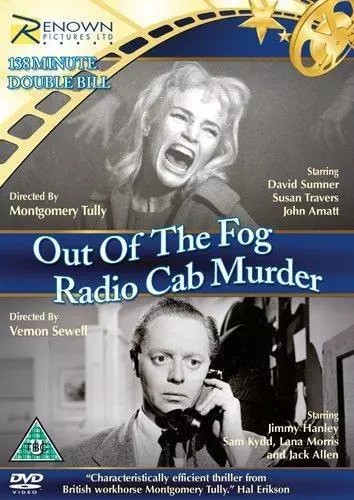
Out of the Fog / Fog for a Killer (1962) ***

Unusual and unusually effective entry into the low-budget British B-film crime category. Teeters for a time on the bittersweet before plunking for ending on a  more realistic sour note. Surprising, too, in being issue-driven – the problem of the rehabilitation of criminals, or the way such efforts are blocked by the general populace wanting nothing to do with thieves and villains, especially when it comes to employment or romance.

On release from prison, George (David Sumner) is given the chance of a new life from do-gooder Tom Daniels (James Hayter) who runs a halfway house for ex-cons. George isn’t particularly grateful, since he sees life stacked up against him. But he’s making an effort and turns down the chance to join the other residents in setting up an illegal scheme. Instead, Tom finds him work as a driver for a furnishings manufacturer where he meets Muriel (Mela White). But their nascent romance is scuppered when the cops come calling, investigating a murder on the “Flats”, an area of wildland close to both the factory where he works and the pub he frequents.

When the killer strikes again, and again, the cops Det Supt Chadwick (John Arnatt) and Sgt Tracey (Jack Watson) realize the murderer is striking at the full moon. Luckily, neither of the detectives is apt to go down the werewolf route, especially as the killer tends to strike when a full moon would be of little assistance because the “Flats” are covered in thick fog (for no apparent reason except the script says so).

George becomes the chief suspect and the cops decide to set up Sgt June Lock (Susan Travers) as bait – odd how often this became a trope in these B-pictures. She’s to befriend George and, come the full moon, prevent herself being killed (the cops are keeping tabs on her) long enough to trap George as the killer.  

There’s generally little time to waste in these running-time-conscious thrillers (this only lasts 68 minutes) on any characterization beyond the obvious but here we discover George has been disowned by his mother, a rather well-off character who lives in a good-sized house in middle-class Chiswick. When he asks to be allowed home, she turns him away and when the cops come calling her first words are, “I don’t have a son.” She’s a cold fish for sure, and hardly the entire reason he’s turned to crime, but it would go some way to explain his general bitterness.

George also appears to have an artistic bent and June encourages him, going so far as lining him up for some work. Before we get to the finale, there are other treats in store, the shrewish mother Mrs Foster (Hilda Fenemore) of the sulking Lily (Coral Morphew) who escaped attack by the killer. The other occupants of the house are also well-drawn, with a villainous hierarchy in operation, and clearly much more likely than George to re-offend.

The cops, too, are more ready than usual to admit defeat. Clues are non-existent what with the fog and any attempt at forensics limited to wondering why George cleaned his shoes so assiduously, the obvious deduction being the existence of mud or grass would have put him close to the crime scene.

In truth, there’s not much to the detection, but at least, as I said, nobody falls for the werewolf line and the idea of the date bait seems to come too easily to the cops.

As it stands, it’s mostly a character study, of a young man who can’t get a break, of society’s attitude to criminals, the lack of redemption available and little chance of a second chance once your past is discovered. I’m not sure how much this was an issue at the time but George exhibits a more understandable seam of bitterness than the likes of the surly Arthur Seaton in Saturday Night and Sunday Morning (1960). The movie only scratches the surface of the affect of a child on the lack of a mother’s love, and since we don’t know what triggered George’s first crime it’s hard to go any deeper.

There’s the chance of a happy ending. June is clearly smitten with George and determined to prove him innocent rather than, as her superiors require, guilty. But bitterness wins out in the end.

Directed by Montgomery Tully (The Terrornauts, 1967) who had a hand in the screenplay along with producer Maurice J. Wilson (Master Spy, 1963) based on the novel by Bruce Graeme.

David Sumner (The Long Duel, 1967) gets his teeth into a peach of a part. Career-wise Jack Watson (The Hill, 1965) fared best though Susan Travers (Peeping Tom, 1960) had a running role in TV series Van der Valk (1972-1973)

Interesting twist on the genre.

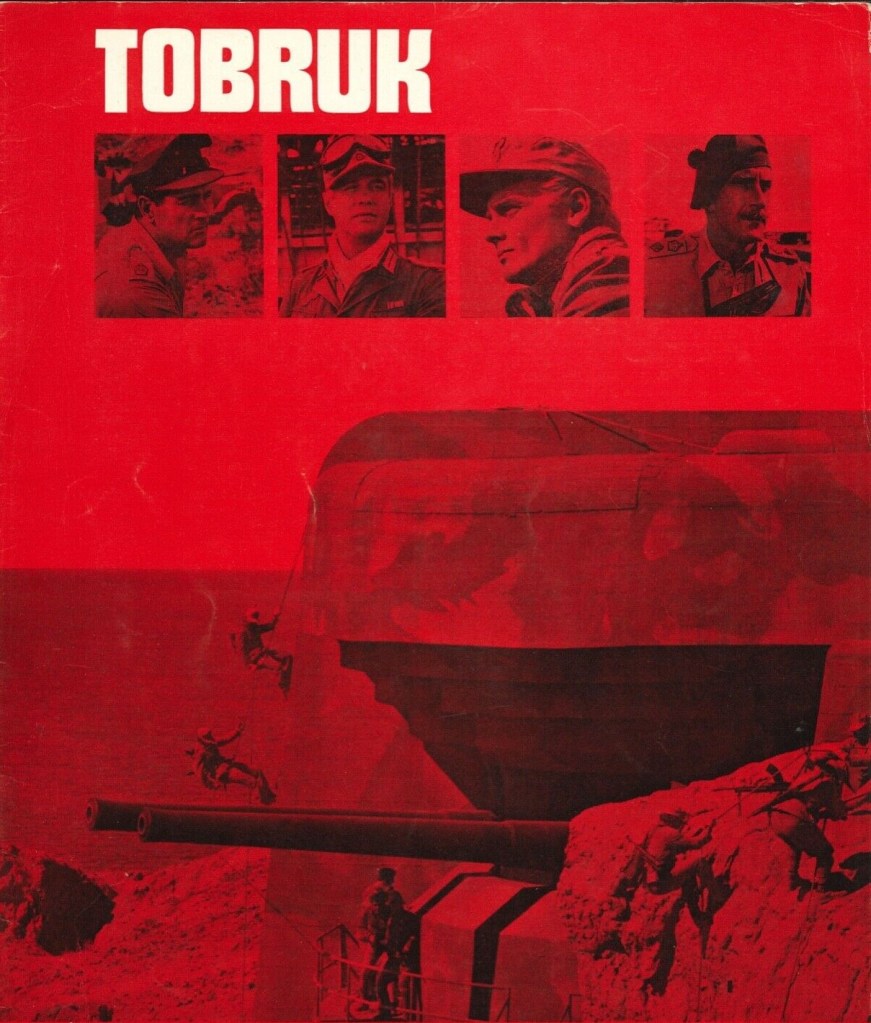
Tobruk (1967) ****

Occasionally ingenious action-packed men-on-a-mission picture that teams reluctant hero Major Craig (Rock Hudson) with Captain Bergman (George Peppard) who heads up a team of Jewish German commandos (i.e good guys). Arthur Hiller (Promise Her Anything, 1966) directs with some skill and to increase tension often utilizes silence in Hitchcockian fashion. He meshes innate antagonism between the two principals and stiff-upper-lip British Col Harker (Nigel Green), two subplots that have a bearing on the final outcome, and explosive battle scenes. In addition, in supporting roles is a Sgt Major (Jack Watson) unusually solicitous of his troops and a grunt (Norman Rossington) with a fund of one-liners.

Craig is liberated by frogmen from a prisoner ship and flown into the Sahara on the eve of the Battle of El Alamein to guide a strike force 800 miles across the desert to blow up Rommel’s underground fuel tanks in Tobruk, Bergman’s outfit providing the perfect cover as Germans escorting British prisoners. “It’s suicide,” protests Craig. “It’s orders,” retorts Harker.

Most action pictures get by on action and personality clashes against authority, but this is distinguished as well by clever ruses. First off, hemmed in by an Italian tank squadron on one side and the Germans on the other, they fire mortars into each, convincing the enemy units to open fire on one another. Craig, on whose topographical skills the unit depends, goes the desert version of off-piste, leading the group through a minefield, personally acting as sweeper with a bayonet as his rudimentary tool, his understanding of how the enemy lays its mines allowing him to virtually explode them all at one. But, ironically, their cover is so complete that they are strafed by a British plane, and equally ironically, have to shoot down one of their own.

Along the way they pick up a stranded father-and-daughter Henry (Liam Redmond) and Heidy Hunt (Cheryl Portman) who are on another mission entirely, to help create a Moslem uprising against the British in Egypt. Their arrival reveals the presence of a traitor in the camp. Naturally, this isn’t the only complication and problems mount as they approach Tobruk and, finding it vastly more populated with German troops than expected, they now, in addition to tackling the virtually impenetrable fuel dumps, have to knock out the city’s radio mast and neutralize the German big guns protecting the beaches.

So it’s basically one dicey situation after another, ingenuity solving problems where sheer force is not enough, and twists all the way to the end.

All the battles are particularly well done, pretty ferocious stuff, flamethrowers especially prominent, but they are also adept at hijacking tanks, and in another brilliant ruse capturing one without blowing it up. The screenplay by Leo Gordon (The Tower of London, 1962) supplies all the main characters with considerable depth. While Craig isn’t exactly a coward, he is not interested in laying down his life for a cause. Although Harker seems a typical officious British officer, he, too, has surprising depths. But it is Bergman who is given the weightiest part, not just a German seeking revenge against his own countrymen for the treatment of Jews but a man looking to a future when Jews will fight for their own homeland in Israel.  

Hudson had begun his career in action films, mostly of the western variety, before being seduced by the likes of Doris Day and Gina Lollobrigida in romantic comedies and this is a welcome return to tough guy form. George Peppard made it two Germans in a row after The Blue Max (1966) but this is far more nuanced performance. There are star turns from Nigel Green, Guy Stockwell (Beau Geste, 1966) as Peppard’s sidekick and the aforementioned Jack Watson (The Hill, 1965) and Norman Rossington.

This was pretty much dismissed on initial release as a straightforward gung-ho actioner and one that tipped Rock Hudson’s career in a downward spiral, but I found it both thoughtful and inventive and had much more of an on-the-ground feeling to it, with nothing going according to plan and alternatives quickly need to be found.

Under-rated and well worth a look.

The Devil’s Brigade (1968) ***

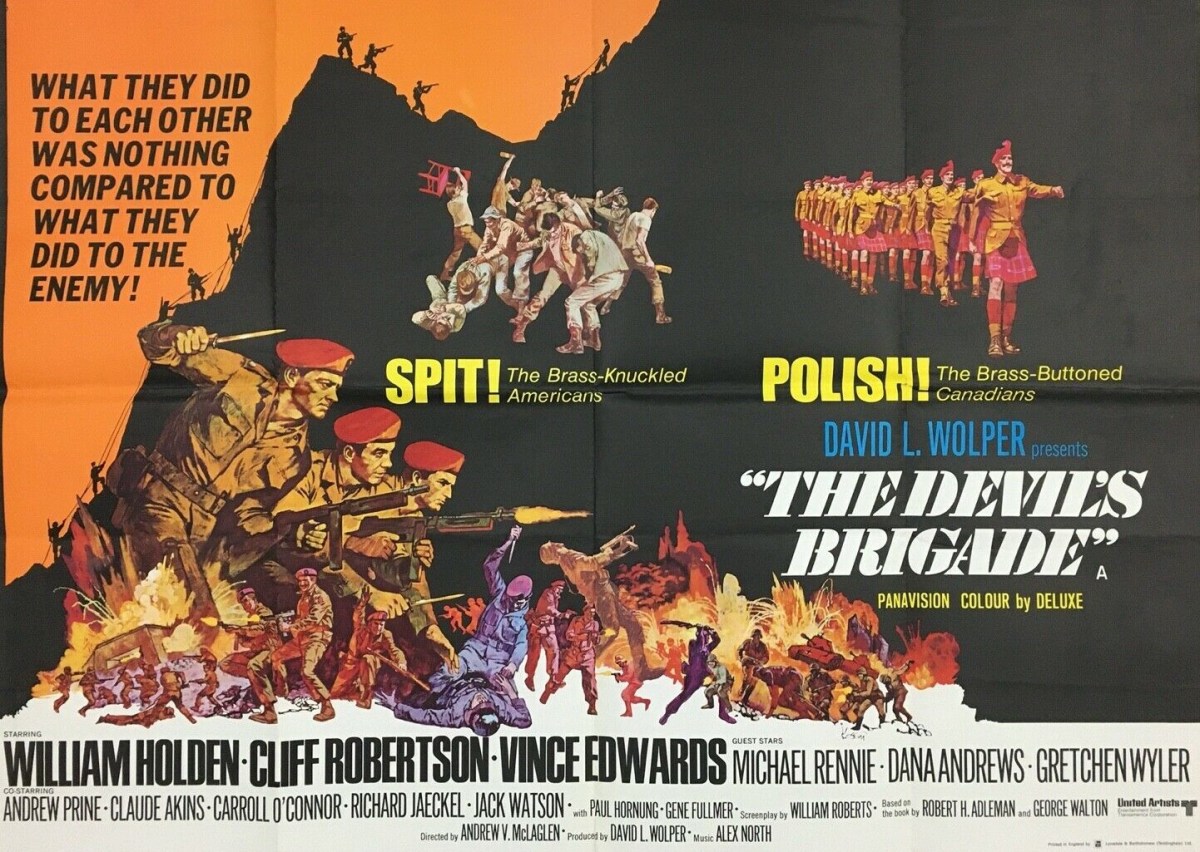
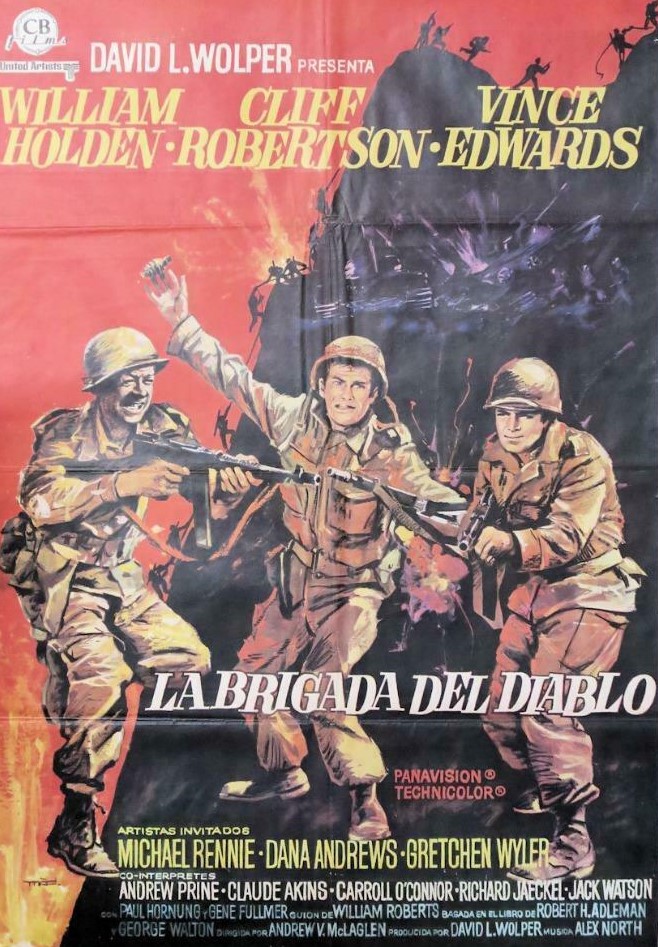
I couldn’t get my head around the idea of the U.S. Army recruiting a bunch of undisciplined misfits, many with jail time, in order to link them up with a crack Canadian outfit. Turns out this part of the film was fictional, the Americans in reality responding to advertisements at Army posts which prioritized men previously employed as forest rangers, game wardens, lumberjacks and the like which made sense since the original mission was mountainous Norway.  I should also point out the red beret the soldiers wear is also fictional and while depicted on the poster sporting a moustache commanding officer Lt. Col. Frederick (William Holden) is minus facial hair in the film.

But, basically, it follows a similar formula to The Dirty Dozen (1967), training and internal conflict followed by a dangerous mission. The conflict comes from a clash of cultures between spit-and-polish Canucks and disorderly/juvenile Yanks though, as with the Robert Aldrich epic, the leader taking some of the brunt of the discontent.  Collapsible bunk beds, snakes under the sheets and a tendency to fisticuffs are the extent of the antipathy between the units, which is all resolved, as with The Dirty Dozen, when they have to take on people they jointly hate, in this case local bar-room brawlers in Utah.

The movie picks up once they are sent to Italy. Initially employed on reconnaissance, Frederick challenges Major-General Hunter (Carroll O’Connor) who wants to do things by the book and sets out to take an Italian position by trekking two miles up a riverbed, creeping into town by stealth and capturing the location without firing a shot. 

Next up is the impregnable Monte la Difensa. Taking a leaf out of the Lawrence of Arabia playbook, in a brilliant tactical move, the Americans attack the mountainous stronghold from the rear by way of a mile-high cliff.  But that’s the easy part. The rest is trench-by-trench, pillbox-by-pillbox, brutal hand-to-hand fighting.

The battle scenes are excellent and the training section would be perfectly acceptable except for the high bar set by The Dirty Dozen. That said, there is enough going on with the various shenanigans to keep up the interest, but we don’t get to know the characters as intimately as in The Dirty Dozen and there is certainly nobody in the supporting cast to match the likes of Telly Savalas, Charles Bronson, Jim Brown and John Cassavetes. That also said, the men do bond sufficiently for some emotional moments during the final battle.

At this point William Holden’s career was in disarray, just one leading role (Alvarez Kelly, 1966) and a cameo (Casino Royale, 1967) in four years, and although his screen persona was more charming maverick than disciplined leader he carries off the role well, especially solid when confronting superiors, exhibiting the world-weariness that would a year later in The Wild Bunch put him back on top. Ironically, Cliff Robertson was coming to a peak and would follow his role as the strict disciplinarian Major Crown, the Canadian chief, with an Oscar-winning turn as Charly (1968). Vince Edwards (Hammerhead, 1968) as cigar-chomping hustler Major Bricker makes an ill-advised attempt to steal scenes.

This was the kind of film where the supporting cast were jockeying for a breakout role that would rocket them up the Hollywood food chain – as it did with The Dirty Dozen. Jack Watson (Tobruk, 1967) is the pick among the supporting cast, but he has plenty of competition from Richard Jaeckel (The Dirty Dozen), Claude Akins (Waterhole 3, 1967), Jeremy Slate (The Born Losers, 1967), Andrew Prine (Texas Across the River, 1966), Tom Stern (Angels from Hell, 1968) and Luke Askew (Cool Hand Luke, 1967). Veterans in tow include Dana Andrews (The Satan Bug, 1965) and Michael Rennie (Hotel, 1966).

William Roberts (The Magnificent Seven, 1960) adapted the bestselling book by Robert H. Ableman and George Walton. Director Andrew V. McLaglen (Shenandoah, 1965) was more at home with the western and although there are some fine sequences and the battle scenes are well done this lacks the instinctive touch of some of his other films.

Discover WordPress

A daily selection of the best content published on WordPress, collected for you by humans who love to read.

The Atavist Magazine

by Brian Hannan

WordPress.com News

The latest news on WordPress.com and the WordPress community.